


火星含水矿物高光谱遥感探测算法的原理、现状及展望
doi: 10.11728/cjss2025.06.2024-0173 cstr: 32142.14.cjss.2024-0173
-
 吴兴 男, 1993年11月出生于陕西省西安市, 现为中国科学院国家空间科学中心副研究员, 硕士生导师, 主要研究方向为火星高光谱遥感. E-mail: wuxing@nssc.ac.cn
 -
 刘洋 男, 1984年1月出生于山东省泰安市, 现为中国科学院国家空间科学中心研究员, 博士生导师, 主要从事行星科学研究, 研究领域包括月球火星物质成分反演、火星宜居环境演化等. E-mail: yangliu@nssc.ac.cn
作者简介:
通讯作者:
Principles, Current Status and Prospects of Hydrated Minerals Detection on Mars with Hyperspectral Remote Sensing
-
摘要: 火星是太阳系中与地球最为相似的类地行星, 因其潜在的宜居性成为深空探测的热点星球. 含水矿物是火星水岩相互作用的产物, 其对研究火星早期水环境、地质演化及宜居性具有重要意义. 高光谱遥感技术通过超高光谱分辨率, 为含水矿物的识别与丰度反演提供了重要工具. 然而火星含水矿物分布零散且丰度极低, 加之光谱混合与噪声影响, 目前探测主要依赖光谱参数法与目视解译, 难以满足海量高光谱数据的处理需求. 近年来, 机器学习在地球高光谱遥感技术中的迅猛发展为火星矿物探测提供了新思路, 但其在火星上的应用研究仍处于初步探索阶段. 本文从定性识别和定量反演两方面系统梳理了火星含水矿物高光谱探测的研究进展, 评估了各种方法的优缺点与适用性, 并结合当前瓶颈提出未来发展方向, 为火星含水矿物探测的发展提供参考.Abstract: Mars is the most Earth-like terrestrial planet in the solar system and a primary focus of deep space exploration. Hydrated minerals, formed through water-rock interactions, are crucial for understanding the planet’s ancient aqueous environments, geological changes, and capacity to support life. Their study offers vital insights into Mars’ climatic evolution and surface processes. Hyperspectral remote sensing, which collects detailed spectral data across hundreds of continuous bands, serves as a powerful tool for detecting and analyzing these minerals. Despite its advantages, hyperspectral detection on Mars faces significant challenges. The sparse distribution and low abundance of hydrated minerals, combined with spectral mixing and noise, diminish the clarity of diagnostic spectral features. Consequently, traditional methods primarily rely on spectral parameter mapping and visual interpretation, which are labor-intensive and struggle to process the vast hyperspectral datasets effectively. Recent advances in machine learning for terrestrial hyperspectral remote sensing offer innovative approaches to Martian mineral mapping, yet their application remains at an early stage. This review first introduces Mars orbital spectral datasets such as the Observatoire pour la Minéralogie, l’Eau, les Glaces et l’Activité (OMEGA) and the Compact Reconnaissance Imaging Spectrometer for Mars (CRISM), and diagnostic spectral features of common hydrated minerals. The current state of Martian hydrated mineral detection is then explored, covering both qualitative identification and quantitative abundance retrieval methods. It evaluates the advantages and limitations of existing approaches and highlights key challenges, such as spectral variability and validation constraints. To advance this field, future work should focus on developing adaptable algorithms, integrating multi-source data, and establishing robust validation frameworks. These efforts will enhance the efficiency and reliability of mineral mapping, providing deeper insights into Mars’ aqueous history and its implications for planetary habitability.
-
Key words:
- Mars /
- Hydrated minerals /
- Hyperspectral remote sensing /
- Mineral mapping
-
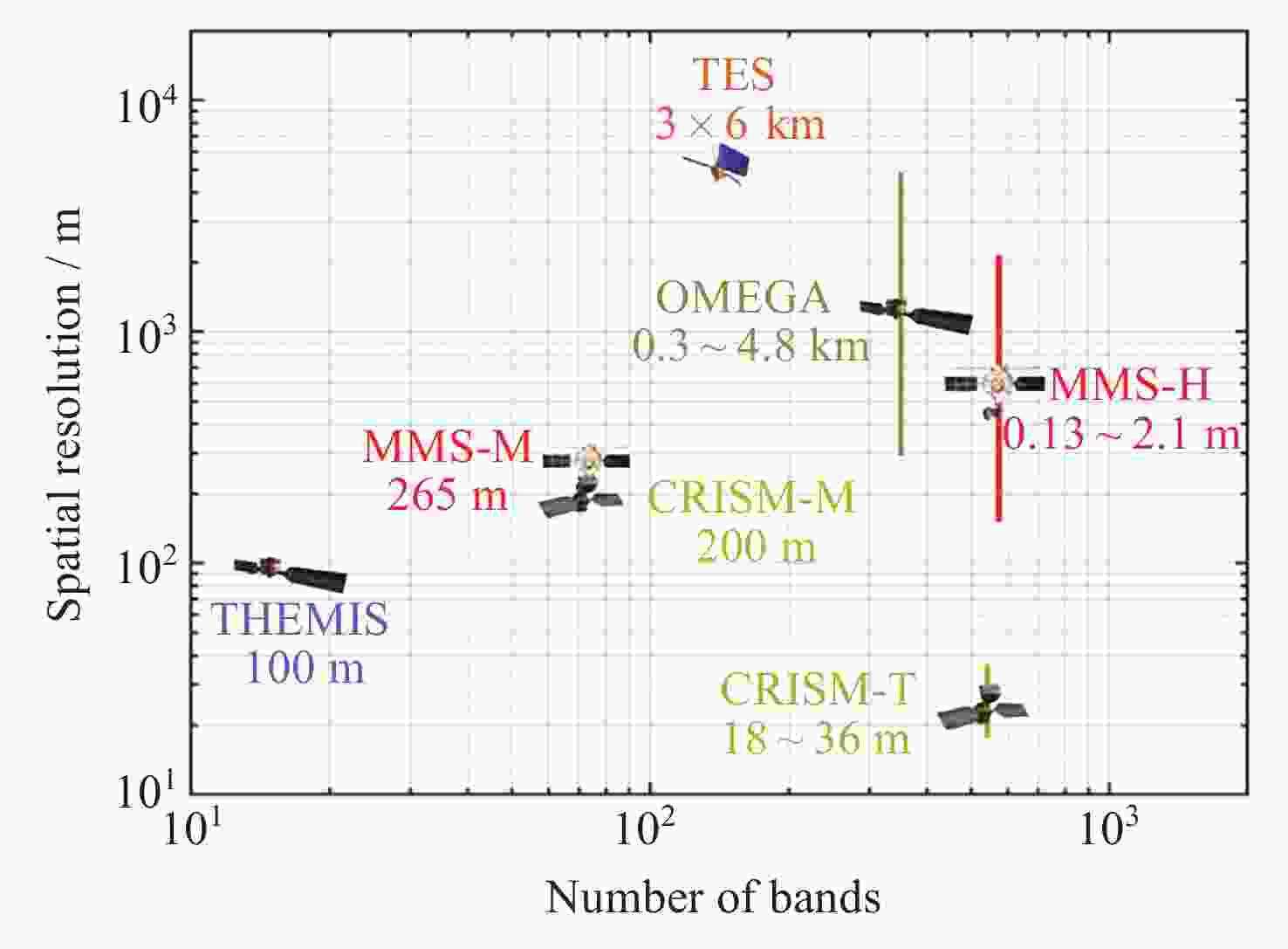
图 1 火星轨道光谱数据空间分辨率与波段数(光谱分辨率)的关系. CRISM-M和CRISM-T分别代表多光谱模式和目标模式观测数据, MMS-M和MMS-H 分别代表多光谱模式和高光谱模式观测数据
Figure 1. Relationship between spatial and spectral resolution of Mars orbital spectral data. CRISM-M and CRISM-T represent target mode and multispectral mode, respectively; whereas MMS-M and MMS-H denote multispectral mode and hyperspectral mode, respectively
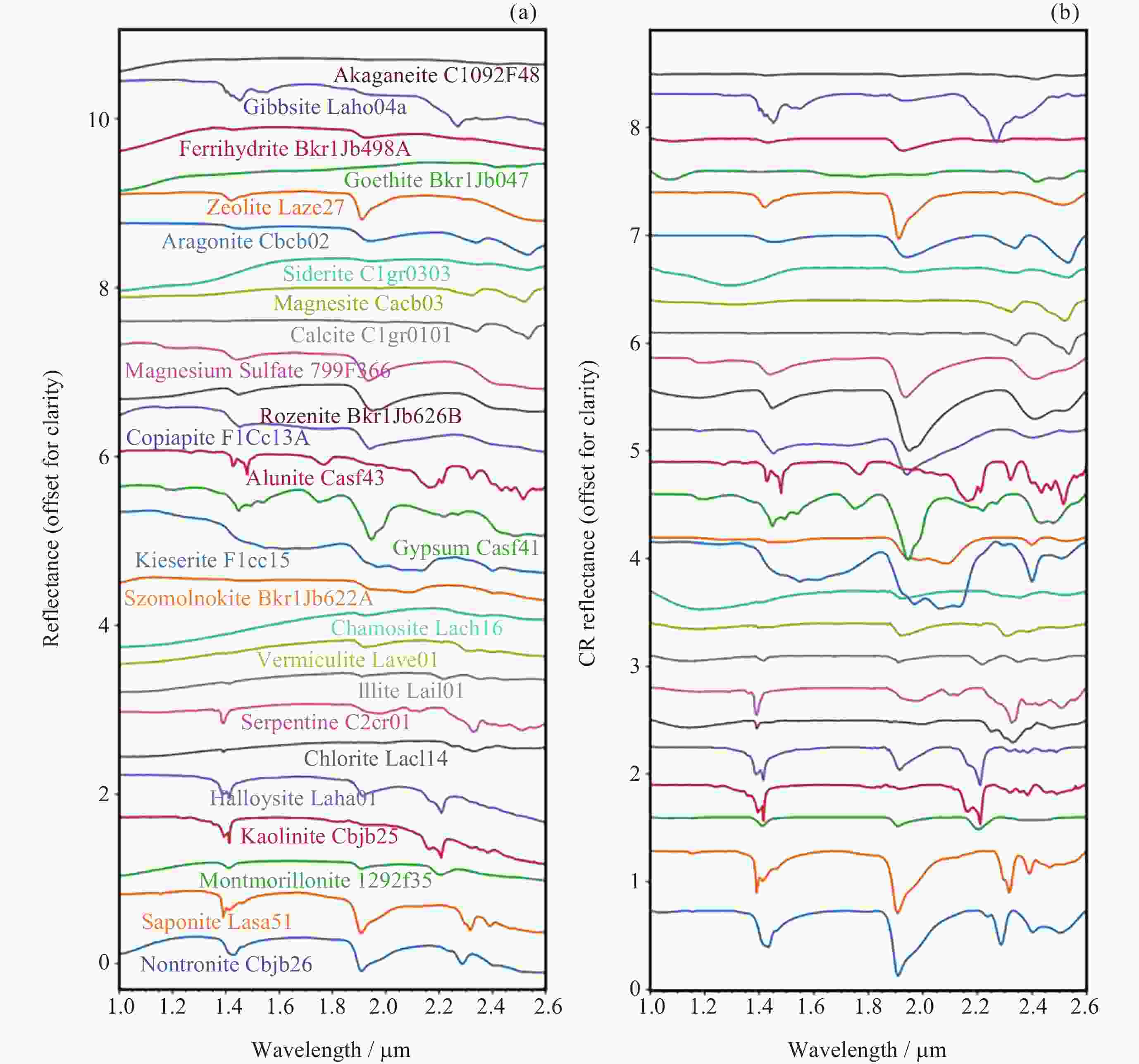
图 2 常见含水矿物的反射率光谱曲线(a)和去连续统光谱曲线(b)
Figure 2. Reflectance spectra (a) and Continuum-Removed (CR) spectra (b) of common hydrated minerals
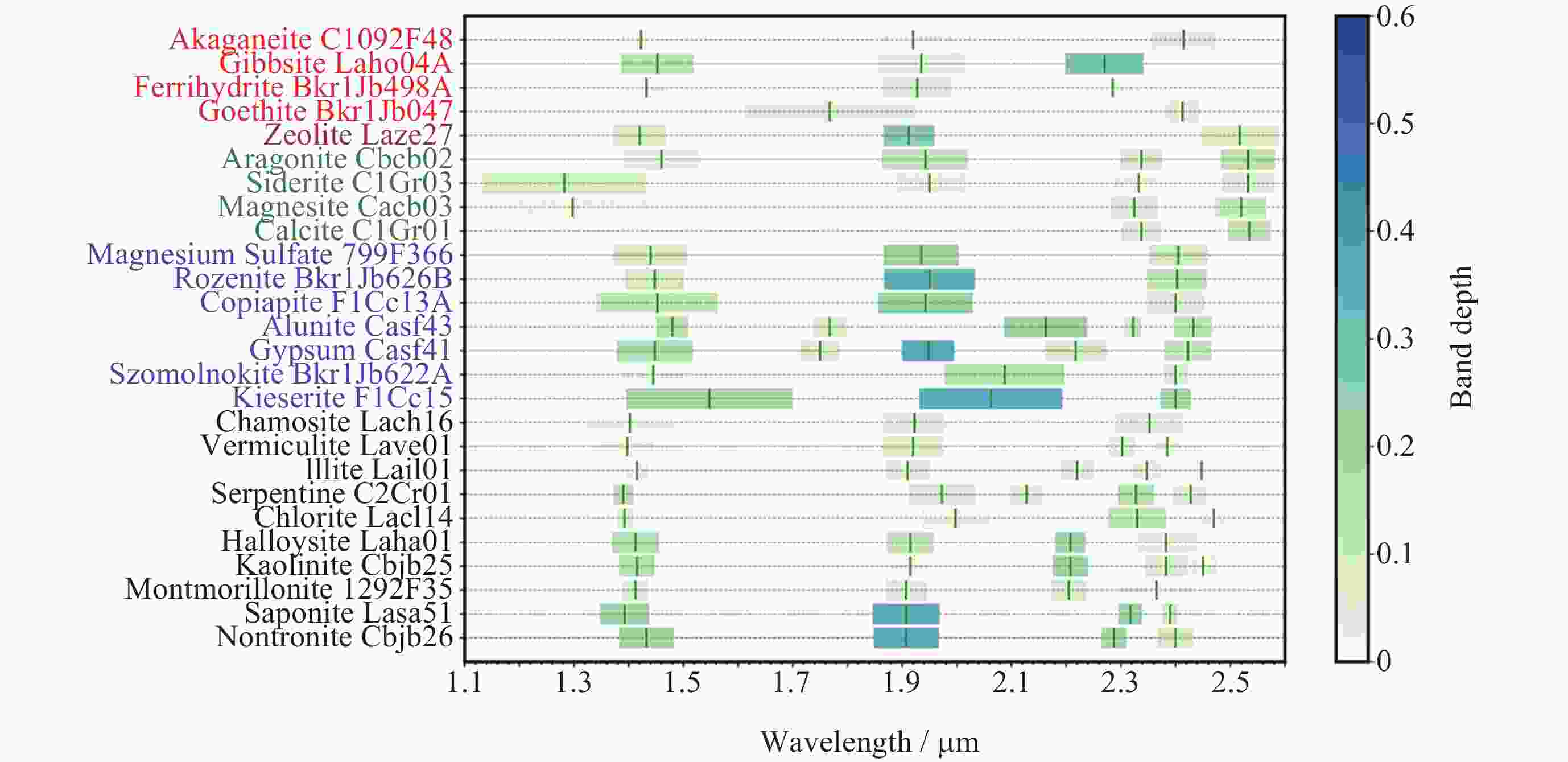
图 3 常见含水矿物吸收特征随波长的变化. 矩形代表吸收特征, 绿色垂线表示吸收中心, 矩形颜色表示吸收深度, 矩形宽度代表吸收深度最大值一半对应的宽度. 黑色、蓝色、绿色、棕色和红色字体分别表示层状硅酸盐、硫酸盐、碳酸盐、其他水合硅酸盐和氢氧化物
Figure 3. Variations of absorption features for hydrated minerals with wavelength. Rectangles represent the absorption features, with the green vertical lines indicating the band center, the color of the rectangles representing the band depth, and the width representing the full width at half maximum. The black, blue, green, brown, and red fonts represent phyllosilicates, sulfates, carbonates, other hydrated silicates, and hydroxides, respectively
-
[1] PAN Yongxin, WANG Chi. Developing the planetary science research for the sustainable deep space exploration of China[J]. Bulletin of National Natural Science Foundation of China, 2021, 35(2): 181-185 (潘永信, 王赤. 国家深空探测战略可持续发展需求: 行星科学研究[J]. 中国科学基金, 2021, 35(2): 181-185PAN Yongxin, WANG Chi. Developing the planetary science research for the sustainable deep space exploration of China[J]. Bulletin of National Natural Science Foundation of China, 2021, 35(2): 181-185 [2] WU Weiren, WANG Chi, LIU Yang, et al. Frontier scientific questions in deep space exploration[J]. Chinese Science Bulletin, 2023, 68(6): 606-627 (吴伟仁, 王赤, 刘洋, 等. 深空探测之前沿科学问题探析[J]. 科学通报, 2023, 68(6): 606-627 doi: 10.1360/TB-2022-0667WU Weiren, WANG Chi, LIU Yang, et al. Frontier scientific questions in deep space exploration[J]. Chinese Science Bulletin, 2023, 68(6): 606-627 doi: 10.1360/TB-2022-0667 [3] EHLMANN B L, ANDERSON F S, ANDREWS‐HANNA J, et al. The sustainability of habitability on terrestrial planets: insights, questions, and needed measurements from Mars for understanding the evolution of Earth‐like worlds[J]. Journal of Geophysical Research: Planets, 2016, 121(10): 1927-1961 doi: 10.1002/2016JE005134 [4] BIBRING J P, LANGEVIN Y, MUSTARD J F, et al. Global mineralogical and aqueous Mars history derived from OMEGA/mars express data[J]. Science, 2006, 312(5772): 400-404 doi: 10.1126/science.1122659 [5] CHEVRIER V, POULET F, BIBRING J P. Early geochemical environment of Mars as determined from thermodynamics of phyllosilicates[J]. Nature, 2007, 448(7149): 60-63 doi: 10.1038/nature05961 [6] CARTER J, POULET F, BIBRING J P, et al. Hydrous minerals on Mars as seen by the CRISM and OMEGA imaging spectrometers: updated global view[J]. Journal of Geophysical Research: Planets, 2013, 118(4): 831-858 doi: 10.1029/2012JE004145 [7] GOU Sheng, YUE Zongyu, DI Kaichang et al. Advances in aqueous minerals detection on Martian surface[J]. Journal of Remote Sensing, 2017, 21(4): 531-548 (芶盛, 岳宗玉, 邸凯昌, 等. 火星表面含水矿物探测进展[J]. 遥感学报, 2017, 21(4): 531-548GOU Sheng, YUE Zongyu, DI Kaichang et al. Advances in aqueous minerals detection on Martian surface[J]. Journal of Remote Sensing, 2017, 21(4): 531-548 [8] CARTER J, RIU L, POULET F, et al. A Mars Orbital Catalog of Aqueous Alteration Signatures (MOCAAS)[J]. Icarus, 2023, 389: 115164 doi: 10.1016/j.icarus.2022.115164 [9] BIBRING J P, LANGEVIN Y, GENDRIN A, et al. Mars surface diversity as revealed by the OMEGA/Mars express observations[J]. Science, 2005, 307(5715): 1576-1581 doi: 10.1126/science.1108806 [10] MURCHIE S, ARVIDSON R, BEDINI P, et al. Compact Reconnaissance Imaging Spectrometer for Mars (CRISM) on Mars Reconnaissance Orbiter (MRO)[J]. Journal of Geophysical Research: Planets, 2007, 112(E5): E05S03 [11] MUSTARD J, PARENTE M, DAS E, et al. Searching for needles[C]//Proceedings of the GSA Connects 2021. Portland, Oregon: GSA, 2021 [12] BIOUCAS-DIAS J M, PLAZA A, CAMPS-VALLS G, et al. Hyperspectral remote sensing data analysis and future challenges[J]. IEEE Geoscience and Remote Sensing Magazine, 2013, 1(2): 6-36 doi: 10.1109/MGRS.2013.2244672 [13] GHAMISI P, YOKOYA N, LI J, et al. Advances in hyperspectral image and signal processing: a comprehensive overview of the state of the art[J]. IEEE Geoscience and Remote Sensing Magazine, 2017, 5(4): 37-78 doi: 10.1109/MGRS.2017.2762087 [14] KUMARI P, SOOR S, SHETTY A, et al. Mineral classification on Martian surface using CRISM hyperspectral data: a survey[J]. Journal of Applied Remote Sensing, 2023, 17(4): 041501 [15] KE T, ZHONG Y F, SONG M, et al. Mineral detection based on hyperspectral remote sensing imagery on Mars: from detection methods to fine mapping[J]. ISPRS Journal of Photogrammetry and Remote Sensing, 2024, 218: 761-780 doi: 10.1016/j.isprsjprs.2024.09.020 [16] WU Xing. Hyperspectral Target Detection for Hydrous Minerals on Mars[D]. Beijing: University of Chinese Academy of Sciences, 2020 (吴兴. 火星含水矿物高光谱目标探测算法研究[D]. 北京: 中国科学院大学, 2020WU Xing. Hyperspectral Target Detection for Hydrous Minerals on Mars[D]. Beijing: University of Chinese Academy of Sciences, 2020 [17] CHRISTENSEN P R, BANDFIELD J L, HAMILTON V E, et al. Mars Global Surveyor Thermal Emission Spectrometer experiment: investigation description and surface science results[J]. Journal of Geophysical Research: Planets, 2001, 106(E10): 23823-23871 doi: 10.1029/2000JE001370 [18] CHRISTENSEN P R, JAKOSKY B M, KIEFFER H H, et al. The Thermal Emission Imaging System (THEMIS) for the Mars 2001 Odyssey Mission[J]. Space Science Reviews, 2004, 110(1): 85-130 [19] HE Z P, XU R, LI C L, et al. Mars Mineralogical Spectrometer (MMS) on the Tianwen-1 mission[J]. Space Science Reviews, 2021, 217(2): 27 doi: 10.1007/s11214-021-00804-z [20] SEELOS F P, SEELOS K D, MURCHIE S L, et al. The CRISM investigation in Mars orbit: overview, history, and delivered data products[J]. Icarus, 2024, 419: 115612 doi: 10.1016/j.icarus.2023.115612 [21] TONG Qingxi, ZHANG Bing, ZHENG Lanfen. Hyperspectral Remote Sensing[M]. Beijing: Higher Education Press, 2006 (童庆禧, 张兵, 郑兰芬. 高光谱遥感——原理、技术与应用[M]. 北京: 高等教育出版社, 2006TONG Qingxi, ZHANG Bing, ZHENG Lanfen. Hyperspectral Remote Sensing[M]. Beijing: Higher Education Press, 2006 [22] CLARK R N, KING T V V, KLEJWA M, et al. High spectral resolution reflectance spectroscopy of minerals[J]. Journal of Geophysical Research: Solid Earth, 1990, 95(B8): 12653-12680 doi: 10.1029/JB095iB08p12653 [23] YIN Haoan, TANG Hong, LI Xiongyao, et al. Occurrence and infrared absorption spectra of Martian water[J]. Chinese Journal of Space Science, 2024, 44(6): 1086-1105 (尹浩安, 唐红, 李雄耀, 等. 火星水的主要赋存状态及其红外光谱特征[J]. 空间科学学报, 2024, 44(6): 1086-1105 doi: 10.11728/cjss2024.06.2023-0118YIN Haoan, TANG Hong, LI Xiongyao, et al. Occurrence and infrared absorption spectra of Martian water[J]. Chinese Journal of Space Science, 2024, 44(6): 1086-1105 doi: 10.11728/cjss2024.06.2023-0118 [24] VIVIANO C E, SEELOS F P, MURCHIE S L, et al. Revised CRISM spectral parameters and summary products based on the currently detected mineral diversity on Mars[J]. Journal of Geophysical Research: Planets, 2014, 119(6): 1403-1431 doi: 10.1002/2014JE004627 [25] CLARK R N, ROUSH T L. Reflectance spectroscopy: quantitative analysis techniques for remote sensing applications[J]. Journal of Geophysical Research: Solid Earth, 1984, 89(B7): 6329-6340 doi: 10.1029/JB089iB07p06329 [26] PELKEY S, MUSTARD J, MURCHIE S, et al. CRISM multispectral summary products: parameterizing mineral diversity on Mars from reflectance[J]. Journal of Geophysical Research: Planets, 2007, 112(E8): E08S14 [27] MUSTARD J F, MURCHIE S L, PELKEY S M, et al. Hydrated silicate minerals on Mars observed by the Mars Reconnaissance Orbiter CRISM instrument[J]. Nature, 2008, 454(7202): 305-309 doi: 10.1038/nature07097 [28] PAN L, EHLMANN B L, CARTER J, et al. The stratigraphy and history of Mars’ northern lowlands through mineralogy of impact craters: a comprehensive survey[J]. Journal of Geophysical Research: Planets, 2017, 122(9): 1824-1854 doi: 10.1002/2017JE005276 [29] KEPP M, PAN L, FRYDENVANG J, et al. Orbital identification of widespread hydrated silica deposits in Gale crater[J]. Earth and Planetary Science Letters, 2024, 648: 119082 doi: 10.1016/j.jpgl.2024.119082 [30] VAN RUITENBEEK F J A, BAKKER W H, VAN DER WERFF H M A, et al. Mapping the wavelength position of deepest absorption features to explore mineral diversity in hyperspectral images[J]. Planetary and Space Science, 2014, 101: 108-117 doi: 10.1016/j.pss.2014.06.009 [31] SUNSHINE J M, PIETERS C M. Estimating modal abundances from the spectra of natural and laboratory pyroxene mixtures using the modified Gaussian model[J]. Journal of Geophysical Research: Planets, 1993, 98(E5): 9075-9087 doi: 10.1029/93JE00677 [32] BROWN A J. Spectral curve fitting for automatic hyperspectral data analysis[J]. IEEE Transactions on Geoscience and Remote Sensing, 2006, 44(6): 1601-1608 doi: 10.1109/TGRS.2006.870435 [33] CLÉNET H, PINET P, DAYDOU Y, et al. A new systematic approach using the Modified Gaussian Model: insight for the characterization of chemical composition of olivines, pyroxenes and olivine–pyroxene mixtures[J]. Icarus, 2011, 213(1): 404-422 doi: 10.1016/j.icarus.2011.03.002 [34] PARENTE M, MAKAREWICZ H D, BISHOP J L. Decomposition of mineral absorption bands using nonlinear least squares curve fitting: application to Martian meteorites and CRISM data[J]. Planetary and Space Science, 2011, 59(5/6): 423-442 [35] SERVENTI G, CARLI C, ALTIERI F, et al. Spectral classification and MGM-based mineralogical characterization of hydrated phases: the Nili Fossae case, Mars[J]. Planetary and Space Science, 2021, 209: 105361 doi: 10.1016/j.pss.2021.105361 [36] BANDFIELD J L, CHRISTENSEN P R, SMITH M D. Spectral data set factor analysis and end‐member recovery: application to analysis of Martian atmospheric particulates[J]. Journal of Geophysical Research: Planets, 2000, 105(E4): 9573-9587 doi: 10.1029/1999JE001094 [37] THOMAS N H, BANDFIELD J L. Identification and refinement of martian surface mineralogy using factor analysis and target transformation of near-infrared spectroscopic data[J]. Icarus, 2017, 291: 124-135 doi: 10.1016/j.icarus.2017.03.001 [38] LIN H L, TARNAS J D, MUSTARD J F, et al. Dynamic Aperture Factor Analysis/Target Transformation (DAFA/TT) for Mg-serpentine and Mg-carbonate mapping on Mars with CRISM near-infrared data[J]. Icarus, 2021, 355: 114168 doi: 10.1016/j.icarus.2020.114168 [39] TARNAS J D, MUSTARD J F, LIN H L, et al. Orbital identification of hydrated silica in Jezero crater, Mars[J]. Geophysical Research Letters, 2019, 46(22): 12771-12782 doi: 10.1029/2019GL085584 [40] TARNAS J D, MUSTARD J F, WU X, et al. Successes and challenges of factor analysis/target transformation application to visible-to-near-infrared hyperspectral data[J]. Icarus, 2021, 365: 114402 doi: 10.1016/j.icarus.2021.114402 [41] AHMAD M, SHABBIR S, ROY S K, et al. Hyperspectral image classification—Traditional to deep models: a survey for future prospects[J]. IEEE Journal of Selected Topics in Applied Earth Observations and Remote Sensing, 2022, 15: 968-999 doi: 10.1109/JSTARS.2021.3133021 [42] PLEBANI E, EHLMANN B L, LEASK E K, et al. A machine learning toolkit for CRISM image analysis[J]. Icarus, 2022, 376: 114849 doi: 10.1016/j.icarus.2021.114849 [43] KUMARI P, SOOR S, SHETTY A, et al. A fully-automated framework for mineral identification on Martian surface using supervised learning models[J]. IEEE Access, 2023, 11: 13121-13137 doi: 10.1109/ACCESS.2023.3243061 [44] KAMPS O M, HEWSON R D, VAN RUITENBEEK F J A, et al. Defining surface types of Mars using global CRISM summary product maps[J]. Journal of Geophysical Research: Planets, 2020, 125(8): e2019JE006337 doi: 10.1029/2019JE006337 [45] ALLENDER E, STEPINSKI T F. Automatic, exploratory mineralogical mapping of CRISM imagery using summary product signatures[J]. Icarus, 2017, 281: 151-161 doi: 10.1016/j.icarus.2016.08.022 [46] SARANATHAN A M, PARENTE M. Adversarial feature learning for improved mineral mapping of CRISM data[J]. Icarus, 2021, 355: 114107 doi: 10.1016/j.icarus.2020.114107 [47] ZHANG Liangpei. Advance and future challenges in hyperspectral target detection[J]. Geomatics and Information Science of Wuhan University, 2014, 39(12): 1387-1394, 1400 (张良培. 高光谱目标探测的进展与前沿问题[J]. 武汉大学学报: 信息科学版, 2014, 39(12): 1387-1394, 1400ZHANG Liangpei. Advance and future challenges in hyperspectral target detection[J]. Geomatics and Information Science of Wuhan University, 2014, 39(12): 1387-1394, 1400 [48] FARRAND W H, BELL III J F, JOHNSON J R, et al. Visible and near‐infrared multispectral analysis of rocks at Meridiani Planum, Mars, by the Mars Exploration Rover Opportunity[J]. Journal of Geophysical Research: Planets, 2007, 112(E6): E06S02 [49] WU X, ZHANG X, CEN Y. Multi-task joint sparse and low-rank representation target detection for hyperspectral image[J]. IEEE Geoscience and Remote Sensing Letters, 2019, 16(11): 1756-1760 doi: 10.1109/LGRS.2019.2908196 [50] WU X, MUSTARD J F, TARNAS J D, et al. Imaging Mars analog minerals’ reflectance spectra and testing mineral detection algorithms[J]. Icarus, 2021, 369: 114644 doi: 10.1016/j.icarus.2021.114644 [51] WU X, ZHANG X, MUSTARD J, et al. Joint Hapke model and spatial adaptive sparse representation with iterative background purification for Martian serpentine detection[J]. Remote Sensing, 2021, 13(3): 500 doi: 10.3390/rs13030500 [52] POULET F, MANGOLD N, LOIZEAU D, et al. Abundance of minerals in the phyllosilicate-rich units on Mars[J]. Astronomy :Times New Roman;">& Astrophysics, 2008, 487(2): L41-L44 [53] BIOUCAS-DIAS J M, PLAZA A, DOBIGEON N, et al. Hyperspectral unmixing overview: geometrical, statistical, and sparse regression-based approaches[J]. IEEE Journal of Selected Topics in Applied Earth Observations and Remote Sensing, 2012, 5(2): 354-379 doi: 10.1109/JSTARS.2012.2194696 [54] SCHMIDT F, LEGENDRE M, LE MOUëLIC S. Minerals detection for hyperspectral images using adapted linear unmixing: LinMin[J]. Icarus, 2014, 237: 61-74 doi: 10.1016/j.icarus.2014.03.044 [55] GILMORE M S, THOMPSON D R, ANDERSON L J, et al. Superpixel segmentation for analysis of hyperspectral data sets, with application to Compact Reconnaissance Imaging Spectrometer for Mars data, Moon Mineralogy Mapper data, and Ariadnes Chaos, Mars[J]. Journal of Geophysical Research: Planets, 2011, 116(E7): E07001 [56] GOU S, YUE Z Y, DI K C, et al. Mineral abundances and different levels of alteration around Mawrth Vallis, Mars[J]. Geoscience Frontiers, 2015, 6(5): 741-758 doi: 10.1016/j.gsf.2014.09.004 [57] KESHAVA N, MUSTARD J F. Spectral unmixing[J]. IEEE Signal Processing Magazine, 2002, 19(1): 44-57 doi: 10.1109/79.974727 [58] HAPKE B. Bidirectional reflectance spectroscopy: 1. Theory[J]. Journal of Geophysical Research: Solid Earth, 1981, 86(B4): 3039-3054 doi: 10.1029/JB086iB04p03039 [59] SHKURATOV Y, STARUKHINA L, HOFFMANN H, et al. A model of spectral albedo of particulate surfaces: implications for optical properties of the Moon[J]. Icarus, 1999, 137(2): 235-246 doi: 10.1006/icar.1998.6035 [60] POULET F, CUZZI J N, CRUIKSHANK D P, et al. Comparison between the Shkuratov and Hapke scattering theories for solid planetary surfaces: application to the surface composition of two centaurs[J]. Icarus, 2002, 160(2): 313-324 doi: 10.1006/icar.2002.6970 [61] POULET F, CARTER J, BISHOP J L, et al. Mineral abundances at the final four curiosity study sites and implications for their formation[J]. Icarus, 2014, 231: 65-76 doi: 10.1016/j.icarus.2013.11.023 [62] LIU Y, GLOTCH T D, SCUDDER N A, et al. End‐member identification and spectral mixture analysis of CRISM hyperspectral data: a case study on southwest Melas Chasma, Mars[J]. Journal of Geophysical Research: Planets, 2016, 121(10): 2004-2036 doi: 10.1002/2016JE005028 [63] LIU Y, STACHURSKI F, LIU Z H, et al. Quantitative assessment of water content and mineral abundances at Gale crater on Mars with orbital observations[J]. Astronomy :Times New Roman;">& Astrophysics, 2020, 637: A79 [64] ZASTROW A M, GLOTCH T D. Distinct carbonate lithologies in Jezero crater, Mars[J]. Geophysical Research Letters, 2021, 48(9): e2020GL092365 doi: 10.1029/2020GL092365 [65] LIN H L, ZHANG X. Retrieving the hydrous minerals on Mars by sparse unmixing and the Hapke model using MRO/CRISM data[J]. Icarus, 2017, 288: 160-171 doi: 10.1016/j.icarus.2017.01.019 [66] LI S, MILLIKEN R E. Estimating the modal mineralogy of eucrite and diogenite meteorites using visible–near infrared reflectance spectroscopy[J]. Meteoritics :Times New Roman;">& Planetary Science, 2015, 50(11): 1821-1850 [67] WYATT M B, MCSWEEN H Y JR. Spectral evidence for weathered basalt as an alternative to andesite in the northern lowlands of Mars[J]. Nature, 2002, 417(6886): 263-266 doi: 10.1038/417263a [68] LAPOTRE M G A, EHLMANN B L, MINSON S E. A probabilistic approach to remote compositional analysis of planetary surfaces[J]. Journal of Geophysical Research: Planets, 2017, 122(5): 983-1009 doi: 10.1002/2016JE005248 -
-

 下载:
下载:


计量
- 文章访问数: 2568
- HTML全文浏览量: 987
- PDF下载量: 264
-
被引次数:
0(来源:Crossref)
0(来源:其他)

