


基于NSGA-II算法的固定式蜂窝板辐射器优化
doi: 10.11728/cjss2025.06.2024-0177 cstr: 32142.14.cjss.2024-0177
-
 王建鹏 男, 1998年7月出生于辽宁省辽阳市, 现为中国科学院微小卫星创新研究院工程师、主任设计师, 主要研究方向为航天器热控设计、卫星载荷散热优化, 至今已参与近百颗卫星的批产研制工作. E-mail: wangjianpenghit@163.com
通讯作者:
Optimization of Fixed Honeycomb Panel Radiator Based on NSGA-II Algorithm
-
摘要: 空间辐射器是航天热控系统的重要组成部分. 为了满足某低轨卫星散热与减重需求, 借助反设计理念提出一种固定式蜂窝板辐射器的优化策略, 由宏观与微观传热角度阐述了辐射器性能改善的根本原因. 以热管–管路布局参数作为设计变量, 采用Kriging构建代理模型, 基于NSGA-II算法迭代优化得到方案α与方案β. 仿真结果表明, 优化方案在降低辐射器质量约1/4的基础上, 表面温度均匀性分别提高3.09 K与4.98 K, 散热能力分别提高18.7%与28.8%. 对优化前后卫星绕轨运行温度水平进行对比分析, 结果表明辐射器的优化设计使航天器热控系统具有更大的温度控制余量, 并且具备显著的减重优势, 有助于航天器在轨任务的进行与拓展.Abstract: Space radiator is an important part of aerospace thermal control system. In order to meet the heat dissipation and weight reduction requirements of a low-orbit satellite, an optimization strategy of fixed honeycomb plate space radiator has been proposed with the help of inverse design concept, and the root cause of space radiator performance improvement has been expounded from the perspective of macro and micro heat transfer. Taking the layout parameters of heat pipes and fluid loop as the design variables, Kriging was used to construct the surrogate model, and schemes α and β were obtained by iterative optimization based on NSGA-II algorithm. The simulation results show that the optimization schemes improve the surface temperature uniformity by 3.09 K and 4.98 K respectively, and improve the heat dissipation capacity by 18.7% and 28.8% on the basis of reducing the mass ratio by about 1/4. The on-orbit temperature levels of satellite were compared and analyzed. The verification results show that the optimal design of the radiator makes the spacecraft thermal control system have greater temperature control margin and significant weight reduction advantages, which is more conducive to the development and expansion of spacecraft on-orbit tasks.
-
Key words:
- Space radiator /
- NSGA-II algorithm /
- Surrogate model /
- Sensitivity analysis
-
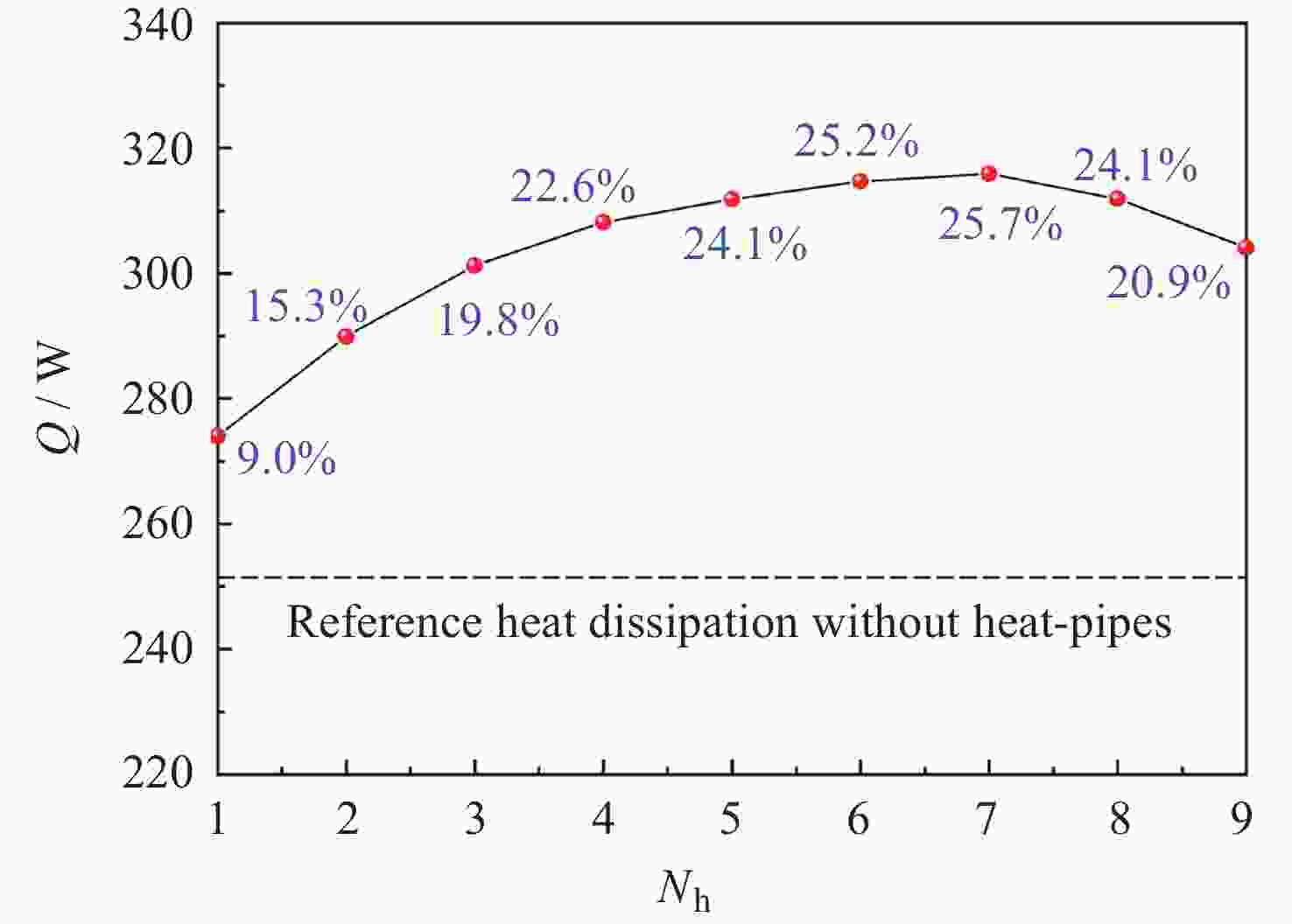
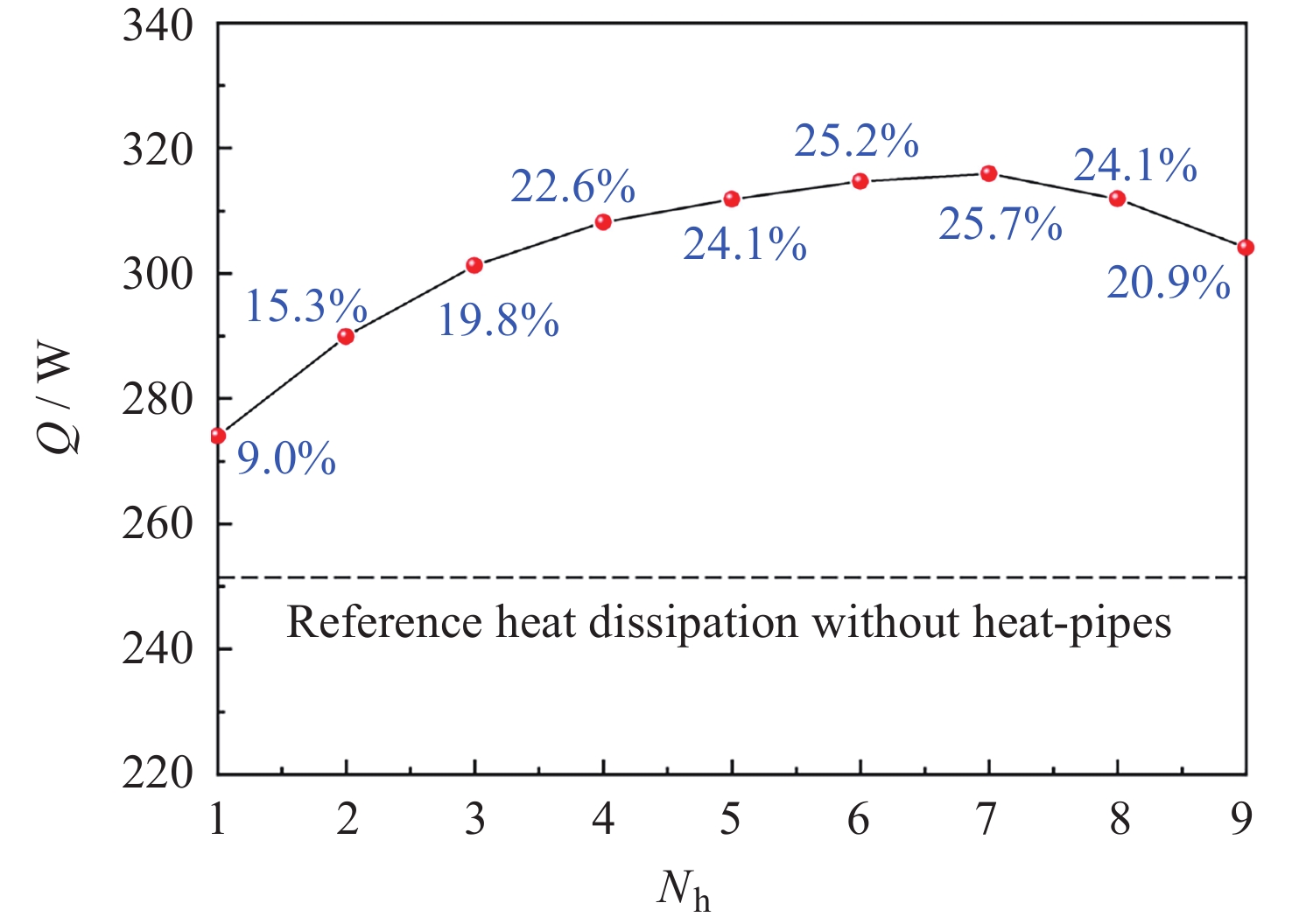
图 3 热管数目Nh对辐射器散热能力的影响
Figure 3. Influence of the number of heat pipes (Nh) on the radiator heat dissipation capacity
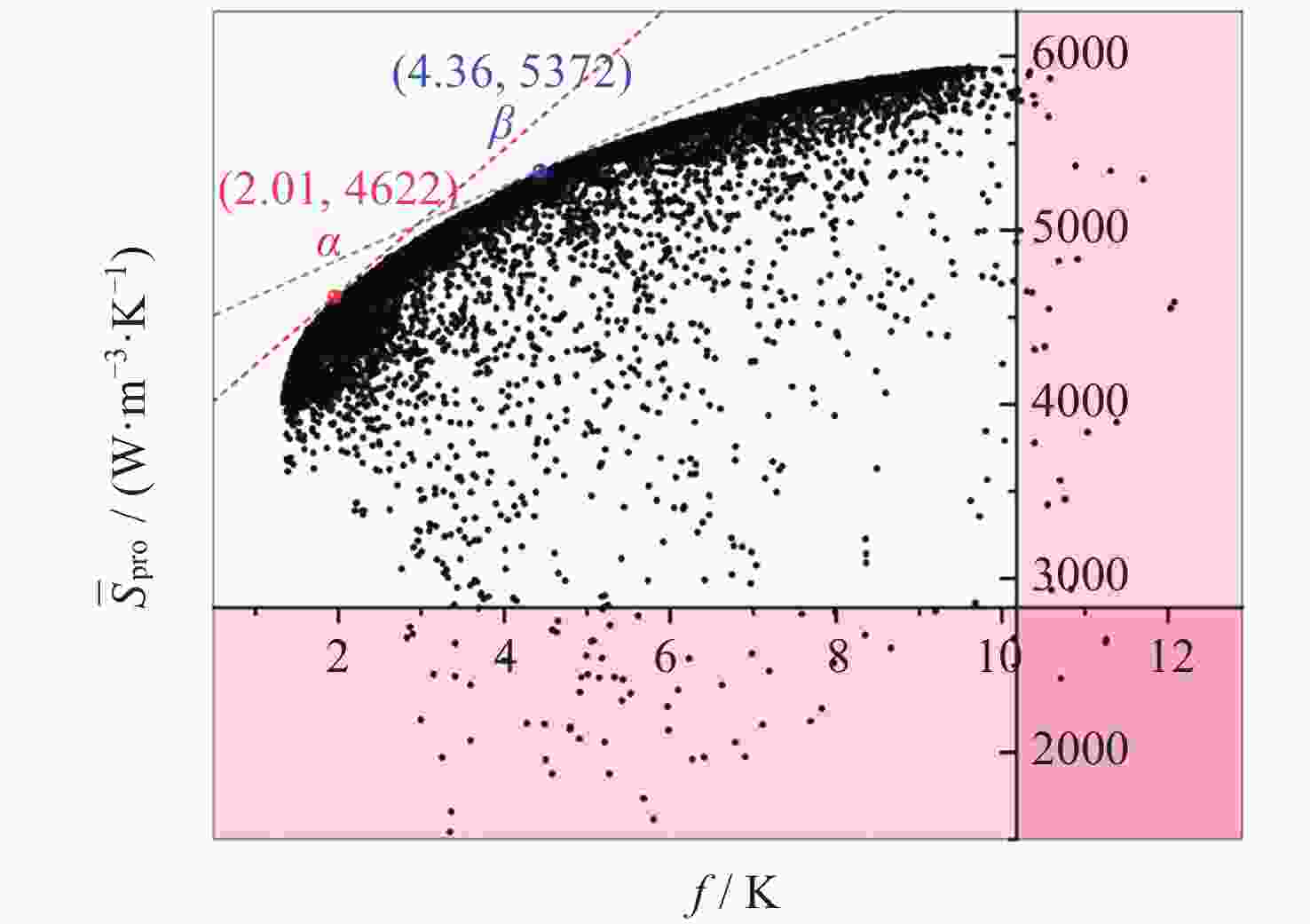
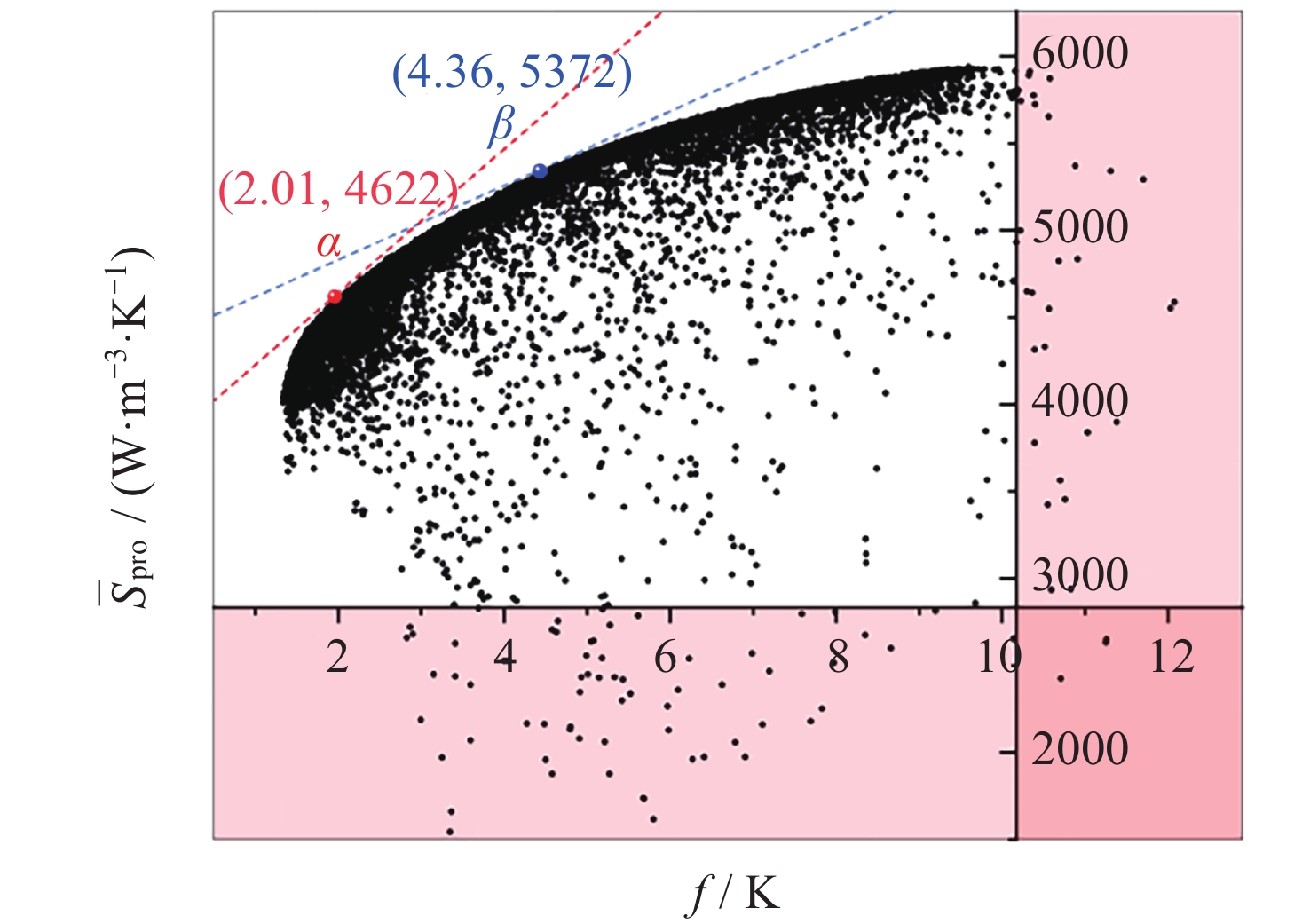
图 7 衍生点分布及优化方案选取
Figure 7. Derivative point distribution and optimization scheme selection
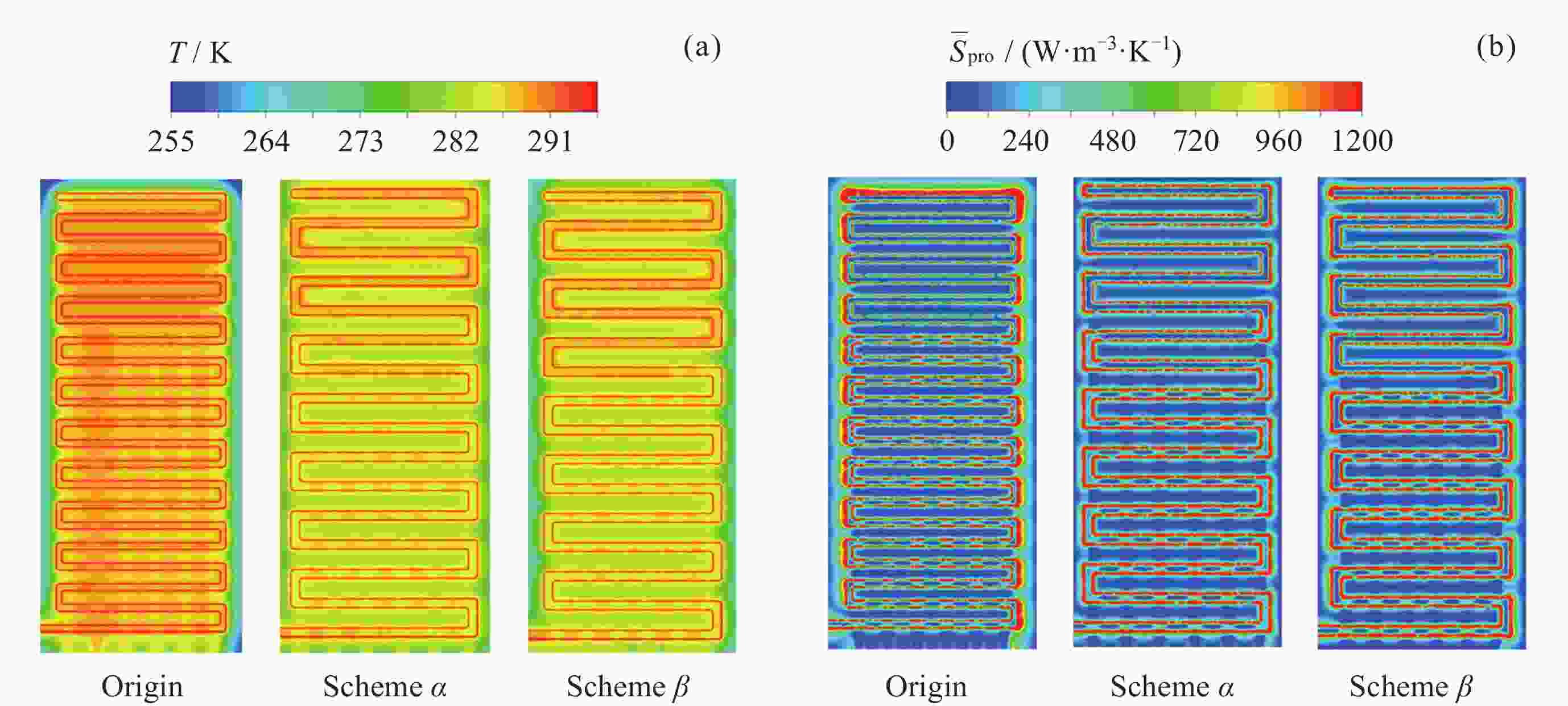
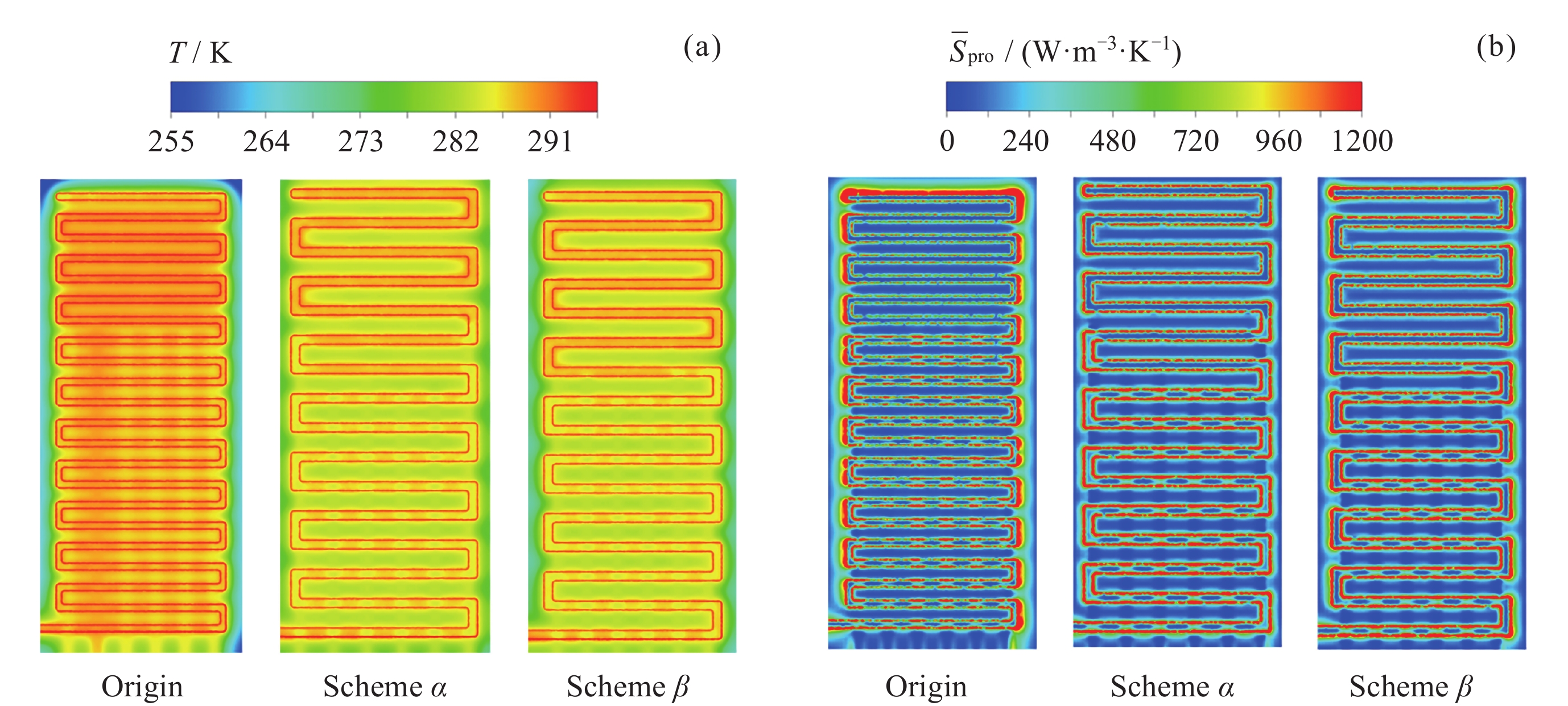
图 8 优化方案前后特征截面热参数分布
Figure 8. Thermal parameter distribution of characteristic section before and after optimization
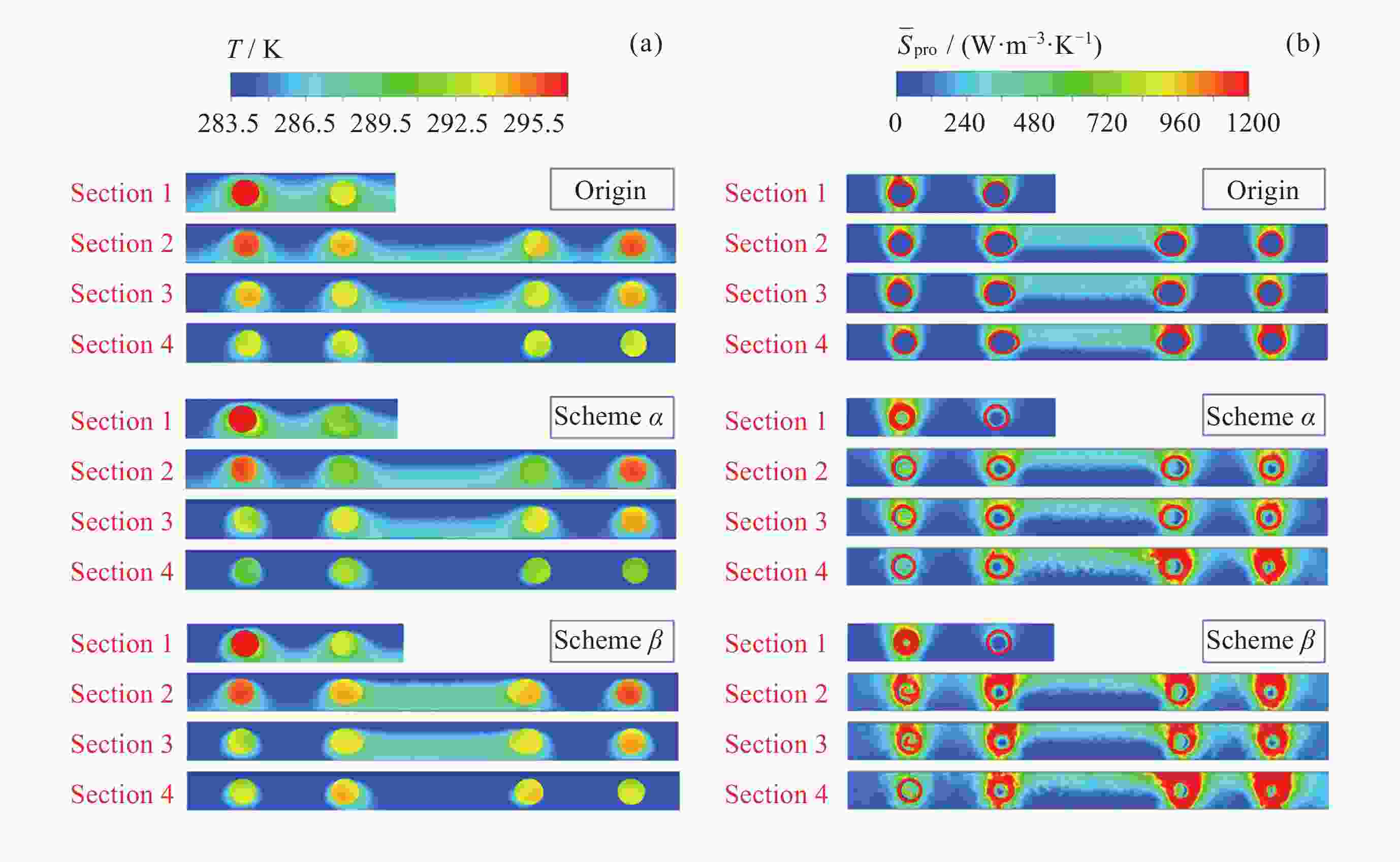
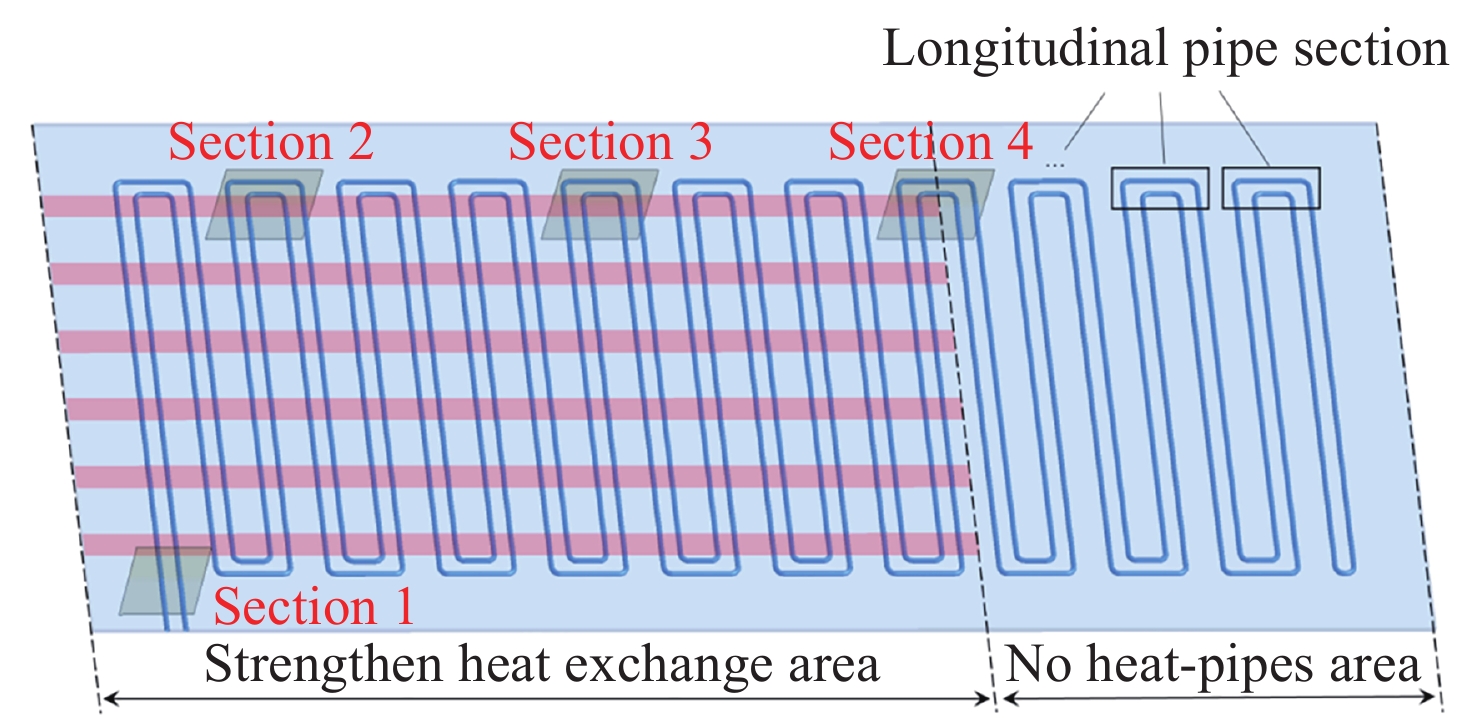
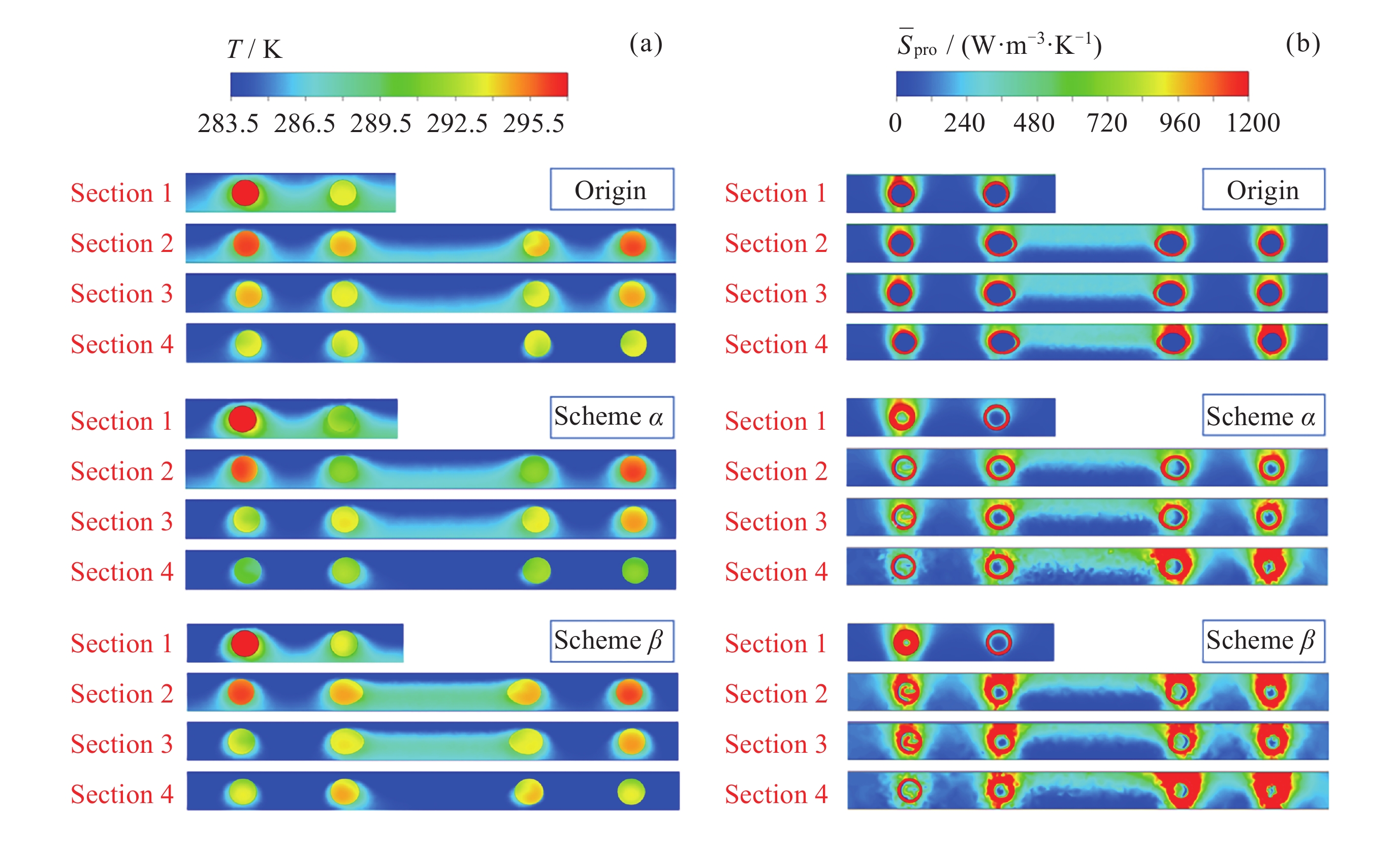
图 10 优化前后各方案纵向特征截面热参数分布
Figure 10. Thermal parameter distribution of longitudinal characteristic section before and after optimization
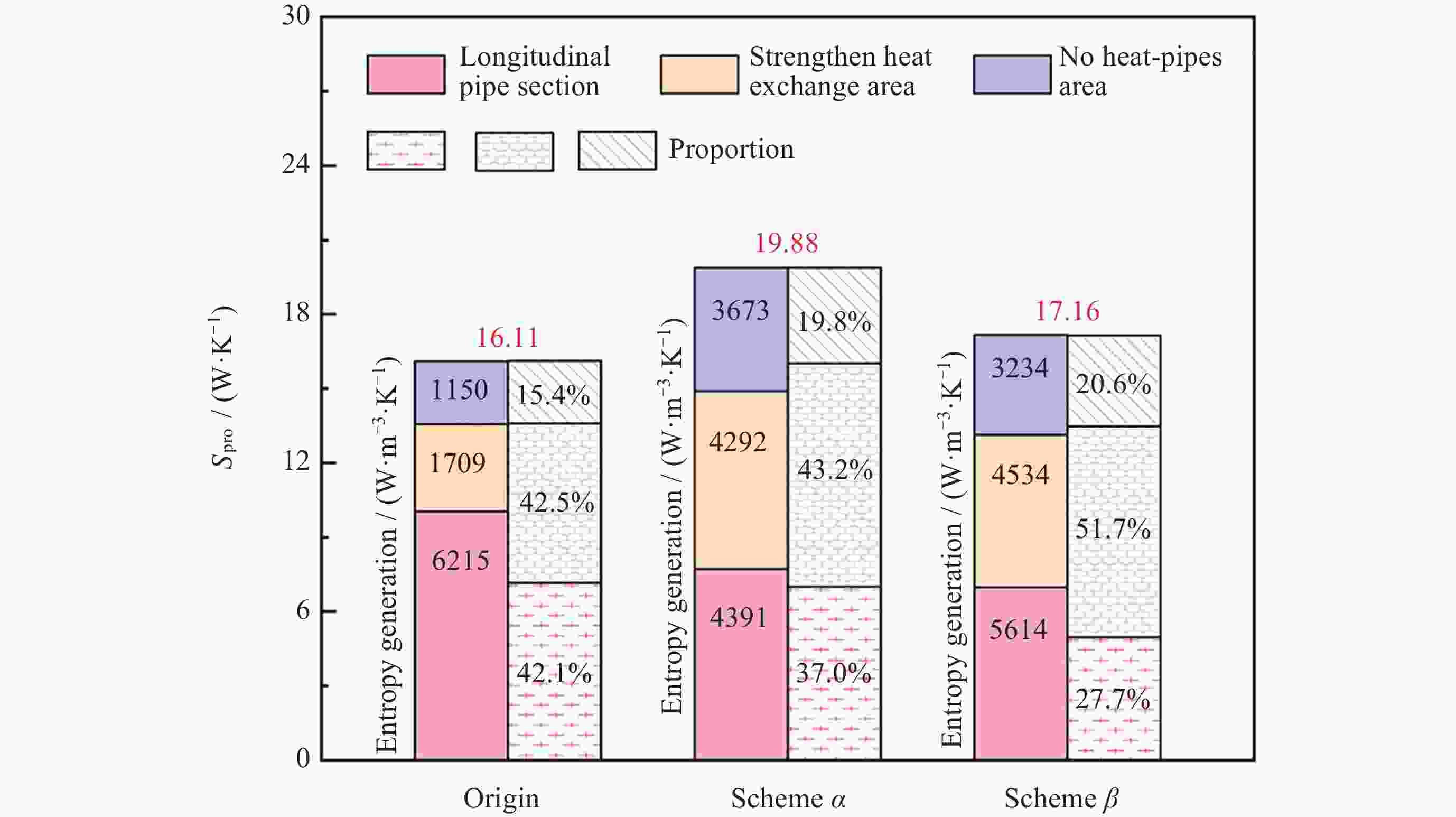
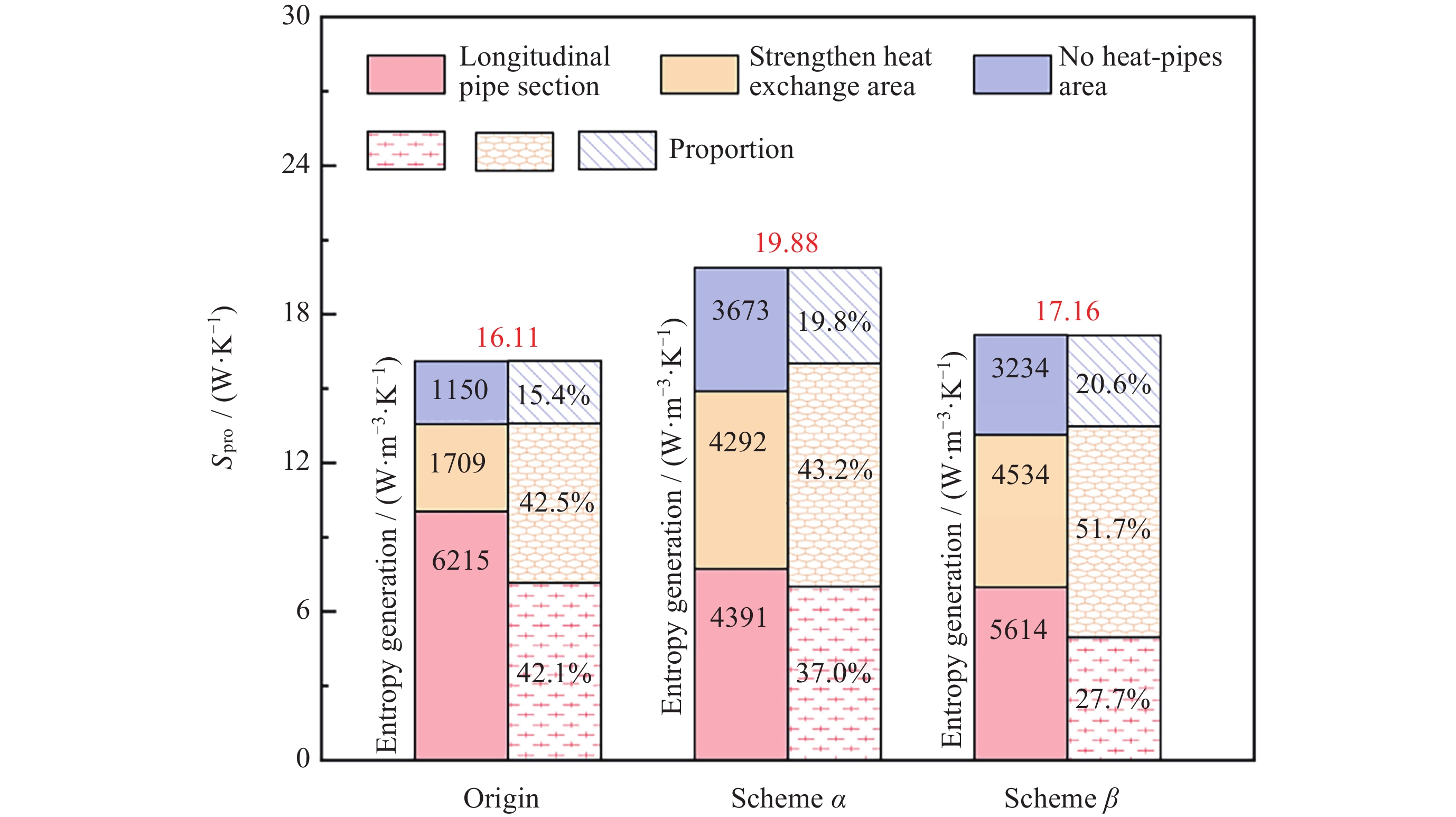
图 11 各区域温差熵产及比例
Figure 11. Entropy generation and proportion of temperature difference in each region
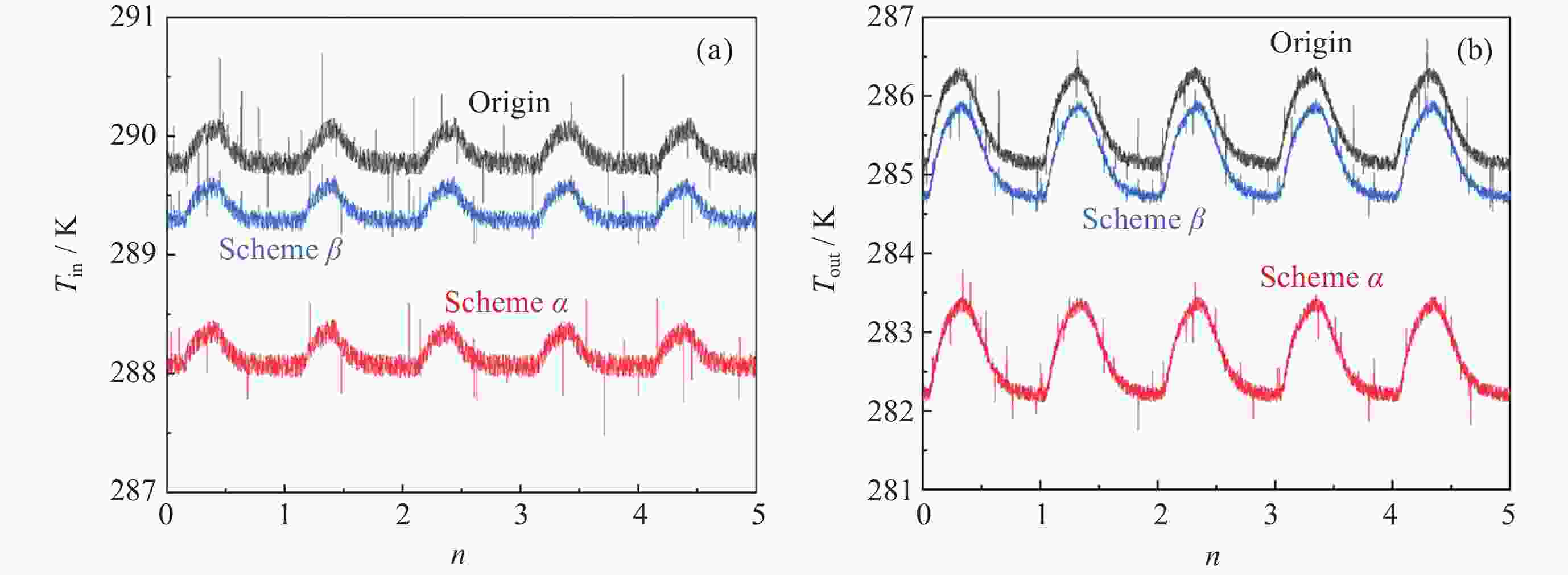
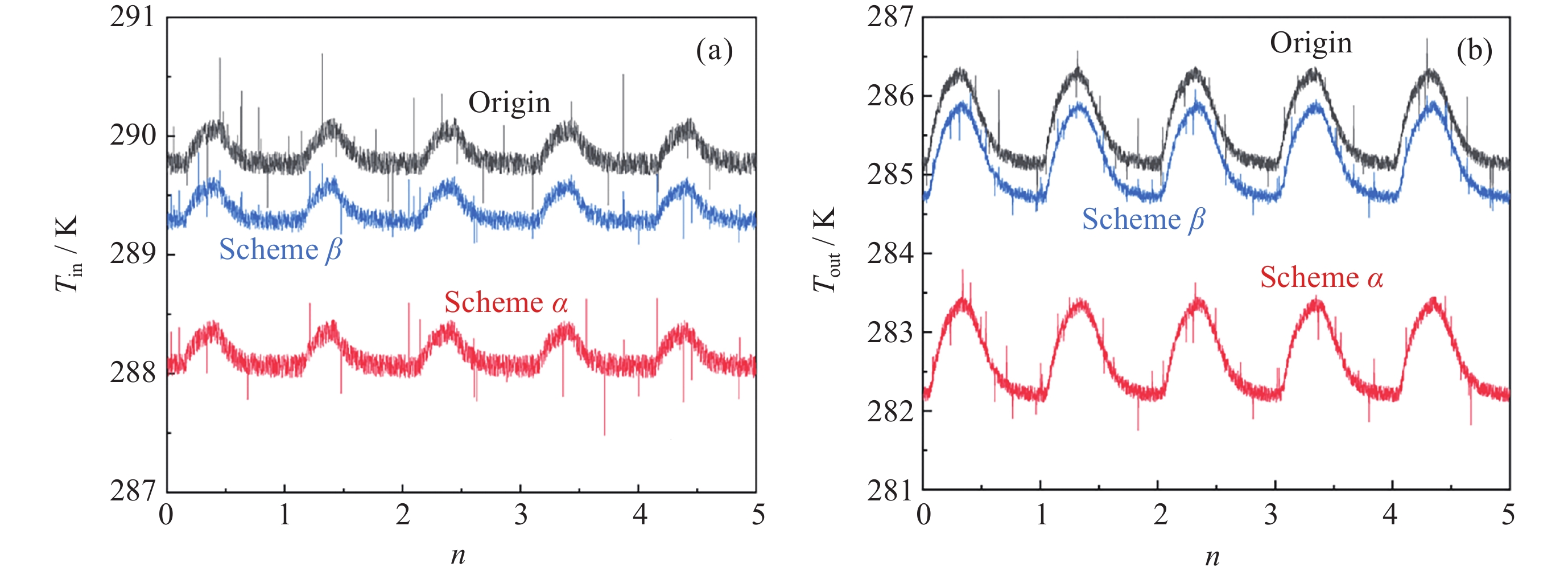
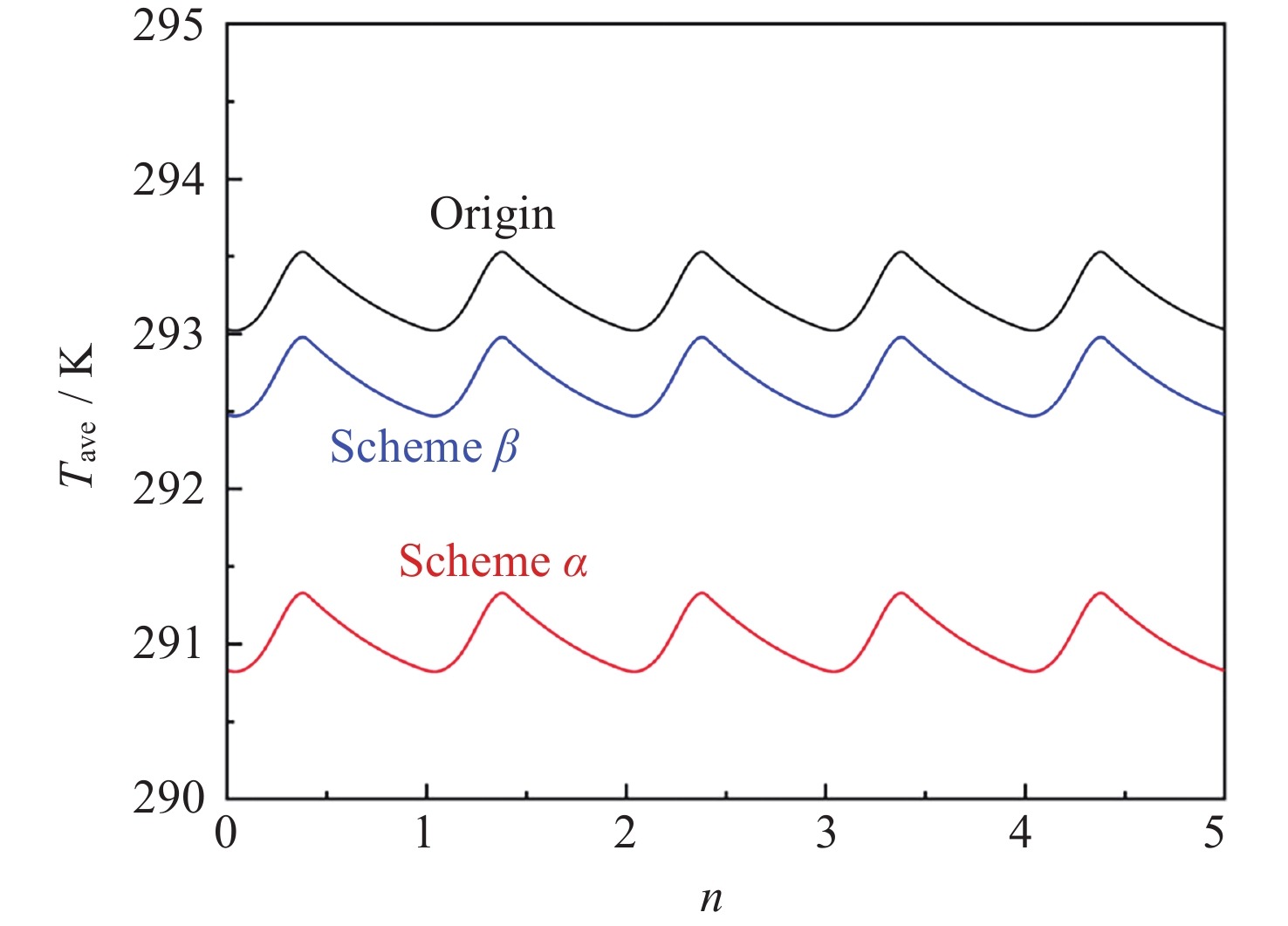
图 12 绕轨运行辐射器流体进出管口温度(n为绕轨周期数)
Figure 12. Inlet and outlet temperature of the fluid during the on-orbit operation (n indicates the number of orbital revolutions)
表 1 材料热物性参数
Table 1. Thermal physical parameters of materials
物质名称 密度/(kg·m–3) 等效热导率/(W·m–1·K–1) 比热/(J·kg–1·K–1) 乙二醇溶液 1111.4 0.252 2415 铝蒙皮 1430 115 880 蜂窝芯[16] 27 面内1.2, 法向2.0 891 外贴热管 1006 12000 910  下载: 导出CSV
表 2 优化前后方案设计变量取值(单位: mm)
Table 2. Design variable values before and after optimization (Unit: mm)
a b c d x l1 l2 l3 l4 l5 l6 原方案 100 25 50 90 72 1200 1200 1200 1200 1200 1200 方案α 73.4 33.4 77.1 47.2 93.6 1243 1046 1038 990 1010 1261 方案β 63.7 33.3 77.6 61.9 80.6 1043 1051 957 959 1070 1089
下载: 导出CSV
-
[1] LI C D, LIANG Z Q, XIAO H Y, et al. Synthesis of ZnO/Zn2SiO4/SiO2 composite pigments with enhanced reflectance and radiation-stability under low-energy proton irradiation[J]. Materials Letters, 2010, 64(18): 1972-1974 doi: 10.1016/j.matlet.2010.06.027 [2] LIU Hong, ZHANG Xiaofeng, FENG Jianchao, et al. Application of precision thermal control techniques in Taiji-1 satellite[J]. Chinese Journal of Space Science, 2021, 41(2): 337-341 (刘红, 张晓峰, 冯建朝, 等. 精密热控技术在太极一号卫星上的应用[J]. 空间科学学报, 2021, 41(2): 337-341LIU Hong, ZHANG Xiaofeng, FENG Jianchao, et al. Application of precision thermal control techniques in Taiji-1 satellite[J]. Chinese Journal of Space Science, 2021, 41(2): 337-341 [3] LI Yijian, LI Chunzhi, WANG Runnan, et al. Thermal design of deployable antenna for high-power space-borne SAR[J]. Modern Radar, 2021, 43(12): 45-51 (李亦健, 李春志, 王润楠, 等. 某高功率星载SAR可展开天线的热设计[J]. 现代雷达, 2021, 43(12): 45-51LI Yijian, LI Chunzhi, WANG Runnan, et al. Thermal design of deployable antenna for high-power space-borne SAR[J]. Modern Radar, 2021, 43(12): 45-51 [4] LIU Qingzhi, HUANG Lei, REN Hongyan, et al. Thermal design and test of high power satellite with deployable radiator[J]. Spacecraft Engineering, 2022, 31(4): 54-58 (刘庆志, 黄磊, 任红艳, 等. 应用可展开辐射器的大功率卫星热设计与验证[J]. 航天器工程, 2022, 31(4): 54-58LIU Qingzhi, HUANG Lei, REN Hongyan, et al. Thermal design and test of high power satellite with deployable radiator[J]. Spacecraft Engineering, 2022, 31(4): 54-58 [5] FENG Maolong, LAI Xiaoyi, HAN Haiying, et al. Study on radiation performance of fluid loop-heat pipe coupled radiator for China space station[J]. Aerospace Shanghai(Chinese :Times New Roman;">& English), 2023, 40(5): 88-93 (丰茂龙, 来霄毅, 韩海鹰, 等. 空间站流体回路/热管耦合式热辐射器性能研究[J]. 上海航天(中英文), 2023, 40(5): 88-93FENG Maolong, LAI Xiaoyi, HAN Haiying, et al. Study on radiation performance of fluid loop-heat pipe coupled radiator for China space station[J]. Aerospace Shanghai(Chinese & English), 2023, 40(5): 88-93 [6] ARSLANTURK C. Optimization of space radiators accounting for variable thermal conductivity and base-to-fin radiation interaction[J]. Proceedings of the Institution of Mechanical Engineers, Part G: Journal of Aerospace Engineering, 2018, 232(1): 121-130 doi: 10.1177/0954410016673091 [7] ZHANG Ningli, JIANG Jun. Mean method for estimating heat transfer efficiency of space radiator[J]. Journal of Harbin Institute of Technology, 2008, 40(9): 1509-1512 (张宁莉, 姜军. 估算空间辐射器传热效率的平均法[J]. 哈尔滨工业大学学报, 2008, 40(9): 1509-1512ZHANG Ningli, JIANG Jun. Mean method for estimating heat transfer efficiency of space radiator[J]. Journal of Harbin Institute of Technology, 2008, 40(9): 1509-1512 [8] TOURNIER J M P, EL-GENK M S. Liquid metal loop and heat pipe radiator for space reactor power system[J]. Journal of Propulsion and Power, 2006, 22(5): 1117-1134 doi: 10.2514/1.20031 [9] LIU Xin, LIANG Xingang. Optimization design and analysis of heat transfer for space radiator[J]. Journal of Astronautics, 2016, 37(5): 605-611 (刘欣, 梁新刚. 太空辐射器传热优化设计及分析[J]. 宇航学报, 2016, 37(5): 605-611LIU Xin, LIANG Xingang. Optimization design and analysis of heat transfer for space radiator[J]. Journal of Astronautics, 2016, 37(5): 605-611 [10] CHENG Xuetao, XU Xianghua, LIANG Xingang. Application of entransy to optimization design of parallel thermal network of thermal control system in spacecraft[J]. Science China Technological Sciences, 2011, 41(4): 507-514 (程雪涛, 徐向华, 梁新刚. (火积)在航天器热控系统并联热网络优化中的应用[J]. 中国科学: 技术科学, 2011, 41(4): 507-514CHENG Xuetao, XU Xianghua, LIANG Xingang. Application of entransy to optimization design of parallel thermal network of thermal control system in spacecraft[J]. Science China Technological Sciences, 2011, 41(4): 507-514 [11] WANG Yuying, LI Yunze, LIU Dongxiao. Optimized design of heat insulation layers’ thickness and radiator surfaces for nano-satellite[J]. Spacecraft Engineering, 2010, 19(2): 46-51 (王玉莹, 李运泽, 刘东晓. 纳卫星隔热层厚度与散热面面积优化设计[J]. 航天器工程, 2010, 19(2): 46-51WANG Yuying, LI Yunze, LIU Dongxiao. Optimized design of heat insulation layers’ thickness and radiator surfaces for nano-satellite[J]. Spacecraft Engineering, 2010, 19(2): 46-51 [12] YAO Liang, WANG Suming, ZHANG Hongna, et al. Design and analysis of “contact-heat conduction” heat pipe radiator[J]. Chinese Space Science and Technology, 2023, 43(3): 81-92 (姚良, 王苏明, 张红娜, 等. "接触–导热"式热管辐射散热器设计与分析[J]. 中国空间科学技术, 2023, 43(3): 81-92YAO Liang, WANG Suming, ZHANG Hongna, et al. Design and analysis of “contact-heat conduction” heat pipe radiator[J]. Chinese Space Science and Technology, 2023, 43(3): 81-92 [13] LU P, YAN X D, WU R, et al. Numerical simulation and conceptual design of an MW-grade space heat pipe radiator[J]. Numerical Heat Transfer, Part A: Applications: An International Journal of Computation and Methodology, 2023, 84(4): 400-411 [14] EBADI A, BAUTISTA J C C, WHITE C M, et al. A heat transfer model of fully developed turbulent channel flow[J]. Journal of Fluid Mechanics, 2020, 884: R7 doi: 10.1017/jfm.2019.1006 [15] CHENG X T, XU X H, LIANG X G. Homogenization of temperature field and temperature gradient field[J]. Science in China Series E: Technological Sciences, 2009, 52(10): 2937-2942 doi: 10.1007/s11431-009-0244-8 [16] LI Wei, XIE Zonghong, ZHAO Jian. The research on the out-of-plane equivalent thermal conductivity of honeycomb cores[J]. Vacuum :Times New Roman;">& Cryogenics, 2010, 16(3): 162-166 (李玮, 谢宗蕻, 赵剑. 蜂窝芯体面外方向导热系数等效研究[J]. 真空与低温, 2010, 16(3): 162-166LI Wei, XIE Zonghong, ZHAO Jian. The research on the out-of-plane equivalent thermal conductivity of honeycomb cores[J]. Vacuum & Cryogenics, 2010, 16(3): 162-166 [17] HAN Zhonghua. Kriging surrogate model and its application to design optimization: a review of recent progress[J]. Acta Aeronautica et Astronautica Sinica, 2016, 37(11): 3197-3225 (韩忠华. Kriging模型及代理优化算法研究进展[J]. 航空学报, 2016, 37(11): 3197-3225HAN Zhonghua. Kriging surrogate model and its application to design optimization: a review of recent progress[J]. Acta Aeronautica et Astronautica Sinica, 2016, 37(11): 3197-3225 [18] LIU Xiaolu, CHEN Yingwu, JING Xianrong, et al. Optimized Latin hypercube sampling method and its application[J]. Journal of National University of Defense Technology, 2011, 33(5): 73-77 (刘晓路, 陈英武, 荆显荣, 等. 优化拉丁方试验设计方法及其应用[J]. 国防科技大学学报, 2011, 33(5): 73-77LIU Xiaolu, CHEN Yingwu, JING Xianrong, et al. Optimized Latin hypercube sampling method and its application[J]. Journal of National University of Defense Technology, 2011, 33(5): 73-77 [19] DEB K, PRATAP A, AGARWAL S, et al. A fast and elitist multiobjective genetic algorithm: NSGA-II[J]. IEEE Transactions on Evolutionary Computation, 2002, 6(2): 182-197 doi: 10.1109/4235.996017 [20] QI Laibin. Statistics analysis and fuzzy comprehensive evaluation of Likert scale[J]. Shandong Science, 2006, 19(2): 18-23,28 (亓莱滨. 李克特量表的统计学分析与模糊综合评判[J]. 山东科学, 2006, 19(2): 18-23,28QI Laibin. Statistics analysis and fuzzy comprehensive evaluation of Likert scale[J]. Shandong Science, 2006, 19(2): 18-23,28 -
-

 下载:
下载:

计量
- 文章访问数: 1112
- HTML全文浏览量: 582
- PDF下载量: 136
-
被引次数:
0(来源:Crossref)
0(来源:其他)

