


太阳全日面视向磁图活动区数据集
doi: 10.11728/cjss2025.06.2025-0086 cstr: 32142.14.cjss.2025-0086
-
 潘劲珲 男, 2001年6月18日出生于甘肃省兰州市, 现为中国科学技术大学地球和空间科学学院博士研究生. E-mail: panjh@mail.ustc.edu.cn
 -
 刘睿 男, 中国科学技术大学博士生导师、讲席教授. 主要从事太阳大气中各种爆发和瞬变现象的研究, 在国际期刊发表论文130余篇. E-mail: rliu@ustc.edu.cn
作者简介:
通讯作者:
Dataset of Solar Active Regions in the Solar Full-disk Magnetograms
-
摘要: 太阳活动区是太阳剧烈爆发活动例如太阳耀斑和日冕物质抛射等的重要源区, 对于太阳活动区的识别有助于预报太阳剧烈活动对地球空间环境的影响. 本数据集使用2010-2019年来自太阳动力学天文台(SDO)搭载的日震与磁像仪(HMI)拍摄的间隔720 s的太阳全日面视向磁图数据, 结合Solar Monitor (
https://solarmonitor.org/ ) 网站给出的美国国家海洋和大气管理局(NOAA)活动区编号, 并基于传统图像处理算法的识别方法, 结合人工标注进行了磁图中活动区的标注. 本数据集包含6975张每天间隔12 h的太阳全日面视向磁图, 给出了每张磁图上的活动区位置信息, 共26531个活动区标注. 本数据集旨在为基于深度学习识别活动区的算法提供一个标准训练集, 从而为空间天气预报提供数据支持.Abstract: Solar active regions are key source regions of intense solar phenomena such as solar flares and Coronal Mass Ejections (CMEs). Accurate identification of these regions can help forecast the impact of solar activities on the geospace environment. This dataset utilizes solar full-disk line-of-sight magnetograms observed by the Helioseismic and Magnetic Imager onboard the Solar Dynamic Observatory (2010-2019), combined with NOAA AR numbers provided by the Solar Monitor website (https://solarmonitor.org/ ). The active regions are annotated using an image processing-based recognition method along with manual labeling in accordance with the NOAA catalog. The dataset consists of 6975 solar full-disk magnetograms, taken every 12 hours, with a total number of 26531 annotations consisting of the active-region information for each magnetogram. This dataset serves as a benchmark resource for developing deep learning solar active region detection models, and aims to enhance predictive capabilities for severe space weather phenomena through physics-informed training samples. -
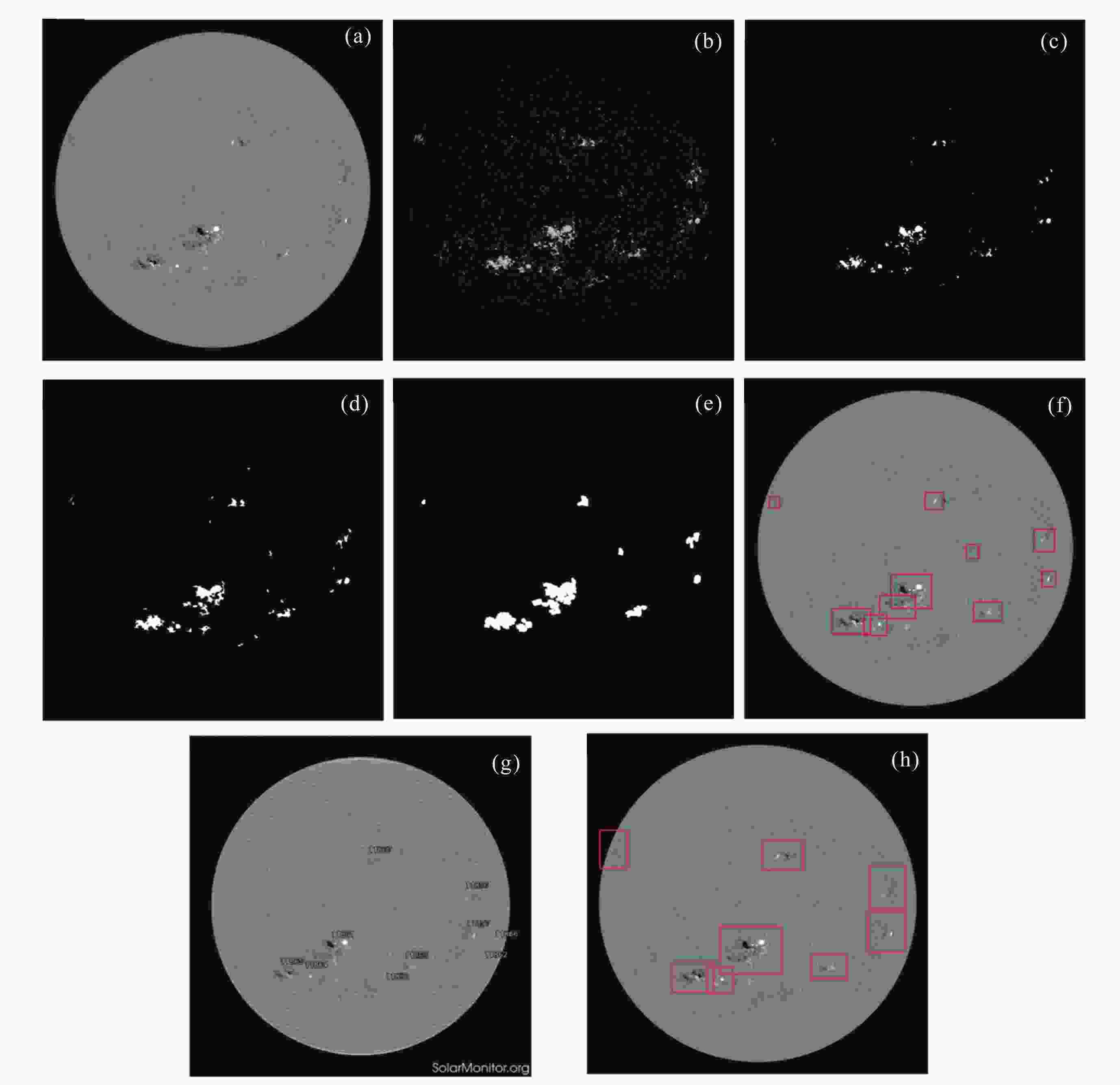
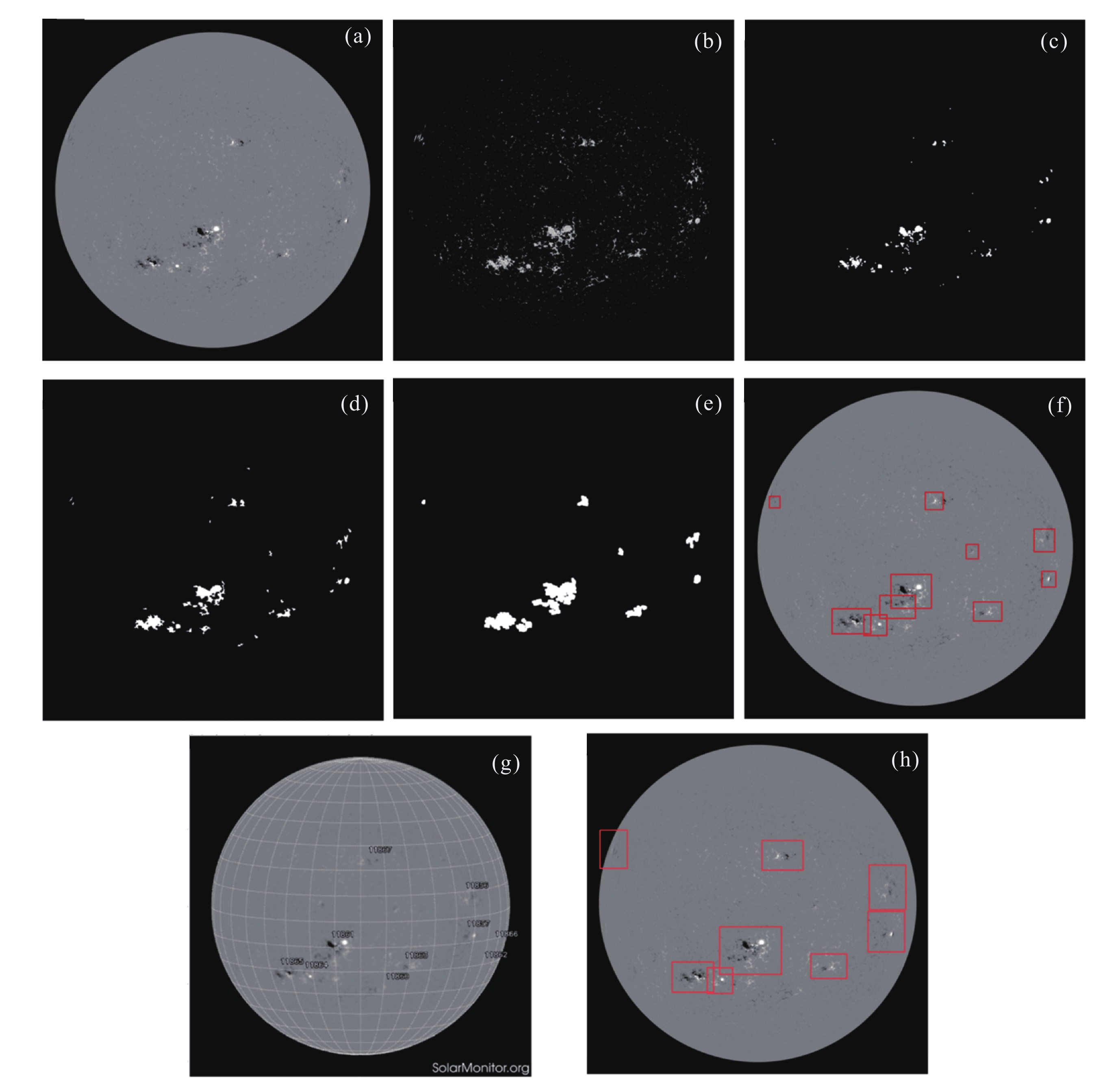
图 1 数据集制备过程中的图像预处理流程. (a) 2013年10月12日 00:00:00 UTC时获取的原始视向磁图, (b)经OTSU阈值化处理后的结果, (c)形态学开运算处理效果, (d)区域生长算法的处理结果, (e)形态学闭运算处理结果, (f)显示最终检测到的活动区, (g) Solar Monitor获取的2013年10月11日 23:31:38 UTC时的NOAA活动区(AR)标注, (h)经过人工调整后的活动区标注
Figure 1. Flowchart of image preprocessing during dataset preparation. (a) Original Line-Of-Sight (LOS) magnetogram acquired at 00:00:00 UTC on 12 October 2013, (b) result of OTSU thresholding, (c) processing effect of morphological opening operation, (d) processing result of region growing algorithm, (e) processing result of morphological closing operation, (f) final detected active regions, (g) NOAA Active-Region (AR) labels from Solar Monitor at 23:31:38 UTC on 11 October 2013, (h) manually adjusted activity area labels
表 1 太阳活动区数据集信息
Table 1. Information of the solar active region dataset
数据集信息 获取方式 文件格式 太阳全日面视向磁图 下载自JSOC数据网站 fits 活动区标注 自动检测结合人工校正 txt  下载: 导出CSV
-
[1] VAN DRIEL-GESZTELYI L, GREEN L M. Evolution of active regions[J]. Living Reviews in Solar Physics, 2015, 12(1): 1 doi: 10.1007/lrsp-2015-1 [2] LIU R, KLIEM B, TÖRÖK T, et al. Slow rise and partial eruption of a double-decker filament. I. Observations and interpretation[J]. The Astrophysical Journal, 2012, 756(1): 59 doi: 10.1088/0004-637X/756/1/59 [3] DANG T, LI X L, LUO B X, et al. Unveiling the space weather during the Starlink satellites destruction event on 4 February 2022[J]. Space Weather, 2022, 20(8): e2022SW003152 doi: 10.1029/2022SW003152 [4] ZHANG J, WANG Y M, LIU Y. Statistical properties of solar active regions obtained from an automatic detection system and the computational biases[J]. The Astrophysical Journal, 2010, 723(2): 1006-1018 doi: 10.1088/0004-637X/723/2/1006 [5] WANG R H, JIANG J, LUO Y K. Toward a live homogeneous database of solar active regions based on SOHO/MDI and SDO/HMI synoptic magnetograms. I. Automatic detection and calibration[J]. The Astrophysical Journal Supplement Series, 2023, 268(2): 55 doi: 10.3847/1538-4365/acef1b [6] GIRSHICK R, DONAHUE J, DARRELL T, et al. Rich feature hierarchies for accurate object detection and semantic segmentation[C]//Proceedings of the IEEE Conference on Computer Vision and Pattern Recognition. Columbus: IEEE, 2014: 580-587 [7] BAEK J H, KIM S, CHOI S, et al. Solar event detection using deep-learning-based object detection methods[J]. Solar Physics, 2021, 296(11): 1-15 [8] REDMON J, DIVVALA S, GIRSHICK R, et al. You only look once: Unified, real-time object detection[C]//Proceedings of the IEEE Conference on Computer Vision and Pattern Recognition. Las Vegas: IEEE, 2016: 779-788 [9] GONG L, YANG Y F, FENG S, et al. Solar active regions detection and tracking based on deep learning[J]. Solar Physics, 2024, 299(8): 1-22 [10] LIU J J, JI C Y, WANG Y M, et al. Improving the automated coronal jet identification with U-NET[J]. The Astrophysical Journal, 2024, 972(2): 187 doi: 10.3847/1538-4357/ad66be [11] Pan J, Liu J, Fang S, et al. SARD: A YOLOv8-based system for solar active region detection with SDO/HMI magnetograms[J]. Solar Physics, 2025, 300(8): 111 doi: 10.1007/s11207-025-02525-w [12] PESNELL W D, THOMPSON B J, CHAMBERLIN P C, et al. The Solar Dynamics Observatory (SDO)[J]. Solar Physics, 2012, 275(1): 3-15 [13] OTSU N. A threshold selection method from gray-level histograms[J]. Automatica, 1975, 11: 23-27 [14] COUVIDAT S, SCHOU J, HOEKSEMA J T, et al. Observables processing for the Helioseismic and Magnetic imager instrument on the Solar dynamics observatory[J]. Solar Physics, 2016, 291(7): 1887-1938 doi: 10.1007/s11207-016-0957-3 [15] BOBRA M G, SUN X, HOEKSEMA J T, et al. The Helioseismic and Magnetic Imager (HMI) vector magnetic field pipeline: SHARPs–space-weather HMI active region patches[J]. Solar Physics, 2014, 289(9): 3549-3578 doi: 10.1007/s11207-014-0529-3 -
-

 下载:
下载:

计量
- 文章访问数: 942
- HTML全文浏览量: 471
- PDF下载量: 124
-
被引次数:
0(来源:Crossref)
0(来源:其他)

