


2011至2022年太阳日珥数据集
doi: 10.11728/cjss2025.06.2025-0089 cstr: 32142.14.cjss.2025-0089
-
 汪谊涛 男, 2000年7月出生于安徽省安庆市, 现为中国科学技术大学空间科学与物理学院硕士研究生, 主要研究方向为太阳日珥事件过程相关研究. E-mail: 484247926@qq.com
 -
 张全浩 男, 2017年毕业于中国科学技术大学, 获博士学位, 现为中国科学技术大学地球和空间科学学院副教授, 主要研究方向为利用观测数据分析和磁流体力学数值模拟, 研究太阳和行星际空间中的活动现象. E-mail: zhangqh@ustc.edu.cn
作者简介:
通讯作者:
Dataset of Solar Prominences from 2011 to 2022
-
摘要: 太阳日珥是悬浮在日冕中具有较低温度(通常小于10000 K)和较稠密电子密度(109~1011 cm–3)的磁结构. 相关研究表明, 太阳日珥与太阳耀斑及日冕物质抛射等可能引起灾害性空间天气的太阳爆发活动具有明显的关联性, 研究太阳日珥的时空分布有助于预报其空间天气效应, 从而尽可能降低太阳爆发活动带来的灾害性影响. 本数据集基于10 min分辨率的SDO (Solar Dynamics Observatory)卫星 AIA (Atmospheric Imaging Assembly)仪器记录的 30.4 nm数据图像, 通过背景重构增大日面外图像的对比度, 而后使用骨架提取、区域生长等自动算法标记重构后图像中的日珥区域, 获得相关参数值, 并将持续时间内存在的相同日珥追踪后存储于数据文件中, 最后将处理后的图像以及日珥数据文件存储在按年–月–日的三级结构目录中. 数据集囊括了从2011年1月1日00:00 UT至2022年12月 31日23:50 UT共计101741个日珥文件, 严格按照相关协议和分类文件进行审核, 确保较高的可靠性, 为太阳日珥周期内的时空分布研究以及灾害性空间天气的预测提供科学数据支持.Abstract: Solar prominences are magnetic structures suspended in the corona, characterized by relatively low temperatures (typically below 10000K) and higher electron densities (109~1011 cm–3). Research indicates a clear correlation between prominences and solar eruptive activities, such as solar flares and coronal mass ejections that may trigger hazardous space weather. Studying the spatiotemporal distribution of solar prominences can aid in forecasting space weather efforts and help mitigate potential catastrophic impacts. This dataset is based on the 30.4 nm wavelength images captured by the Atmospheric Imaging Assembly (AIA) instrument aboard the Solar Dynamics Observatory (SDO) satellite, with a temporal resolution of 10 minutes. By employing background reconstruction to enhance the contrast of off-limb images, the automated algorithms, such as the skeleton extraction and the region-growing techniques, were used to identify prominence regions in the reconstructed images and extract relevant parameters. For those evolving in the same region during continuous frames, misidentification caused by duplicate naming is avoided by K-Nearest Neighbor (KNN) classification. Before tracking a procedure called non-prominence feature removal is used to discriminate real prominences from non-prominence features: Through Linear Discriminant Analysis (LDA), the eigenvalue of any target region can be calculated, and compare it with the derived distribution which is fitted with Gaussian distribution functions, to determine the likeliness of a real prominence, by which SLIPCAT can exclude active regions without involving other observation methods. Persisting prominences were tracked and stored in data files. At last, the processed images and prominence data files are organized in a year-month-day three-level directory structure. The dataset encompasses a total of 101741 prominence files, covering the period from 00:00 UT on 1 January 2011 to 23:50 UT on 31 December 2022. Rigorous validation was conducted in accordance with relevant protocols and classification standards to ensure high reliability. This dataset provides scientific support for research on the spatiotemporal distribution of solar prominences over their activity cycles and for the prediction of hazardous space weather events.
-
Key words:
- Solar prominences /
- Space weather /
- Solar eruptive events /
- Solar events
-
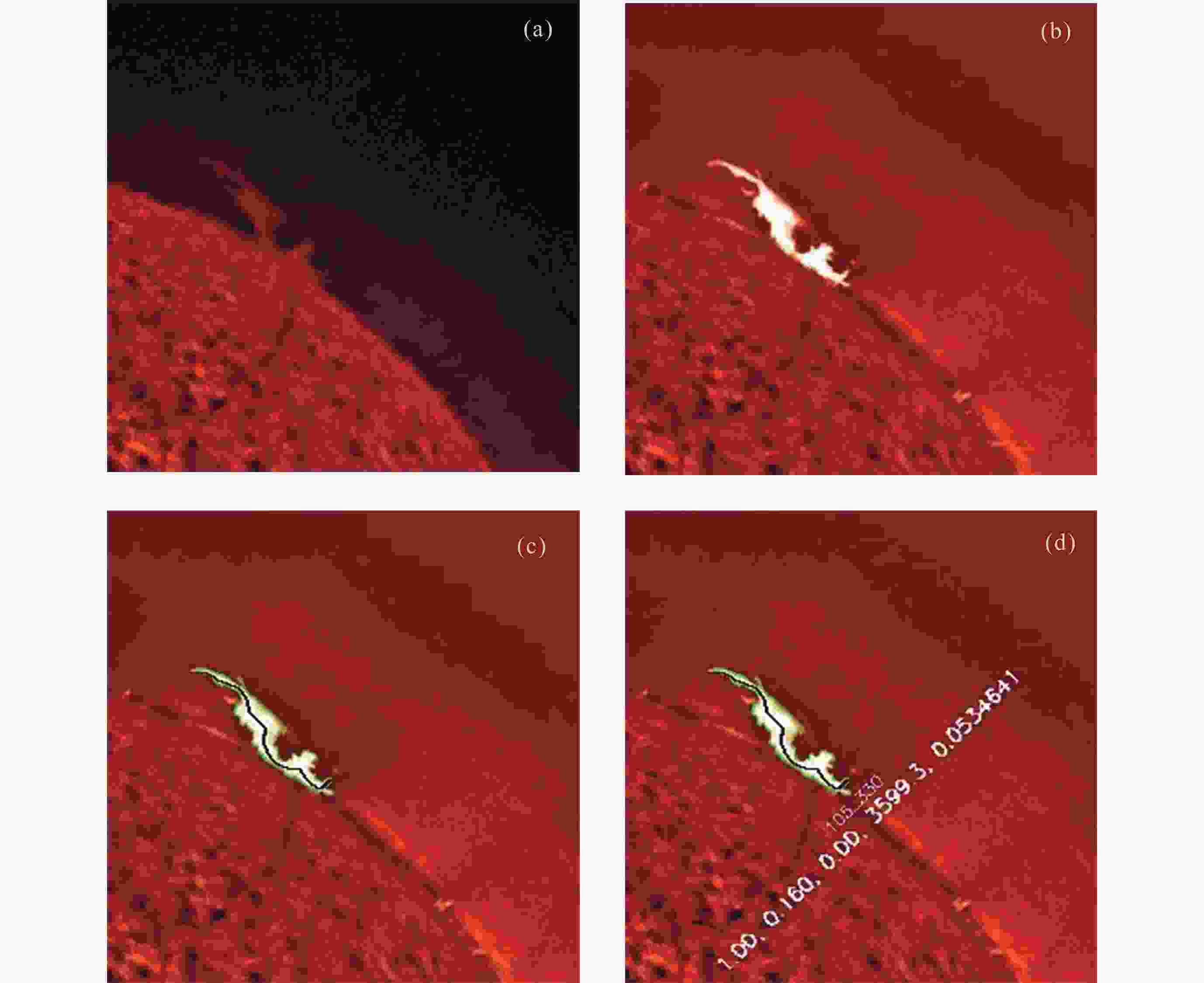
图 2 2013年11月2日23:40 UT 的单帧图像处理结果. (a) 原始图像, (b) 背景重构后的全日面图像, (c) 标记出日珥区域的全日面图像, (d) 标记出日珥区域及部分参数的全日面图像
Figure 2. Processing results of the single frame at 23:40 UT on 2 November 2013. (a) Original image, (b) full-disk image after background reconstruction, (c) full-disk image with prominence regions marked, (d) full-disk image with prominence regions and partial parameters marked
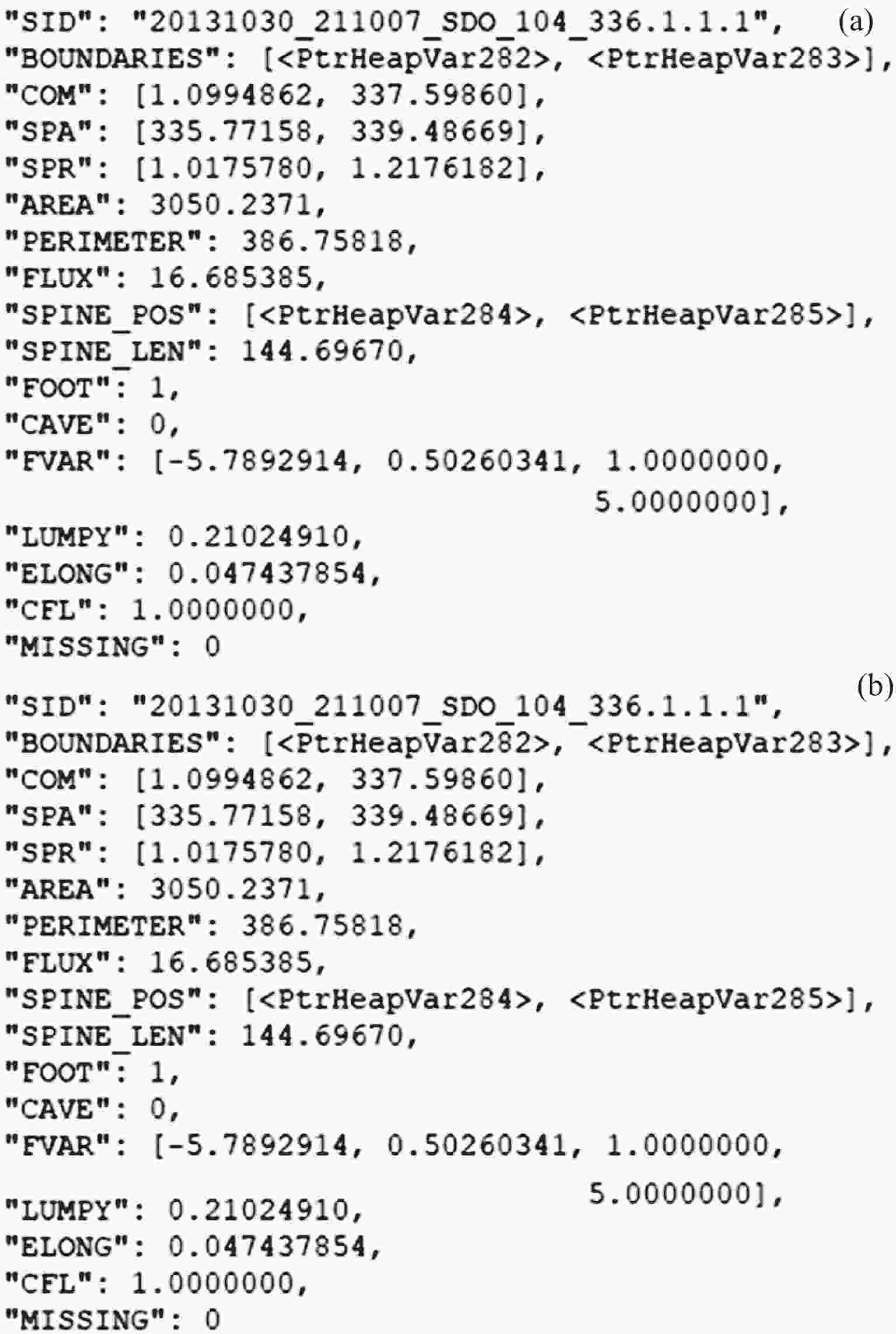
图 3 单个日珥样例参数信息. (a) 2013年11月2日23:40 UT分日珥参数信息, (b)日珥追踪过程存储参数信息
Figure 3. Parameter information of a single prominence sample. (a) Prominence parameters at 23:40 UT on 2 November 2013, (b) parameters stored during the prominence tracking process
表 1 日珥参数信息描述
Table 1. Prominence parameter details
序号 参数 信息描述 1 SID 日珥 id 2 BOUNDARIES 指针型变量, 包含标记的日珥边界坐标(x, y, 单位pixel) 以及默认设定的算法阈值 (info) 3 COM 包含两个元素的一维数组, 加权后的日心距(单位为1Rs, Rs表示太阳半径)和方位角(单位为°) 4 SPA 日珥的所有像素点的最低和最高方位角 (单位为°) 5 SPR 日珥的所有像素点的最低高度和最大高度, 单位为1Rs 6 AREA 日珥的面积, 单位 Mm2 7 PERIMETER 日珥的周长, 单位 Mm 8 FLUX 日珥的总亮度, 单位 DN (Digital Number) 9 SPINE-POS 日珥中脊线 (骨架主干线) 长度, 单位 Mm 10 SPINE-LEN 日珥的骨架参数信息, 包含两个参数: skel_info为默认设定的算法阈值, skel_ xy为骨架的每个坐标点的信息, 单位 pixel 11 FOOT 日珥的足点数量 12 CAVE 未定义参数, 可以忽略 13 FVAR 包含4个元素的一维数组, LDA线性拟合过程中的结果参数 14 LUMPY 日珥的形态学参数定义为日珥面积与日珥区域像素坐标最远距离为直径的圆面积比值. 如果比值接近1, 说明日珥的区域形状接近正圆 15 ELONG 日珥的形态学参数定义为中脊线长度与日珥面积的比值. 比值越接近1, 说明日珥长宽比越大; 比值越接近0, 说明日珥越接近正圆 16 CFL 日珥的置信度, 非1代表非日珥, 1代表日珥 17 MISSING 中间参数可以忽略  下载: 导出CSV
-
[1] LABROSSE N, HEINZEL P, VIAL J C, et al. Physics of solar prominences: I—spectral diagnostics and non-LTE modelling[J]. Space Science Reviews, 2010, 151(4): 243-332 doi: 10.1007/s11214-010-9630-6 [2] KOLEVA K, GOPALSWAMY N, DEVI P, et al. Spatial relationship between CMEs and prominence eruptions during SC 24 and SC 25[J]. The Astrophysical Journal, 2024, 966(1): 22 doi: 10.3847/1538-4357/ad2df3 [3] FILIPPOV B P, DEN O G. Prominence height and vertical gradient in magnetic field[J]. Astronomy Letters, 2000, 26(5): 322-327 doi: 10.1134/1.20397 [4] BERNASCONI P N, RUST D M, HAKIM D. Advanced automated solar filament detection and characterization code: description, performance, and results[J]. Solar Physics, 2005, 228(1/2): 97-117 [5] FOULLON C, VERWICHTE E. Automated detection of EUV prominences[J]. Solar Physics, 2006, 234(1): 135-150 doi: 10.1007/s11207-006-0054-0 [6] LOBODA I P, BOGACHEV S A. Quiescent and eruptive prominences at solar minimum: a statistical study via an automated tracking system[J]. Solar Physics, 2015, 290(7): 1963-1980 doi: 10.1007/s11207-015-0735-7 [7] WANG Y M, CAO H, CHEN J H, et al. Solar Limb Prominence Catcher and Tracker (SLIPCAT): an automated system and its preliminary statistical results[J]. The Astrophysical Journal, 2010, 717(2): 973-986 doi: 10.1088/0004-637X/717/2/973 [8] LEMEN J R, TITLE A M, AKIN D J, et al. The Atmospheric Imaging Assembly (AIA) on the Solar Dynamics Observatory (SDO)[J]. Solar Physics, 2012, 275(1/2): 17-40 [9] FISHER R A. The use of multiple measurements in taxonomic problems[J]. Annals of Human Genetics, 1936, 7(2): 179-188 [10] PARENTI S. Solar prominences: observations[J]. Living Reviews in Solar Physics, 2014, 11(1): 1 -
-

 下载:
下载:


计量
- 文章访问数: 773
- HTML全文浏览量: 348
- PDF下载量: 149
-
被引次数:
0(来源:Crossref)
0(来源:其他)

