


基于宽度学习的HY-2微波散射计海面高风速订正
doi: 10.11728/cjss2026.02.2025-0023 cstr: 32142.14.cjss.2025-0023
-
 苏月 女, 2002年9月出生于山东省聊城市, 现为中国科学院空天信息创新研究院硕士研究生, 主要研究方向为海面风场反演. E-mail: suyue@aircas.ac.cn
 -
 汪胜 男, 1994年8月出生于湖北省武汉市, 现为中国科学院空天信息创新研究院助理研究员, 主要研究方向为海面风场反演、海面风场融合、热带气旋监测. E-mail: wangsheng01@aircas.ac.cn
作者简介:
通讯作者:
High Wind Speed Correction of HY-2 Satellite Microwave Scatterometer Based on Broad Learning System
-
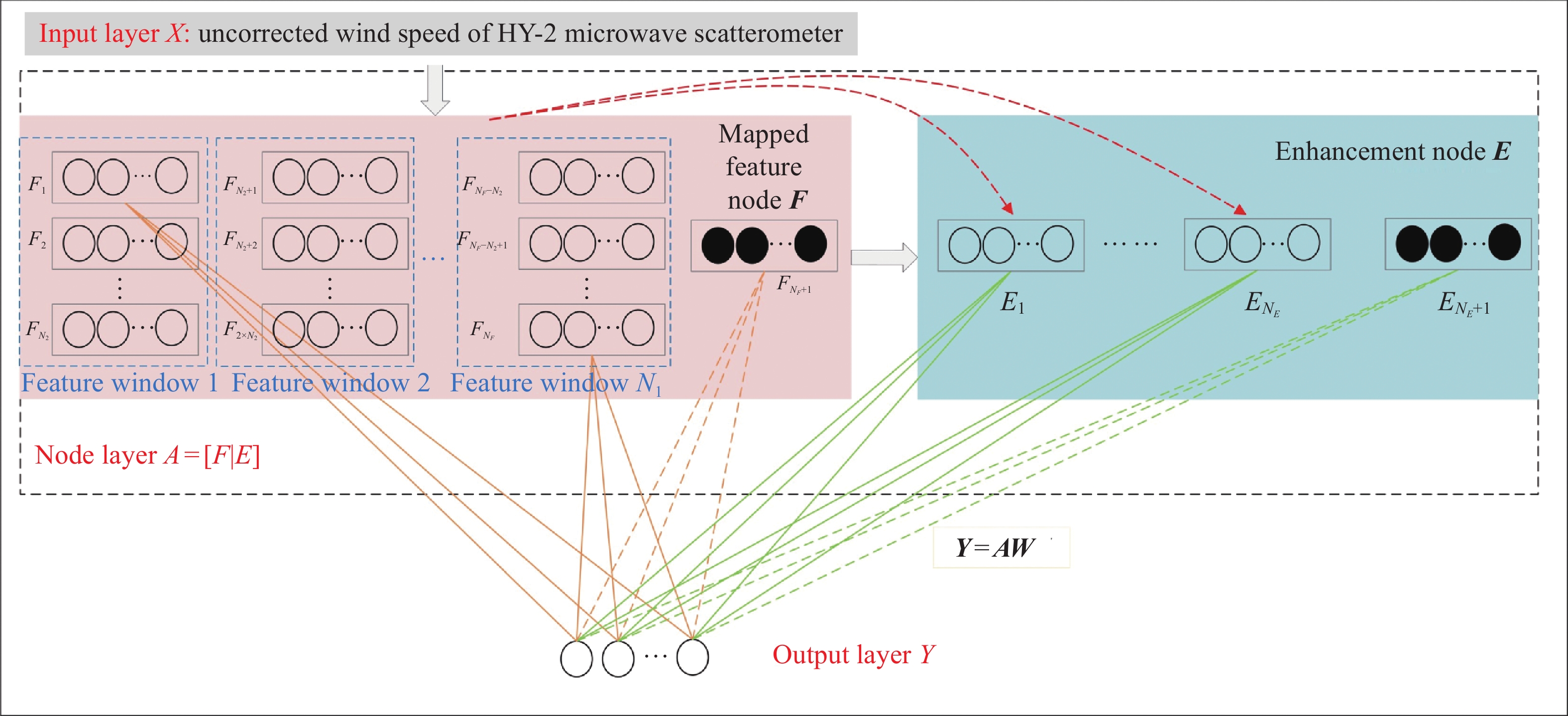
摘要: 针对国产微波散射计高风速订正需求, 以2021-2022年9个台风的HY-2系列微波散射计观测资料为数据源, 以机载步频微波辐射计(Stepped Frequency Microwave Radiometer, SFMR)风速为参考真值, 通过时空匹配构建建模数据集, 并将其以7∶3随机划分为训练集与测试集; 基于轻量化的宽度学习系统(Broad Learning System, BLS)开展回归分析, 构建高风速订正模型. 模型测试结果表明: 订正后HY-2风速的均方根误差(Root Mean Square Error, RMSE)为4.47 m·s–1, 比订正前提升了35%; 风速大于25 m·s–1时, 订正后风速的RMSE为6.76 m·s–1, 相比订正前的13.27 m·s–1有了明显改善. 此外, 以2021年台风灿都为例进行对比分析, 结果显示订正后HY-2C最大风速从22.09 m·s–1提高至32.73 m·s–1, 并且风速廓线的对比进一步证实了本文模型的有效性.Abstract: Accurate observation of sea surface wind fields is essential for tropical cyclone forecasting and meteorological hazard mitigation. The HY-2 series microwave scatterometer continuously measures Ku-band ocean surface winds. However, its current wind speed retrieval algorithm struggles in high wind conditions and systematically underestimates speeds during extreme events such as typhoons. To address this bias, this study utilized the HY-2 wind speed data of nine tropical cyclones between 2021 and 2022 as the data source. The Stepped Frequency Microwave Radiometer (SFMR) wind speed measurements served as the ground truth. A modeling dataset was constructed by resampling the SFMR reference data to match the 25 km spatial resolution of the HY-2 scatterometer, followed by spatiotemporal matching within a two-hour time window. The matched dataset was then randomly divided into a training set and a testing set at a 7∶3 ratio. Subsequently, the Broad Learning System (BLS) was employed to conduct the regression analysis and develop a high-wind-speed correction model. BLS employs a shallow, flat architecture in which input features are expanded into “enhanced nodes”, avoiding the deep stacks typical of conventional neural networks. This structure reduces computational cost and accelerates convergence while maintaining predictive performance. Validation results demonstrate that the corrected HY-2 wind speeds achieved a Root Mean Square Error (RMSE) of 4.47 m·s–1, representing a 35% improvement compared to the uncorrected data. For wind speeds exceeding 25 m·s–1, the corrected RMSE reached 6.76 m·s–1, marking significant enhancements over the original values of 13.27 m·s–1. Additionally, a comparative analysis using Typhoon Chanthu (in 2021) as a case study revealed that the corrected HY-2C maximum wind speed increased from 22.09 m·s–1 to 32.73 m·s–1, closely matching wind fields retrieved by Synthetic Aperture Radar (SAR). Further validation through wind speed profile comparisons confirmed the effectiveness of the proposed model. These results demonstrate that our correction framework markedly improves extreme-wind retrieval accuracy, yielding bias-corrected HY-2 products that are more reliable for applications, such as storm surge simulation and typhoon track forecasting.
-
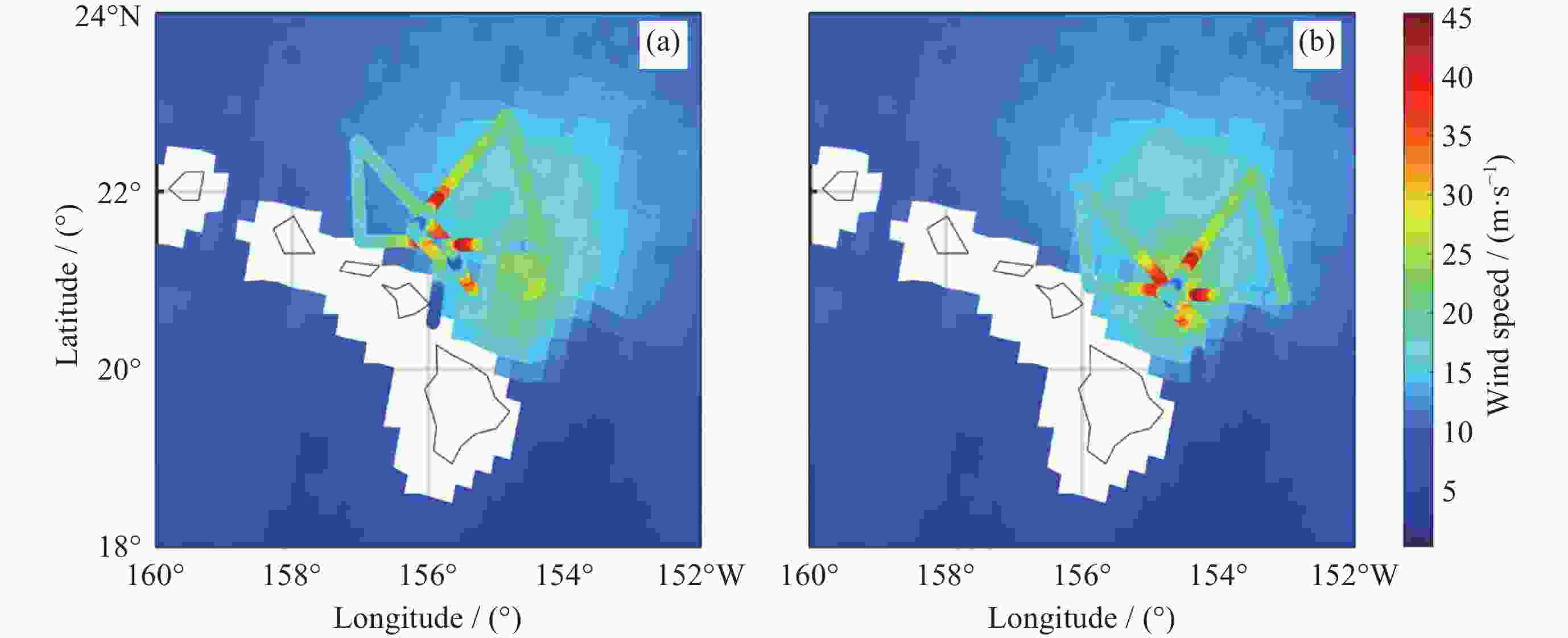
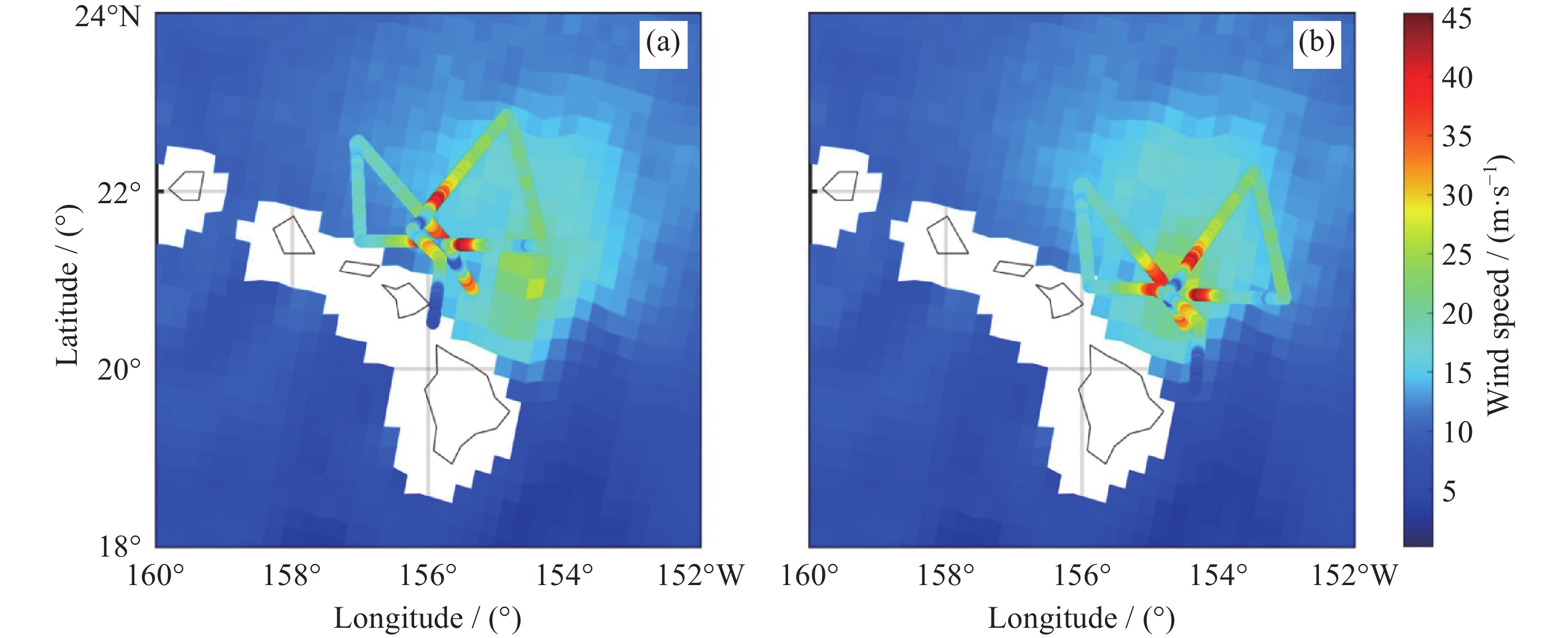
图 1 HY-2B微波散射计风速与SFMR的时空匹配结果. (a) SFMR位置校正前, (b) SFMR位置校正后
Figure 1. Spatiotemporal matching diagram of wind speed between HY-2B microwave scatterometer and SFMR before (a) and after (b) SFMR position correction
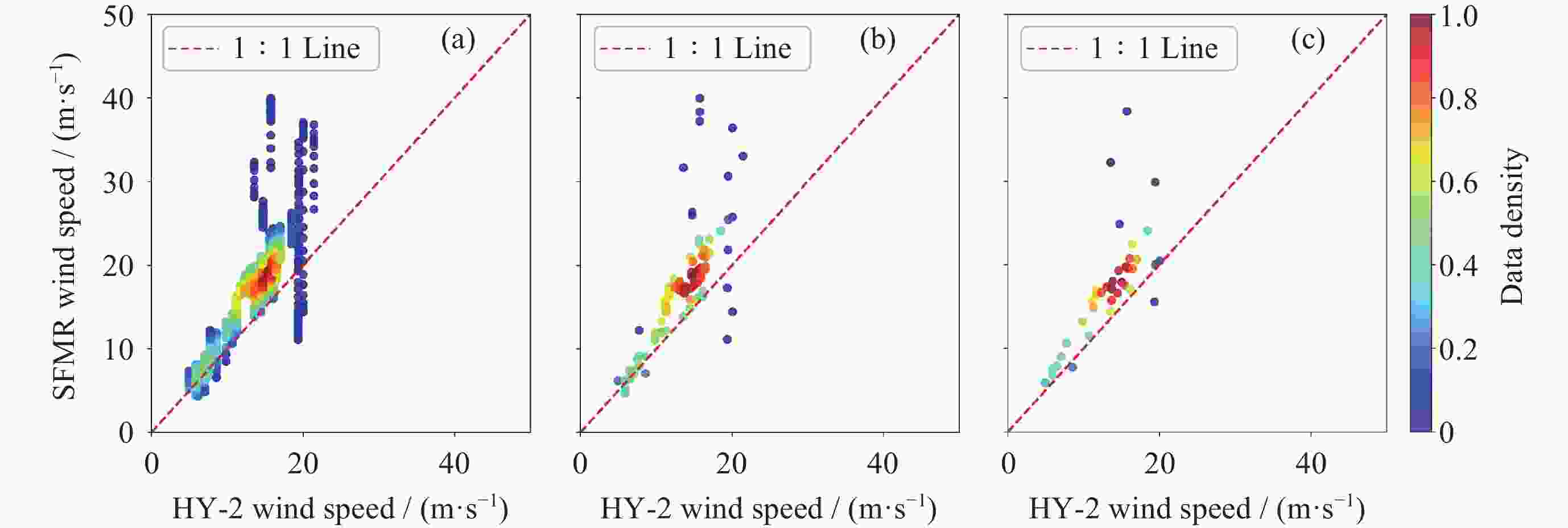
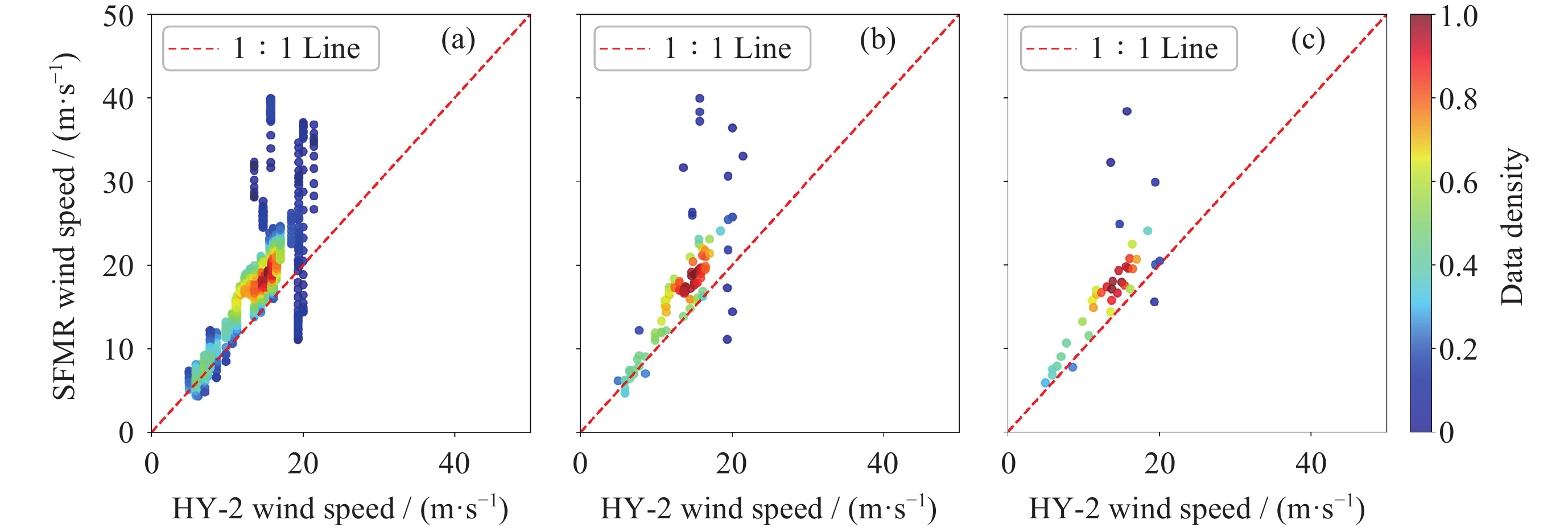
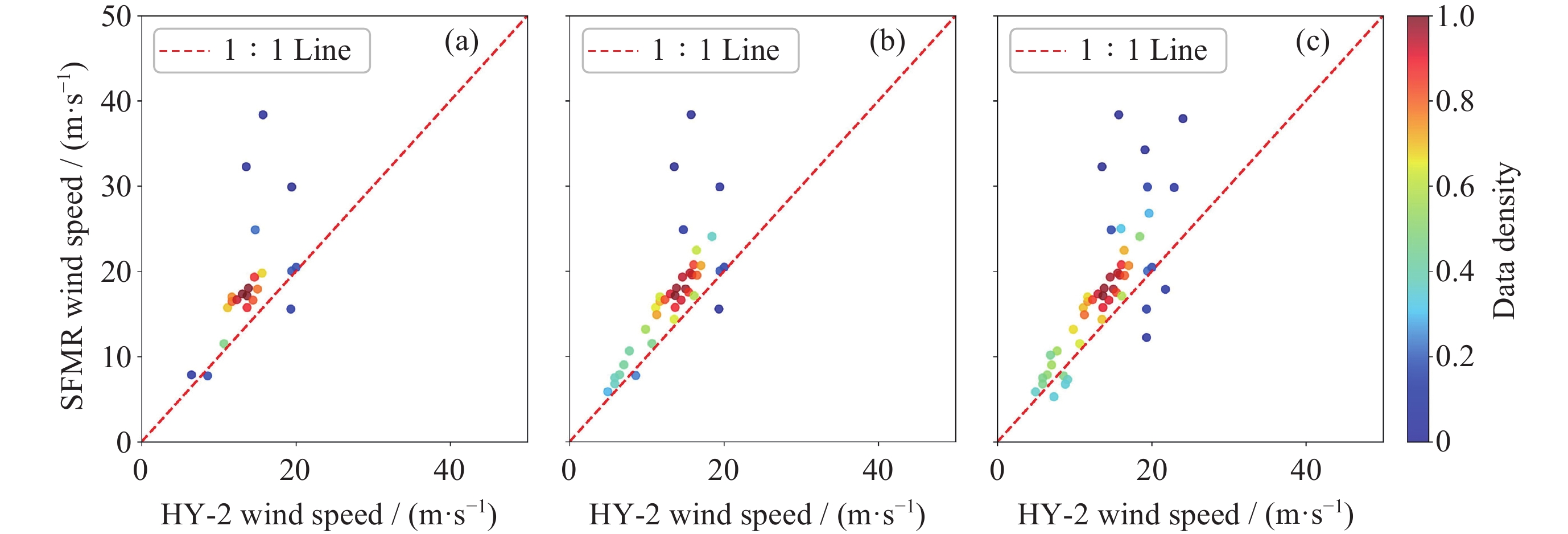
图 2 不同SFMR分辨率下的HY-2B微波散射计风速与SFMR的时空匹配散点密度. (a) SFMR分辨率为1 km, (b) SFMR分辨率为10 km, (c) SFMR分辨率为25 km
Figure 2. Spatiotemporal matching point density distribution of wind speed between HY-2B microwave scatterometer and SFMR at various SFMR resolutions. (a) SFMR resolution is 1 km, (b) SFMR resolution is 10 km, (c) SFMR resolution is 25 km
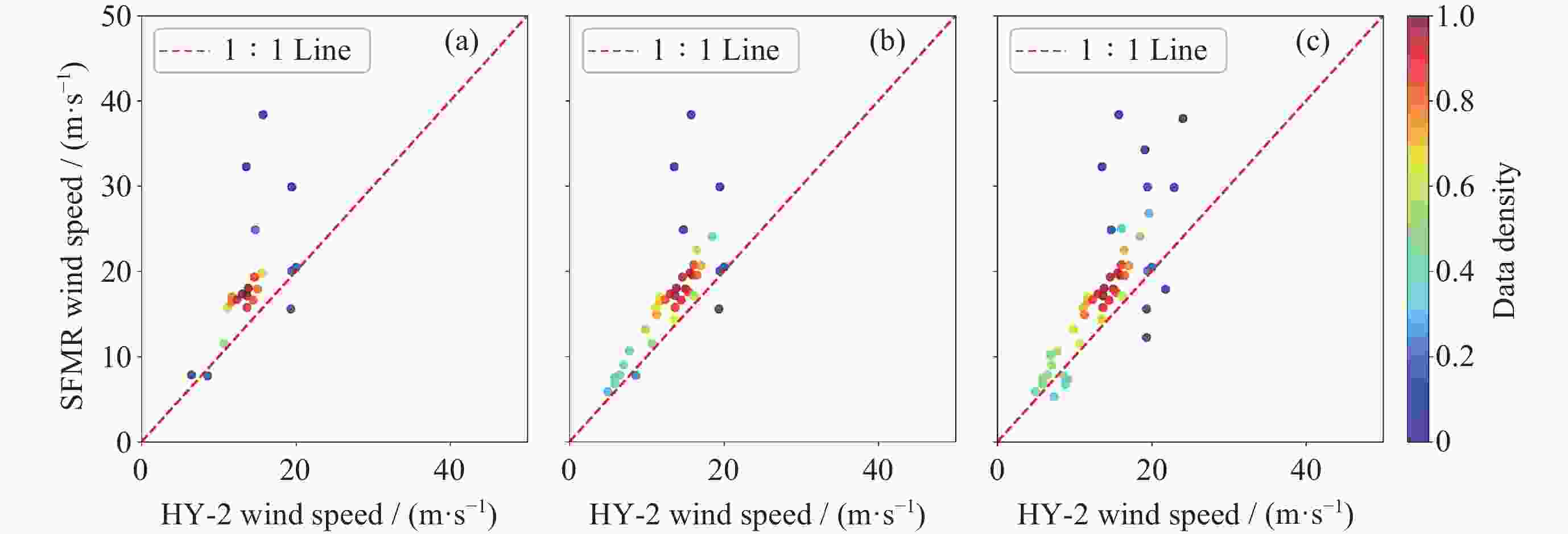
图 3 不同时间窗口下HY-2B微波散射计风速与SFMR的时空匹配散点密度. (a)时间窗口为1 h, (b)时间窗口为2 h, (c)时间窗口为3 h
Figure 3. Spatiotemporal matching point density distribution of wind speed between HY-2B microwave scatterometer and SFMR under different time windows. (a) 1-hour time window, (b) 2-hour time window, (c) 3-hour time window
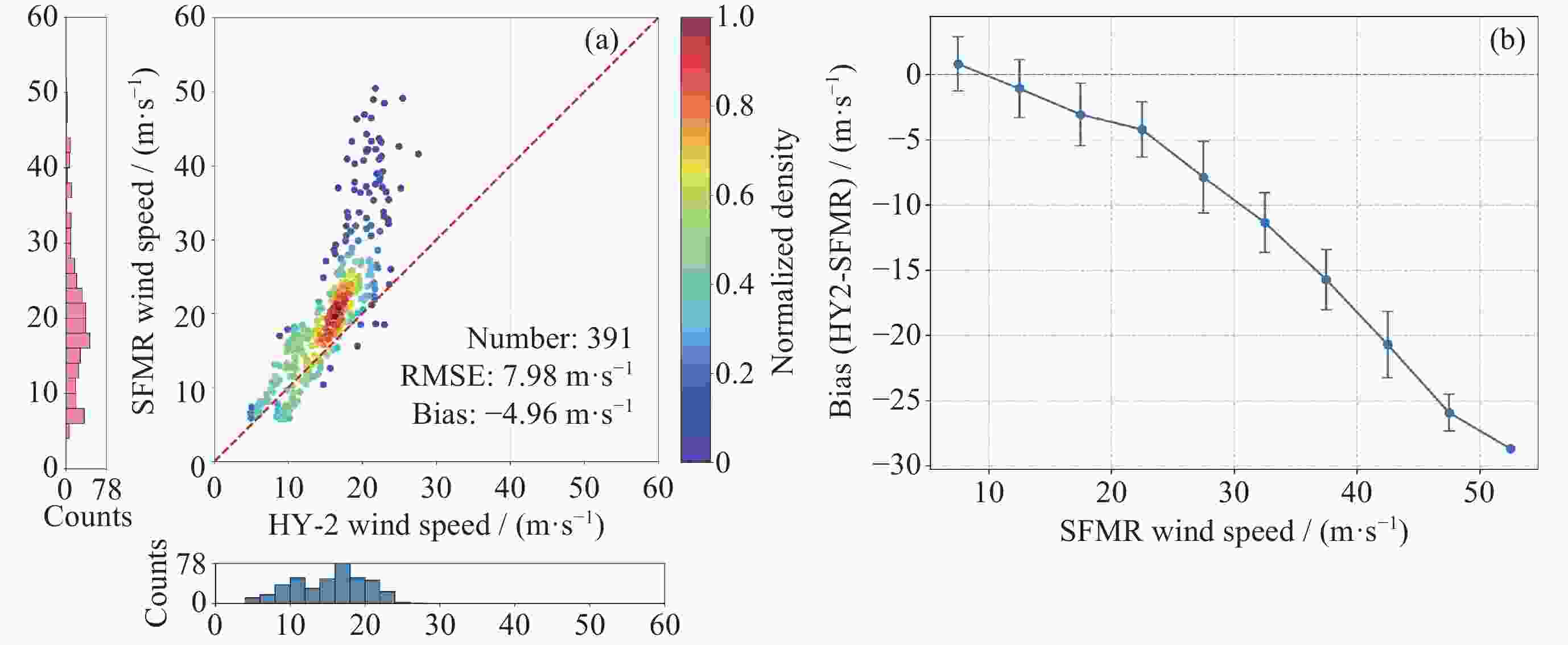
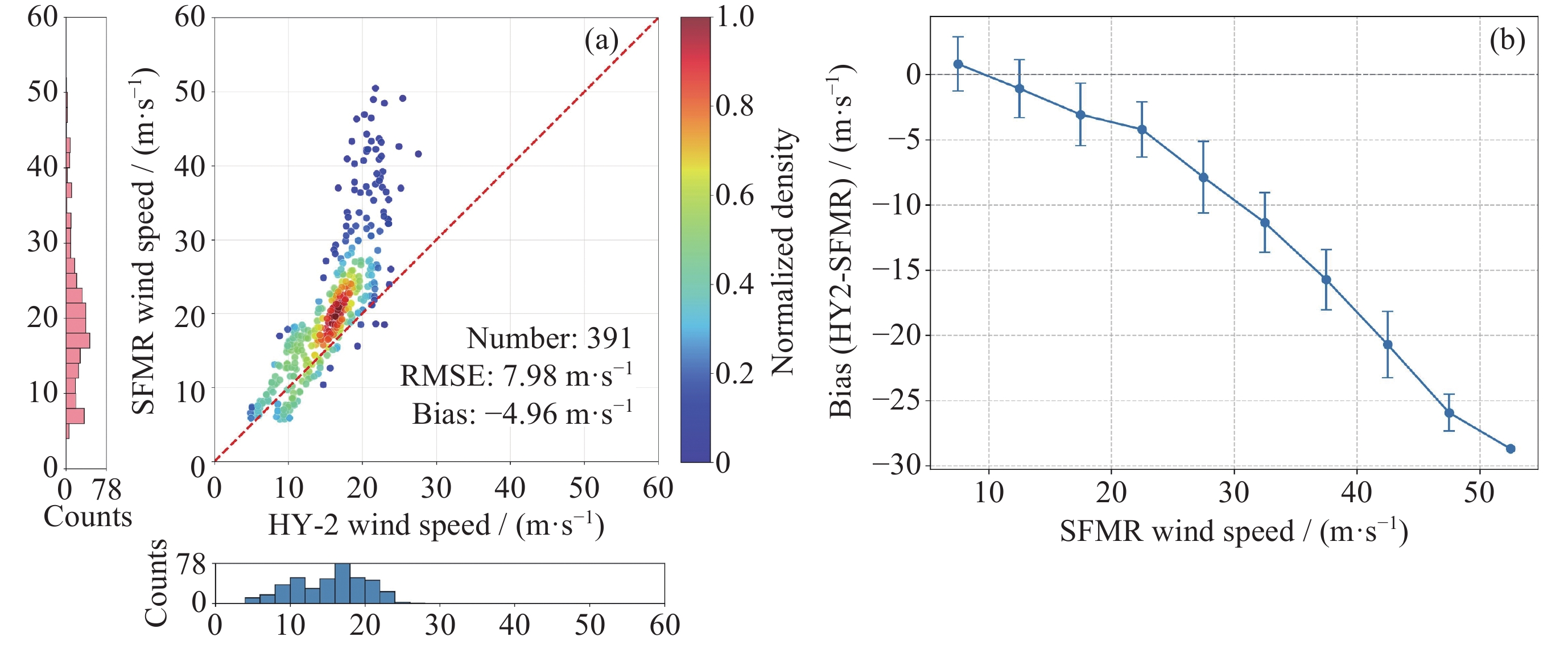
图 4 HY-2与SFMR风速的散点分布及二者风速差值变化趋势. (a) SFMR与HY-2时空匹配数据风速散点分布, (b)不同风速区间HY-2与SFMR风速差值分布
Figure 4. Scatter plot of wind speeds between HY-2 and SFMR, and the vatiation trend of the wind speed difference between them. (a) Scatter plot of wind speed distribution for SFMR and HY-2 spatiotemporal matching data, (b) distribution of wind speed difference between HY-2 and SFMR in different wind speed ranges
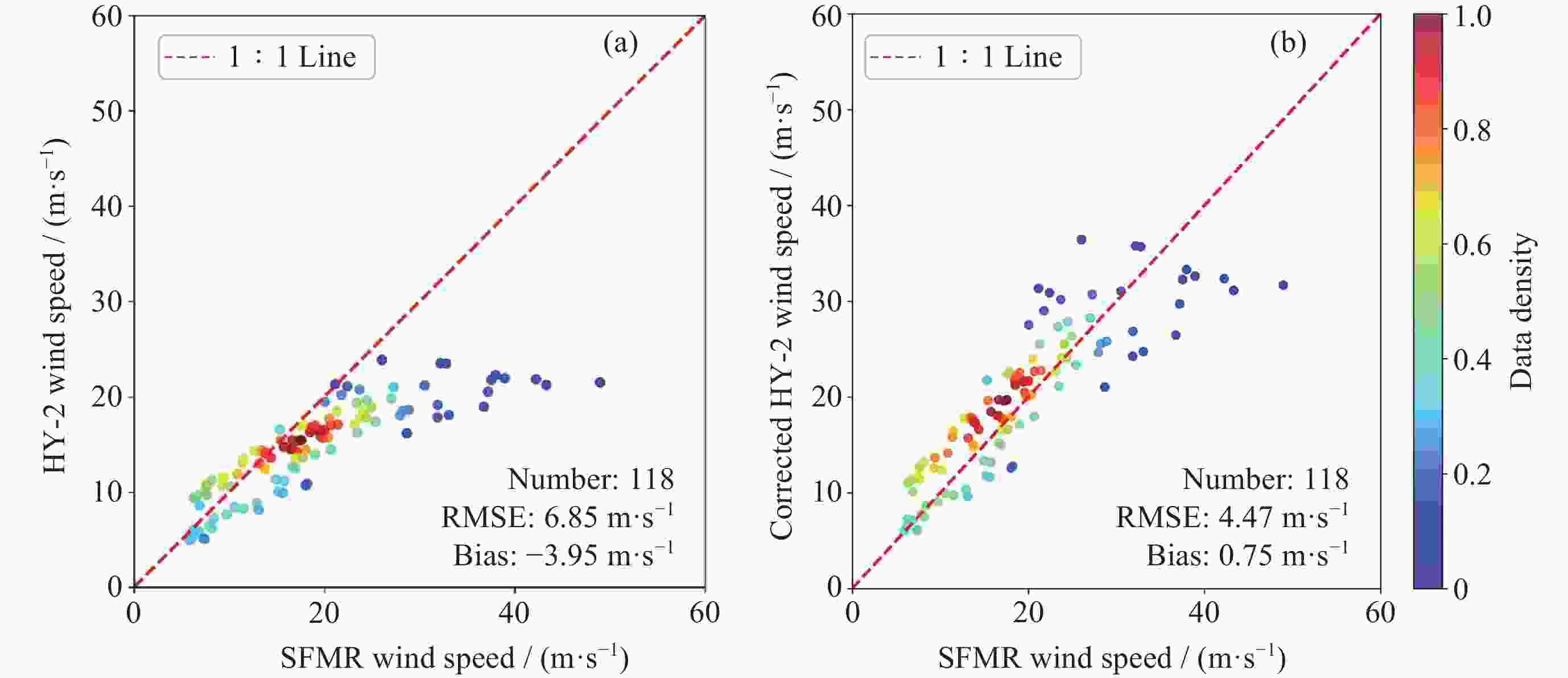
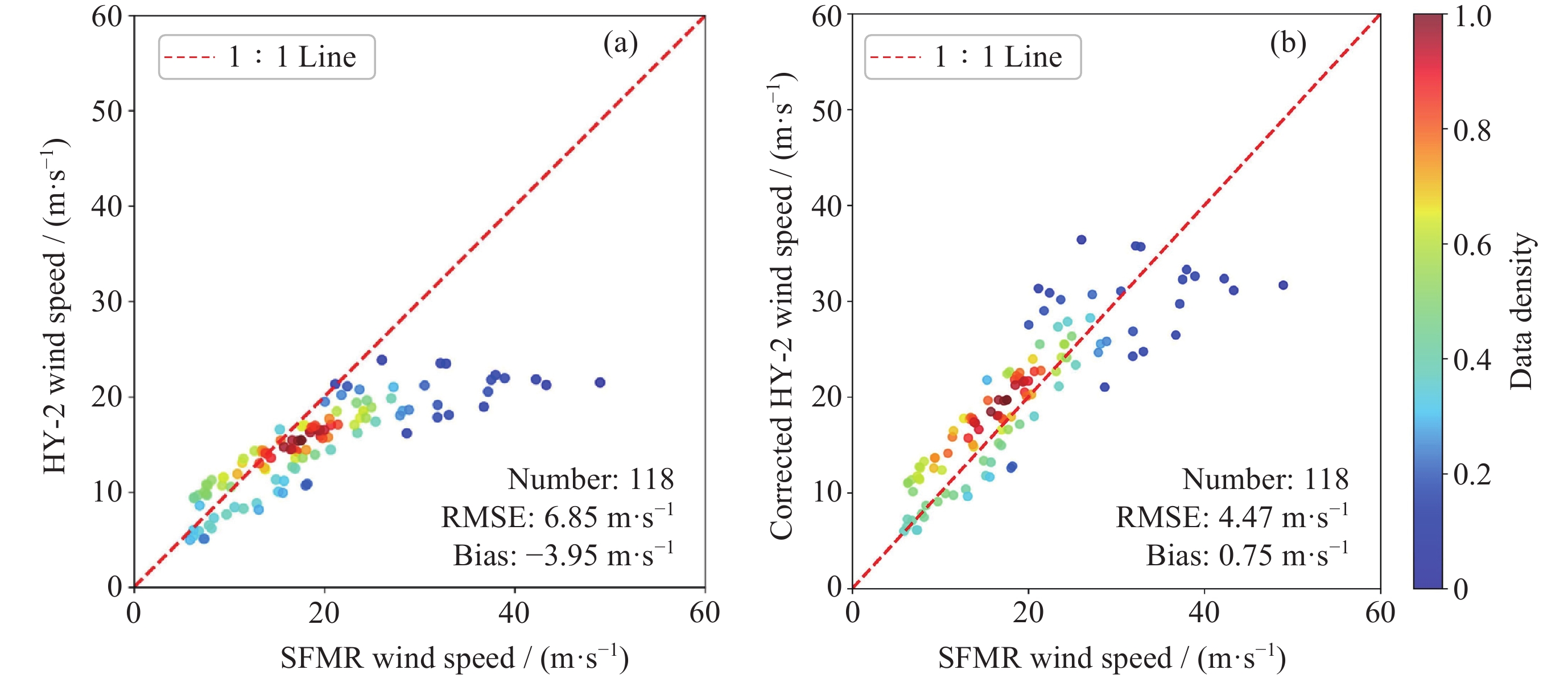
图 6 模型订正前后HY-2与SFMR风速值散点密度. (a)订正前, (b)订正后
Figure 6. Scatter density plot of HY-2 and SFMR wind speed. (a) Before model correction, (b) after model correction
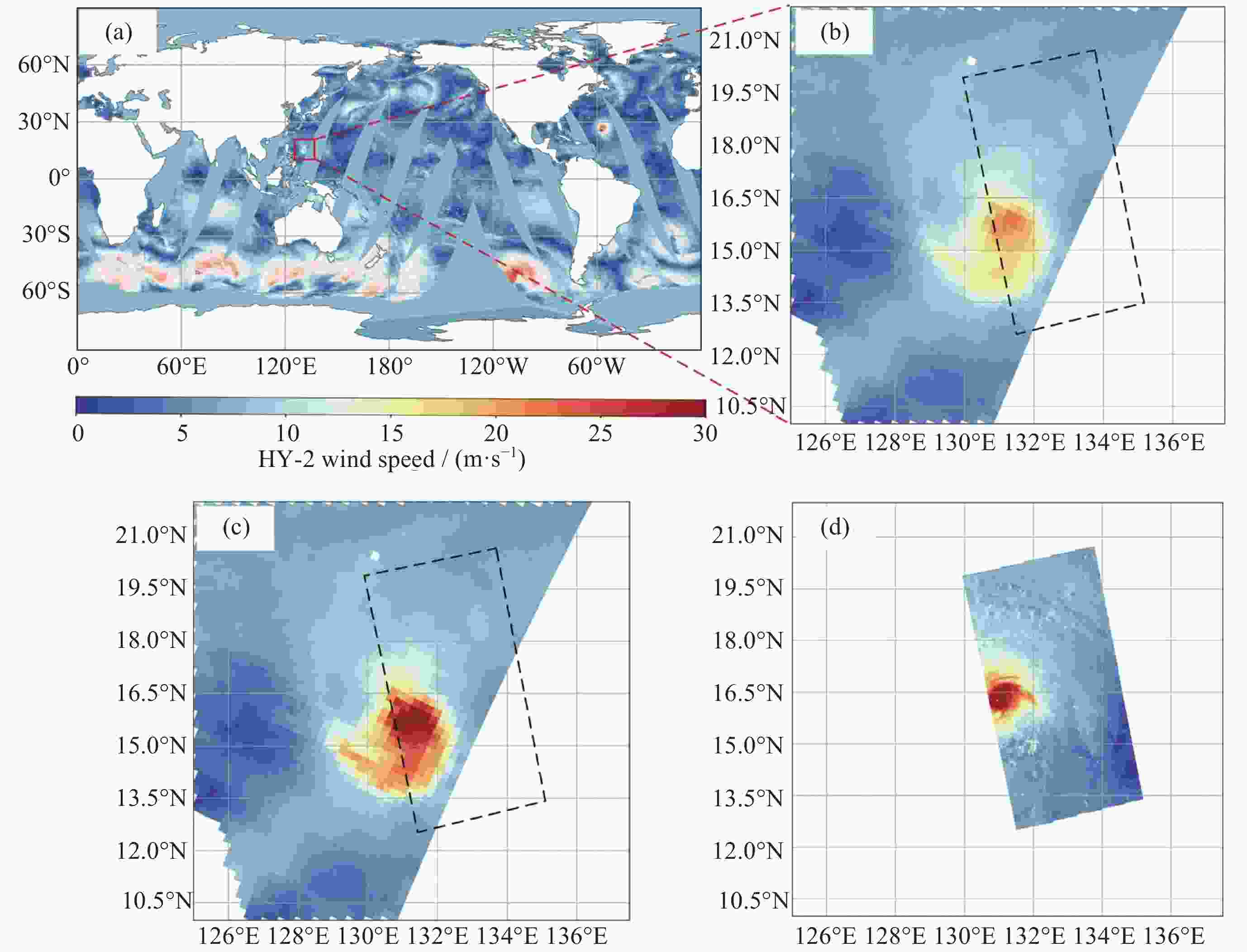
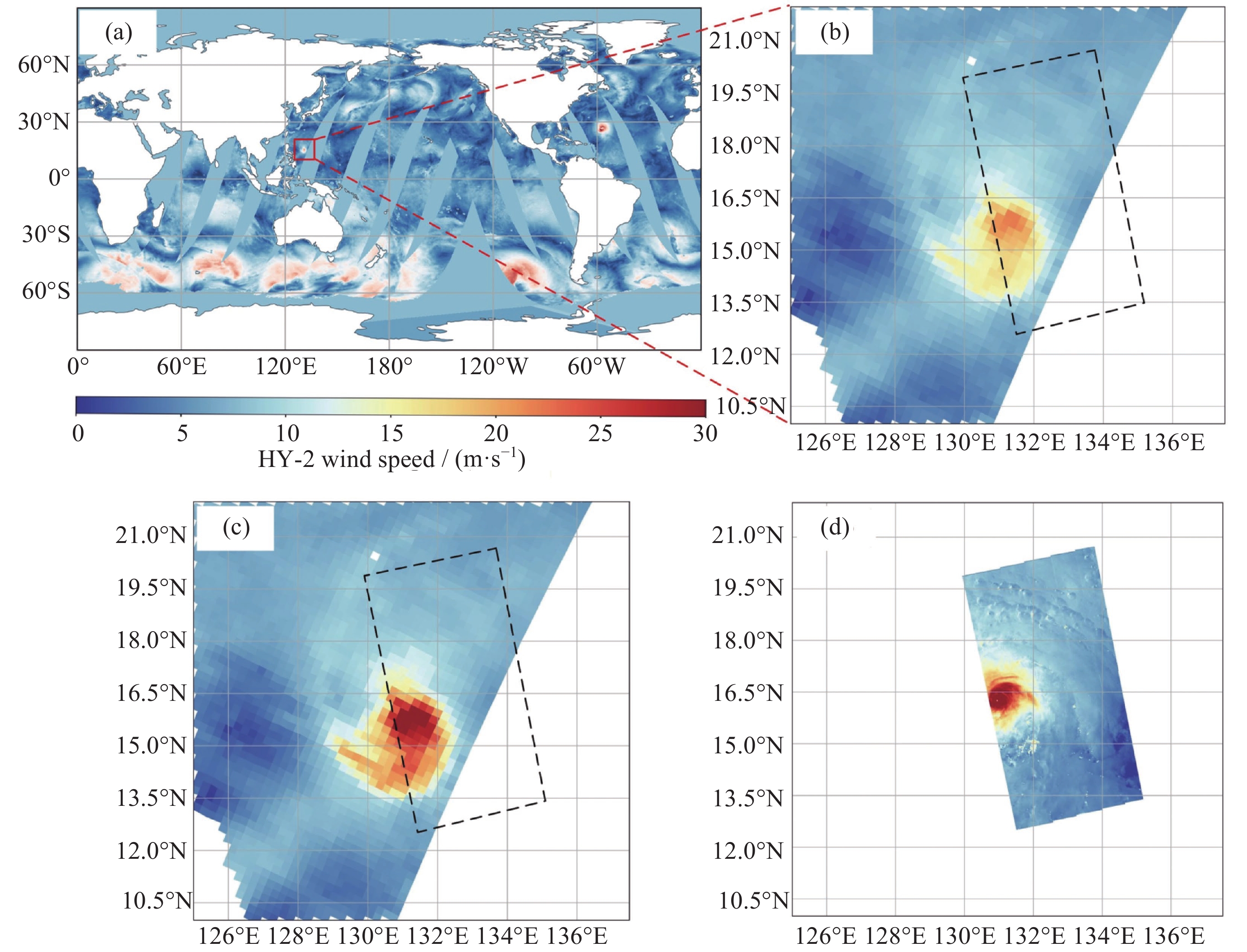
图 7 2021年9月8日HY-2C微波散射计和台风灿都的风速. (a) HY-2C微波散射计全球风速, (b) 08:36-08:39 UTC台风灿都风速, (c) 模型订正后HY-2微波散射计风速, (d) 09:17 UTC SAR反演风速
Figure 7. Wind speed of HY-2C microwave scatterometer and Typhoon Chanthu on 8 September 2021. (a) Global wind speed of HY-2C microwave scatterometer, (b) wind speed of Typhoon Chanthu at 08:36-08:39 UTC, (c) corrected HY-2 wind speed from microwave scatterometer, (d) SAR-derived wind speed at 09:17 UTC
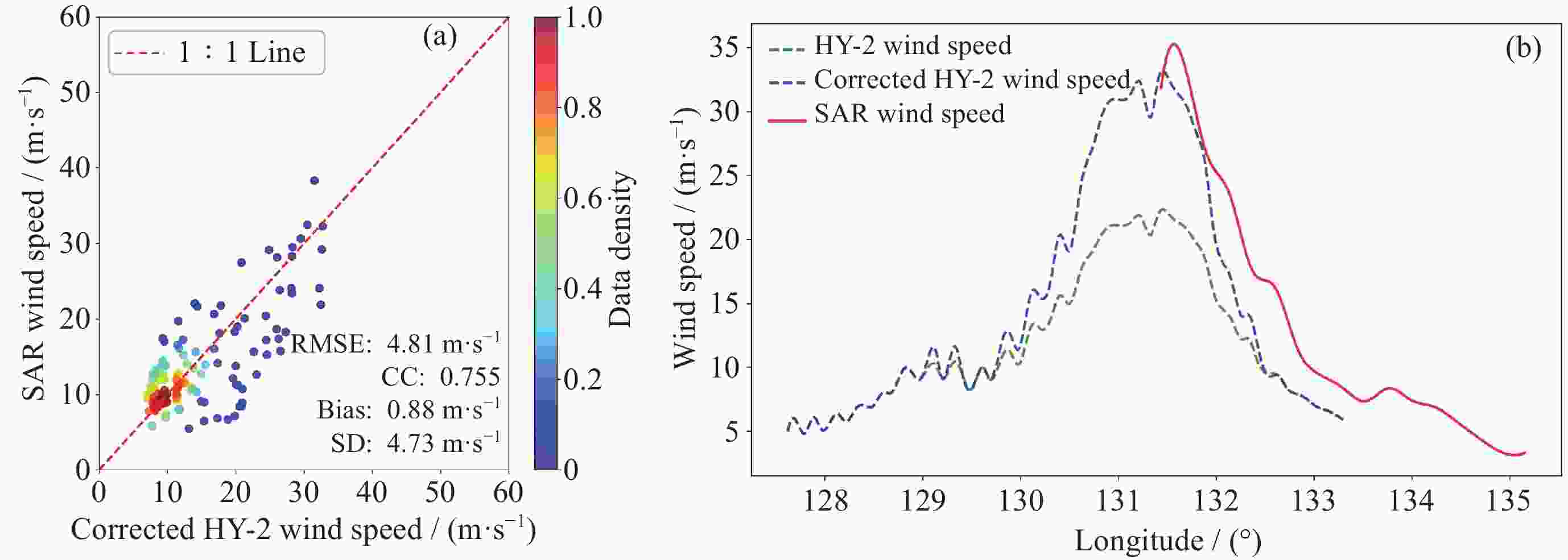
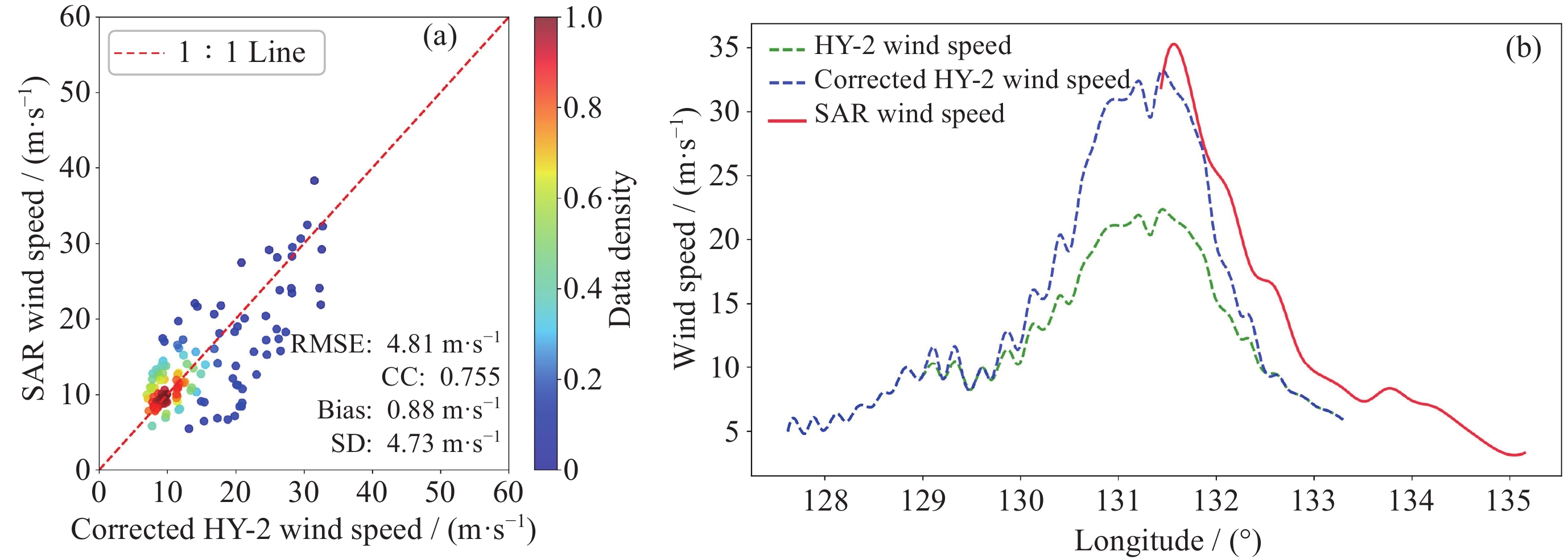
图 8 订正后HY-2与SAR风速散点 (a)及订正前后HY-2风速廓线与SAR风速廓线 (b)
Figure 8. Scatter plot of wind speed of corrected HY-2 and SAR (a). Wind speed profiles of HY-2 and SAR before and after correction (b)
表 1 HY-2系列微波散射计主要信息
Table 1. Main information of HY-2 series microwave scatterometer
卫星 散射计 在轨时间 波段 标称风速范围/(m·s–1) 轨道重访周期/d HY-2B HSCAT-B 2018-10至今 Ku 2~24 14 HY-2C HSCAT-C 2020-09至今 Ku 2~24 10 HY-2 D HSCAT-D 2021-05至今 Ku 2~24 10  下载: 导出CSV
表 2 飓风案例及对应的SFMR与HY-2卫星观测数据
Table 2. Hurricane cases and corresponding SFMR and HY-2 satellite observation data
台风名称 日期 HY-2数据源 HY-2观测时间 (UTC) SFMR观测时间段 (UTC) 道格拉斯 (Douglas) 2020-07-25 HY-2B 2020-07-25 03:20:00 2020-07-25 02:15:34-05:20:59 道格拉斯 (Douglas) 2020-07-26 HY-2B 2020-07-26 16:34:00 2020-07-26 16:04:10-18:34:59 萨利 (Sally) 2020-09-17 HY-2B 2020-09-17 21:45:00 2020-09-17 20:30:27-23:35:58 贝塔 (Beta) 2020-09-20 HY-2B 2020-09-20 00:16:00 2020-09-20 00:00:00-02:16:59 泰迪 (Teddy) 2020-09-21 HY-2B 2020-09-21 09:57:00 2020-09-21 07:57:01-11:57:59 泰迪 (Teddy) 2020-09-21 HY-2B 2020-09-21 21:33:00 2020-09-21 19:33:00-23:33:59 德尔塔 (Delta) 2020-10-08 HY-2B 2020-10-08 00:00:00 2020-10-08 00:00:00-02:00:59 德尔塔 (Delta) 2020-10-08 HY-2B 2020-10-08 12:49:00 2020-10-08 10:49:00-14:49:59 拉里 (Larry) 2021-09-07 HY-2C 2021-09-07 20:30:00 2021-09-07 18:30:00-22:30:59 山姆 (Sam) 2021-09-27 HY-2C 2021-09-27 15:52:00 2021-09-27 15:22:22-17:52:59
下载: 导出CSV
表 3 模型订正前后各风速区间指标统计结果
Table 3. Statistical results of metrics for each wind speed interval before and after model correction
风速区间/(m·s–1) RMSE/(m·s–1) CC SD/(m·s–1) 订正前 0~10 2.03 –0.07 1.98 10~25 3.76 0.77 2.44 > 25 13.27 0.24 5.25 订正后 0~10 2.67 –0.06 1.95 10~25 3.84 0.76 3.70 > 25 6.76 0.25 6.07
下载: 导出CSV
-
[1] PANDEY R S, LIOU Y A. Typhoon strength rising in the past four decades[J]. Weather and Climate Extremes, 2022, 36: 100446 doi: 10.1016/j.wace.2022.100446 [2] MORI N, TAKEMI T. Impact assessment of coastal hazards due to future changes of tropical cyclones in the North Pacific Ocean[J]. Weather and Climate Extremes, 2015, 11: 53-69 [3] WU C, GRAF J, FREILICH M, et al. The SeaWinds scatterometer instrument[C]//Proceedings of IGARSS'94-1994 IEEE International Geoscience and Remote Sensing Symposium. Pasadena: IEEE, 1994: 1511-1515 [4] YANG J G, ZHANG J. Evaluation of ISS-RapidScat wind vectors using buoys and ASCAT data[J]. Remote Sensing, 2018, 10(4): 648 doi: 10.3390/rs10040648 [5] SAF O S I, Team E W. ASCAT wind product user manual[J]. Version, 2019, 1: 23. [6] SHIBATA A. AMSR/AMSR-E algorithm development and data distribution[C]//Proceedings of the IGARSS 2000. IEEE 2000 International Geoscience and Remote Sensing Symposium. Taking the Pulse of the Planet: The Role of Remote Sensing in Managing the Environment. Proceedings (Cat. No. 00CH37120). Honolulu: IEEE, 2000: 59-61 [7] BORMANN N, DUNCAN D, ENGLISH S, et al. Growing operational use of FY-3 data in the ECMWF system[J]. Advances in Atmospheric Sciences, 2021, 38(8): 1285-1298 doi: 10.1007/s00376-020-0207-3 [8] LI X Z, LIN W M, LIU B C, et al. Sea surface wind retrieval using the combined scatterometer and altimeter backscatter measurements of the HY-2B satellite[J]. IEEE Transactions on Geoscience and Remote Sensing, 2022, 60: 5101312 doi: 10.1109/tgrs.2021.3065663 [9] ZOU J H, ZENG T, CUI S X. A high wind geophysical model fuction for QuikSCAT wind retrievals and application to Typhoon IOKE[J]. Acta Oceanologica Sinica, 2015, 34(7): 65-73 doi: 10.1007/s13131-015-0698-4 [10] STOFFELEN A, ANDERSON D. Scatterometer data interpretation: measurement space and inversion[J]. Journal of Atmospheric and Oceanic Technology, 1997, 14(6): 1298-1313 doi: 10.1175/1520-0426(1997)014<1298:sdimsa>2.0.co;2 [11] WENTZ F J, SMITH D K. A model function for the ocean-normalized radar cross section at 14 GHz derived from NSCAT observations[J]. Journal of Geophysical Research: Oceans, 1999, 104(C5): 11499-11514 doi: 10.1029/98JC02148 [12] FREILICH M H, DUNBAR R S. The accuracy of the NSCAT 1 vector winds: comparisons with National Data Buoy Center buoys[J]. Journal of Geophysical Research: Oceans, 1999, 104(C5): 11231-11246 doi: 10.1029/1998JC900091 [13] BOURASSA M A, LEGLER D M, O’BRIEN J J, et al. SeaWinds validation with research vessels[J]. Journal of Geophysical Research: Oceans, 2003, 108(C2): 3019 doi: 10.1029/2001jc001028 [14] POLVERARI F, PORTABELLA M, LIN W M, et al. On high and extreme wind calibration using ASCAT[J]. IEEE Transactions on Geoscience and Remote Sensing, 2022, 60: 4202210 [15] 兰友国, 郎姝燕, 林明森, 等. 海洋二号卫星A星微波散射计在台风遥感监测中的应用[J]. 卫星应用, 2018(5): 40-42LAN Youguo, LANG Shuyan, LIN Mingsen, et al. Application of the Scatterometer on board the HY-2A satellite in typhoon remote sensing monitoring[J]. Satellite Application, 2018(5): 40-42 [16] 杨典, 宋清涛, 蒋兴伟, 等. 基于散射计风场数据的台风强度诊断方法——以海洋二号卫星数据为例[J]. 海洋学报, 2019, 41(1): 151-159YANG Dian, SONG Qingtao, JIANG Xingwei, et al. A typhoon intensity estimation technique based on scatterometer winds observed from the HY-2 satellite[J]. Acta Oceanologica Sinica, 2019, 41(1): 151-159 [17] 刘思琦, 林文明, 王志雄, 等. 基于HY-2B散射计的热带气旋定位定强研究[J]. 海洋学报, 2021, 43(11): 146-156LIU Siqi, LIN Wenming, WANG Zhixiong, et al. Determination of tropical cyclone location and intensity using HY-2B scatterometer data[J]. Acta Oceanologica Sinica, 2021, 43(11): 146-156 [18] 王婧. HY-2A卫星微波散射计高风速海面风场反演模型研究[D]. 广州: 广州大学, 2017: 1314WANG Jing. A study of HY-2A Satellite Microwave Scatterometer Sea-surface High-wind Field Retrieval Model[D]. Guangzhou: Guangzhou University, 2017: 1314 [19] 金铸钰. 基于CCMP的海面风场特征分析与风速订正方法研究[D]. 北京: 国家海洋环境预报中心, 2022JIN Zhuyu. CCMP-Based Analysis of Sea Surface Wind Field Characteristics and Wind Speed Correction Techniques[D]. Beijing: National Marine Environmental Forecasting Center, 2022 [20] 吕思睿. 多源卫星海面风场融合研究[D]. 南京: 南京信息工程大学, 2023LYU Sirui. Research on Multi-source Satellite Sea Surface Wind Field Fusion[D]. Nanjing: Nanjing University of Information Science and Technology, 2023 [21] KONG Y, WANG X S, CHENG Y H, et al. Hyperspectral imagery classification based on semi-supervised broad learning system[J]. Remote Sensing, 2018, 10(5): 685 doi: 10.3390/rs10050685 [22] LIU D, BALDI S, YU W W, et al. On training traffic predictors via broad learning structures: a benchmark study[J]. IEEE Transactions on Systems, Man, and Cybernetics: Systems, 2022, 52(2): 749-758 doi: 10.1109/TSMC.2020.3006124 [23] KUOK S C, YUEN K V. Broad learning for nonparametric spatial modeling with application to seismic attenuation[J]. Computer-Aided Civil and Infrastructure Engineering, 2020, 35(3): 203-218 doi: 10.1111/mice.12494 [24] KUOK S C, YUEN K V. Broad learning system for nonparametric modeling of clay parameters[J]. ASCE-ASME Journal of Risk and Uncertainty in Engineering Systems, Part A: Civil Engineering, 2020, 6(2): 04020024 doi: 10.1061/ajrua6.0001066 [25] 夏静, 汪胜, 杨晓峰, 等. 宽度学习系统的SAR影像海面强降雨智能检测研究[J]. 遥感学报, 2023, 27(7): 1605-1614XIA Jing, WANG Sheng, YANG Xiaofeng, et al. Intelligent detection of rain cells with SAR imagery based on broad learning system[J]. National Remote Sensing Bulletin, 2023, 27(7): 1605-1614 [26] ZHANG Y, YUEN K V. Crack detection using fusion features-based broad learning system and image processing[J]. Computer-Aided Civil and Infrastructure Engineering, 2021, 36(12): 1568-1584 doi: 10.1111/mice.12753 [27] WANG S, YUEN K V, YANG X F, et al. Tropical cyclogenesis detection from remotely sensed sea surface winds using graphical and statistical features-based broad learning system[J]. IEEE Transactions on Geoscience and Remote Sensing, 2023, 61: 4203815 doi: 10.1109/tgrs.2023.3266814 [28] MOUCHE A A, CHAPRON B, ZHANG B, et al. Combined Co- and cross-polarized SAR measurements under extreme wind conditions[J]. IEEE Transactions on Geoscience and Remote Sensing, 2017, 55(12): 6746-6755 doi: 10.1109/TGRS.2017.2732508 [29] MOUCHE A, CHAPRON B, KNAFF J, et al. Copolarized and cross-polarized SAR measurements for high-resolution description of major hurricane wind structures: application to Irma category 5 hurricane[J]. Journal of Geophysical Research: Oceans, 2019, 124(6): 3905-3922 [30] UHLHORN E W, BLACK P G, FRANKLIN J L, et al. Hurricane surface wind measurements from an operational stepped frequency microwave radiometer[J]. Monthly Weather Review, 2007, 135(9): 3070-3085 doi: 10.1175/MWR3454.1 [31] SAPP J W, ALSWEISS S O, JELENAK Z, et al. Stepped frequency microwave radiometer wind-speed retrieval improvements[J]. Remote Sensing, 2019, 11(3): 214 doi: 10.3390/rs11030214 [32] UHLHORN E W, BLACK P G. Verification of remotely sensed sea surface winds in hurricanes[J]. Journal of Atmospheric and Oceanic Technology, 2003, 20(1): 99-116 doi: 10.1175/1520-0426(2003)020<0099:VORSSS>2.0.CO;2 [33] KNAFF J A, SAMPSON C R, KUCAS M E, et al. Estimating tropical cyclone surface winds: current status, emerging technologies, historical evolution, and a look to the future[J]. Tropical Cyclone Research and Review, 2021, 10(3): 125-150 doi: 10.1016/j.tcrr.2021.09.002 [34] ZHANG G S, LI X F, PERRIE W, et al. A hurricane wind speed retrieval model for C-band RADARSAT-2 cross-polarization ScanSAR images[J]. IEEE Transactions on Geoscience and Remote Sensing, 2017, 55(8): 4766-4774 doi: 10.1109/TGRS.2017.2699622 [35] WANG S, YUEN K V, YANG X F, et al. A nonparametric tropical cyclone wind speed estimation model based on dual-polarization SAR observations[J]. IEEE Transactions on Geoscience and Remote Sensing, 2022, 60: 4208213 doi: 10.1109/tgrs.2022.3188328 [36] ROY C, KOVORDÁNYI R. Tropical cyclone track forecasting techniques—a review[J]. Atmospheric Research, 2012, 104-105: 40-69 [37] WANG S, YANG X F, LI H Y, et al. An improved asymmetric hurricane parametric model based on cross-polarization SAR observations[J]. IEEE Journal of Selected Topics in Applied Earth Observations and Remote Sensing, 2021, 14: 1411-1422 doi: 10.1109/JSTARS.2020.3043246 -
-

 下载:
下载:

计量
- 文章访问数: 1503
- HTML全文浏览量: 758
- PDF下载量: 80
-
被引次数:
0(来源:Crossref)
0(来源:其他)

