


夜光云季起始时间的长期变化特征及其影响因素
doi: 10.11728/cjss2026.02.2025-0035 cstr: 32142.14.cjss.2025-0035
-
 孙韶阳 女, 硕士研究生, 研究方向为中高层大气动力学、夜光云物理等. E-mail: sunshaoyang@nuist.edu.cn
 -
 郜海阳 男, 1984年生, 工学博士, 南京信息工程大学大气物理学院教授, 硕士研究生导师, 主要研究方向为大气光学遥感仪器研发、夜光云物理等. E-mail: gaohy@nuist.edu.cn
作者简介:
通讯作者:
Long-term Variation Characteristics of the Onset of Polar Mesospheric Clouds Season and Its Influencing Factors
-
摘要: 夜光云作为形成于中高层(高度约83 km)大气的冰晶云, 其季节起始时间是研究极地中间层热力学与动力学耦合过程的重要参数. 基于1979-2023年多源观测数据, 系统分析了南北半球夜光云季节起始时间的长期演变特征, 并分析其与平流层纬向风场反转事件及太阳活动的相关性. 结果表明, 南北半球夜光云起始时间存在显著差异, 南半球的年际变幅(标准差22 d)约为北半球(11 d)的2倍, 这可能与半球间大气环流模态、重力波活动强度等热力和动力过程差异有关. 在南半球, 夜光云季起始时间与平流层纬向平均风的反转时间表现出极强的正相关关系; 对于北半球, 虽然呈现反相关特性, 但约60 d的相隔时间并不能直接判定二者的影响关系. 太阳活动(Lyman-α 辐射)对夜光云季节起始的调控也呈现半球不对称性, 北半球在2011年前与太阳活动呈一定的负相关, 后期因平流层动力背景转变而衰减, 南半球则表现为微弱响应, 表明太阳辐射效应与动力过程可能共同发挥作用. 此外, 多源数据在结果上的差异也表明, 不同探测体制和数据类型会对夜光云长期变化特性研究带来一定的不确定性.
-
关键词:
- 夜光云 /
- 季节开启 /
- 长期变化 /
- 平流层纬向平均风反转 /
- 太阳周期活动
Abstract: Polar Mesospheric Clouds (PMCs), as ice crystal clouds formed in the middle and upper atmosphere (approximately 83 km high), have a seasonal onset that serves as an important parameter for studying the coupling processes between thermodynamics and dynamics in the polar mesosphere. Based on multi-source observational data from 1979 to 2023, the long-term evolution characteristics of the onset of PMCs in both hemispheres are systematically analyzed, and their correlations with the reversal time of stratospheric zonal mean wind and solar activity are examined. Results show that there are significant differences in the onset of PMCs between the two hemispheres: the interannual variation (with a standard deviation of 22 d) in the southern hemisphere is about twice that in the northern hemisphere (11 d), which may be related to differences in thermal and dynamic processes such as inter-hemispheric circulation modes and the intensity of gravity wave activity. In the southern hemisphere, the onset of PMCs season exhibits a very strong positive correlation with the reversal time of the stratospheric zonal mean wind, while in the northern hemisphere, although a negative correlation is observed, the approximately 60-day difference does not directly indicate a causal relationship between the two. The regulation of the onset by solar activity (Lyman-α radiation) also shows hemispheric asymmetry. In the northern hemisphere, there was a certain negative correlation with solar activity before 2011 that later weakened due to changes in the stratospheric dynamic background, whereas the southern hemisphere exhibited only a weak response. This indicates that both solar radiation effects and dynamic processes may jointly contribute. In addition, the discrepancies among multi-source data suggest that differences in detection systems and data types can introduce uncertainties in studies of the long-term variation characteristics of PMCs. -
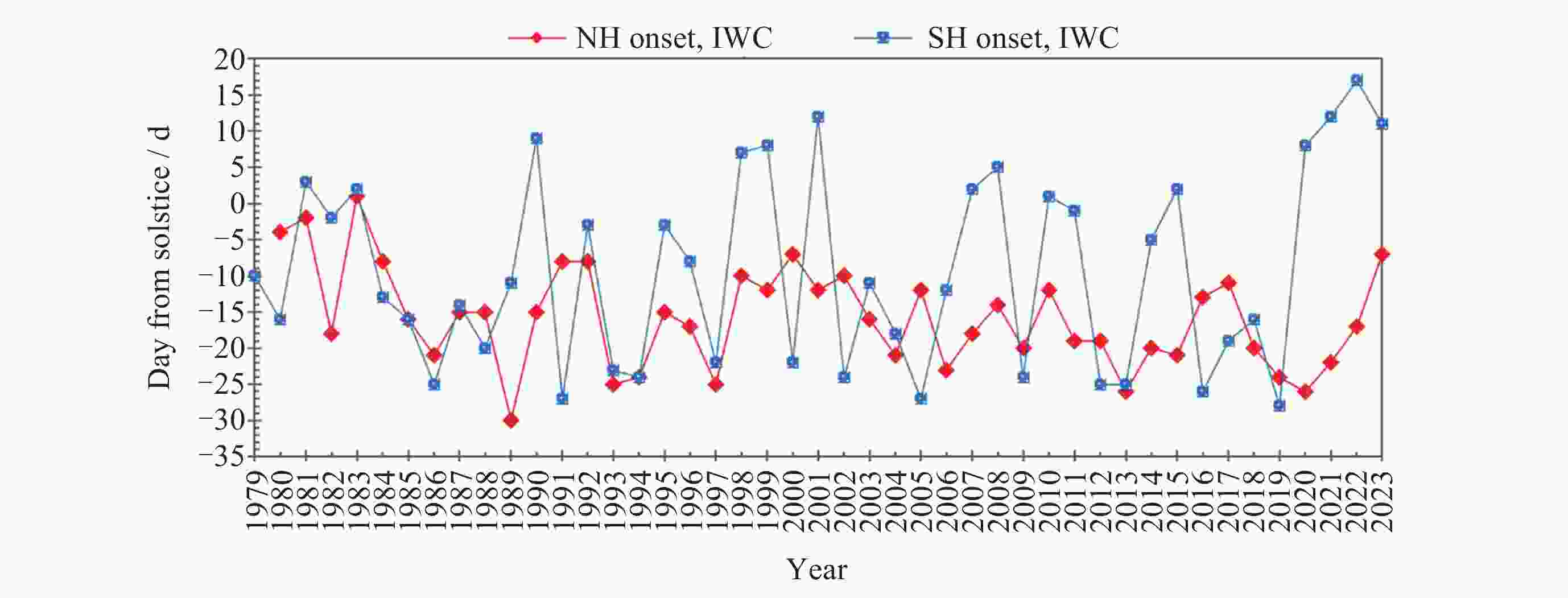
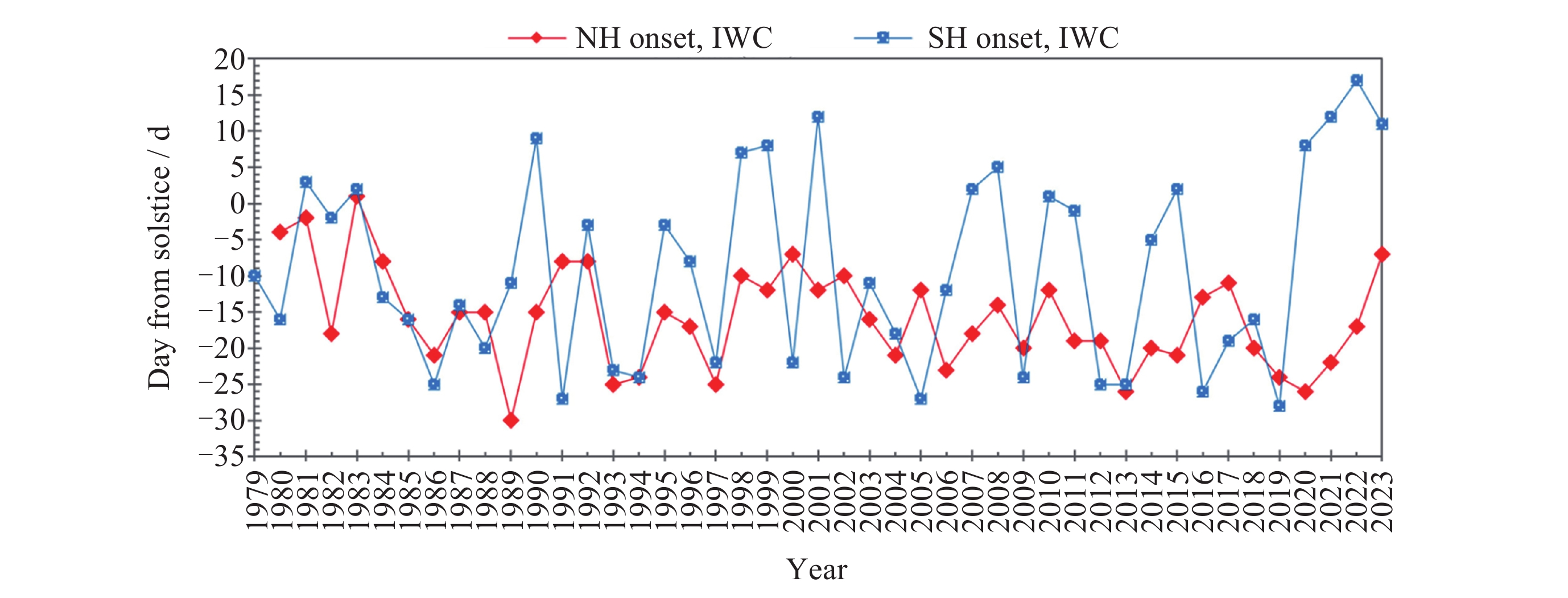
图 1 1979-2023年南北半球的夜光云季起始时间
Figure 1. Onset of PMC seasons from 1979 to 2023 in both Northern Hemispheres (NH) and Southern Hemispheres (SH), respectively
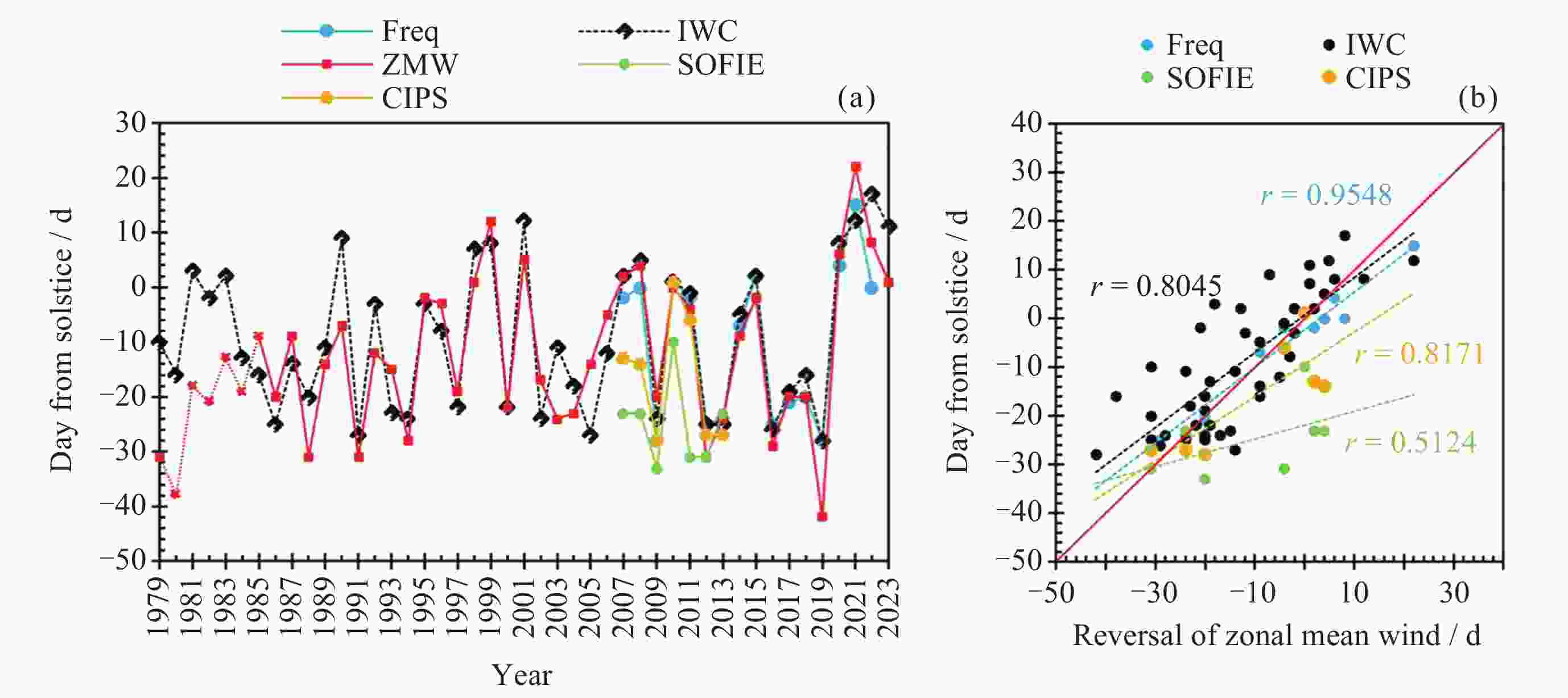
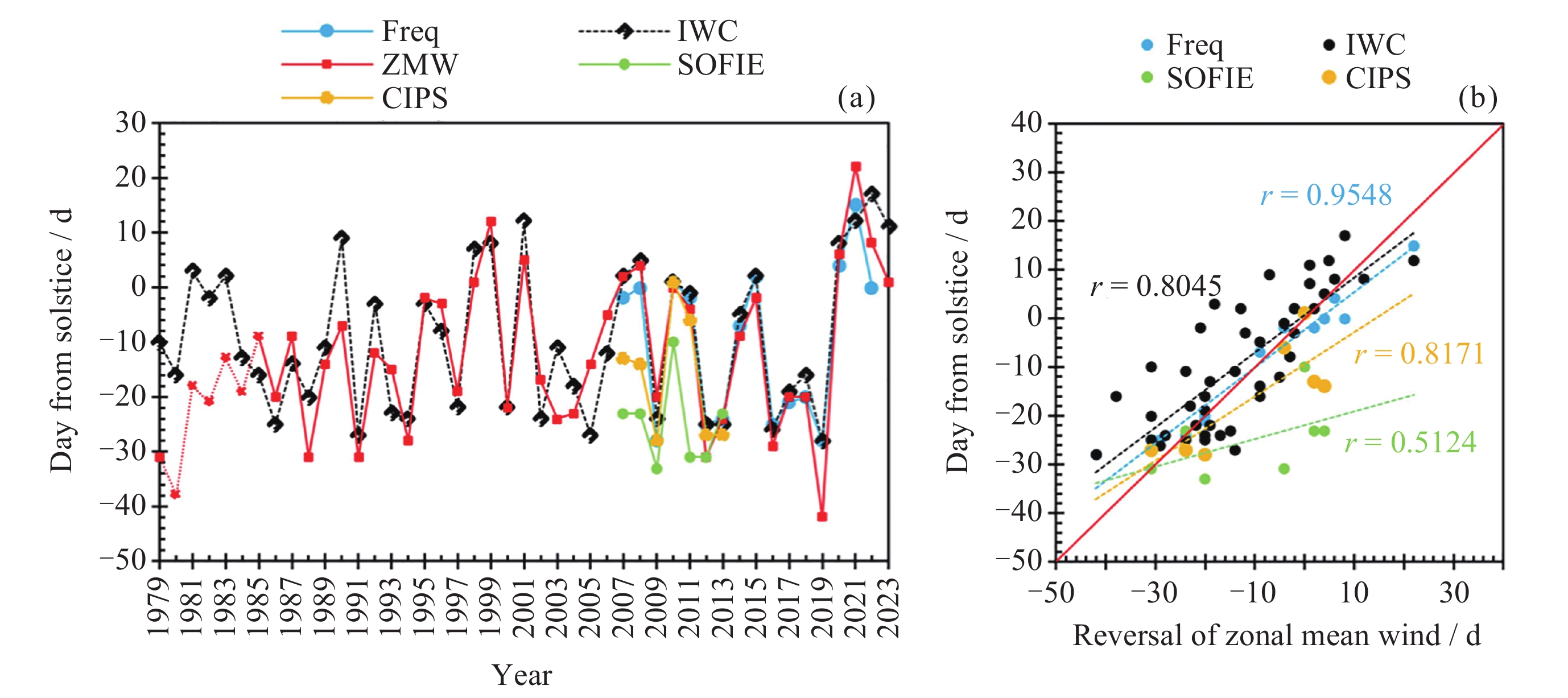
图 2 1979-2023年南半球夜光云季起始时间与纬向平均风的相关性. (a)季节起始时间与纬向平均风反转时间的年际变化, (b)季节起始时间与纬向平均风反转时间的相关性
Figure 2. Correlation between the onset of PMC seasons and the Zonal Mean Wind (ZMW) in the Southern Hemisphere (SH). (a) The interannual variation between the onset of PMC seasons and the reversal time of ZMW, (b) the correlation between them
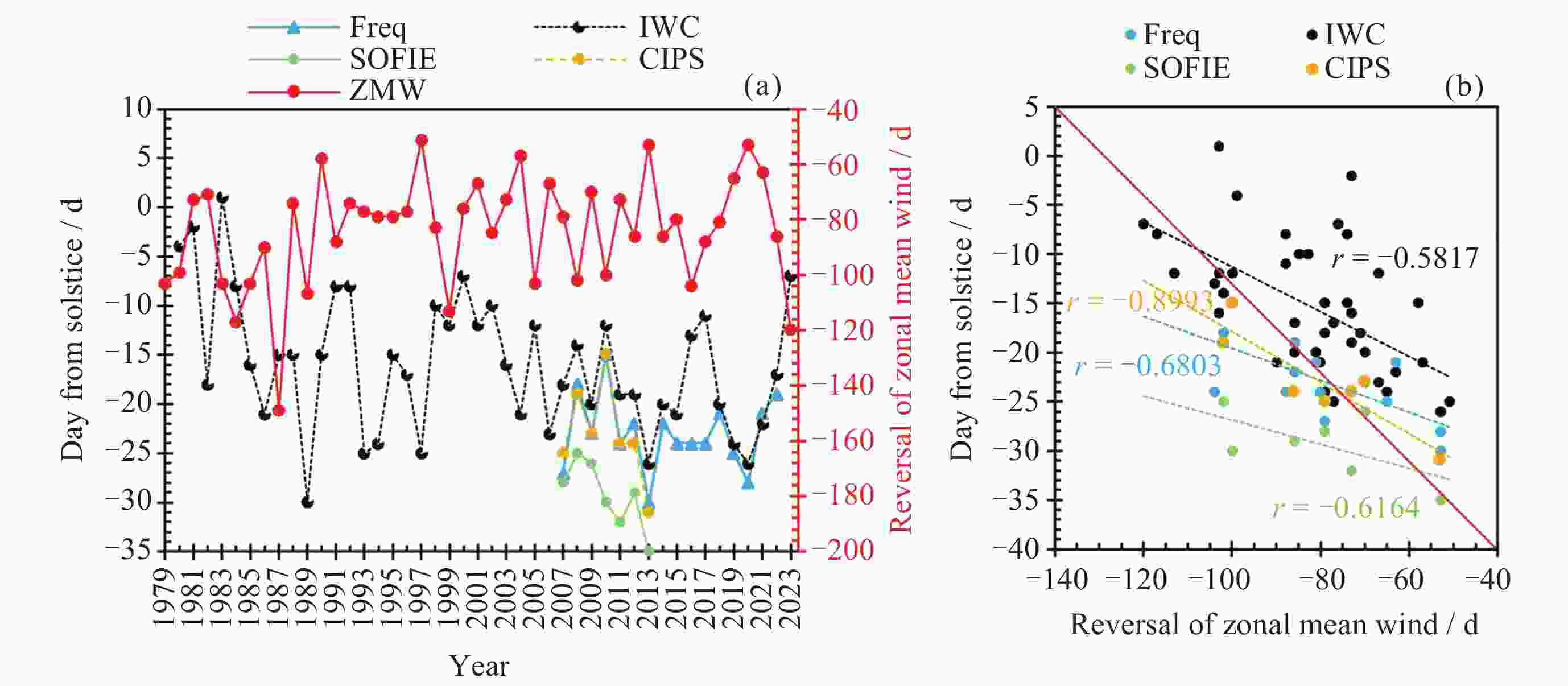
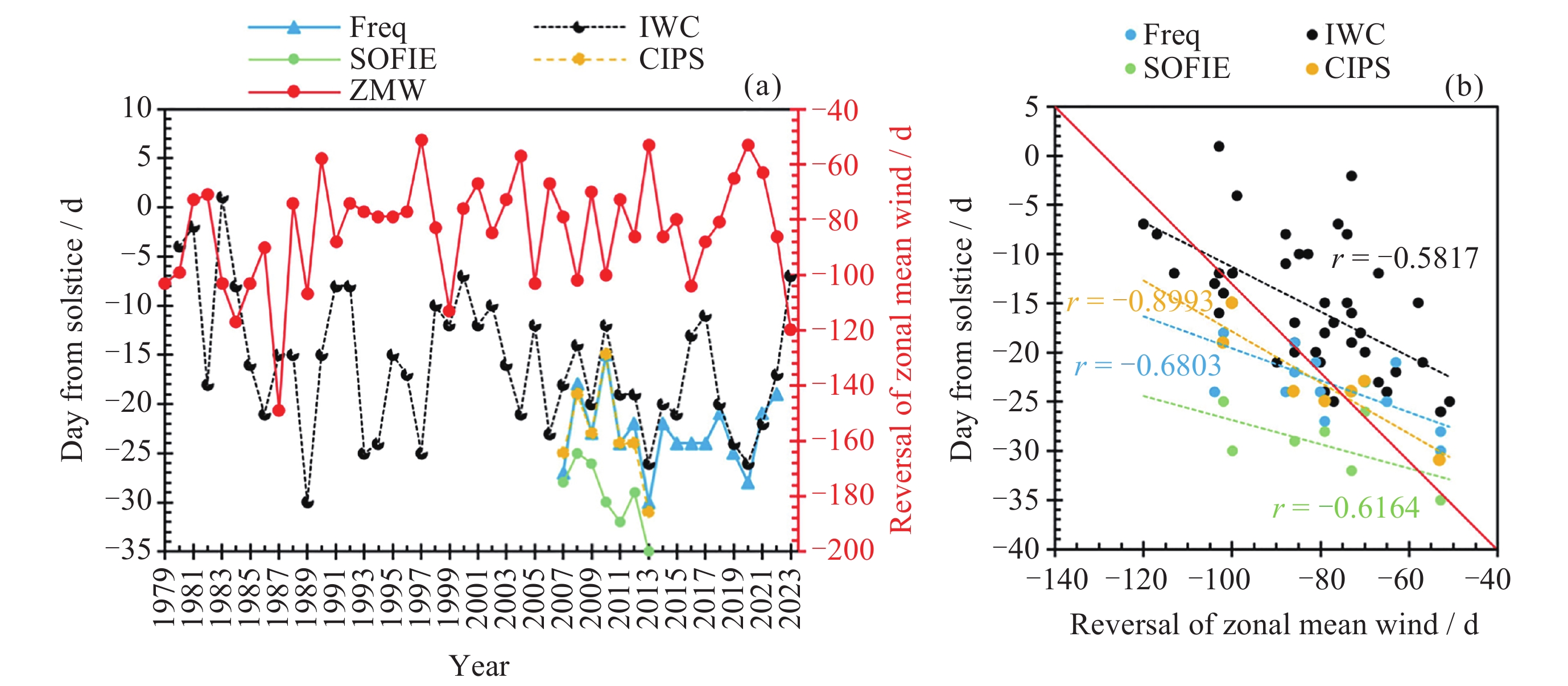
图 3 1979-2023年北半球夜光云季起始时间与纬向平均风的相关性. (a) 季节起始时间与纬向平均风反转时间的年际变化, (b) 表示季节起始时间与纬向平均风反转时间的相关性
Figure 3. Correlation between the onset of PMC seasons and the Zonal Mean Wind (ZMW) in the Northern Hemisphere (NH). (a) The interannual variation between the onset of PMC seasons and the reversal time of ZMW, (b) the correlation between them
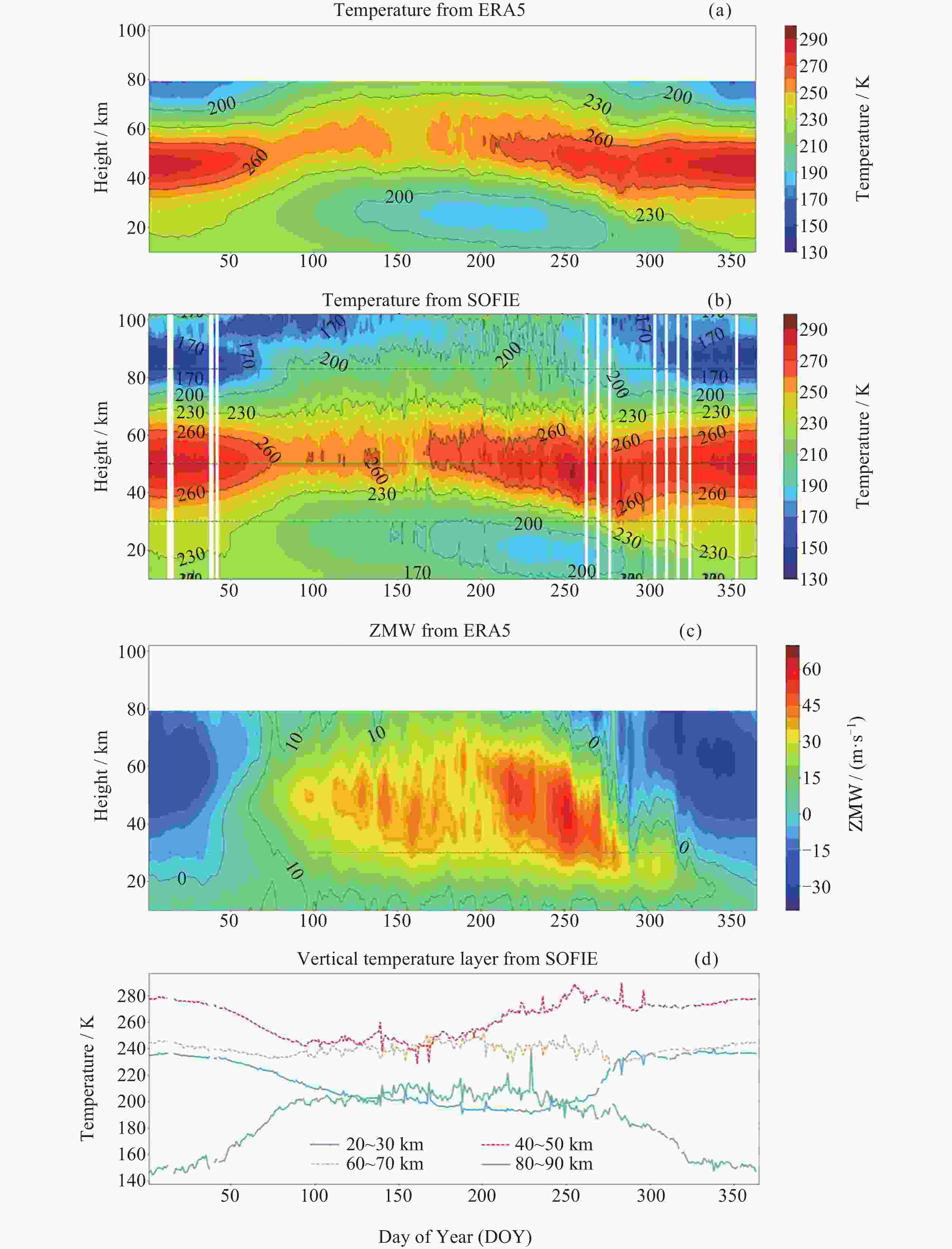
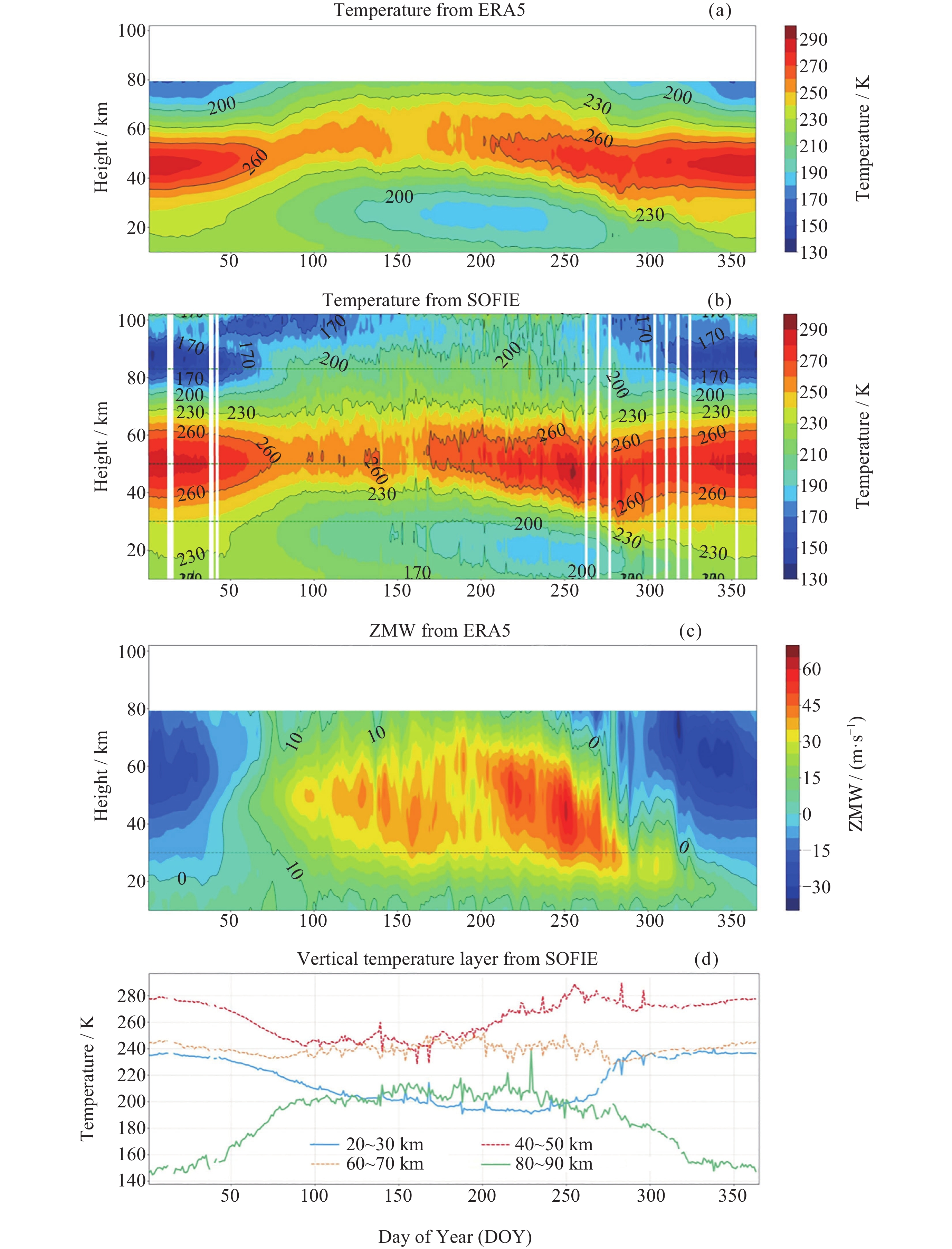
图 4 2009年南半球的温度与纬向平均风的时空分布. (a) 60°S-90°S纬度范围的ERA5平均温度场; (b) SOFIE每日平均温度数据, 纬度覆盖范围为64°S-82°S, ERA5与SOFIE二者可相互验证温度数据的可用性; (c) 60°S-90°S纬度范围的ERA5纬向平均风场; (d) SOFIE四个不同垂直高度层的温度廓线
Figure 4. Spatio-temporal distributions of temperature and zonal mean wind over the Southern Hemisphere during 2009. (a) Zonal mean temperature field from ERA5 reanalysis data within 60°S-90°S latitude. (b) Daily-averaged temperature observations from SOFIE, covering 64°S-82°S latitude. These two datasets enable cross-validation of temperature measurements. (c) ZMW field from ERA5 across 60°S-90°S latitude. (d) Vertical temperature profiles from SOFIE at four distinct altitude layers
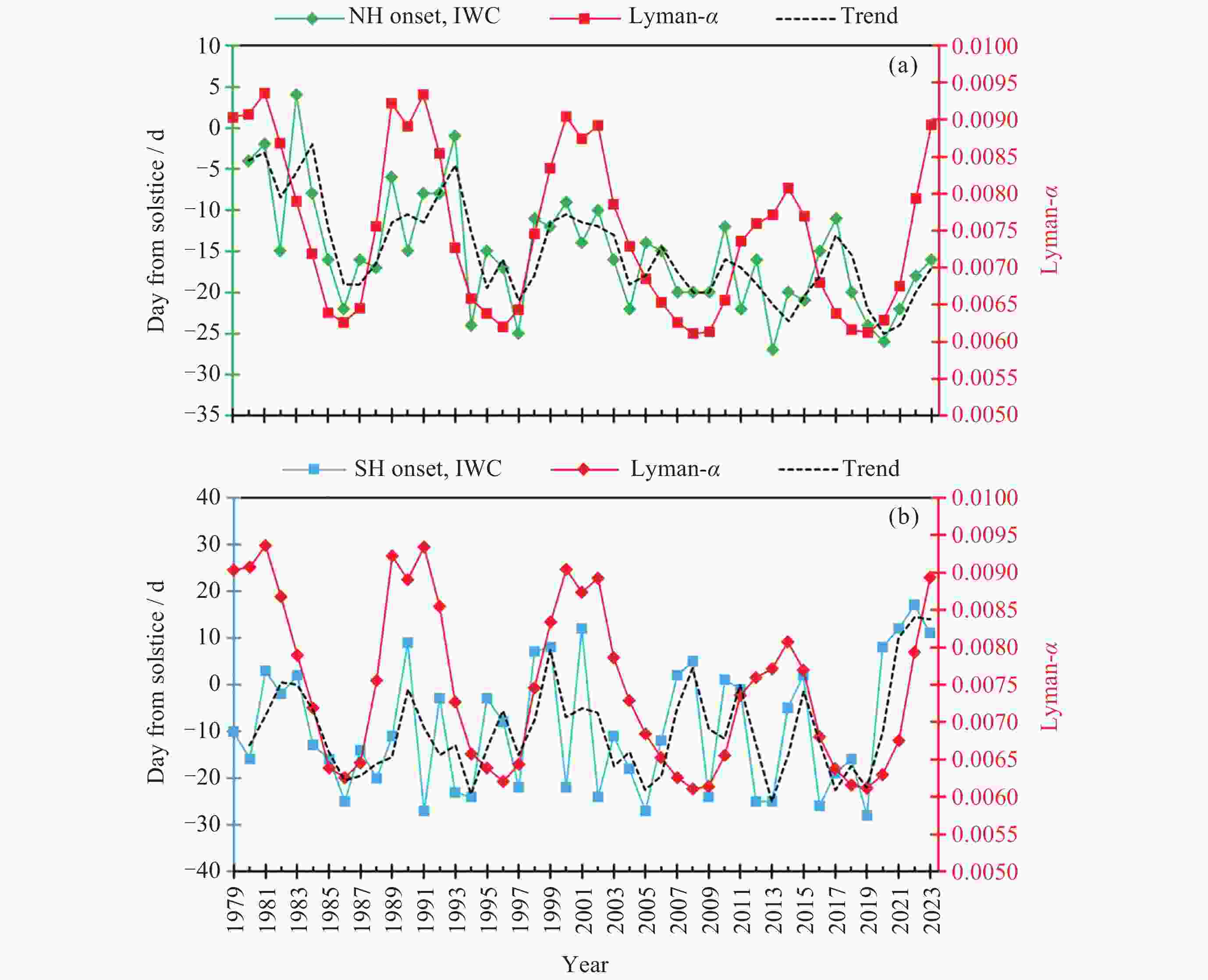
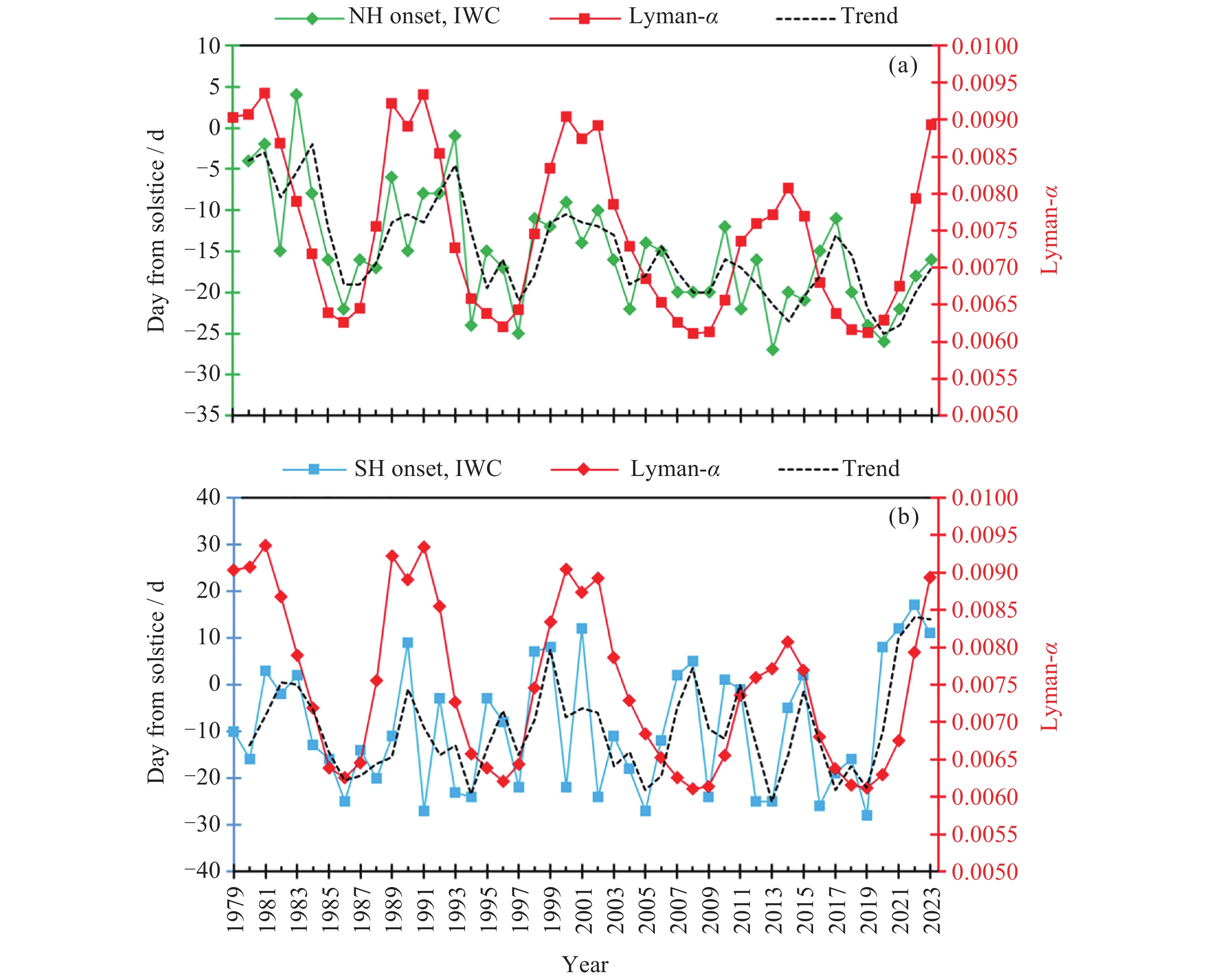
图 5 1979-2023年南北半球季节起始时间与太阳辐射的年际变化
Figure 5. Interannual variations of the onset of PMC seasons and solar radiation in both Northern Hemispheres (NH) and Southern Hemispheres (SH) from 1979 to 2023
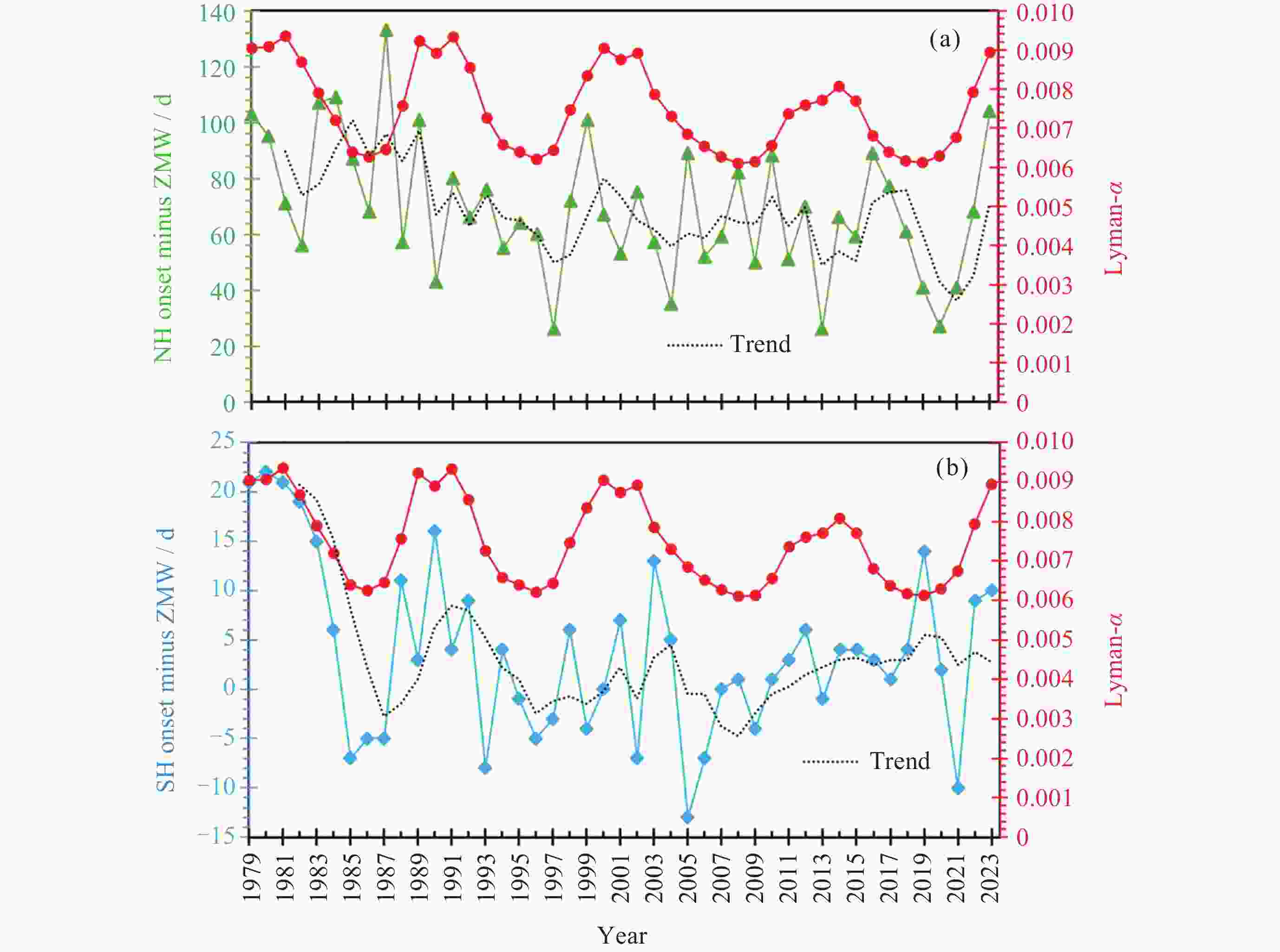
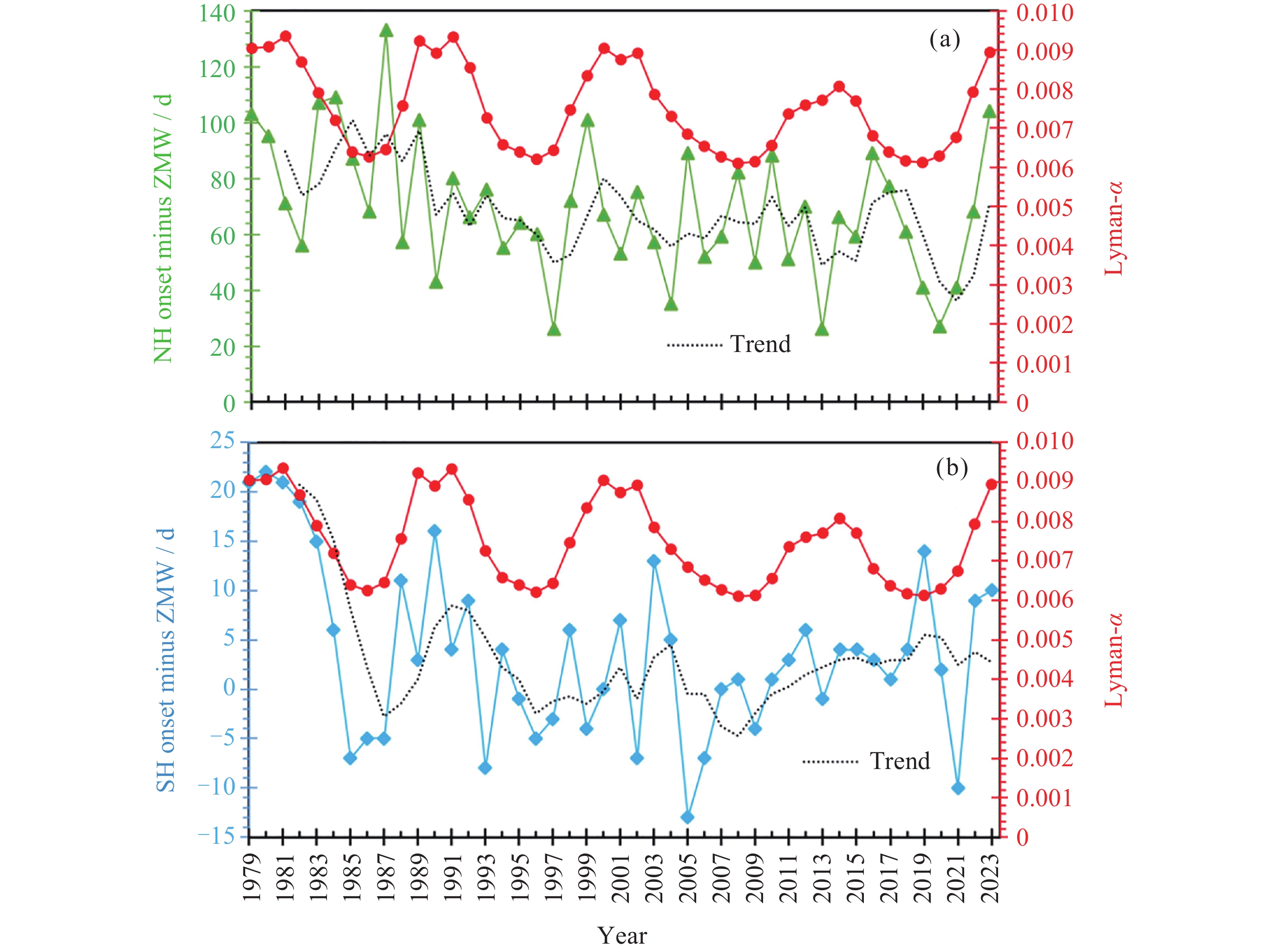
图 6 1979-2023年南北半球季节起始时间和纬向平均风反转时间的差值与太阳辐射的年际变化
Figure 6. Interannual variations in the difference between the onset of the PMC seasons and Zonal Mean Wind (ZMW) reversal time in relation to solar radiation in both Northern Hemispheres (NH) and Southern Hemispheres (SH) from 1979 to 2023
-
[1] DONAHUE T M, GUENTHER B, BLAMONT J E. Noctilucent clouds in daytime: circumpolar particulate layers near the summer mesopause[J]. Journal of the Atmospheric Sciences, 1972, 29(6): 1205-1209 doi: 10.1175/1520-0469(1972)029<1205:NCIDCP>2.0.CO;2 [2] DELAND M T, SHETTLE E P, THOMAS G E, et al. Latitude-dependent long-term variations in polar mesospheric clouds from SBUV version 3 PMC data[J]. Journal of Geophysical Research: Atmospheres, 2007, 112(D10): D10315 doi: 10.1029/2006JD007857 [3] RONG P P, RUSSELL III J M, RANDALL C E, et al. Northern PMC brightness zonal variability and its correlation with temperature and water vapor[J]. Journal of Geophysical Research: Atmospheres, 2014, 119(5): 2390-2408 doi: 10.1002/2013JD020513 [4] LÜBKEN F J. Thermal structure of the Arctic summer mesosphere[J]. Journal of Geophysical Research: Atmospheres, 1999, 104(D8): 9135-9149 [5] KARLSSON B, KÖRNICH H, GUMBEL J. Evidence for interhemispheric stratosphere-mesosphere coupling derived from noctilucent cloud properties[J]. Geophysical Research Letters, 2007, 34(16): L16806 doi: 10.1029/2007GL030282 [6] KARLSSON B, RANDALL C E, SHEPHERD T G, et al. On the seasonal onset of polar mesospheric clouds and the breakdown of the stratospheric polar vortex in the Southern Hemisphere[J]. Journal of Geophysical Research: Atmospheres, 2011, 116(D18): D18107 doi: 10.1029/2011JD015989 [7] BECKER E, SCHMITZ G. Climatological effects of orography and land–sea heating contrasts on the gravity wave–driven circulation of the mesosphere[J]. Journal of the Atmospheric Sciences, 2003, 60(1): 103-118 doi: 10.1175/1520-0469(2003)060<0103:CEOOAL>2.0.CO;2 [8] BENZE S, RANDALL C E, KARLSSON B, et al. On the onset of polar mesospheric cloud seasons as observed by SBUV[J]. Journal of Geophysical Research: Atmospheres, 2012, 117(D7): D07104 doi: 10.1029/2011JD017350 [9] DELAND M T, SHETTLE E P, THOMAS G E, et al. Solar Backscattered Ultraviolet (SBUV) observations of Polar Mesospheric Clouds (PMCs) over two solar cycles[J]. Journal of Geophysical Research: Atmospheres, 2003, 108(D8): 8445 doi: 10.1029/2002JD002398 [10] SHETTLE E P, DELAND M T, THOMAS G E, et al. Long term variations in the frequency of polar mesospheric clouds in the Northern Hemisphere from SBUV[J]. Geophysical Research Letters, 2009, 36(2): L02803 doi: 10.1029/2008GL036048 [11] MITRA G, GUHARAY A. Impact of sudden stratospheric warming on middle atmospheric circulation in the southern hemisphere: a comparative study[J]. Journal of Atmospheric and Solar-Terrestrial Physics, 2024, 254: 106173 doi: 10.1016/j.jastp.2024.106173 [12] SHEN X C, WANG L, OSPREY S. The southern hemisphere sudden stratospheric warming of September 2019[J]. Science Bulletin, 2020, 65(21): 1800-1802 doi: 10.1016/j.scib.2020.06.028 [13] GERDING M, BAUMGARTEN G, ZECHA M, et al. On the unusually bright and frequent noctilucent clouds in summer 2019 above northern Germany[J]. Journal of Atmospheric and Solar-Terrestrial Physics, 2021, 217: 105577 doi: 10.1016/j.jastp.2021.105577 [14] THOMAS G E. Are noctilucent clouds harbingers of global change in the middle atmosphere[J]. Advances in Space Research, 2003, 32(9): 1737-1746 doi: 10.1016/S0273-1177(03)90470-4 [15] DELAND M T, SHETTLE E P, THOMAS G E, et al. A quarter-century of satellite polar mesospheric cloud observations[J]. Journal of Atmospheric and Solar-Terrestrial Physics, 2006, 68(1): 9-29 doi: 10.1016/j.jastp.2005.08.003 [16] RUSSELL III J M, BAILEY S M, GORDLEY L L, et al. The Aeronomy of Ice in the Mesosphere (AIM) mission: overview and early science results[J]. Journal of Atmospheric and Solar-Terrestrial Physics, 2009, 71(3/4): 289-299 doi: 10.1016/j.jastp.2008.08.011 [17] HERVIG M E, STEVENS M H, GORDLEY L L, et al. Relationships between polar mesospheric clouds, temperature, and water vapor from Solar Occultation for Ice Experiment (SOFIE) observations[J]. Journal of Geophysical Research: Atmospheres, 2009, 114(D20): D20203 doi: 10.1029/2009JD012302 [18] MCCLINTOCK W E, RUSCH D W, THOMAS G E, et al. The cloud imaging and particle size experiment on the aeronomy of ice in the mesosphere mission: instrument concept, design, calibration, and on-orbit performance[J]. Journal of Atmospheric and Solar-Terrestrial Physics, 2009, 71(3/4): 340-355 doi: 10.1016/j.jastp.2008.10.011 [19] HERSBACH H, BELL B, BERRISFORD P, et al. The ERA5 global reanalysis[J]. Quarterly Journal of the Royal Meteorological Society, 2020, 146(730): 1999-2049 doi: 10.1002/qj.3803 [20] GELARO R, MCCARTY W, SUÁREZ M J, et al. The Modern-Era Retrospective Analysis for research and applications, version 2 (MERRA-2)[J]. Journal of Climate, 2017, 30(14): 5419-5454 doi: 10.1175/JCLI-D-16-0758.1 [21] GUMBEL J, KARLSSON B. Intra- and inter-hemispheric coupling effects on the polar summer mesosphere[J]. Geophysical Research Letters, 2011, 38(14): L14804 doi: 10.1029/2011GL047968 [22] FRITTS D C, ALEXANDER M J. Gravity wave dynamics and effects in the middle atmosphere[J]. Reviews of Geophysics, 2003, 41(1): 1003 doi: 10.1029/2001RG000106 [23] GARCIA R R. Dynamics, radiation, and photochemistry in the mesosphere: implications for the formation of noctilucent clouds[J]. Journal of Geophysical Research: Atmospheres, 1989, 94(D12): 14605-14615 doi: 10.1029/JD094iD12p14605 [24] THOMAS G E. Mesospheric clouds and the physics of the mesopause region[J]. Reviews of Geophysics, 1991, 29(4): 553-575 doi: 10.1029/91RG01604 [25] FOMICHEV V I, OGIBALOV V P, BEAGLEY S R. Solar heating by the near-IR CO2 bands in the mesosphere[J]. Geophysical Research Letters, 2004, 31(21): L21102 doi: 10.1029/2004GL020324 [26] BERGER U, LÜBKEN F J. Trends in mesospheric ice layers in the Northern Hemisphere during 1961–2013[J]. Journal of Geophysical Research: Atmospheres, 2015, 120(21): 11277-11298 doi: 10.1002/2015JD023355 -
-

 下载:
下载:

计量
- 文章访问数: 1414
- HTML全文浏览量: 655
- PDF下载量: 74
-
被引次数:
0(来源:Crossref)
0(来源:其他)

