


南北半球中纬度地区热层风场对2018年3月18日磁暴的响应特征
doi: 10.11728/cjss2026.02.2025-0039 cstr: 32142.14.cjss.2025-0039
-
 夏新淼 女, 2000年12月出生于四川省泸州市, 现为中国科学院国家空间科学中心太阳活动与空间天气全国重点实验室硕士研究生, 主要研究方向为中高层大气物理方向. E-mail: xiaxinmiao22@mails.ucas.ac.cn
 -
 姜国英 女, 1979年4月出生于河北省邢台市, 现为中国科学院国家空间科学中心太阳活动与空间天气全国重点实验室副研究员, 硕士生导师, 主要研究方向为中高层大气动力学、热层–电离层耦合等. E-mail: gyjiang@swl.ac.cn
作者简介:
通讯作者:
Response of Thermospheric Winds at Mid-latitudes in the Northern and Southern Hemispheres to the Geomagnetic Storm on 18 March 2018
-
摘要: 基于兴隆(XLON, 40.2°N, 117.6°E; 磁纬35°N)和南非Sutherland天文台(SAAO, 32.2°S, 20.48°E; 磁纬40.7°S)的地基Fabry-Perot干涉仪(FPI)观测数据, 结合热层–电离层–电动力学环流模型(TIEGCM), 系统分析了2018年3月18-19日磁暴事件期间南北半球中纬度地区热层风场的响应特征. 研究发现, 南半球热层风场对磁暴的响应较北半球更为显著. 在SAAO台站观测到显著的赤道向和西向风增强现象, 其中经向风最大速度达128.4 m·s–1 (赤道向), 纬向风最大速度达 –165.6 m·s–1 (西向). 与TIEGCM模拟结果的对比分析表明, 模型能够较好地再现观测数据的扰动趋势, 特别是在SAAO经向风和XLON纬向风的变化特征方面. 然而模型在风速定量预测方面仍存在一定偏差, 对SAAO东向纬向风存在低估现象, 而对XLON赤道向经向风则呈现高估趋势.Abstract: The responses of thermospheric winds at middle latitudes to the moderate geomagnetic storm of 18-19 March 2018, are examined using two ground-based Fabry-Perot Interferometer (FPI) observations from the Xinglong (XLON, 40.2°N, 117.6°E; magnetic latitude 35°N) and the Sutherland Astronomical Observatory (SAAO, 32.2°S, 20.48°E; magnetic latitude 40.7°S), combined with simulations from the Thermosphere-Ionosphere-Electrodynamics General Circulation Model (TIEGCM). The storm reached a maximum Kp index of 6, classifying it as a moderate storm. Ground-based FPI measurements provided high-resolution wind data at both stations, capturing the temporal evolution of zonal (east-west) and meridional (north-south) wind components. Meanwhile, the TIEGCM simulations offered a theoretical framework to interpret the observed disturbances and assess the model’s capability in reproducing storm-induced thermospheric dynamics. The results reveal that the response of thermospheric winds to the geomagnetic storm is more pronounced in the southern hemisphere than that in the northern hemisphere. Significant enhancements in equatorward and westward winds are observed at the SAAO station, with maximum meridional wind speeds reaching 128.4 m·s–1 (equatorward) and maximum zonal wind speeds reaching –165.6 m·s–1 (westward). Comparative analysis with TIEGCM simulations indicates that the model can reasonably reproduce the disturbance trends in observations, particularly in the variations of meridional winds at SAAO and zonal winds at XLON. The model successfully captured the transition from quiet-time wind patterns to storm-driven disturbances, including the shift toward westward and equatorward. However, certain quantitative discrepancies remain in the model’s predictions: the model underestimates the eastward zonal winds at SAAO and overestimates the equatorward meridional winds at XLON. Future studies could consider using multiple ground-based stations and a variety of observations, such as temperature, density, chemical composition for the study. Furthermore, investigating the role of seasonal and local time effects in modulating hemispheric asymmetries could provide deeper insights into thermospheric storm responses. Overall, this study contributes to a better understanding of the storm impacts on thermospheric winds and hemispheric differences, as well as their potential physical causes.
-
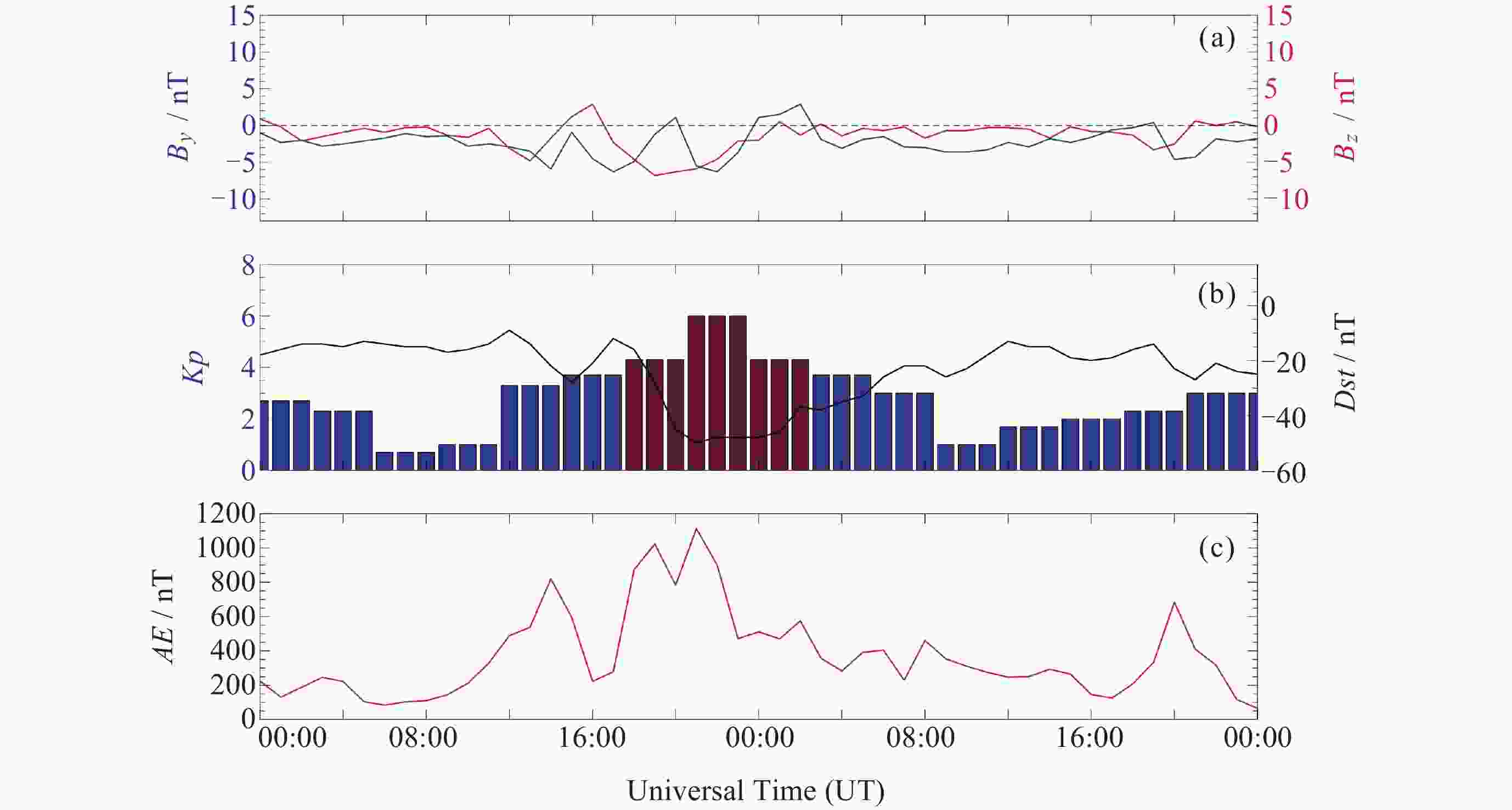
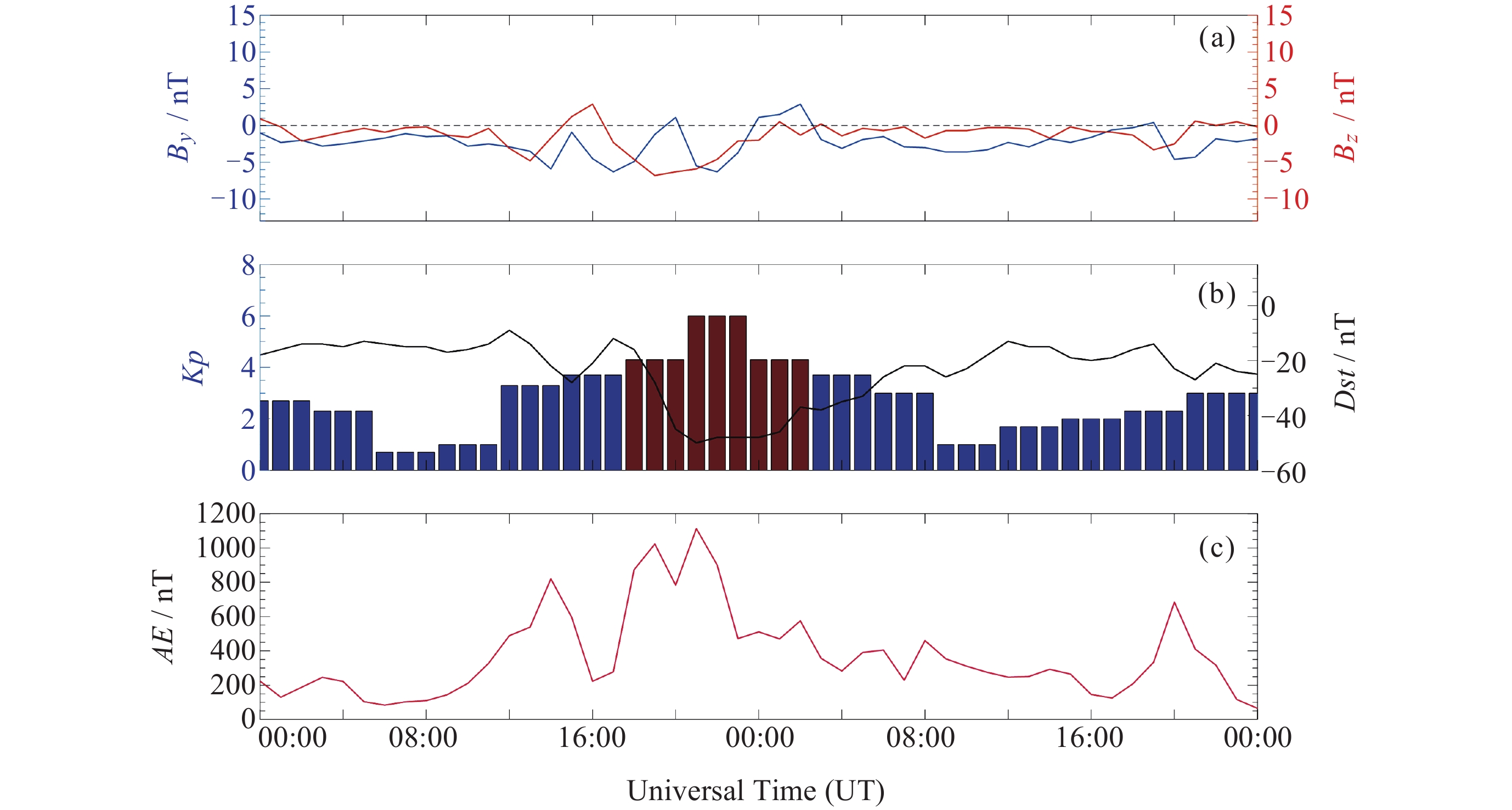
图 1 2018年3月18-19日行星际磁场By, Bz 分量及地磁指数Kp, Dst, AE 随时间的变化
Figure 1. Time variations of IMF By, Bz and geomagnetic indices Kp, Dst, AE during 18-19 March 2018
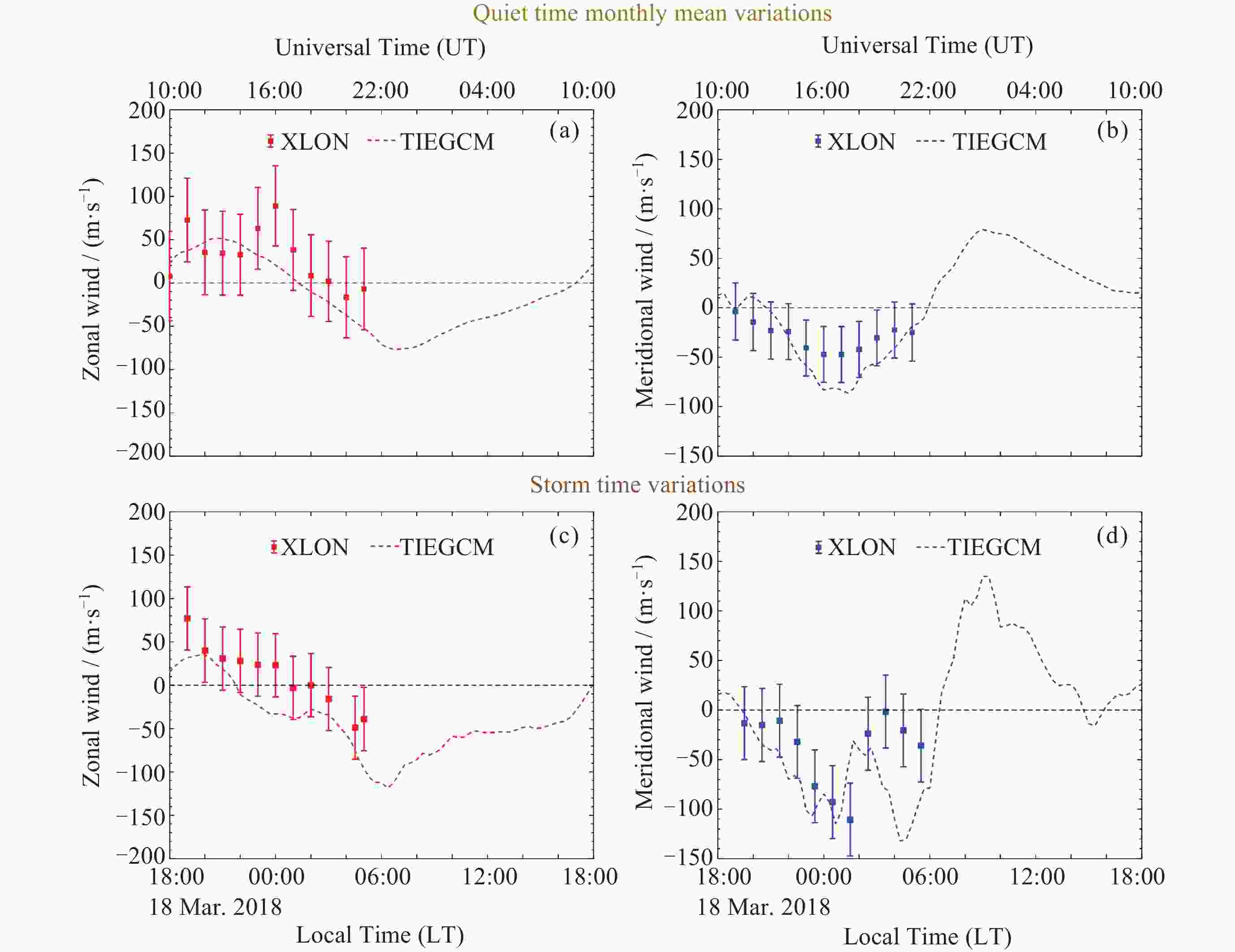
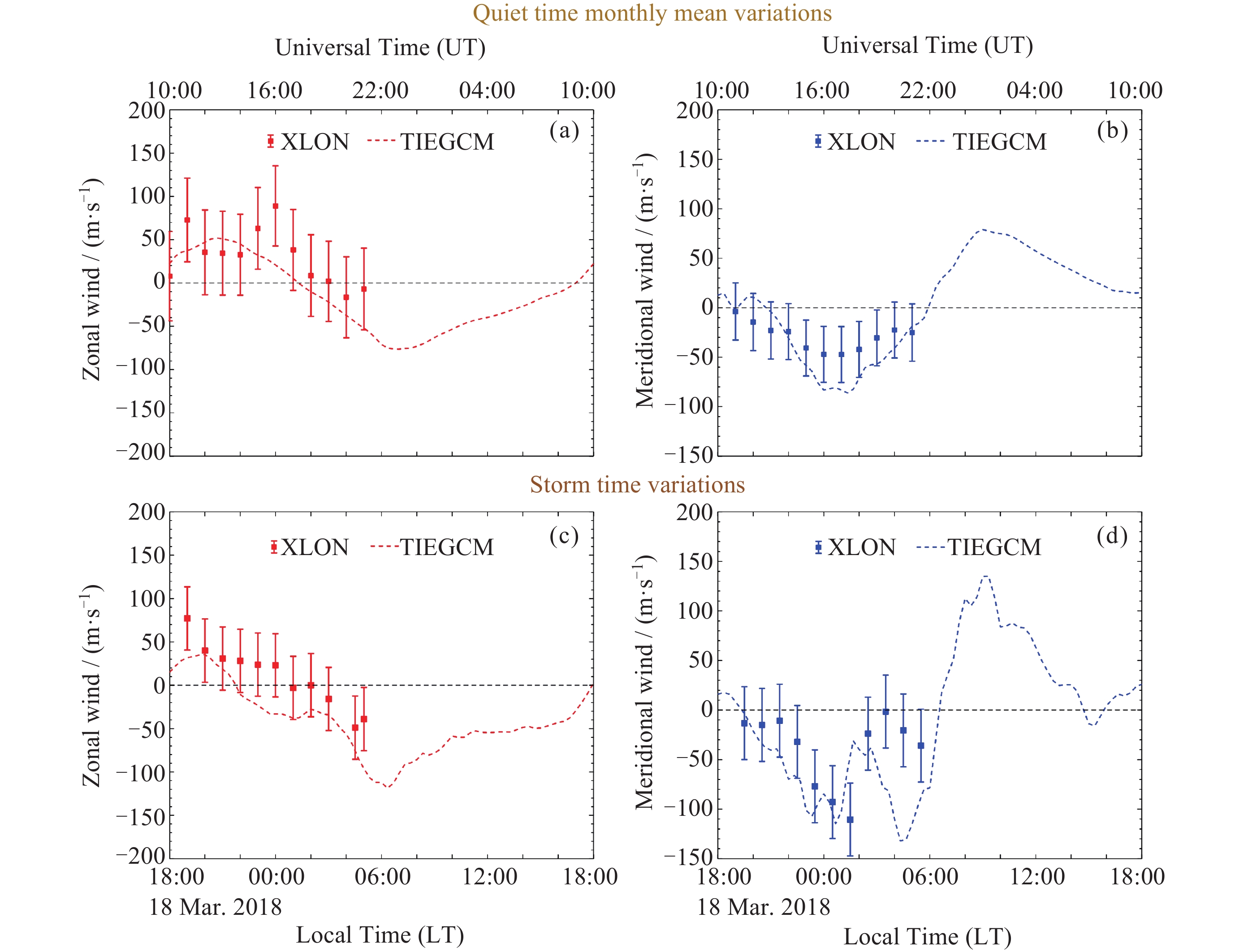
图 2 XLON 台站观测数据与TIEGCM模型数据在热层风场纬向风和经向风随世界时和地方时的变化
Figure 2. Thermospheric zonal and meridional winds from XLON observation and TIEGCM simulation as functions of UT and LT
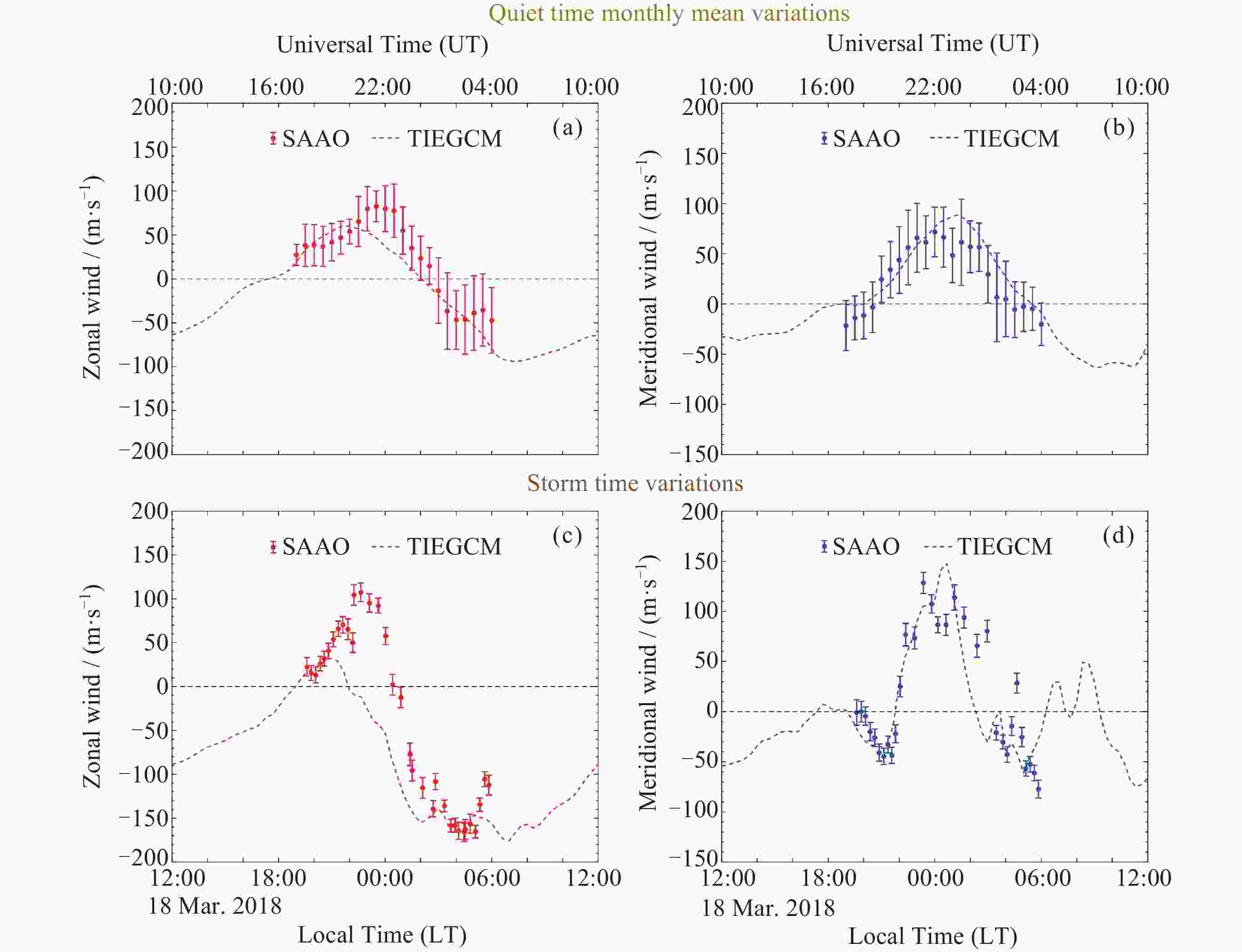
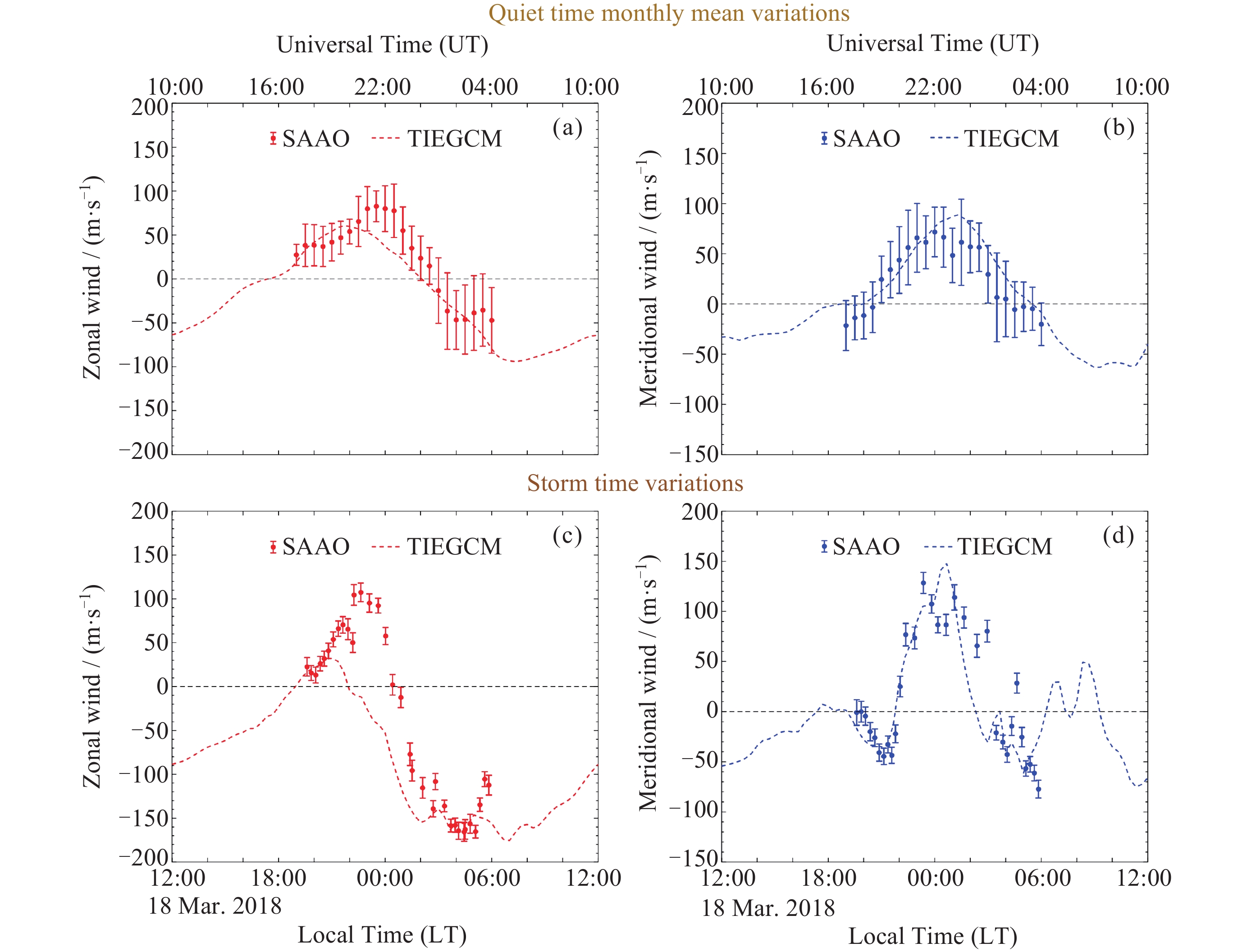
图 3 SAAO台站观测数据与TIEGCM模型数据在热层风场纬向风和经向风随世界时和地方时的变化
Figure 3. Thermospheric zonal and meridional winds from SAAO observation and TIEGCM simulation as functions of UT and LT
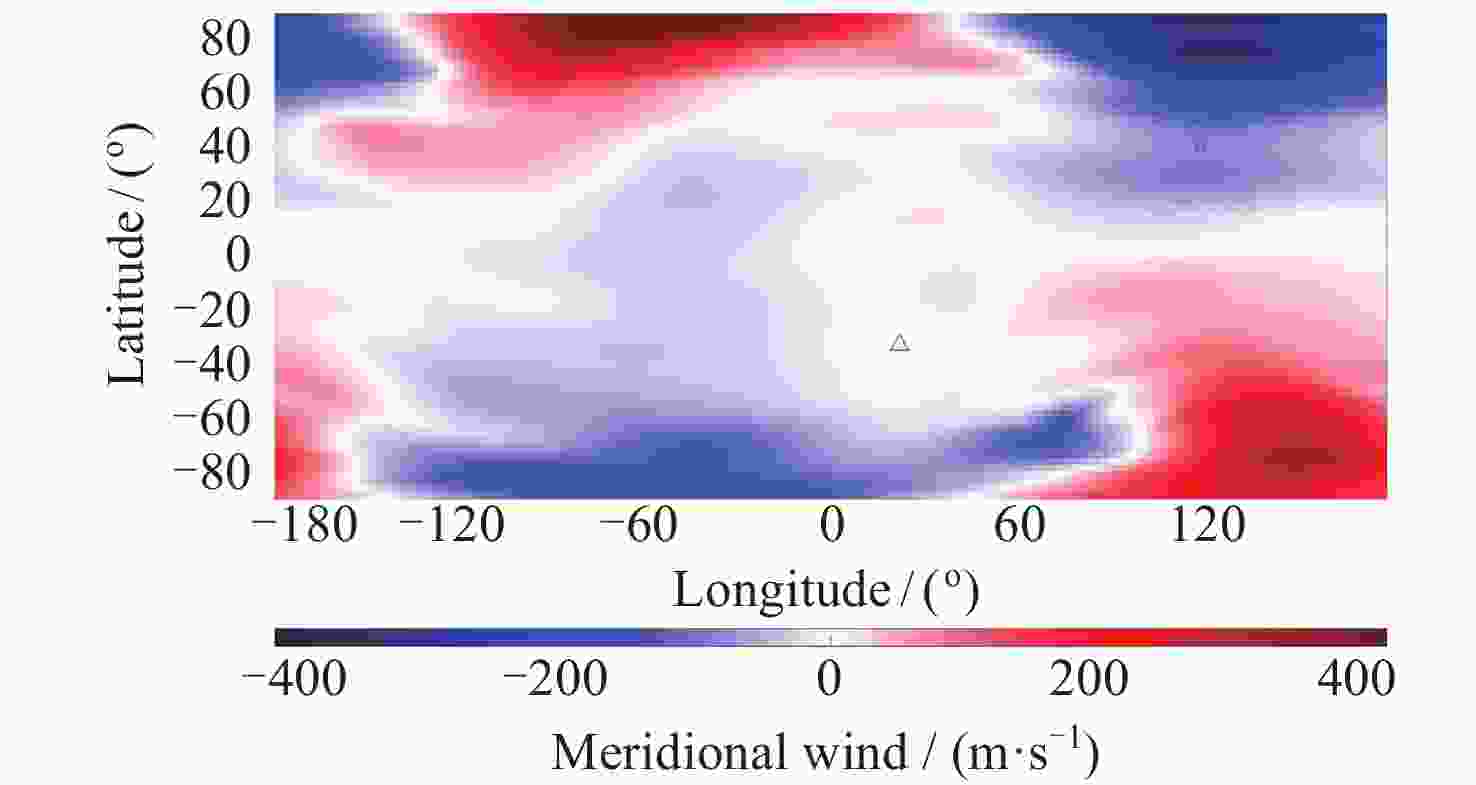
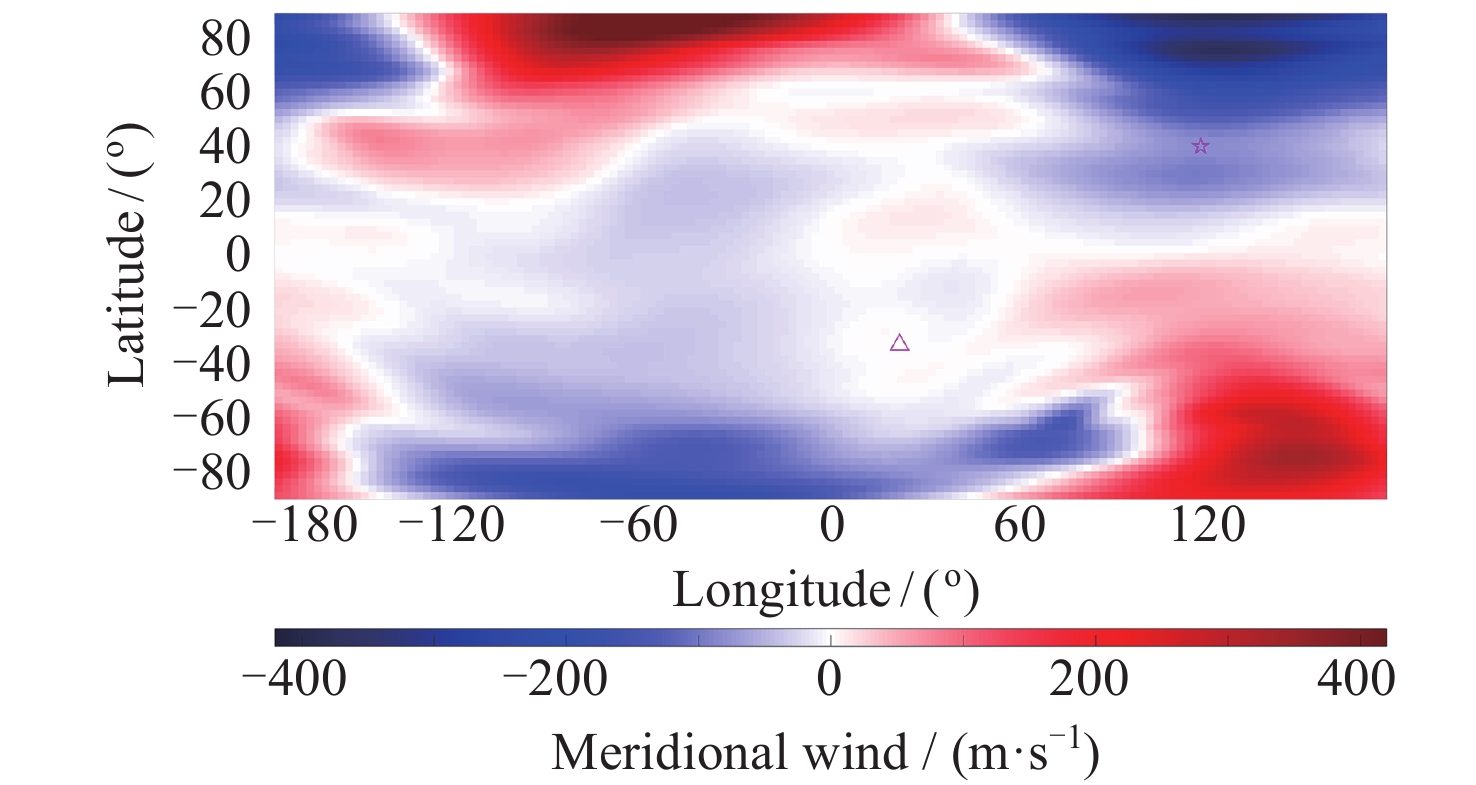
图 4 TIEGCM模拟的2018年3月18日16:00 UT经向风全球分布
Figure 4. Global distribution of meridional wind at 16:00 UT on 18 March 2018 simulated by TIEGCM
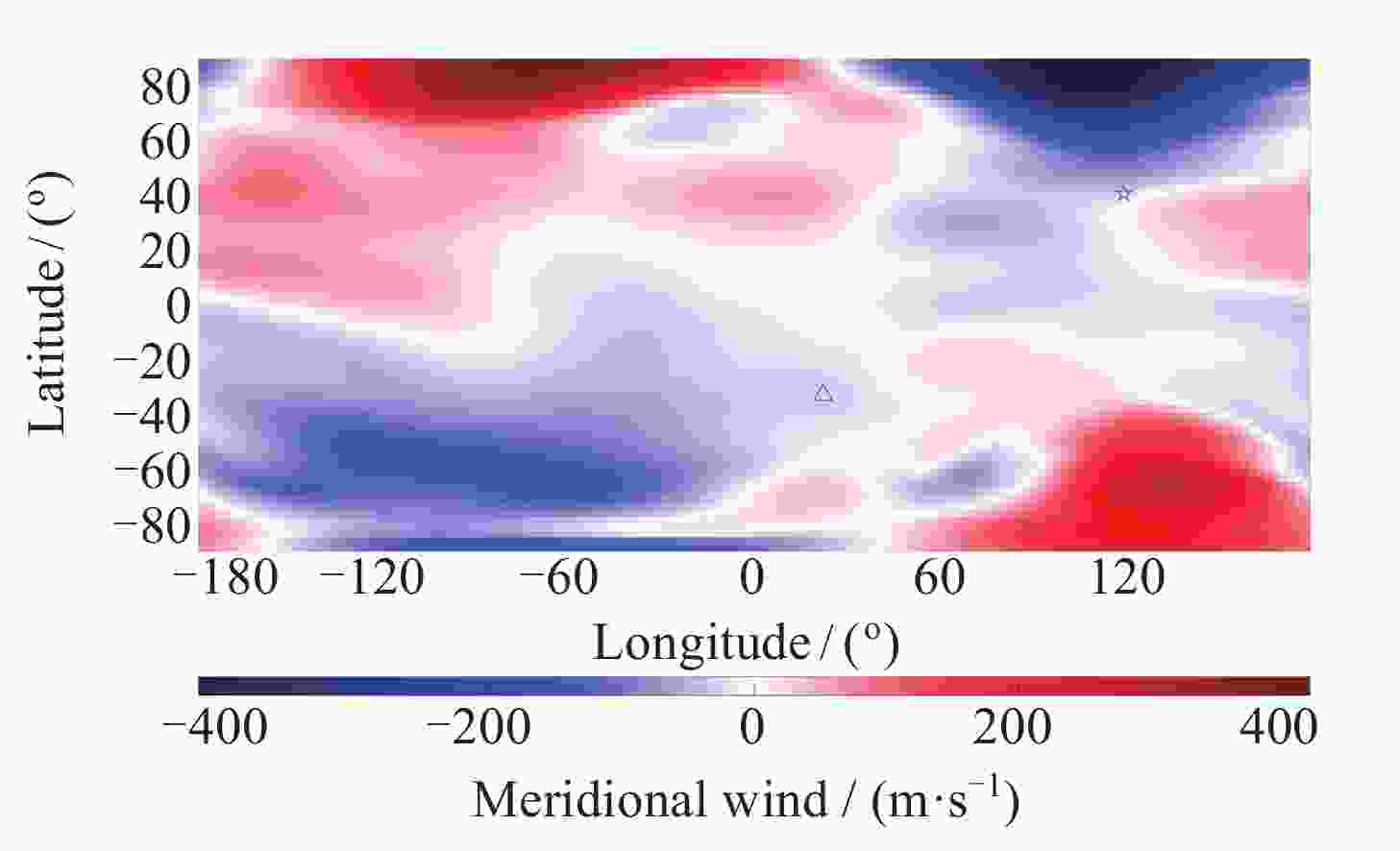
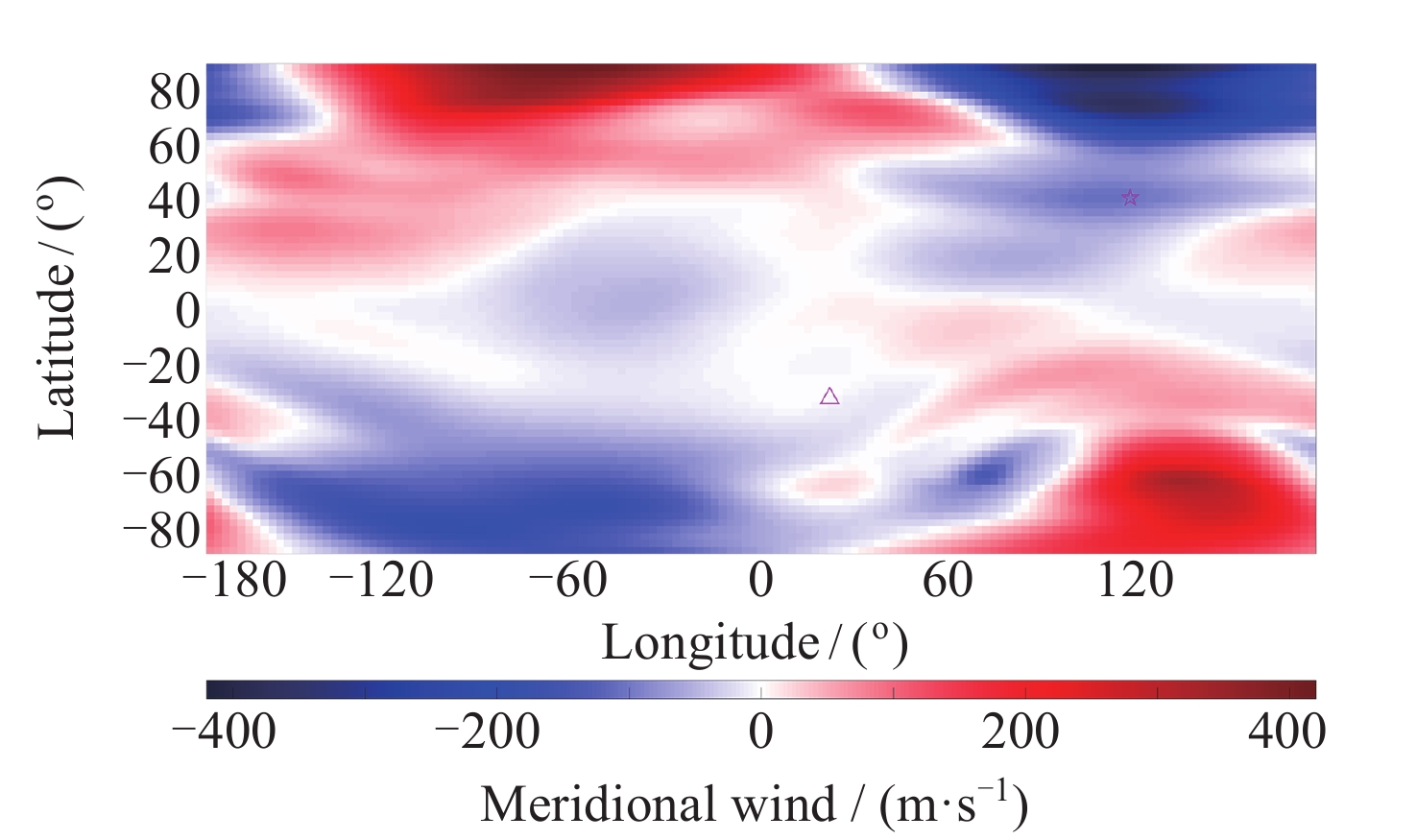
图 6 TIEGCM模拟的2018年3月18日18:00 UT经向风全球分布
Figure 6. Global distribution of meridional wind at 18:00 UT on 18 March 2018 simulated by TIEGCM
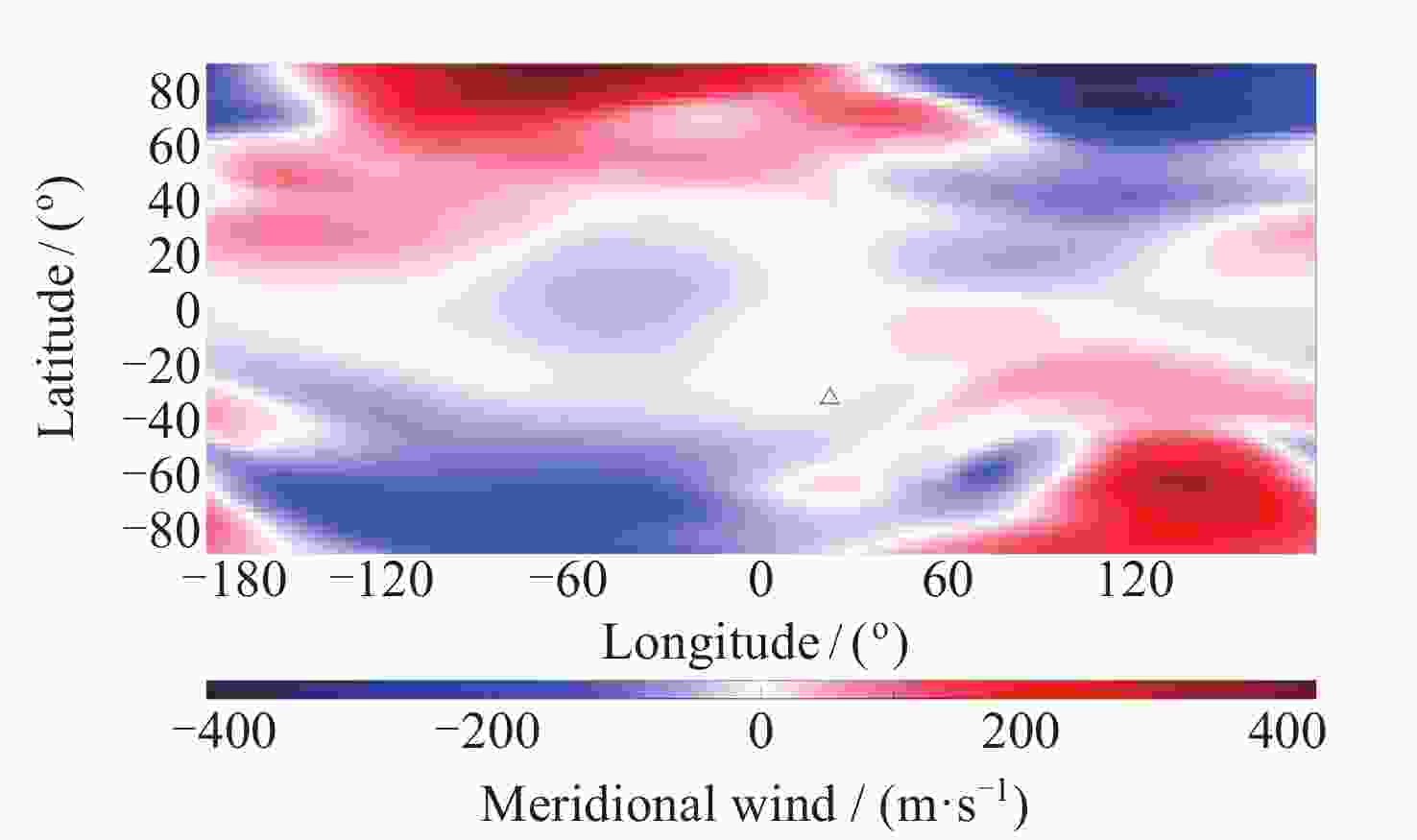
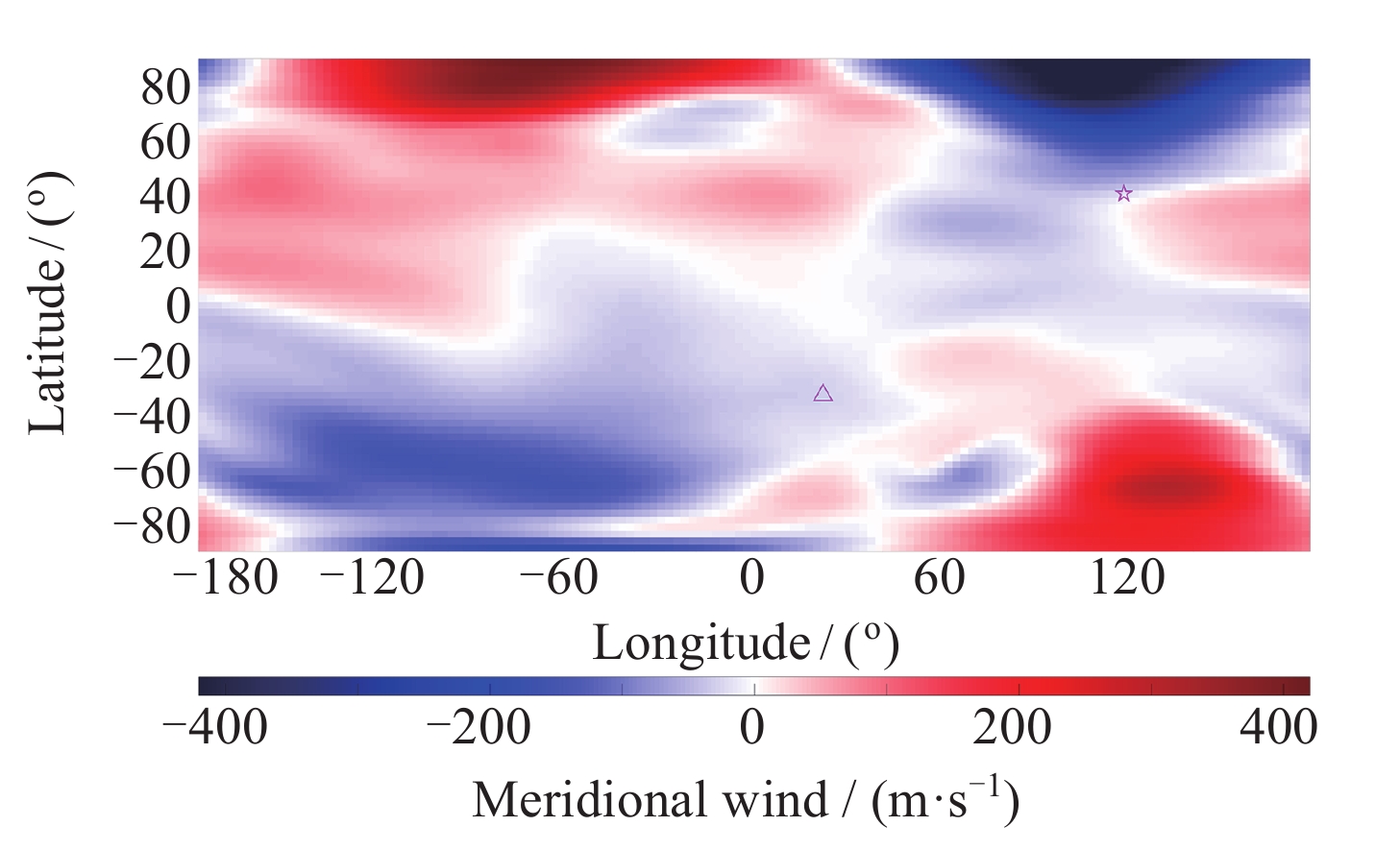
图 5 TIEGCM模拟的2018年3月18日17:00 UT经向风全球分布
Figure 5. Global distribution of meridional wind at 17:00 UT on 18 March 2018 simulated by TIEGCM
表 1 XLON和 SAAO台站位置
Table 1. Locations of XLON and SAAO stations
Station Longitude/(°) Latitude/(°) XLON 117.6 E 40.2 N SAAO 20.48 E 32.2 S  下载: 导出CSV
-
[1] HEPPNER J P, MILLER M L. Thermospheric winds at high latitudes from chemical release observations[J]. Journal of Geophysical Research: Space Physics, 1982, 87(A3): 1633-1647 doi: 10.1029/JA087iA03p01633 [2] HSU V W, THAYER J P, WANG W B, et al. New insights into the complex interplay between drag forces and its thermospheric consequences[J]. Journal of Geophysical Research: Space Physics, 2016, 121(10): 10417-10430 doi: 10.1002/2016ja023058 [3] KILLEEN T L, ROBLE R G. An analysis of the high-latitude thermospheric wind pattern calculated by a thermospheric general circulation model: 1. Momentum forcing[J]. Journal of Geophysical Research: Space Physics, 1984, 89(A9): 7509-7522 doi: 10.1029/JA089iA09p07509 [4] RISHBETH H, YELLE R V, MENDILLO M. Dynamics of Titan’s thermosphere[J]. Planetary and Space Science, 2000, 48(1): 51-58 doi: 10.1016/S0032-0633(99)00076-8 [5] FORBES J M, ROBLE R G, MARCOS F A. Thermospheric dynamics during the March 22, 1979, magnetic storm: 2. comparisons of model predictions with observations[J]. Journal of Geophysical Research: Space Physics, 1987, 92(A6): 6069-6081 doi: 10.1029/JA092iA06p06069 [6] BURNS A G, KILLEEN T L, DENG W, et al. Geomagnetic storm effects in the low-to middle-latitude upper thermosphere[J]. Journal of Geophysical Research: Space Physics, 1995, 100(A8): 14673-14691 [7] FULLER-ROWELL T J, CODRESCU M V, MOFFETT R J, et al. Response of the thermosphere and ionosphere to geomagnetic storms[J]. Journal of Geophysical Research: Space Physics, 1994, 99(A3): 3893-3914 doi: 10.1029/93JA02015 [8] BUONSANTO M J. Ionospheric Storms — a review[J]. Space Science Reviews, 1999, 88(3/4): 563-601 [9] FEJER B G, EMMERT J T, SHEPHERD G G, et al. Average daytime F region disturbance neutral winds measured by UARS: initial results[J]. Geophysical Research Letters, 2000, 27(13): 1859-1862 doi: 10.1029/2000GL003787 [10] YU T, HUANG C, ZHAO G X, et al. A preliminary study of thermosphere and mesosphere wind observed by Fabry-Perot over Kelan, China[J]. Journal of Geophysical Research: Space Physics, 2014, 119(6): 4981-4997 doi: 10.1002/2013JA019492 [11] WU Q, NOTO J, KERR R, et al. First Palmer and Millstone Hill midlatitude conjugate observation of thermospheric winds[J]. Journal of Geophysical Research: Space Physics, 2014, 119(4): 3016-3028 doi: 10.1002/2013JA019062 [12] WEI Y F, GU S Y, LI N, et al. Passive optical observation of mesosphere and thermosphere wind over three stations in China[J]. Journal of Geophysical Research: Space Physics, 2024, 129(3): e2023JA032214 doi: 10.1029/2023JA032214 [13] OYAMA S, VANHAMÄKI H, CAI L, et al. Thermospheric wind response to march 2023 storm: largest wind ever observed with a Fabry-Perot Interferometer in Tromsø, Norway since 2009[J]. Space Weather, 2024, 22(3): e2023SW003728 doi: 10.1029/2023SW003728 [14] OKOH D, BOUNHIR A, HABARULEMA J B, et al. Thermospheric neutral wind measurements and investigations across the African region—a review[J]. Atmosphere, 2022, 13(6): 863 doi: 10.3390/atmos13060863 [15] LOUTFI A, BOUNHIR A, PITOUT F, et al. Thermospheric neutral winds above the Oukaimeden Observatory: effects of geomagnetic activity[J]. Journal of Geophysical Research: Space Physics, 2020, 125(7): e2019JA027383 doi: 10.1029/2019JA027383 [16] HUANG C, XU J Y, ZHANG X X, et al. Mid-latitude thermospheric wind changes during the St. Patrick’s Day storm of 2015 observed by two Fabry-Perot interferometers in China[J]. Advances in Space Research, 2018, 61(7): 1873-1879 doi: 10.1016/j.asr.2017.10.013 [17] HERNANDEZ G, ROBLE R G, RIDLEY E C, et al. Thermospheric response observed over Fritz Peak, Colorado, during two large geomagnetic storms near Solar Cycle Maximum[J]. Journal of Geophysical Research: Space Physics, 1982, 87(A11): 9181-9192 doi: 10.1029/JA087iA11p09181 [18] HERNANDEZ G, ROBLE R G. Thermospheric nighttime neutral temperature and winds over Fritz Peak Observatory: observed and calculated solar cycle variation[J]. Journal of Geophysical Research: Space Physics, 1995, 100(A8): 14647-14659 doi: 10.1029/95JA00565 [19] FORBES J M, ZHANG X L, BRUINSMA S. Middle and upper thermosphere density structures due to nonmigrating tides[J]. Journal of Geophysical Research: Space Physics, 2012, 117(A11): A11306 doi: 10.1029/2012ja018087 [20] FEJER B G, EMMERT J T, SIPLER D P. Climatology and storm time dependence of nighttime thermospheric neutral winds over Millstone Hill[J]. Journal of Geophysical Research: Space Physics, 2002, 107(A5): SIA 3-1-SIA 3-9 [21] EMMERT J T, FAIVRE M L, HERNANDEZ G, et al. Climatologies of nighttime upper thermospheric winds measured by ground-based Fabry-Perot interferometers during geomagnetically quiet conditions: 1. Local time, latitudinal, seasonal, and solar cycle dependence[J]. Journal of Geophysical Research: Space Physics, 2006, 111(A12): A12303 doi: 10.1029/2006ja011948 [22] TAGI T, DYSON P L. The response of the mid-latitude thermospheric wind to magnetic activity[J]. Planetary and Space Science, 1985, 33(4): 461-467 [23] BRUM C G M, TEPLEY C A, FENTZKE J T, et al. Long-term changes in the thermospheric neutral winds over Arecibo: climatology based on over three decades of Fabry-Perot observations[J]. Journal of Geophysical Research: Space Physics, 2012, 117(A2): A00H14 [24] YATAGAI A, OYAMA S I. Thermospheric nocturnal wind Climatology observed by Fabry-Perot interferometers over the Asia-Oceania region[J]. Journal of the Meteorological Society of Japan. Ser. II, 2016, 94(6): 525-536 doi: 10.2151/jmsj.2016-026 [25] OJO T T, KATAMZI-JOSEPH Z T, CHU K T, et al. A climatology of the nighttime thermospheric winds over Sutherland, South Africa[J]. Advances in Space Research, 2022, 69(1): 209-219 doi: 10.1016/j.asr.2021.10.015 [26] YUAN W, XU J Y, MA R P, et al. First observation of mesospheric and thermospheric winds by a Fabry-Perot interferometer in China[J]. Chinese Science Bulletin, 2010, 55(35): 4046-4051 doi: 10.1007/s11434-010-4192-2 [27] WU Q, GABLEHOUSE R D, SOLOMON S C, et al. A new Fabry-Perot interferometer for upper atmosphere research[C]//Proceedings Volume 5660, Instruments, Science, and Methods for Geospace and Planetary Remote Sensing. Honolulu, Hawai’i: SPIE2004: 218-227 [28] YUAN W, LIU X, XU J, et al. FPI observations of nighttime mesospheric and thermospheric winds in China and their comparisons with HWM07[J]. Annales Geophysicae, 2013, 31(8): 1365-1378 doi: 10.5194/angeo-31-1365-2013 [29] JIANG G Y, XU J Y, WANG W B, et al. A comparison of quiet time thermospheric winds between FPI observations and model calculations[J]. Journal of Geophysical Research: Space Physics, 2018, 123(9): 7789-7805 doi: 10.1029/2018JA025424 [30] JIANG G Y, XU J Y, YUAN W, et al. A comparison of mesospheric winds measured by FPI and meteor radar located at 40N[J]. Science China Technological Sciences, 2012, 55(5): 1245-1250 doi: 10.1007/s11431-012-4773-1 [31] LIU X, XU J Y, ZHANG S R, et al. Thermospheric planetary wave-type oscillations observed by FPIs over Xinglong and Millstone Hill[J]. Journal of Geophysical Research: Space Physics, 2014, 119(8): 6891-6901 doi: 10.1002/2014JA020043 [32] LINK R, COGGER L L. A reexamination of the O I 6300-Å nightglow[J]. Journal of Geophysical Research: Space Physics, 1988, 93(A9): 9883-9892 [33] FISHER D J, MAKELA J J, MERIWETHER J W, et al. Climatologies of nighttime thermospheric winds and temperatures from Fabry-Perot interferometer measurements: from solar minimum to solar maximum[J]. Journal of Geophysical Research: Space Physics, 2015, 120(8): 6679-6693 doi: 10.1002/2015JA021170 [34] QIAN L Y, BURNS A G, EMERY B A, et al. The NCAR TIE-GCM[M]//HUBA J, SCHUNK R, KHAZANOV G. Modeling the Ionosphere–Thermosphere System. San Francisco: American Geophysical Union, 2014: 73-83 [35] HEELIS R A, LOWELL J K, SPIRO R W. A model of the high-latitude ionospheric convection pattern[J]. Journal of Geophysical Research: Space Physics, 1982, 87(A8): 6339-6345 doi: 10.1029/JA087iA08p06339 [36] WEIMER D R. Improved ionospheric electrodynamic models and application to calculating Joule heating rates[J]. Journal of Geophysical Research: Space Physics, 2005, 110(A5): A05306 doi: 10.1029/2004ja010884 [37] RICHARDS P G, FENNELLY J A, TORR D G. EUVAC: A solar EUV flux model for aeronomic calculations[J]. Journal of Geophysical Research: Space Physics, 1994, 99(A5): 8981-8992 doi: 10.1029/94JA00518 [38] HAGAN M E, FORBES J M. Migrating and nonmigrating diurnal tides in the middle and upper atmosphere excited by tropospheric latent heat release[J]. Journal of Geophysical Research: Atmospheres, 2002, 107(D24): ACL 6-1-ACL 6-15 [39] HAGAN M E, FORBES J M. Migrating and nonmigrating semidiurnal tides in the upper atmosphere excited by tropospheric latent heat release[J]. Journal of Geophysical Research: Space Physics, 2003, 108(A2): 1062 doi: 10.1029/2002ja009466 [40] ZHANG K D, WANG W B, WANG H, et al. The longitudinal variations of upper thermospheric zonal winds observed by the CHAMP Satellite at low and midlatitudes[J]. Journal of Geophysical Research: Space Physics, 2018, 123(11): 9652-9668 doi: 10.1029/2018JA025463 [41] WU Q, SHENG C, WANG W B, et al. The midlatitude thermospheric dynamics from an interhemispheric perspective[J]. Journal of Geophysical Research: Space Physics, 2019, 124(10): 7971-7983 doi: 10.1029/2019JA026967 [42] RICHMOND A D, RIDLEY E C, ROBLE R G. A thermosphere/ionosphere general circulation model with coupled electrodynamics[J]. Geophysical Research Letters, 1992, 19(6): 601-604 doi: 10.1029/92GL00401 [43] SINGH A, RATHORE V S, SINGH R P, et al. Source identification of moderate (–100 nT<Dst<–50 nT) and intense geomagnetic storms (Dst<–100 nT) during ascending phase of solar cycle 24[J]. Advances in Space Research, 2017, 59(5): 1209-1222 [44] Gonzalez W D, Joselyn J A, Kamide Y, et al. What is a geomagnetic storm[J]. Journal of Geophysical Research: Space Physics, 1994, 99(A4): 5771-5792 doi: 10.1029/93JA02867 [45] Loewe C A, Prölss G W. Classification and mean behavior of magnetic storms[J]. Journal of Geophysical Research: Space Physics, 1997, 102(A7): 14209-14213 doi: 10.1029/96JA04020 [46] RUKUNDO W. The ionospheric dynamics of the African sector responding to a severe geomagnetic storm: the storm of 3–5 November 2021[J]. Space Weather, 2023, 21(3): e2022SW003219 doi: 10.1029/2022SW003219 -
-

 下载:
下载:

计量
- 文章访问数: 1234
- HTML全文浏览量: 710
- PDF下载量: 91
-
被引次数:
0(来源:Crossref)
0(来源:其他)

