


面向月球南极水冰原位探测的微定量采样定标方法
doi: 10.11728/cjss2026.02.2025-0108 cstr: 32142.14.cjss.2025-0108
-
 唐钧跃 男, 1989年出生于江苏省溧阳市, 现为哈尔滨工业大学机电工程学院航空宇航制造工程系研究员, 博士生导师, 长期从事星球采样探测机器人技术研究, 主要包括星壤物质高相似模拟及应用、星壤原位采样探测与资源利用. E-mail: tangjunyue@hit.edu.cn
-
 姜生元 男, 1969年出生于吉林白城, 现为哈尔滨工业大学机电工程学院长聘教授, 博士生导师, 主要研究方向为地外天体采样返回技术、月壤水冰就位采样探测、真实月壤研究及其物质模拟、和月球资源近场勘查与原位利用等. E-mail: jiangshy@hit.edu.cn
通讯作者:
Research on Micro Quantitative Sampling Calibration Method for In-situ Exploration of Icy Lunar Regolith in the South Pole of the Moon
-
摘要: 受现有遥感探测原理的固有局限, 月壤中水冰的真实赋存状态与精准含量仍无法直接判别, 亟须开展原位验证. 中国探月工程嫦娥七号任务计划在月球南极开展水冰探测, 由巡视器搭载的月壤挥发分测量仪通过微量取样装置实现月壤的原位定量采集. 月表工况的复杂性与不确定性易导致采样质量离散性较大, 而采样过程中机–壤温差及机械作用引发的水冰升华损失会进一步降低探测精度. 为保障挥发分测量仪探测数据的可靠性, 提出采样量和水冰损失定标方法, 采用气相沉积法制备月壤水冰模拟物, 并利用自研定标装置完成采样量定标试验. 初步结果表明, 不同粒径级配的月壤模拟物采样量存在显著差异, 后续将深入研究多因素耦合作用下月壤水冰采样的物理机理, 为嫦娥七号在轨数据的精准判读与科学解译提供高置信的物理响应参数谱.Abstract: Due to the inherent limitations of current remote sensing techniques, the actual occurrence and accurate abundance of water ice in lunar regolith cannot be directly identified, making in-situ verification urgently necessary. The Chang’E-7 mission of China’s Lunar Exploration Program plans to conduct water ice detection at the lunar south pole, where an in-situ micro-sampling device mounted on the rover will perform quantitative collection of lunar regolith for the volatiles in-situ measurement instrument. However, the uncertainty of lunar surface conditions leads to considerable dispersion in sampling mass. Moreover, water ice sublimation loss caused by tool-soil temperature difference and mechanical interactions during sampling will further reduce the detection accuracy. To ensure the reliability of detection data from the volatiles measurement instrument, this paper proposes calibration methods for sampling mass and water ice loss. Icy lunar regolith simulant is prepared via vapor deposition during sampling, and sampling mass calibration experiments are carried out using a self-developed calibration device. Preliminary results show that sampling mass varies significantly with regolith particle size distribution. Further research will be conducted on the physical mechanism of icy lunar regolith sampling under multi-factor coupling conditions. This study aims to provide a high-confidence physical response parameter spectrum for accurate interpretation and scientific analysis of Chang’E-7 in-orbit data.
-
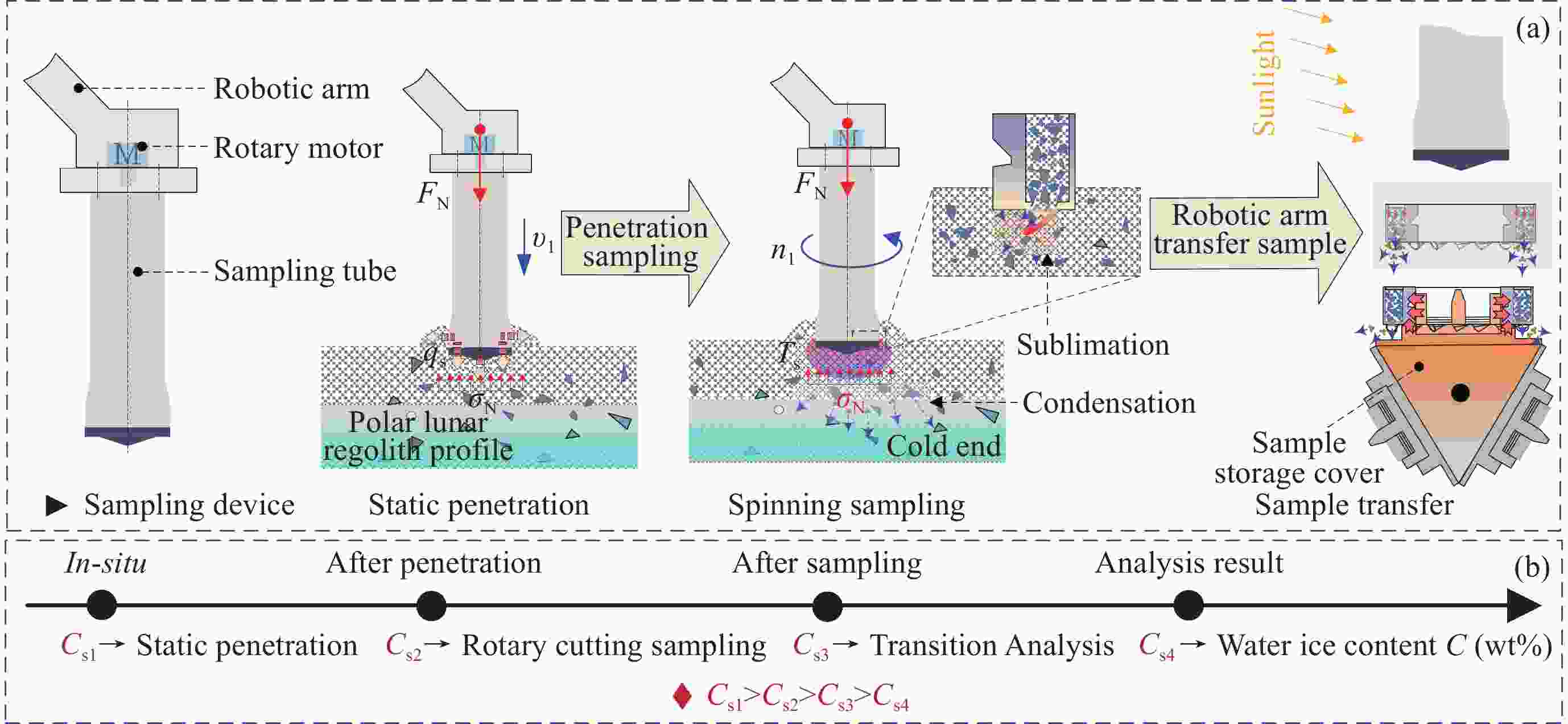
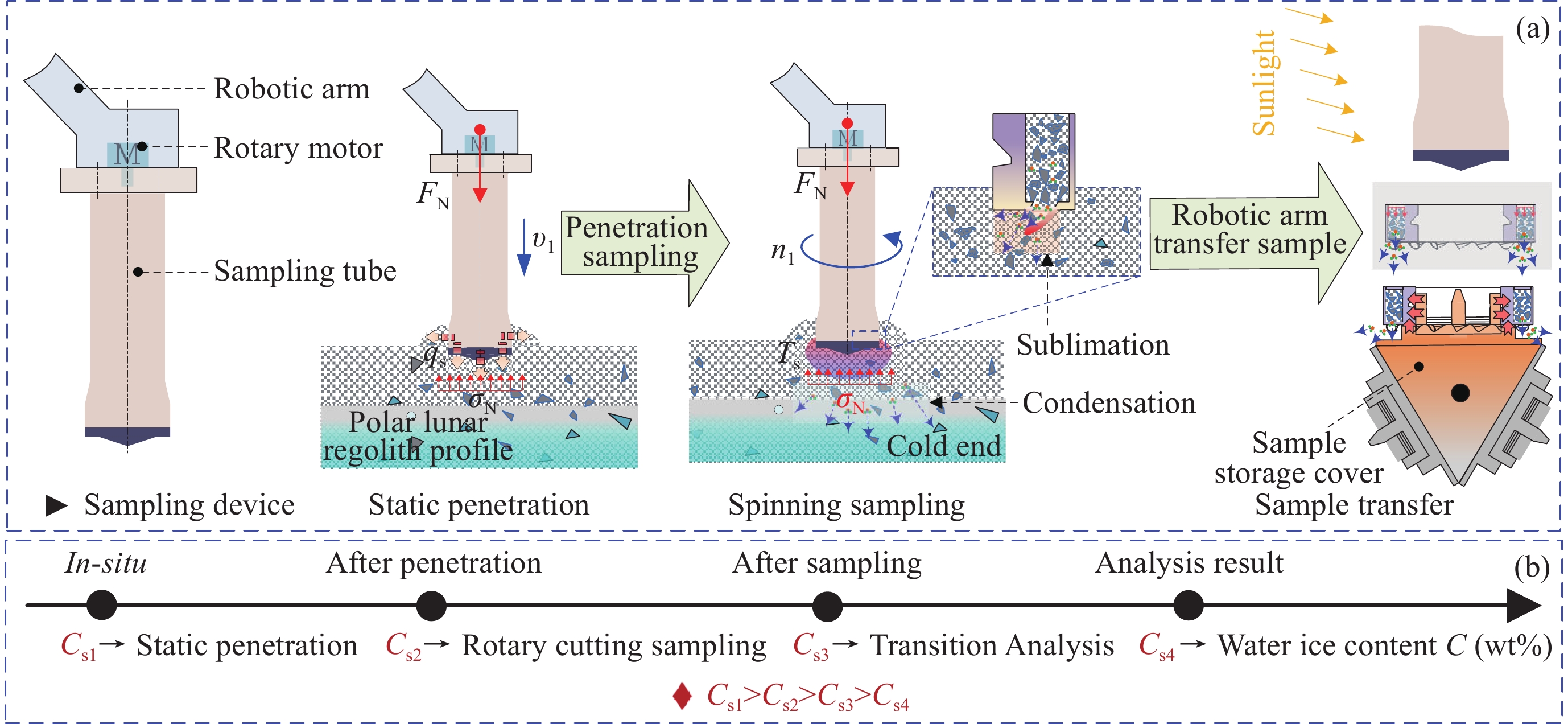
图 2 采样探测过程中水冰损失流程. (a) 月壤水冰采样与转移流程, (b) 月壤样本中水冰含量变化
Figure 2. Process of water ice loss during sampling and detection. (a) Sampling and transfer process of icy lunar regolith, (b) the variation route of water ice content in lunar regolith sample
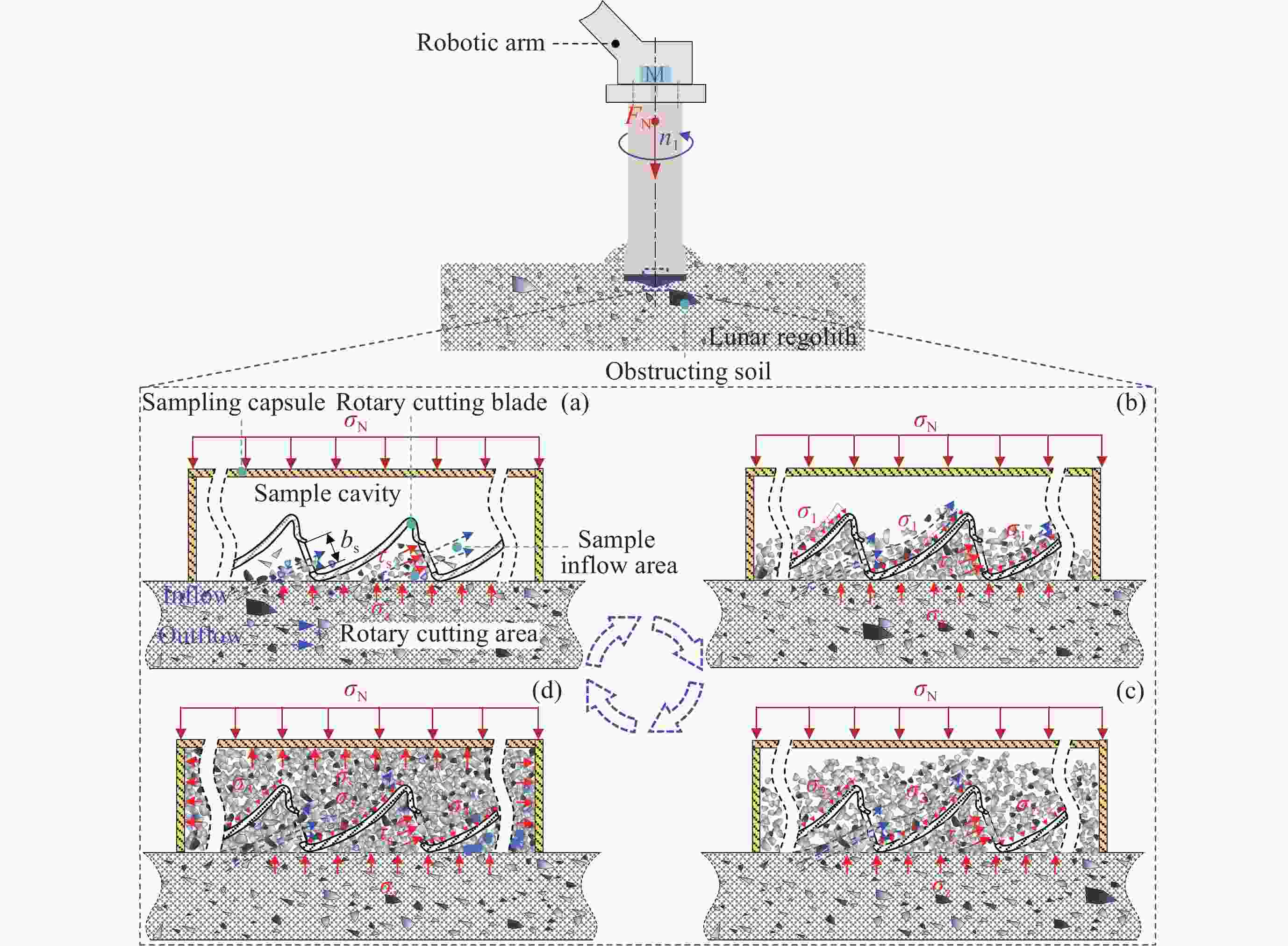
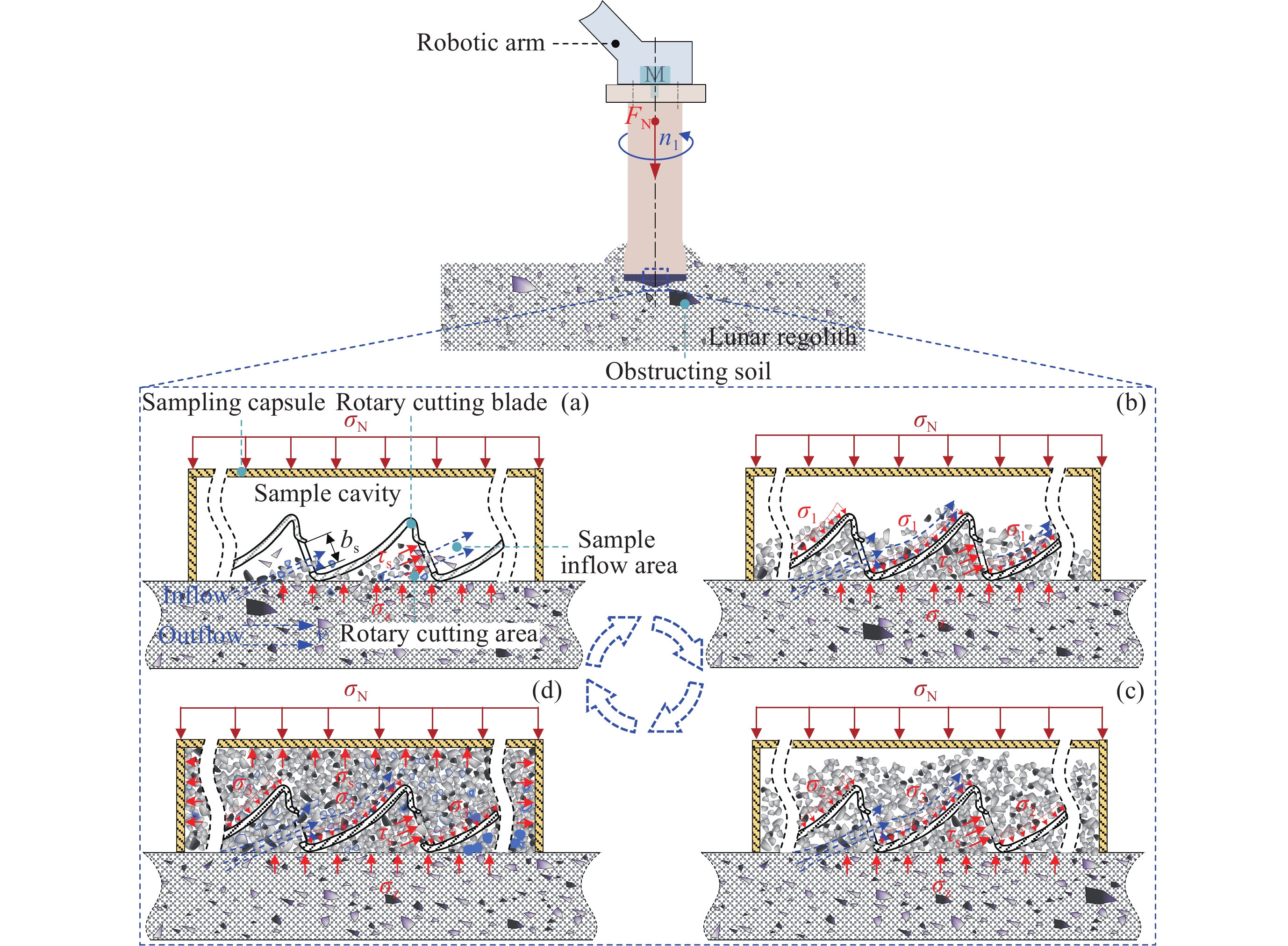
图 4 取样装置旋切采样工作原理. (a) 旋切破碎, (b) 样本运移与填充, (c) 完全填充, (d) 稳定密实
Figure 4. Working principle of sampling device rotary cutting. (a) Rotary cutting and crushing, (b) sample transfer and filling, (c) sample fully filled, (d) densify and stabilize
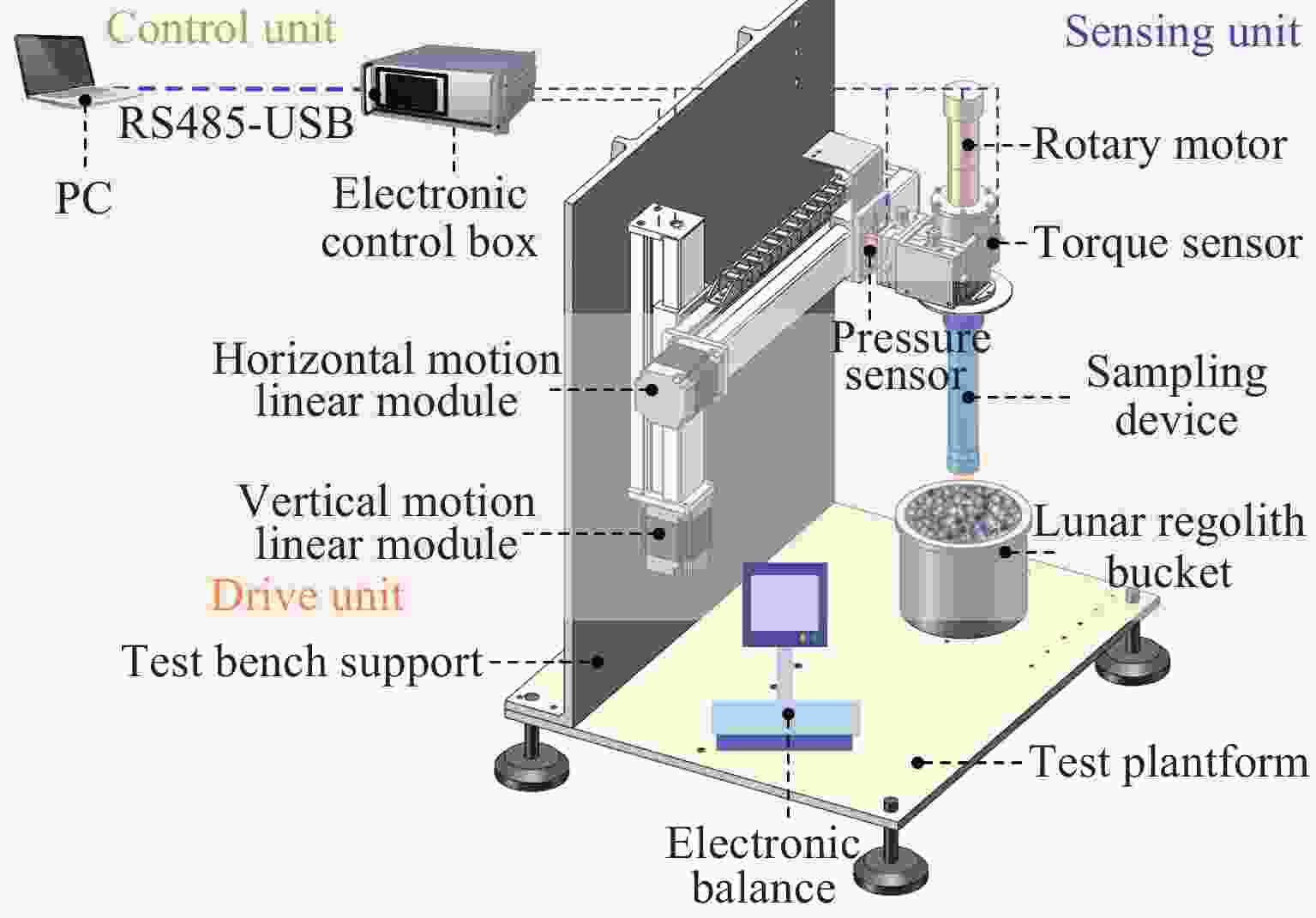
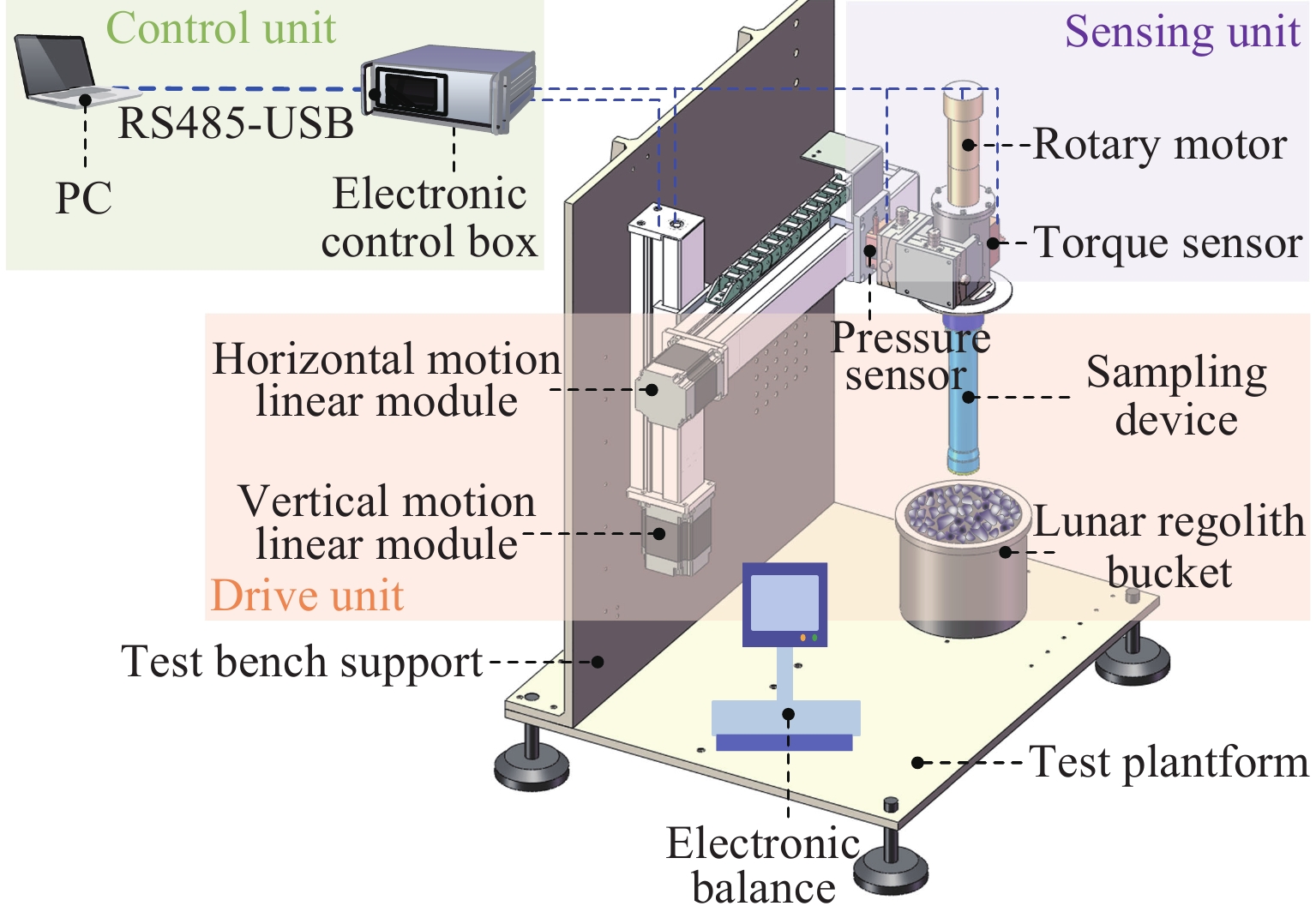
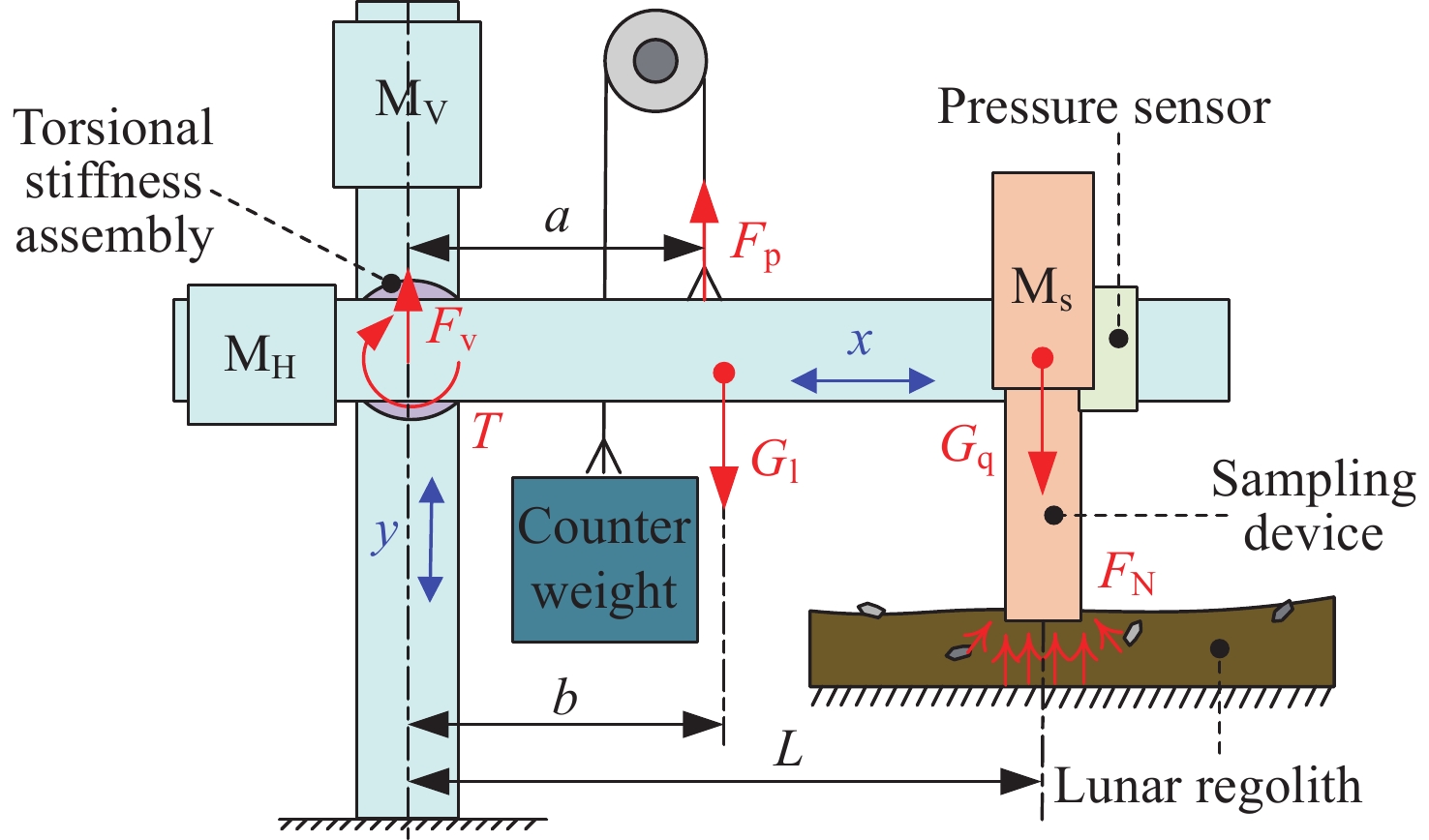
图 5 月壤微定量采样定标试验系统原理
Figure 5. Calibration system for micro-quantitative sampling of lunar regolith
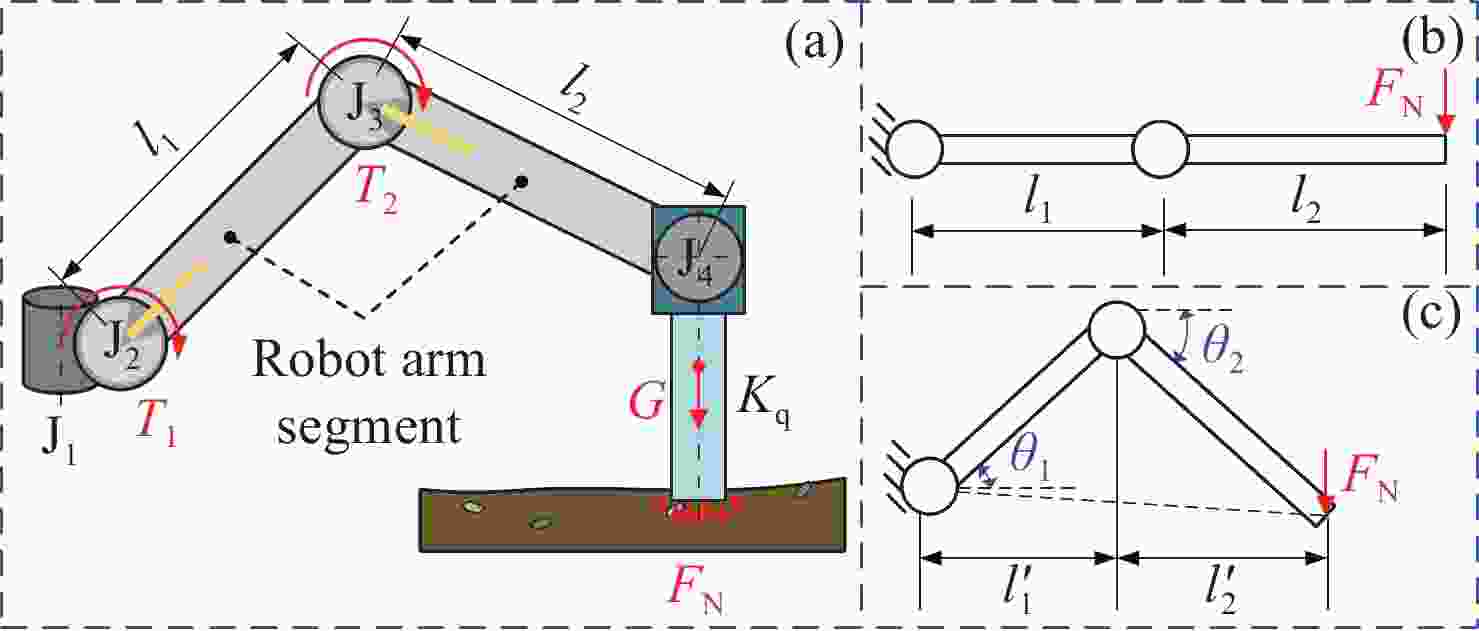
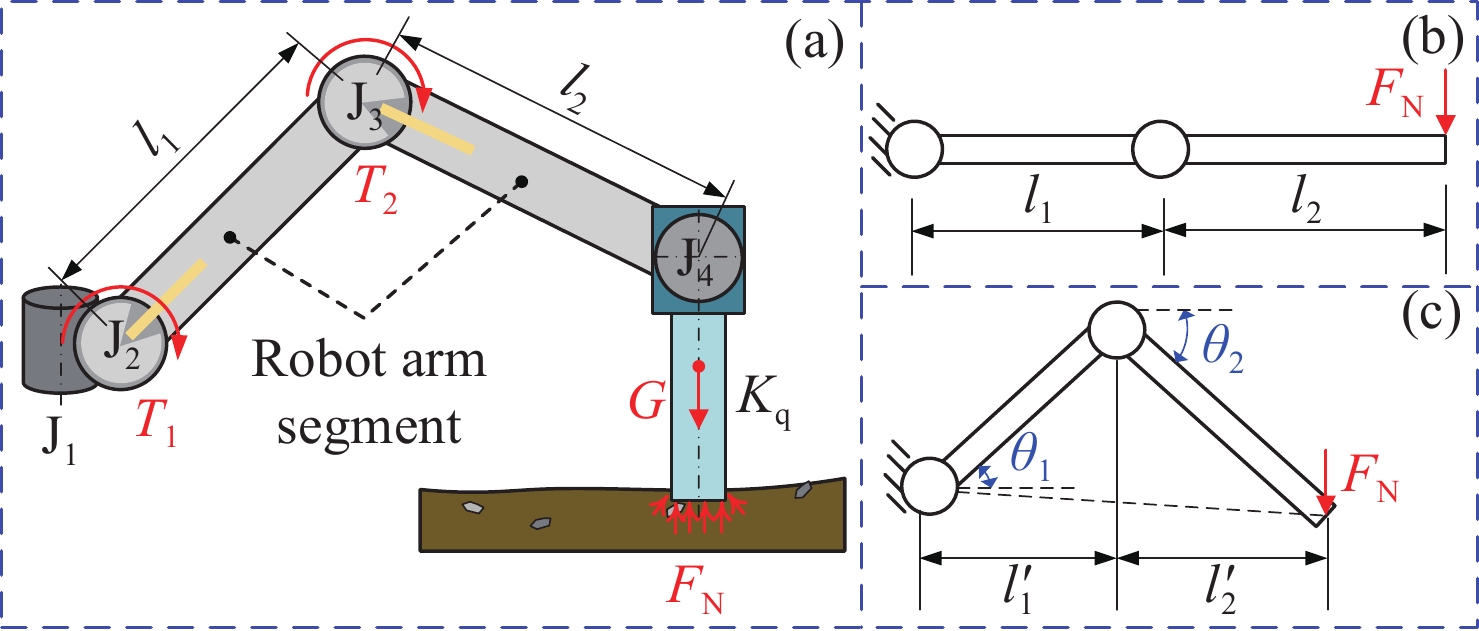
图 6 机械臂刚度分析. (a) 机械臂工作原理, (b) 取样刚度最小工作场景, (c) 机械臂正常工作场景
Figure 6. Stiffness analysis of robotic arm. (a) Schematic diagram of the robotic arm, (b) minimum stiffness during sampling, (c) normal operating scenario of the robotic arm
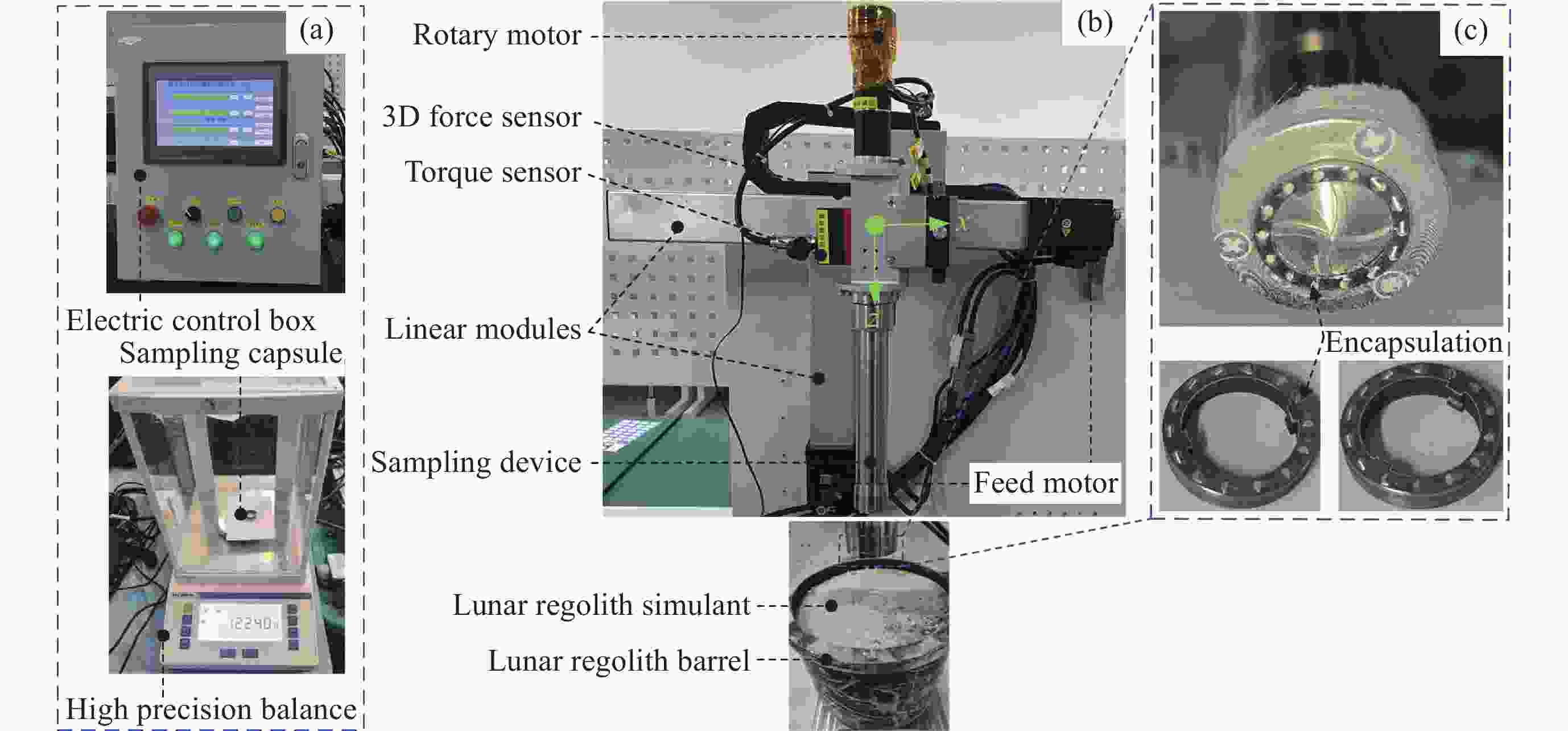
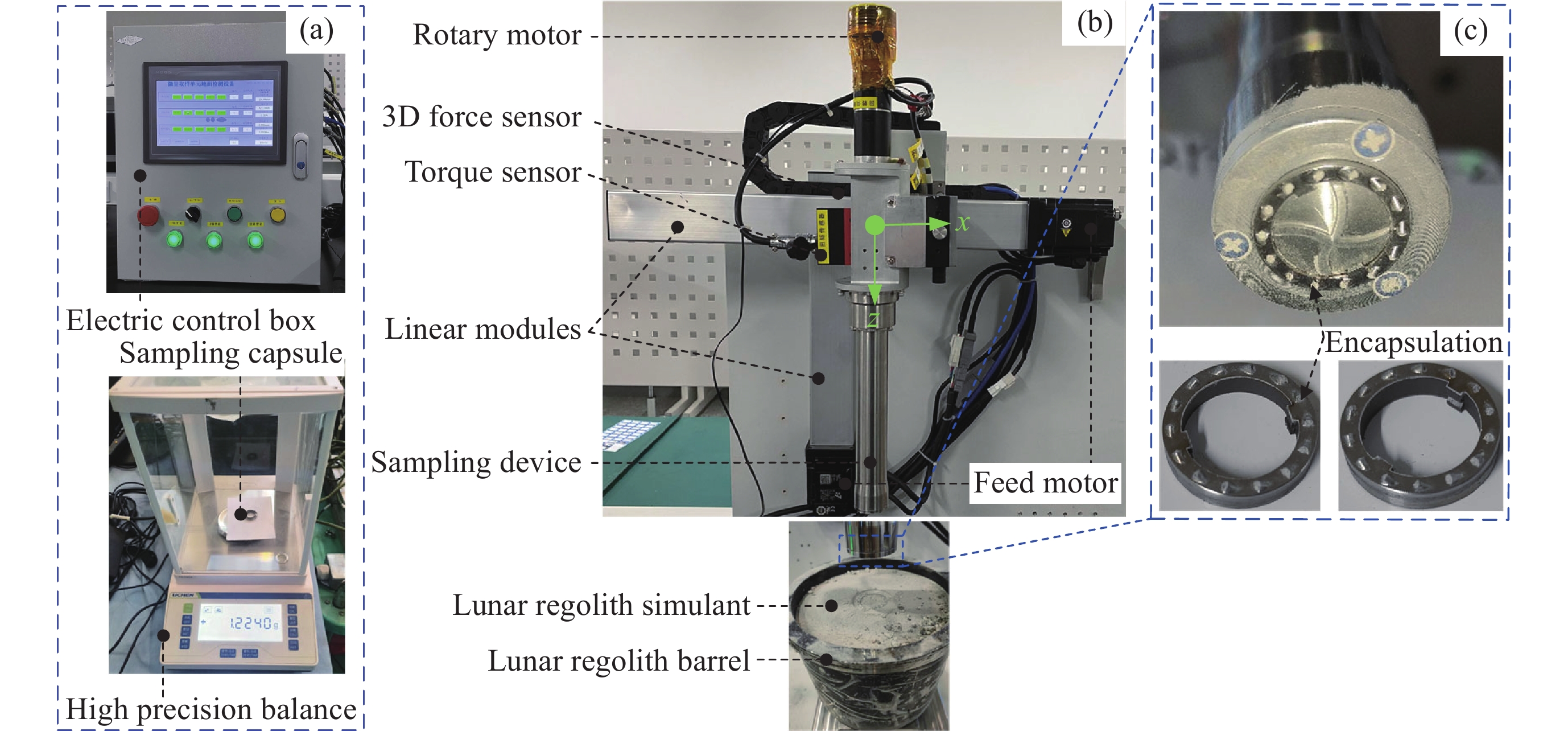
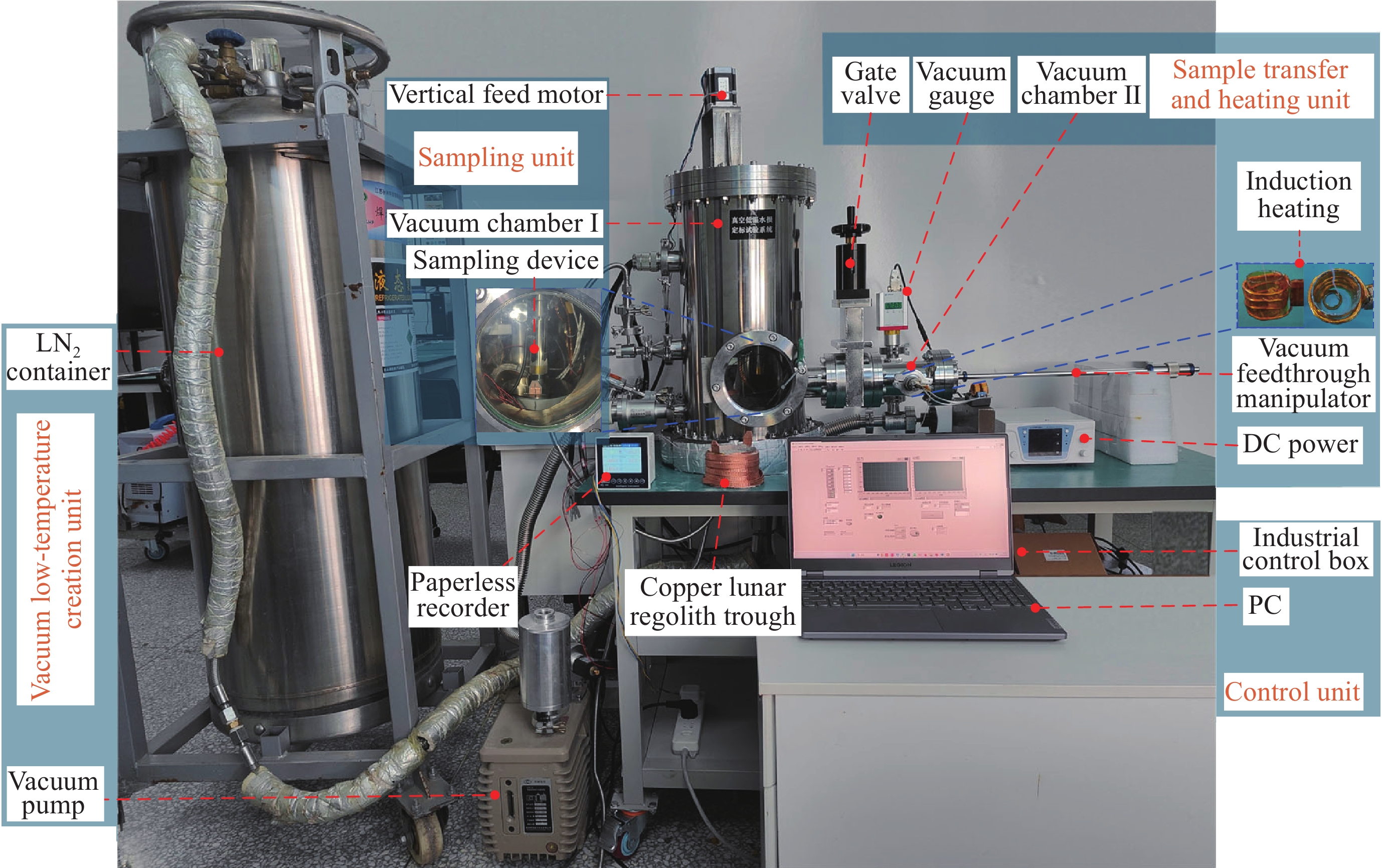
图 8 采样定标系统. (a) 控制和测量设备, (b) 采样试验台, (c) 采样后的采样片
Figure 8. Sampling calibration system. (a) Control and measuring equipment, (b) sampling test stand, (c) sampling capsule after sampling
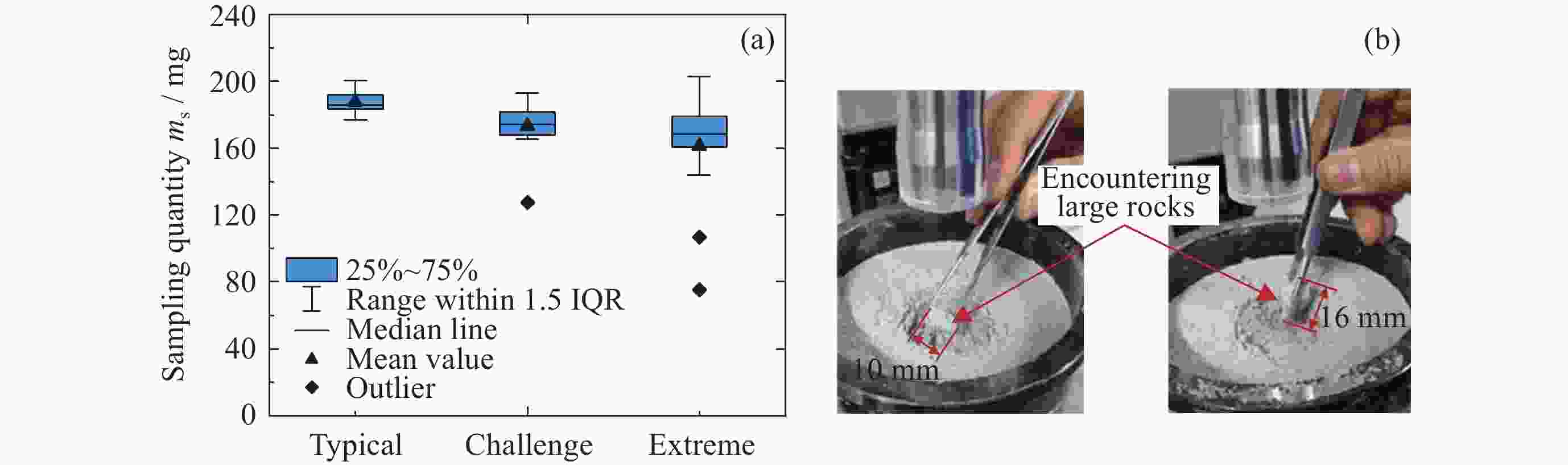
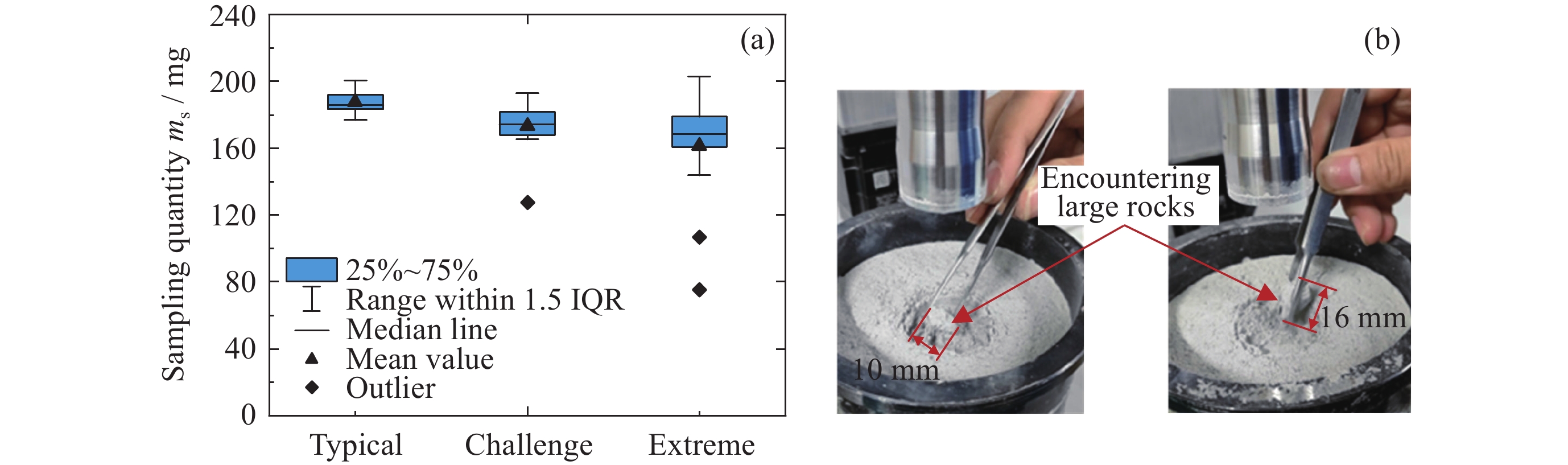
图 9 不同工况采样试验结果. (a) 采样量结果分析, (b) 采样过程遭遇岩块
Figure 9. Sampling test results under different operating conditions. (a) Analysis of sampling quantity statistics results, (b) encountering rocks during sampling
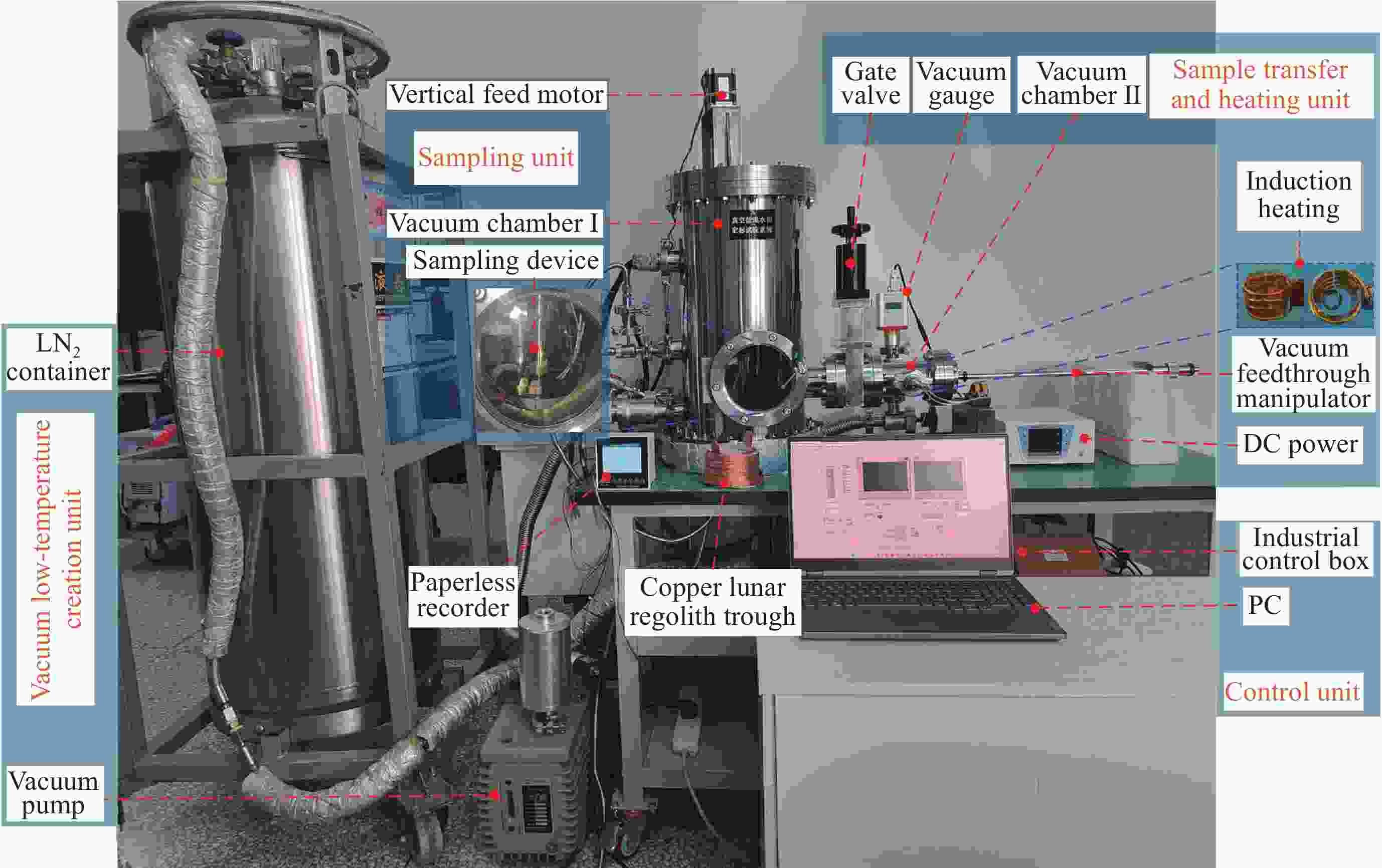
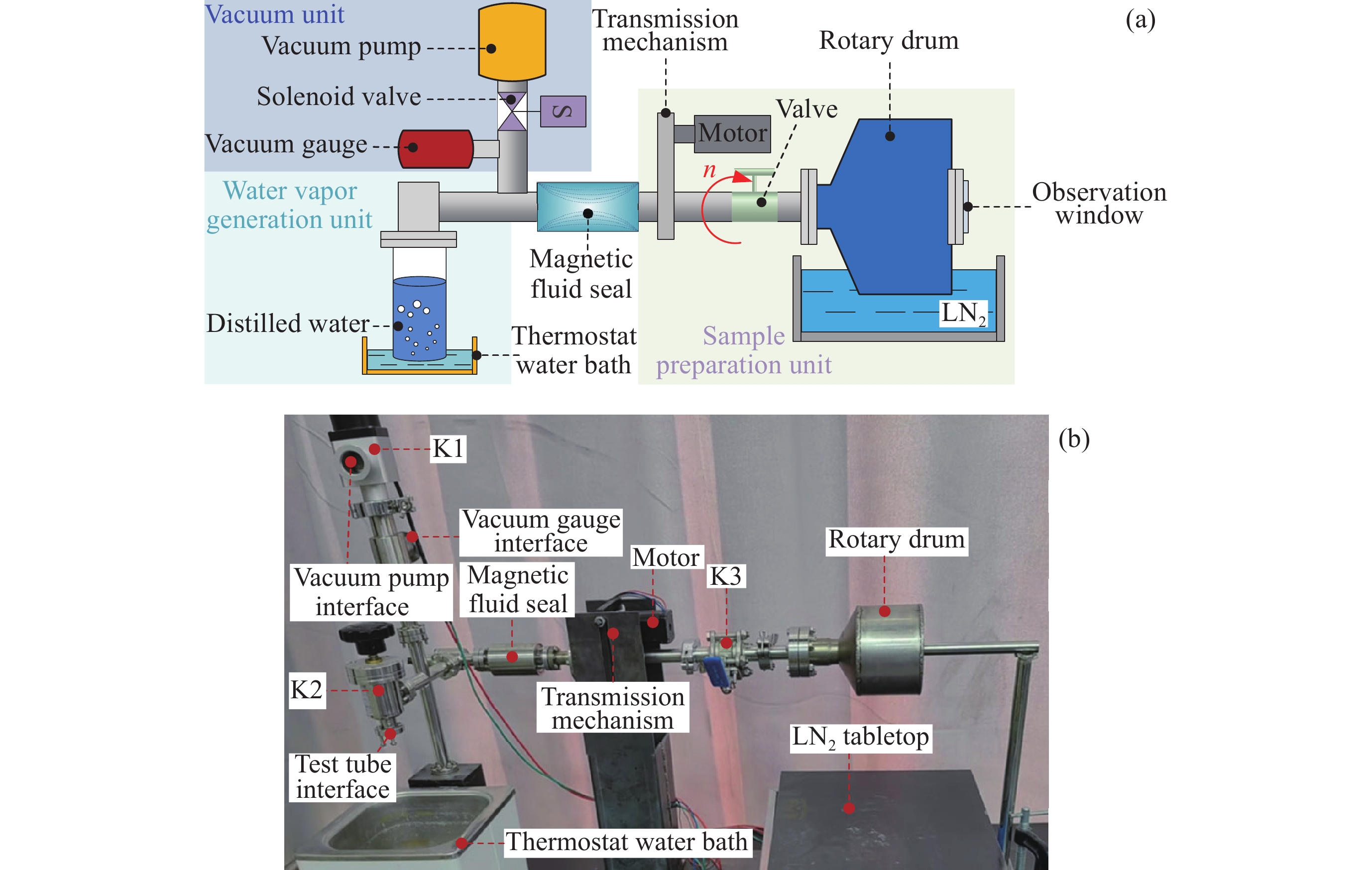
图 10 小型真空低温水损定标试验系统
Figure 10. Small vacuum low-temperature water loss calibration test system
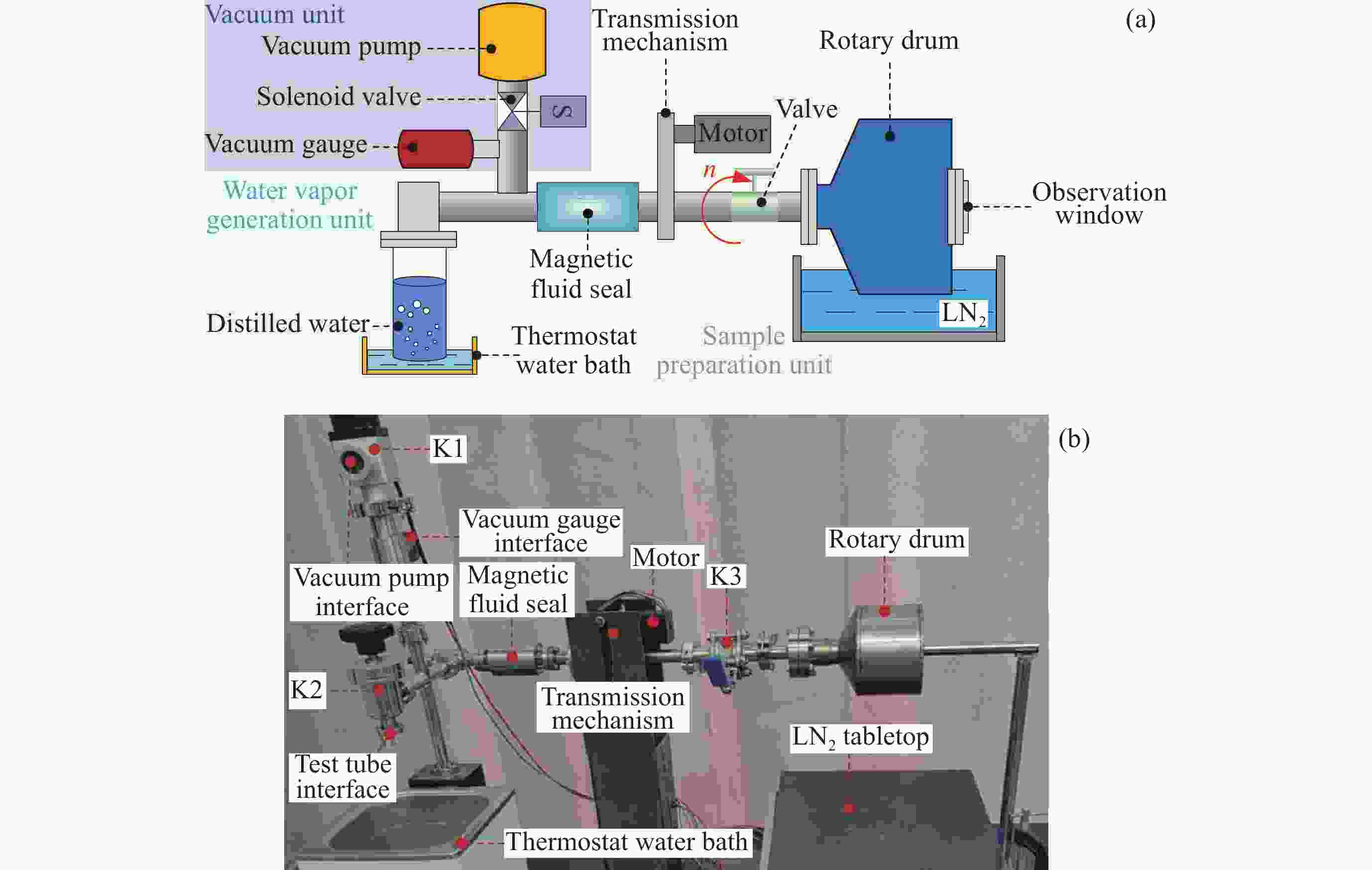
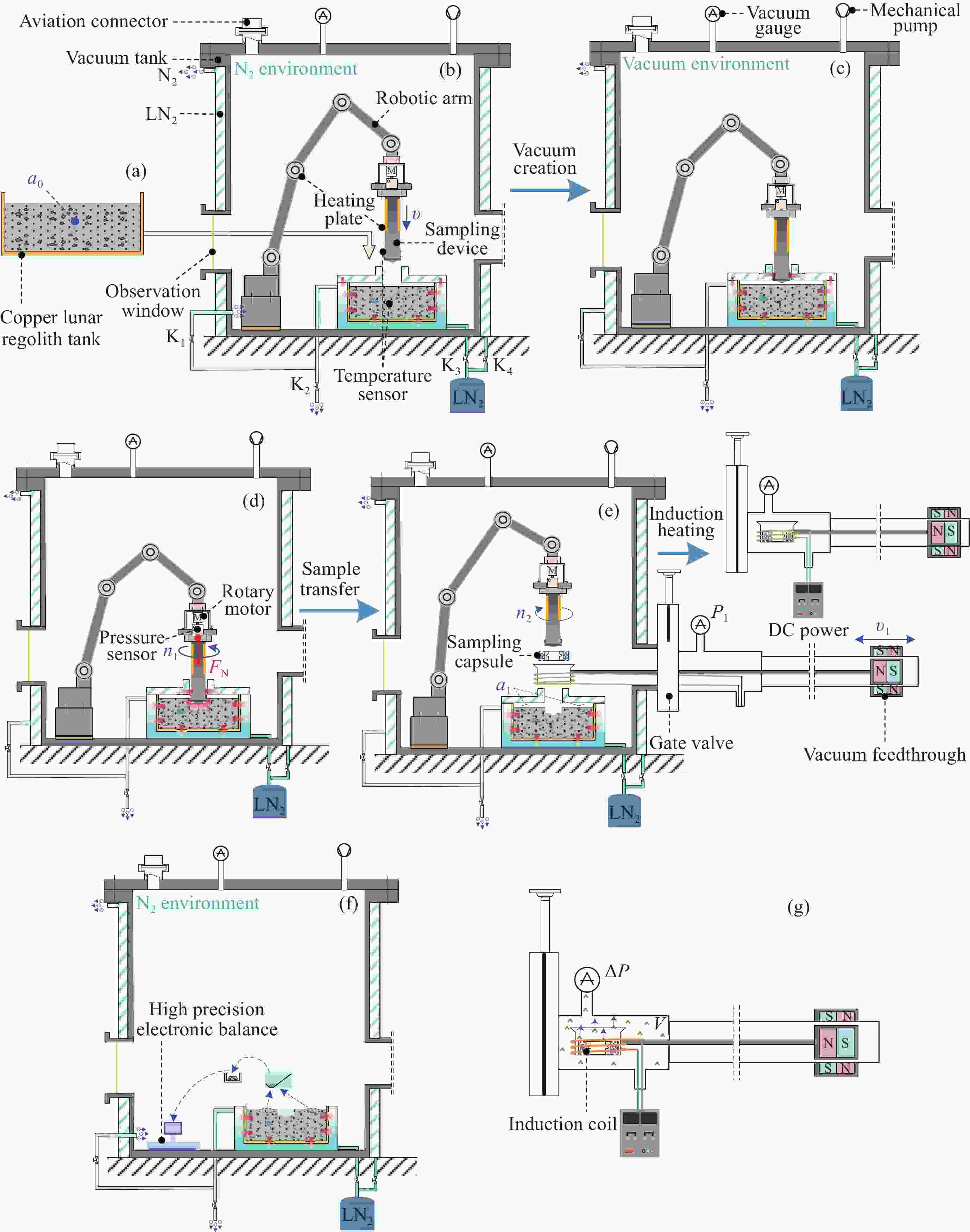
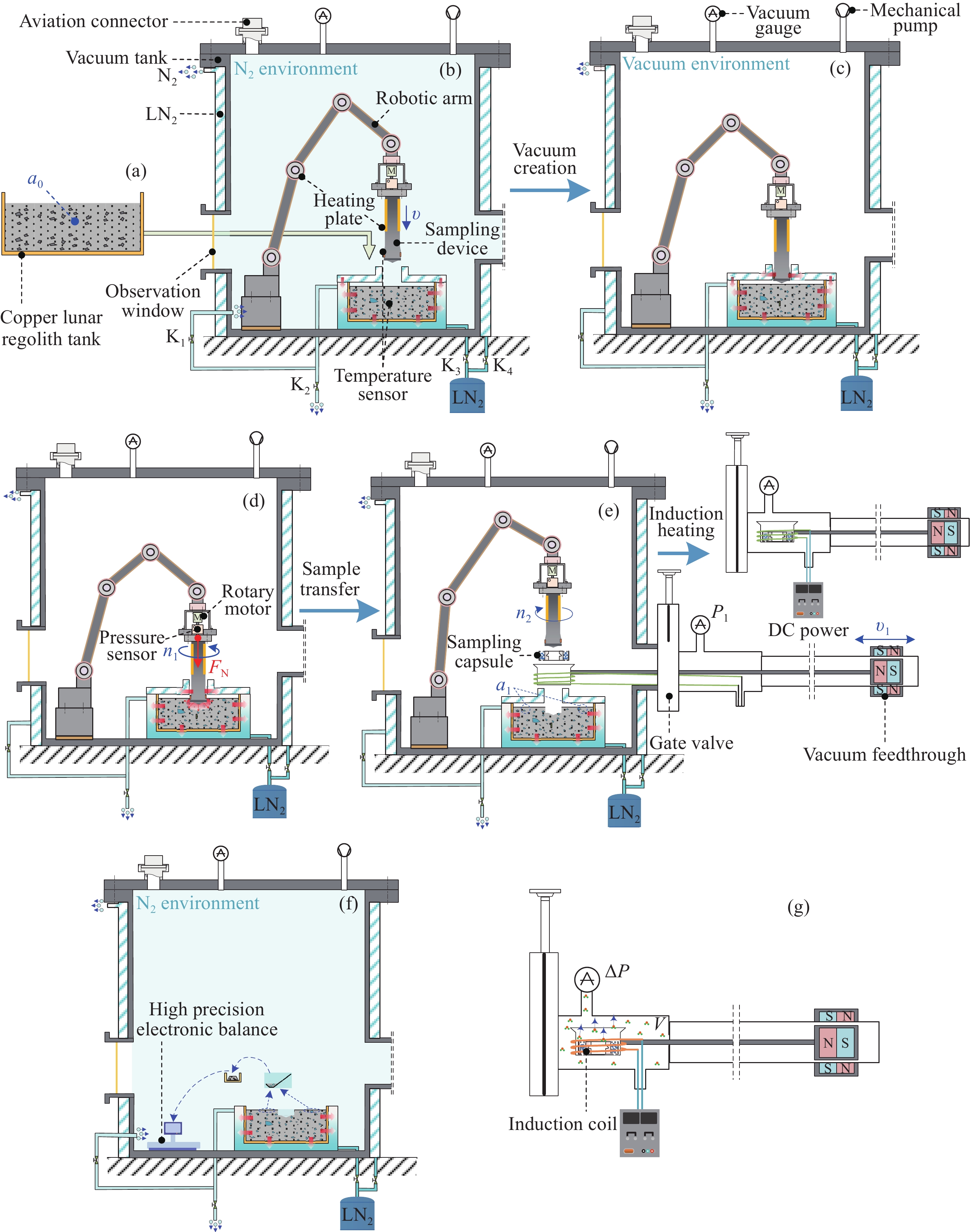
图 12 采样水损定标试验流程. (a) 月壤水冰模拟物制备, (b) 实验前样本预处理, (c) 真空环境营造, (d) 取样装置采样, (e) 采样片转移, (f) 表层含水率的测量, (g) 水汽提取与测量
Figure 12. Sampling water loss calibration test process. (a) Preparation of icy lunar regolith simulant, (b) sample pretreatment, (c) vacuum creating, (d) sampling by sampling device, (e) sampling capsule transfering, (f) measuring of surface moisture content, (g) water vapor extracting and measuring
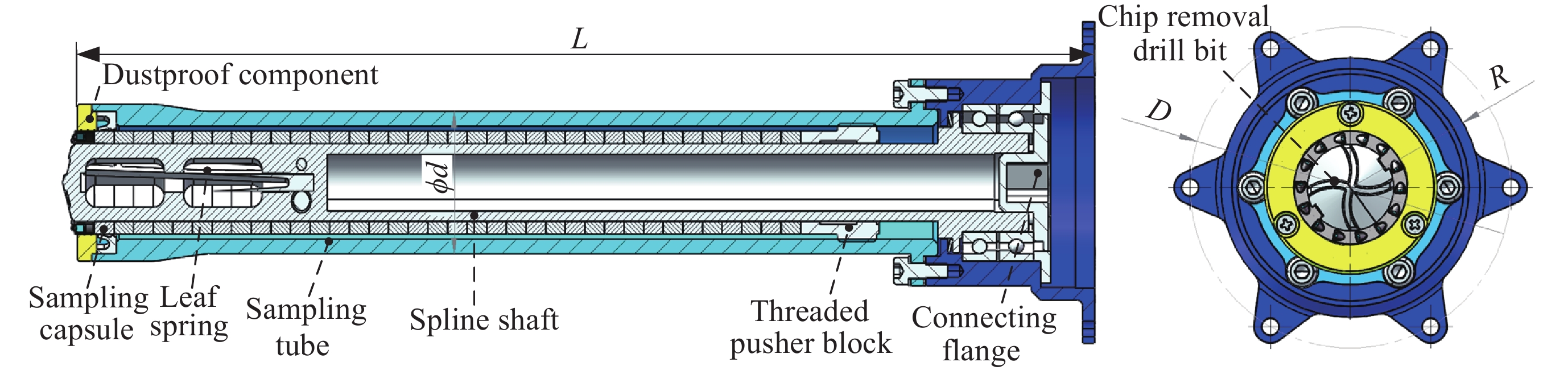
表 1 取样装置结构参数
Table 1. Structure parameters of sampling device
结构参数 尺寸/mm 连接法兰直径D 59.5 取样管头部半径R 16 取样管外径d 29 取样管长度L 207.5  下载: 导出CSV
表 2 月壤模拟物粒径级配
Table 2. Particle size distribution of lunar regolith simulant
粒径/mm 质量百分比/(%) 典型工况 挑战工况 极端工况 <1 81 61 60 1~2 7 7 10 2~4 5 15 10 4~10 5 15 10 10~16 2 12 5 >16 0 0 5
下载: 导出CSV
表 3 月壤模拟物密实度参数
Table 3. Compactness parameters of lunar regolith simulant
深度/mm 平均相对密实度/(%) 0~150 65 68 71 0~300 74 77 80
下载: 导出CSV
表 4 采样系统机械臂设计参数
Table 4. Design parameters of robotic arms for sampling system
名称 参量 数值 大臂长/mm l1 410 小臂长/mm l2 450 肩关节角度/(°) θ1 60 肘关节角度/(°) θ2 60 关节刚度/(N·m·rad–1) Kg 1.5×10⁴
下载: 导出CSV
表 5 不同位置配重与力的关系
Table 5. Relationship between counterweight and force at different positions
序号 配重悬挂位置a 配重力Fp 竖直力Fv 1 b [(Gq–FN)L+G1b]/b (G–FN) – [(Gq–FN)L+G1b]/b 2 c [(Gq–FN)L+G1b]/c (G–FN) – [(Gq–FN)L+G1b]/c 3 [(Gq–FN)L+G1b]/(G–FN) (G–FN) 0
下载: 导出CSV
-
[1] 张天, 唐红, 贺怀宇, 等. 月球水冰资源综合开发技术研究概况[J]. 空间科学学报, 2023, 43(2): 273-290 doi: 10.11728/cjss2023.02.2022-0069ZHANG Tian, TANG Hong, HE Huaiyu, et al. Review of comprehensive exploitation technology of lunar water ice resource[J]. Chinese Journal of Space Science, 2023, 43(2): 273-290 doi: 10.11728/cjss2023.02.2022-0069 [2] 季节, 张伟伟, 杨旭, 等. 月球极区水冰采样探测技术综述[J]. 深空探测学报(中英文), 2022, 9(2): 101-113 doi: 10.15982/j.issn.2096-9287.2022.20210151JI Jie, ZHANG Weiwei, YANG Xu, et al. Overview of water ice sampling and detection techniques in the lunar polar region[J]. Journal of Deep Space Exploration, 2022, 9(2): 101-113 doi: 10.15982/j.issn.2096-9287.2022.20210151 [3] 贾瑛卓, 覃朗, 徐琳, 等. 月球水冰探测[J]. 深空探测学报(中英文), 2020, 7(3): 290-296 doi: 10.15982/j.issn.2096-9287.2022.20210151JIA Yingzhuo, QIN Lang, XU Lin, et al. Lunar water-ice exploration[J]. Journal of Deep Space Exploration, 2020, 7(3): 290-296 doi: 10.15982/j.issn.2096-9287.2022.20210151 [4] 张志恒, 唐钧跃, 张伟伟, 等. 月壤微定量采样器设计与试验验证[J]. 深空探测学报(中英文), 2022, 9(2): 165-172ZHANG Zhiheng, TANG Junyue, ZHANG Weiwei, et al. Micro quantitative sampler for lunar regolith: design and validation[J]. Journal of Deep Space Exploration, 2022, 9(2): 165-172 [5] FINZI A E, ZAZZERA F B, DAINESE C, et al. SD2 – how to sample a comet[J]. Space Science Reviews, 2007, 128(1): 281-299 doi: 10.1007/s11214-006-9134-6 [6] LAWSON P R, KIZOVSKI T V, TICE M M, et al. Adaptive sampling with PIXL on the Mars Perseverance rover[J]. Icarus, 2025, 429: 116433 doi: 10.1016/j.icarus.2024.116433 [7] ARVIDSON R E, BONITZ R G, ROBINSON M L, et al. Results from the Mars Phoenix Lander Robotic Arm experiment[J]. Journal of Geophysical Research: Planets, 2009, 114(E1): E00E02 doi: 10.1109/aero.2009.4839306 [8] GROTZINGER J P, CRISP J, VASAVADA A R, et al. Mars science laboratory mission and science investigation[J]. Space Science Reviews, 2012, 170(1/2/3/4): 5-56 [9] MAHAFFY P R, WEBSTER C R, CABANE M, et al. The sample analysis at mars investigation and instrument suite[J]. Space Science Reviews, 2012, 170(1): 401-478 [10] 张鹏, 刘光辉, 刘欣, 等. 月面原位水资源获取技术与发展趋势[J]. 空间科学学报, 2024, 44(2): 309-317 doi: 10.11728/cjss2024.02.2023-0006ZHANG Peng, LIU Guanghui, LIU Xin, et al. Research progress of lunar in-situ water production techniques[J]. Chinese Journal of Space Science, 2024, 44(2): 309-317 doi: 10.11728/cjss2024.02.2023-0006 [11] PAIGE D A, SIEGLER M A, ZHANG J A, et al. Diviner lunar radiometer observations of cold traps in the Moon’s south polar region[J]. Science, 2010, 330(6003): 479-482 doi: 10.1126/science.1187726 [12] SANIN A B, MITROFANOV I G, LITVAK M L, et al. Hydrogen distribution in the lunar polar regions[J]. Icarus, 2017, 283: 20-30 doi: 10.1016/j.icarus.2016.06.002 [13] COLAPRETE A, SCHULTZ P, HELDMANN J, et al. Detection of water in the LCROSS Ejecta plume[J]. Science, 2010, 330(6003): 463-468 doi: 10.1126/science.1186986 [14] 徐克, 周孙鹏, 杨阳, 等. 月壤多孔介质中水分子原位扩散规律研究进展[J]. 空间科学与试验学报, 2024, 1(3): 6-16 doi: 10.19963/j.cnki.2097-4302.2024.03.002XU Ke, ZHOU Sunpeng, YANG Yang, et al. Research progress on in-situ water vapor diffusion in lunar regolith[J]. Journal of Space Science and Experiment, 2024, 1(3): 6-16 doi: 10.19963/j.cnki.2097-4302.2024.03.002 [15] HAYNE P O, AHARONSON O, SCHÖRGHOFER N. Micro cold traps on the Moon[J]. Nature Astronomy, 2020, 5(2): 169-175 doi: 10.1038/s41550-020-1198-9 [16] 余后满, 饶炜, 张益源, 等. “嫦娥七号”探测器任务综述[J]. 深空探测学报(中英文), 2023, 10(6): 567-576 doi: 10.15982/j.issn.2096-9287.2023.20230119YU Houman, RAO Wei, ZHANG Yiyuan, et al. Mission analysis and spacecraft design of Chang’E-7[J]. Journal of Deep Space Exploration, 2023, 10(6): 567-576 doi: 10.15982/j.issn.2096-9287.2023.20230119 [17] SLYUTA E N. Physical and mechanical properties of the lunar soil (a review)[J]. Solar System Research, 2014, 48(5): 330-353 doi: 10.1134/S0038094614050050 [18] BASU A, RIEGSECKER S. Modal mineralogic distribution in the regolith at Apollo landing sites[J]. Journal of Geophysical Research: Planets, 2000, 105(E2): 4361-4368 doi: 10.1029/1999JE001084 [19] 季节, 王晓光, 肖俊孝, 等. 月球冻土模拟与剪切强度试验分析[J]. 深空探测学报(中英文), 2023, 10(2): 199-210JI Jie, WANG Xiaoguang, XIAO Junxiao, et al. Simulation of icy lunar regolith and experiment on its shear strength[J]. Journal of Deep Space Exploration, 2023, 10(2): 199-210 [20] XIAO J X, JIANG S Y, TANG J Y, et al. A study of high-velocity penetration on icy lunar regolith simulants[J]. International Journal of Mechanical Sciences, 2024, 271: 109147 doi: 10.1016/j.ijmecsci.2024.109147 [21] TANG J Y, QUAN Q Q, JIANG S Y, et al. Dynamic-compacting based lunar soil simulant preparation for subsurface exploration[J]. Acta Astronautica, 2020, 167: 222-231 doi: 10.1016/j.actaastro.2019.08.014 [22] 李雄耀, 魏广飞, 曾小家, 等. 极区月壤和水冰形成演化机制及物理特性研究[J]. 深空探测学报(中英文), 2022, 9(2): 123-133 doi: 10.15982/j.issn.2096-9287.2022.20210147LI Xiongyao, WEI Guangfei, ZENG Xiaojia, et al. Review of the lunar regolith and water ice on the poles of the Moon[J]. Journal of Deep Space Exploration, 2022, 9(2): 123-133 doi: 10.15982/j.issn.2096-9287.2022.20210147 [23] MOORES J E. Lunar water migration in the interval between large impacts: heterogeneous delivery to permanently shadowed regions, fractionation, and diffusive barriers[J]. Journal of Geophysical Research: Planets, 2016, 121(1): 46-60 doi: 10.1002/2015JE004929 [24] TEOLIS B, SARANTOS M, SCHORGHOFER N, et al. Surface exospheric interactions[J]. Space Science Reviews, 2023, 219(1): 4 doi: 10.1007/s11214-023-00951-5 [25] LIN H L, LI S, XU R, et al. In situ detection of water on the Moon by the Chang’E-5 lander[J]. Science Advances, 2022, 8(1): eabl9174 doi: 10.1126/sciadv.abl9174 [26] LIU J J, LIU B, REN X, et al. Evidence of water on the lunar surface from Chang’E-5 in-situ spectra and returned samples[J]. Nature Communications, 2022, 13(1): 3119 doi: 10.1038/s41467-022-30807-5 [27] LIU B, ZENG X G, XU R, et al. Lunar surface and subsurface water revealed by Chang’E-6[J]. Nature Astronomy, 2025, 9(12): 1776-1784 doi: 10.1038/s41550-025-02668-7 [28] ZHOU C J, TANG H, LI X Y, et al. Chang’E-5 samples reveal high water content in lunar minerals[J]. Nature Communications, 2022, 13(1): 5336 doi: 10.1038/s41467-022-33095-1 [29] LI S, MORIARTY III D P, PIETERS C M, et al. A controlled mosaic of moon mineralogy mapper (M3) reflectance data in the lunar polar regions for understanding the mineralogy and water of the artemis exploration zone[J]. Icarus, 2025, 440: 116668 doi: 10.1016/j.icarus.2025.116668 [30] LI M Y, SUN J H, YUE X A, et al. Upper limit of ice content at the lunar south pole as revealed by the Earth-based SYISR–FAST bistatic radar system[J]. Science Bulletin, 2025, 70(10): 1691-1698 doi: 10.1016/j.scib.2025.02.033 [31] 周孙鹏, 徐克. 月壤孔隙内水冰奥斯特瓦尔德熟化理论[J]. 空间科学与试验学报, 2025, 2(3): 11-18 doi: 10.19963/j.cnki.2097-4302.2025.03.002ZHOU Sunpeng, XU Ke. Ostwald ripening of water-ice particles in lunar regolith pore space[J]. Journal of Space Science and Experiment, 2025, 2(3): 11-18 doi: 10.19963/j.cnki.2097-4302.2025.03.002 [32] 姜生元, 刘君巍, 李雄耀, 等. 月壤水冰组构特征模拟及其力学特性研究展望与构想[J]. 机械工程学报, 2024, 60(22): 351-363JIANG Shengyuan, LIU Junwei, LI Xiongyao, et al. Prospects and ideas on the simulation of the fabric feature of lunar icy regolith and the test of its mechanical properties[J]. Journal of Mechanical Engineering, 2024, 60(22): 351-363 [33] RICARDO D, HODGKINSON J, RHAMDHANI M A, et al. A review on the preparation techniques and geotechnical behaviour of icy lunar regolith simulants[J]. Advances in Space Research, 2023, 72(10): 4553-4581 doi: 10.1016/j.asr.2023.09.032 [34] TIAN Y, TANG J Y, JIANG S Y, et al. Lunar regolith water ice simulation method and characterization[J]. Icarus, 2024, 417: 116119 doi: 10.1016/j.icarus.2024.116119 [35] ZHANG Z H, CHI G X, TANG J Y, et al. Soil flow behavior in baffled rotary drum based icy lunar regolith simulant preparation[J]. Powder Technology, 2025, 451: 120460 doi: 10.1016/j.powtec.2024.120460 -
-

 下载:
下载:

计量
- 文章访问数: 1500
- HTML全文浏览量: 793
- PDF下载量: 119
-
被引次数:
0(来源:Crossref)
0(来源:其他)

