


单台站地磁Kpest指数数据集(2022-2024年)
doi: 10.11728/cjss2026.02.2025-0131 cstr: 32142.14.cjss.2025-0131
-
 王晶 女, 1978年12月出生于辽宁省抚顺市, 现为中国科学院国家空间科学中心副研究员, 主要研究方向为空间环境监测数据应用、空间环境指数建模等. E-mail: jwang@nssc.ac.cn
 -
 钟秋珍 女, 1974年8月出生于河南省唐河县, 现为中国科学院国家空间科学中心研究员、硕士研究生导师, 主要研究方向为空间环境预报方法与模型. E-mail: zhongqz@nssc.ac.cn
作者简介:
通讯作者:
A Dataset of Geomagnetic Kpest Index from Individual Stations (2022-2024)
-
摘要: 2011年中国科学院国家空间科学中心建立了中国科学院空间环境监测网, 地磁台站分别位于漠河、北京、廊坊、三亚、富克. 通过融合处理这5个地磁台站磁通门磁力仪H分量监测数据, 发展一种可以有效识别地磁规则日变化, 反映地磁扰动季节变化和地方时效应, 并且适合中国地磁台网分布特性的估算地磁指数Kpest. 本数据集包含2022-2024年5个地磁台站的地磁指数Kpest, 能够改变目前官方Kp指数发布延迟2周无法满足业务需求的现状, 为空间天气预报服务提供数据支撑.Abstract: The Kp index is a parameter designed to indicate the level of global geomagnetic disturbances originating from the interaction of the solar wind with the magnetosphere. The index is defined at 3-hour intervals and has 28 levels. Kp is a global version of the local K index, which was conceived by Bartels and is commonly used in scientific research of the solar-terrestrial relationship. The continuity of the index over 50 year makes it particularly valuable in studies of solar-cycle variations and other long-term effects on interplanetary and magnetospheric phenomena. For example, Kp has been used in studies of solar wind shock waves, the interplanetary magnetic field, plasma density variations in the magnetosphere, and magnetospheric ULF waves. In addition, the index is widely used as an input to magnetospheric/ionospheric models. For example, the plasmapause is modeled to move closer to the Earth with increasing Kp. The location of substorm injection is modeled to have a similar Kp dependence. The magnetic field model of Tsyganenko has an explicit Kp dependence, and the magnetotail becomes more stretched for higher Kp. These models are used both in scientific research and in monitoring and predicting space weather. In 2011, the National Space Science Center of the Chinese Academy of Sciences established the Chinese Academy of Sciences Space Environment Monitoring Network, which included Mohe, Beijing, Langfang, Sanya, and Fuke stations. A geomagnetic Kpest index, which can effectively identify the day-to-day variation characteristics of the geomagnetic regular daily variation, reflect the seasonal and local time effects of geomagnetic disturbances, and is suitable for the distribution characteristics of China’s geomagnetic observatory network, has been developed through the integration and processing of the H-component monitoring data from fluxgate magnetometers at these five geomagnetic observatory stations. This dataset contains the geomagnetic Kpest indices for the five geomagnetic observatory stations from 2022 to 2024. It addresses the current situation where the official Kp index is released with a two-week delay, failing to meet operational requirements, and can provide data support for space weather forecasting services.
-
Key words:
- Kpest index /
- Geomagnetic storm /
- Space weather /
- Fluxgate magnetometer
-
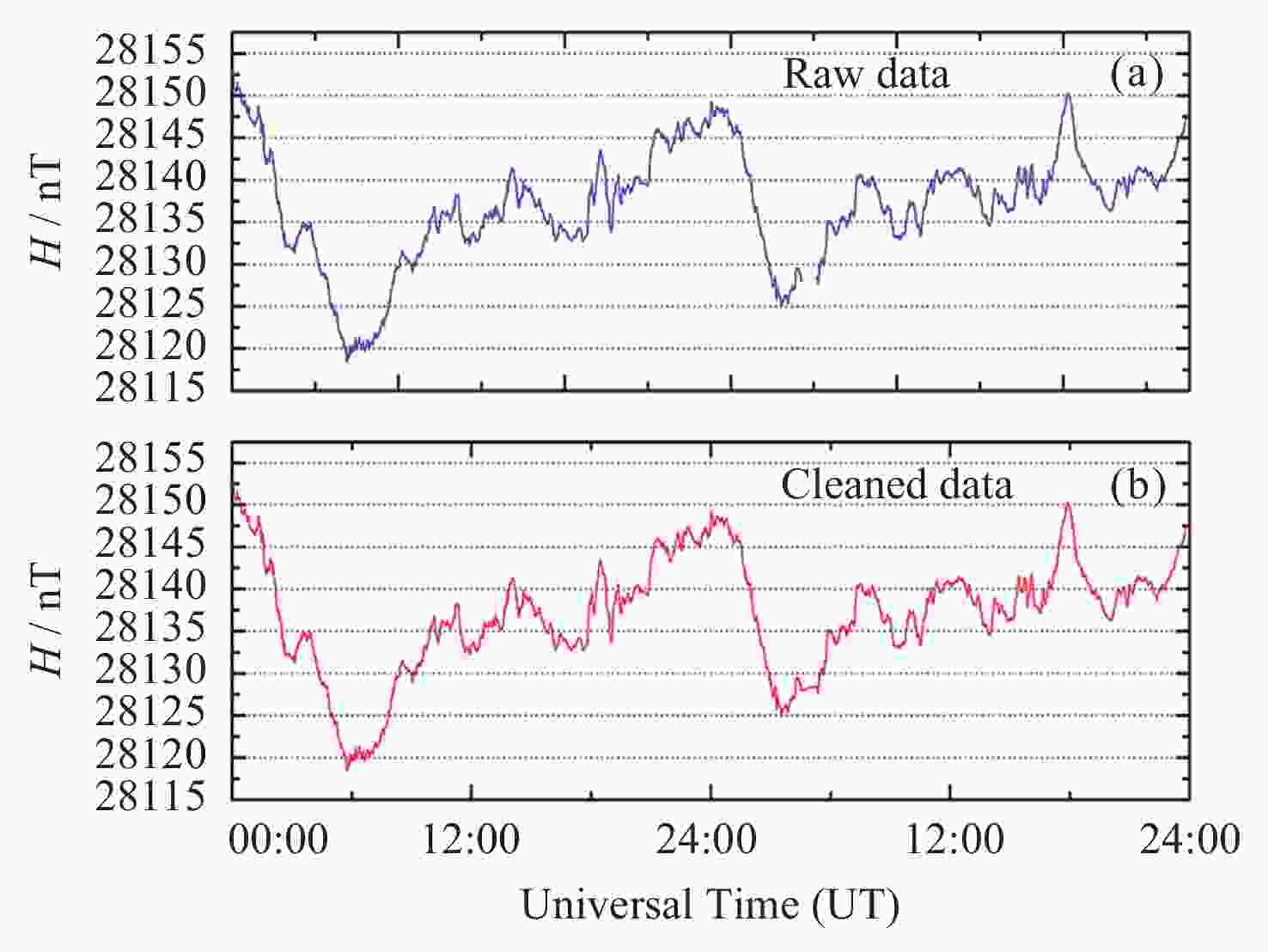
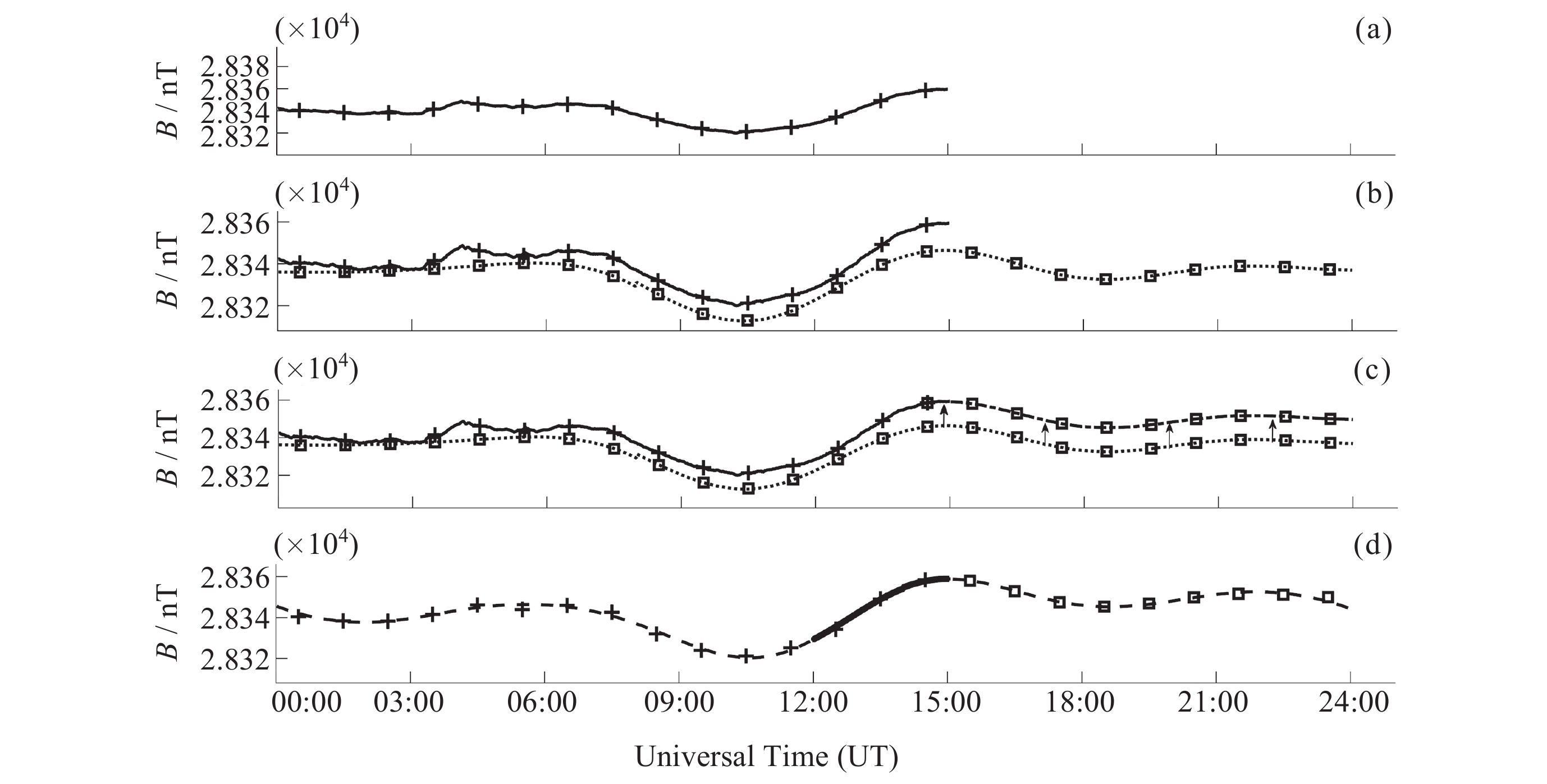
图 2 2024年1月30-31日北京台站地磁H分量数据修正前后对比
Figure 2. Comparison of the data of the H component of the geomagnetic field in Beijing station before and after correction on 30-31 Jan. 2024
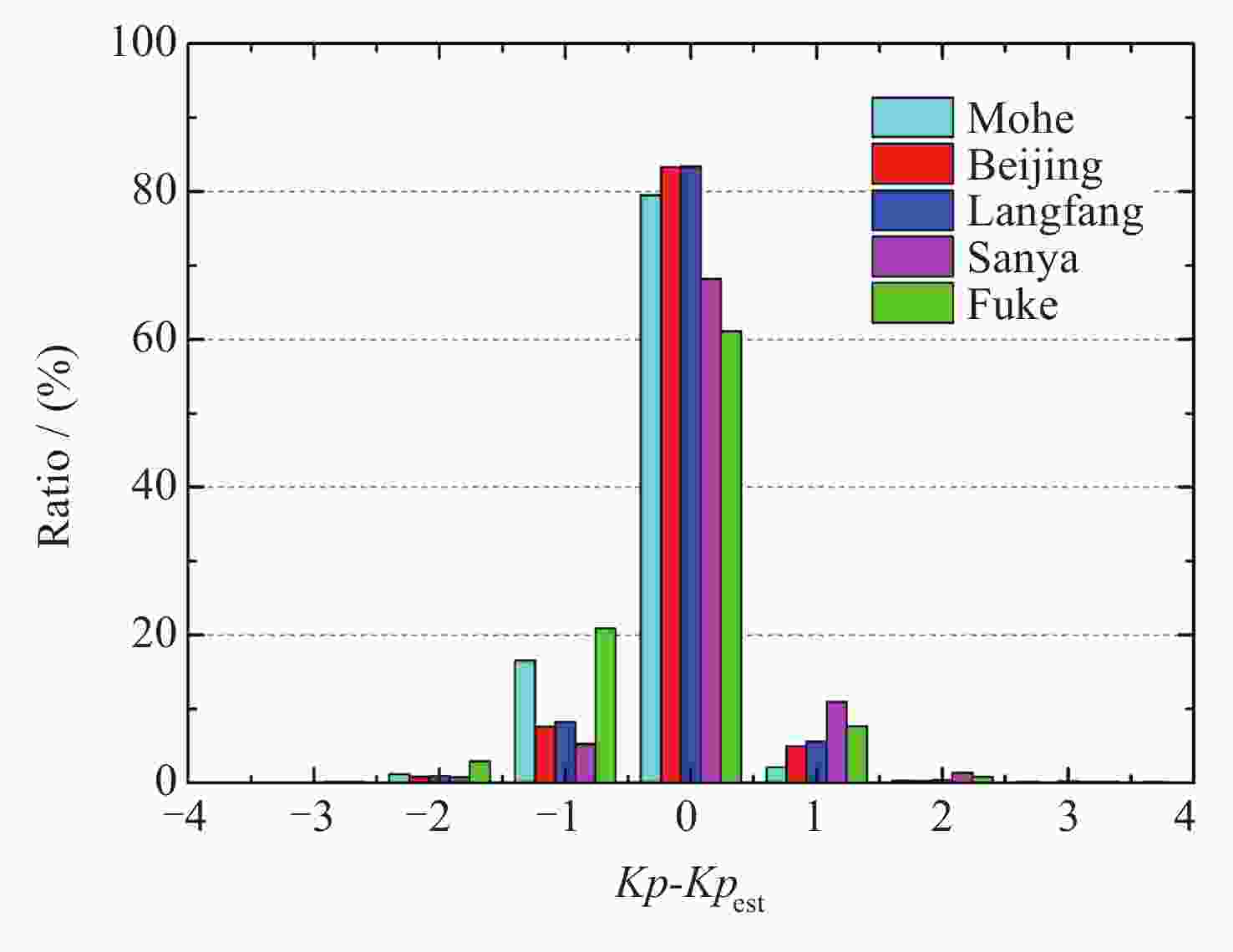
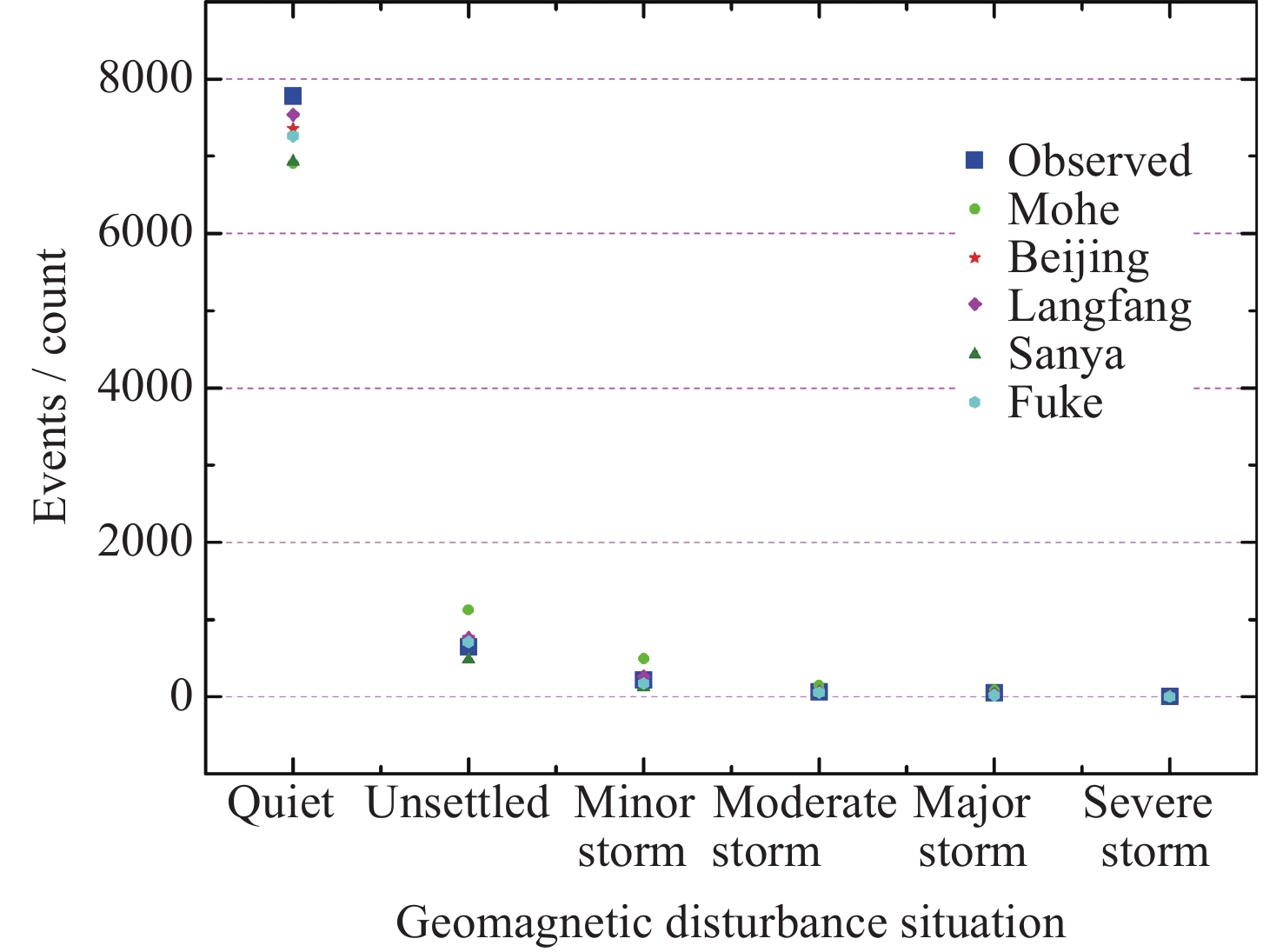
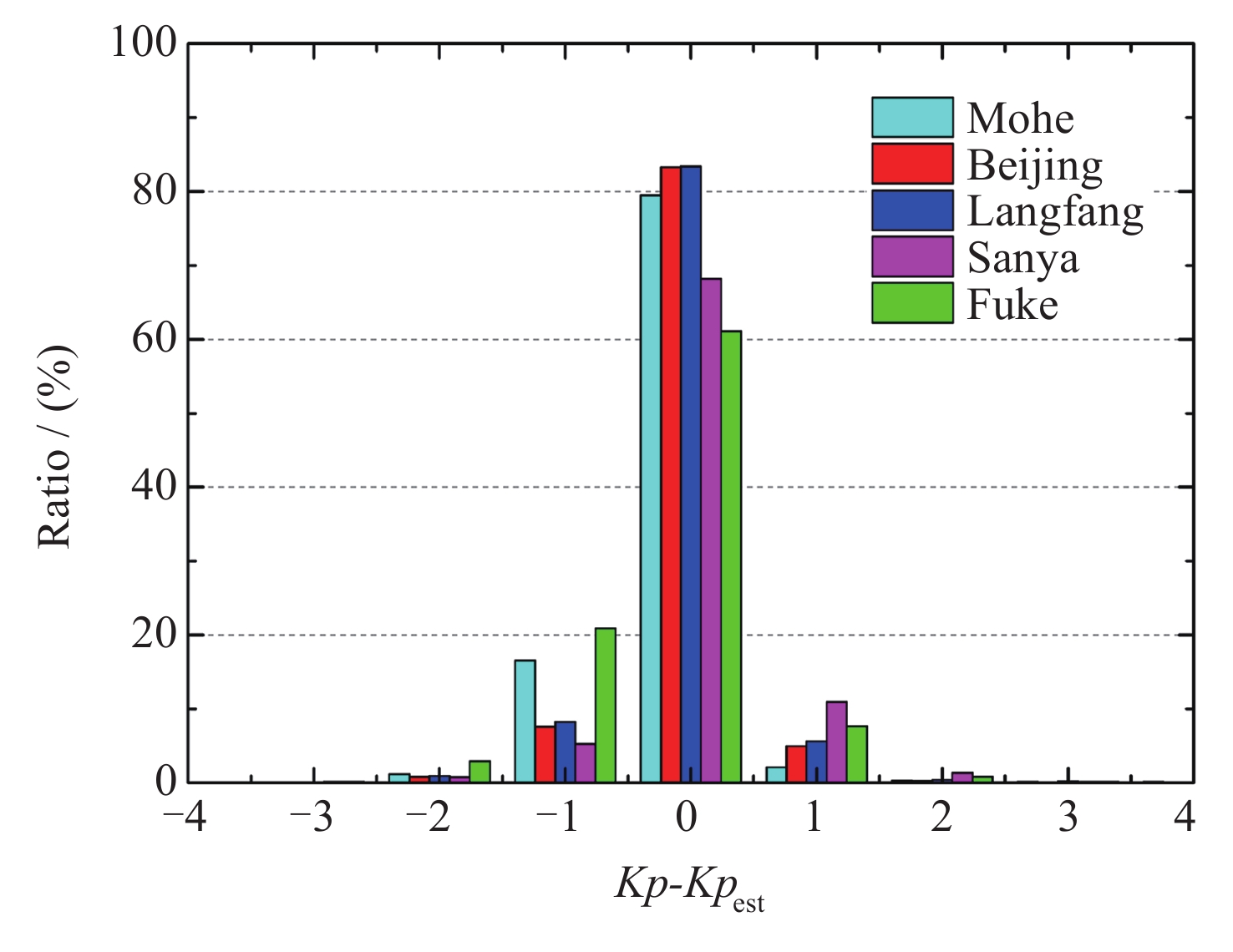
图 7 5个台站Kpest指数与官方Kp指数差值分布
Figure 7. Differences distribution between the Kpest indices of 5 stations and the official Kp index
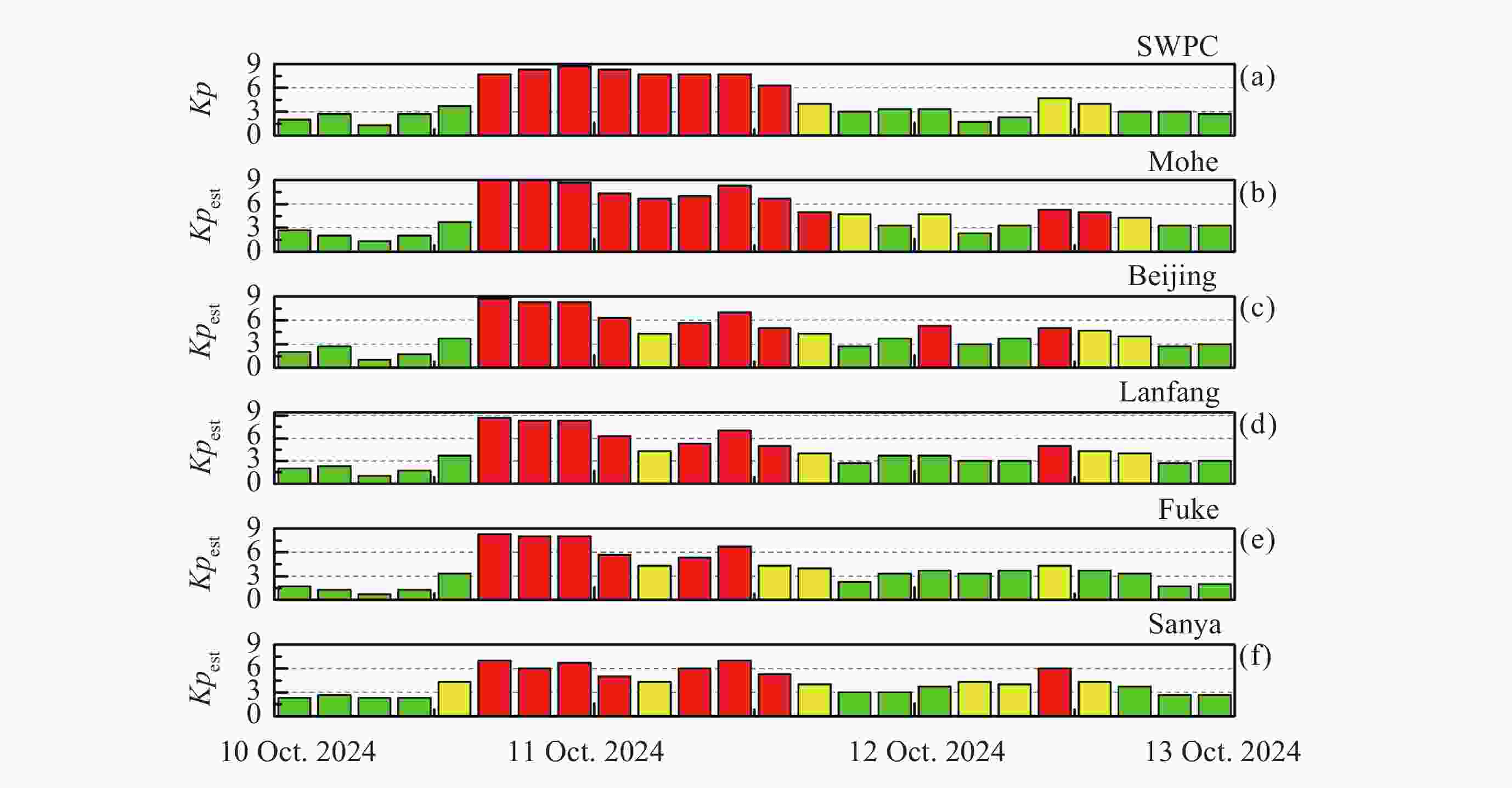
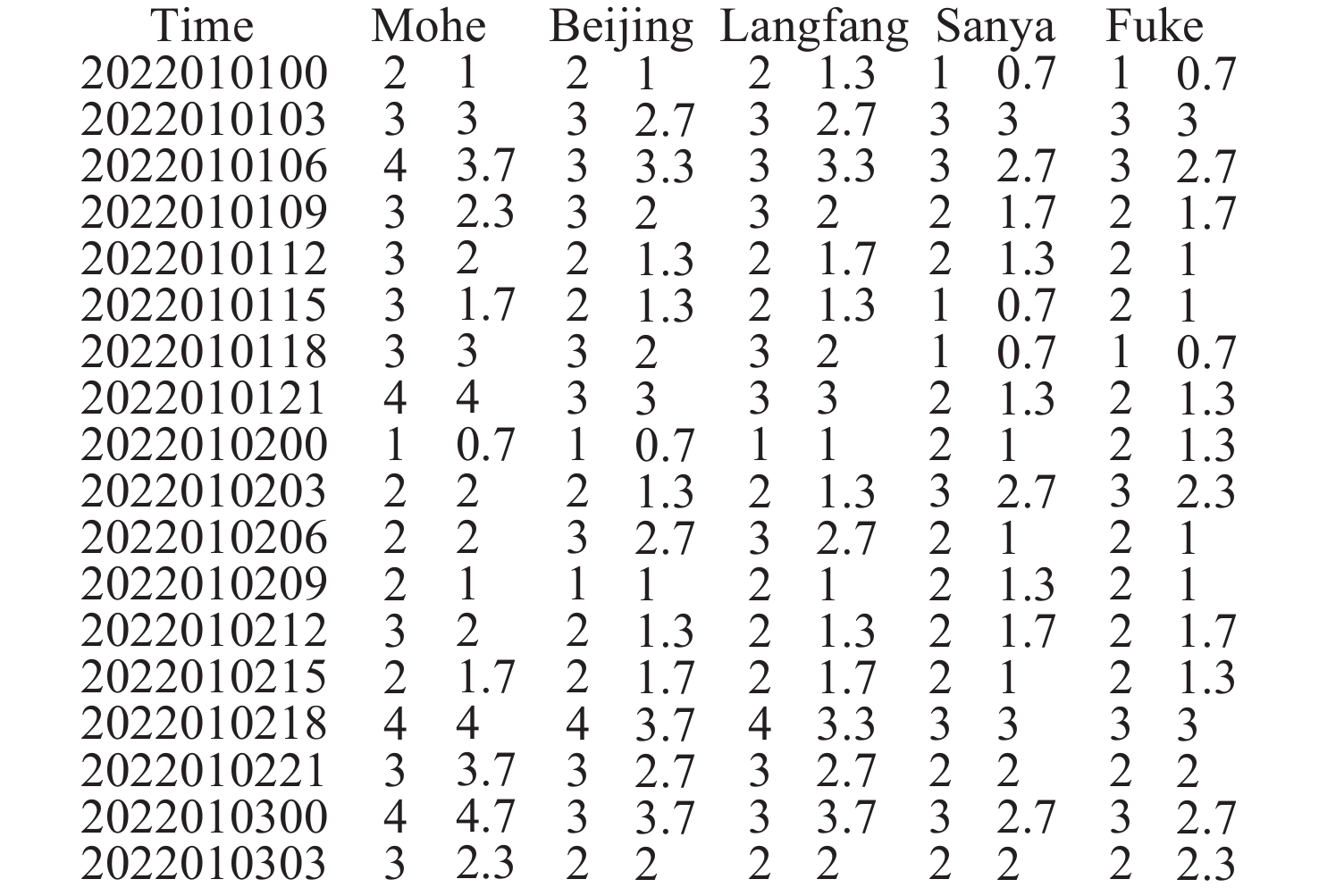
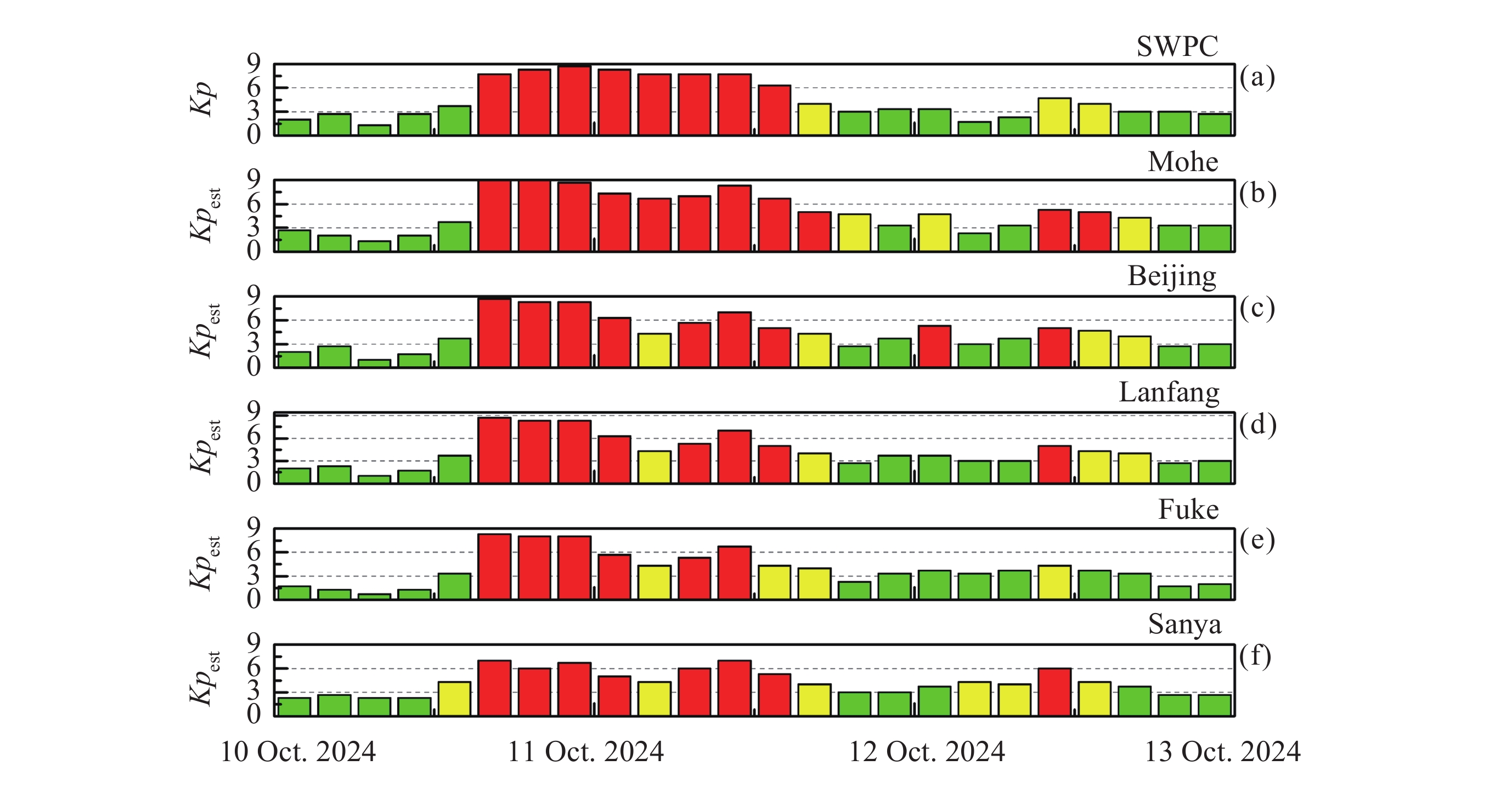
图 8 2024年10月10-13日5个台站Kpest指数与官方Kp指数的对比
Figure 8. Comparison of the Kpest index of 5 stations with the official Kp index during 10-13 October 2024
表 1 监测网5个地磁台站位置信息
Table 1. Location information of 5 geomagnetic stations in the monitoring network
序号 台站名称 地理纬度/(°)N 地理经度/(°)E 地磁纬度/(°)N 地磁经度/(°)E 1 漠河 53.49 122.34 43.12 191.37 2 北京 40.30 116.19 29.76 186.85 3 廊坊 39.50 116.70 28.97 187.33 4 富克 19.50 109.10 8.94 180.66 5 三亚 18.44 108.97 7.89 180.54  下载: 导出CSV
表 2 K指数与地磁扰幅对照
Table 2. Comparison of K index and geomagnetic disturbance amplitude
K 0 1 2 3 4 5 6 7 8 9 amin/nT 0 3 6 12 24 40 70 120 200 300
下载: 导出CSV
表 3 Kpest指数数据记录格式
Table 3. Kpest index data recording format
列 参数 格式 值域 无效填充值 1 年、月、日、时 A10 - - 2 漠河台站K指数 I1 0~9 NaN 3 漠河台站Kpest指数 F3.1 0~9 NaN 4 北京台站K指数 I1 0~9 NaN 5 北京台站Kpest指数 F3.1 0~9 NaN 6 廊坊台站K指数 I1 0~9 NaN 7 廊坊台站Kpest指数 F3.1 0~9 NaN 8 三亚台站K指数 I1 0~9 NaN 9 三亚台站Kpest指数 F3.1 0~9 NaN 10 富克台站K指数 I1 0~9 NaN 11 富克台站Kpest指数 F3.1 0~9 NaN
下载: 导出CSV
-
[1] 徐文耀. 地球电磁现象物理学[M]. 合肥: 中国科学技术大学出版社, 2009XU Wenyao. Physics of Electromagnetic Phenomena of the Earth[M]. Hefei: University of Science and Technology of China Press, 2009 [2] WELLING D T, ANDRÉ M, DANDOURAS I, et al. The earth: plasma sources, losses, and transport processes[J]. Space Science Reviews, 2015, 192(1/2/3/4): 145-208 doi: 10.1007/978-1-4939-3544-4_5 [3] EMERY B A, COUMANS V, EVANS D S, et al. Seasonal, Kp, solar wind, and solar flux variations in long-term single-pass satellite estimates of electron and ion auroral hemispheric power[J]. Journal of Geophysical Research: Space Physics, 2008, 113(A6): A06311 doi: 10.1029/2007JA012866 [4] GOLDSTEIN J, DE PASCUALE S, KLETZING C, et al. Simulation of Van Allen probes plasmapause encounters[J]. Journal of Geophysical Research: Space Physics, 2014, 119(9): 7464-7484 doi: 10.1002/2014JA020252 [5] PIERRARD V, GOLDSTEIN J, ANDRÉ N, et al. Recent progress in physics-based models of the plasmasphere[J]. Space Science Reviews, 2009, 145(1/2): 193-229 doi: 10.1007/978-1-4419-1323-4_7 [6] DENTON M H, HENDERSON M G, JORDANOVA V K, et al. An improved empirical model of electron and ion fluxes at geosynchronous orbit based on upstream solar wind conditions[J]. Space Weather, 2016, 14(7): 511-523 doi: 10.1002/2016SW001409 [7] KORTH H, THOMSEN M F, BOROVSKY J E, et al. Plasma sheet access to geosynchronous orbit[J]. Journal of Geophysical Research: Space Physics, 1999, 104(A11): 25047-25061 doi: 10.1029/1999JA900292 [8] CARPENTER D L, ANDERSON R R. An ISEE/whistler model of equatorial electron density in the magnetosphere[J]. Journal of Geophysical Research: Space Physics, 1992, 97(A2): 1097-1108 doi: 10.1029/91JA01548 [9] TSYGANENKO N A. A magnetospheric magnetic field model with a warped tail current sheet[J]. Planetary and Space Science, 1989, 37(1): 5-20 doi: 10.1016/0032-0633(89)90066-4 [10] AGAPITOV O V, ARTEMYEV A V, MOURENAS D, et al. Empirical model of lower band chorus wave distribution in the outer radiation belt[J]. Journal of Geophysical Research: Space Physics, 2015, 120(12): 10425-10442 doi: 10.1002/2015JA021829 [11] ORLOVA K, SPASOJEVIC M, SHPRITS Y. Activity-dependent global model of electron loss inside the plasmasphere[J]. Geophysical Research Letters, 2014, 41(11): 3744-3751 doi: 10.1002/2014GL060100 [12] 王庚. 地磁Kp指数现报模式及全球K指数分布预报模式[D]. 北京: 中国科学院研究生院(空间科学与应用研究中心), 2015WANG Geng. Algorithm for Nowcast of Kp Index and A Model for Forecast of Global K Index Distribution[D]. Beijing: Center for Space Science and Applied Research, Chinese Academy of Sciences, 2015 [13] WING S, JOHNSON J R, JEN J, et al. Kp forecast models[J]. Journal of Geophysical Research: Space Physics, 2005, 110(A4): A04203 doi: 10.1029/2004JA010500 [14] 王晓美, 滕云田, 马洁美, 等. 地磁矢量场观测数据一致性校正方法: 中国, 201810101718.8[P]. 2025-07-31WANG Xiaomen, TENG Yuntian, MA Jiemei, et al. Geomagnetic vector field observation data consistency correction method: CN, 201810101718.8[P]. 2025-07-31 [15] TAKAHASHI K, TOTH B A, OLSON J V. An automated procedure for near-real-time Kp estimates[J]. Journal of Geophysical Research: Space Physics, 2001, 106(A10): 21017-21032 [16] BITTERLY M, MENVIELLE M, BITTERLY J, et al. A comparison between computer derived (FMI method) and hand-scaled K indices at Port-aux-français and Port Alfred French observatories[C]//Proceedings of the VIth International Workshop on Geomagnetic Instruments, Data Acquisition and Processing. Bruxelles: Académie Royale de Belgique, 1997: 136-143 [17] 王庚, 罗冰显, 刘四请, 等. 一种改进的Kp指数现报模式[J]. 空间科学学报, 2016, 36(2): 153-166 doi: 10.11728/cjss2016.02.153WANG Geng, LUO Bingxian, LIU Siqing, et al. An improved algorithm for nowcast of Kp index[J]. Chinese Journal of Space Science, 2016, 36(2): 153-166 doi: 10.11728/cjss2016.02.153 -
-

 下载:
下载:

计量
- 文章访问数: 1340
- HTML全文浏览量: 843
- PDF下载量: 27
-
被引次数:
0(来源:Crossref)
0(来源:其他)

