


一种用于CCSDS凿孔卷积码的最大后验概率译码算法
doi: 10.11728/cjss2026.03.2025-0058 cstr: 32142.14.cjss.2025-0058
-
 顾雪晨 女, 2000 年12月出生于江苏省盐城市, 中国科学院国家空间科学中心硕士研究生, 主要研究方向为卫星通信互联网、信道编译码等. E-mail: guxuechen22@mails.ucas.ac.cn
 -
 范亚楠 男, 1991年1月出生于河南省焦作市, 现为中国科学院国家空间科学中心副研究员、硕士生导师, 主要研究方向为空间通信组网、卫星通信、空间频谱感知等. E-mail: fanyanan@nssc.ac.cn
作者简介:
通讯作者:
A Maximum A-posteriori Probability Decoding Algorithm for the CCSDS Punctured Convolutional Codes
-
摘要: 针对CCSDS标准中凿孔后的卷积码在维特比译码算法下存在编码增益损失的问题, 提出了用于该码型的一种最大后验译码算法, 通过在网格图上进行似然信息的前向和后向更新, 获得每个输入信息位的最大后验对数似然比信息, 降低由凿孔所带来的信道似然信息丢失, 从而提升凿孔卷积码的译码性能. 仿真分析结果表明, 本文所提译码算法可降低CCSDS凿孔卷积码的误比特率, 提升编码增益, 且码率越高, 误比特率降低越显著, 相比于维特比译码算法, 在5/6和7/8码率下, 所提算法可将编码增益分别提升0.2 dB和0.6 dB, 其计算复杂度与Viterbi译码算法相当, 具有较好的实际工程应用价值, 可用于提升现有空间通信系统的可靠性.Abstract: CCSDS punctured convolutional codes suffer from bit-error-rate performance degradation using the Viterbi decoding algorithm. Aiming at this issue, this paper proposed a maximum a-posteriori probability decoding algorithm for these codes. The algorithm takes a forward and backward update process of the likelihood messages based on the trellis graph, to obtain the maximum a-posteriori log-likelihood ratio for the corresponding input bits, reducing the loss of channel likelihood information caused by puncturing, thereby improving the performance of the punctured convolutional code. As shown by the simulation results, the proposed algorithm can achieve an even lower bit-error-rate for the CCSDS punctured convolutional codes and improve the encoding gain, and the higher the code rate, the more significant the bit error rate reduction. Compared with the Viterbi decoding algorithm, the proposed decoding algorithm provides a coding gain of about 0.2 dB and 0.6 dB for code rates of 5/6 and 7/8 respectively. Its computational complexity is comparable to that of the Viterbi decoding algorithm, thus it has good engineering application value, which can be used to improve the reliability of existing space telecommunication systems.
-
Key words:
- CCSDS /
- Punctured convolutional code /
- Maximum a-posteriori probability /
- Channel coding
-

图 1 CCSDS凿孔卷积码编码
Figure 1. Encoder block diagram for the punctured CCSDS convolutional codes
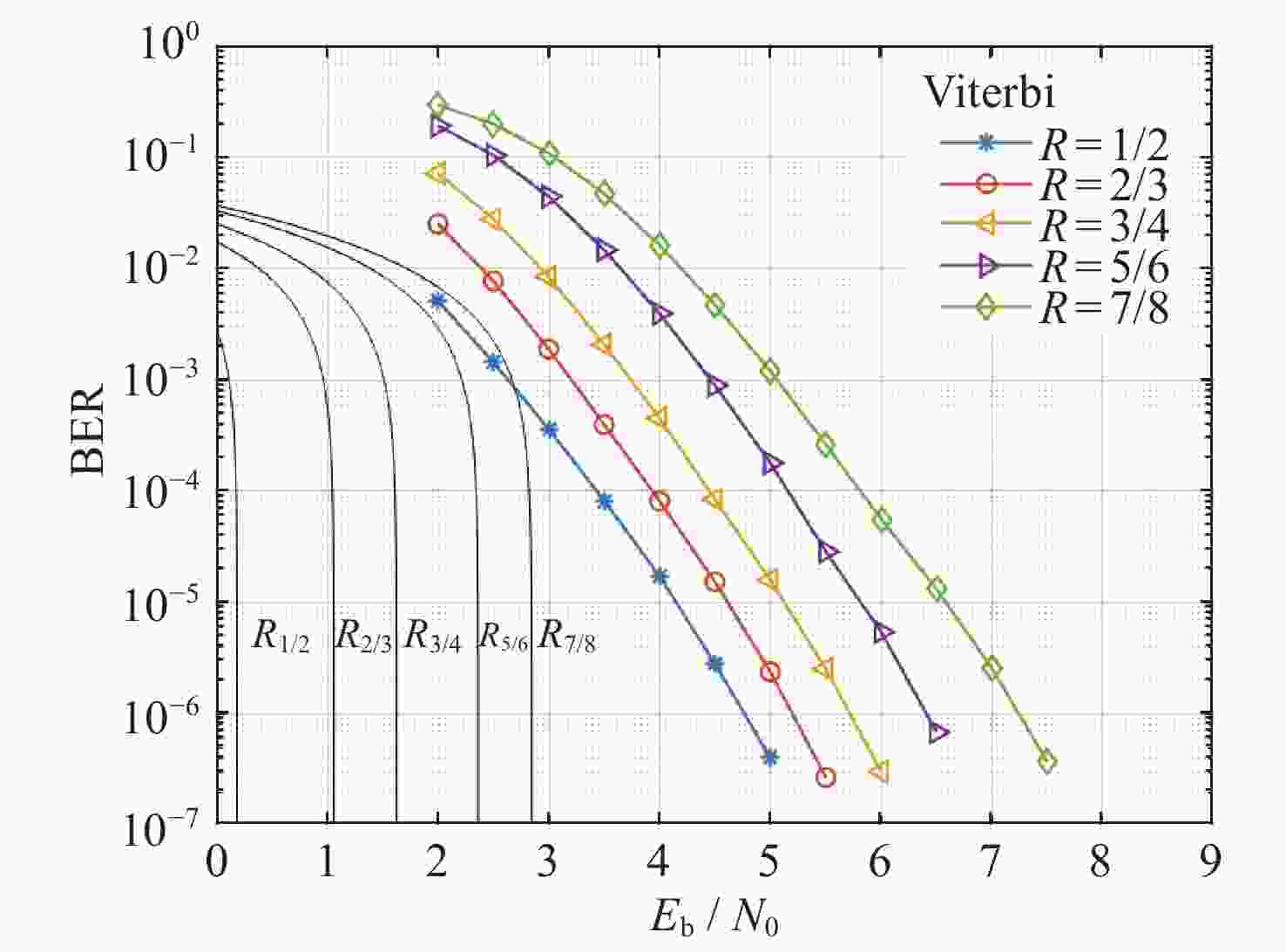
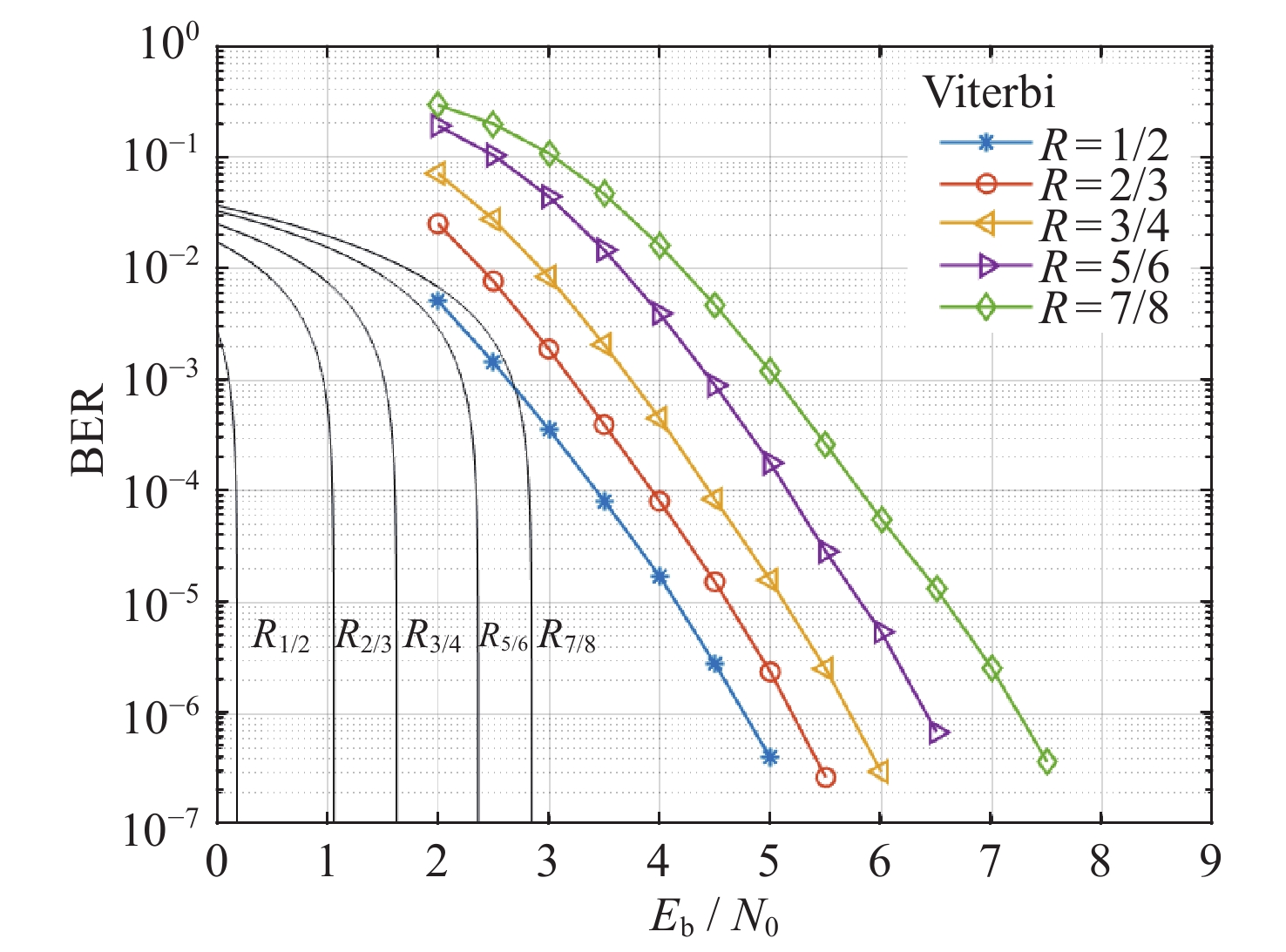
图 2 CCSDS不同码率卷积码Viterbi译码误比特率曲线 (信息位长度为8920)
Figure 2. BER of the punctured CCSDS convolutional codes under Viterbi decoding algorithm (information length is 8920)
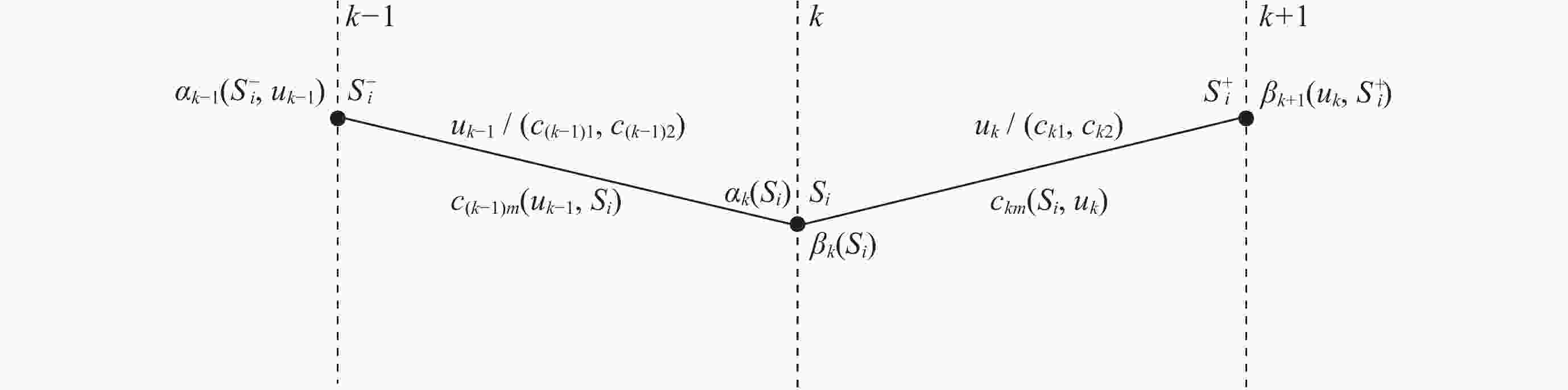
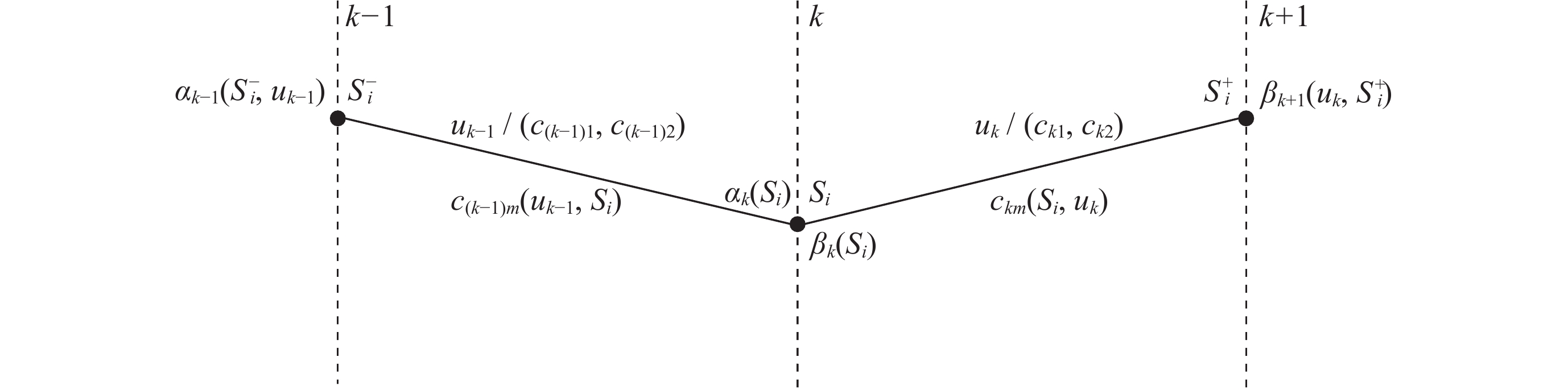
图 3 卷积码的Trellis图及符号定义
Figure 3. Trellis graph for CC and the definition of the notations
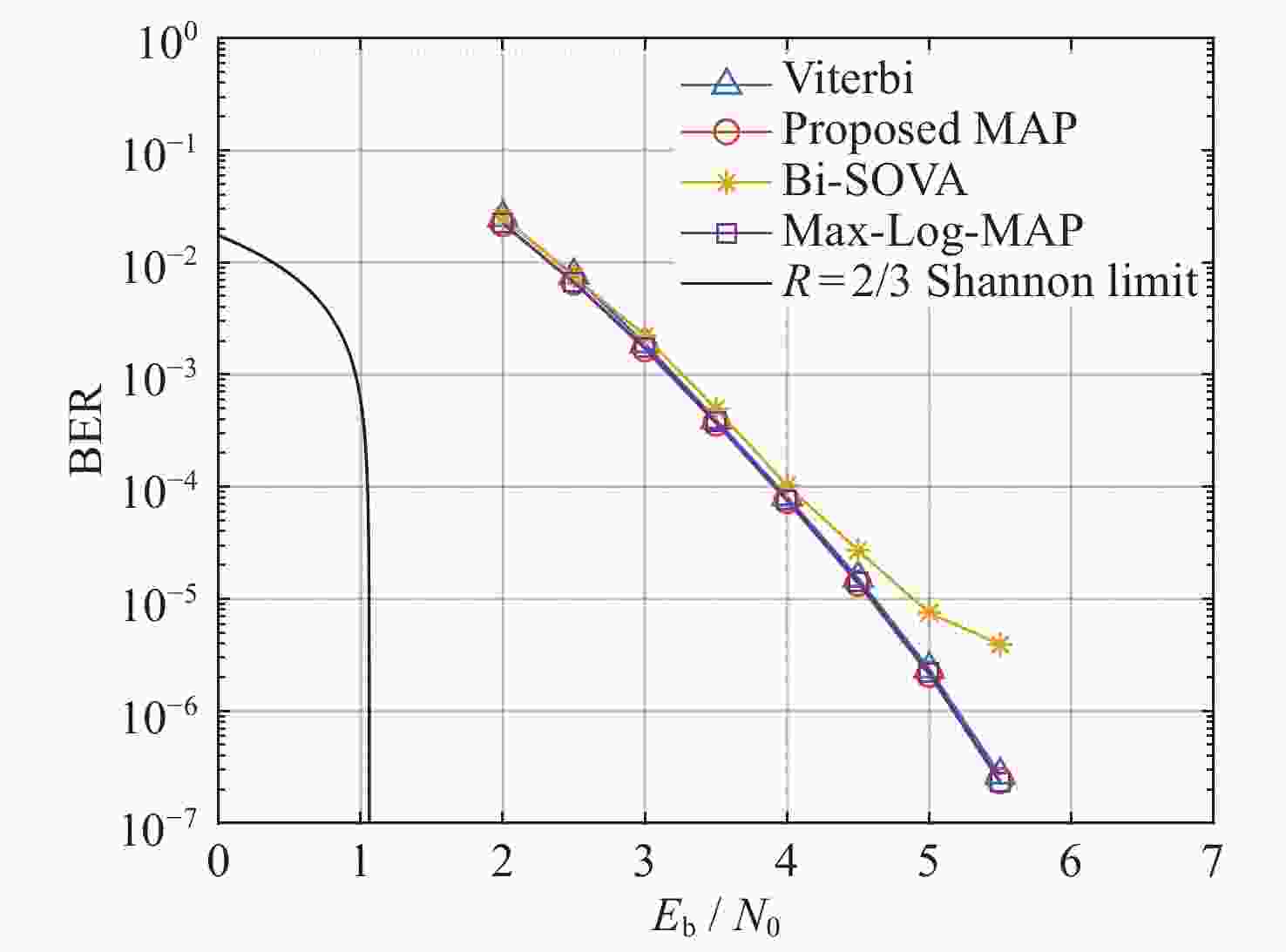
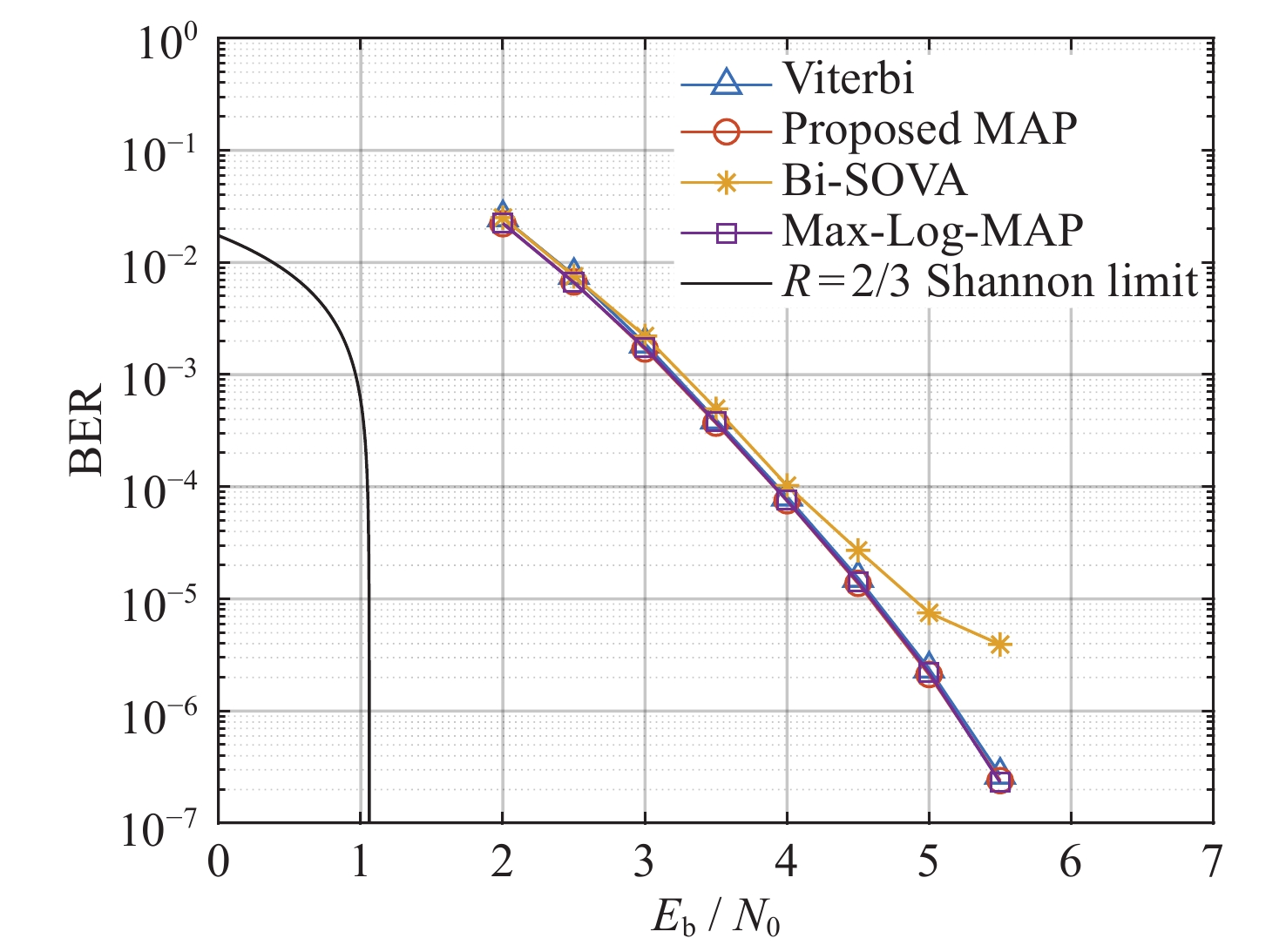
图 4 不同译码算法的2/3码率CCSDS卷积码误比特率特性
Figure 4. BER curves for 2/3 CCSDS CC using the proposed algorithm
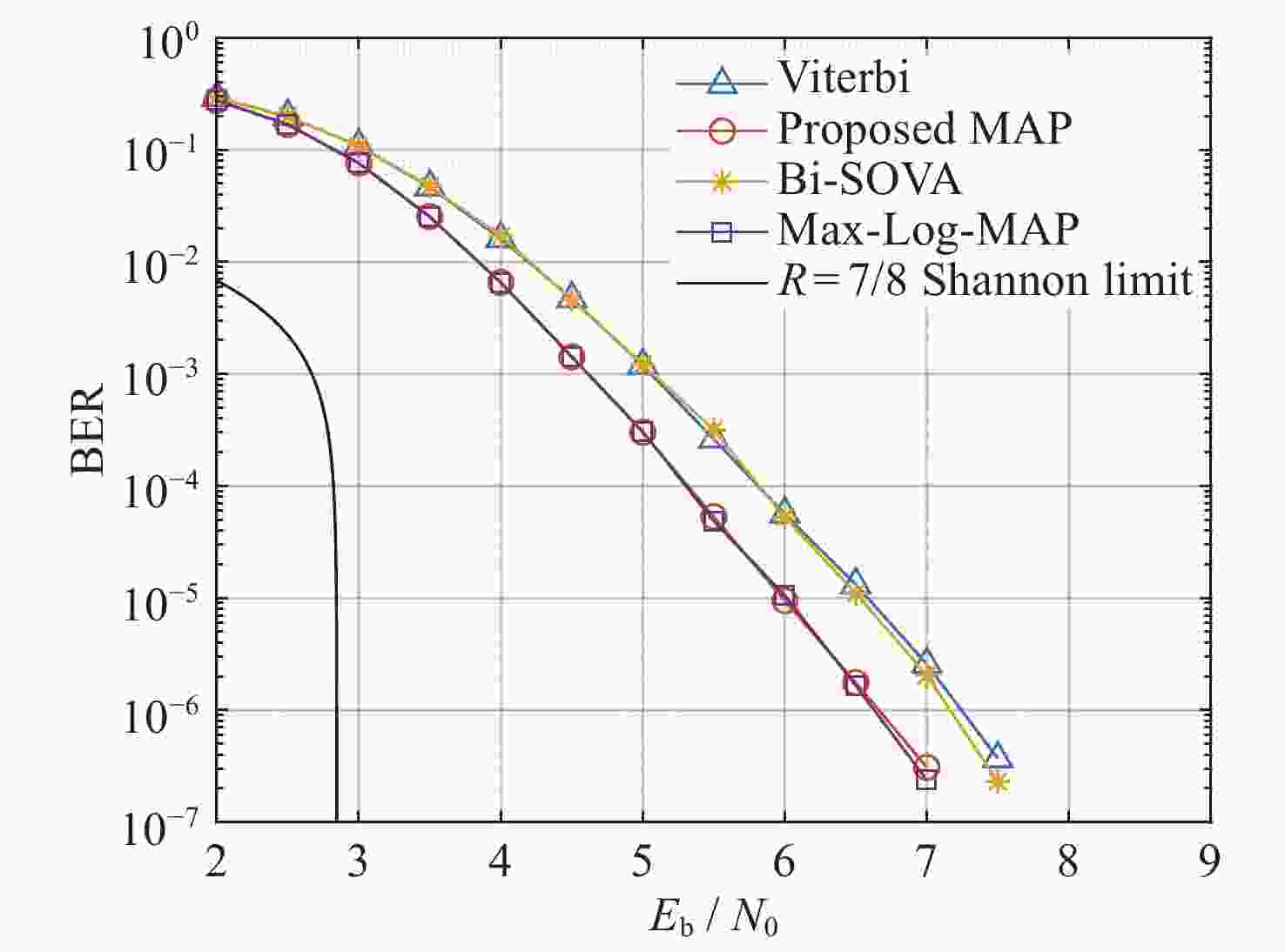
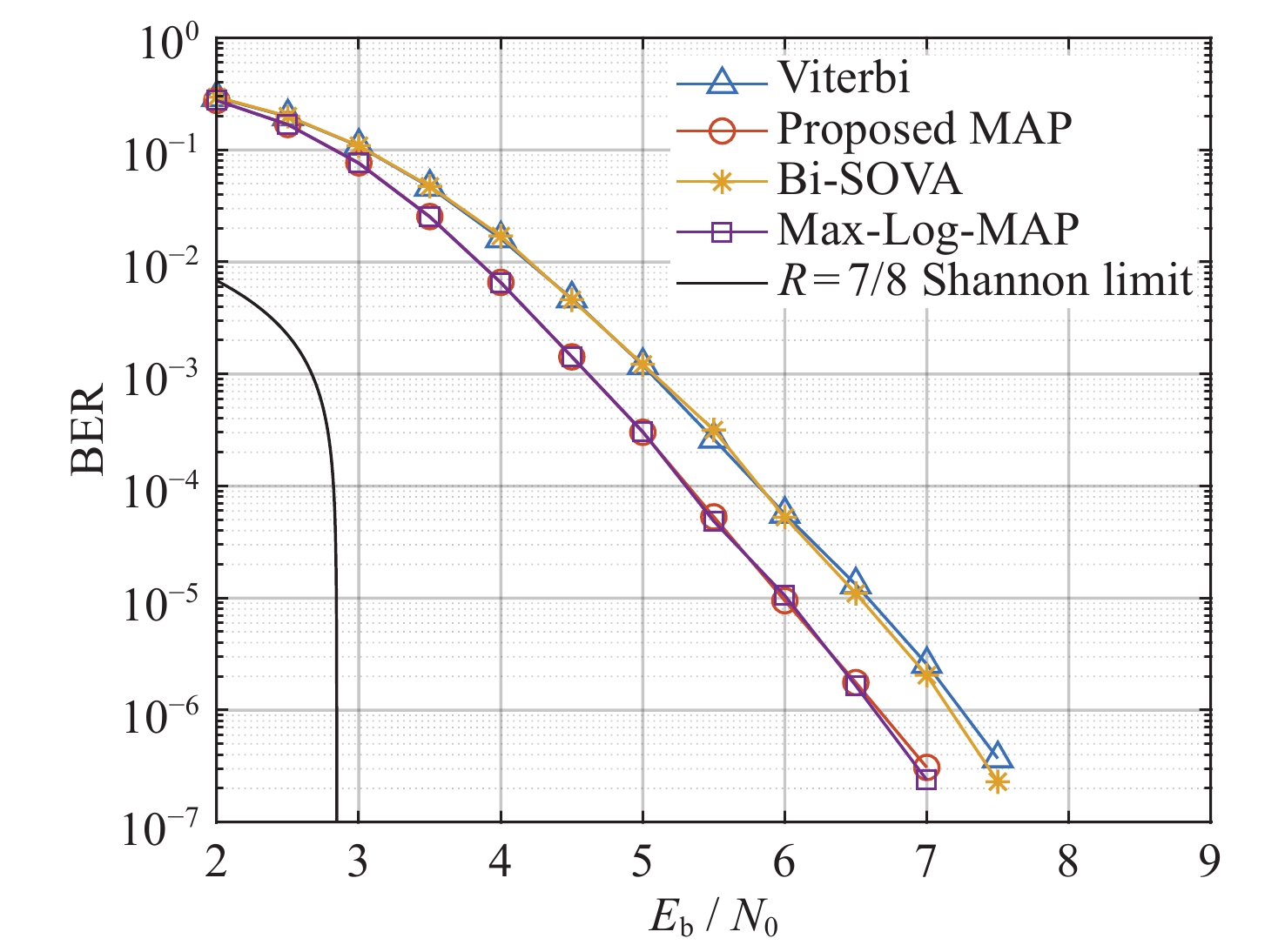
图 7 不同译码算法的7/8码率CCSDS卷积码误比特率特性
Figure 7. BER curves for 7/8 CCSDS CC using the proposed algorithm
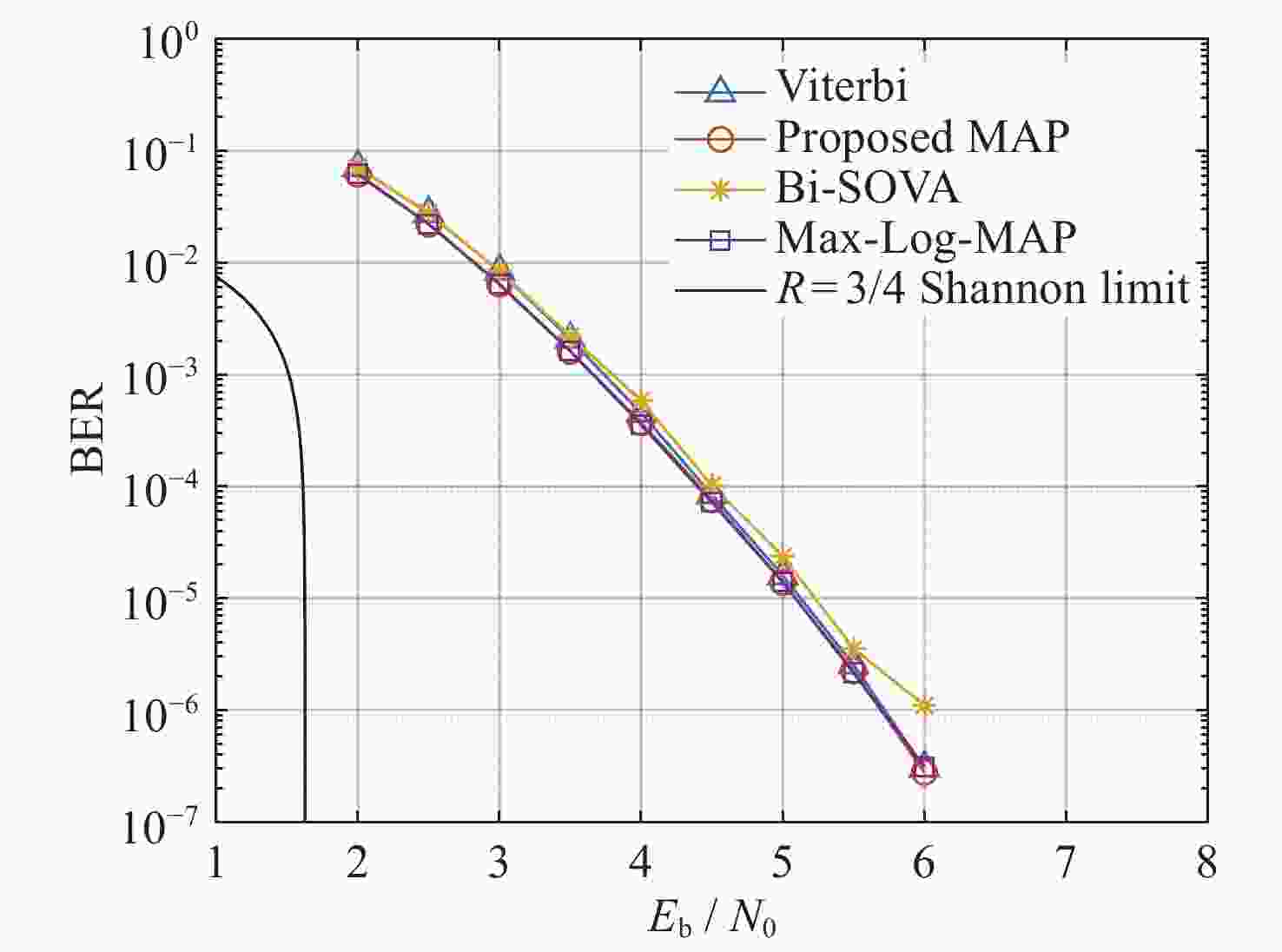
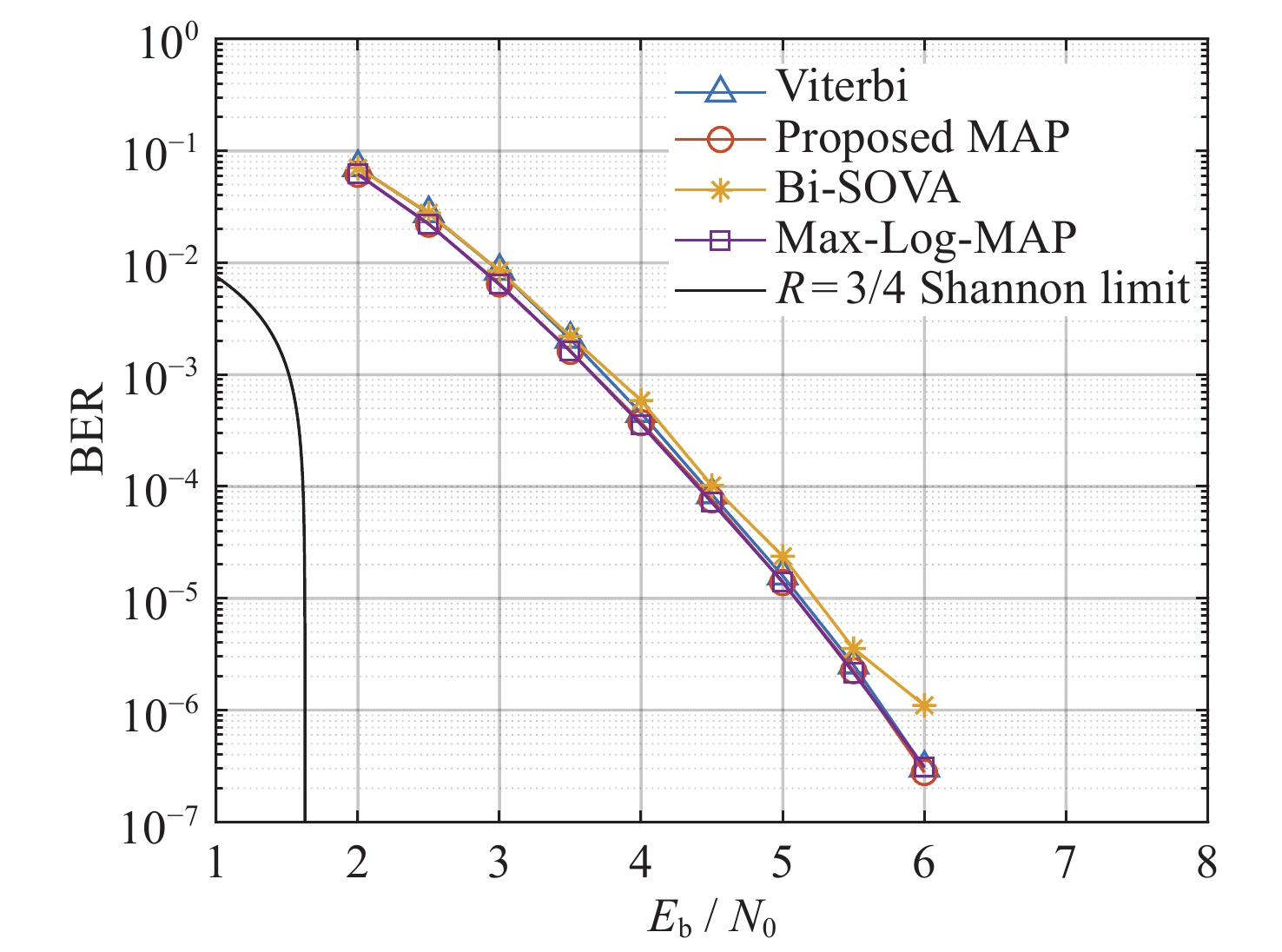
图 5 不同译码算法的3/4码率CCSDS卷积码误比特率特性
Figure 5. BER curves for 3/4 CCSDS CC using the proposed algorithm
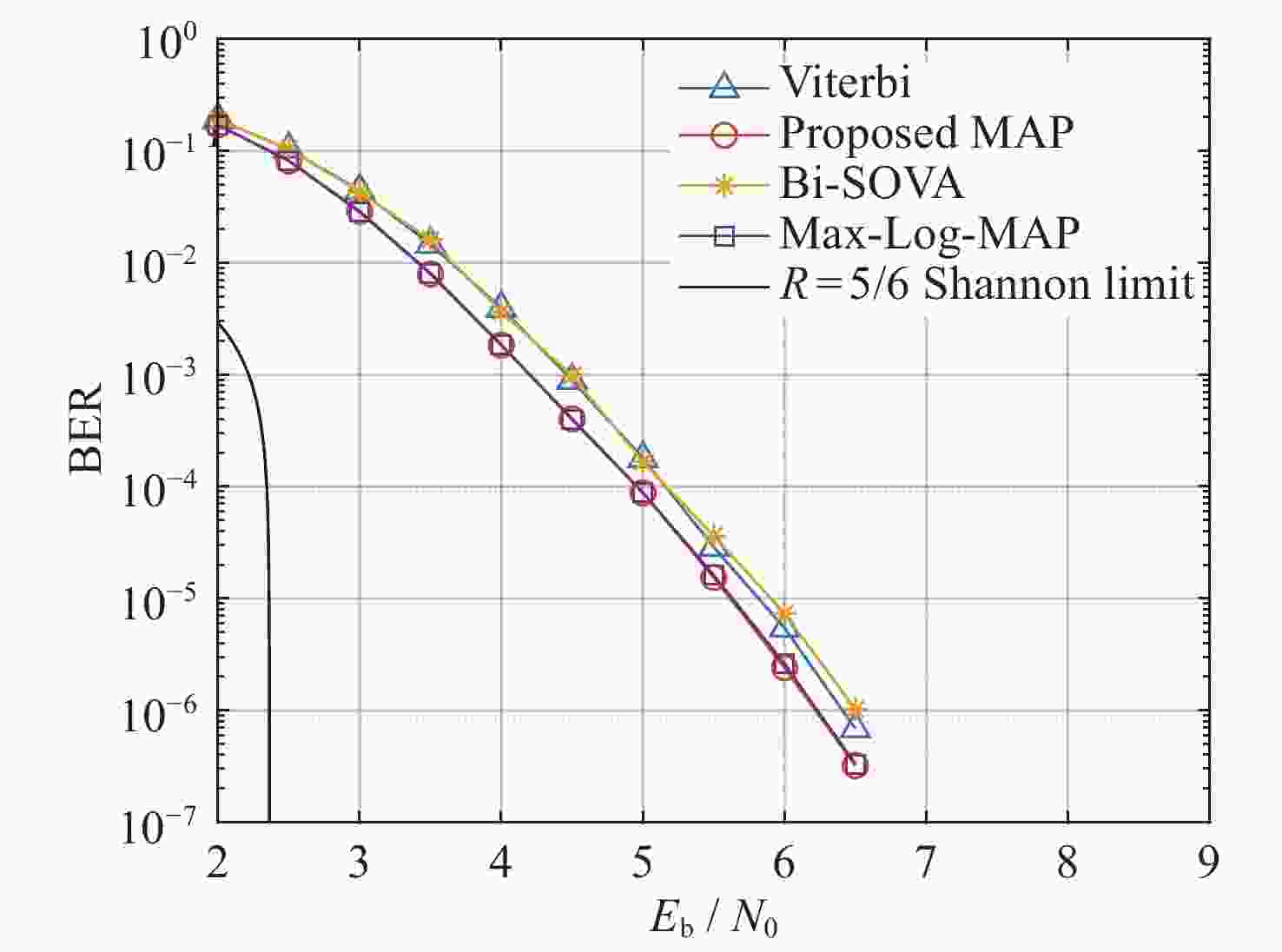
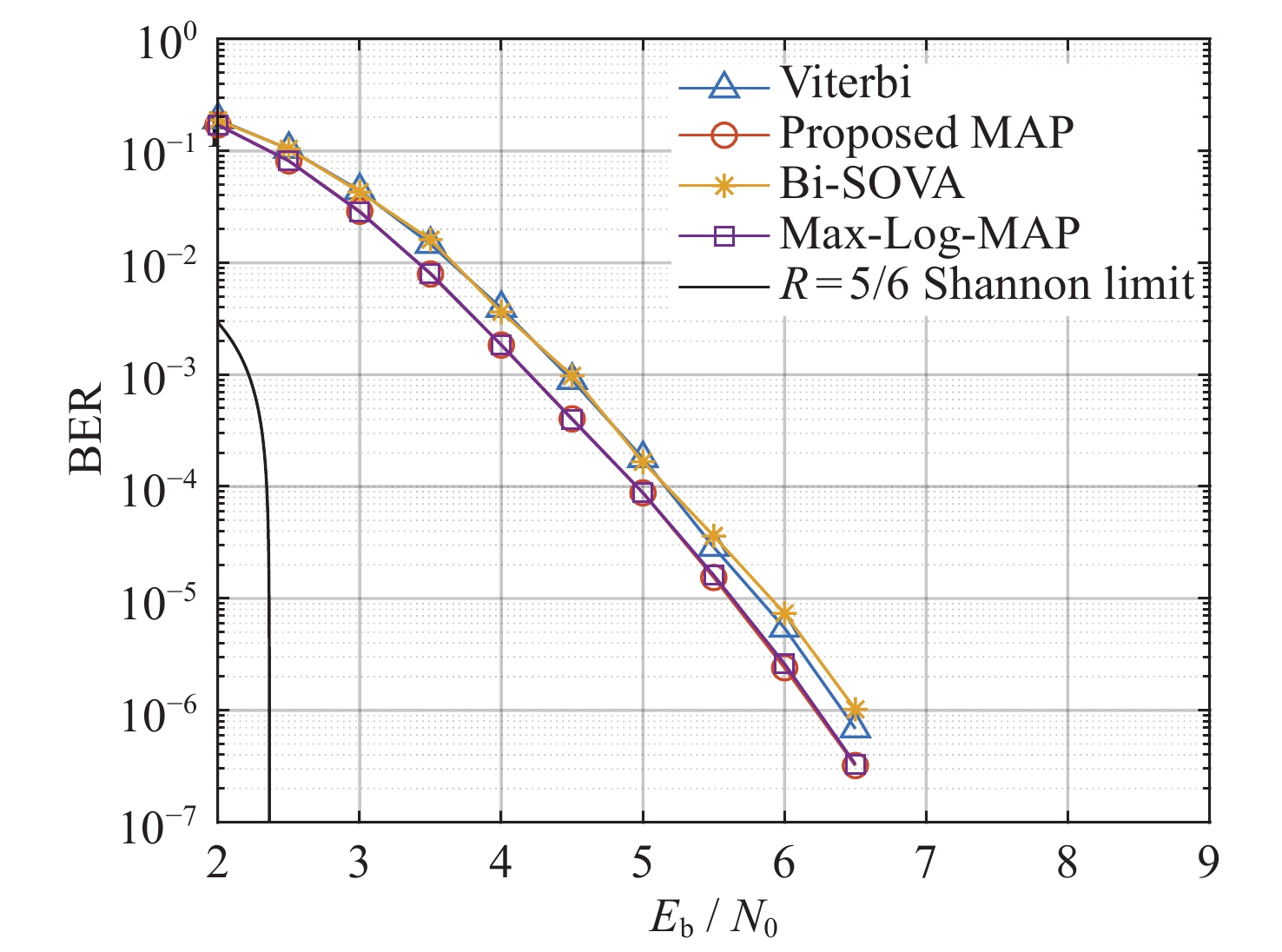
图 6 不同译码算法的5/6码率CCSDS卷积码误比特率特性
Figure 6. BER curves for 5/6 CCSDS CC using the proposed algorithm
表 1 CCSDS凿孔卷积码的凿孔模式
Table 1. Puncturing patterns for the CCSDS punctured convolutional code rates
凿孔模式
1: 传输比特
0: 不传输比特码率 c1: 1 0
c2: 1 12/3 c1: 1 0 1
c2: 1 1 03/4 c1: 1 0 1 0 1
c2: 1 1 0 1 05/6 c1: 1 0 0 0 1 0 1
c2: 1 1 1 1 0 1 07/8  下载: 导出CSV
表 2 不同码率CCSDS卷积码性能与连续输入香农限的差距
Table 2. Distances from the continuous input Shannon limit for different code rate CCSDS CCs
码率 连续输入
香农限/dB所需最低
信噪比/dB差距/dB 1/2 0.00 4.75 4.75 2/3 0.57 5.22 4.65 3/4 0.86 5.73 4.87 5/6 1.16 6.42 5.26 7/8 1.31 7.25 5.94
下载: 导出CSV
表 3 不同码率CCSDS卷积码性能与二进制输入香农限的差距
Table 3. Distances from the binary input Shannon limit for different code rate CCSDS CCs
码率 二进制输入
香农限/dB所需最低
信噪比/dB差距/dB 1/2 0.19 4.75 4.56 2/3 1.06 5.22 4.16 3/4 1.63 5.73 4.10 5/6 2.37 6.42 4.05 7/8 2.85 7.25 4.40
下载: 导出CSV
表 4 算法复杂度对比
Table 4. Comparison of algorithm complexity
算法 加法 比较 查表 存储 Viterbi $ L\times {2}^{k}\times {2}^{v-1} $ $ L\times {2}^{v-1} $ 0 $ {2}^{v-1} $ Bi-SOVA $ L\times {2}^{k}\times {2}^{v} $ $ (L+v)\times {2}^{v-1} $ 0 $ {2}^{v-1}+L $ Max-Log-MAP $ L\times {2}^{k}\times {2}^{v+1} $ $ L\times {2}^{v} $ $ L\times {2}^{k}\times {2}^{v-1} $ $ L\times {2}^{v-1} $ 本文算法 $ L\times {2}^{k}\times {2}^{v+1} $ $ L\times {2}^{v+1} $ 0 $ L\times {2}^{v-1} $
下载: 导出CSV
-
[1] VITERBI A J. A personal history of the Viterbi algorithm[J]. IEEE Signal Processing Magazine, 2006, 23(4): 120-142 doi: 10.1109/MSP.2006.1657823 [2] 蔡穗华, 王义文, 白宝明, 等. 面向高可靠低时延通信的信道编码技术研究综述[J]. 电子学报, 2025, 53(2): 629-644 doi: 10.12263/DZXB.20240137CAI Suihua, WANG Yiwen, BAI Baoming, et al. Channel coding techniques for ultra-reliable and low-latency communication[J]. Acta Electronica Sinica, 2025, 53(2): 629-644 doi: 10.12263/DZXB.20240137 [3] RACHINGER C, HUBER J B, MULLER R R. Comparison of convolutional and block codes for low structural delay[J]. IEEE Transactions on Communications, 2015, 63(12): 4629-4638 doi: 10.1109/TCOMM.2015.2488661 [4] COŞKUN M C, DURISI G, JERKOVITS T, et al. Efficient error-correcting codes in the short block length regime[J]. Physical Communication, 2019, 34: 66-79 doi: 10.1016/j.phycom.2019.03.004 [5] 赵子伟. 极化调整卷积码的高效译码算法研究[D]. 杭州: 浙江大学, 2024ZHAO Ziwei. Research on Efficient Decoding Algorithms for PAC Codes[D]. Hangzhou: Zhejiang University, 2024 [6] ARKAN E. From sequential decoding to channel polarization and back again[OL]. arXiv preprint arXiv: 1908.09594, 2019. DOI: 10.48550/arXiv.1908.09594 [7] 郭网媚, 刘丹丹, 陈琦, 等. 二元稀疏卷积纠删码[J]. 西安电子科技大学学报, 2023, 50(3): 112-121GUO Wangmei, LIU Dandan, CHEN Qi, et al. Binary sparse convolutional erasure correction coding[J]. Journal of Xidian University, 2023, 50(3): 112-121 [8] MOISION B, HAMKINS J. Coded modulation for the deep-space optical channel: serially concatenated pulse-position modulation[J]. The Interplanetary Network Progress Report, 2005, 42(161): 1-26 [9] 向劲松, 陈怀柔. QAM调制下基于卷积码与累加编码调制级联的纠错码性能研究[J]. 半导体光电, 2023, 44(6): 924-930 doi: 10.16818/j.issn1001-5868.2023090102XIANG Jinsong, CHEN Huairou. Research on the performance of error correctioncodes based on convolutional code and accumulative code modulation cascade under QAM modulation[J]. Semiconductor Optoelectronics, 2023, 44(6): 924-930 doi: 10.16818/j.issn1001-5868.2023090102 [10] WESEL R, ANTONINI A, WANG L F, et al. ELF codes: concatenated codes with an expurgating linear function as the outer code[C]//12th International Symposium on Topics in Coding (ISTC). Brest, France: IEEE, 2023: 1-5 [11] HUG F, BOCHAROVA I E, JOHANNESSON R, et al. A rate R=5/20 Hypergraph-based woven convolutional code with free distance 120[J]. IEEE Transactions on Information Theory, 2010, 56(4): 1618-1623 doi: 10.1109/TIT.2010.2040966 [12] 何倩. 基于卷积码的隐蔽通信技术研究[D]. 西安: 西安电子科技大学, 2023HE Qian. Research on Covert Communication Based on Convolutional Code[D]. Xi’an: Xidian University, 2023 [13] FORNEY G D, GRASSL M, GUHA S. Convolutional and tail-biting quantum error-correcting codes[J]. IEEE Transactions on Information Theory, 2007, 53(3): 865-880 doi: 10.1109/TIT.2006.890698 [14] WACHTER-ZEH A, STINNER M, SIDORENKO V. Convolutional codes in rank metric with application to random network coding[J]. IEEE Transactions on Information Theory, 2015, 61(6): 3199-3213 doi: 10.1109/TIT.2015.2424930 [15] YASUDA Y, KASHIKI K, HIRATA Y. High-rate punctured convolutional codes for soft decision viterbi decoding[J]. IEEE Transactions on Communications, 1984, 32(3): 315-319 doi: 10.1109/TCOM.1984.1096047 [16] YAMAGUCHI K, NAKAJIMA A, NODA M. A simple design of puncturing pattern for symbol-wise viterbi decoding[C]//2022 IEEE 8th World Forum on Internet of Things (WF-IoT). Yokohama, Japan: IEEE, 2022: 1-6 [17] The Consultative Committee for Space Data Systems. CCSDS TM Synchronization and Channel Coding: 131.0-B-5[S]. Washington: National Aeronautics and Space Administration, 2023: 9 [18] HAGENAUER J, HOEHER P. A Viterbi algorithm with soft-decision outputs and its applications[C]//1989 IEEE Global Telecommunications Conference and Exhibition Communications Technology for the 1990s and Beyond. Dallas, TX, USA: IEEE, 1989: 1680-1686 [19] GUO Z J, CAO L. SOVA decoded serially concatenated continuous phase modulations with binary markov source[C]//SoutheastCon 2025. Concord, NC, USA: IEEE, 2025: 753-758 [20] CHEN J, FOSSORIER M P C, LIN S, et al. Bi-directional SOVA decoding for turbo-codes[J]. IEEE Communications Letters, 2000, 4(12): 405-407 doi: 10.1109/4234.898722 [21] BAHL L, COCKE J, JELINEK F, et al. Optimal decoding of linear codes for minimizing symbol error rate (Corresp.)[J]. IEEE Transactions on Information Theory, 1974, 20(2): 284-287 doi: 10.1109/tit.1974.1055186 [22] WOODARD J P, HANZO L. Comparative study of turbo decoding techniques: an overview[J]. IEEE Transactions on Vehicular Technology, 2000, 49(6): 2208-2233 doi: 10.1109/25.901892 [23] ROBERTSON P, VILLEBRUN E, HOEHER P. A comparison of optimal and sub-optimal MAP decoding algorithms operating in the log domain[C]//Proceedings IEEE International Conference on Communications ICC’95. Seattle, WA, USA: IEEE, 1995: 1009-1013 [24] CHANG Y C, LAIN J K. Improved decoding with the bi-directional SOVA for turbo codes[C]//2005 IEEE 61st Vehicular Technology Conference. Stockholm: IEEE, 2005: 673-677 [25] The Consultative Committee for Space Data Systems. CCSDS 130.1-G-3 TM Synchronization and Channel Coding—Summary of Concept and Rationale[S]. Washington: National Aeronautics and Space Administration, 2020 [26] COSTELLO D J, FORNEY G D. Channel coding: the road to channel capacity[J]. Proceedings of the IEEE, 2007, 95(6): 1150-1177 doi: 10.1109/JPROC.2007.895188 [27] BUTMAN S A, MCELIECE R J. The ultimate limits of binary coding for a wideband Gaussian channel[J]. JPL Deep Space Network Progress Report, 1974: 78-80 -
-

 下载:
下载:


计量
- 文章访问数: 1316
- HTML全文浏览量: 864
- PDF下载量: 91
-
被引次数:
0(来源:Crossref)
0(来源:其他)

