


基于长短期记忆网络的两行根数高精度轨道合成
doi: 10.11728/cjss2026.03.2025-0093 cstr: 32142.14.cjss.2025-0093
-
 胡开辉 男, 2002年12月出生于云南省曲靖市, 现为昆明理工大学国土资源工程学院在读硕士研究生, 主要研究方向为利用深度学习的太空目标轨道预报精度优化方法. E-mail: 20242201139@stu.kust.edu.cn
 -
 陈俊宇 男, 1989年1月出生于云南省大理市, 现为昆明理工大学国土资源工程学院讲师, 硕士研究生导师, 主要研究方向为空间态势感知. E-mail: jychen@kust.edu.cn
作者简介:
High-precision Orbit Synthesis of Two-line Elements Based on Long Short Term Memory Network
-
摘要: 为提升TLE (两行根数)在轨道预报中的精度, 解决传统多项式拟合和物理建模方法在难以处理轨道非线性演化趋势时的问题, 提出一种基于长短期记忆网络(LSTM)的高精度TLE轨道参数拟合方法, 利用历史TLE数据对轨道要素进行高精度时间序列拟合与轨道合成. 采用LSTM神经网络对TLE轨道参数进行时间序列建模, 并结合多项式拟合形成混合建模策略. 实验以87个铱星33碎片的TLE数据为基础, 构建拟合模型并生成合成TLE利用SGP4传播器正向传播位置误差. 实验结果表明, 常规时段81个碎片合成TLE传播7天位置误差改善目标占比达65.43%~88.89%, 误差分布更集中稳定; 磁暴期间65个碎片的合成TLE传播3天位置误差改善目标占比为70.77%~80.00%, 误差波动范围低于原始TLE. 基于LSTM的TLE轨道合成方法在捕捉轨道参数非线性演化方面表现优越, 结合角度线性化和平滑滤波策略, 提高了轨道参数拟合的精度与稳定性.Abstract: To improve the accuracy of TLE (Two Line Elements) in orbit prediction and solve the problem of traditional polynomial fitting and physical modeling methods being difficult to handle the nonlinear evolution trend of orbits, a high-precision TLE orbit parameter fitting method based on Long Short Term Memory (LSTM) network is proposed. TLEs are widely applied in orbit prediction and space situational awareness because of their simplicity and accessibility, yet their accuracy deteriorates quickly when propagated forward due to perturbations such as atmospheric drag, solar activity, and Earth’s nonspherical gravity field. Therefore, developing a data-driven strategy that can capture the hidden dynamics and extend the validity of TLE prediction has significant practical value. Historical TLE data is used for high-precision time series fitting and orbit synthesis of orbit elements. LSTM neural network is used to model the time series of TLE orbit parameters, and a mixed modeling strategy is formed by combining polynomial fitting. Based on the TLE data of 87 Iridium 33 fragments, a fitting model was constructed and a synthetic TLE was generated using SGP4 (Simplified General Perturbations 4) propagator to propagate position error in the forward direction. The experimental results show that the proportion of the target for improving the position error of 81 fragments in the synthesized TLE propagation for 7 days during the conventional period is 65.43%~88.89%, and the error distribution is more concentrated and stable. The proportion of the target for improving the position error of the synthesized TLE propagation of 65 fragments during a geomagnetic storm for 3 days is 70.77%~80.00%, and the error fluctuation range is lower than that of the original TLE. The TLE orbital synthesis method based on LSTM performs excellently in capturing the nonlinear evolution of orbital parameters. By combining angle linearization and smooth filtering strategies, the accuracy and stability of orbital parameter fitting are improved.
-
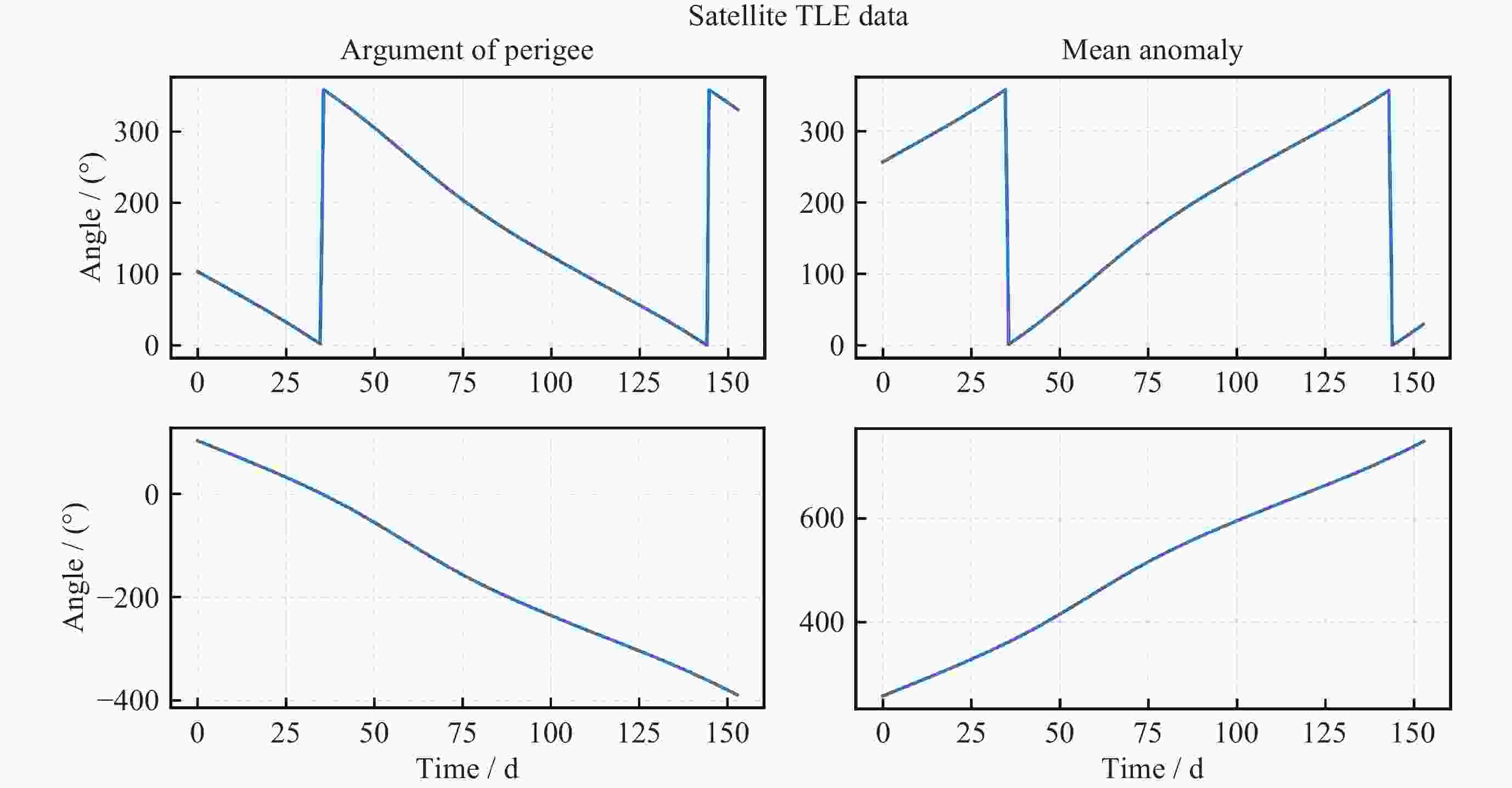
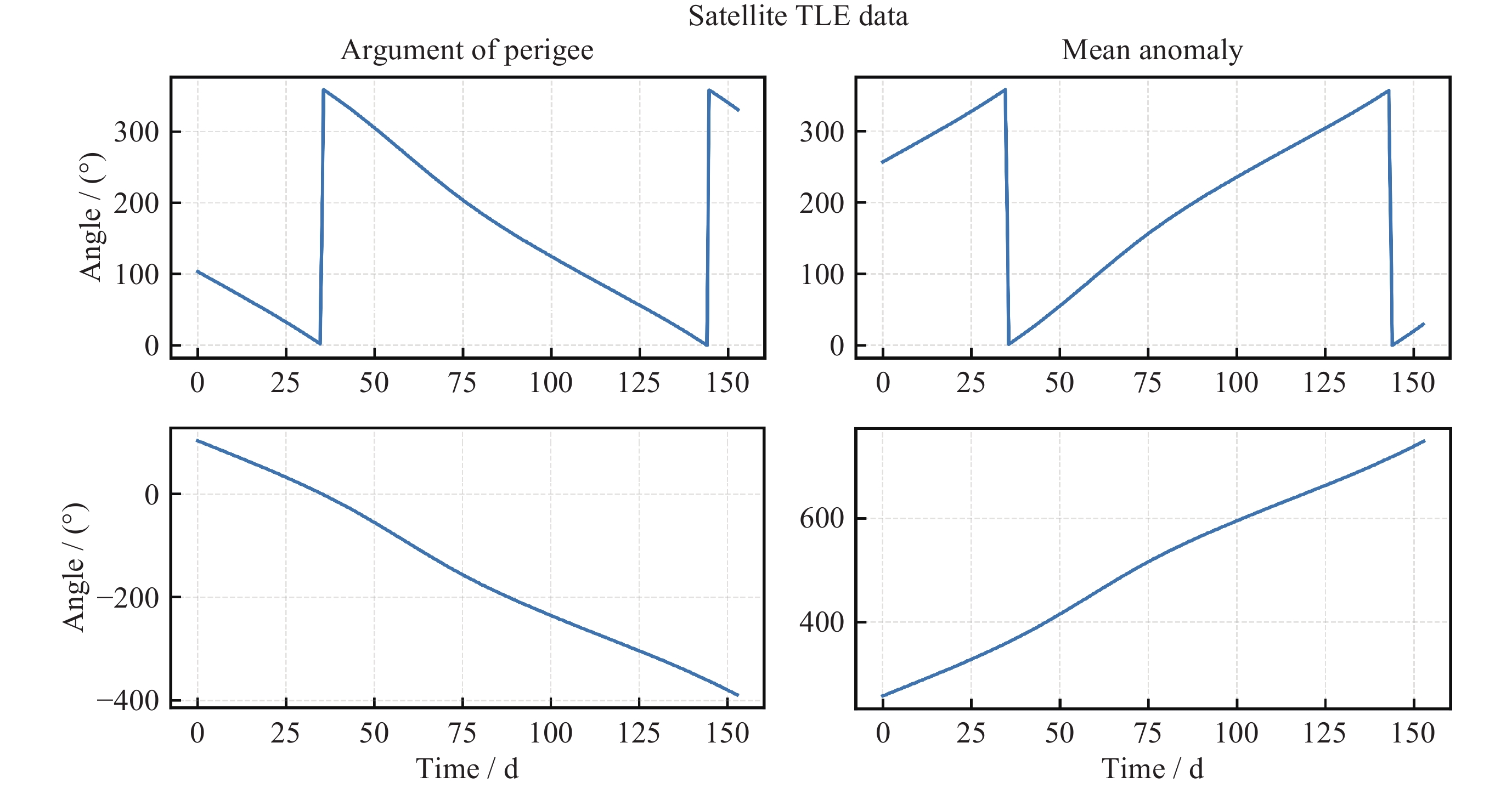
图 1 NORAD ID 33773调整前后的拼接效果
Figure 1. Stitching effect of NORAD ID 33773 before and after adjustment
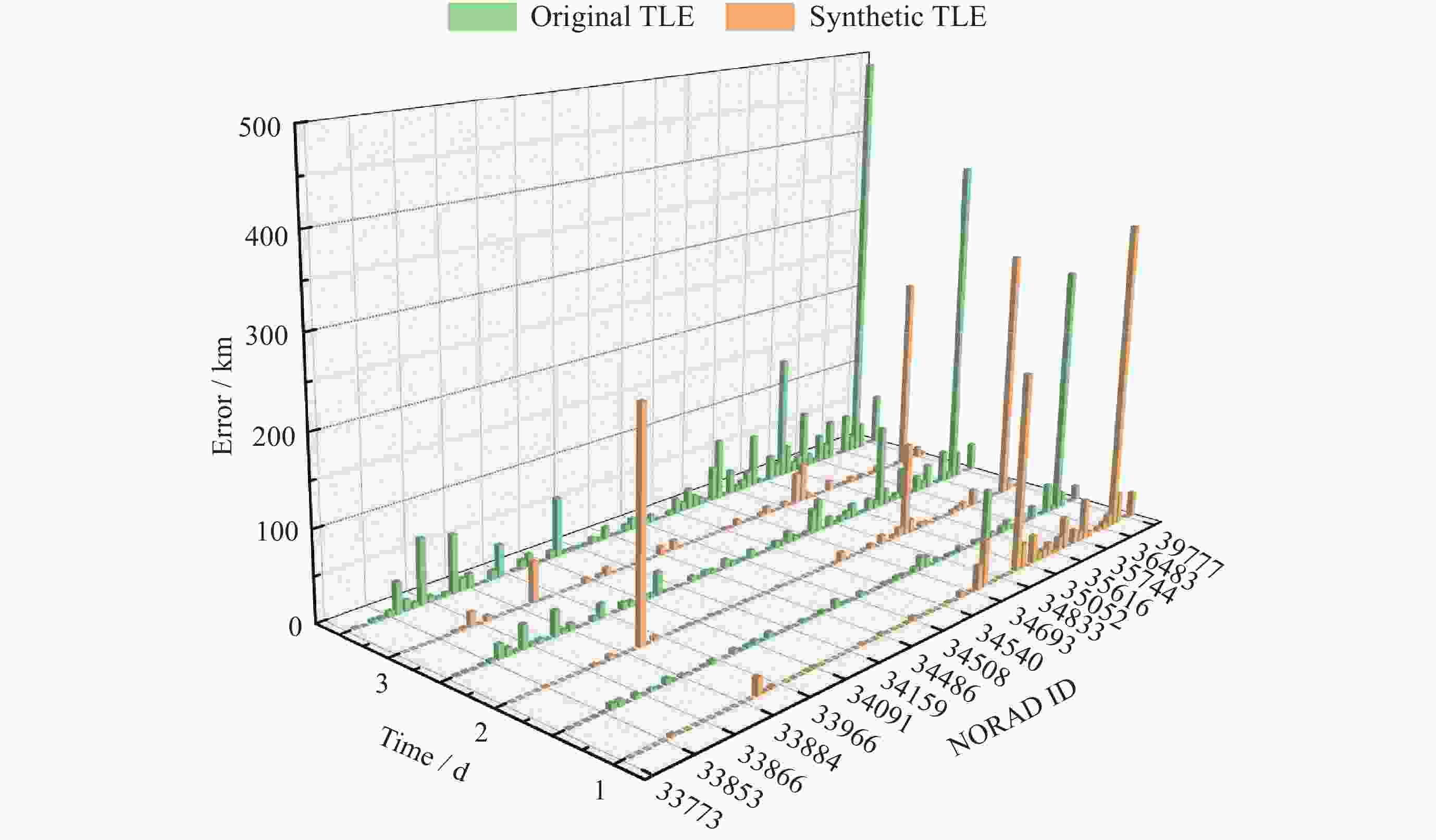
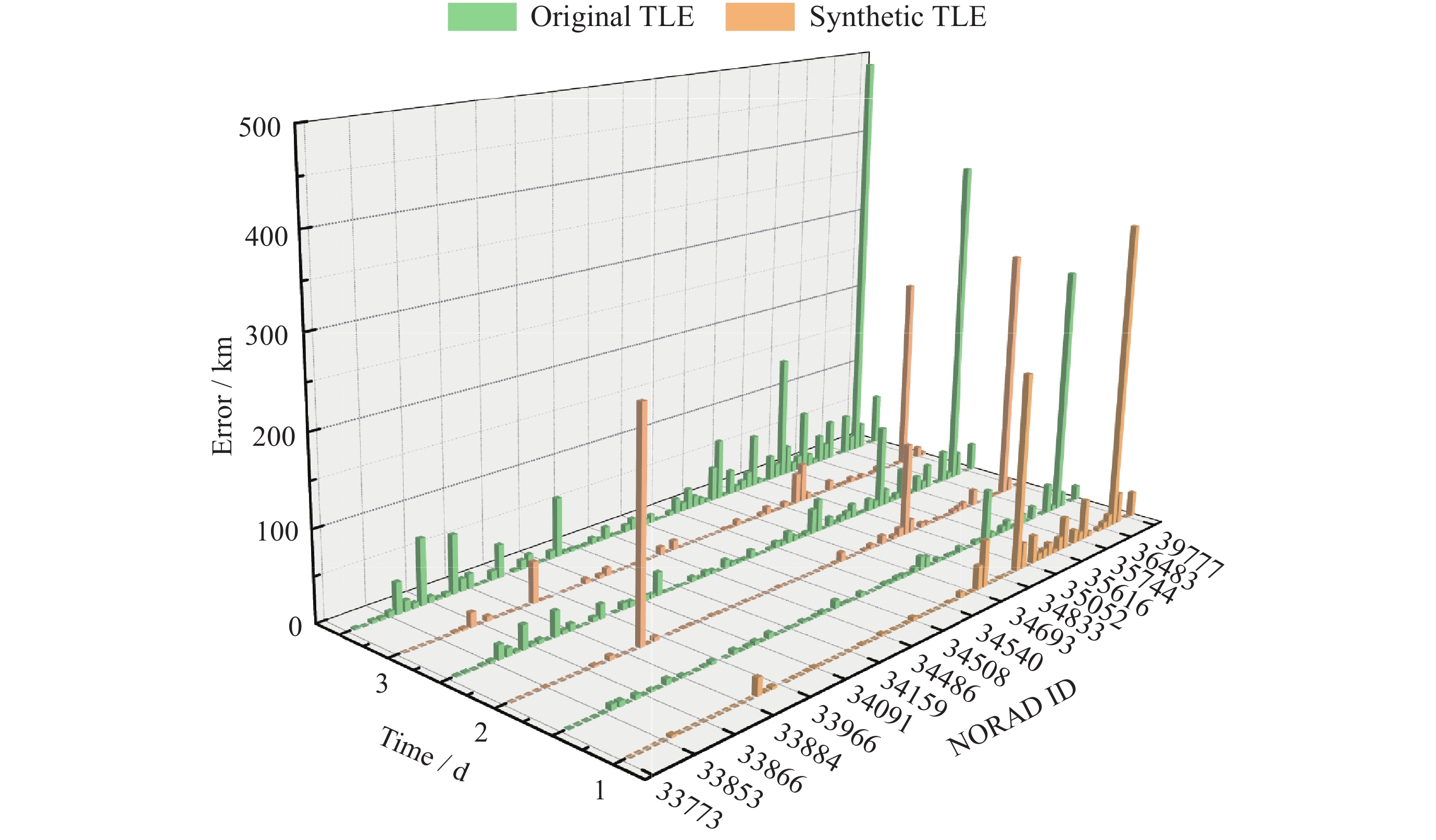
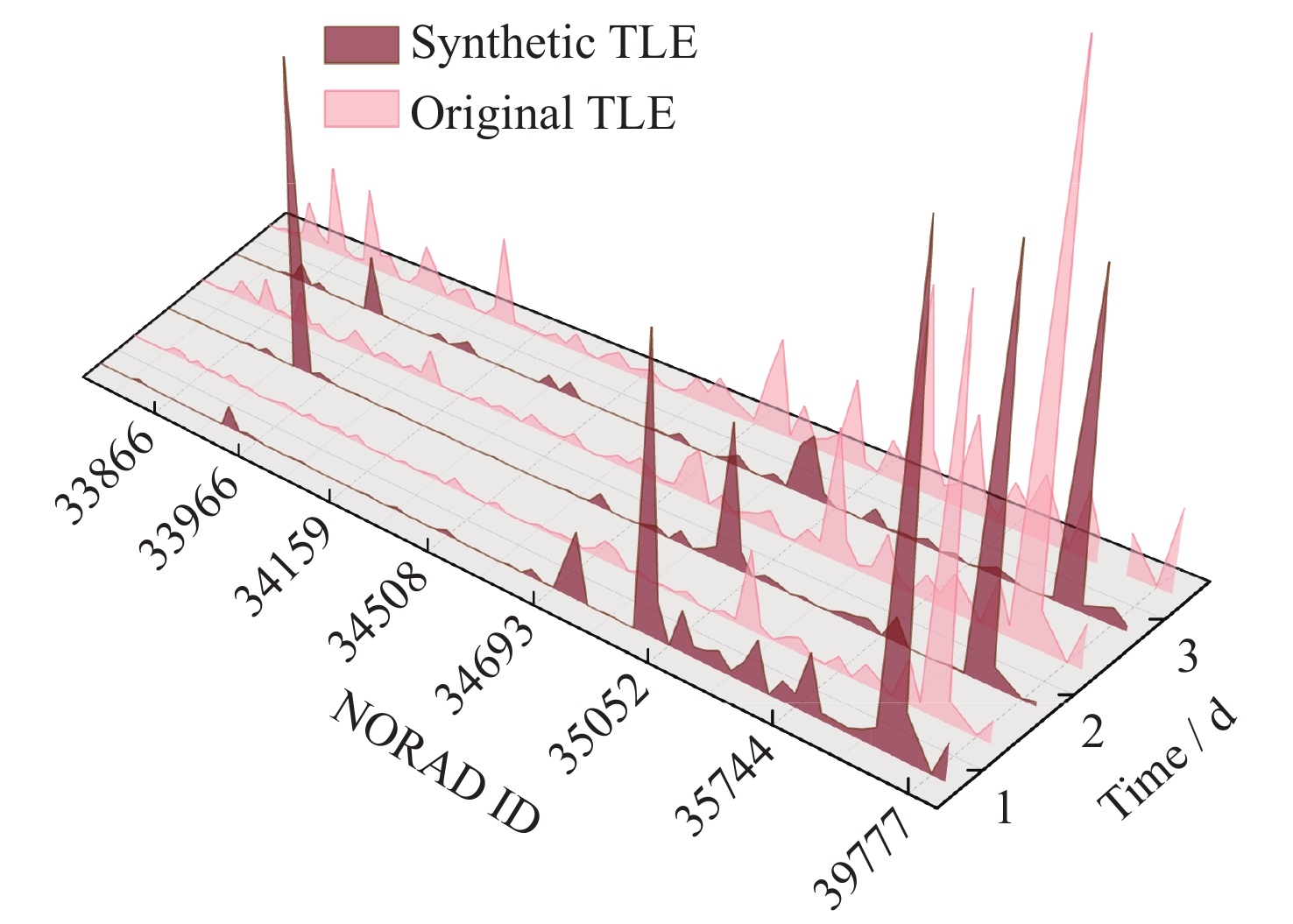
图 5 81个铱星33碎片位置误差三维柱状结果
Figure 5. 3D position error bar of 81 fragments from Iridium 33
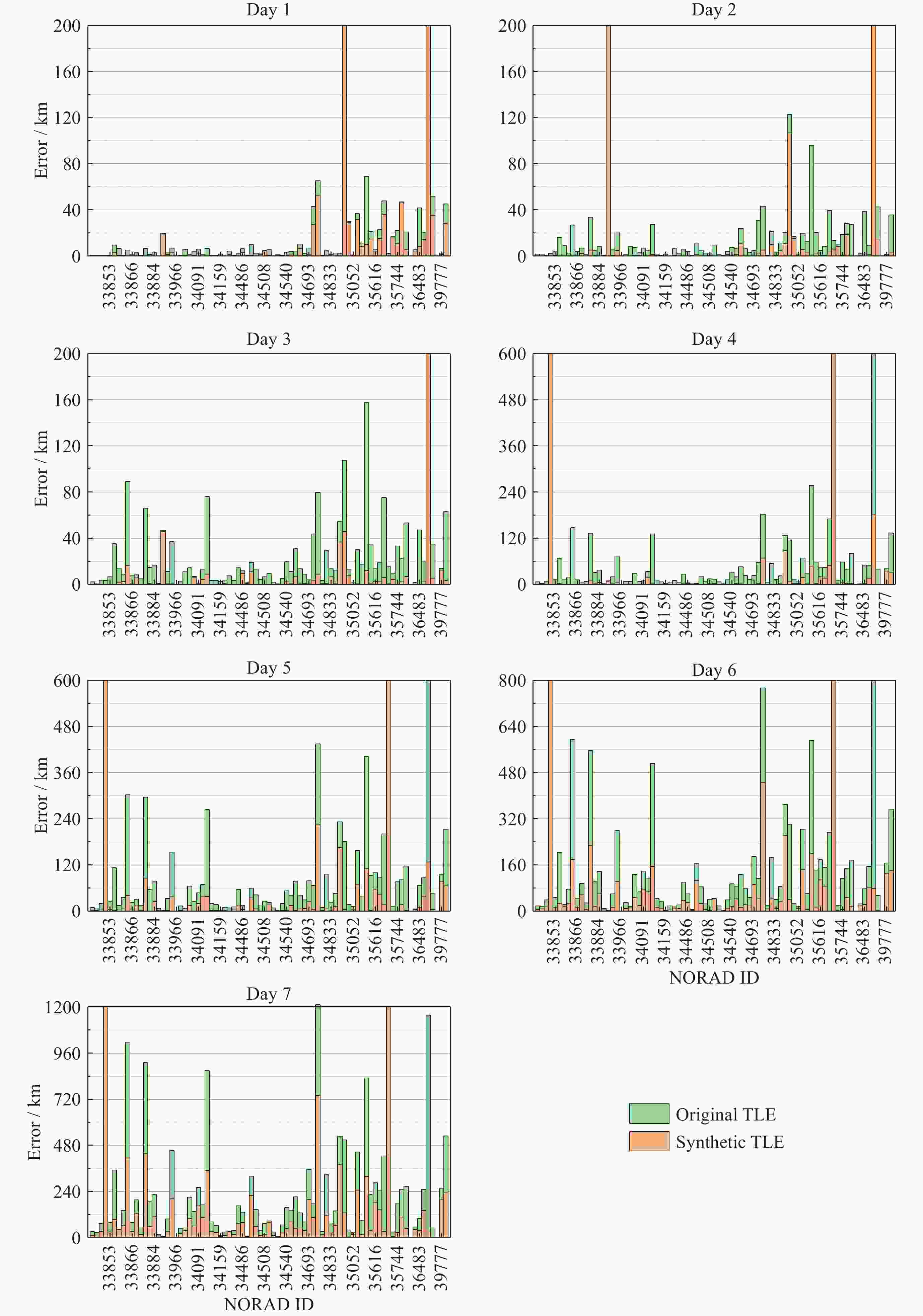
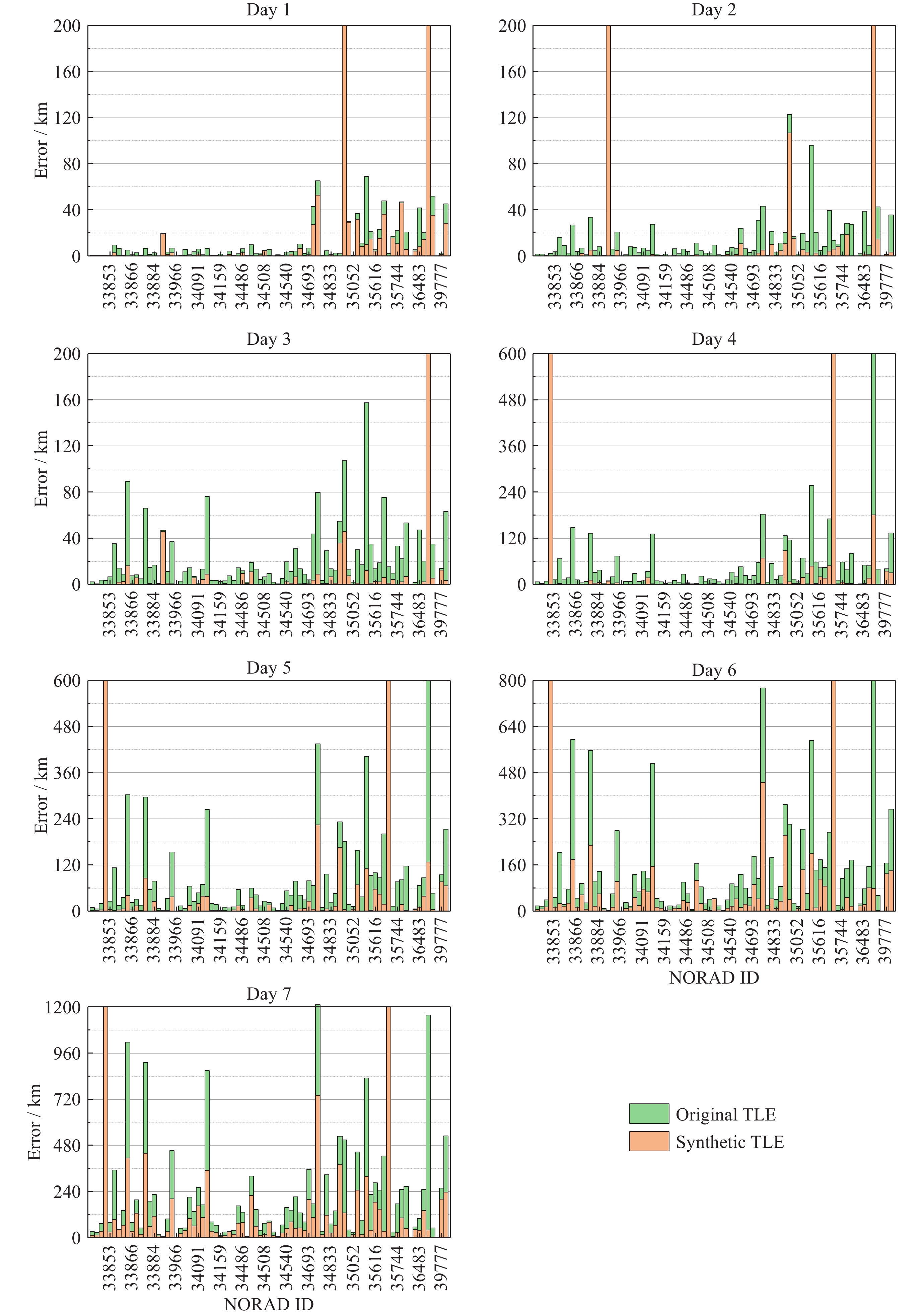
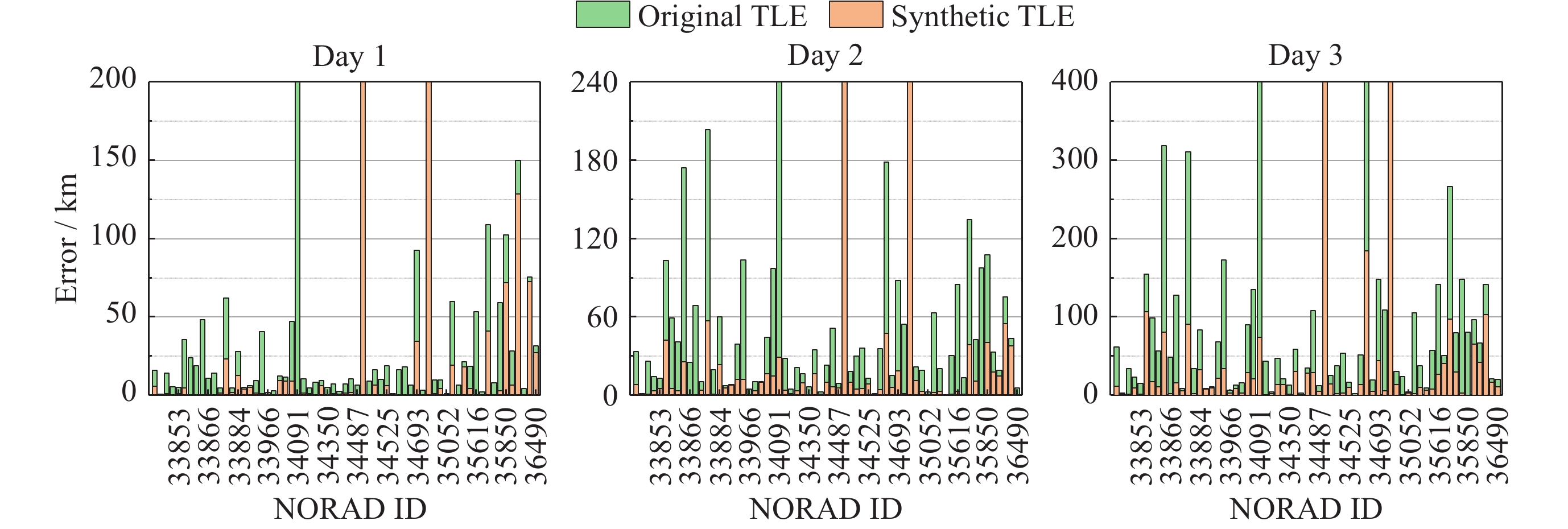
图 6 81个铱星33碎片传播7天位置误差对比的柱状结果
Figure 6. Bar chart comparison of the 81 Iridium 33 fragments position errors over seven-day propagation
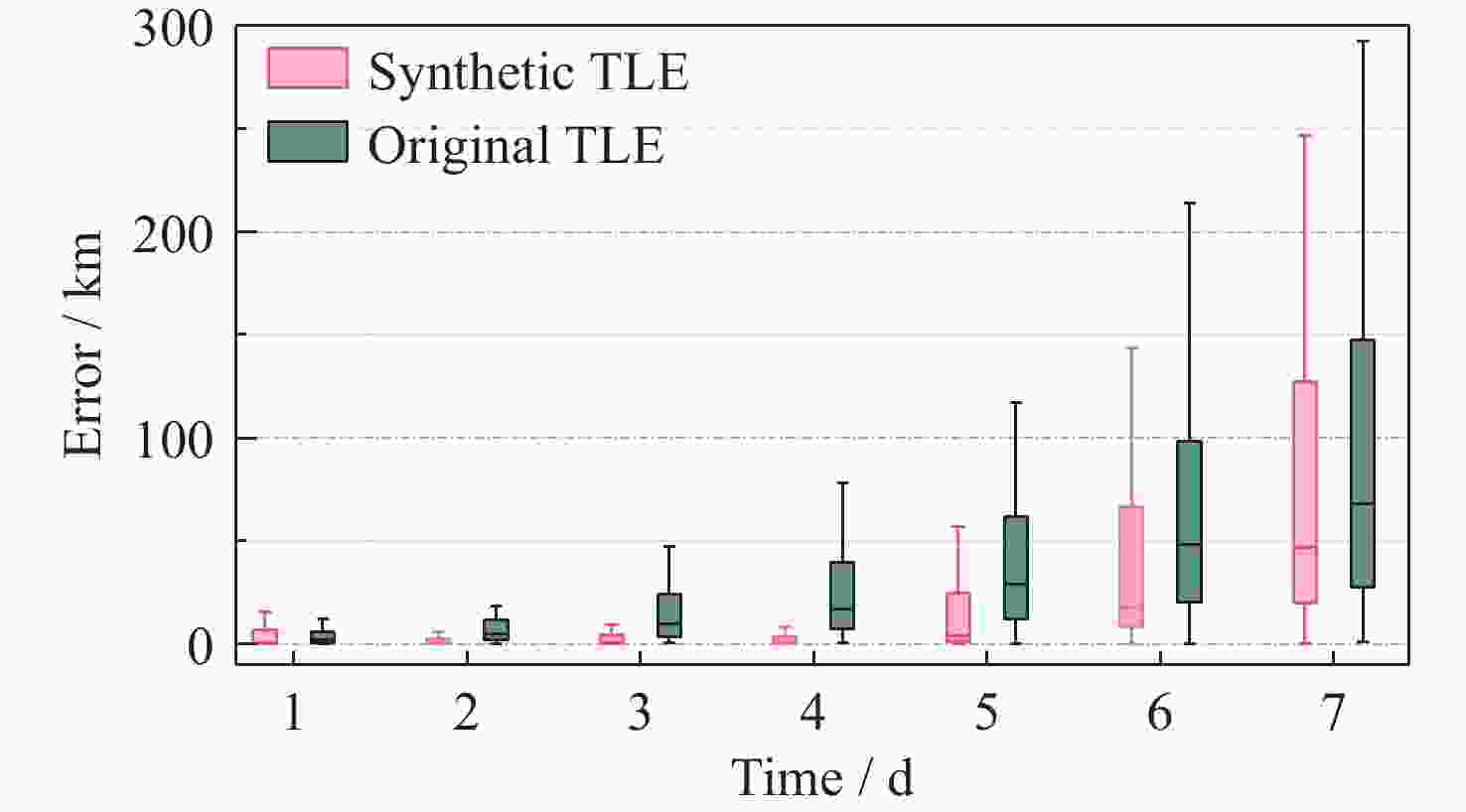
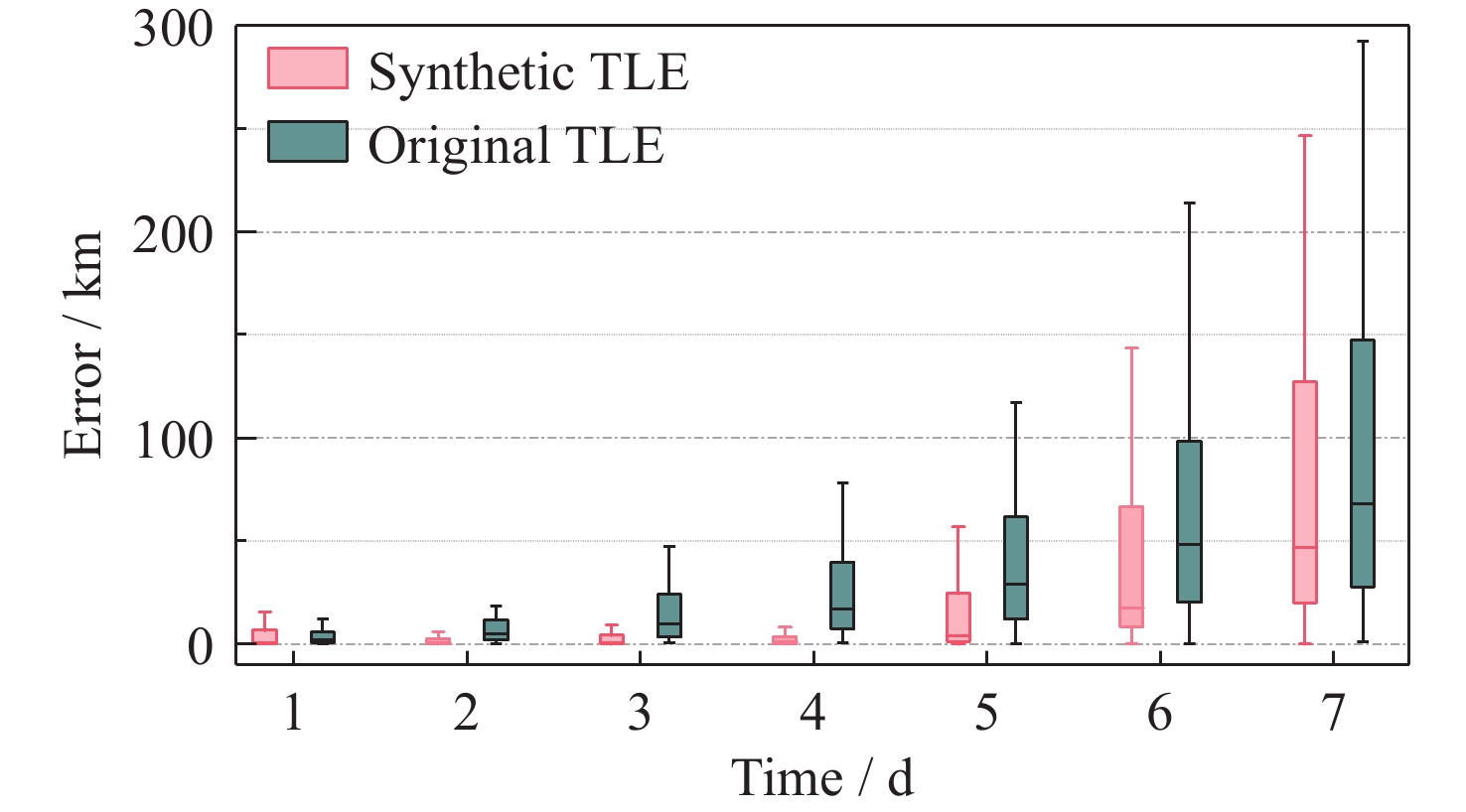
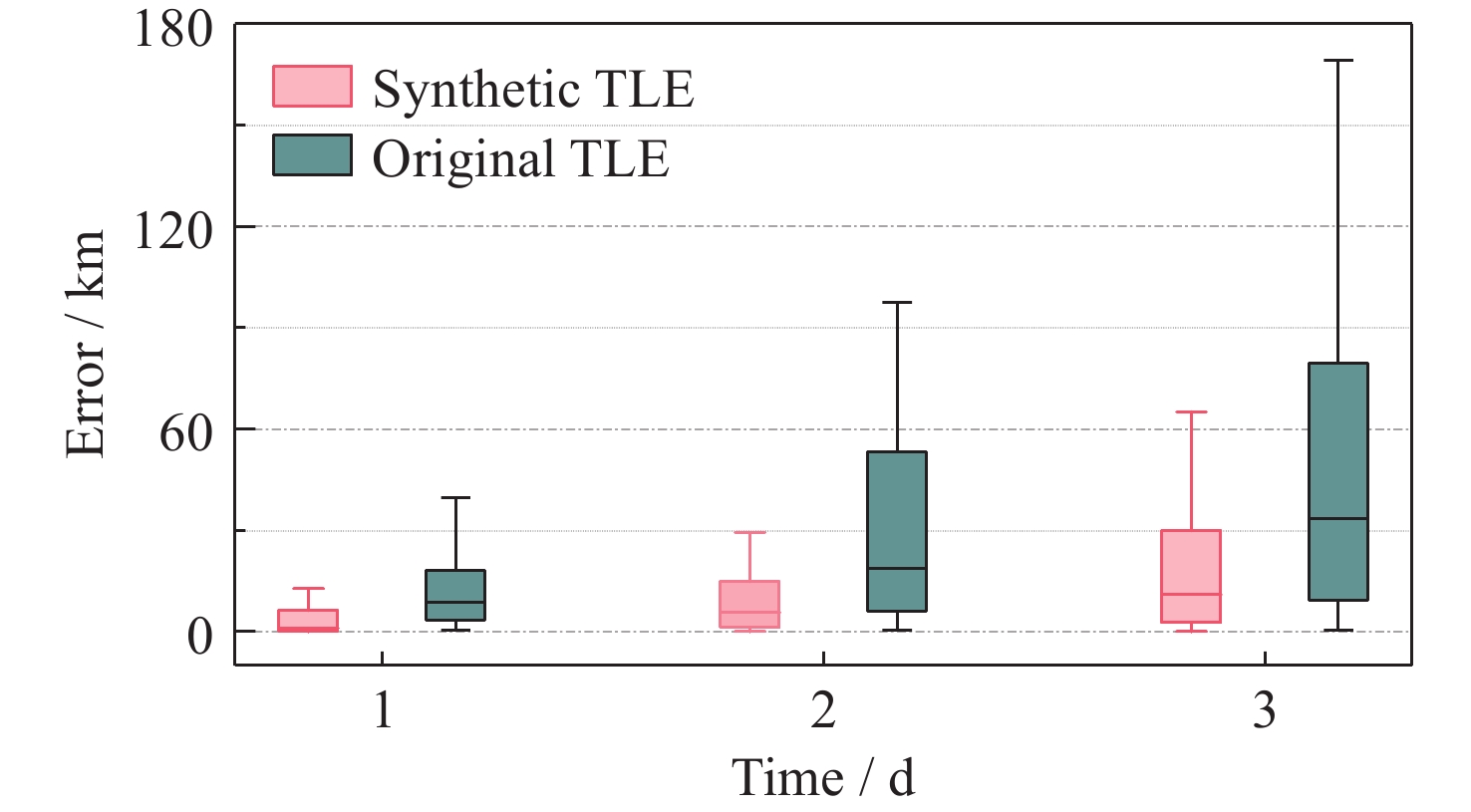
图 7 81个铱星33碎片传播误差箱线结果对比
Figure 7. Boxplot comparison of the propagation errors of 81 Iridium 33 fragments
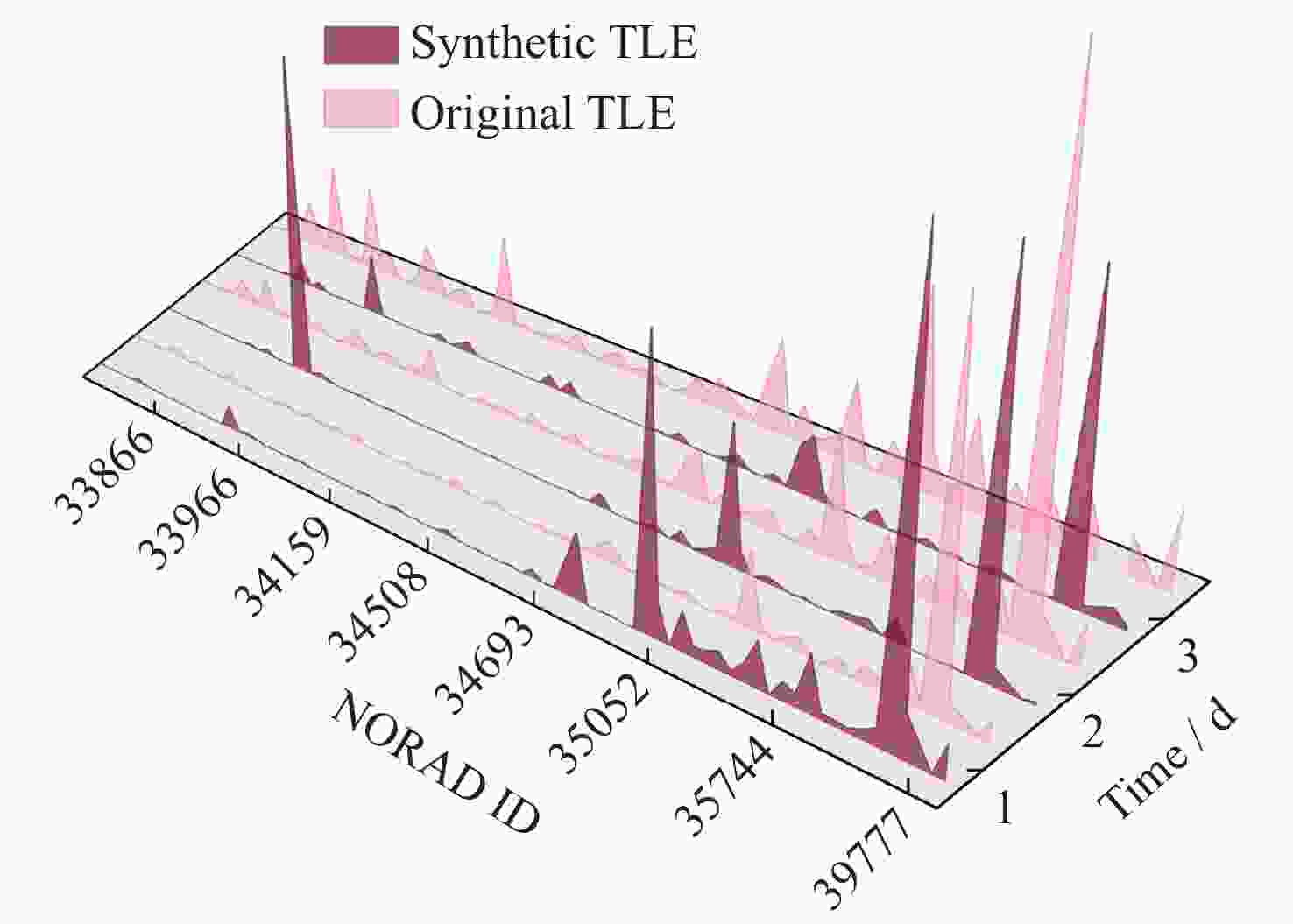
图 8 81个铱星33碎片误差变化三维瀑布结果
Figure 8. 3D waterfall plot of the error changes of 81 Iridium 33 fragments
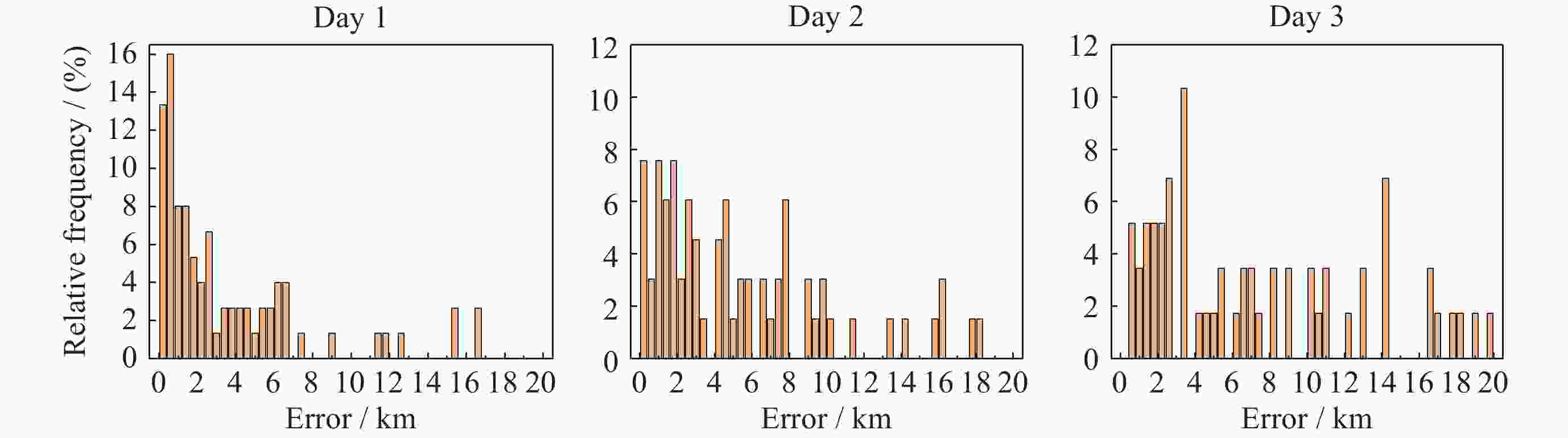
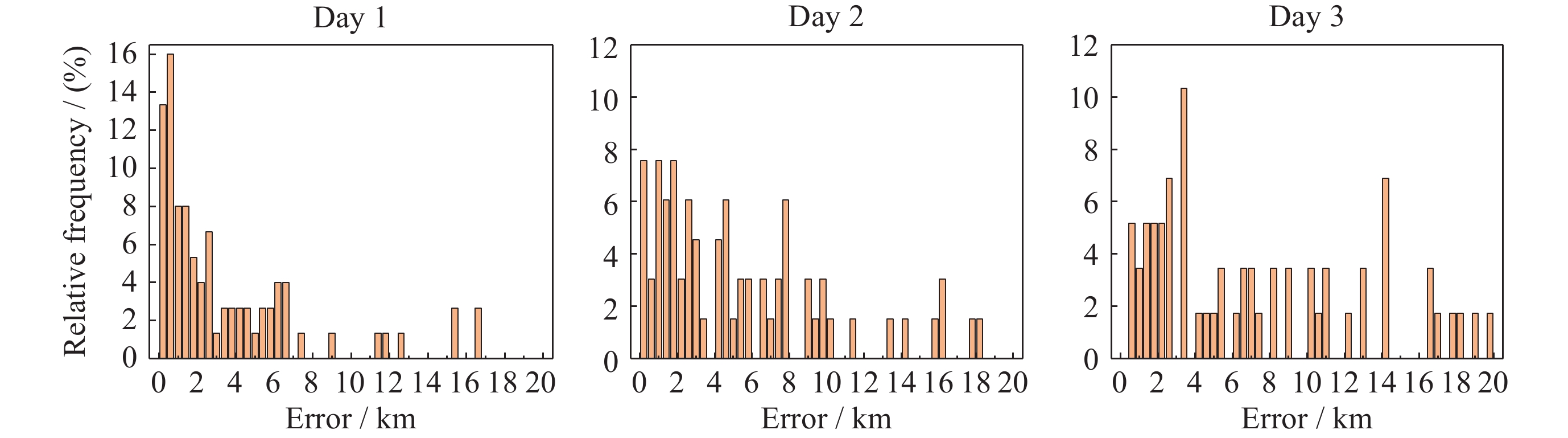
图 9 81个铱星33碎片原始TLE 3天传播误差频率分布
Figure 9. Distribution of original TLE 3-day propagation error frequencies for 81 Iridium 33 fragments
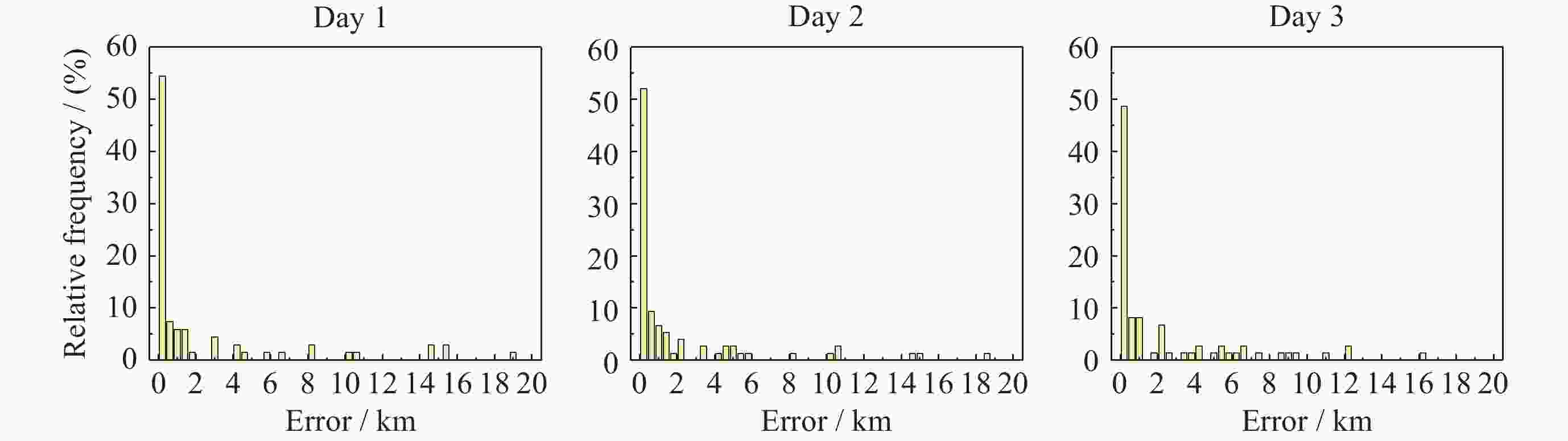
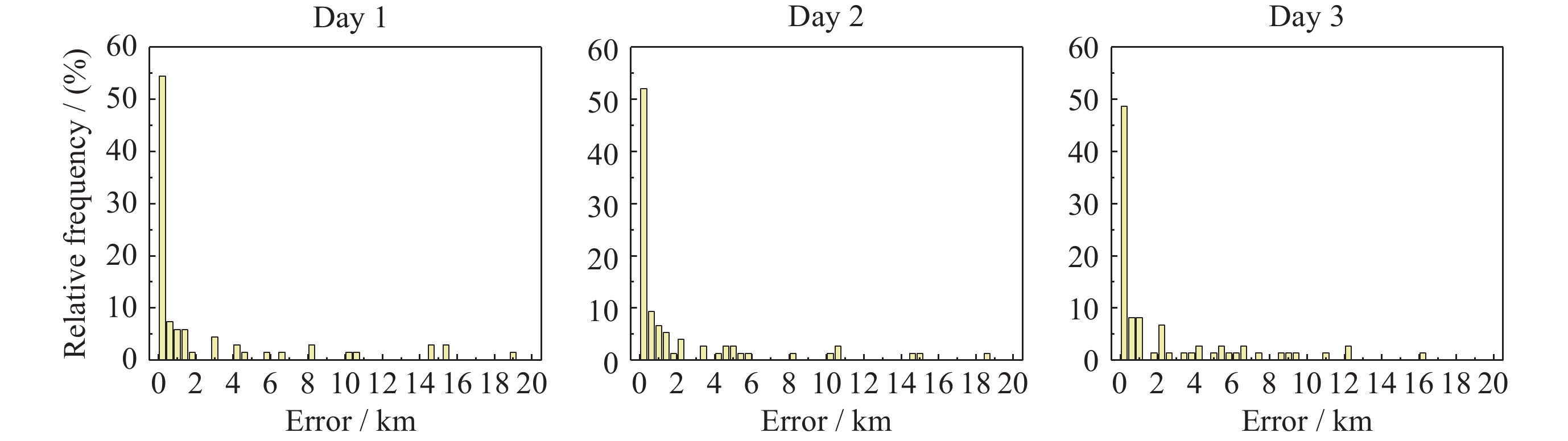
图 10 81个铱星33碎片合成TLE 3天传播误差频率分布
Figure 10. Distribution of synthetic TLE 3-day propagation error frequencies for 81 Iridium 33 fragments
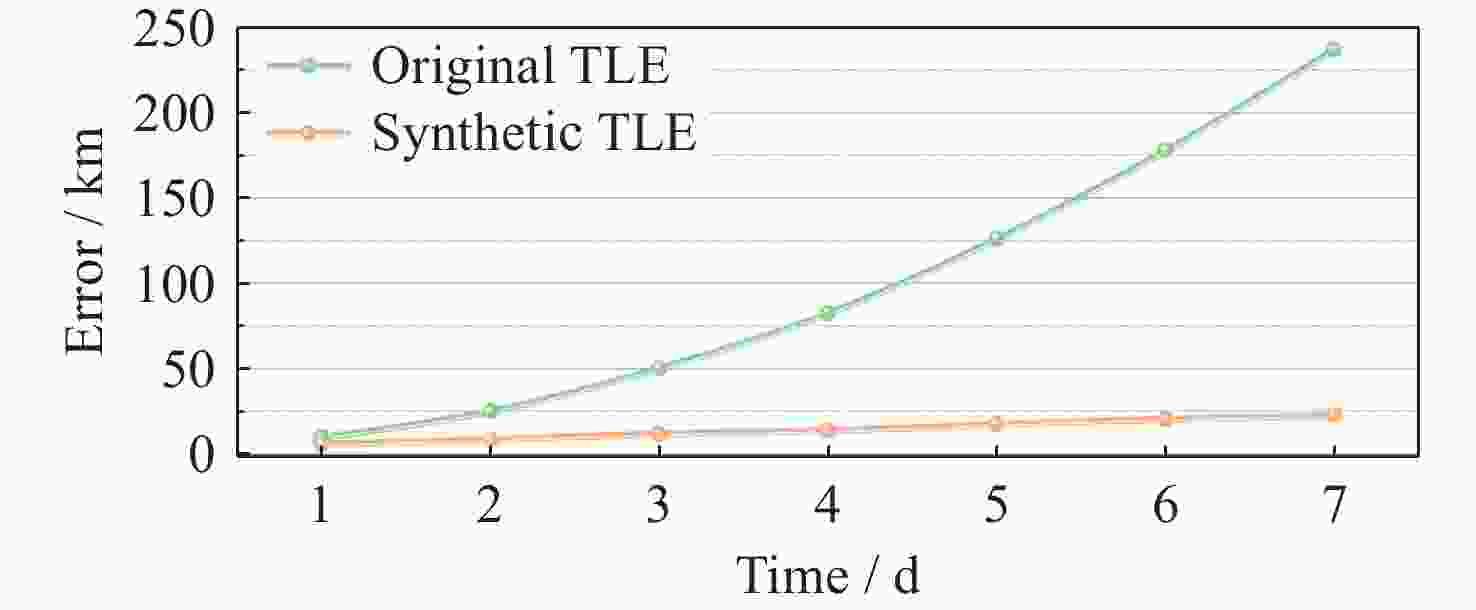
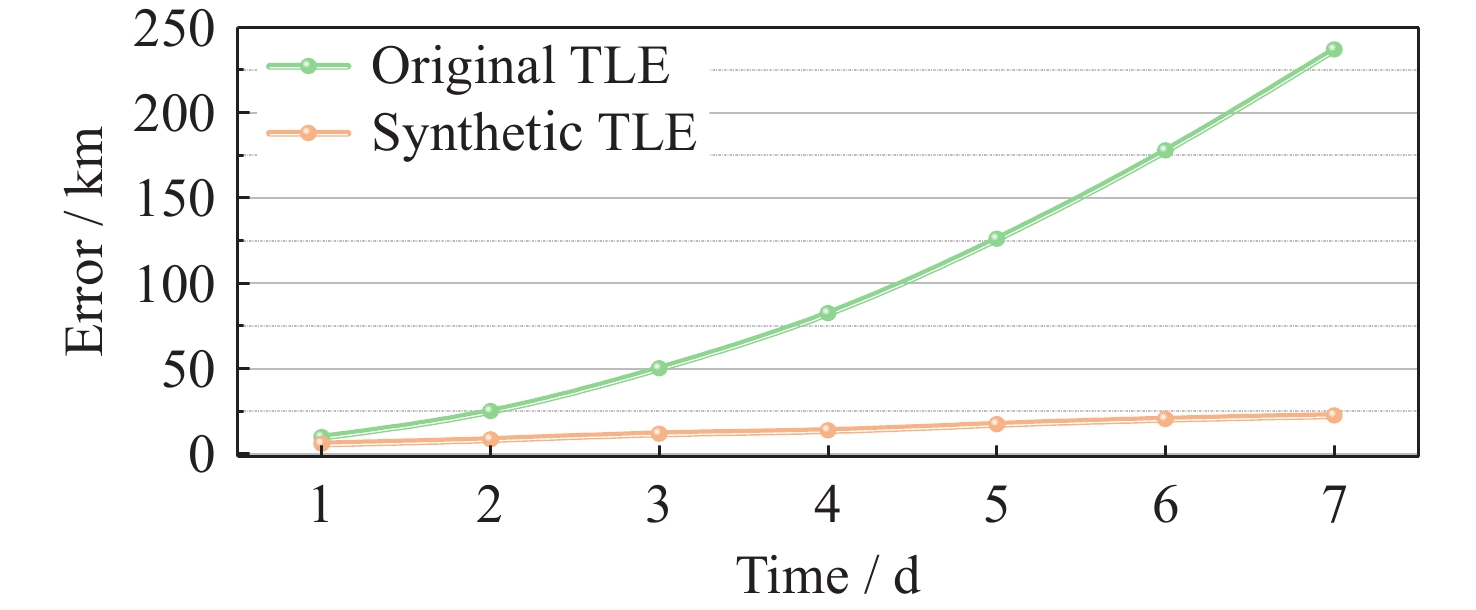
图 11 目标33773传播7天的误差对比
Figure 11. Comparison of the propagation errors for Target 33773 over 7 days
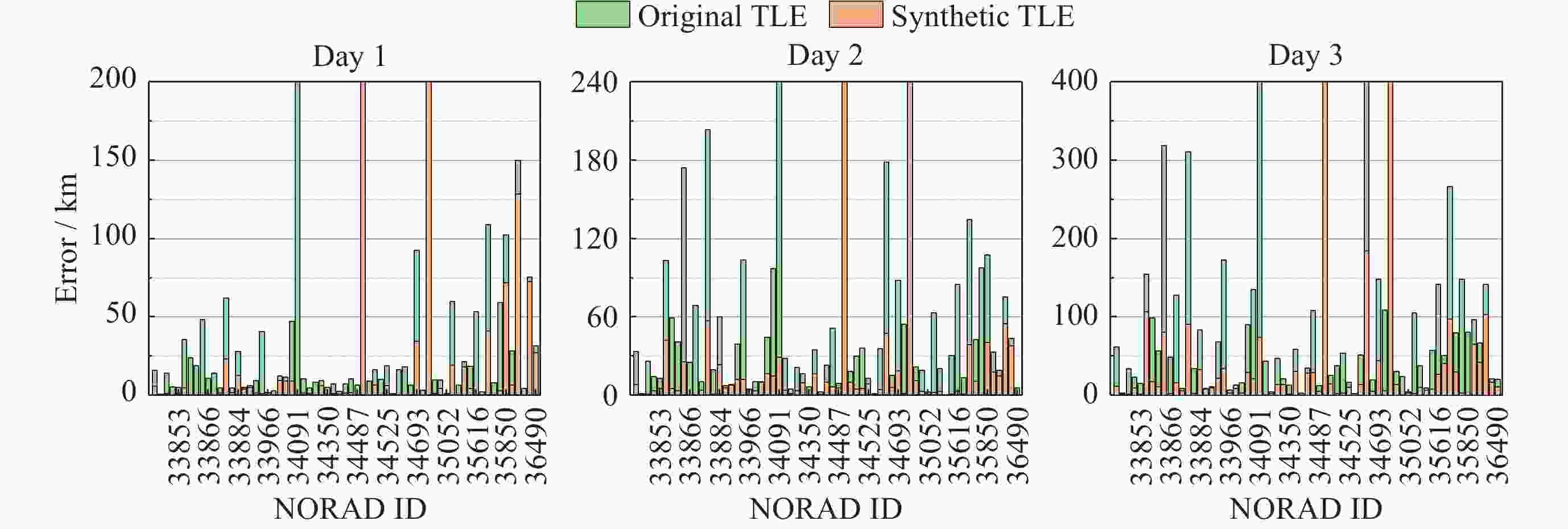
图 12 65个铱星33碎片传播三天位置误差的柱状结果对比
Figure 12. Bar chart comparison of the position errors of 65 Iridium 33 fragments propagated over three days
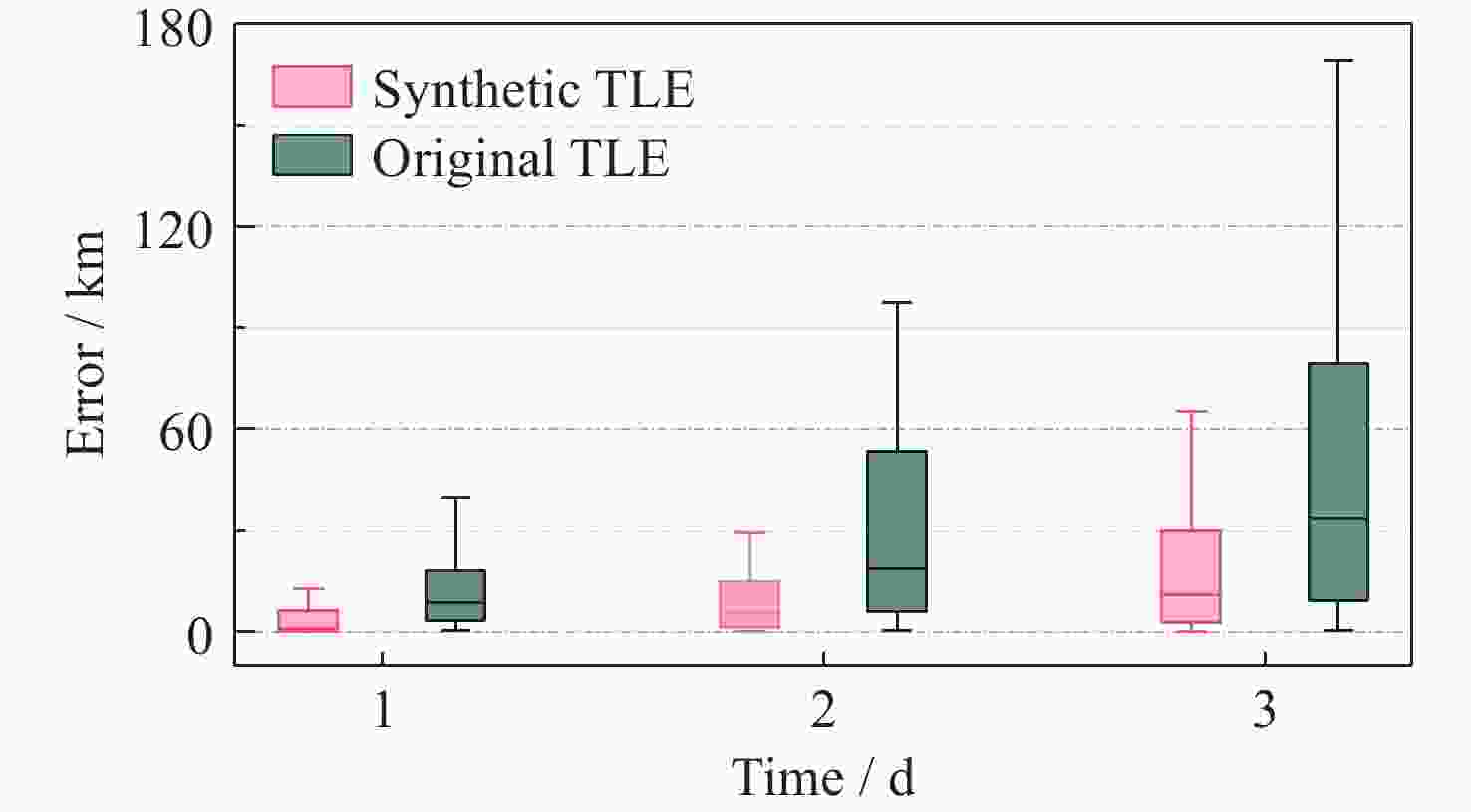
图 13 65个铱星33碎片传播误差箱线结果对比
Figure 13. Boxplot comparison of the propagation errors of 65 Iridium 33 fragments
表 1 TLE数据训练集
Table 1. TLE data training set
NORAD ID Satname Apogee/km Perigee/km Inclination/(°) Period/min 33773 IRIDIUM33 DEB 757 742 86.40 99.82 33775 IRIDIUM33 DEB 765 747 86.37 99.95 40996 IRIDIUM33 DEB 627 607 86.35 97.04 46965 IRIDIUM33 DEB 713 683 86.33 98.73  下载: 导出CSV
表 2 81个铱星33碎片TLE 7天传播误差改善效果统计
Table 2. Statistic of improvement effect on seven-day propagation error of 81 Iridium 33 fragments
Time/d Proportion of improved cases/(%) Number of unimproved items 1 69.14 25 2 87.65 10 3 86.42 11 4 88.89 9 5 82.72 14 6 70.37 24 7 65.43 28
下载: 导出CSV
-
[1] THAMMAWICHAI M, LUANGWILAI T. Data-driven satellite orbit prediction using two-line elements[J]. Astronomy and Computing, 2024, 46: 100782 doi: 10.1016/j.ascom.2023.100782 [2] 王震, 季逸民, 白国庆, 等. 我国空间站应对空间碎片能力提升方案研究[J]. 上海航天(中英文), 2025, 42(3): 26-31 doi: 10.19328/j.cnki.2096-8655.2025.03.004WANG Zhen, JI Yimin, BAI Guoqing, et al. Research on the enhancement strategies for the space debris handling capabilities of China space station[J]. Aerospace Shanghai (Chinese & English), 2025, 42(3): 26-31 doi: 10.19328/j.cnki.2096-8655.2025.03.004 [3] 雷祥旭, 夏胜夫, 刘宏康, 等. 伽利略卫星首次轨道机动规避空间碎片事件分析[C]//第十四届中国卫星导航年会论文集——S03卫星轨道与精密定位. 济南: 中国卫星导航系统管理办公室学术交流中心, 2024: 50-56LEI Xiangxu, XIA Shengfu, LIU Hongkang, et al. Analysis of the first space debris collision avoidance event of Galileo satellite[C]//Proceedings of the 14th China Satellite Navigation Annual Conference. Jinan: Academic Exchange Center of China Satellite Navigation System Management Office, 2024: 50-56 [4] 刘祺, 毛威, 胡鹏, 等. 高精度霍尔电推进技术的应用与发展研究[J]. 中国空间科学技术, 2023, 43(2): 1-15LIU Qi, MAO Wei, HU Peng, et al. Application and development of high-precision Hall electric propulsion technology[J]. Chinese Space Science and Technology, 2023, 43(2): 1-15 [5] JIA Q L, XIAO J P, BAI L, et al. Space situational awareness systems: bridging traditional methods and artificial intelligence[J]. Acta Astronautica, 2025, 228: 321-330 doi: 10.1016/j.actaastro.2024.11.025 [6] ACCIARINI G, BAYDIN A G, IZZO D. Closing the gap between SGP4 and high-precision propagation via differentiable programming[J]. Acta Astronautica, 2025, 226: 694-701 doi: 10.1016/j.actaastro.2024.10.063 [7] LI B, ZHANG Y, HUANG J, et al. Improved orbit predictions using two-line elements through error pattern mining and transferring[J]. Acta Astronautica, 2021, 188: 405-415 doi: 10.1016/j.actaastro.2021.08.002 [8] CHANG S Y, WU H C, SOTIROPOULOS F, et al. Robust satellite-orbit prediction using artificial neural network based on Levenberg-Marquardt algorithm[C]//2022 International Wireless Communications and Mobile Computing (IWCMC). Dubrovnik, Croatia: IEEE, 2022: 1329-1334 [9] 鲁瑞颖. 面向序列数据特征学习的深度动态生成模型构建方法研究[D]. 西安: 西安电子科技大学, 2022LU Ruiying. Research on Deep Dynamic Generative Model for Learning Feature from Sequential Data[D]. Xi’an: Xidian University, 2022 [10] OSAMA A, RAAFAT M, DARWISH A, et al. Satellite orbit prediction based on recurrent neural network using two line elements[C]//2022 5th International Conference on Computing and Informatics (ICCI). New Cairo, Cairo, Egypt: IEEE, 2022: 298-302 [11] DRÁČEK F, ĎURIKOVIČ R, ŠILHA J. Validation of unsupervised anomaly detection from historical satellite positional data[C]//2024 28th International Conference Information Visualisation (IV). Coimbra, Portugal: IEEE, 2024: 1-5 [12] Li H G, LIU Y Q, SHI J L, et al. Multimodal LSTM forecasting for LEO satellite communication terminal access[C]//2023 IEEE 97th Vehicular Technology Conference (VTC2023-Spring). Florence, Italy: IEEE, 2023: 1-5 [13] 潘雄, 黄伟凯, 王聪, 等. 半参数变系数与支持向量机组合模型的BDS-3钟差短期预报算法研究[J]. 武汉大学学报(信息科学版), 2024: 1-13PAN Xiong, HUANG Weikai, WANG Cong, et al. BDS-3 clock error short-term prediction algorithm based on semi-parametric-varying-coefficient-SVM combined model[J]. Geomatics and Information Science of Wuhan University, 2024: 1-13 [14] 龚柏春, 李爽, 郑莉莉, 等. 空间非合作目标近程交会仅测角相对导航方法[J]. 中国惯性技术学报, 2018, 26(2): 173-179 doi: 10.13695/j.cnki.12-1222/o3.2018.02.006GONG Baichun, LI Shuang, ZHENG Lili, et al. Angles-only relative navigation algorithm for close-in proximity of space non-cooperative target[J]. Journal of Chinese Inertial Technology, 2018, 26(2): 173-179 doi: 10.13695/j.cnki.12-1222/o3.2018.02.006 [15] 汤靖师, 程昊文. 空间碎片问题的起源、现状和发展[J]. 物理, 2021, 50(5): 317-323TANG Jingshi, CHENG Haowen. The origin, status and future of space debris[J]. Physics, 2021, 50(5): 317-323 [16] 张心宇, 刘源, 宋佳凝. 基于LSTM神经网络的短期轨道预报[J]. 系统工程与电子技术, 2022, 44(3): 939-947 doi: 10.12305/j.issn.1001-506X.2022.03.26ZHANG Xinyu, LIU Yuan, SONG Jianing. Short-term orbit prediction based on LSTM neural network[J]. Systems Engineering and Electronics, 2022, 44(3): 939-947 doi: 10.12305/j.issn.1001-506X.2022.03.26 [17] 何欣燃, 钟秋珍, 崔延美, 等. 基于长短期记忆神经网络的太阳耀斑短期预报[J]. 空间科学学报, 2022, 42(5): 862-872 doi: 10.11728/cjss2022.05.210315028HE Xinran, ZHONG Qiuzhen, CUI Yanmei, et al. Solar flare short-term forecast model based on long and short-term memory neural network[J]. Chinese Journal of Space Science, 2022, 42(5): 862-872 doi: 10.11728/cjss2022.05.210315028 [18] Lin C S, Chen J Y. Using long short-term memory neural network for satellite orbit prediction based on two-line element data[J]. IEEE Transactions on Aerospace and Electronic Systems, 2025, 61: 1-10 -
-

 下载:
下载:

计量
- 文章访问数: 1958
- HTML全文浏览量: 807
- PDF下载量: 121
-
被引次数:
0(来源:Crossref)
0(来源:其他)

