


基于残差补偿WHO-RF模型的电离层不规则体预测
doi: 10.11728/cjss2026.03.2025-0117 cstr: 32142.14.cjss.2025-0117
-
 陈清燕 女, 2001年6月出生于广西梧州市, 现为桂林电子科技大学信息与通信学院硕士研究生, 主要研究方向为卫星导航电离层时空演变规律及预测. E-mail: 2572642573@qq.com
 -
 纪元法 男, 1975年12月出生于山东聊城, 现为桂林电子科技大学信息与通信学院教授, 博士生导师, 主要研究方向为卫星导航、信号处理. E-mail: jiyuanfa@163.com
作者简介:
通讯作者:
Prediction of the Ionospheric Irregularities Based on Residual Compensation WHO-RF Model
-
摘要: 针对电离层不规则体预测困难和单一随机森林(RF)模型在预测中存在精度不高且参数调整困难等问题, 在结合野马优化(Wild Horse Optimizer, WHO)算法的基础上进行残差补偿(Residual Compensation, RC), 构建RC-WHO-RF电离层不规则体预测模型. 利用2020年3月1日至2024年6月30日香港HKWS站的观测数据, 计算电离层总电子含量变化率的标准差 (ROTI) 以及选择一系列与不规则体相关的背景电离层参数作为输入特征进行实验分析. 结果表明, ROTI、余弦相位日变化因子和地磁活动指数对电离层不规则体的预测至关重要; RC-WHO-RF模型预测的均方根误差均小于0.1 TECU·min–1, 对突发性磁暴事件也具有优异的响应能力和预测精度; RC-WHO-RF模型在提前30 min的短临预报中平均相对精度达90.67%, 比WHO-RF提升8.16%, 比单一RF模型提升11.2%, 组合模型的预测效果要明显优于单一RF模型和WHO-RF模型.Abstract: In response to the difficulties in predicting ionospheric irregularities and the low accuracy and tendency to fall into local optima of a single Random Forest (RF) model in prediction, a RC-WO-RF ionospheric irregularities regression prediction model was constructed by combining the Wild Horse Optimizer (WHO) algorithm with Residual Compensation (RC). Using observation data from the Hong Kong HKWS station from 1 March 2020 to 30 June 2024, the Rate of Total Electron Content Index (ROTI) was calculated, and a series of background ionospheric parameters related to ionospheric irregularities were selected as input features. The results indicate that, ROTI, Cosine phase daily variation factor and geomagnetic activity are crucial for ionospheric irregularities; The root mean square error of the RC-WO-RF model is less than 0.1 TECU·min–1, and it has excellent response capability and prediction accuracy for sudden geomagnetic storm events; The average relative accuracy of the RC-WO-RF model in short-term forecasting 30 min in advance is 90.67%, which is 8.16% higher than the WHO-RF model and 11.2% higher than the single RF model. The prediction performance of the combined model is significantly better than that of the single RF model and the WHO-RF model.
-
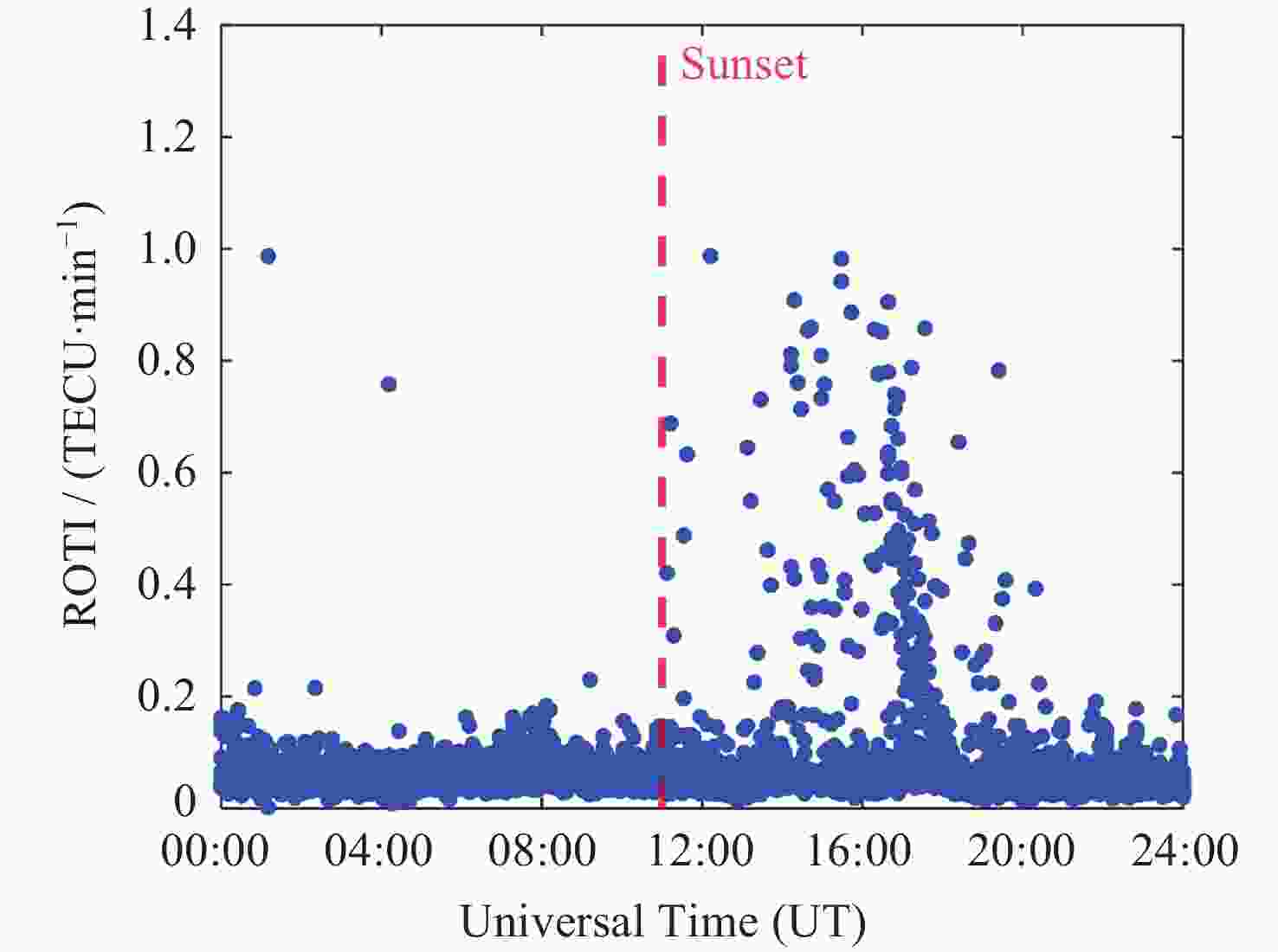
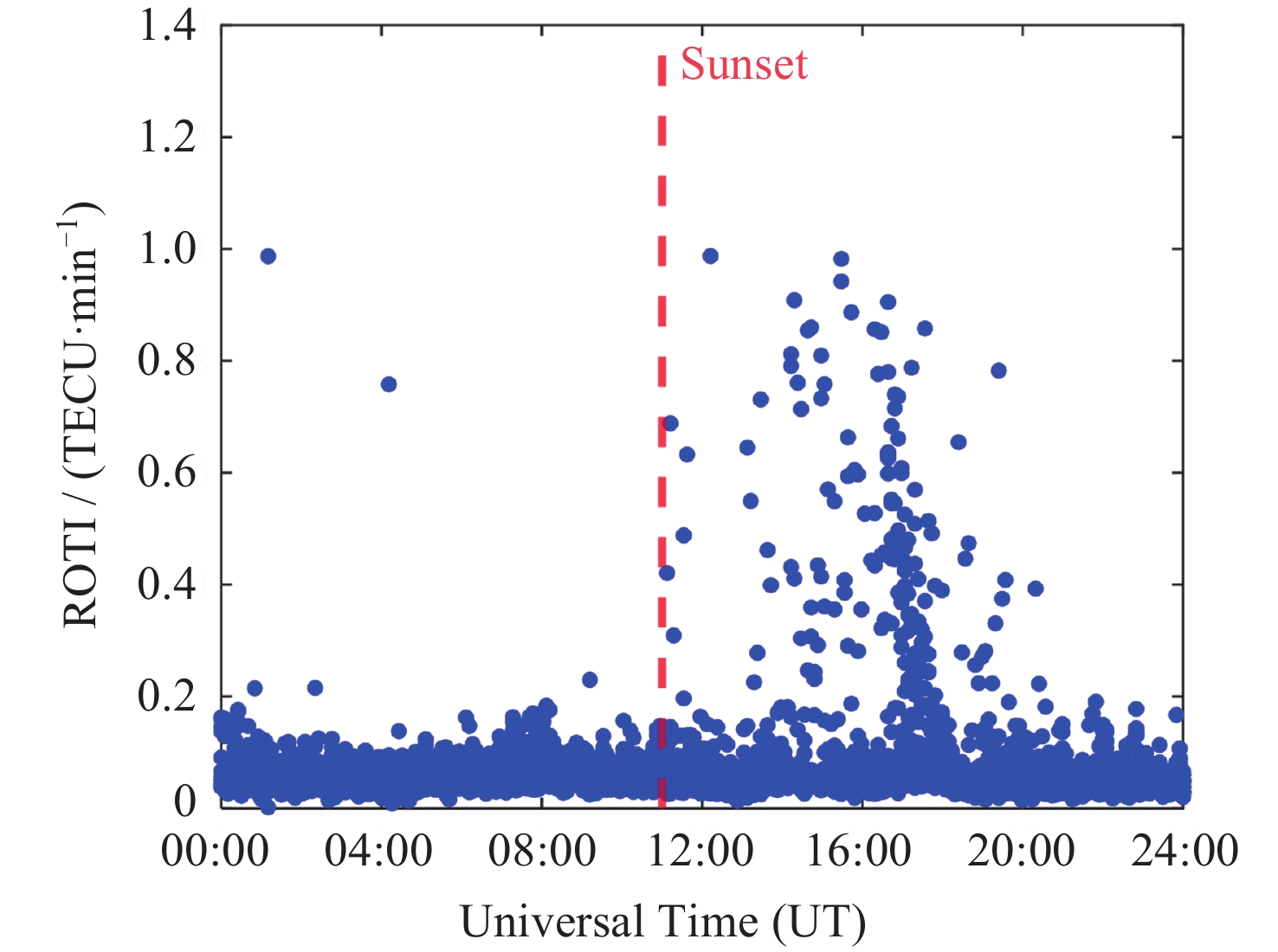
图 1 香港HKWS站点2024年3月31日日落后发生电离层不规则体时ROTI示例
Figure 1. Example of ROTI when ionospheric irregularities occur at the HKWS station in Hong Kong after sunset on 31 March 2024
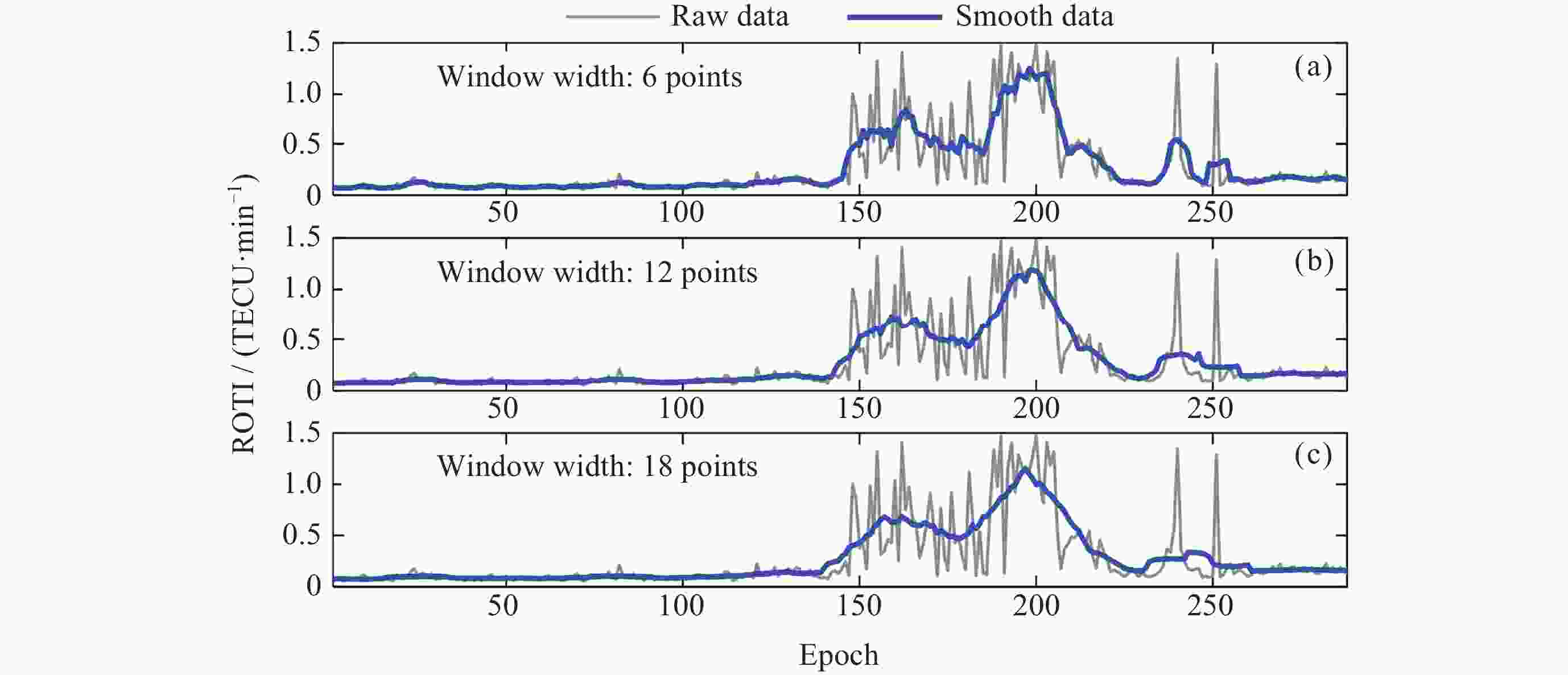
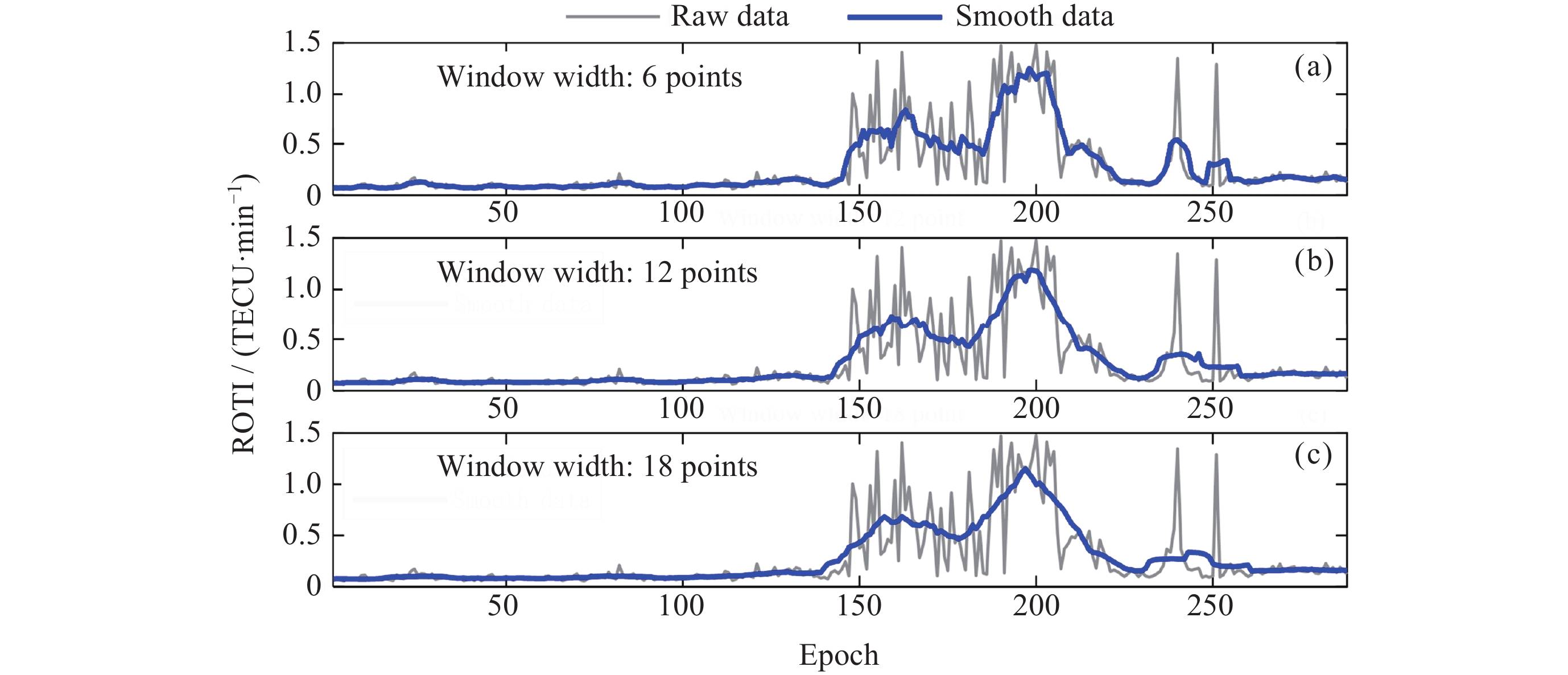
图 2 使用6点、12点和18点移动窗口的平滑效果对比
Figure 2. Comparison of smooth effects of moving windows using 6 points, 12 points, and 18 points
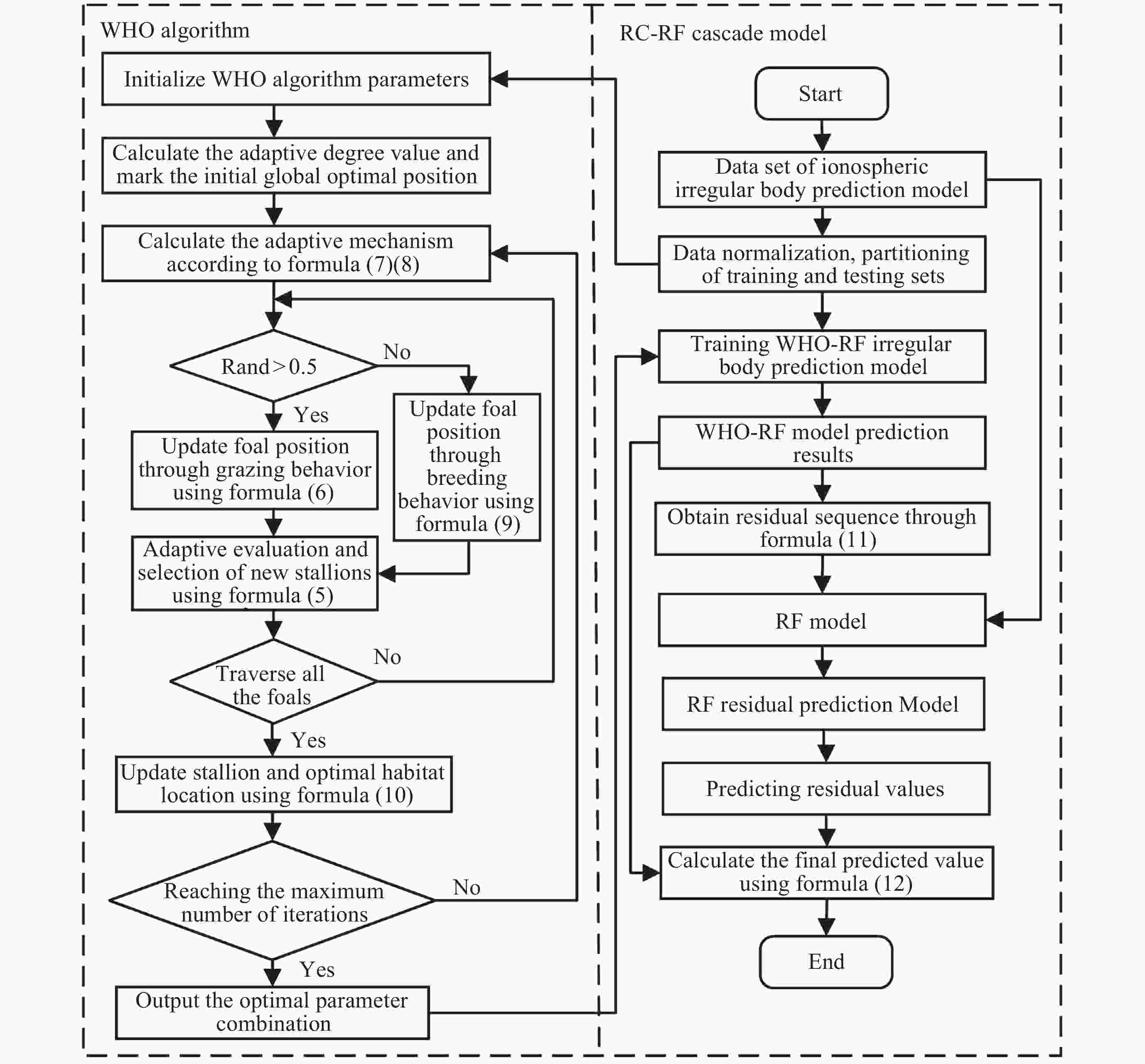
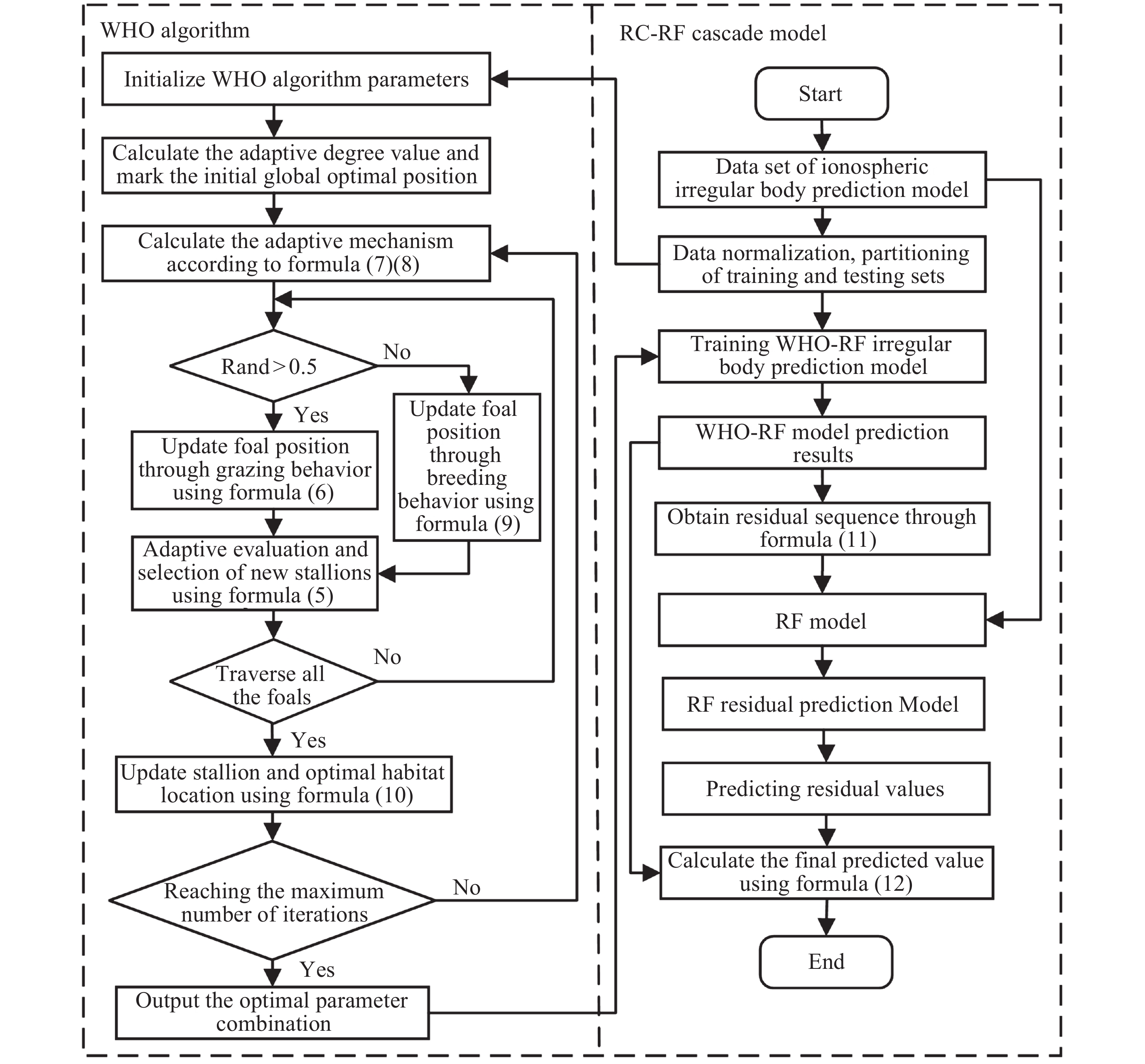
图 4 RC-WHO-RF电离层不规则体预测模型流程
Figure 4. Flow chart of RC-WO-RF ionospheric irregular body prediction model
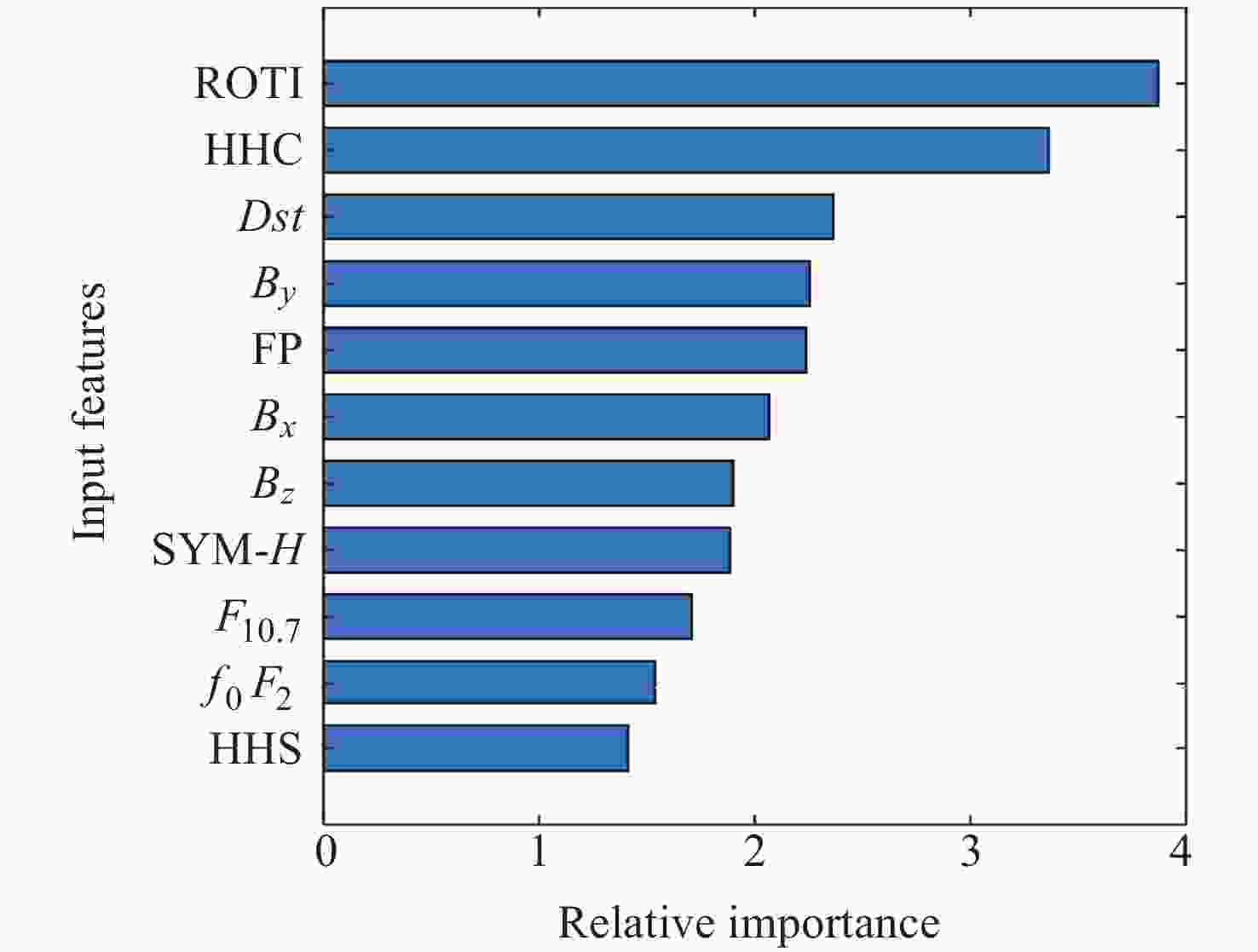
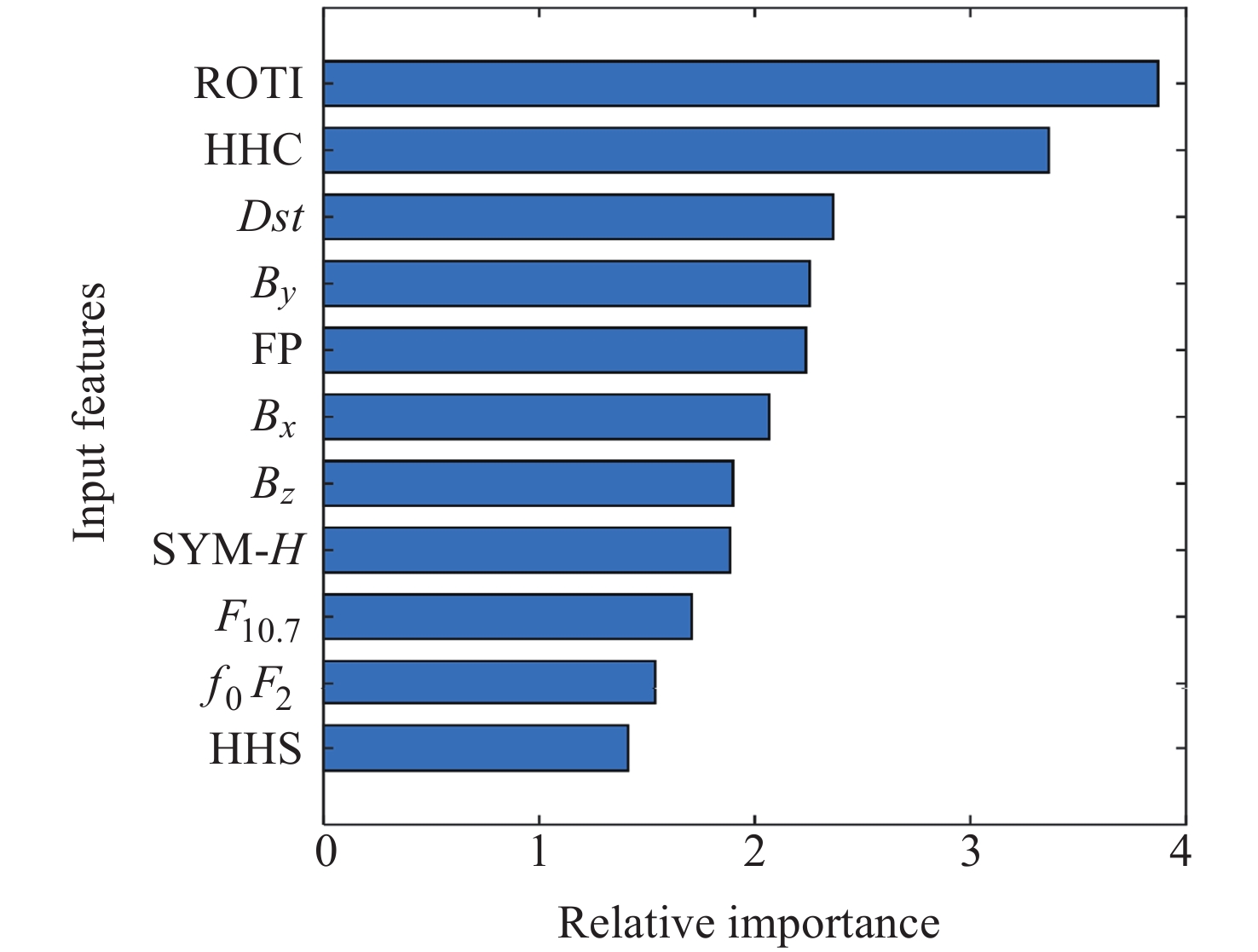
图 5 基于RF方法的输入参数重要性排序
Figure 5. Importance ranking of input parameters based on random forest method
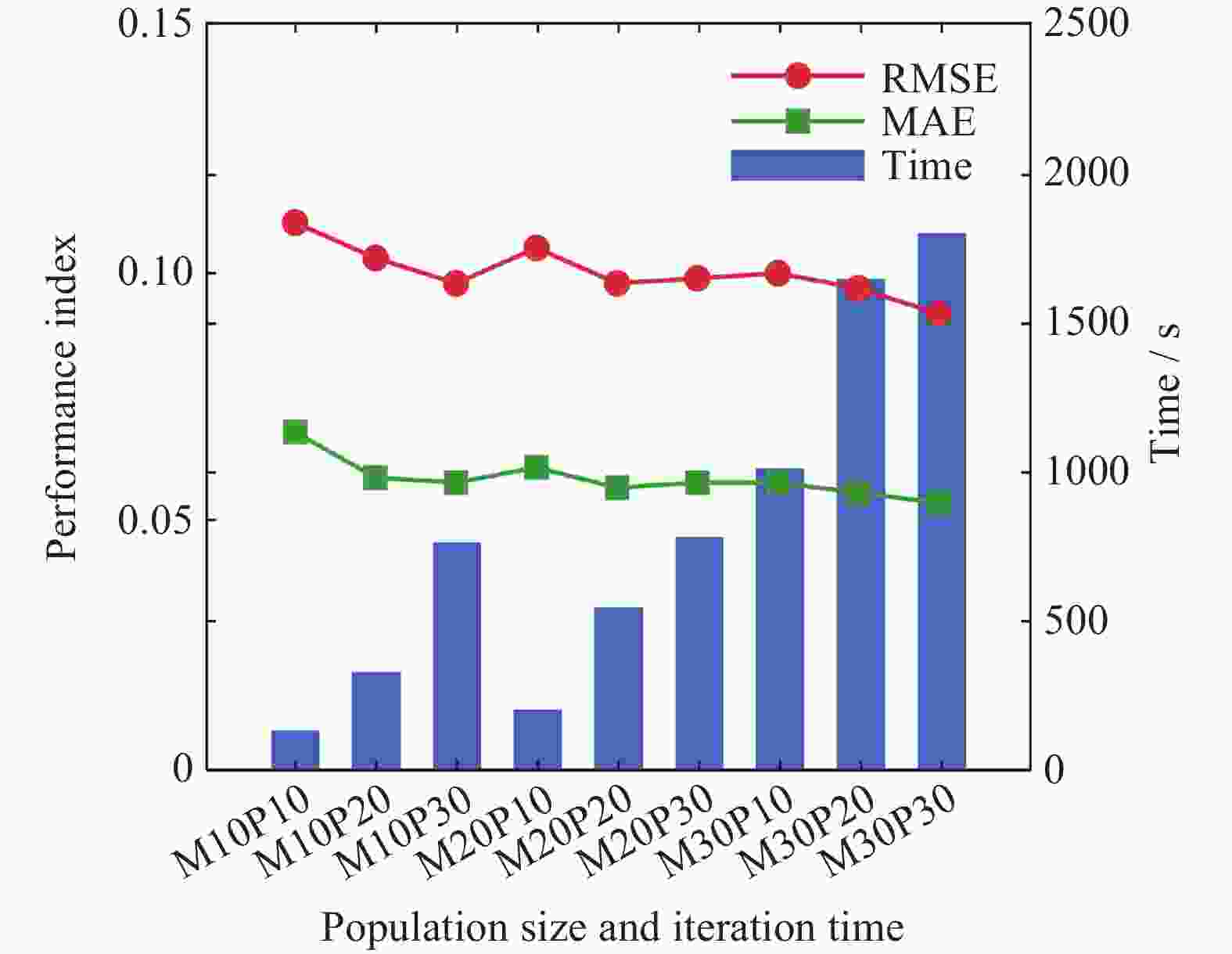
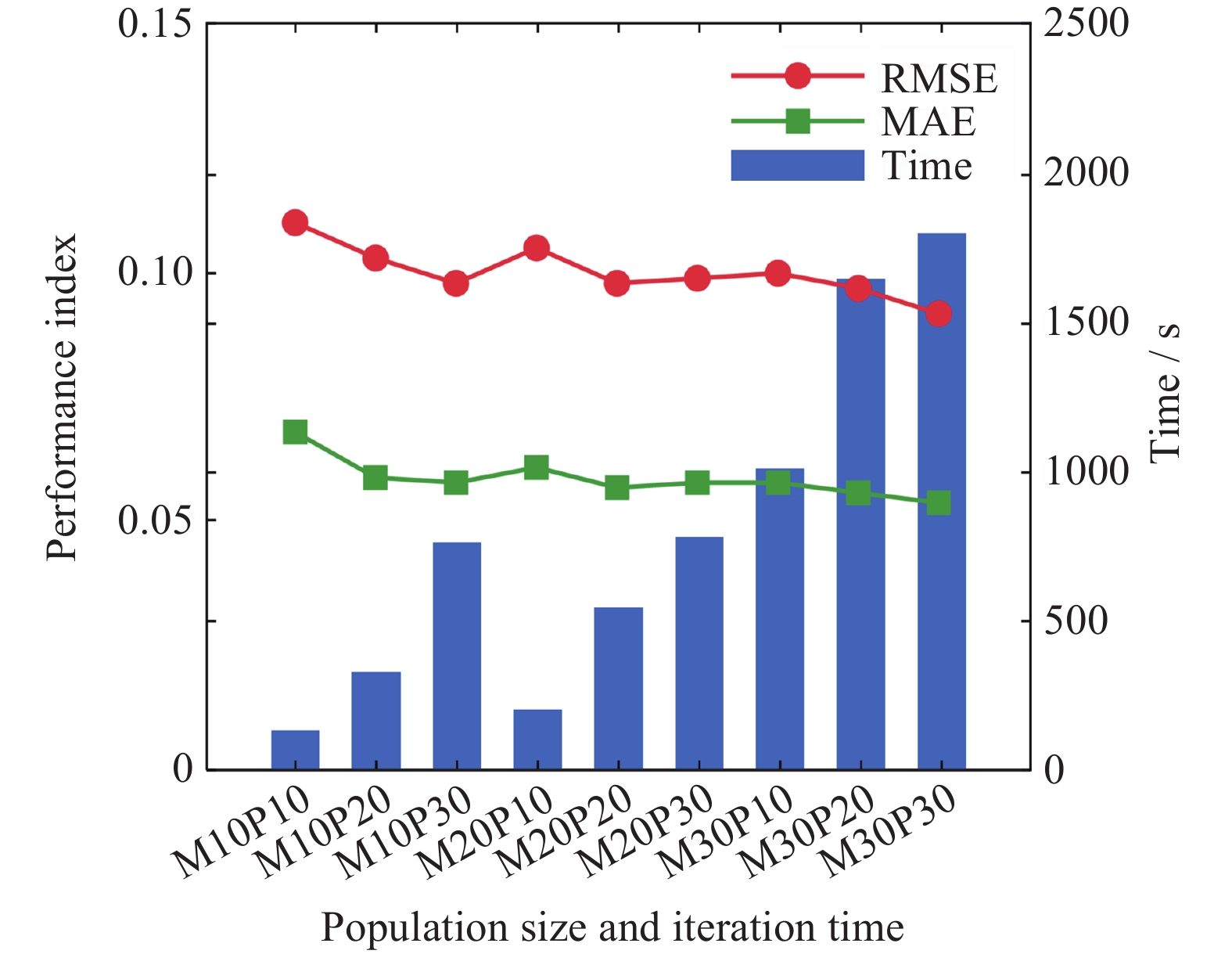
图 6 不同参数组合下的WHO-RF模型性能及寻优时间
Figure 6. Performance and optimization time of WHO-RF model under different parameter combinations
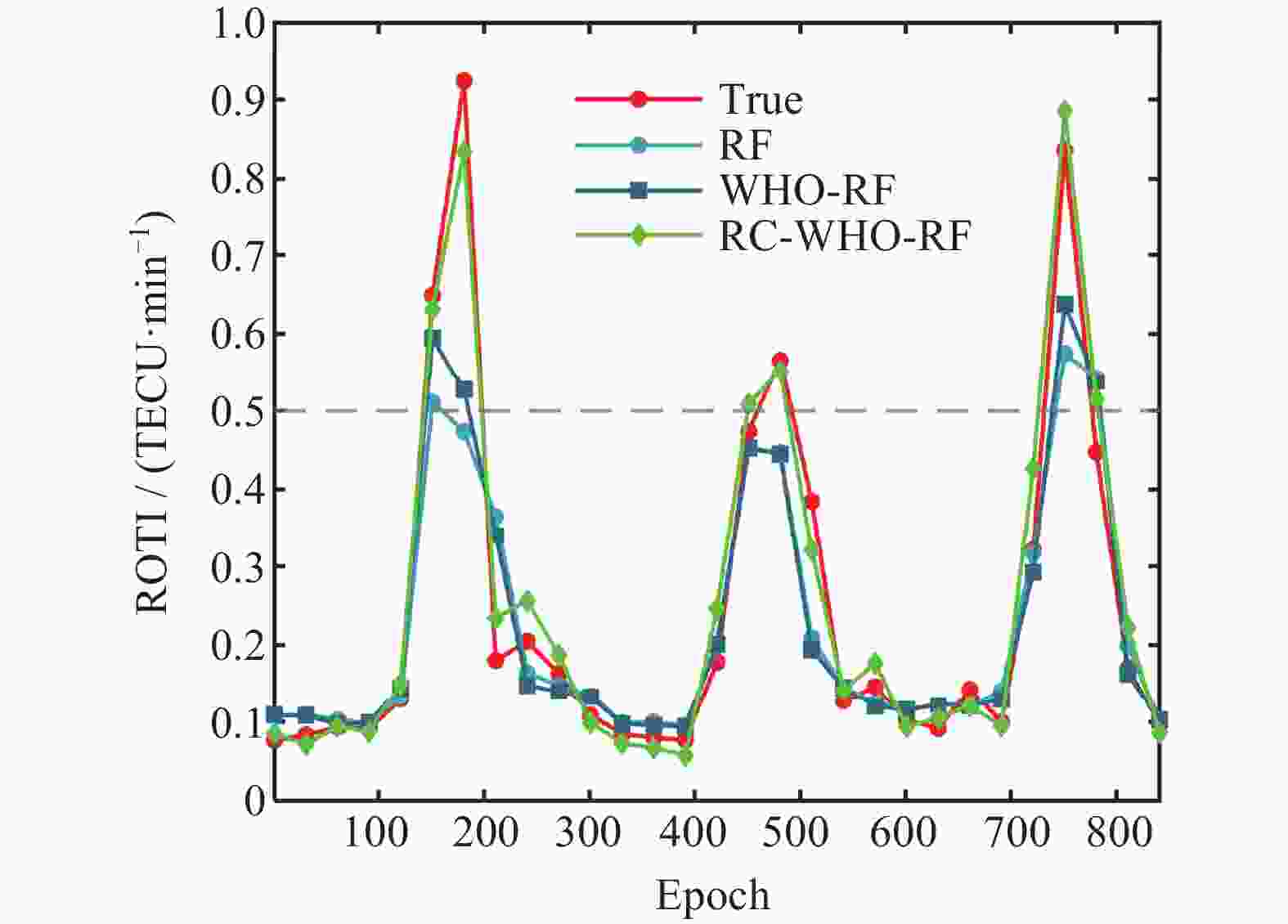
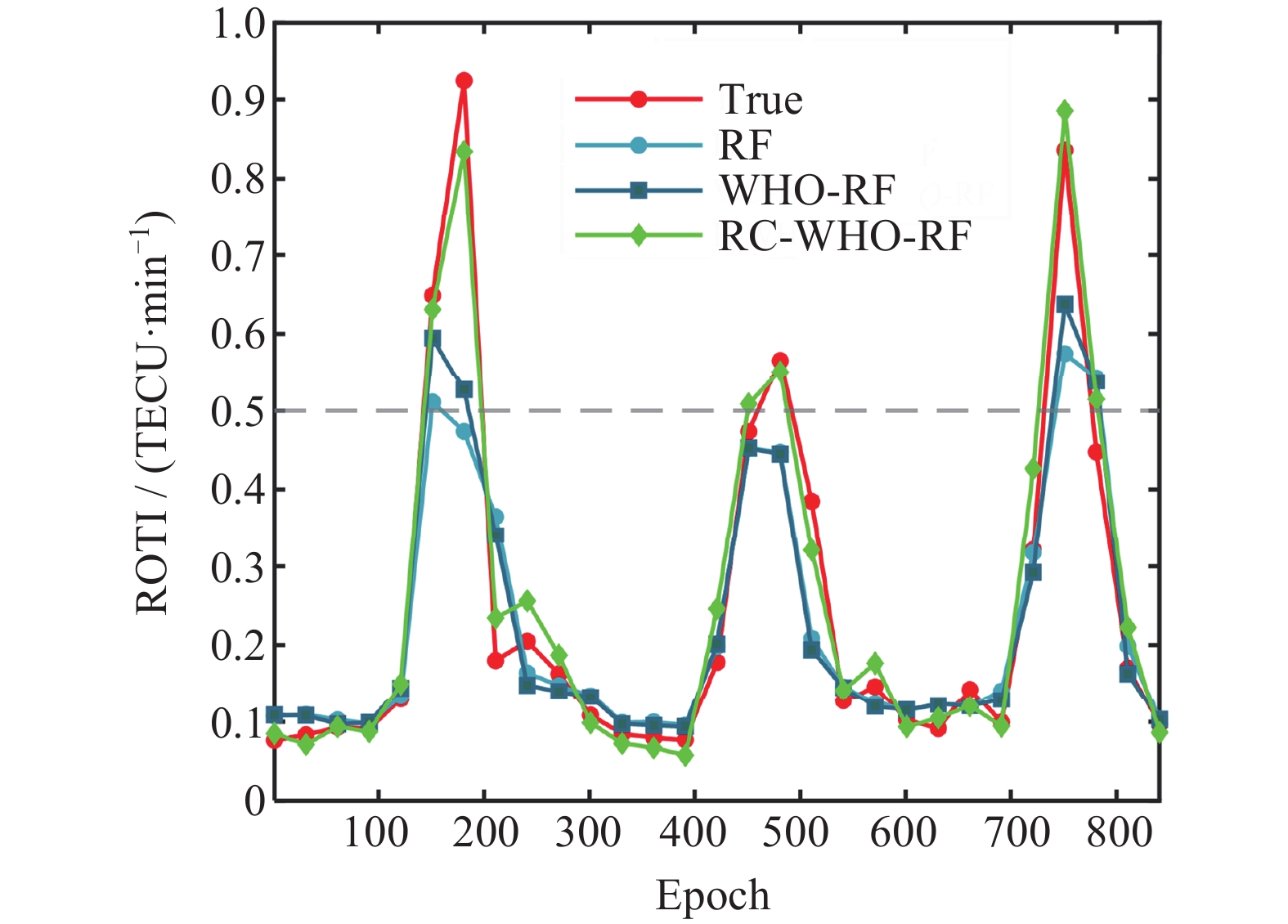
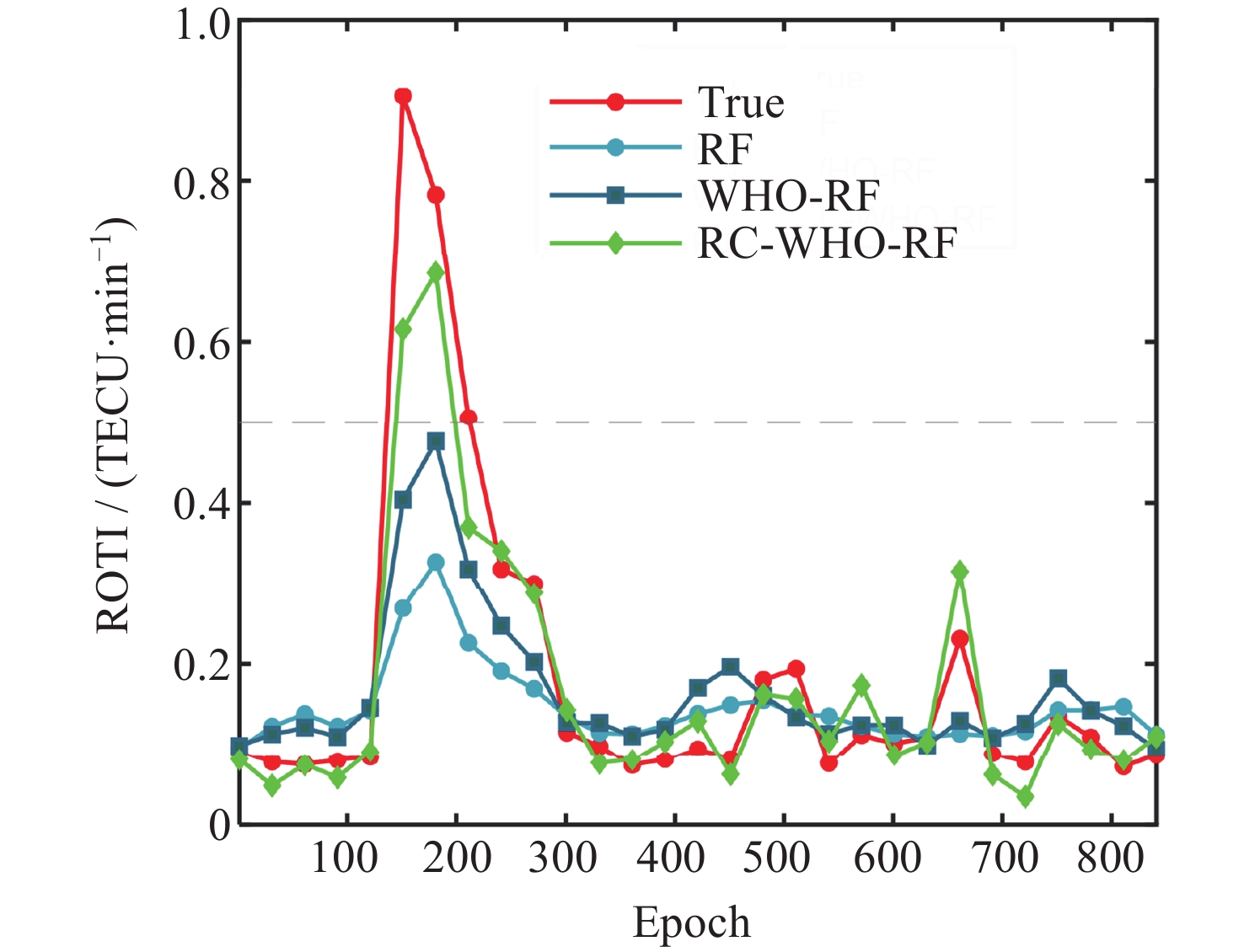
图 7 2024年3月29-31日ROTI预测值与真实值的对比
Figure 7. Comparison between ROTI forecast and actual values from 29 to 31 in March 2024
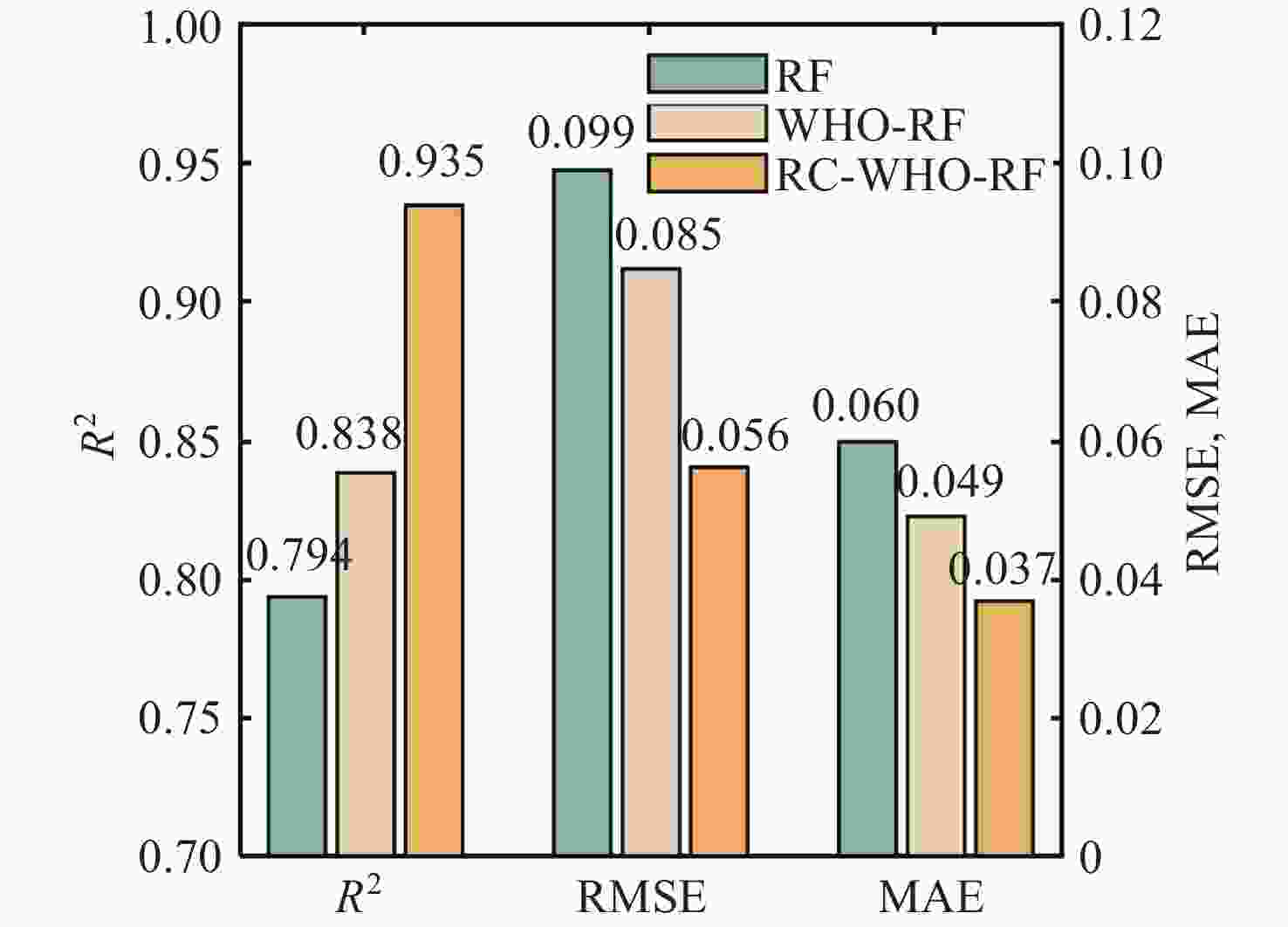
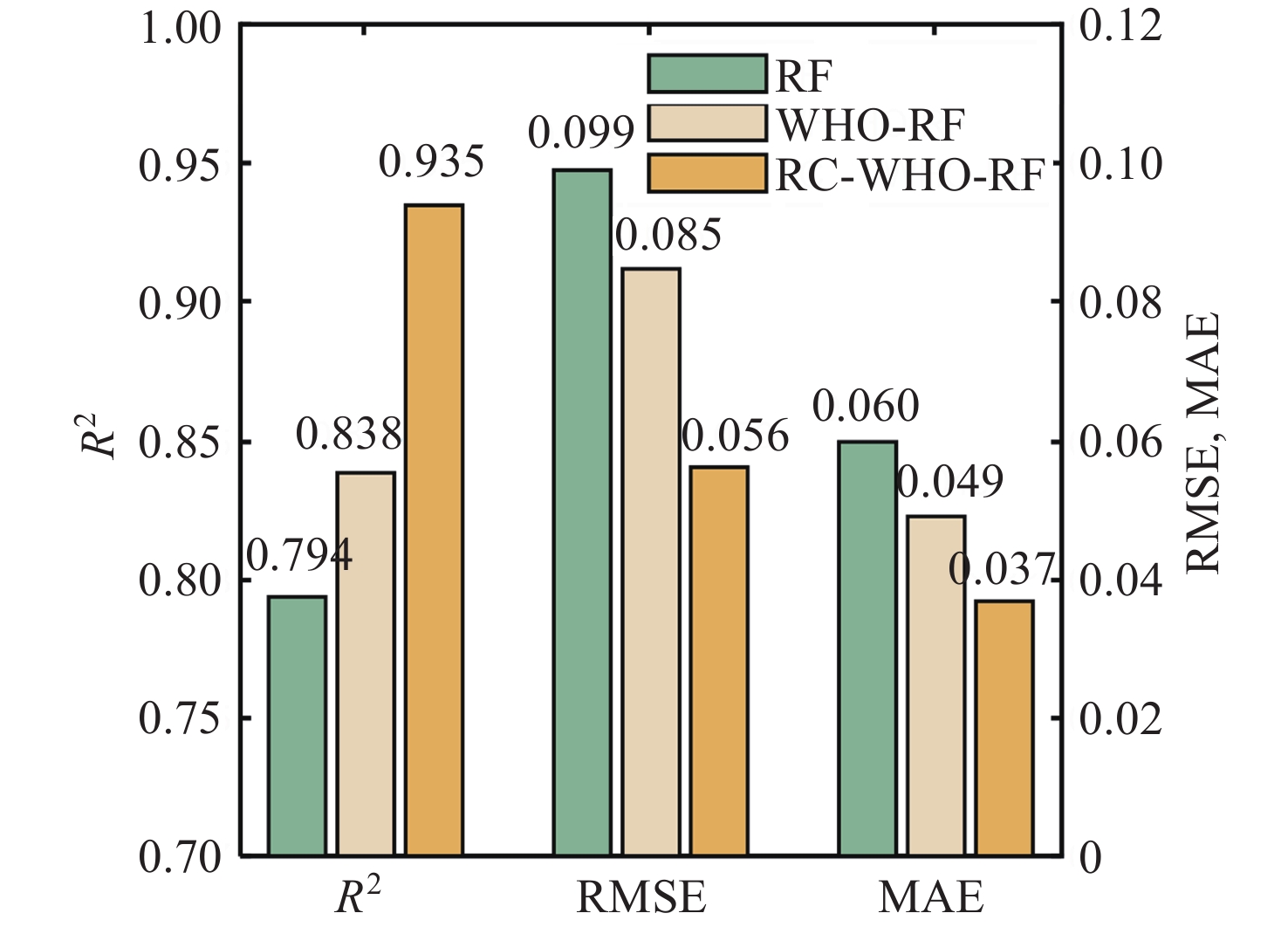
图 8 2024年3月29-31日ROTI预测值的R2, RMSE和MAE分布
Figure 8. Distribution of R2, RMSE and MAE for ROTI forecast values from 29 to 31 in March 2024
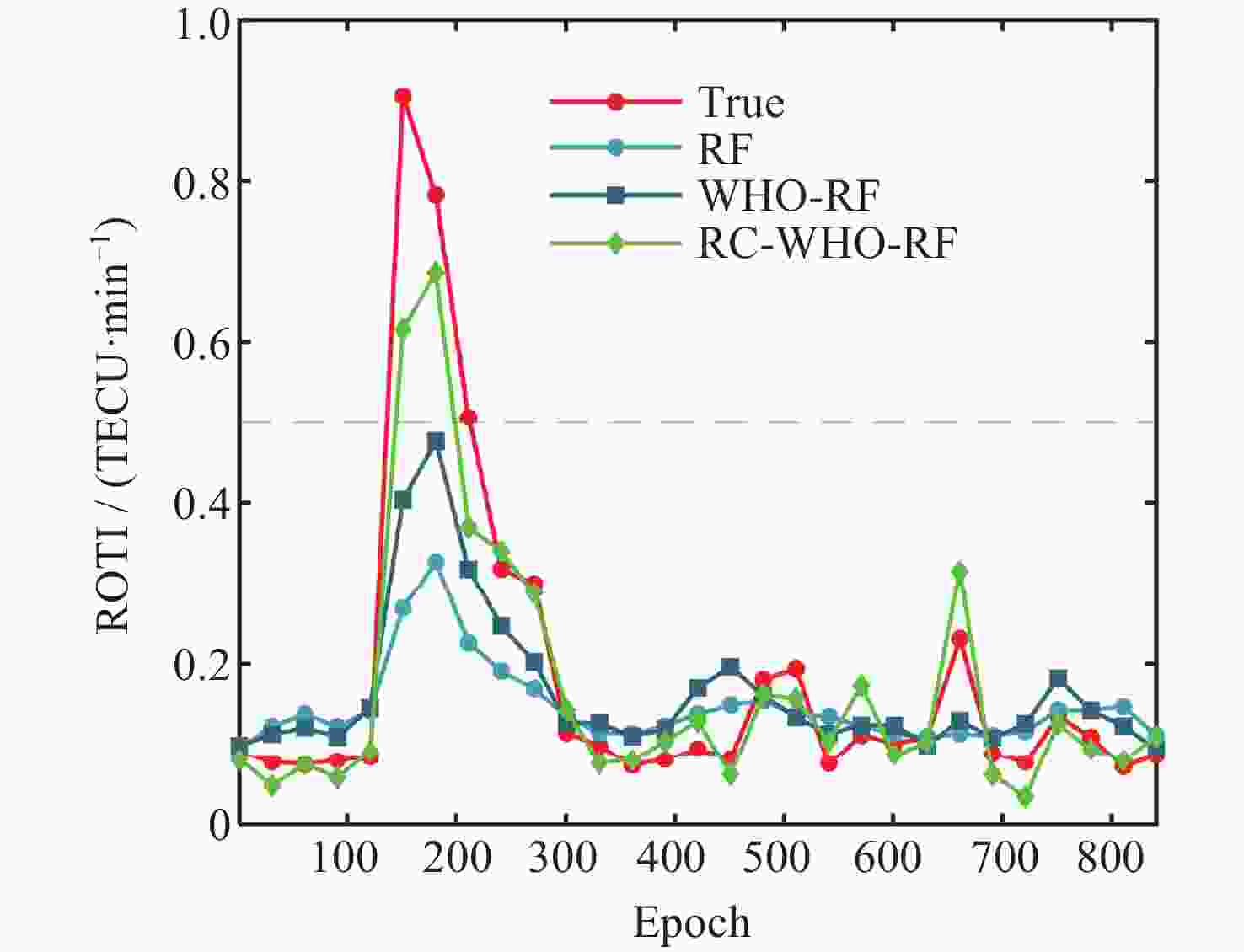
图 9 2024年6月28-30日ROTI预测值与真实值对比
Figure 9. Comparison between ROTI forecast and actual values from 28 to 30 in June 2024
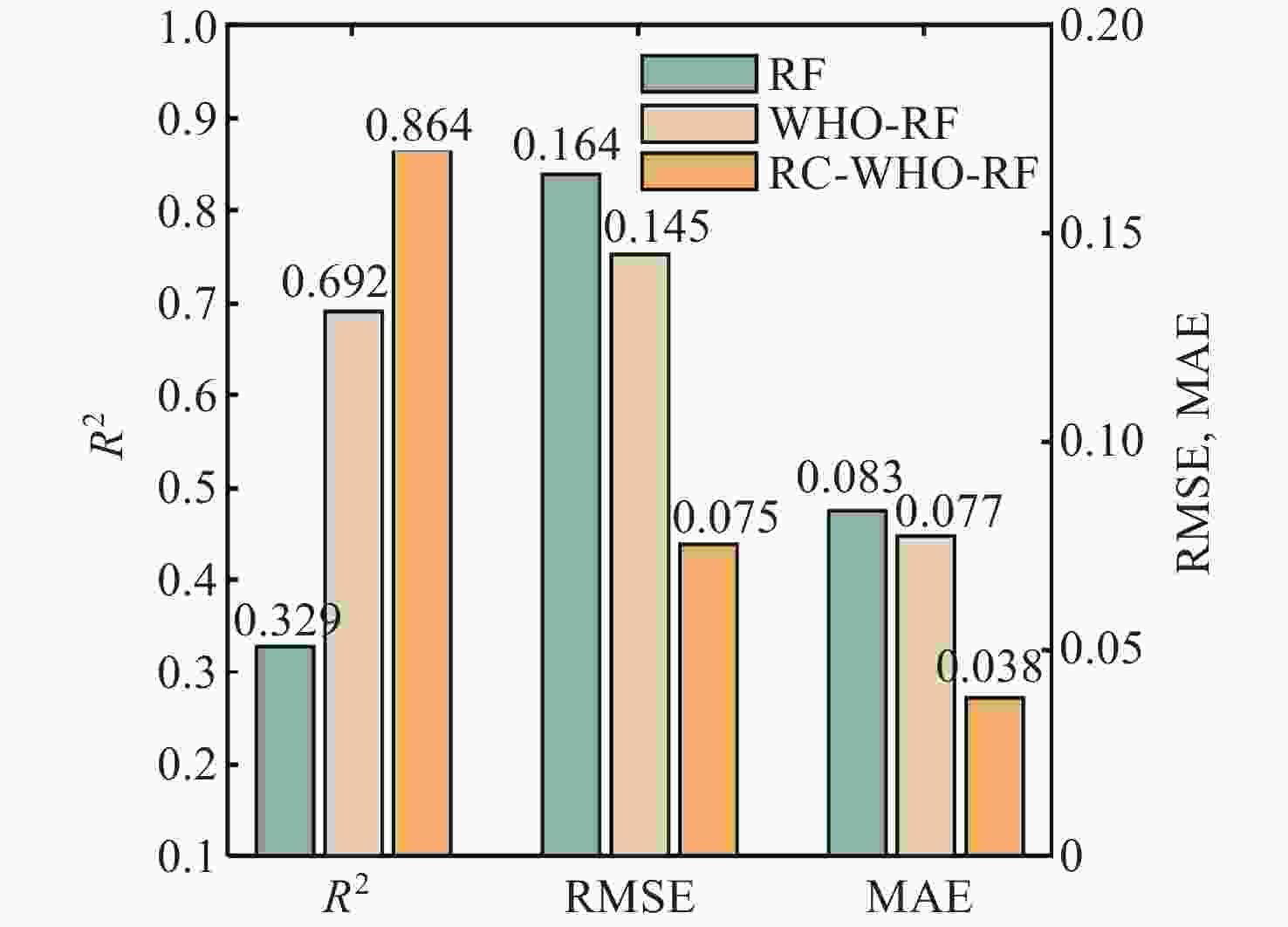
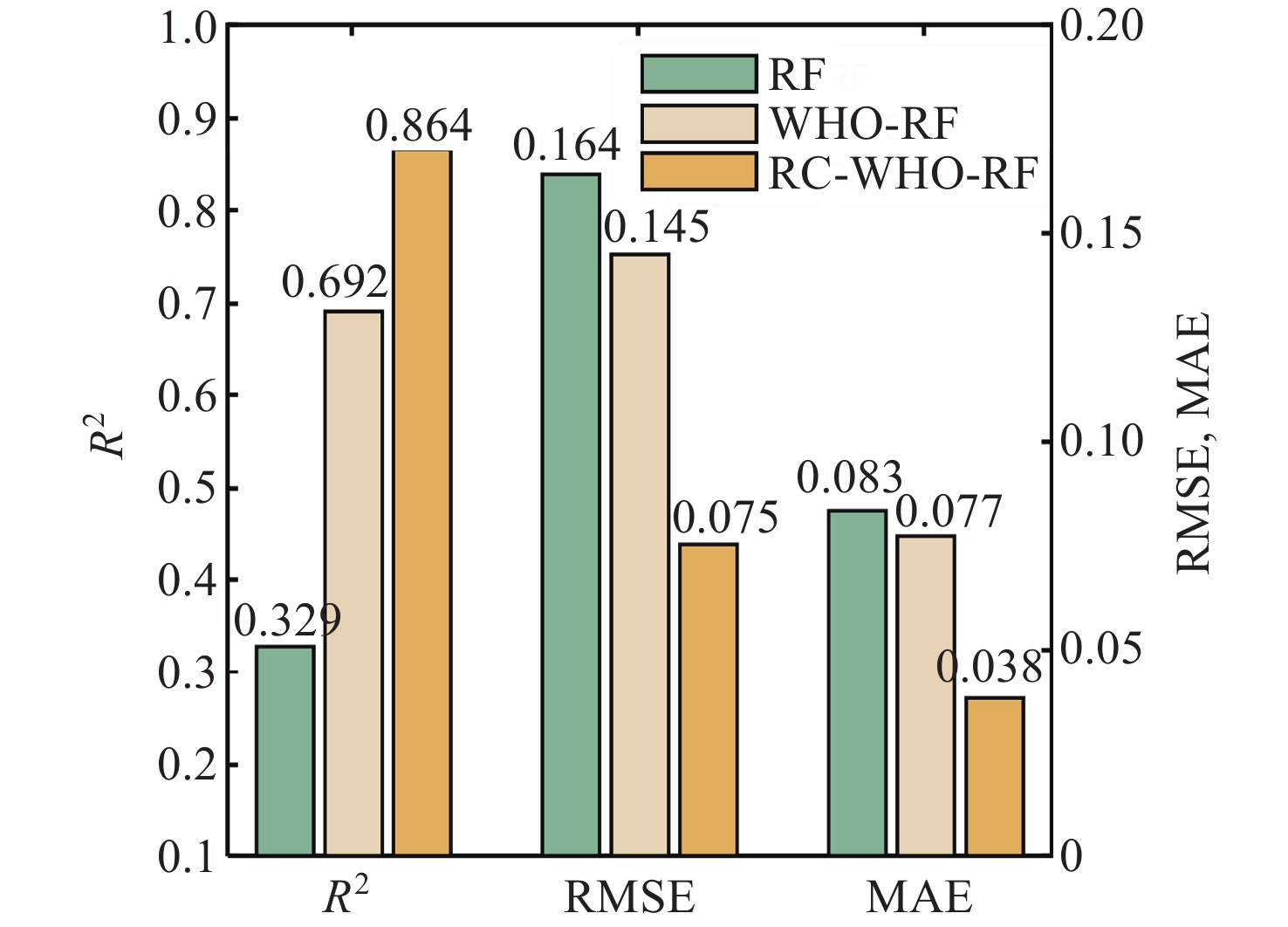
图 10 2024年6月28-30日ROTI预测值的R2, RMSE和MAE分布
Figure 10. Distribution of R2, RMSE and MAE for ROTI forecast values from 28 to 30 in June 2024
表 1 电离层背景环境参数 (数据分辨率为 15 min)
Table 1. Ionospheric background environmental parameters (Data resolution is 15 min)
环境参数 数据描述 HHC 余弦相位日变化因子 HHS 正弦相位日变化因子 Dst 地磁指数 F10.7 太阳射电流量指数 Bx 行星际磁场径向分量 By 行星际磁场东向分量 Bz 行星际磁场垂向分量 SYM/H 环电流的对称水平分量 Flow Pressure (FP) 磁流体压力 f0F2 F2层临界频率  下载: 导出CSV
表 2 不同参数组合下的WHO-RF模型性能及寻优时间
Table 2. Performance and optimization time of WHO-RF model under different parameter combinations
Maxstep 10 20 30 Pop 10 20 30 10 20 30 10 20 30 RMSE/(TECU·min–1) 0.110 0.103 0.098 0.105 0.098 0.099 0.100 0.097 0.092 MAE/(TECU·min–1) 0.068 0.059 0.058 0.061 0.057 0.058 0.058 0.056 0.054 $ {R}^{2} $ 0.780 0.800 0.803 0.782 0.803 0.799 0.798 0.805 0.810 Time/s 129 331 760 198 545 778 1013 1649 1797
下载: 导出CSV
表 3 不同残差权重的RC-WHO-RF模型预测结果
Table 3. Prediction results of RC-WHO-RF models with different residual weights
不规则体发生率 高 低 残差权重倍数 3 4 5 4 5 6 RMSE/(TECU·min–1) 0.059 0.056 0.074 0.082 0.075 0.093 MAE/(TECU·min–1) 0.042 0.037 0.048 0.044 0.038 0.063 $ {R}^{2} $ 0.902 0.935 0.891 0.843 0.864 0.797
下载: 导出CSV
表 4 RC-WHO-RF模型提前不同时间的预测性能
Table 4. RC-WHO-RF model predicts performance at different advance time
评价指标 提前时间/min 10 30 60 90 120 180 240 RMSE/(TECU·min–1) 0.026 0.039 0.043 0.048 0.053 0.059 0.066 $ {R}^{2} $ 0.987 0.972 0.965 0.962 0.951 0.949 0.942 MRA/(%) 91.94 90.67 89.15 87.40 86.97 85.54 82.79
下载: 导出CSV
表 5 太阳活动低/高年模型预测效果对比
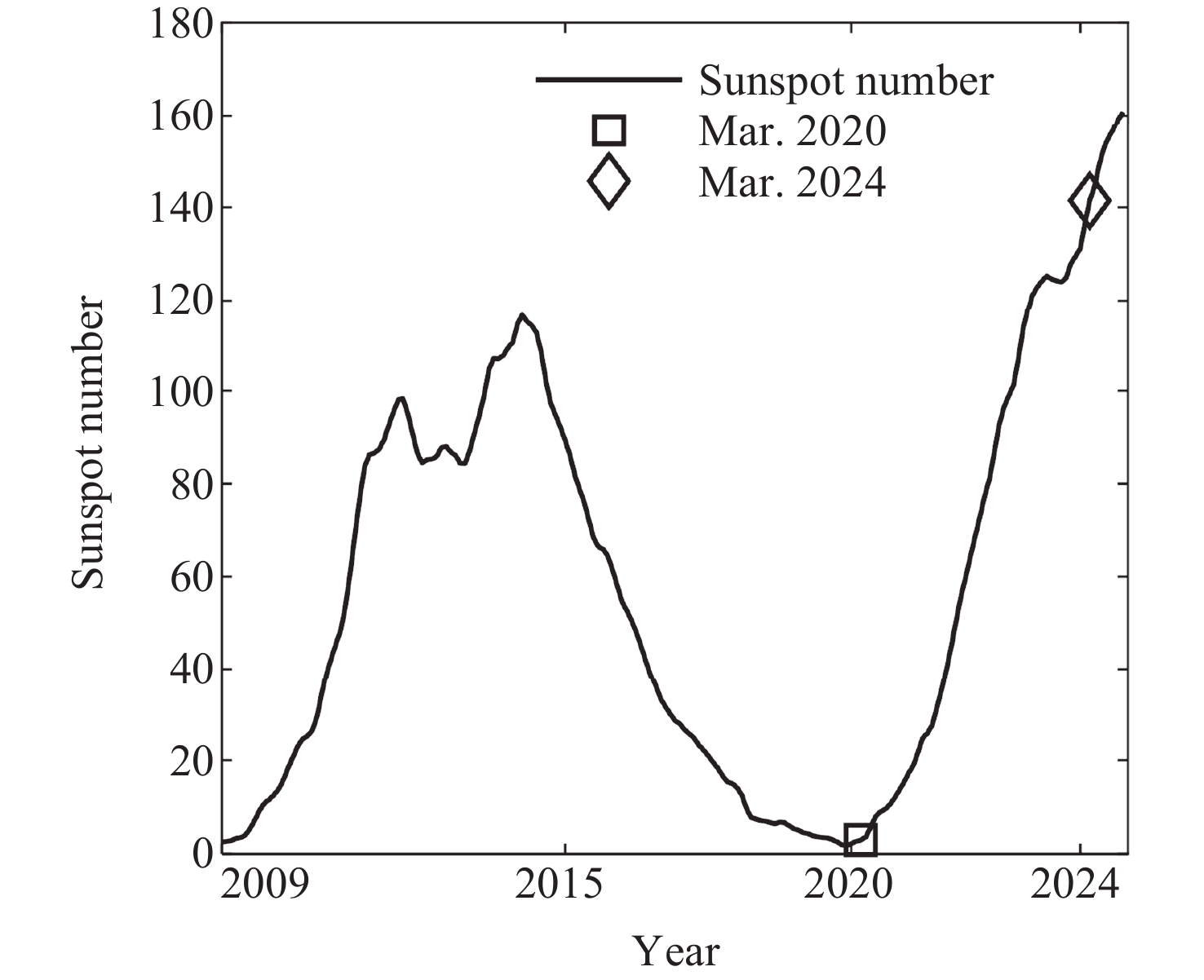
Table 5. Comparison of prediction results between low/high solar activity year models
时段 模型 指标 RMSE/(TECU·min–1) MAE/(TECU·min–1) MRA/(%) 2020年3月 RF 0.036 0.016 85.40 WHO-RF 0.028 0.013 87.59 RC-WHO-RF 0.015 0.007 92.98 2024年3月 RF 0.099 0.060 79.47 WHO-RF 0.085 0.049 82.51 RC-WHO-RF 0.039 0.037 90.67
下载: 导出CSV
-
[1] BASU S, MACKENZIE E, BASU S. Ionospheric constraints on VHF/UHF communications links during solar maximum and minimum periods[J]. Radio Science, 1988, 23(3): 363-378 doi: 10.1029/RS023i003p00363 [2] 尚社平, 史建魁, 程征伟, 等. 夏季强对流活动对东亚低纬电离层不规则体影响的事件分析[J]. 空间科学学报, 2022, 42(6): 1111-1121 doi: 10.11728/cjss2022.06.211228135SHANG Sheping, SHI Jiankui, CHENG Zhengwei, et al. Event analysis of the influence of strong tropospheric convection in summer on low-latitude ionospheric irregularities in East Asia[J]. Chinese Journal of Space Science, 2022, 42(6): 1111-1121 doi: 10.11728/cjss2022.06.211228135 [3] 张红波, 王飞飞, 郝书吉, 等. 低纬地区电离层闪烁发生概率预报模型研究[J]. 电波科学学报, 2023, 38(4): 691-697 doi: 10.12265/j.cjors.2023026ZHANG Hongbo, WANG Feifei, HAO Shuji, et al. Occurrence probability prediction model of ionospheric scintillation for the low-latitude region[J]. Chinese Journal of Radio Science, 2023, 38(4): 691-697 doi: 10.12265/j.cjors.2023026 [4] PI X, MANNUCCI A J, LINDQWISTER U J, et al. Monitoring of global ionospheric irregularities using the worldwide GPS network[J]. Geophysical Research Letters, 1997, 24(18): 2283-2286 doi: 10.1029/97GL02273 [5] LIU L, MORTON Y J, LIU Y X. Machine learning prediction of storm-time high-latitude ionospheric irregularities from GNSS-derived ROTI maps[J]. Geophysical Research Letters, 2021, 48(20): e2021GL095561 doi: 10.1029/2021GL095561 [6] TETE S, OTSUKA Y, ZAHRA W K, et al. Leveraging machine learning techniques and GPS measurements for precise TEC rate predictions[J]. GPS Solutions, 2024, 28(3): 115 doi: 10.1007/s10291-024-01652-4 [7] HABYARIMANA V, HABARULEMA J B, OKOH D, et al. Single station modelling of ionospheric irregularities using artificial neural networks[J]. Astrophysics and Space Science, 2023, 368(12): 105 doi: 10.1007/s10509-023-04261-8 [8] ATABATI A, ALIZADEH M, SCHUH H, et al. Ionospheric scintillation prediction on S4 and ROTI parameters using artificial neural network and genetic algorithm[J]. Remote Sensing, 2021, 13(11): 2092 doi: 10.3390/rs13112092 [9] ZHAO X K, LI G Z, XIE H Y, et al. A novel short‐term prediction model for regional equatorial plasma bubble irregularities in East and Southeast Asia[J]. Space Weather, 2025, 23(2): e2024SW004224 doi: 10.1029/2024SW004224 [10] 吴家燕, 甄卫民, 欧明, 等. 一种基于GNSS数据的全球电离层不规则结构活动表征方法[J]. 空间科学学报, 2022, 42(1): 82-90 doi: 10.11728/cjss2022.01.201009088WU Jiayan, ZHEN Weimin, OU Ming, et al. A characterization method of global ionospheric irregularities activities based on GNSS data[J]. Chinese Journal of Space Science, 2022, 42(1): 82-90 doi: 10.11728/cjss2022.01.201009088 [11] REZENDE L F C, DE PAULA E R, STEPHANY S, et al. Survey and prediction of the ionospheric scintillation using data mining techniques[J]. Space Weather, 2010, 8(6): S06D09 doi: 10.1029/2009sw000532 [12] 刘磊. 基于多源数据的电离层建模及暴时电离层扰动分析[D]. 武汉: 武汉大学, 2017LIU Lei. Studying on Ionospheric Modeling Using Multi Source Data and Ionospheric Responses to Magnetic Storms[D]. Wuhan: Wuhan University, 2017 [13] BREIMAN L. Random forests[J]. Machine Learning, 2001, 45(1): 5-32 doi: 10.1023/A:1010933404324 [14] NARUEI I, KEYNIA F. Wild horse optimizer: a new meta-heuristic algorithm for solving engineering optimization problems[J]. Engineering with Computers, 2022, 38(4): 3025-3056 [15] LIU H, YANG P X, REN X D, et al. The short‐term prediction of low‐latitude ionospheric irregularities leveraging a hybrid ensemble model[J]. IEEE Transactions on Geoscience and Remote Sensing, 2024, 62: 4100615 doi: 10.1109/tgrs.2023.3346449 [16] 杨芸珍, 刘立龙, 莫诗蕾, 等. 太阳活动高低年广西及周边地区电离层时空频域特性[J]. 空间科学学报, 2024, 44(6): 1021-1030 doi: 10.11728/cjss2024.06.2024-0002YANG Yunzhen, LIU Lilong, MO Shilei, et al. Ionospheric TEC variation in Guangxi and surrounding during high and low solar activity years[J]. Chinese Journal of Space Science, 2024, 44(6): 1021-1030 doi: 10.11728/cjss2024.06.2024-0002 [17] 王凯, 刘昂, 高为广, 等. 太阳活动高峰期BDS服务性能分析[J]. 导航定位学报, 2025, 13(1): 61-68WANG Kai, LIU Ang, GAO Weiguang, et al. Analysis on open service performance of BDS during peak of solar cycle 25[J]. Journal of Navigation and Positioning, 2025, 13(1): 61-68 -
-

 下载:
下载:

计量
- 文章访问数: 1385
- HTML全文浏览量: 722
- PDF下载量: 121
-
被引次数:
0(来源:Crossref)
0(来源:其他)

