


月球阿波罗与嫦娥任务10个典型着陆区撞击坑数据库: 小撞击坑数据库构建与分布规律
doi: 10.11728/cjss2026.03.2025-0135 cstr: 32142.14.cjss.2025-0135
-
 刘方超 男, 1992年10月出生于山东省潍坊市, 现为山东大学空间科学与技术学院博士研究生, 主要研究方向为行星科学与大数据. E-mail: you_mu_sdu@163.com
 -
 郭弟均 男, 1988年9月出生于四川省巴中市, 现为中国科学院国家空间科学中心副研究员、硕士生导师, 主要研究方向为月球与行星地质、行星遥感. E-mail: guodijun@nssc.ac.cn
-
 吕英波 男, 1980年3月出生于山东省莱芜市, 现为山东大学空间科学与技术学院教授、博士生导师, 主要研究方向为空间科学数据分析、深度学习与数据挖掘、深空资源勘探与利用、空间太阳能利用、材料模拟与工程仿真等相关的科学研究与技术攻关工作. E-mail: lyb@sdu.edu.cn
作者简介:
通讯作者:
Impact Crater Database of 10 Landing Regions from Apollo and Chang’E Missions: Construction and Distribution Patterns of Small Impact Crater Databases
-
摘要: 月球是撞击坑保存最完整的内太阳系天体, 拥有就位探测数据和返回样品的月球典型着陆区是认识撞击事件和撞击改造效应的重要研究对象. 其中小撞击坑对月壤的形成和演化具有重要影响, 但是现有的月球撞击坑数据库对直径<100 m的小尺度撞击坑覆盖不足. 因此, 筛选太阳入射角在50°~70°之间的月球高分辨率LROC NAC影像, 制作了覆盖10个着陆区20 km×20 km的镶嵌数据, 利用改进的YOLO11+SAHI深度学习模型对这10个着陆区中直径≥15 m的撞击坑进行自动提取, 经人工校验后建成了含357764条记录的撞击坑数据库. 系统构建了覆盖6个阿波罗任务与4个嫦娥任务共10个典型着陆区、直径≥15 m的撞击坑数据库, 且数据库中的撞击坑数据完整性优于现有研究. 进一步分析小尺寸撞击坑的密度分布与直径–频率分布特征. 本数据集可为月球地质年代标定、撞击通量演化、月表过程研究及样品分析提供高质量数据支持, 并为未来的撞击坑智能识别模型提供训练与验证基础.Abstract: Among the celestial bodies within the solar system, the Moon maintains the most pristine conditions of impact craters. Some landing sites on the lunar surface have in-situ exploration data and experimental measurement results from the returned samples, providing distinguished meanings to understand the impact events and their reshaping effects on the lunar surface. Small craters play a significant role in the formation and evolution of lunar regolith. However, existing lunar impact crater databases lack comprehensive coverage of small-scale impact craters with diameters less than 100 m. Therefore, this study produced ten mosaic images of 20 km×20 km in width, using the high-resolution Lunar Reconnaissance Orbiter Camera Narrow Angle Camera images acquired under solar incidence angles between 50° and 70°. These images cover ten lunar landing sites, including six Apollo missions and four Chang’E missions. An improved YOLO11+SAHI deep learning model was then applied to automatically extract craters with diameters ≥15 m within these regions. After manual verification, a high-quality crater database containing 357764 records was constructed. Compared with existing datasets, the proposed database demonstrates superior crater completeness. Based on this database, the density distribution and diameter-frequency characteristics of small-sized impact craters were further calculated and analyzed. This dataset can provide robust support for studies of lunar geological chronology, impact flux evolution, surface process, and sample interpretation. In addition, it supplies a valuable training and validation resource for future artificial intelligence models of detecting the impact craters.
-
Key words:
- Small-scale impact craters /
- Moon /
- Landing sites /
- Datasets /
- Deep learning
-
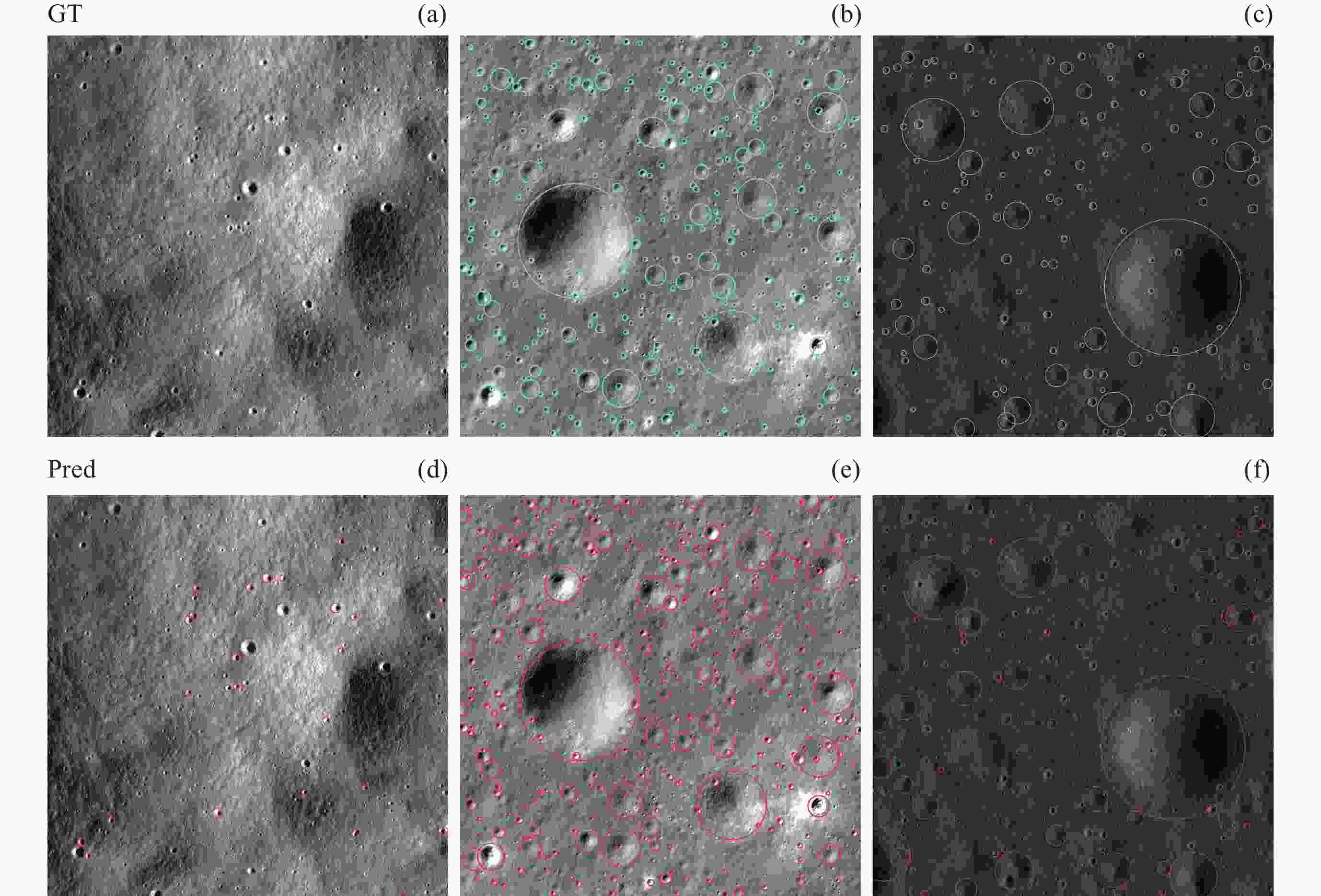
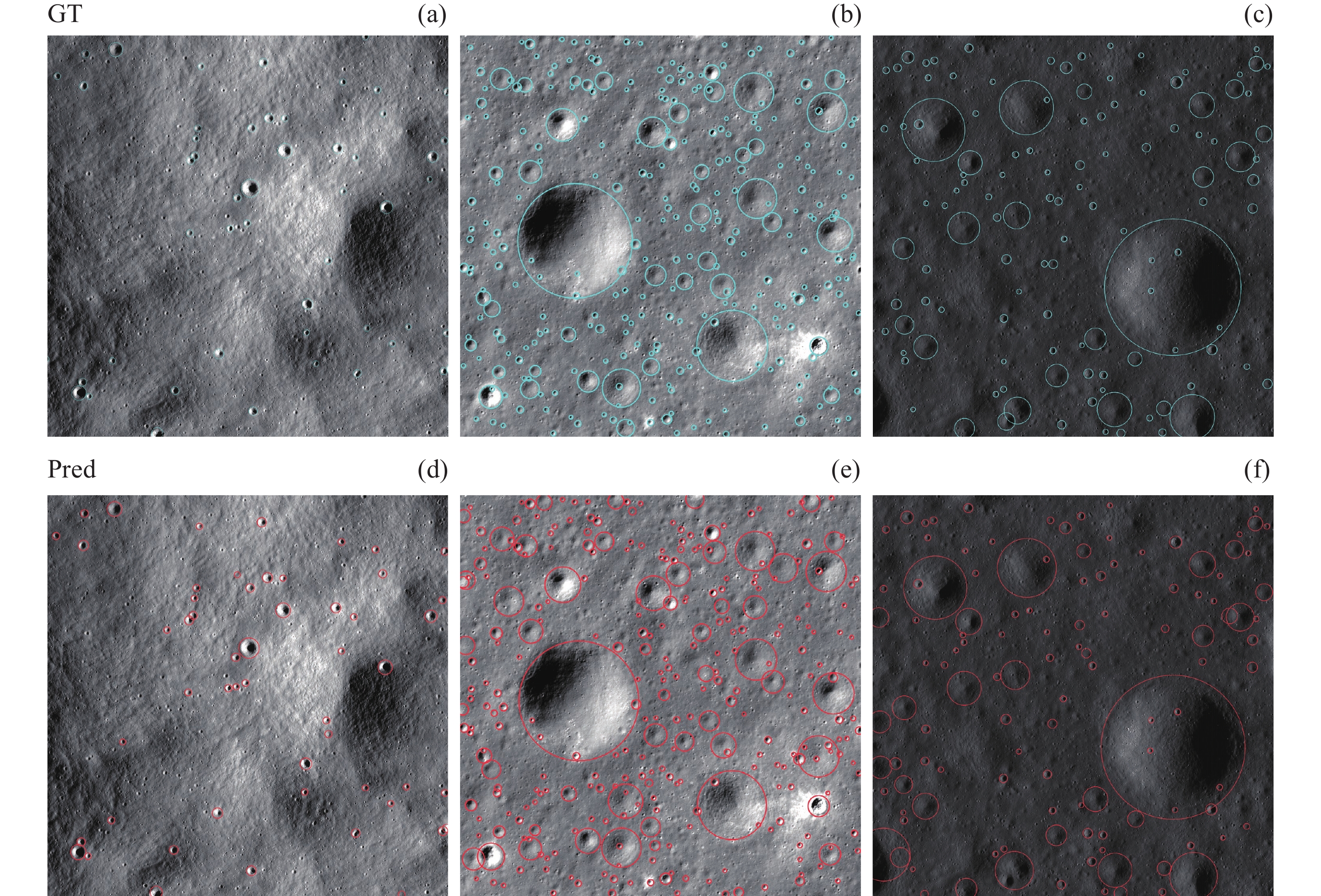
图 2 选取的具有不同地形与不同光照条件的三个区域. GT表示真值, Pred表示预测值. (a)(d) 反照率较高的高地区域, 整体撞击坑尺寸较小; (b)(e) 反照率较低的月海区域, 撞击坑尺度为中等大小; (c)(f) 反照率较低的月海区域, 存在一些大尺度的撞击坑
Figure 2. Schematic images with different illumination and terrain character. (a) (d) High-albedo elevated regions with generally smaller crater sizes. (b) (e) Low-albedo lunar mare regions with medium-sized impact craters. (c) (f) Low-albedo lunar mare regions containing some large-scale impact craters
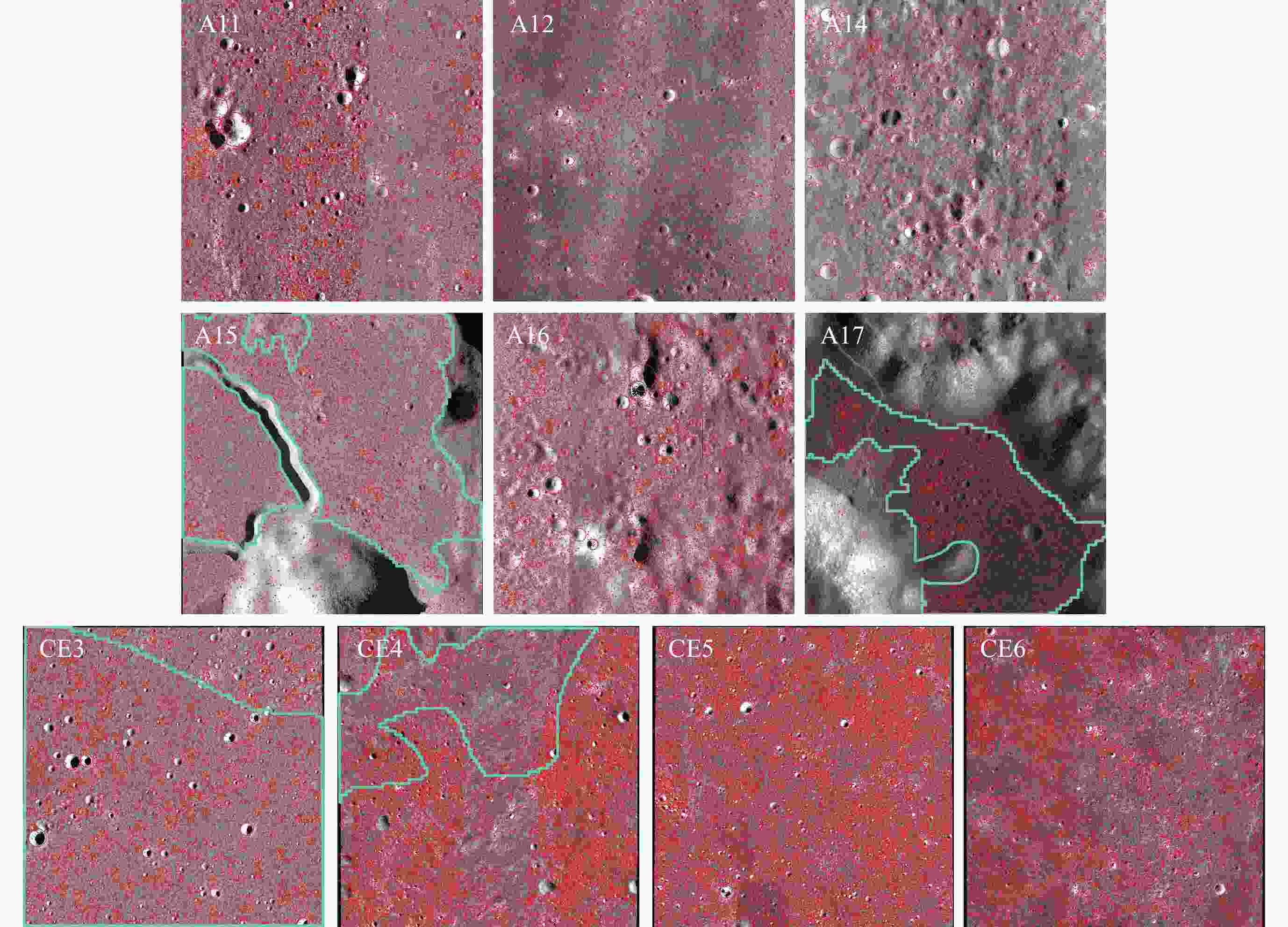
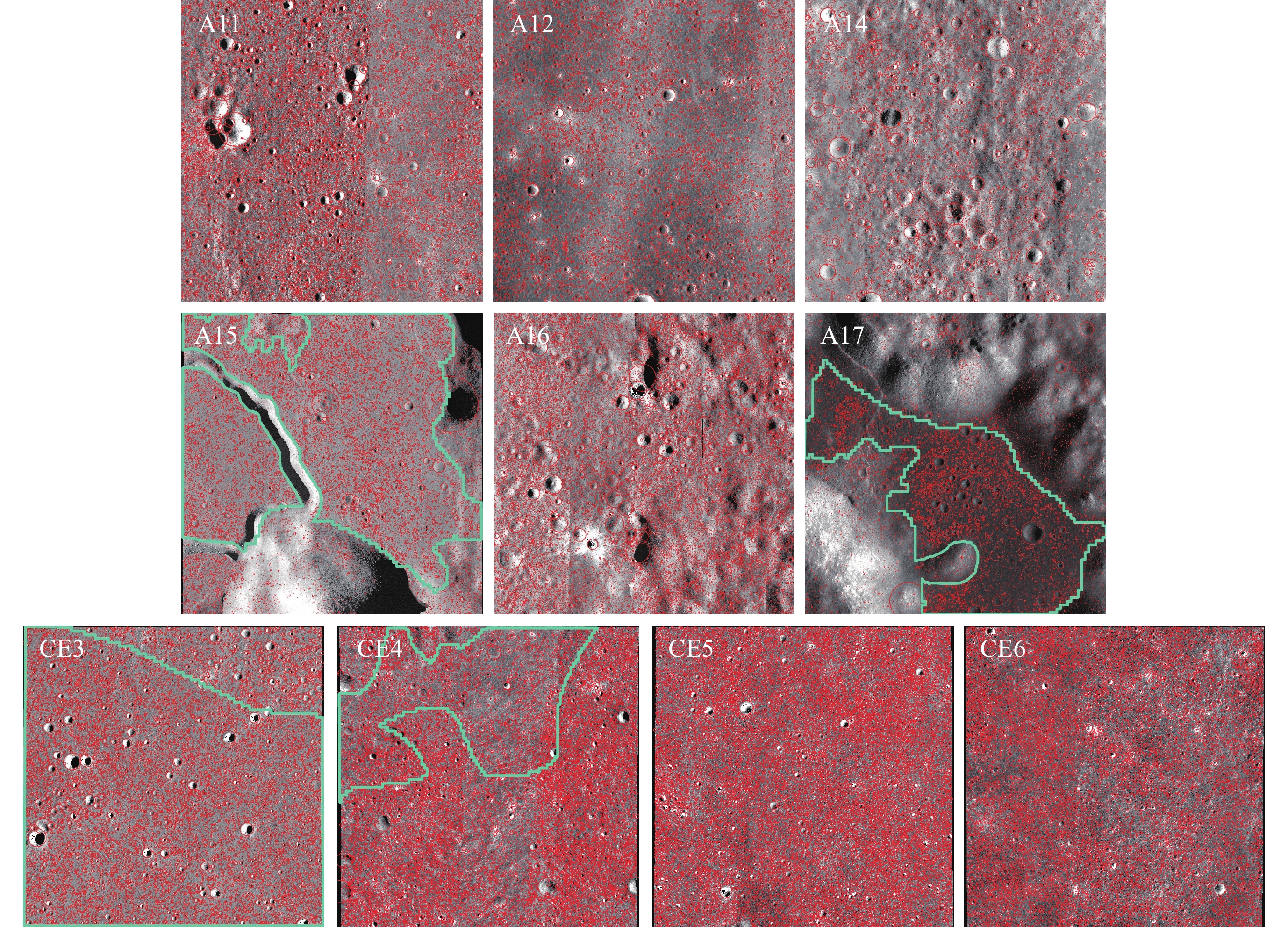
图 3 10个着陆区的撞击坑标记 (绿色线表示研究区包含多个地质单元时着陆点所在地质单元的边界)
Figure 3. Impact crater maps density maps for ten landing regions (The green line indicates the boundary of the geological unit where the landing site is located when the study area contains multiple geological units)
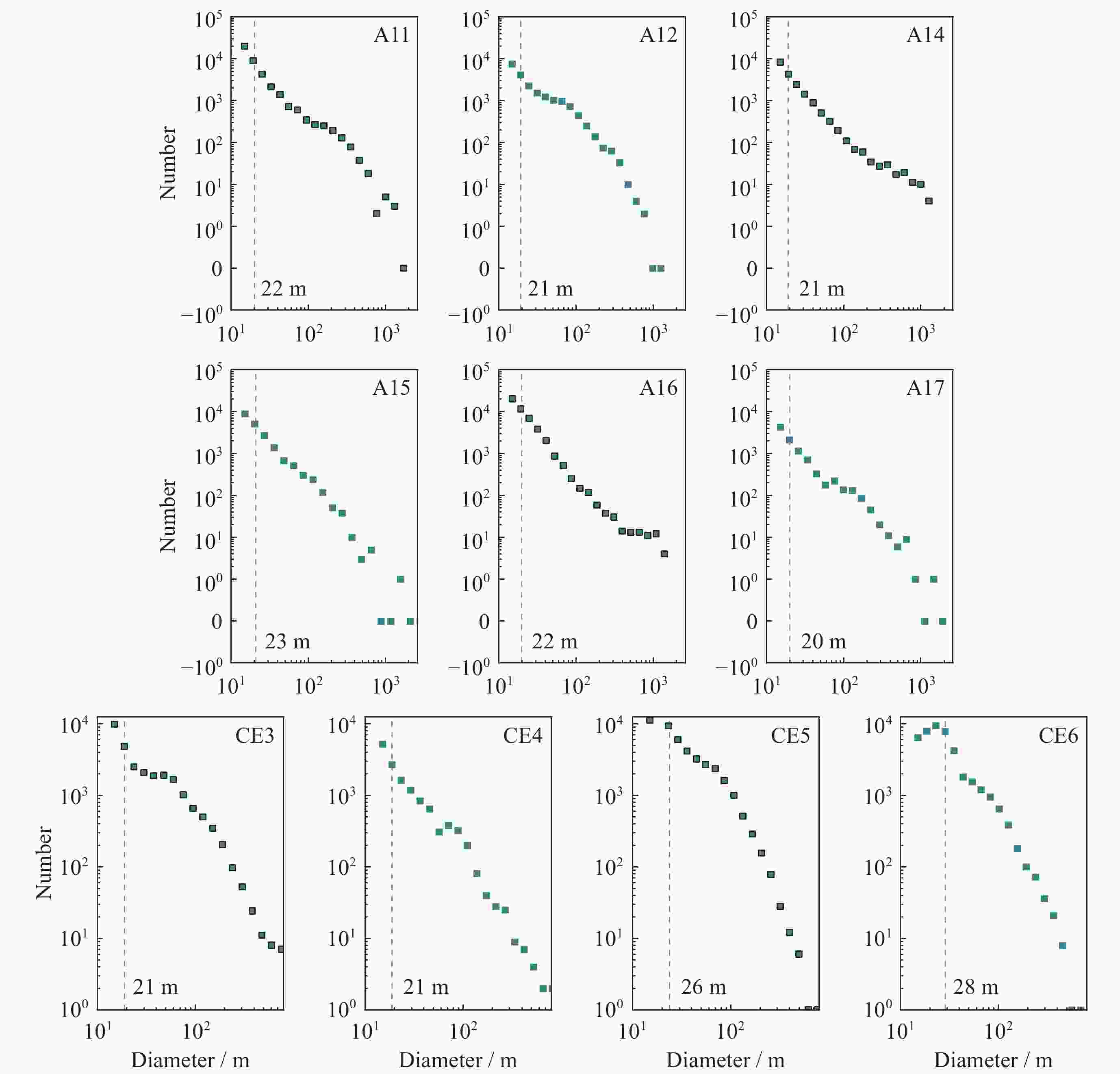
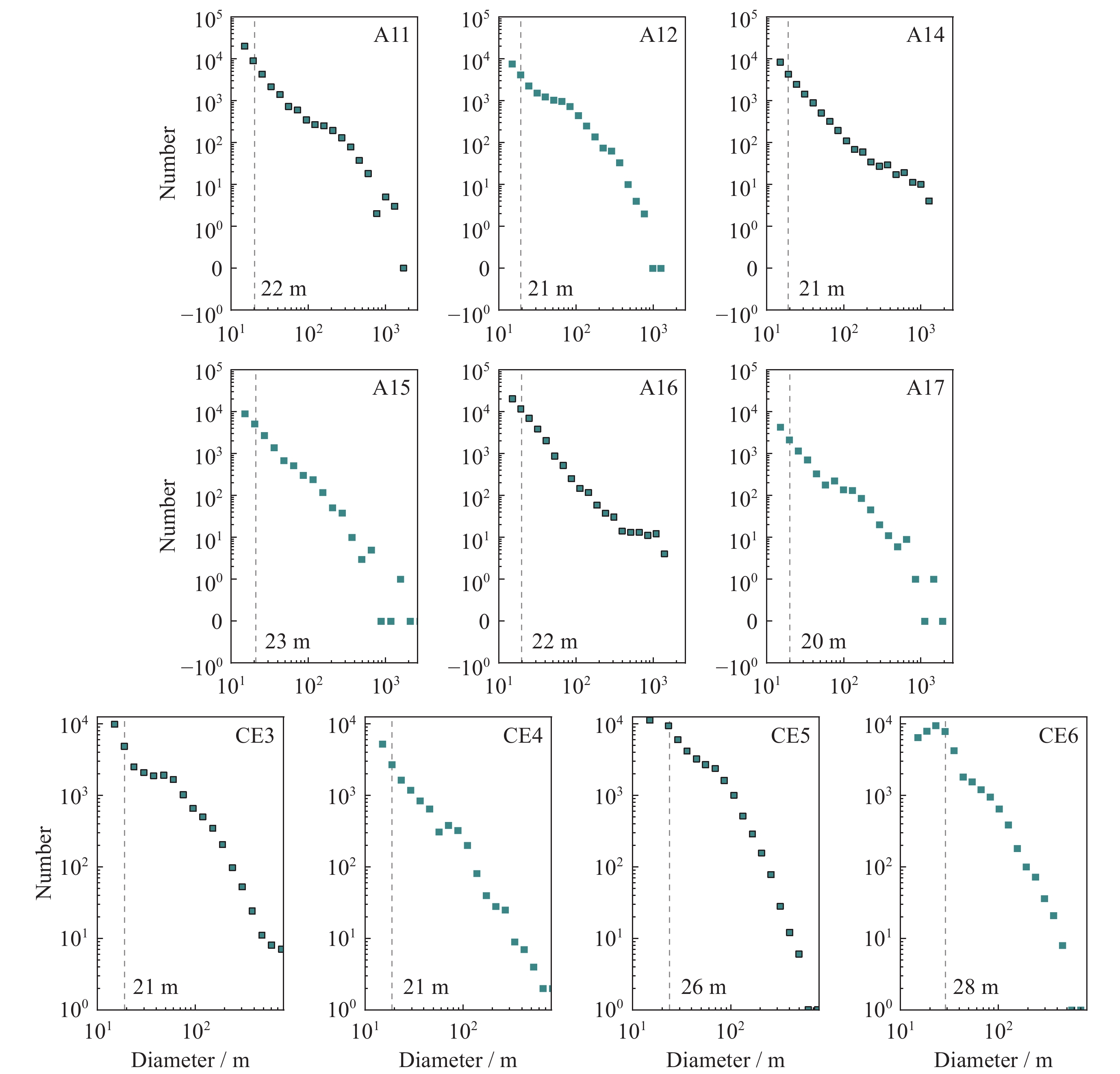
图 4 10个着陆区中的撞击坑大小频率累计分布 (垂直虚线表示完整性直径的位置)
Figure 4. Cumulative frequency distribution of crater sizes across ten landing regions (The vertical dashed lines indicate the positions of the integrity completeness diameter)
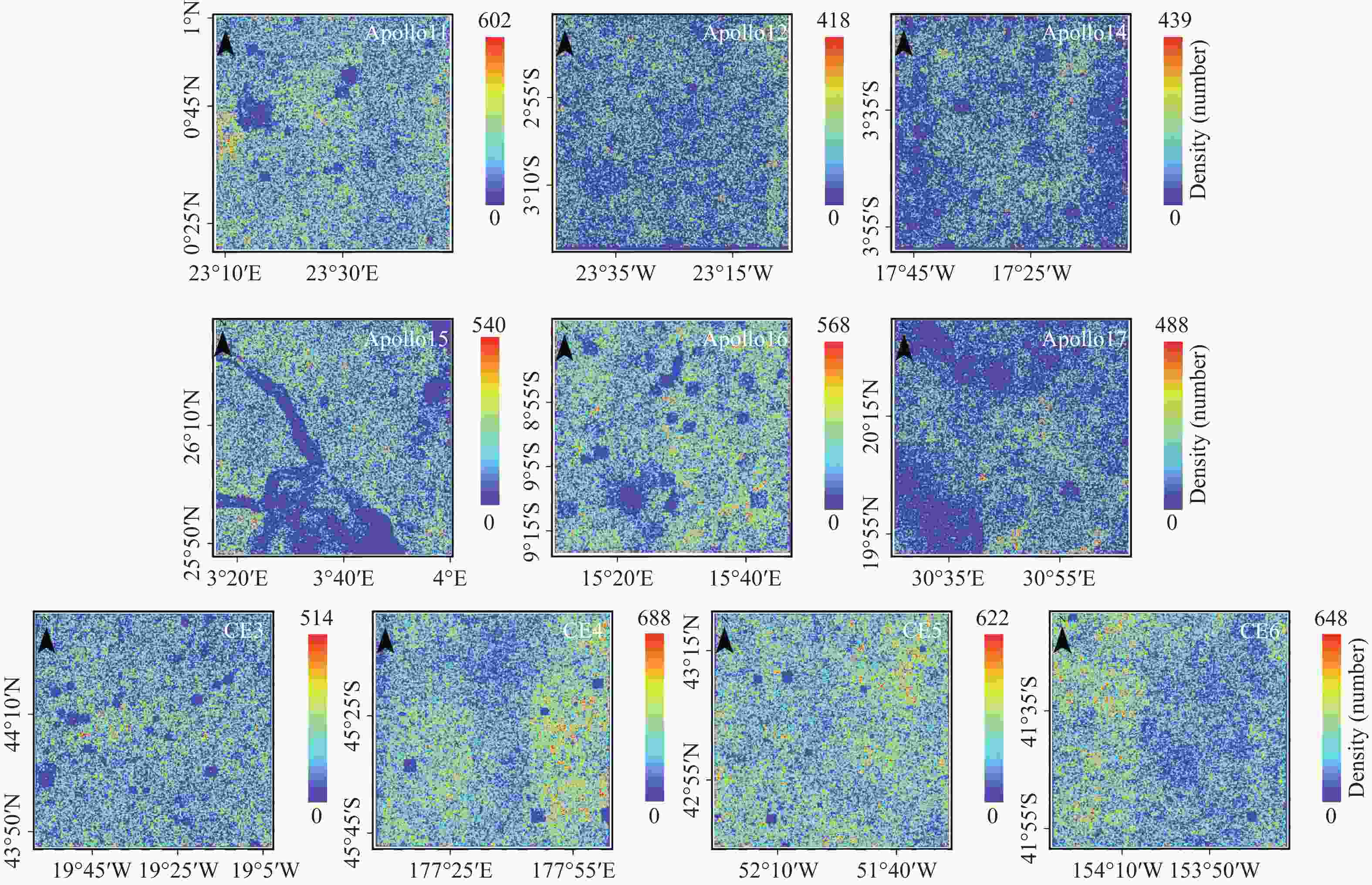
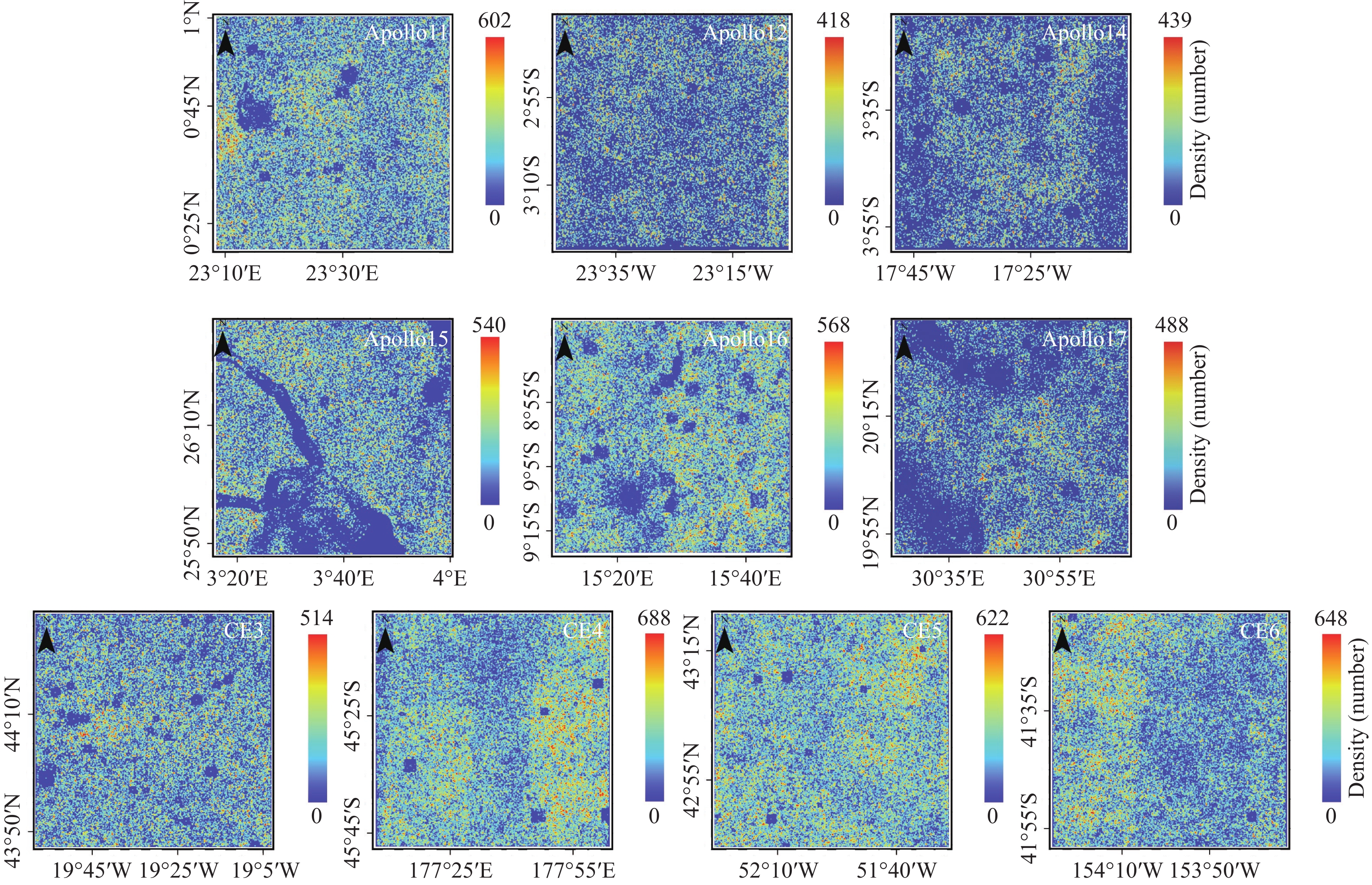
图 5 10个着陆区撞击坑核密度分布
Figure 5. Kernel density distribution of impact craters in ten landing regions
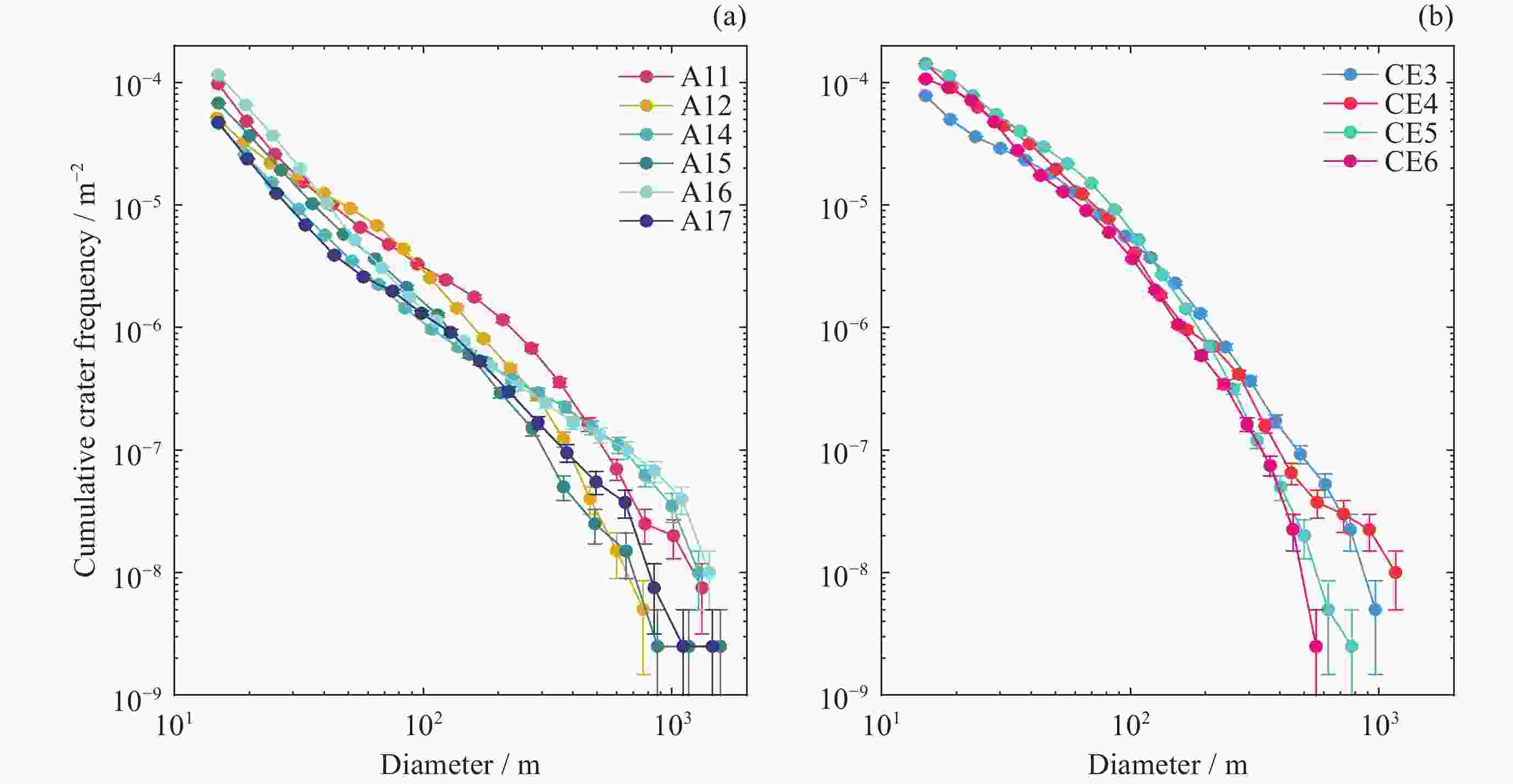
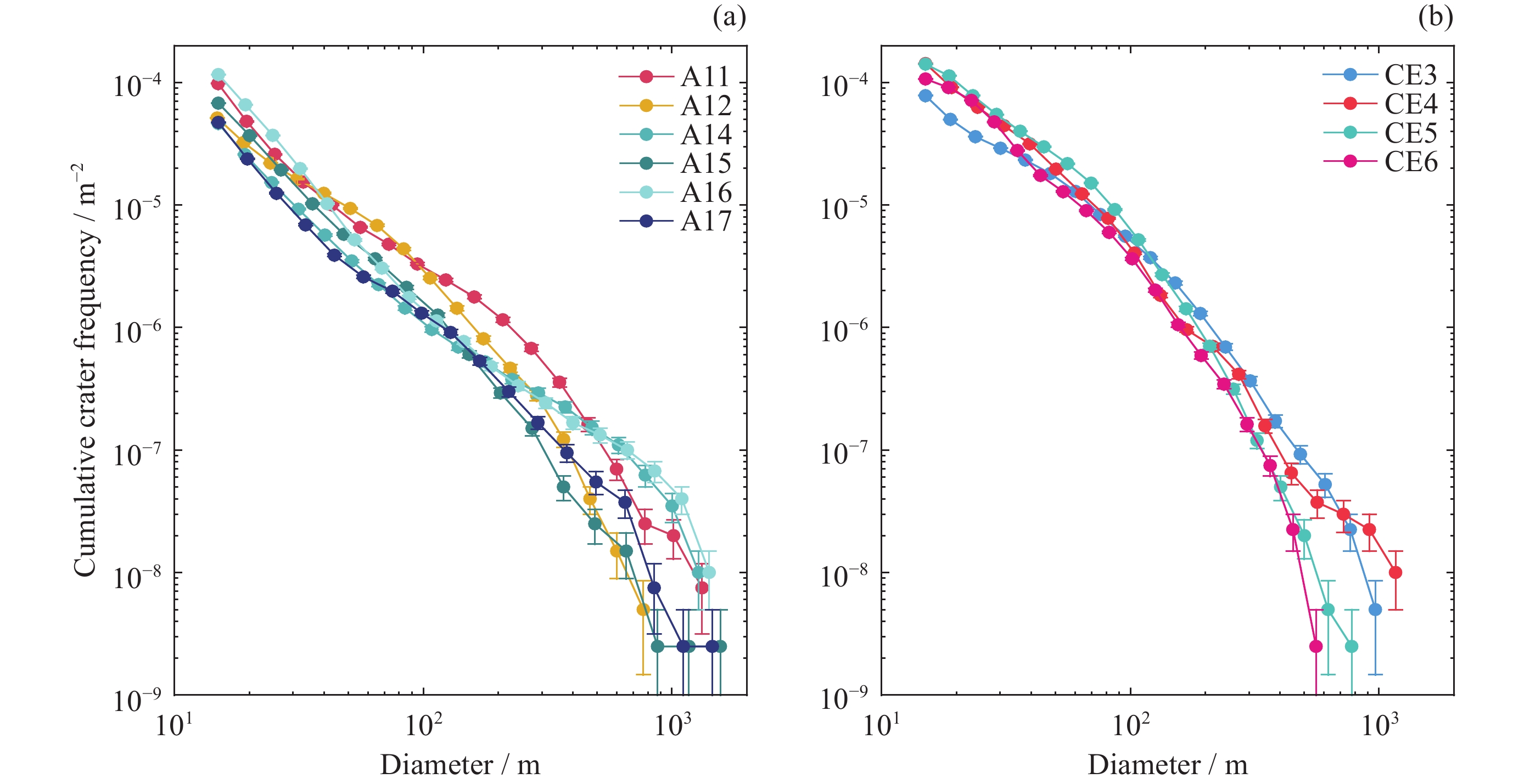
图 6 10个着陆区的撞击坑直径–频率的累积分布. (a) Apollo 11~17, (b) Chang’E-3~6
Figure 6. Cumulative distribution plots of crater diameter versus frequency for ten landing regions. (a) Apollo 11~17, (b) Chang’E-3~6
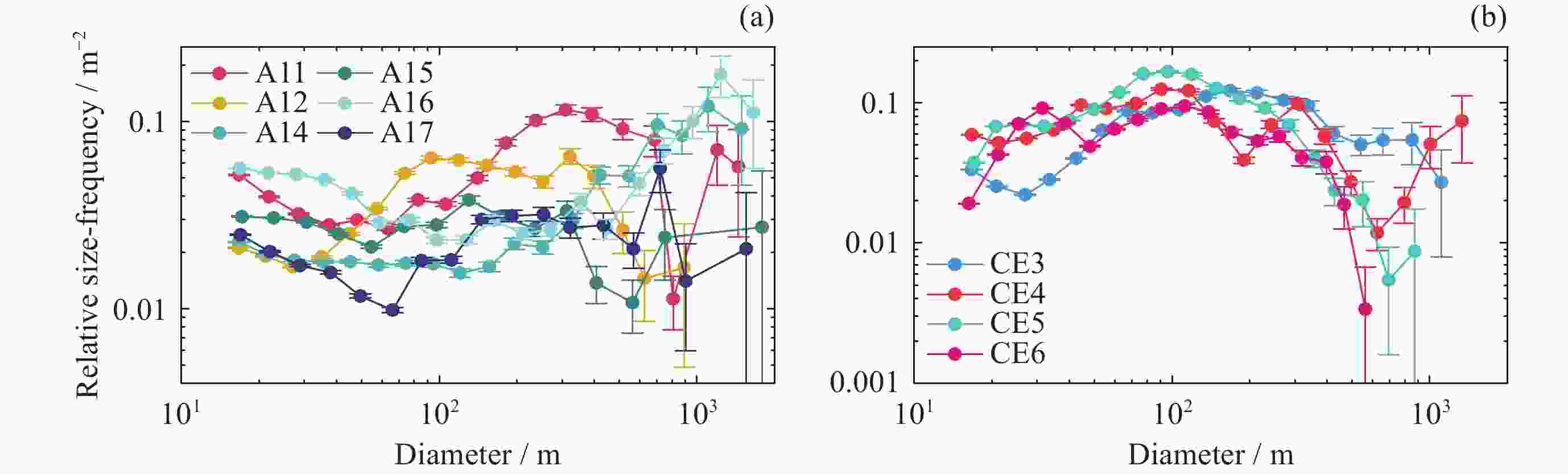
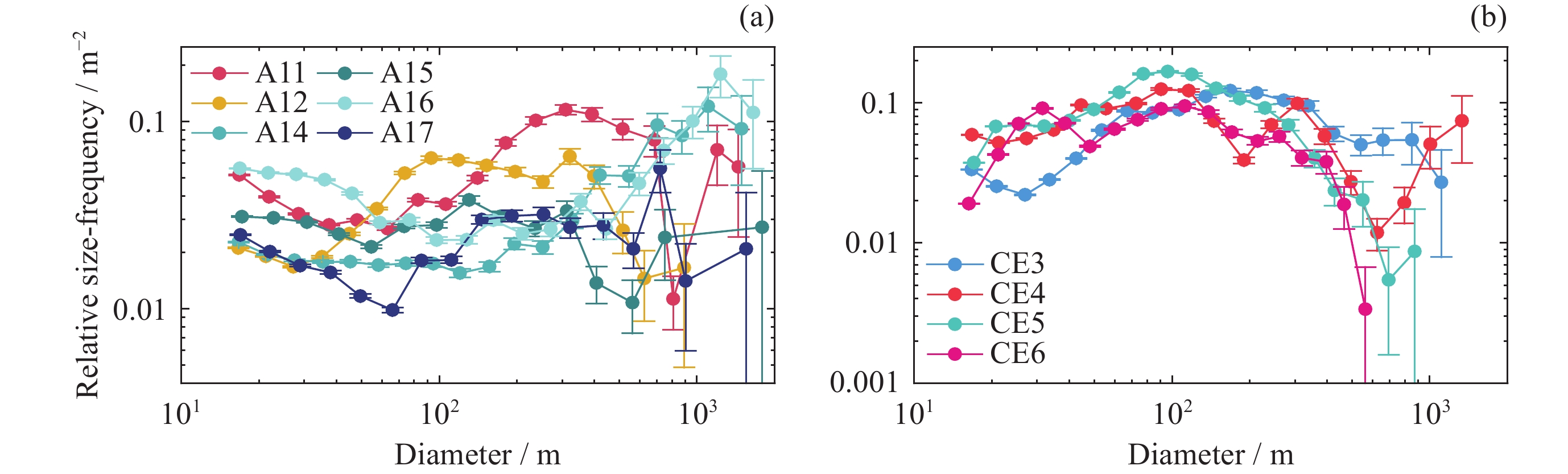
图 7 10个着陆区的撞击坑直径–频率的R分布. (a) Apollo 11~17, (b) Chang’E-3~6
Figure 7. R-plots of crater diameter-frequency distributions for ten landing regions. (a) Apollo 11~17, (b) Chang’E-3~6
表 1 构建训练集时选择的9个典型着陆区域的LRO NAC影像信息
Table 1. LRO NAC imagery information for the 9 landing regions where sample collection was conducted
着陆区 数据ID 分辨率/(m·pixel–1) 太阳入射角/(°) 相位角/(°) A11 M117338434 R 0.475 74.41 83.35 A12 M162466771 L 0.497 76.27 87.18 A14 M162426054 L 0.477 76.07 77.75 A15 M119829425 L 0.501 58.21 41.45 A16 M177535538 L 0.469 69.64 73.36 A17 M162107606 L 0.478 73.86 77.58 CE3 M1152001999 R 1.357 56.56 55.65 CE4 M1303619844 R 1.400 62.64 67.2 CE5 M1428381550 L+R 0.905 59.91 61.43  下载: 导出CSV
表 2 10个着陆区的镶嵌数据集范围
Table 2. Mosaic dataset coverage of ten landing regions
着陆区 纬度范围 经度范围 A11 0°20'40.75''-1°0'15.04'' 23°8'35.54''-23°48'10.06'' A12 –3°20'32.49''-–2°40'58.20'' –23°45'7.82''-–23°5'30.18'' A14 –3°58'30.17''-–3°18'55.88'' –17°48'6.48''-–17°8'27.31'' A15 25°48'8.91''-26°27'43.20'' 3°15'59.58''-4°0'4.21'' A16 –9°18'11.21''-–8°38'36.92'' 15°10'2.43''-15°50'6.22'' A17 19°51'39.79''-20°31'14.08'' 30°25'13.16''-31°7'22.93'' CE3 43°47'28.51''-44°27'2.80'' –19°58'15.06''-–19°3'7.74'' CE4 –45°47'14.84''-–45°7'40.55'' 177°7'10.91''-178°3'36.00'' CE5 42°43'33.08''-43°23'7.37'' –52°22'8.01''-–51°27'58.71'' CE6 –41°58'4.97''-–41°18'30.68'' –154°25'36.71''-–153°32'39.61''
下载: 导出CSV
表 3 使用自然间断点分级法获得的10个着陆区各区间撞击坑直径区间划分以及区间内的桩径数量统计
Table 3. Statistics on the number of impact craters in each section of ten landing regions using Jenks methods
着陆区 区间划分及撞击坑分区数量 总数量 A11 15~26 26~46 46~77 77~130 130~205 205~319 318~562 562~2240 39024 29438 6116 1764 828 414 271 158 35 A12 15~21 21~30 30~44 44~63 63~93 93~147 147~387 387~1610 19355 9258 4267 1921 1421 1227 805 421 35 A14 15~21 21~32 32~49 49~76 76~141 141~272 272~472 472~1641 17862 10025 4409 1918 840 418 133 55 64 A15 15~24 24~36 36~54 54~83 83~128 128~206 206~437 437~3741 27309 17678 5486 2219 1034 499 277 104 12 A16 15~27 27~44 44~72 72~121 121~197 197~320 320~615 615~1818 46889 34608 8971 2196 712 226 83 48 45 A17 15~22 22~32 32~50 50~79 79~124 124~201 201~355 355~2489 19066 11628 4355 1808 525 367 237 102 44 CE3 15~31 31~57 57~93 93~143 143~208 208~305 305~504 504~1216 31497 20297 5537 3310 1278 659 269 113 34 CE4 15~26 26~43 43~68 68~100 100~142 142~251 251~515 515~1484 57259 33801 12529 6478 2689 1203 361 180 18 CE5 15~36 36~60 60~96 96~140 140~201 201~297 297~447 447~966 56545 40650 8036 4980 1930 640 245 54 10 CE6 15~30 30~47 47~71 71~98 98~133 133~198 198~338 338~853 42958 25470 11247 3018 1607 924 464 194 34 注 第一列为着陆区名称, 每个着陆区对应数据的第一行为Jenks划分直径区间 (单位: m), 第二行为各区间内统计的撞击坑数量, 最后一竖列为该着陆区内撞击坑总数量.
下载: 导出CSV
表 4 参与训练的9个着陆点数据集详细信息及模型在其测试集上的准确率
Table 4. Detailed information on the nine landing site datasets used in training and the model’s accuracy on their test sets
着陆区 数据ID 标签数量 精确率 召回率 F1分数 A11 M117338434 R 1178 0.964 0.933 0.948 A12 M162466771 L 1131 0.938 0.902 0.919 A14 M162426054 L 1321 1 0.919 0.958 A15 M119829425 L 1282 0.993 0.939 0.965 A16 M177535538 L 3073 0.985 0.996 0.990 A17 M162107606 L 1823 1 0.964 0.982 CE3 M1152001999 R 1279 1 0.963 0.981 CE4 M1303619844 R 20785 0.993 0.915 0.952 CE5 M1428381550 L+R 5598 0.988 0.929 0.959 均值 0.985 0.94 0.962
下载: 导出CSV
表 5 10个着陆区检测到的撞击坑直径统计信息
Table 5. Statistical information on crater diameters detected across ten landing regions
着陆区 最小直径/m 最大直径/m 完整性直径/m 大于完整性直径的数量 A11 15 2239 22 14389 A12 15 1609 21 10023 A14 15 1641 21 7971 A15 15 3740 23 10808 A16 15 1817 22 19990 A17 15 2488 20 9184 CE3 15 1216 21 16975 CE4 15 1483 21 31203 CE5 15 965 26 26242 CE6 15 852 28 19618
下载: 导出CSV
表 6 10个着陆点所在地质单元的撞击坑密度和地质背景
Table 6. Impact crater density and geological background of the address units where the ten landing sites are located
着陆区 单个地质单元
面积/km2单个地质单元
撞击坑数量撞击坑
密度/km–2年龄/Ga 地质单元 地质单元起伏情况 A11 400 39176 97.94 3.58~3.85[28] 静海 平坦 A12 400 20595 51.49 3.15~3.22[28] 风暴洋月海平原 平坦 A14 400 18564 46.41 3.77~3.85[28] 弗拉·摩罗高地 崎岖 A15 247 20331 82.31 3.28~3.33[28] 靠近盆缘高地的月海平原 平坦 A16 400 46889 117.22 3.77~3.85[28] 笛卡尔高地 崎岖 A17 139 9560 68.78 3.5~3.85[28] 靠近高地的月海平原 相对平坦 CE3 342 27685 80.95 2~3[29] 虹湾月海平原 相对平坦 CE4 117 13653 116.69 2.95~3.67[30] 被溅射物覆盖的月海平原 相对崎岖 CE5 400 56545 141.36 2.03[31] 月海平原 相对平坦 CE6 400 42966 107.42 2.83[32] 月海平原 平坦
下载: 导出CSV
-
[1] XIAO Z Y, DI K C, XIE M G, et al. Impact flux on the moon[J]. Space: Science & Technology, 2024, 4(4): 0148 [2] SHYLAJA B S. Determination of lunar surface ages from crater frequency—size distribution[J]. Journal of Earth System Science, 2005, 114(6): 609-612 doi: 10.1007/BF02715944 [3] CHEN D, HU F, ZHANG L Q, et al. Impact crater recognition methods: a review[J]. Science China Earth Sciences, 2024, 67(6): 1719-1742 doi: 10.1007/s11430-023-1284-9 [4] MICHAEL G G, NEUKUM G. Planetary surface dating from crater size-frequency distribution measurements: partial resurfacing events and statistical age uncertainty[J]. Earth and Planetary Science Letters, 2010, 294(3-4): 223-229 doi: 10.1016/j.epsl.2009.12.041 [5] ROBBINS S J. A new global database of lunar impact craters >1-2 km: 1. Crater locations and sizes, comparisons with published databases, and global analysis[J]. Journal of Geophysical Research: Planets, 2019, 124(4): 871-892 doi: 10.1029/2018JE005592 [6] WANG Y R, WU B, XUE H O, et al. An improved global catalog of lunar impact craters (≥1 km) with 3D morphometric information and updates on global crater analysis[J]. Journal of Geophysical Research: Planets, 2021, 126(9): e2020JE006728 doi: 10.1029/2020JE006728 [7] LA GRASSA R, MARTELLATO E, CREMONESE G, et al. LU5M812TGT: an AI-powered global database of impact craters ≥ 0.4 km on the Moon[J]. ISPRS Journal of Photogrammetry and Remote Sensing, 2025, 220: 75-84 doi: 10.1016/j.isprsjprs.2024.11.010 [8] 赵丹冬. 月球着陆区小型撞击坑智能识别与空间分布特征分析[D]. 长春: 吉林大学, 2022ZHAO D D. Intelligent Identification and Spatial Distribution Analysis of Small Craters in Lunar Landing Area[D]. Changchun: Jilin University, 2022 [9] JIA M N, YUE Z Y, DI K C, et al. A catalogue of impact craters larger than 200 m and surface age analysis in the Chang’E-5 landing area[J]. Earth and Planetary Science Letters, 2020, 541: 116272 doi: 10.1016/j.epsl.2020.116272 [10] WANG Y X, NAN J, ZHAO C X, et al. A catalogue of impact craters and surface age analysis in the Chang’E-6 landing area[J]. Remote Sensing, 2024, 16(11): 2014 doi: 10.3390/rs16112014 [11] YANG C, WANG X L, ZHAO D D, et al. Accurate mapping and evaluation of small impact craters within the lunar landing area[J]. Remote Sensing, 2024, 16(12): 2165 doi: 10.3390/rs16122165 [12] IQBAL W, HIESINGER H, BORISOV D, et al. Geological mapping and chronology of lunar landing sites: Apollo 14[J]. Icarus, 2023, 406: 115732 doi: 10.1016/j.icarus.2023.115732 [13] IQBAL W, HIESINGER H, VAN DER BOGERT C H. Geological mapping and chronology of lunar landing sites: Apollo 12[J]. Icarus, 2020, 352: 113991 doi: 10.1016/j.icarus.2020.113991 [14] CADOGAN P H. Automated precision counting of small lunar craters - a broader view[J]. Icarus, 2024, 408: 115796 doi: 10.1016/j.icarus.2023.115796 [15] DELATTE D M, CRITES S T, GUTTENBERG N, et al. Automated crater detection algorithms from a machine learning perspective in the convolutional neural network era[J]. Advances in Space Research, 2019, 64(8): 1615-1628 doi: 10.1016/j.asr.2019.07.017 [16] FAIRWEATHER J H, LAGAIN A, SERVIS K, et al. Automatic mapping of small lunar impact craters using LRO-NAC images[J]. Earth and Space Science, 2022, 9(7): e2021EA002177 doi: 10.1029/2021EA002177 [17] HEAD III J W, FASSETT C I, KADISH S J, et al. Global distribution of large lunar craters: implications for resurfacing and impactor populations[J]. Science, 2010, 329(5998): 1504-1507 doi: 10.1126/science.1195050 [18] CADOGAN P H. Automated precision counting of very small craters at lunar landing sites[J]. Icarus, 2020, 348: 113822 doi: 10.1016/j.icarus.2020.113822 [19] YANG J, ZHANG S, LI L, et al. Topographic knowledge-aware network for automatic small-scale impact crater detection from lunar digital elevation models[J]. International Journal of Applied Earth Observation and Geoinformation, 2024, 129: 103831 doi: DOI.org/10.1016/j.jag.2024.103831 [20] KHANAM R, HUSSAIN M. YOLOv11: An overview of the Key Architectural Enhancements[OL]. arXiv preprint arXiv: 2410.17725, 2024 [21] ZHUO S L, BAI H, JIANG L F, et al. SCL-YOLOv11: A lightweight object detection network for low-illumination environments[J]. IEEE Access, 2025, 13: 47653-47662 doi: 10.1109/ACCESS.2025.3550947 [22] WANG G R, CHEN S Y, HU G, et al. Detection algorithm of abnormal flow state fluid on closed vibrating screen based on improved YOLOv5[J]. Engineering Applications of Artificial Intelligence, 2023, 123: 106272 doi: 10.1016/j.engappai.2023.106272 [23] NAN J, WANG Y X, DI K C, et al. YOLOv8-LCNET: an improved YOLOv8 automatic crater detection algorithm and application in the Chang’E-6 landing area[J]. Sensors, 2025, 25(1): 243 doi: 10.3390/s25010243 [24] AKYON F C, ALTINUC S O, TEMIZEL A. Slicing aided hyper inference and fine-tuning for small object detection[C]//Proceedings of the 2022 IEEE International Conference on Image Processing (ICIP). Bordeaux: IEEE, 2022: 966-970 [25] ZHANG H, HAO C Y, SONG W R, et al. Adaptive slicing-aided hyper inference for small object detection in high-resolution remote sensing images[J]. Remote Sensing, 2023, 15(5): 1249 doi: 10.3390/rs15051249 [26] JI J Z, GUO D J, LIU J Z, et al. The 1: 2, 500, 000-scale geologic map of the global moon[J]. Science Bulletin, 2022, 67(15): 1544-1548 doi: 10.1016/j.scib.2022.05.021 [27] QIAN Y Q, XIAO L, ZHAO J W, et al. First magnetic and spectroscopic constraints on attenuated space weathering at the Chang’E-5 landing site[J]. Icarus, 2024, 410: 115892 doi: 10.1016/j.icarus.2023.115892 [28] Meyer C. Lunar Sample Compendium[R]. Washington: NASA, 2005 [29] 李勃, 凌宗成, 张江, 等. 嫦娥三号着陆区月海玄武岩的年龄、成因及地质意义[J]. 岩石学报, 2016, 32(1): 19-28LI Bo, LING Zongcheng, ZHANG Jiang, et al. Geochronology, petrogenesis and geological significance of the lunar basalts around CE-3 landing site[J]. Acta Petrologica Sinica, 2016, 32(1): 19-28 [30] 阳梅萍, 岳宗玉, 邸凯昌, 等. 基于全景相机数据的嫦娥四号着陆区次级坑统计分析[J]. 矿物岩石地球化学通报, 2021, 40(3): 720-729YANG Meiping, YUE Zongyu, DI Kaichang, et al. Statistical analysis of secondary craters in the Chang’E-4 landing area based on panoramic camera data[J]. Bulletin of Mineralogy, Petrology and Geochemistry, 2021, 40(3): 720-729 [31] LI Q L, ZHOU Q, LIU Y, et al. Two-billion-year-old volcanism on the moon from Chang’E -5 basalts[J]. Nature, 2021, 600(7887): 54-58 doi: 10.1038/s41586-021-04100-2 [32] CUI Z X, YANG Q, ZHANG Y Q, et al. A sample of the Moon’s far side retrieved by Chang’E -6 contains 2.83-billion-year-old basalt[J]. Science, 2024, 386(6728): 1395-1399 doi: 10.1126/science.adt1093 [33] LIU S C, DU K C, TONG X H, et al. In-situ mapping of iron and titanium with the Visible and Near-infrared Image Spectrometer (VNIS) along the Yutu-2 rover traverse on the far side of the moon[J]. Icarus, 2024, 412: 116003 doi: 10.1016/j.icarus.2024.116003 [34] QIAO L, XU L Y, YANG Y Z, et al. Cratering records in the Chang’E -5 mare unit: filling the “age gap” of the lunar crater chronology and preparation for its recalibration[J]. Geophysical Research Letters, 2021, 48(22): e2021GL095132 doi: 10.1029/2021GL095132 -
-

 下载:
下载:

计量
- 文章访问数: 1600
- HTML全文浏览量: 879
- PDF下载量: 110
-
被引次数:
0(来源:Crossref)
0(来源:其他)

