


地表和低层大气剧烈事件激发的波动在中高层大气中的传播
doi: 10.11728/cjss2026.05.2025-0154 cstr: 32142.14.cjss.2025-0154
-
 徐寄遥 男, 1959年1月出生, 现为中国科学院国家空间科学中心研究员, 博士生导师, 主要研究方向为中高层大气动力学、光化学, 以及辐射过程的探测方法、数值模拟、数据反演和分析方面的研究. E-mail: jyxu@spaceweather.ac.cn
作者简介:
Propagation of Waves in the Middle and Upper Atmosphere Excited by Intense Events at the Earth’s Surface and in the Lower Atmosphere
-
摘要: 地表与低层大气中的剧烈事件激发的波动以声波和重力波的形式向中高层大气和电离层传播, 并对中高层大气及电离层产生显著影响. 此类事件为研究地球各圈层耦合的物理机制提供了典型样本. 本文回顾了肖佐教授等关于地震、台风等剧烈事件对电离层影响的观测与研究成果, 重点介绍了所建立的覆盖中国上空的双层气辉观测台网, 以及依托该探测系统, 针对火山爆发、台风和雷暴等事件激发的重力波在中高层大气与电离层中的传播特性及其效应开展的相关研究. 研究结果表明, 尽管火山爆发产生的重力波难以直接长距离、大范围地在中高层大气中传播, 但通过海–气相互作用可以实现长距离大范围的传播背景大气结构对重力波传播具有重要影响, 其中大气波导可支持重力波发生反常的长距离、大范围的传播; 中小尺度重力波虽难以直接上传至热层, 但二次波机制可有效促进重力波从中层大气向高层大气传播; 针对台风事件开展的研究, 为探究低层大气剧烈事件对高层大气和电离层的影响提供了直接的观测证据.Abstract: Severe events at the Earth’s surface and in the lower atmosphere—such as volcanic eruptions, earthquakes, typhoons, thunderstorms, and anthropogenic explosions—can excite various types of waves. These waves propagate into the middle/upper atmosphere and ionosphere in the form of acoustic and gravity waves, exerting significant impacts on these regions. Such events provide typical case studies for investigating the physical mechanisms of coupling between Earth’s various spheres. This paper reviews the observational and research findings of Professor Xiao Zuo’s team regarding the effects of severe events like earthquakes and typhoons on the ionosphere. The paper also highlights the establishment of a dual-layer airglow observation network over China and the utilization of this detection system to study the propagation characteristics and effects of gravity waves excited by events such as volcanic eruptions, typhoons, and thunderstorms in the middle/upper atmosphere and ionosphere. The research results reveal that although gravity waves generated by volcanic eruptions cannot propagate directly over long distances in the middle and upper atmosphere, they can achieve extensive and long-range transmission through ocean-atmosphere interactions. The background atmospheric structure plays a crucial role in gravity wave propagation, with atmospheric waveguides enabling anomalous long-distance propagation of gravity waves. Although small- to medium-scale gravity waves have difficulty directly propagating upward to the thermosphere, secondary wave mechanisms can effectively facilitate their propagation from the middle atmosphere to the upper atmosphere. Furthermore, studies on typhoon events provide direct observational evidence of how severe lower atmospheric events influence the upper atmosphere and ionosphere.
-
Key words:
- Airglow /
- Gravity waves /
- Volcanic eruptions /
- Typhoons /
- Thunderstorms /
- Middle and upper atmosphere /
- Ionosphere /
- Irregularity
-
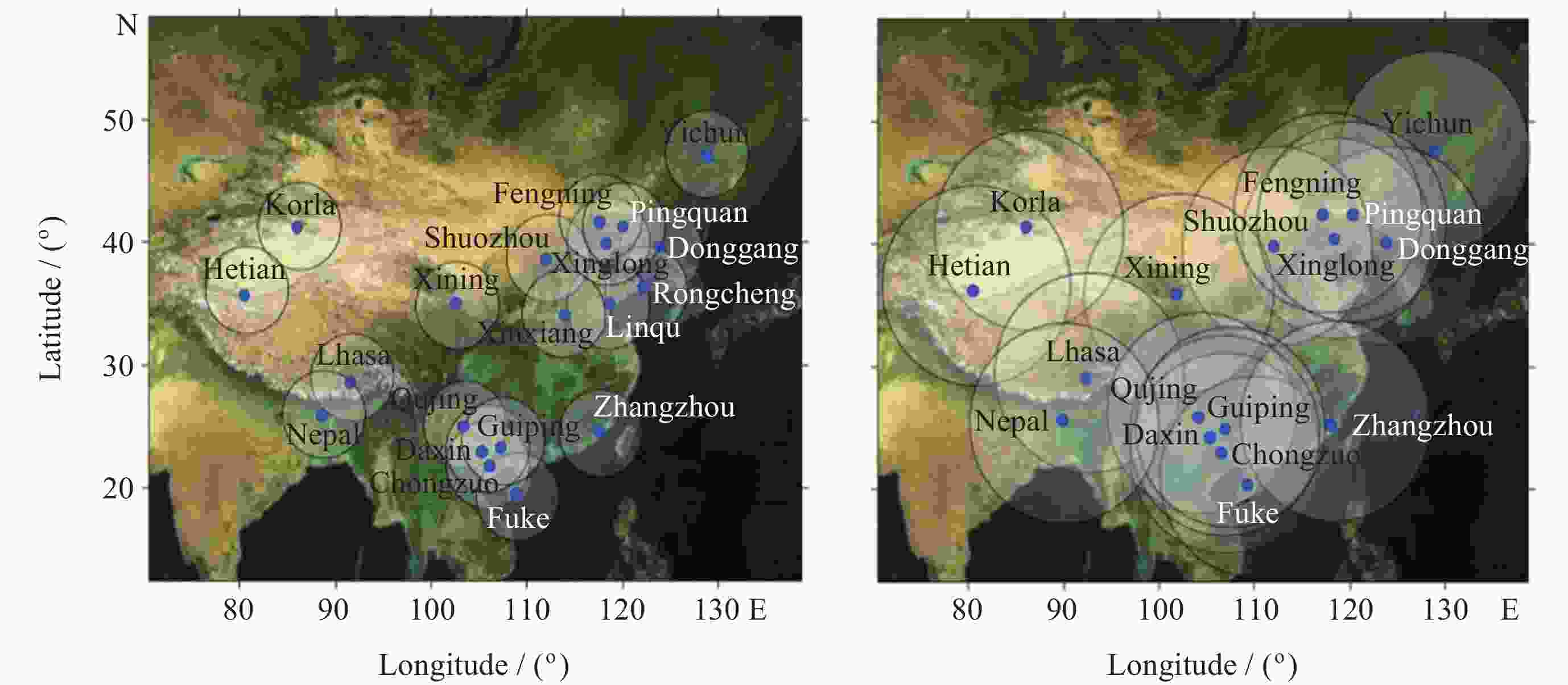
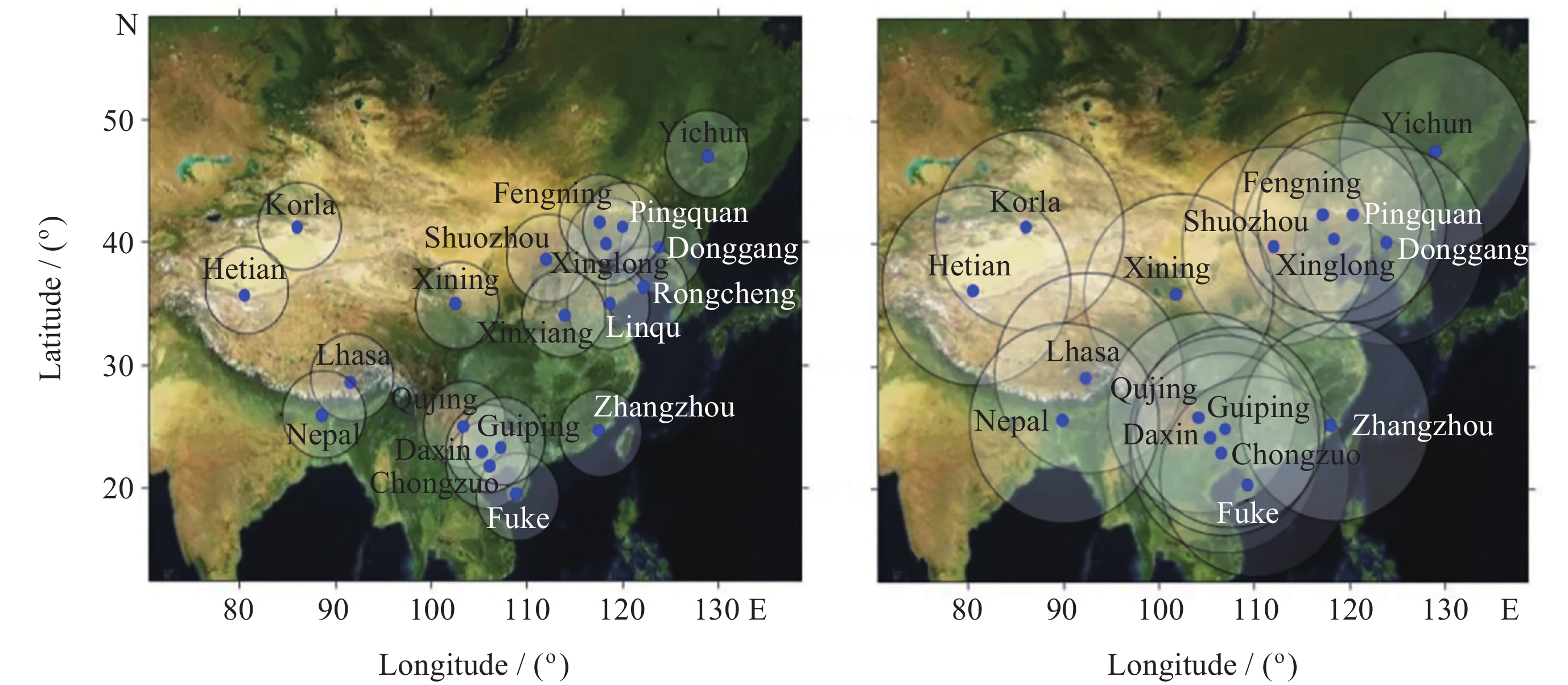
图 1 双层气辉台网布局. (a) 探测高度约为87 km的 OH气辉台网, (b) 探测高度约为250 km的红光(OI 630 nm)气辉台网
Figure 1. Layout of the double-layer airglow observation network. (a) OH airglow network with a detection altitude of approximately 87 km, (b)red-line (OI 630 nm) airglow network with a detection altitude of approximately 250 km
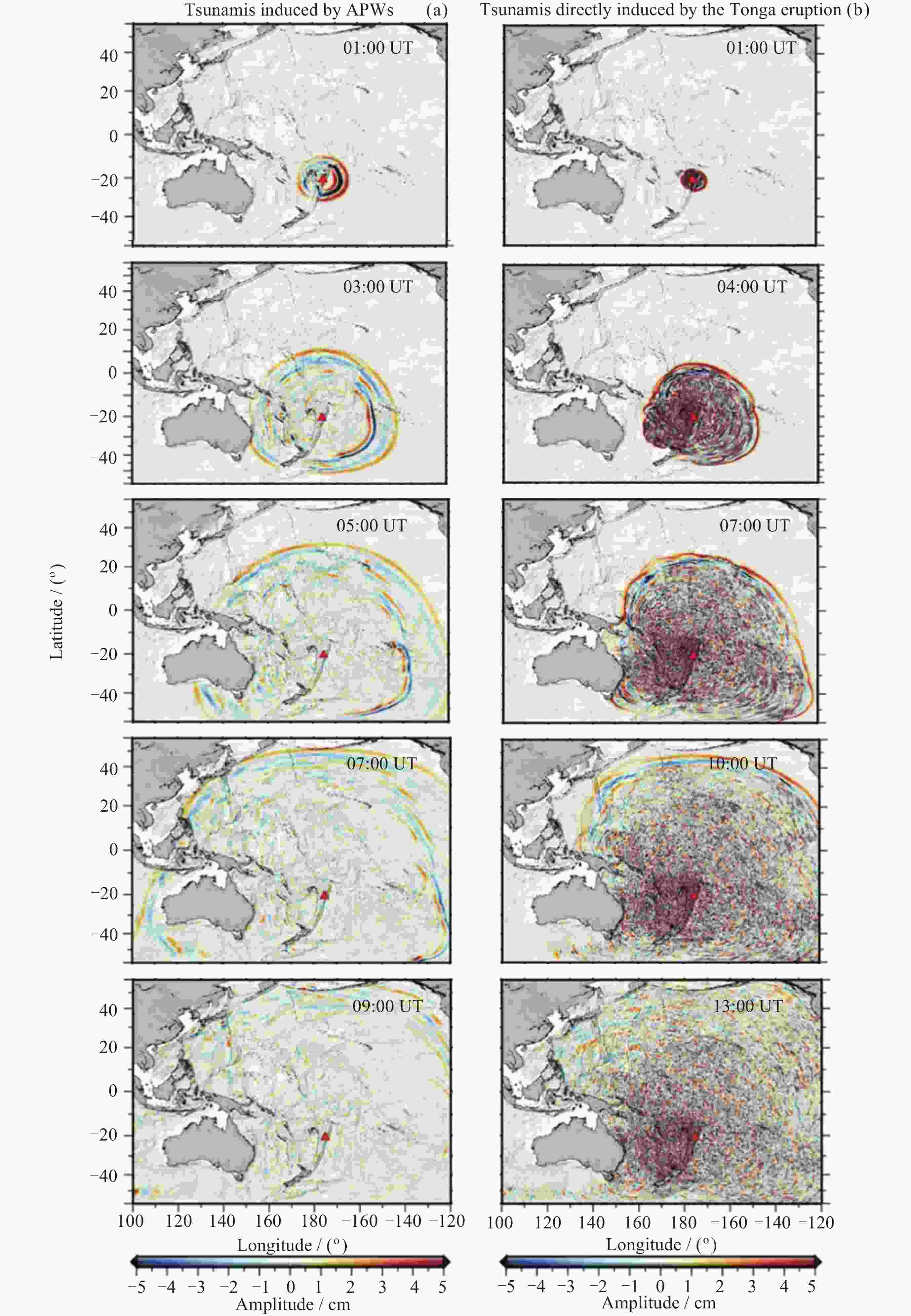
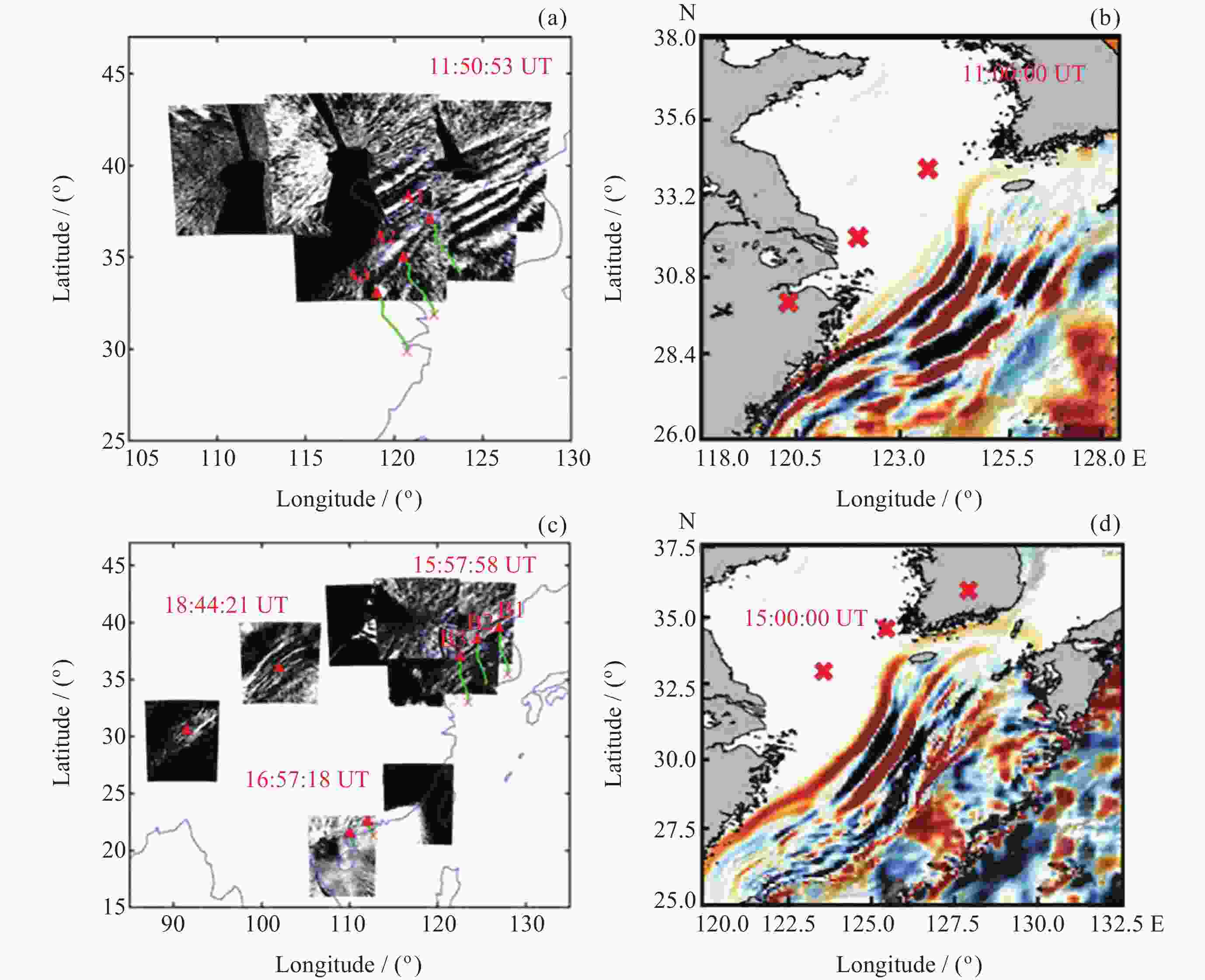
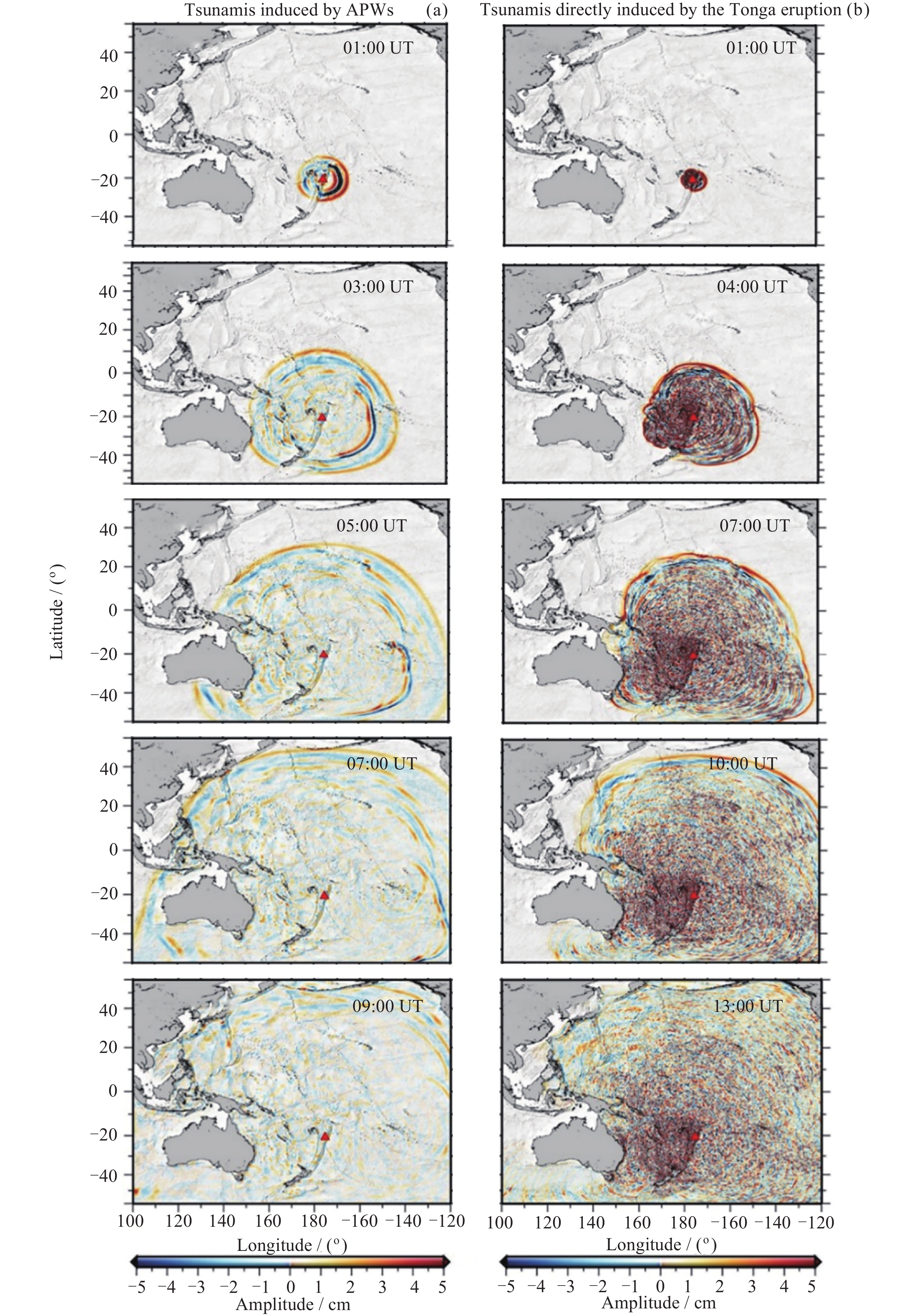
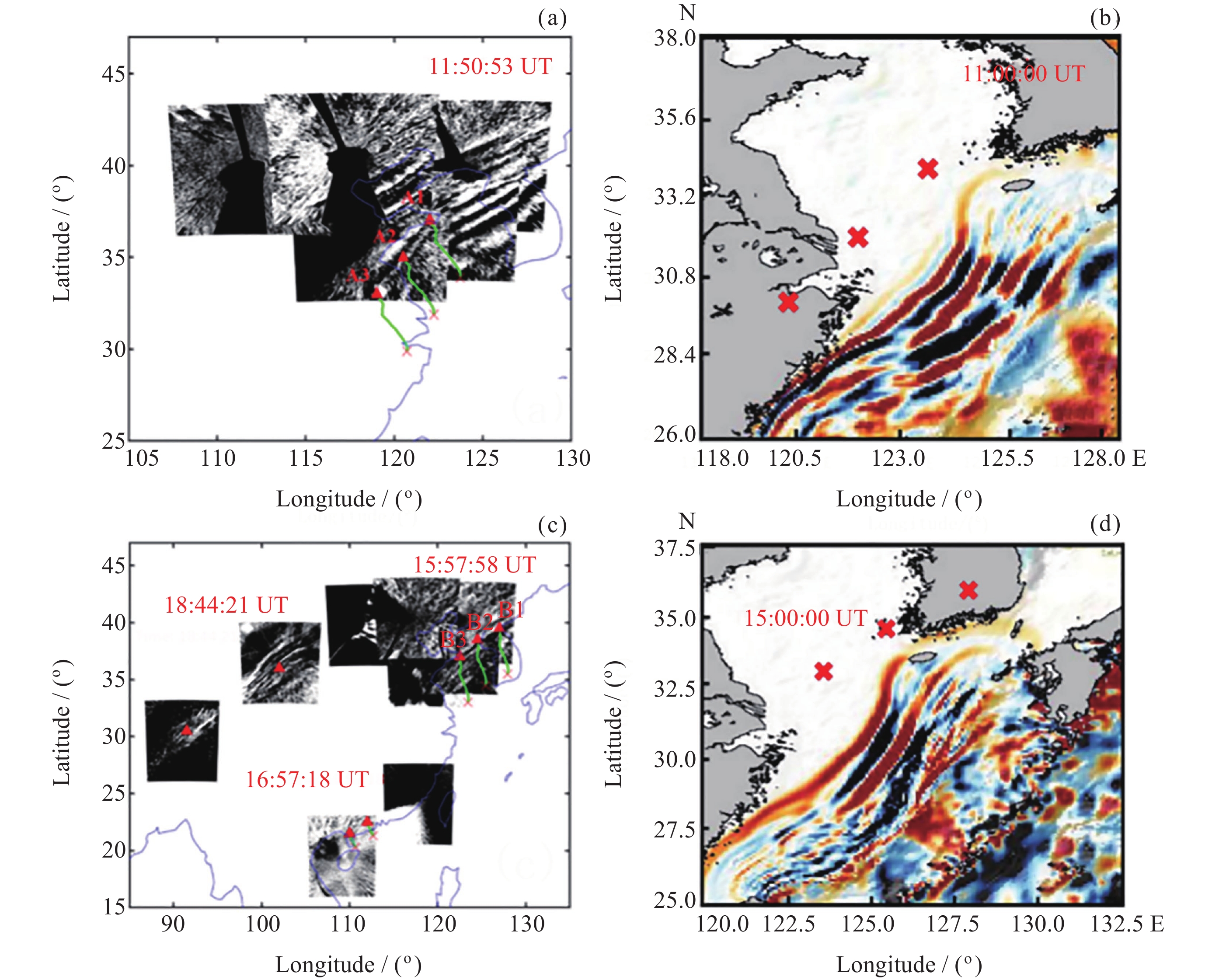
图 3 汤加火山喷发引发的两类海洋波动及其在中层顶区域激发的重力波[19]. (a)气辉台网观测到的中层顶区域重力波及(b)大气压力波激发的海洋波动; (c)气辉台网观测到的中层顶区域重力波及(d)汤加火山喷发直接引发的海洋波动
Figure 3. Two types of ocean waves induced by the Hunga Tonga volcanic eruption and the associated gravity waves generated in the mesopause region [19]. (a) Gravity waves in the mesopause region observed by the airglow imager network and (b) ocean waves excited by atmospheric pressure waves; (c) gravity waves in the mesopause region observed by the airglow imager network and (d) ocean waves directly generated by the Hunga Tonga volcanic eruption
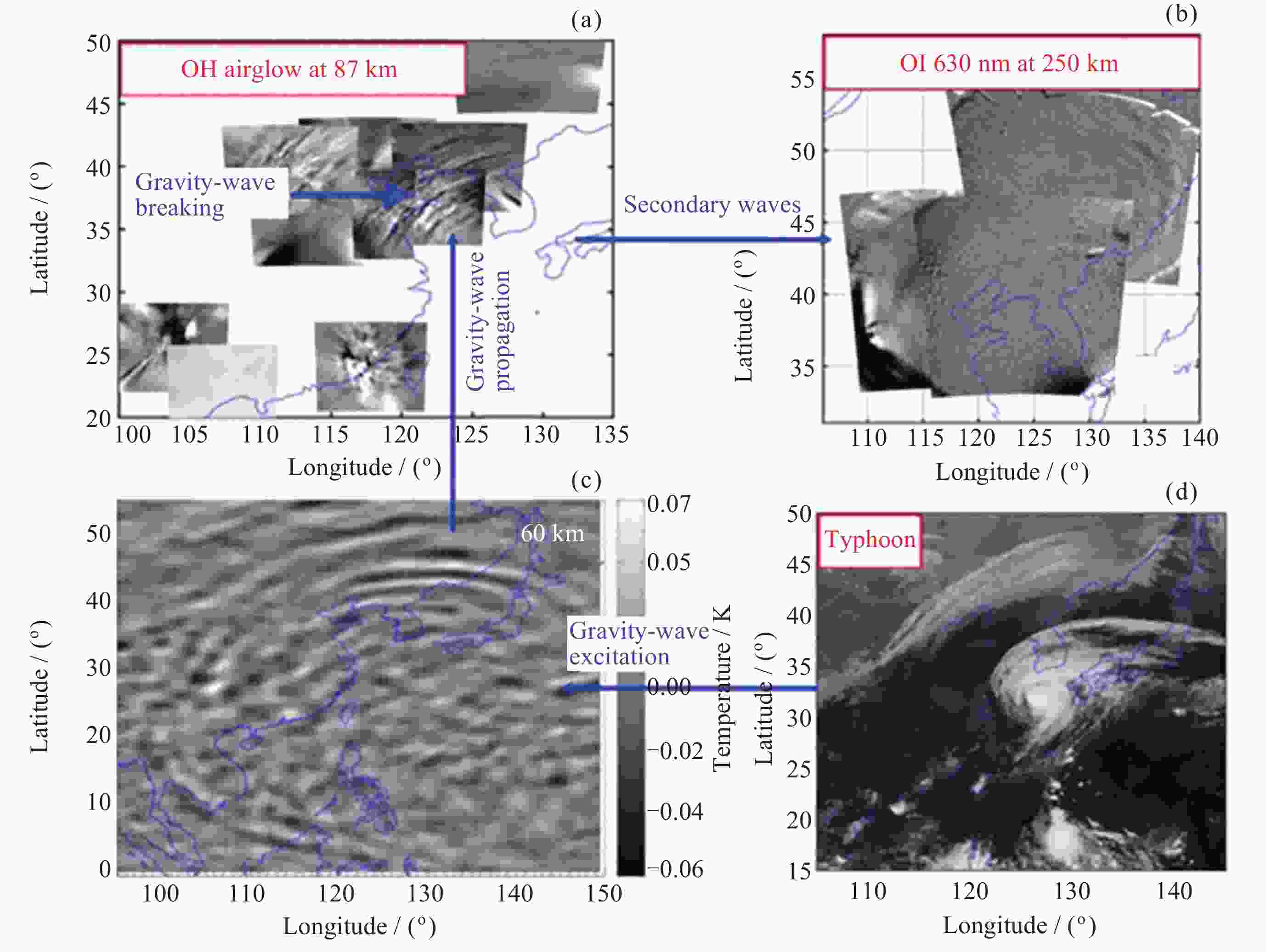
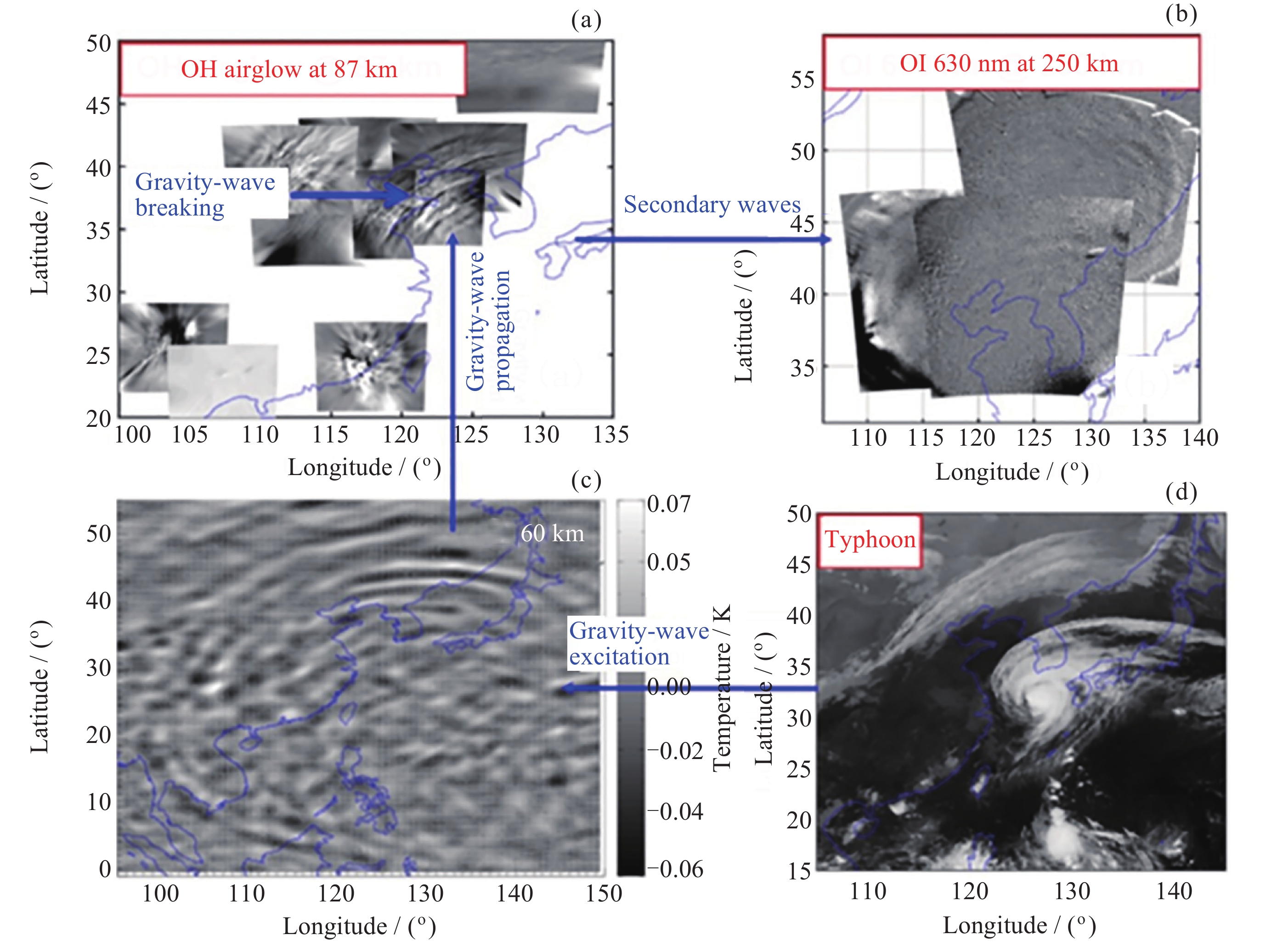
图 4 台风激发的重力波及其从对流层经平流层向中层顶和热层区域传播的观测结果[21]. (a) OH气辉台网观测的中层顶区域重力波及其破碎, (b)OI 630.0 nm气辉台网观测的热层次级重力波, (c)ERA5再分析数据揭示的平流层重力波, (d)卫星观测的台风云系
Figure 4. Typhoon-generated gravity waves and their propagation from the troposphere through the stratosphere to the mesopause and thermosphere [21]. (a) Gravity waves and their breaking in the mesopause region observed by the OH airglow imager network, (b) secondary gravity waves in the thermosphere observed by the OI 630.0 nm airglow imager network, (c) stratospheric gravity waves revealed by ERA5 reanalysis data, and (d) the typhoon cloud system observed by satellite
-
[1] 肖佐, 刘凯军, 张东和. 典型电离层多普勒记录及其讨论[J]. 空间科学学报, 2002, 22(4): 321-329 doi: 10.3969/j.issn.0254-6124.2002.04.005XIAO Zuo, LIU Kaijun, ZHANG Donghe. Some typical records of ionospheric Doppler shift and their significance in the study of ionospheric morphology[J]. Chinese Journal of Space Science, 2002, 22(4): 321-329 doi: 10.3969/j.issn.0254-6124.2002.04.005 [2] 肖赛冠, 郝永强, 张东和, 等. 电离层对台风响应的全过程的特例研究[J]. 地球物理学报, 2006, 49(3): 623-628 doi: 10.3321/j.issn:0001-5733.2006.03.003XIAO Saiguan, HAO Yongqiang, ZHANG Donghe, et al. A case study on whole response processes of the ionosphere to typhoons[J]. Chinese Journal of Geophysics, 2006, 49(3): 623-628 doi: 10.3321/j.issn:0001-5733.2006.03.003 [3] XIAO Z, XIAO S G, HAO Y Q, et al. Morphological features of ionospheric response to typhoon[J]. Journal of Geophysical Research: Space Physics, 2007, 112(A4): A04304. doi: 10.1029/2006JA011671 [4] SONG Q, DING F, ZHANG X X, et al. GPS detection of the ionospheric disturbances over China due to impacts of Typhoons Rammasum and Matmo[J]. Journal of Geophysical Research: Space Physics, 2017, 122(1): 1055-1063. doi: 10.1002/2016JA023449 [5] HAO Y Q, XIAO Z, ZHANG D H. Multi-instrument observation on co-seismic ionospheric effects after great Tohoku earthquake[J]. Journal of Geophysical Research: Space Physics, 2012, 117(A2): A02305. doi: 10.1029/2011JA017036 [6] 郝永强, 李泉翰, 郭建广, 等. 利用中国GPS站网对地震波引发的大尺度电离层扰动的观测[J]. 地球物理学报, 2021, 64(11): 3925-3932 doi: 10.6038/cjg2021P0088HAO Yongqiang, LI Quanhan, GUO Jianguang, et al. Imaging of the large-scale ionospheric disturbances induced by seismic waves using GPS network in China[J]. Chinese Journal of Geophysics, 2021, 64(11): 3925-3932 doi: 10.6038/cjg2021P0088 [7] HAO Y Q, XIAO Z, ZHANG D H. Teleseismic Magnetic Effects (TMDs) of 2011 Tohoku earthquake[J]. Journal of Geophysical Research: Space Physics, 2013, 118(6): 3914-3923. doi: 10.1002/jgra.50326 [8] ZHAO B Q, HAO Y Q. Ionospheric and geomagnetic disturbances caused by the 2008 Wenchuan earthquake: a revisit[J]. Journal of Geophysical Research: Space Physics, 2015, 120(7): 5758-5777. doi: 10.1002/2015JA021035 [9] LIU H T, DING F, ZHAO B Q, et al. Ionospheric response following the MW 7.8 Gorkha earthquake on 25 April 2015[J]. Journal of Geophysical Research: Space Physics, 2017, 122(6): 6495-6507. doi: 10.1002/2016JA023079 [10] ZHANG S R, VIERINEN J, AA E, et al. 2022 Tonga volcanic eruption induced global propagation of ionospheric disturbances via Lamb waves[J]. Frontiers in Astronomy and Space Sciences, 2022, 9: 871275. doi: 10.3389/fspas.2022.871275 [11] WRIGHT C J, HINDLEY N P, ALEXANDER M J, et al. Surface-to-space atmospheric waves from Hunga Tonga-Hunga Ha’apai eruption[J]. Nature, 2022, 609(7928): 741-746. doi: 10.1038/s41586-022-05012-5 [12] THEMENS D R, WATSON C, ŽAGAR N, et al. Global propagation of ionospheric disturbances associated with the 2022 Tonga volcanic eruption[J]. Geophysical Research Letters, 2022, 49(7): e2022GL098158. doi: 10.1029/2022GL098158 [13] MATOZA R S, FEE D, ASSINK J D, et al. Atmospheric waves and global seismoacoustic observations of the January 2022 Hunga eruption, Tonga[J]. Science, 2022, 377(6601): 95-100 doi: 10.1126/science.abo7063 [14] Corwin J. Wright, Neil P. Hindley, M. Joan Alexander, , et al. Surface-to-space atmospheric waves from Hunga Tonga–Hunga Ha’apai eruption [J]. Nature, 2022, 609(741). https://doi.org/10.1038/s41586-022-05012-5 [15] LIU H L, WANG W, HUBA J D, et al. Atmospheric and ionospheric responses to Hunga-Tonga volcano eruption simulated by WACCM-X[J]. Geophysical Research Letters, 2023, 50(10): e2023GL103682. doi: 10.1029/2023GL103682 [16] AA E, ZHANG S R, WANG W B, et al. Pronounced suppression and X-pattern merging of equatorial ionization anomalies after the 2022 Tonga volcano eruption[J]. Journal of Geophysical Research: Space Physics, 2022, 127(6): e2022JA030527. doi: 10.1029/2022JA030527 [17] XU J Y, LI Q Z, SUN L C, et al. The ground-based airglow imager network in China[M]//WANG W B, ZHANG Y L, PAXTON L J. Upper Atmosphere Dynamics and Energetics. American Geophysical Union, 2021: 365-394. DOI: 10.1002/9781119815631.ch19 [18] LIU X, XU J Y, YUE J, et al. Strong gravity waves associated with Tonga volcano eruption revealed by SABER observations[J]. Geophysical Research Letters, 2022, 49(10): e2022GL098339. doi: 10.1029/2022GL098339 [19] LI Q Z, XU J Y, GUSMAN A R, et al. Upper-atmosphere responses to the 2022 Hunga Tonga–Hunga Ha'apai volcanic eruption via acoustic gravity waves and air–sea interaction[J]. Atmospheric Chemistry and Physics, 2024, 24(14): 8343-8361. doi: 10.5194/acp-24-8343-2024 [20] XU J Y, LI Q Z, YUE J, et al. Concentric gravity waves over northern China observed by an airglow imager network and satellites[J]. Journal of Geophysical Research: Atmospheres, 2015, 120(21): 11058-11078. doi: 10.1002/2015JD023786 [21] LI Q Z, XU J Y, LIU H L, et al. How do gravity waves triggered by a typhoon propagate from the troposphere to the upper atmosphere?[J]. Atmospheric Chemistry and Physics, 2022, 22(18): 12077-12091. doi: 10.5194/acp-22-12077-2022 [22] SUN L C, XU J Y, WANG W B, et al. A statistical analysis of equatorial plasma bubble structures based on an all-sky airglow imager network in China[J]. Journal of Geophysical Research: Space Physics, 2016, 121(11): 11495-11517. doi: 10.1002/2016JA022950 [23] WU K, XU J Y, WANG W B, et al. Interesting equatorial plasma bubbles observed by all-sky imagers in the equatorial region of China[J]. Journal of Geophysical Research: Space Physics, 2017, 122(10): 10596-10611. doi: 10.1002/2017JA024561 -
-

 下载:
下载:

计量
- 文章访问数: 1297
- HTML全文浏览量: 255
- PDF下载量: 173
-
被引次数:
0(来源:Crossref)
0(来源:其他)

