


基于NCSW空间天气事件概率预报水平分析
doi: 10.11728/cjss2026.05.2025-0188 cstr: 32142.14.cjss.2025-0188
-
 刘丹丹 女, 博士, 1979年出生于湖北省随州市, 现为国家卫星气象中心(国家空间天气监测预警中心)高级工程师, 主要研究方向为空间天气预报和预报模式研究. E-mail: liudd@cma.gov.cn
作者简介:
Analysis of Probabilistic Forecasts for NCSW Space Weather Events
-
摘要: 基于国家空间天气监测预警中心(NCSW)2005-2022 年空间天气事件概率预报数据, 系统检验 M 级耀斑、X 级耀斑、质子事件、小地磁暴及中等及以上地磁暴预报性能, 并在可靠性–锐度–分辨率框架下与美国 SWPC 对比. 结果表明, 各类事件预报技巧均随时效延长衰减. M 级耀斑预报在样本充足年份性能稳定, 太阳活动低年波动明显; X 级耀斑样本稀缺, 空报现象突出, 业务上呈现 “宁可虚报” 的策略; 质子事件采用零虚报的保守预报策略; 小地磁暴预报在后期同等样本条件下技巧较早期显著提升; 中等及以上地磁暴发生频次低, 整体预报技巧偏弱. 多指标联合分析显示, TSS 适用于逐年业务能力跟踪, 统计特征分析服务于长期系统校准, PC 指标受事件基础率影响显著, 需结合 TSS 综合评估. 对比可见, NCSW 在预报可靠性与虚报控制方面具备优势, SWPC 锐度表现更强; 短时效 NCSW 综合判别能力更佳, 二者性能差异随预报时效延长逐步缩小. 本文完成 NCSW 18 年概率预报连续检验, 揭示稀少空间天气事件预报特征, 可为中国空间天气业务评估与预报能力建设提供支撑.Abstract: Based on the probabilistic forecast data of space weather events from the National Center for Space Weather, China (NCSW) during 2005–2022, this study systematically examines the forecast performance of M-class flares, X-class flares, proton events, minor geomagnetic storms, and moderate-and-above geomagnetic storms, and compares the results with the U.S. Space Weather Prediction Center (SWPC) within the reliability-sharpness-resolution framework. The results show that the forecast skill of all event types degrades with increasing lead time. For M-class flares, the forecast performance is stable in years with sufficient samples but fluctuates obviously during solar minimum. X-class flares have scarce samples and prominent false alarms, with an operational strategy of “preferring false alarms to misses”. Proton event forecasts adopt a conservative zero-false-alarm strategy. Under comparable sample conditions, the forecast skill of minor geomagnetic storms improves significantly in later periods compared with earlier stages. Moderate-and-above geomagnetic storms have low occurrence frequency and generally weak forecast skill. Multi-metric joint analysis indicates that TSS is suitable for annual operational capability tracking, and statistical characteristic analysis serves long-term systematic calibration. The PC metric is strongly affected by the event base rate and requires comprehensive assessment combined with TSS. The comparison shows that NCSW has advantages in forecast reliability and false alarm control, while SWPC achieves stronger sharpness. NCSW presents better overall discrimination skill at short lead times, and the performance difference between the two agencies gradually narrows with extended lead time. This study conducts continuous verification of NCSW’s 18-year probabilistic forecasts and reveals the forecast characteristics of rare space weather events, which provides support for China’s space weather operational assessment and forecasting capability development.
-
Key words:
- Space weather events /
- Solar activity level /
- Solar flares /
- Solar proton events /
- Geomagnetic storms /
- TS score /
- TSS score
-
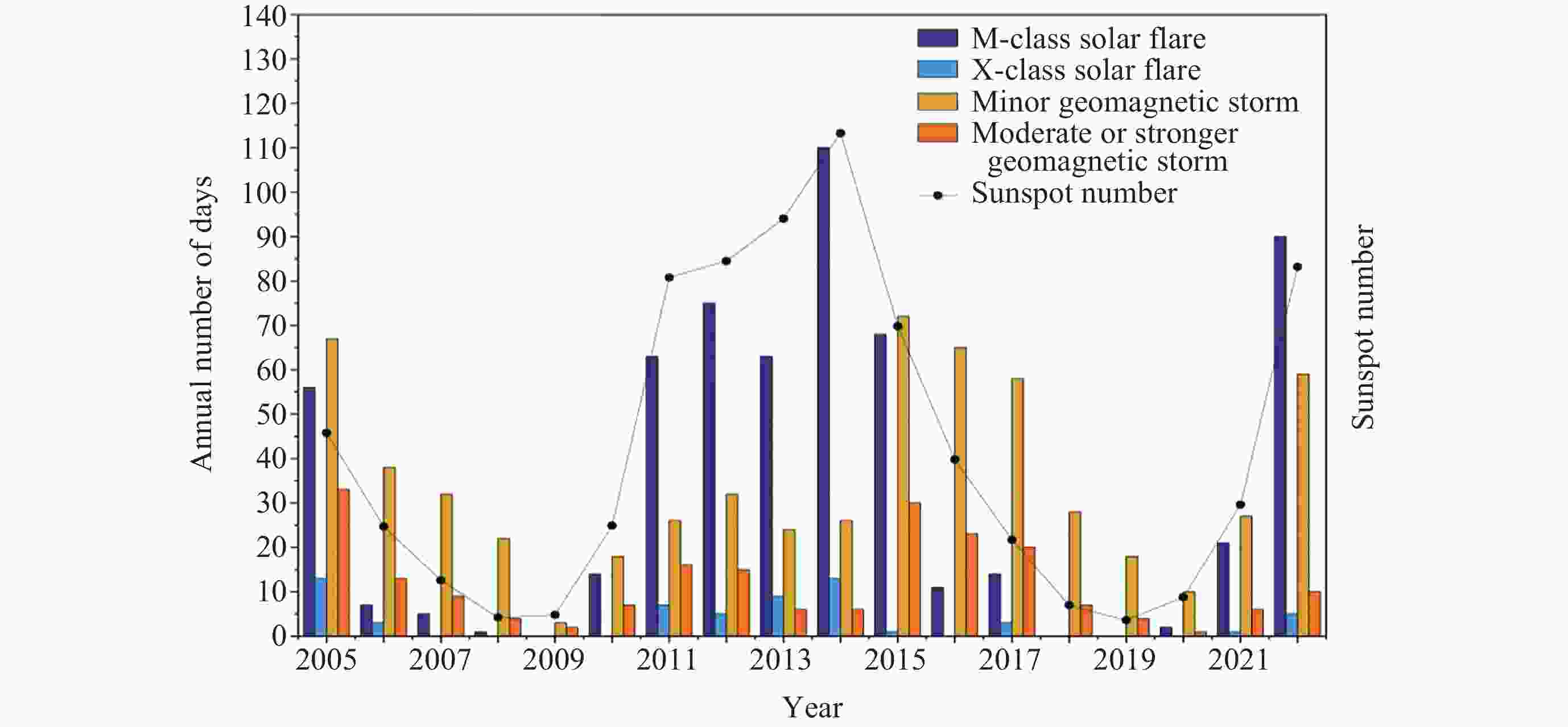
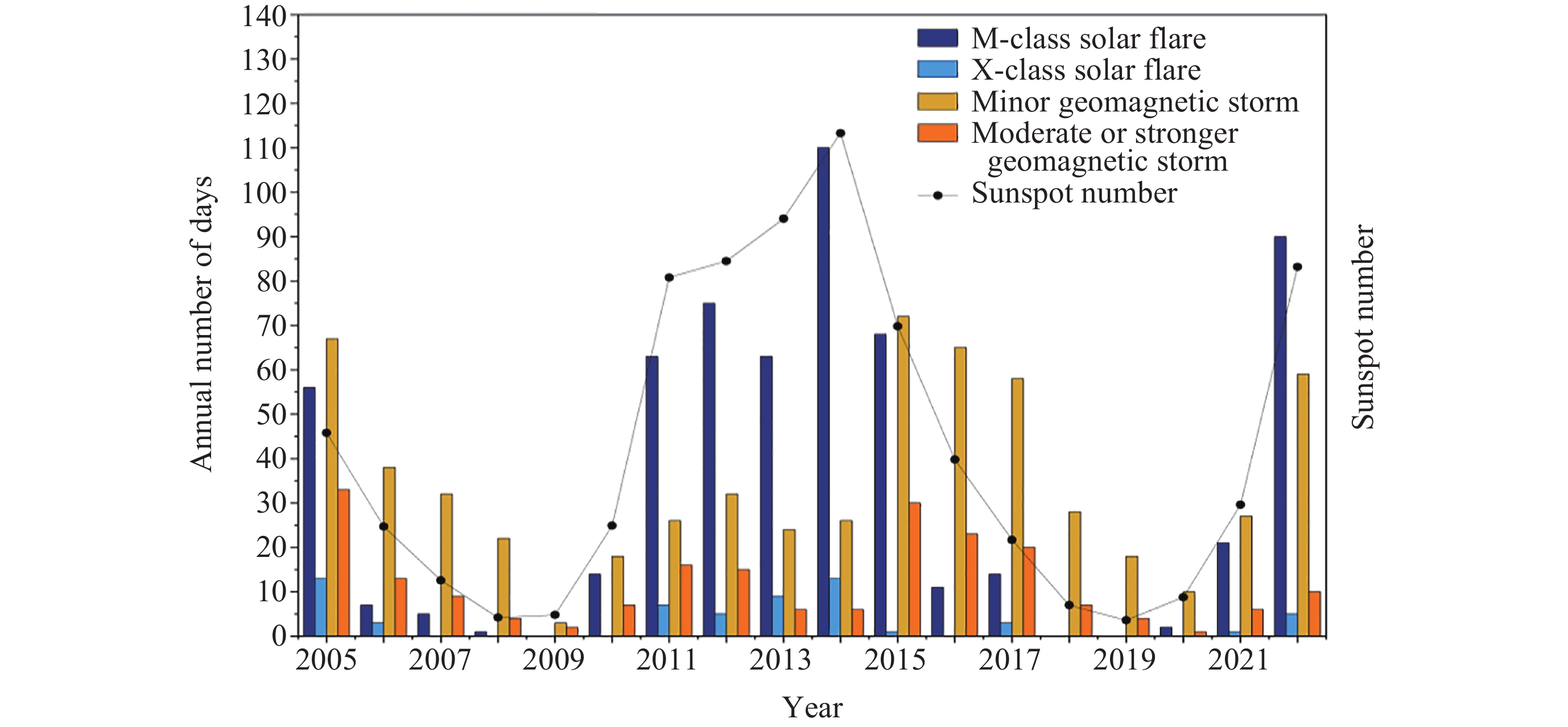
图 1 2005-2022年耀斑及地磁暴事件天数与太阳黑子数的变化
Figure 1. Variations of flare and geomagnetic storm event days and sunspot number from 2005 to 2022
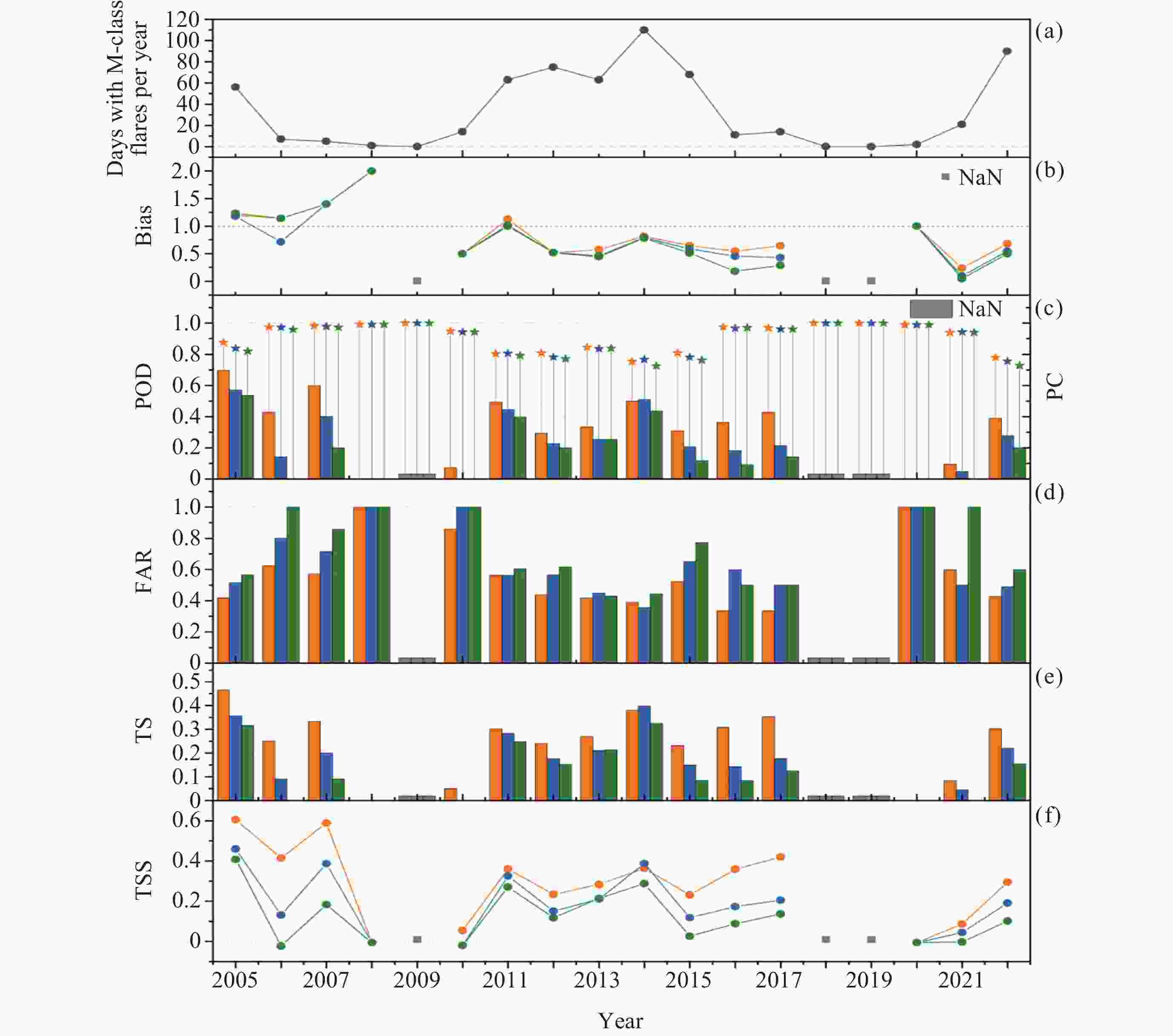
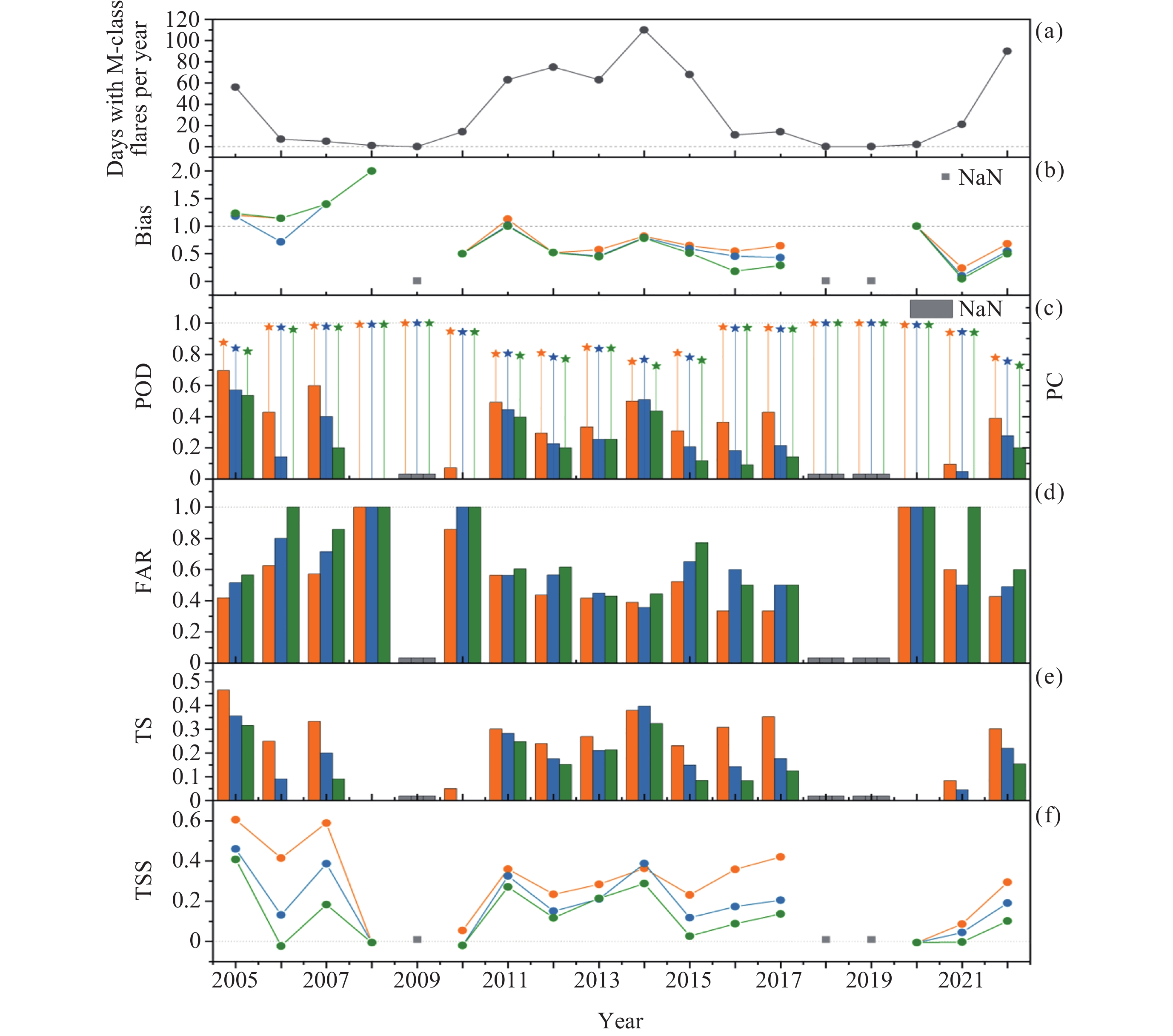
图 2 国家空间天气监测预警中心(NCSW)M级耀斑概率预报检验分析(2005-2022年). (a) M级耀斑发生天数, (b)预报偏差(Bias), (c)命中率(POD, 柱状)与正确率(PC, 星号), (d)空报率(FAR), (e)威胁评分(TS), (f)真实技巧评分(TSS)
Figure 2. Verification of M-class solar flare probability forecasts from the National Center for Space Weather (NCSW) during 2005-2022. (a) Annual number of days with M-class flares, (b) Frequency bias (Bias), (c) Probability of Detection (POD, bars) and Percent Correct (PC, asterisks), (d) False Alarm Ratio (FAR), (e) Threat Score (TS), (f) True Skill Statistic (TSS)
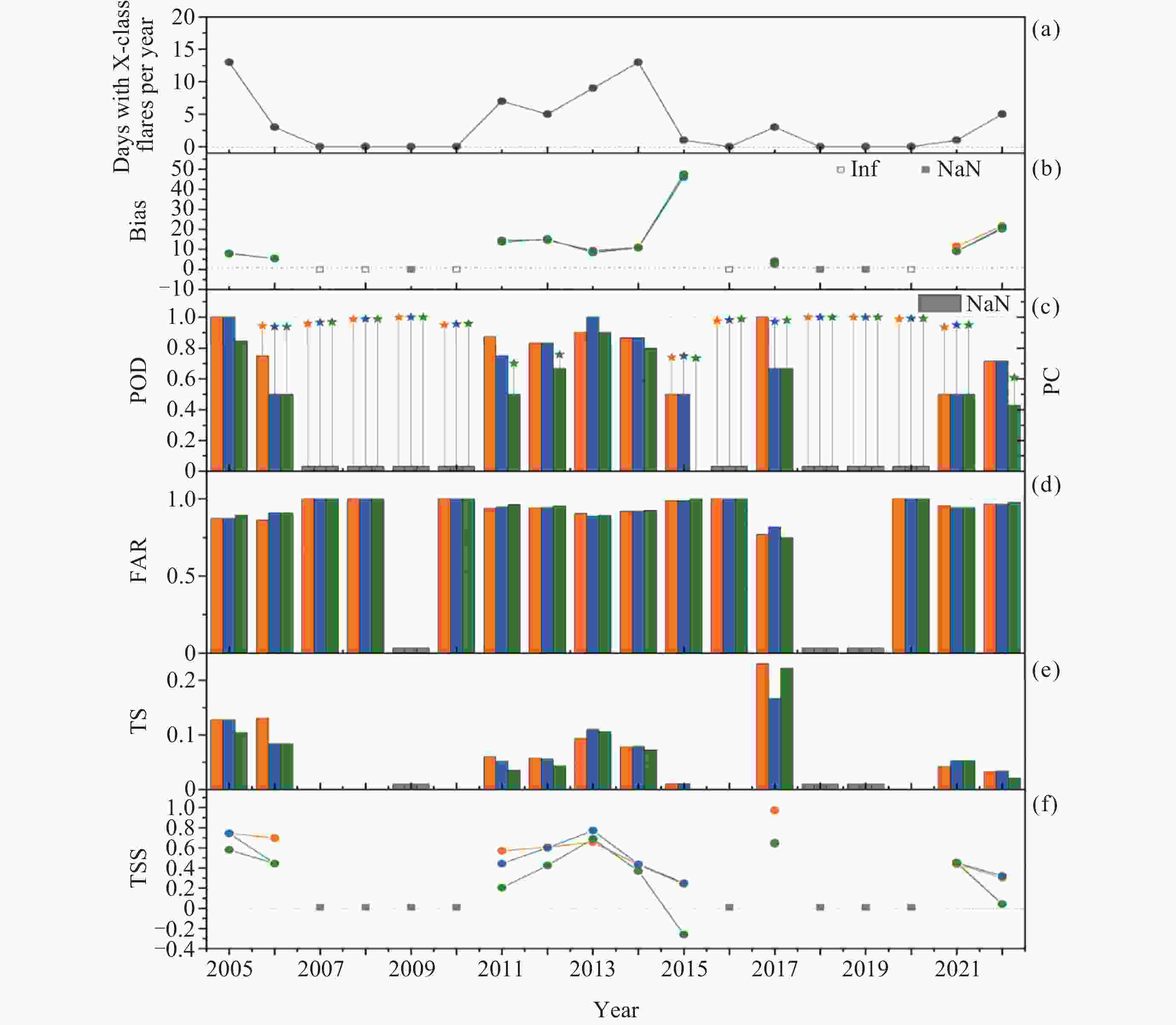
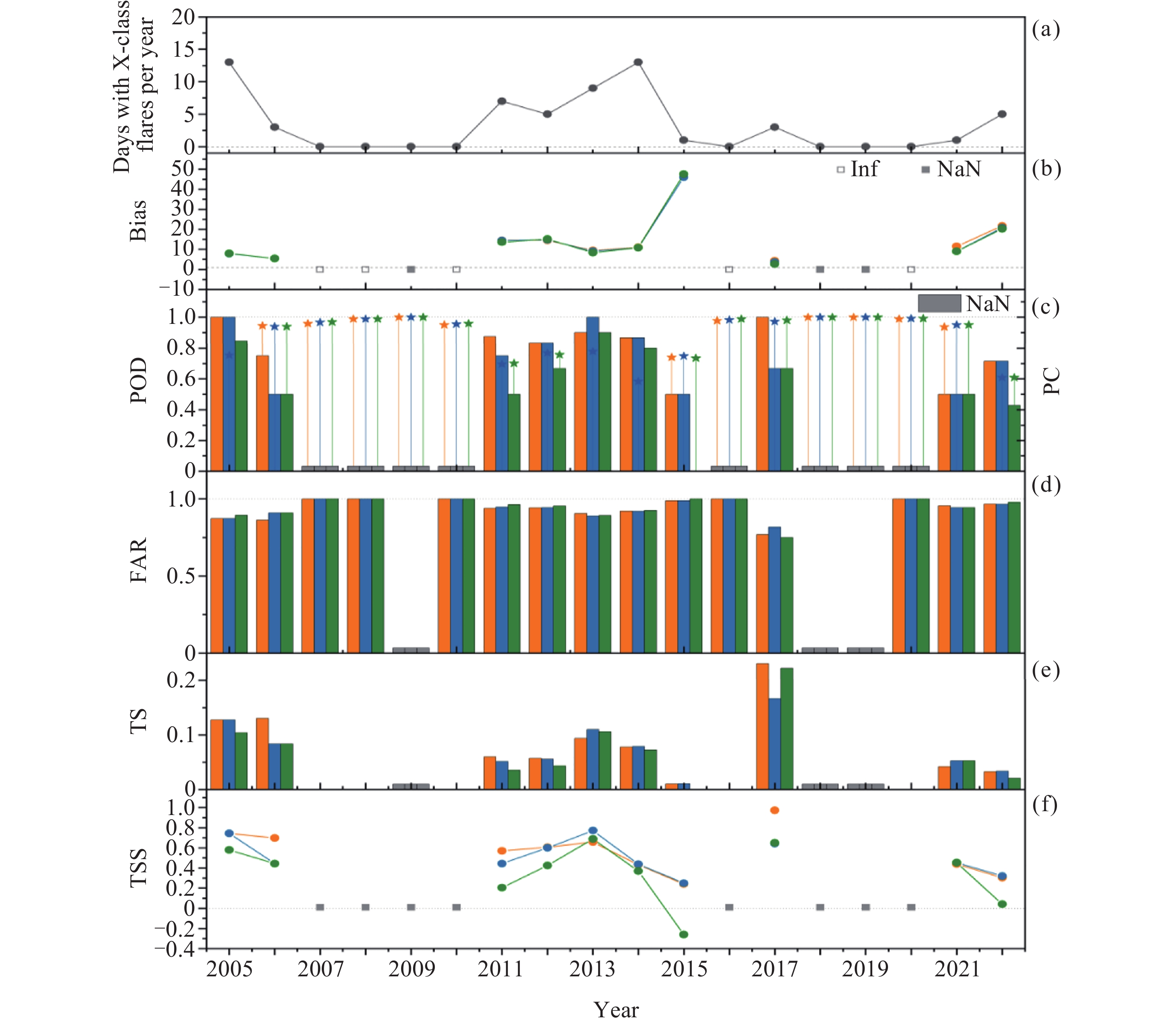
图 3 国家空间天气监测预警中心(NCSW)X级耀斑概率预报检验评分析(2005-2022年). (a) X级耀斑发生天数, (b)预报偏差(Bias), (c)命中率(POD, 柱状)与正确率(PC, 星号), (d)空报率(FAR), (e)威胁评分(TS), (f)真实技巧评分(TSS)
Figure 3. Verification of X-class solar flare probability forecasts from the National Center for Space Weather (NCSW) during 2005-2022. (a) Annual number of days with X-class flares, (b) Frequency Bias (Bias), (c) Probability of Detection (POD, bars) and Percent Correct (PC, asterisks), (d) False Alarm Ratio (FAR), (e) Threat Score (TS), (f) True Skill Statistic (TSS)
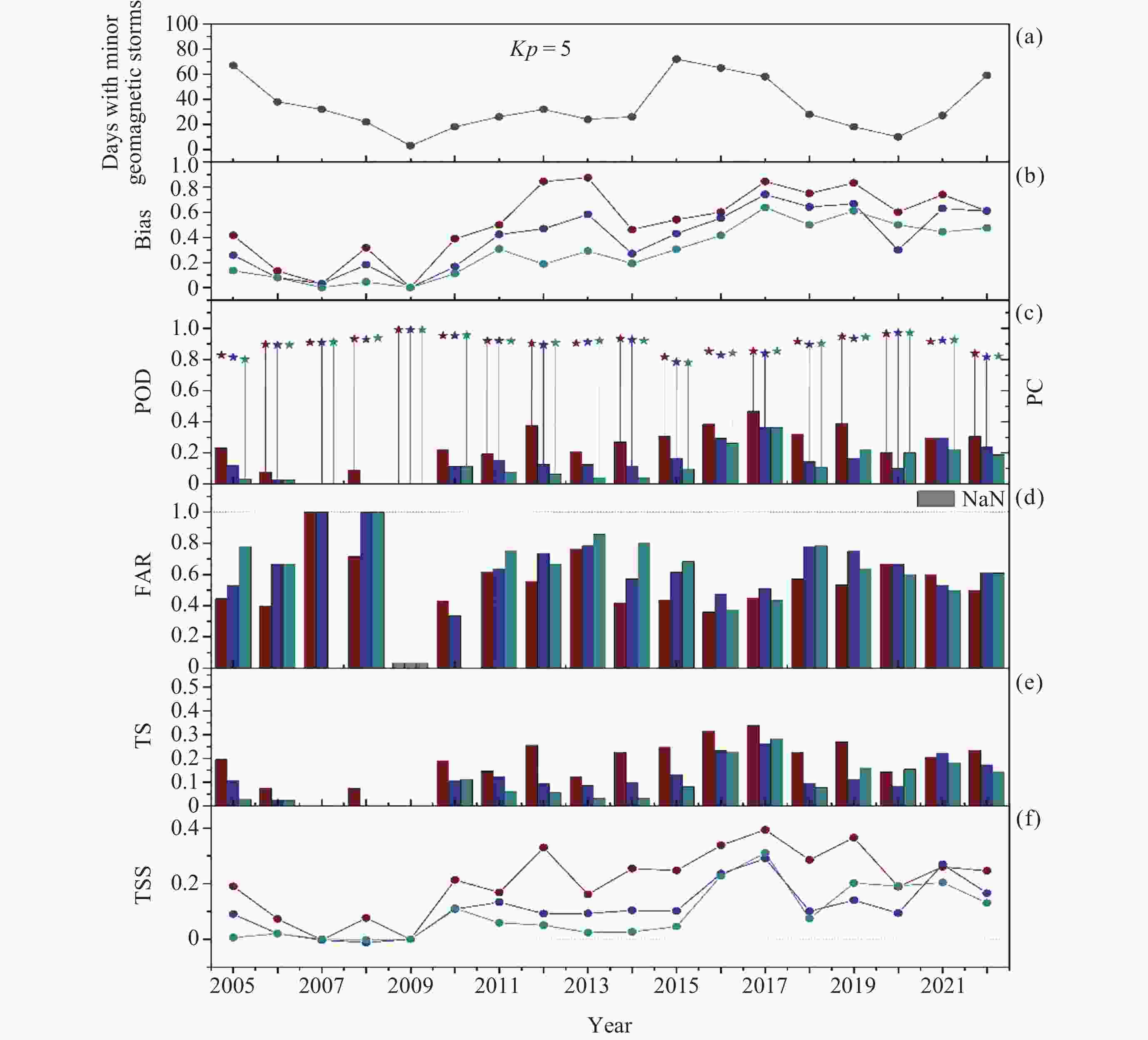
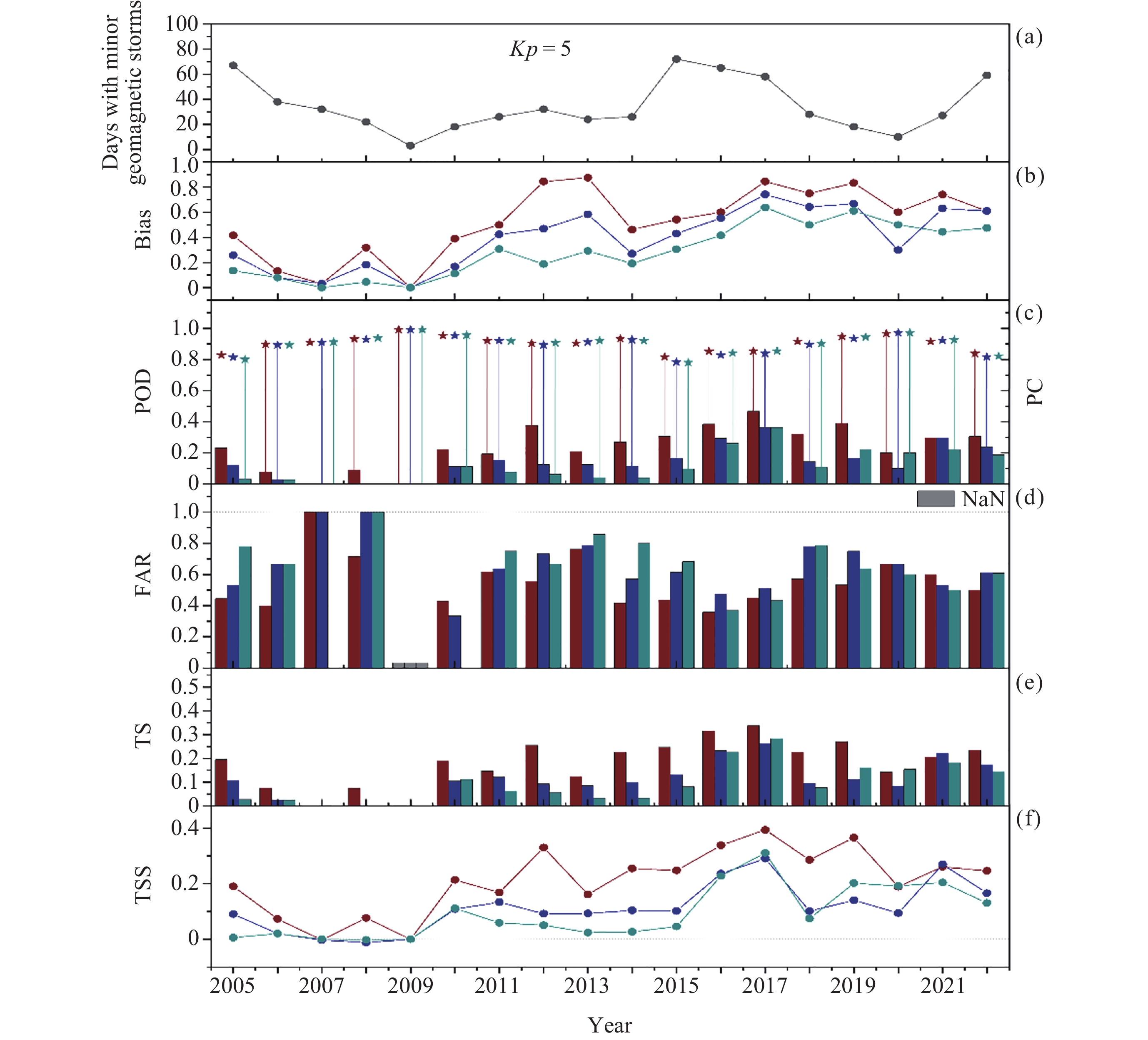
图 4 国家空间天气监测预警中心(NCSW)小地磁暴(Kp=5)概率预报检验分析(2005-2022年). (a)小地磁暴发生天数, (b)预报偏差(Bias), (c)命中率(POD, 柱状)与预报准确率(PC, 星号), (d)空报率(FAR), (e)威胁评分(TS), (f)真实技巧评分(TSS)
Figure 4. Verification of minor geomagnetic storm (Kp=5) probability forecasts from the National Center for Space Weather (NCSW) during 2005-2022. (a) Annual number of days with minor geomagnetic storms, (b) Frequency Bias (Bias), (c) Probability of Detection (POD, bars) and Percent Correct (PC, asterisks), (d) False Alarm Ratio (FAR), (e) Threat Score (TS), (f) True Skill Statistic (TSS)
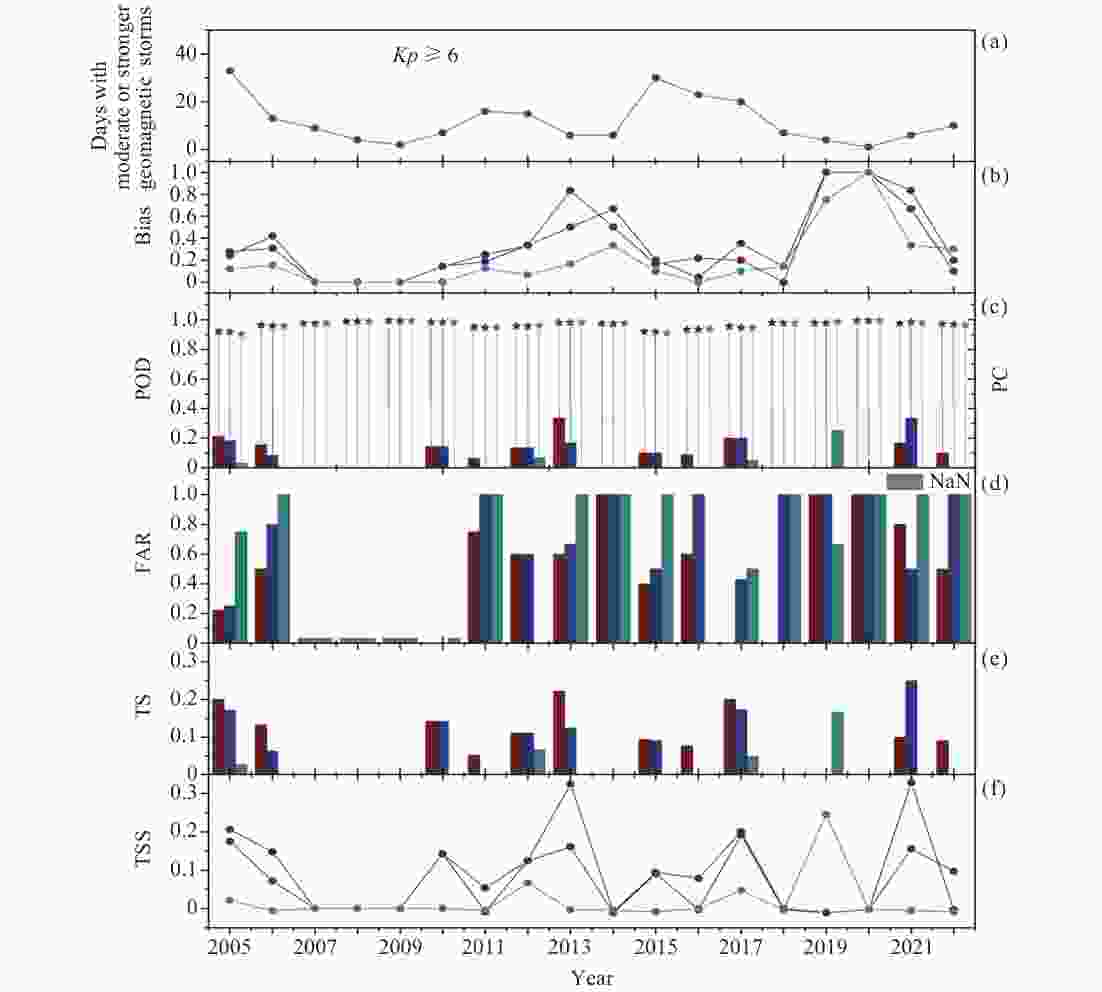
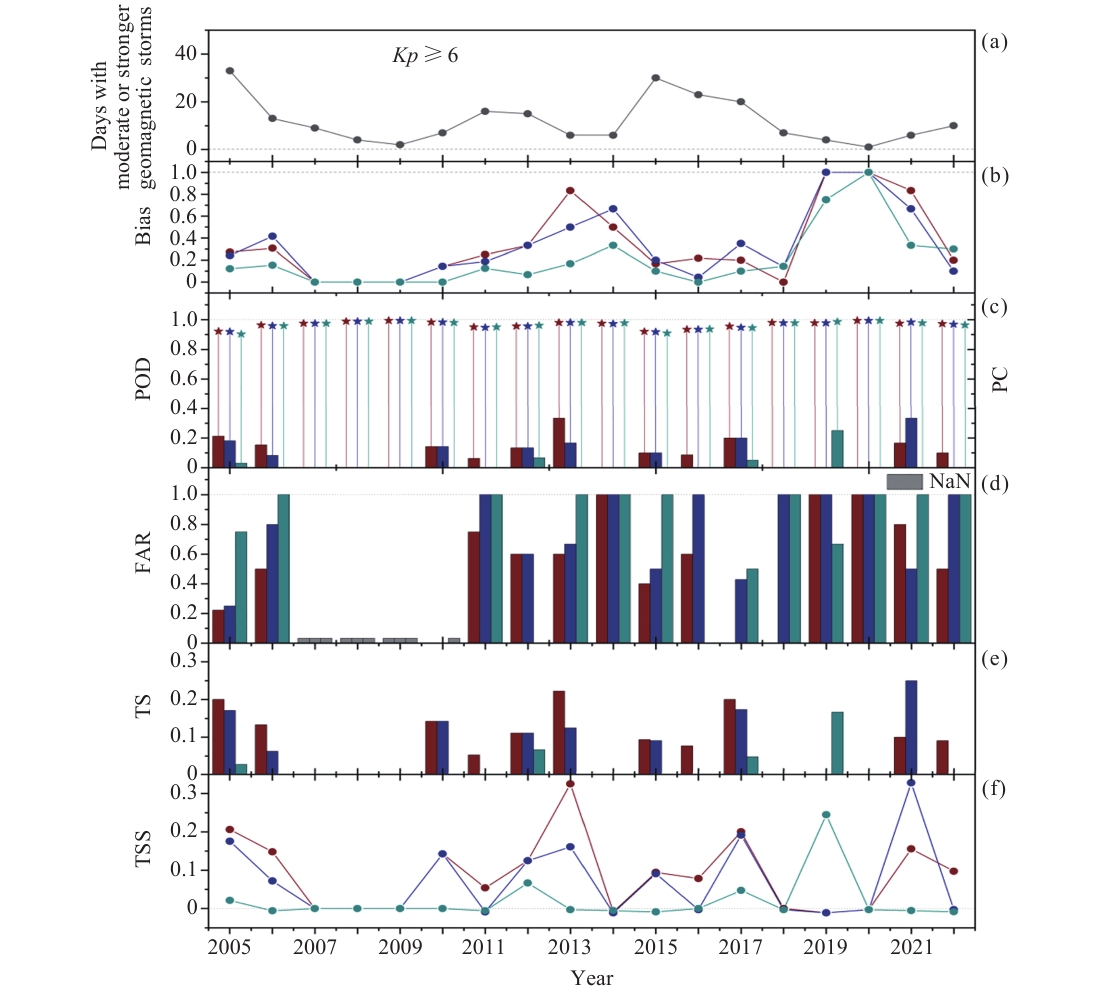
图 5 国家空间天气监测预警中心(NCSW)的中等及以上地磁暴(Kp≥6)概率预报检验分析(2005-2022年). (a) 中等及以上地磁暴发生天数, (b) 预报偏差(Bias), (c) 命中率(POD, 柱状)与预报准确率(PC, 星号), (d) 空报率(FAR), (e) 威胁评分(TS), (f) 真实技巧评分(TSS)
Figure 5. Verification of moderate or stronger geomagnetic storm probability forecasts from the National Center for Space Weather (NCSW) during 2005-2022. (a) Annual number of days with moderate or stronger geomagnetic storms, (b) Frequency Bias (Bias), (c) Probability of Detection (POD, bars) and Percent Correct (PC, asterisks), (d) False Alarm Ratio (FAR), (e) Threat Score (TS), (f) True Skill Statistic (TSS)
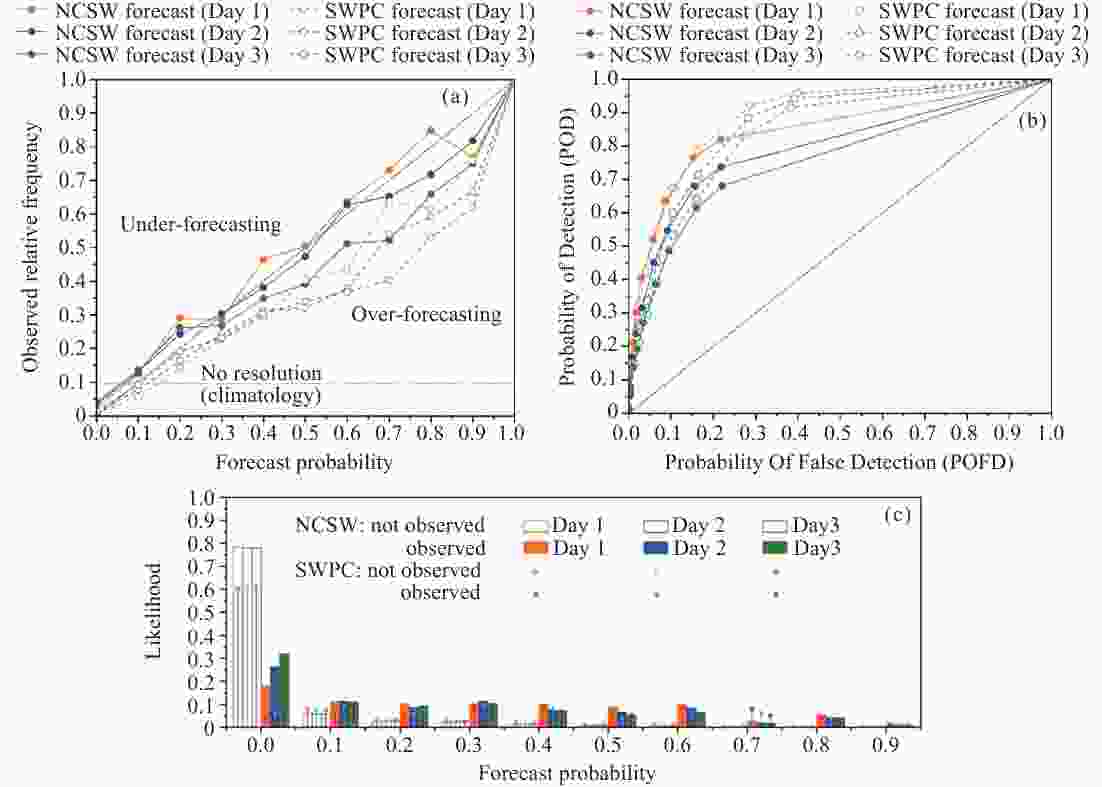
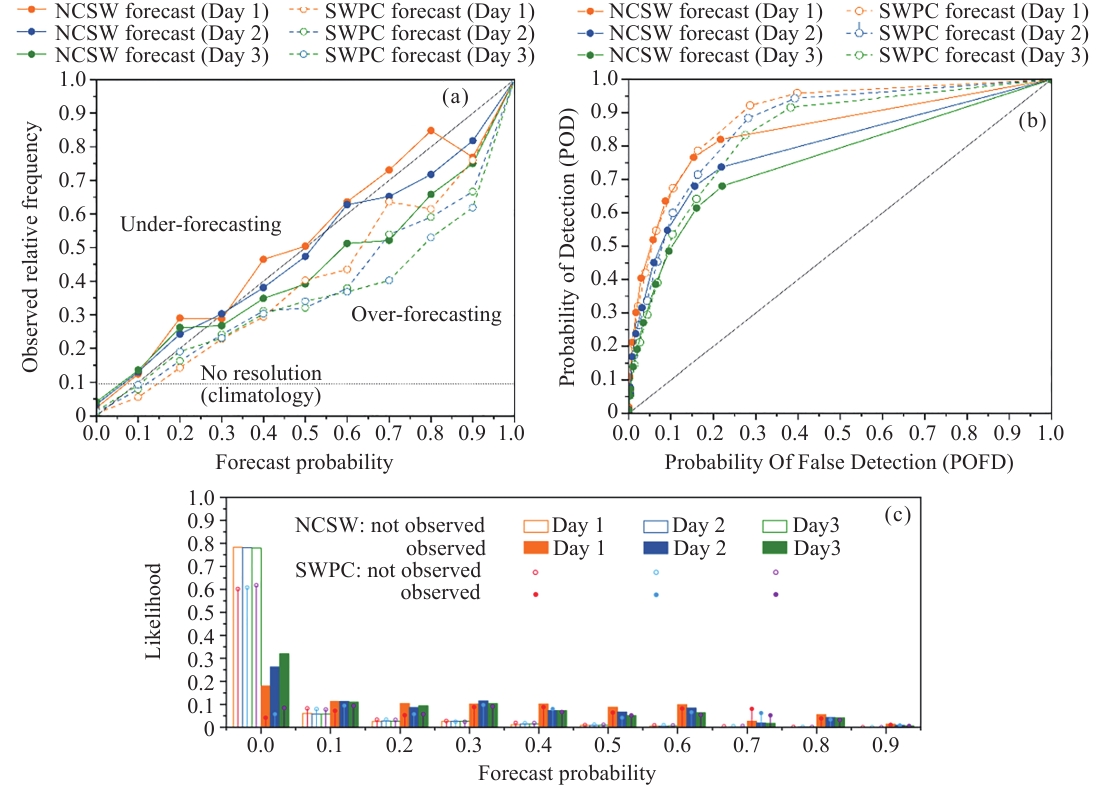
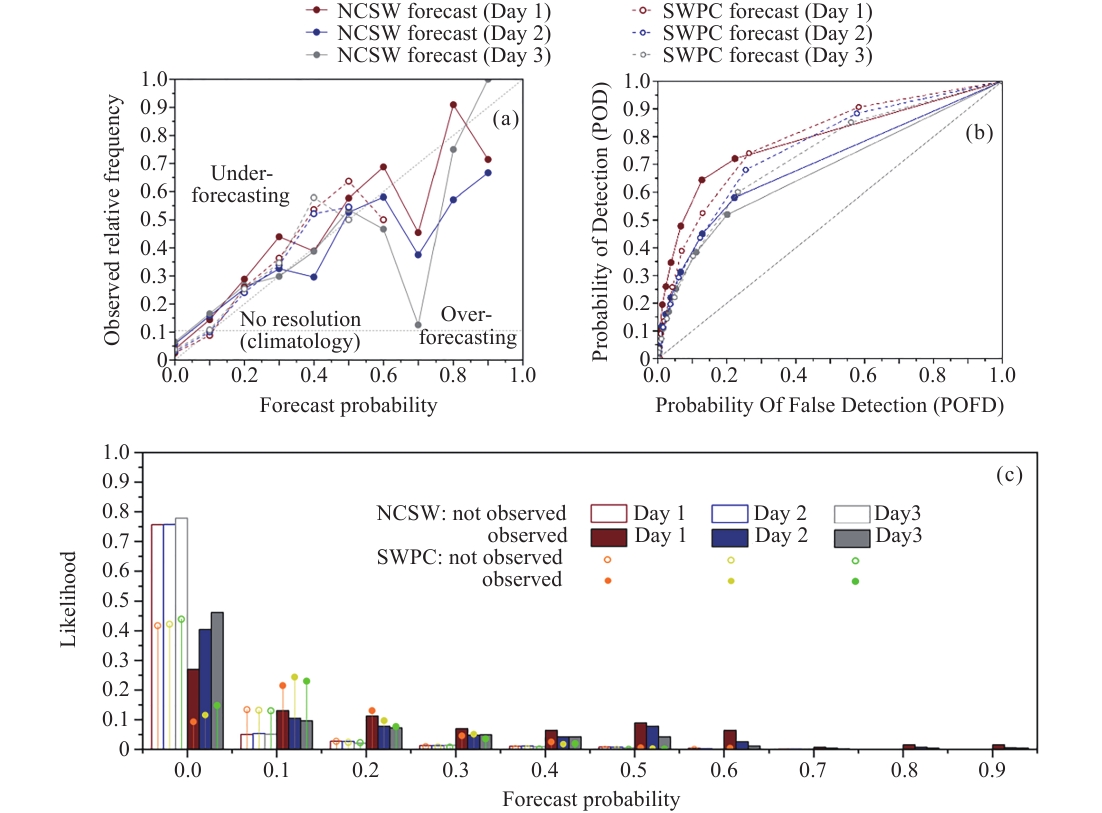
图 6 国家空间天气监测预警中心(NCSW)与美国空间天气预报中心(SWPC)的M级耀斑概率预报统计性能对比(2005-2022年). (a)可靠性图, (b) ROC曲线, (c)区分图
Figure 6. Statistical performance comparison of M-class solar flare probability forecasts between the National Center for Space Weather (NCSW) and the Space Weather Prediction Center (SWPC) for the period 2005-2022. (a) Reliability diagram, (b) ROC curve, (c) discrimination diagram
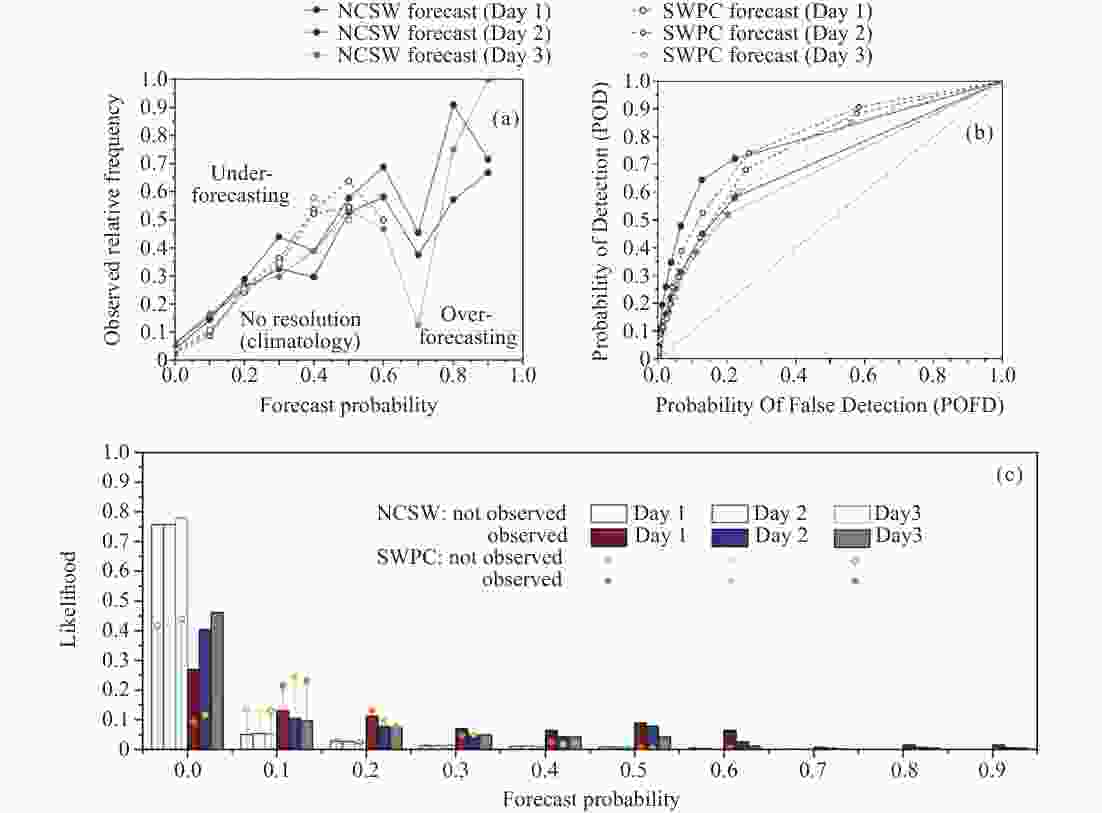
图 7 国家空间天气监测预警中心(NCSW)与美国空间天气预报中心(SWPC)的地磁暴(Kp≥5)概率预报统计性能对比(2005-2022年). (a)可靠性图, (b) ROC曲线, (c)区分图
Figure 7. Statistical performance comparison of geomagnetic storm (Kp≥5) probability forecasts between the National Center for Space Weather (NCSW) and the Space Weather Prediction Center (SWPC) for the period 2005-2022. (a) Reliability diagram, (b) ROC curve, (c) discrimination diagram
表 1 太阳软X射线耀斑强度等级划分
Table 1. Classification of solar soft X-ray flare intensity
强度级别 流量范围 (W·m–2) 强度级别 流量范围 (W·m–2) A FX<1.00×10⁻⁷ B 1.00×10⁻⁷≤FX<1.00×10⁻⁶ C 1.00×10⁻⁶≤FX<1.00×10⁻⁵ M 1.00×10⁻⁵≤FX<1.00×10⁻⁴ X FX≥1.00×10⁻⁴ – –  下载: 导出CSV
表 4 空间天气事件概率预报检验列联表
Table 4. Contingency table for probabilistic space weather forecast verification
预报
观测有 无 有 $ \text{命中次数(}N_{k}^{\text{A}}) $ $ \text{漏报次数(}N_{k}^{\text{C}}) $ 无 虚报次数$ (N_{k}^{\text{B}}) $ 正确否定次数$ (N_{k}^{\text{D}}) $
下载: 导出CSV
表 2 基于Kp指数的地磁暴强度等级划分
Table 2. Classification of geomagnetic storm intensity based on Kp index
强度级别 Kp指数范围 强度级别 Kp指数范围 强度级别 Kp指数范围 平静 Kp<4 活跃 Kp=4 小地磁暴 Kp=5 中等地磁暴 Kp=6 大地磁暴 Kp=7 严重地磁暴 Kp=8 极端地磁暴 Kp=9 – – – –
下载: 导出CSV
表 3 空间天气事件预报概率阈值
Table 3. Probability thresholds for space weather event forecasting
事件 M级耀斑 X级耀斑 小地磁暴 中等以上地磁暴 太阳质子事件 概率阈值 P≥35% P≥20% P≥35% P≥20% P≥20% 注 M级耀斑和小地磁暴采用35%阈值, X级耀斑、中等以上地磁暴和太阳质子事件采用20%阈值.
下载: 导出CSV
表 5 NCSW太阳质子事件概率预报性能分析(2005-2022年)
Table 5. Performance of NCSW solar proton event forecasts (2005-2022)
太阳质子事件预报 / h TSS评分 TS评分 报准率(POD) 偏差
(Bias)虚报率
(FAR)正确率
(PC)24 0.70 0.70 0.70 0.70 0 0.994 48 0.43 0.43 0.43 0.43 0 0.988 72 0.19 0.19 0.19 0.19 0 0.983
下载: 导出CSV
-
[1] 汪景琇. 太阳剧烈活动与空间灾害天气[J]. 紫金山天文台台刊, 2003, 22(1): 48-57WANG Jingxiu. Explosive solar activity and disastrous space weather[J]. Publications of Purple Mountain Observatory, 2003, 22(1): 48-57 [2] 王胜国, 谢志辉, 赵增亮, 等. 灾害性空间天气对国家安全的影响与对策[C]//国家安全地球物理丛书(九)——防灾减灾与国家安全. 西安: 西安地图出版社, 2013: 37-42WANG Shengguo, XIE Zhihui, ZHAO Zengliang, et al. Influence on national security of disastrous space weather[C]//National Security Geophysics Series (9): Disaster Prevention and Reduction and National Security. Xi’an: Xi’an Map Publishing House, 2013: 37-42 [3] 李小明. 空间天气电网磁暴灾害监测系统的研究与实现[D]. 保定: 华北电力大学, 2013LI Xiaoming. Research and Implement of Space Weather Power Grid Geomagnetic Storm Monitoring System[D]. Baoding: North China Electric Power University, 2013 [4] SCHRIJVER C J, KAURISTIE K, AYLWARD A D, et al. Understanding space weather to shield society: a global road map for 2015-2025 commissioned by COSPAR and ILWS[J]. Advances in Space Research, 2015, 55(12): 2745-2807 doi: 10.1016/j.asr.2015.03.023 [5] ZHENG Y H, GANUSHKINA N Y, JIGGENS P, et al. Space radiation and plasma effects on satellites and aviation: quantities and metrics for tracking performance of space weather environment models[J]. Space Weather, 2019, 17(10): 1384-1403 doi: 10.1029/2018SW002042 [6] 王劲松, 焦维新. 空间天气灾害[M]. 北京: 气象出版社, 2009WANG Jinsong, JIAO Weixin. Space Weather Disasters[M]. Beijing: China Meteorological Press, 2009 (in Chinese) [7] CALDWELL B, MCCARRON E, JONAS S. An abridged history of federal involvement in space weather forecasting[J]. Space Weather, 2017, 15(10): 1222-1237 doi: 10.1002/2017SW001626 [8] LILENSTEN J, BELEHAKI A. Developing the scientific basis for monitoring, modelling and predicting space weather[J]. Acta Geophysica, 2009, 57(1): 1-14 doi: 10.2478/s11600-008-0081-3 [9] 王劲松. 中国气象局的空间天气业务[J]. 气象科技进展, 2011, 1(4): 6-12WANG Jinsong. Space weather operations in CMA[J]. Advances in Meteorological Science and Technology, 2011, 1(4): 6-12 [10] LIU S Q, GONG J C. Operational space weather services in national space science center of Chinese academy of sciences[J]. Space Weather, 2015, 13(10): 599-605 doi: 10.1002/2015SW001298 [11] 牟惟丰. 预报评分方法述评和方案建议[J]. 气象, 1986, 12(2): 45-49MOU Weifeng. Review of forecast verification methods and proposals for schemes[J]. Meteorological Monthly, 1986, 12(2): 45-49 [12] CROWN M D. Validation of the NOAA Space Weather Prediction Center’s solar flare forecasting look-up table and forecaster-issued probabilities[J]. Space Weather, 2012, 10(6): 2011SW000760 doi: 10.1029/2011SW000760 [13] CAMPOREALE E, BERGER T E. Verification of the NOAA Space Weather Prediction Center solar flare forecast (1998-2024)[J]. Space Weather, 2025, 23(10): e2025SW004546 doi: 10.1029/2025SW004546 [14] BALCH C C. Updated verification of the Space Weather Prediction Center’s solar energetic particle prediction model[J]. Space Weather, 2008, 6(1): 2007SW000337. doi: 10.1029/2007SW000337 [15] BAIN H M, STEENBURGH R A, ONSAGER T G, et al. A summary of National Oceanic and Atmospheric Administration Space Weather Prediction Center proton event forecast performance and skill[J]. Space Weather, 2021, 19(7): e2020SW002670. doi: 10.1029/2020SW002670 [16] SHARPE M A, MURRAY S A. Verification of space weather forecasts issued by the Met Office Space Weather Operations Centre[J]. Space Weather, 2017, 15(10): 1383-1395 doi: 10.1002/2017SW001683 [17] MURRAY S A, BINGHAM S, SHARPE M, et al. Flare forecasting at the Met Office Space Weather Operations Centre[J]. Space Weather, 2017, 15(4): 577-588 doi: 10.1002/2016SW001579 [18] DEVOS A, VERBEECK C, ROBBRECHT E. Verification of space weather forecasting at the Regional Warning Center in Belgium[J]. Journal of Space Weather and Space Climate, 2014, 4: A29 doi: 10.1051/swsc/2014025 [19] CUI Y M, LIU S Q, ERCHA A, et al. Verification of SPE probability forecasts at the Space Environment Prediction Center (SEPC)[J]. Science China Earth Sciences, 2016, 59(6): 1292-1298 doi: 10.1007/s11430-016-5284-x [20] 刘丹丹, 赵海娟, 唐伟. 地磁暴短期概率预报水平的检验评估[J]. 地球物理学报, 2026, 69(7): 2843-2857 doi: 10.6038/cjg2026T0007LIU Dandan, ZHAO Haijuan, TANG Wei. Verification of short-term geomagnetic storm forecasts[J]. Chinese Journal of Geophysics, 2026, 69(7): 2843-2857 doi: 10.6038/cjg2026T0007 [21] 林元章. 太阳物理导论[M]. 北京: 科学出版社, 2000LIN Yuanzhang. Introduction to Solar Physics[M]. Beijing: Science Press, 2000 (in Chinese) [22] 全国卫星气象与空间天气标准化委员会空间天气监测预警分技术委员会. 太阳软X射线耀斑强度分级: GB/T 31157-2014[S]. 北京: 中国标准出版社, 2014: 9 [23] 涂传诒, 宗秋刚, 何建森等. 日地空间物理学(第二版)(上册): 日球层物理[M]. 北京: 科学出版社, 2020TU Chuanyi, Zong Qiugang, He Jiansen, et al. Space Physics (2nd Edition, Vol. 1): Heliospheric Physics[M]. Beijing: Science Press, 2020 [24] ONSAGER T, GRUBB R, KUNCHES J, et al. Operational uses of the GOES energetic particle detectors[C]// Proceedings Volume 2812, GOES-8 and Beyond. Denver: International Society for Optics and Photonics, 1996, 2812: 281-290 [25] WILKS D S. Statistical Methods in the Atmospheric Sciences[M]. 2nd ed. Amsterdam: Elsevier, 2006 [26] 涂传诒, 宗秋刚, 周煦之. 日地空间物理学(行星际与磁层)(下册)[M]. 北京: 科学出版社, 2020TU Chuanyi, ZONG Qiugang, ZHOU Xuzhi. Space Physics (Interplanetary and Magnetosphere) (Vol. 2)[M]. Beijing: Science Press, 2020 [27] 全国卫星气象与空间天气标准化委员会空间天气监测预警分技术委员会. 空间天气短期预报检验方法: QX/T 295-2015[S]. 北京: 中国气象出版社, 2015 [28] JOLLIFFE I T, STEPHENSON D B. Forecast Verification: A Practitioner’s Guide In Atmospheric Science[M]. 2nd ed. Chichester: Wiley Blackwell, 2012: 274 [29] FAWCETT T. An introduction to ROC analysis[J]. Pattern Recognition Letters, 2006, 27(8): 861-874 doi: 10.1016/j.patrec.2005.10.010 [30] GONZALEZ W D, JOSELYN J A, KAMIDE Y, et al. What is a geomagnetic storm?[J]. Journal of Geophysical Research: Space Physics, 1994, 99(A4): 5771-5792 doi: 10.1029/93JA02867 [31] RICHARDSON I G, CANE H V. Near-Earth interplanetary coronal mass ejections during solar cycle 23 (1996-2009): Catalog and summary of properties[J]. Solar Physics, 2010, 264(1): 189-237 doi: 10.1007/s11207-010-9568-6 [32] KILPUA E K J, HIETALA H, TURNER D L, et al. Unraveling the drivers of the storm time radiation belt response[J]. Geophysical Research Letters, 2015, 42(9): 3076-3084 doi: 10.1002/2015GL063542 [33] HATHAWAY D H. The solar cycle[J]. Living Reviews in Solar Physics, 2015, 12(1): 4 doi: 10.1007/lrsp-2015-4 [34] BLOOMFIELD D S, HIGGINS P A, MCATEER R T J, et al. Toward reliable benchmarking of solar flare forecasting methods[J]. The Astrophysical Journal Letters, 2012, 747(2): L41 doi: 10.1088/2041-8205/747/2/L41 [35] DOSWELL III C A, DAVIES-JONES R, KELLER D L. On summary measures of skill in rare event forecasting based on contingency tables[J]. Weather and Forecasting, 1990, 5(4): 576-585 doi: 10.1175/1520-0434(1991)006<0400:cosmos>2.0.co;2 [36] FERRO C A T, FRICKER T E. A bias-corrected decomposition of the Brier score[J]. Quarterly Journal of the Royal Meteorological Society, 2012, 138(668): 1954-1960 doi: 10.1002/qj.1924 -
-

 下载:
下载:

计量
- 文章访问数: 353
- HTML全文浏览量: 54
- PDF下载量: 38
-
被引次数:
0(来源:Crossref)
0(来源:其他)

