


弱亚暴期STEVE演化的多源观测
doi: 10.11728/cjss2026.05.2025-0201 cstr: 32142.14.cjss.2025-0201
-
 王镜涵 男, 2005年3月出生于山东省淄博市, 现为山东大学澳国立联合理学院物理专业学生. 当前主要参与空间物理与空间环境相关研究工作, 研究方向包括亚极光区电离层卫星观测数据分析及空间等离子体物理过程等. E-mail: wangjinghan0101@163.com
 -
 李书翰 男, 1989年11月出生于辽宁省辽阳市, 现为山东大学空间科学与技术学院助理研究员, 硕士生导师, 主要研究方向为亚极光区电离层、电离层理论及人工智能建模等. E-mail: lishuhan@sdu.edu.cn
作者简介:
通讯作者:
Multi-Instrument Observations of STEVE Evolution under Weak Substorm Conditions
-
摘要: STEVE是亚极光电离层的白紫色光弧结构, 其形态演化能反映电离层–磁层–热层之间的耦合作用. 通过对2021年4月16日的STEVE事件的多源观测分析, 探究了弱亚暴条件下STEVE的形态演化与能量来源. 综合THEMIS全天空相机和GNSS, Swarm, AMPERE, NOAA POSE以及Arase(ERG)电离层与磁层卫星的多源观测, 确定该STEVE事件持续约1.5 h, 并演化出Picket Fence结构, STEVE局地表现出高电子温度、低电子密度、高速西向离子流和下行场向电流的典型特征. 局地较高的西向流速度(约4 km·s–1)与相对较高的电子温度(约8000 K)表明在SAID的摩擦加热之外还存在额外潜在热源. 磁层卫星观测显示, 以低能为主的电子沉降可能在STEVE形成过程中提供了额外能量. 在弱亚暴期间, SAID与低能电子沉降的联合作用会显著提升亚极光区电离层的电子温度, 进而促进STEVE和Picket Fence结构的形成.
-
关键词:
- STEVE /
- Picket Fence /
- SAID /
- 电离层 /
- 粒子沉降
Abstract: STEVE (Strong Thermal Emission Velocity Enhancement) is a white/mauve optical arc in the subauroral region ionosphere that reflects the coupling among the ionosphere, magnetosphere, and thermosphere. A STEVE event on 16 April 2021 is analyzed using multi-instrument observations to investigate its morphological evolution and energy sources under relatively quiet solar wind and weak substorm conditions. By integrating optical observations from THEMIS all-sky imagers with ionospheric and magnetospheric measurements from GNSS TEC, the Swarm satellites, AMPERE field-aligned currents, NOAA POSE, and the Arase (ERG) spacecraft, we find that this STEVE event lasted for approximately 1.5 hours and evolved into Picket Fence structures. The STEVE region exhibited typical localized signatures of electron heating, electron density depletion, fast westward ion flow, and downward field-aligned currents. The elevated westward plasma velocity (about 4 km·s–1), together with the unusually high electron temperatures (about 8000 K during STEVE), suggests that frictional heating associated with Subauroral Ion Drifts (SAIDs) alone cannot account for the observed thermal enhancement. Magnetospheric observations reveal broadband electron energy flux enhancements (dominated by <10 keV electrons), indicating that low-energy electron precipitation likely supplied additional energy to the STEVE region. This study demonstrates that, even during weak substorm periods, the combined effects of SAID and low-energy electron precipitation can substantially elevate electron temperatures in the subauroral ionosphere, thereby facilitating the formation of STEVE and Picket Fence structures. -
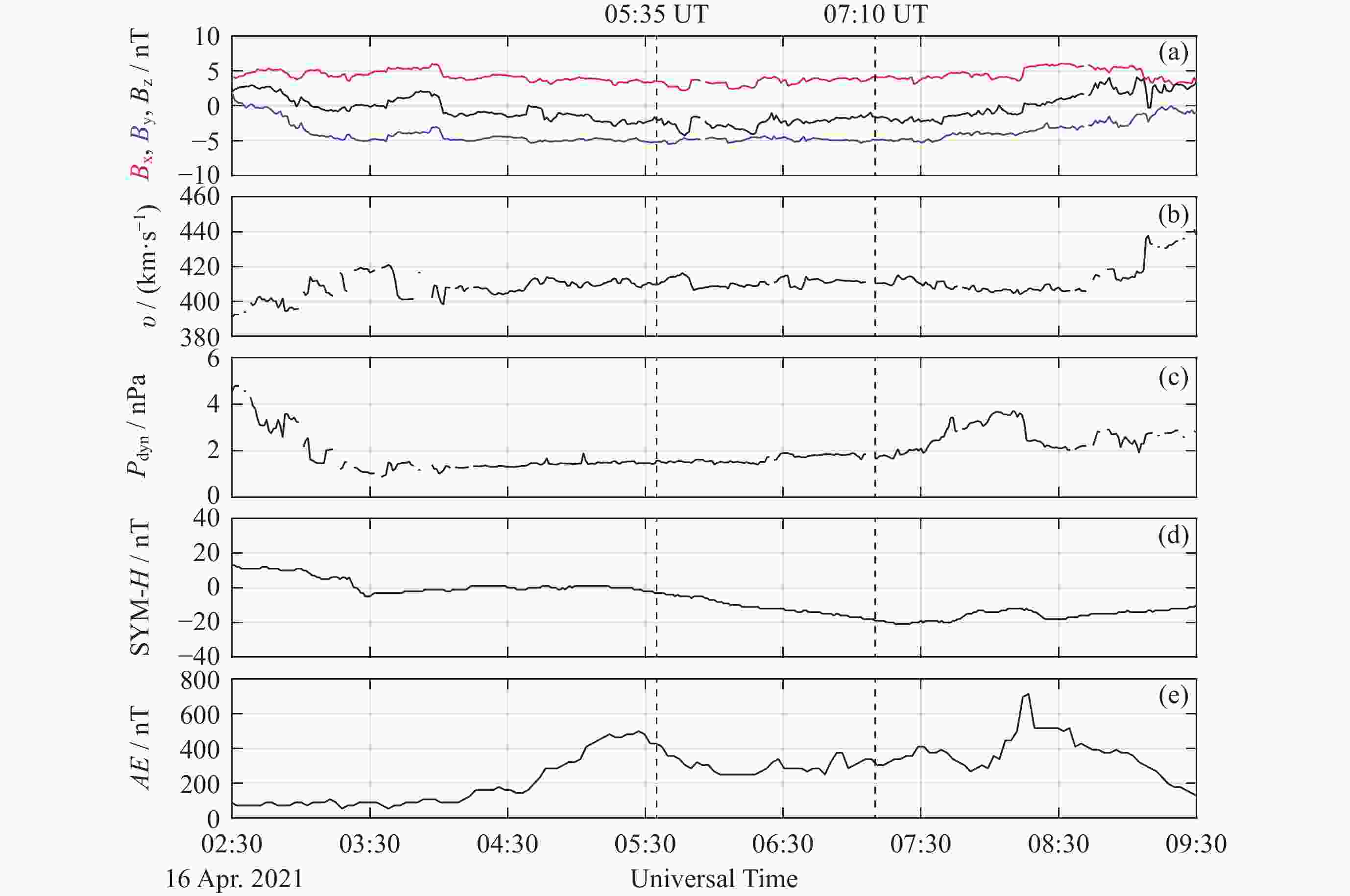
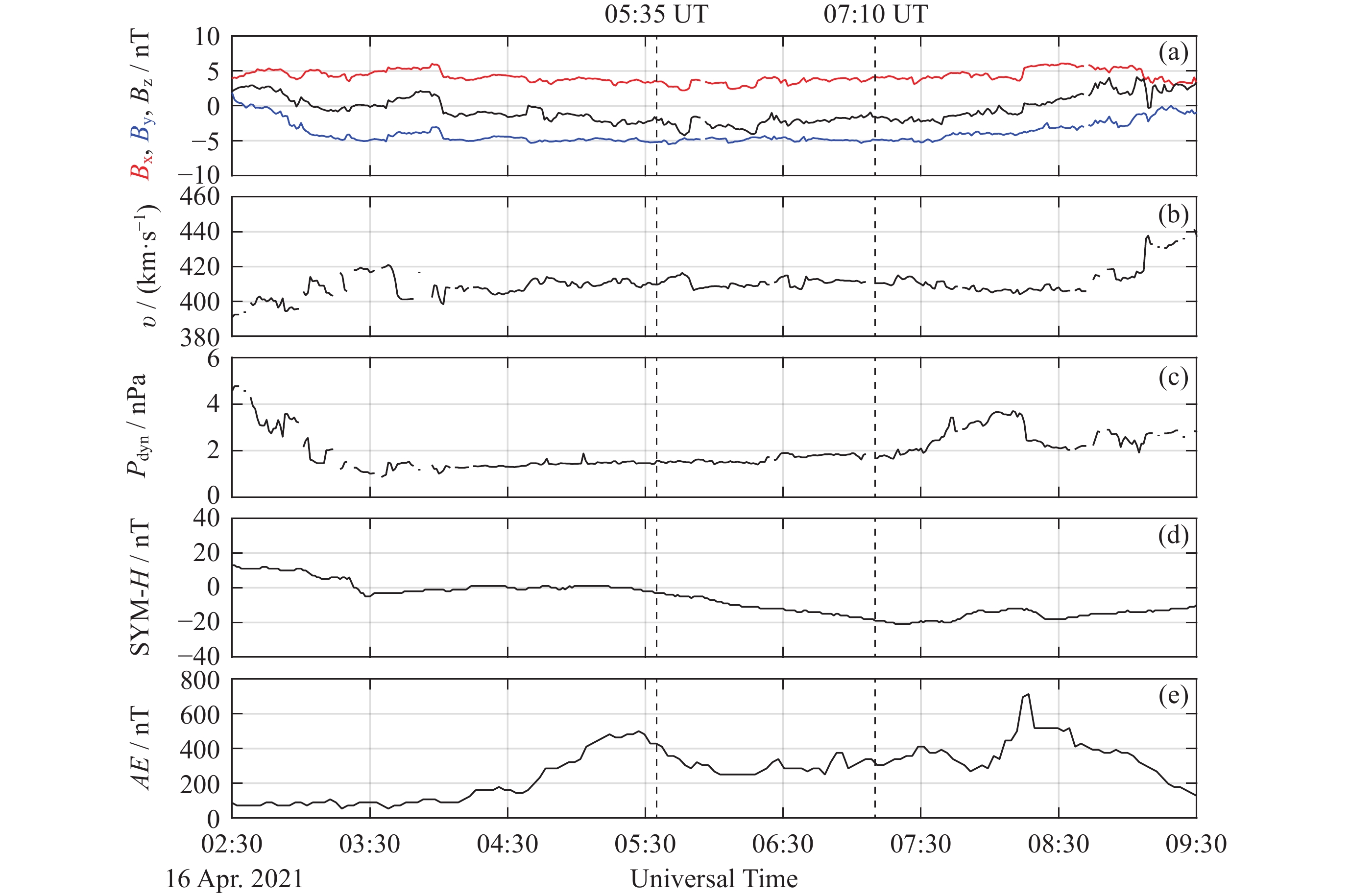
图 1 2021年4月16日02:30-09:30 UT太阳风与地磁条件
Figure 1. Solar wind and geomagnetic conditions from 02:30 to 09:30 UT on 16 April 2021
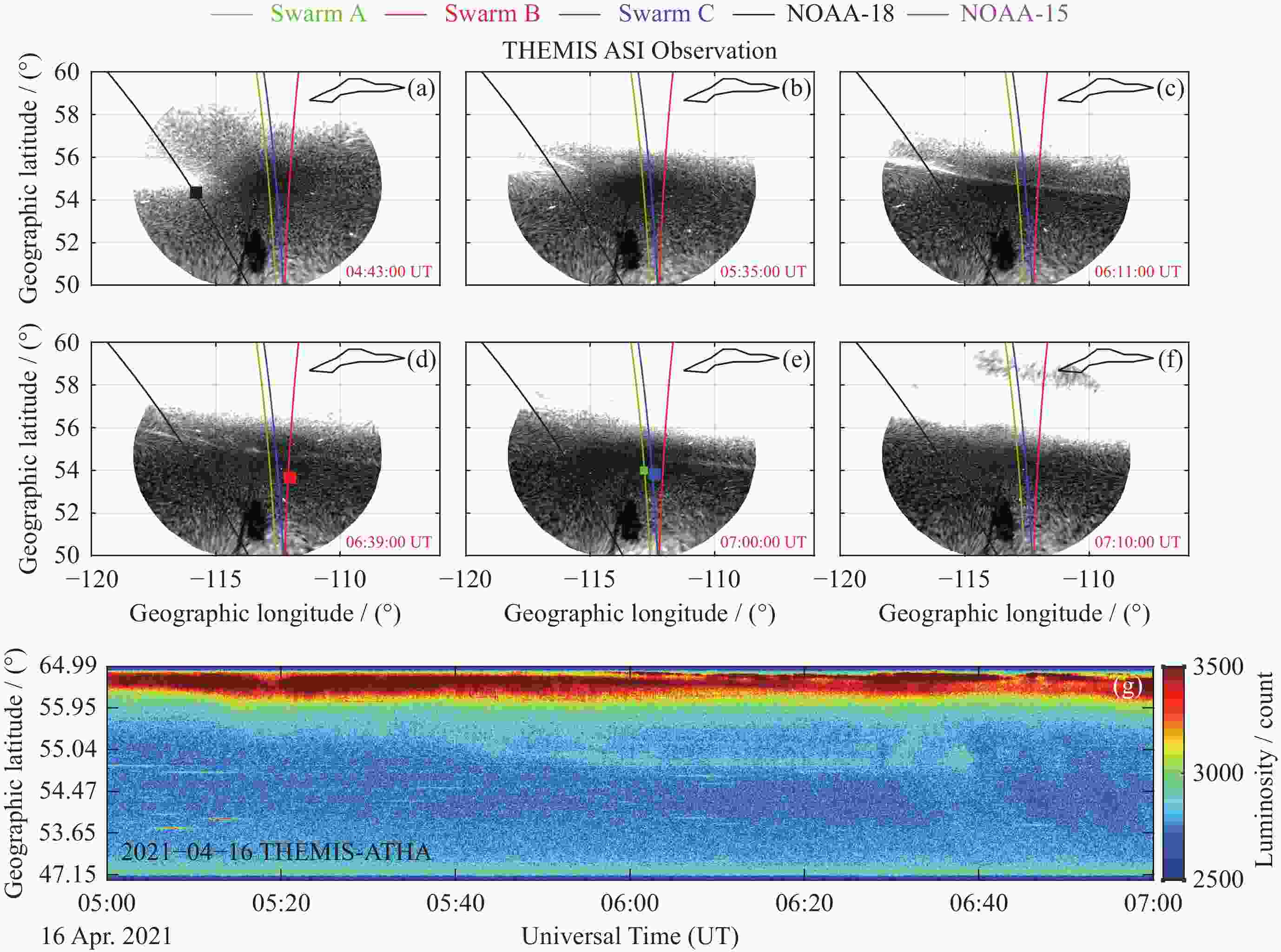
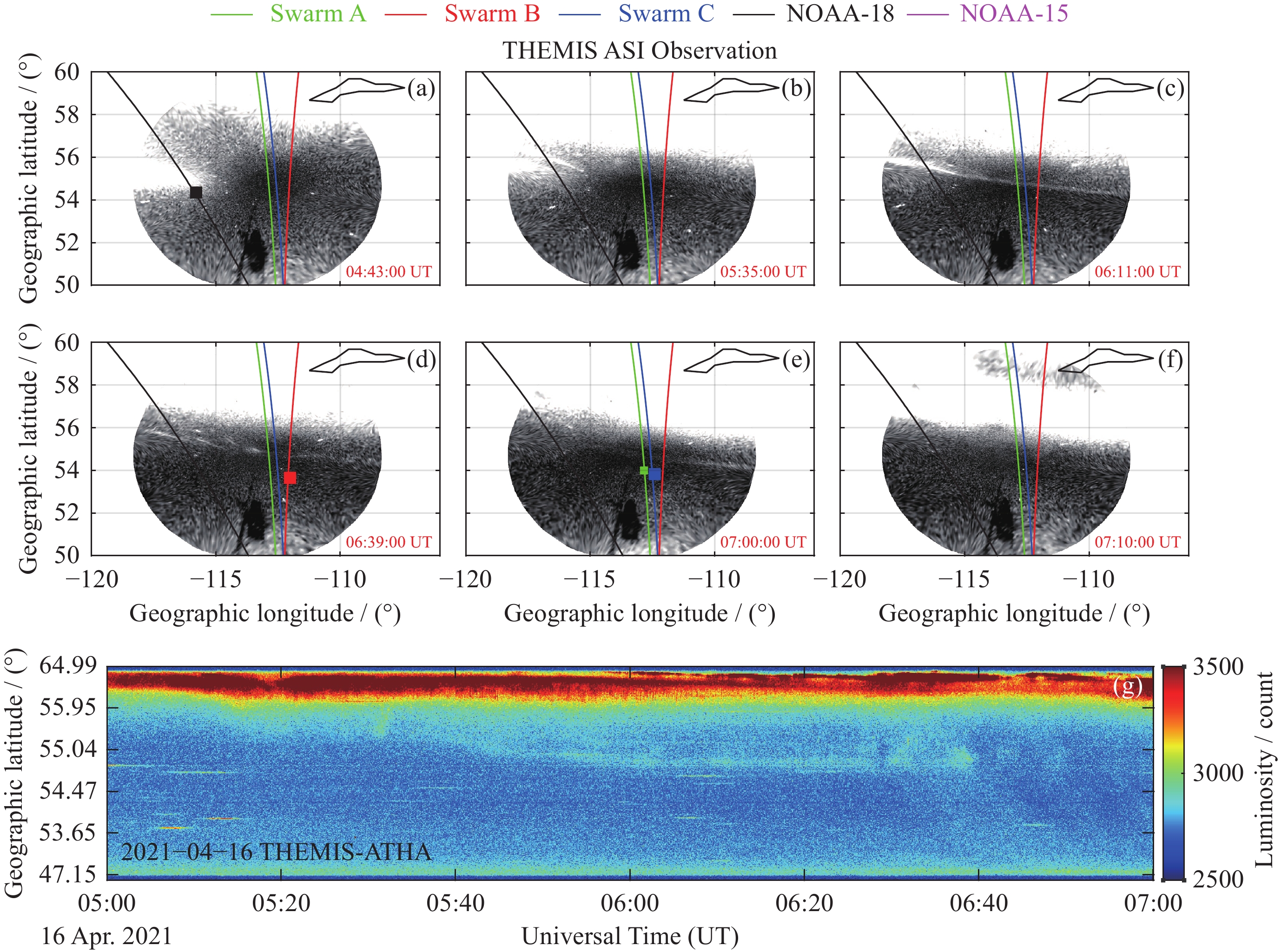
图 2 2021年4月16日THEMIS- ATHA 台站的STEVE观测结果. (a)~(f) STEVE事件随时间演变的轨迹, 叠加了Swarm A, B, C卫星及NOAA 15, 18卫星的足点数据, (g)事件的时间剖面
Figure 2. Observations of the STEVE event from THEMIS-ATHA ASI on 16 April 2021. (a)~(f) Temporal evolution of STEVE overlapped by the foot points of Swarm A, B, C and NOAA 15, 18, (g) Keogram summarizing the event
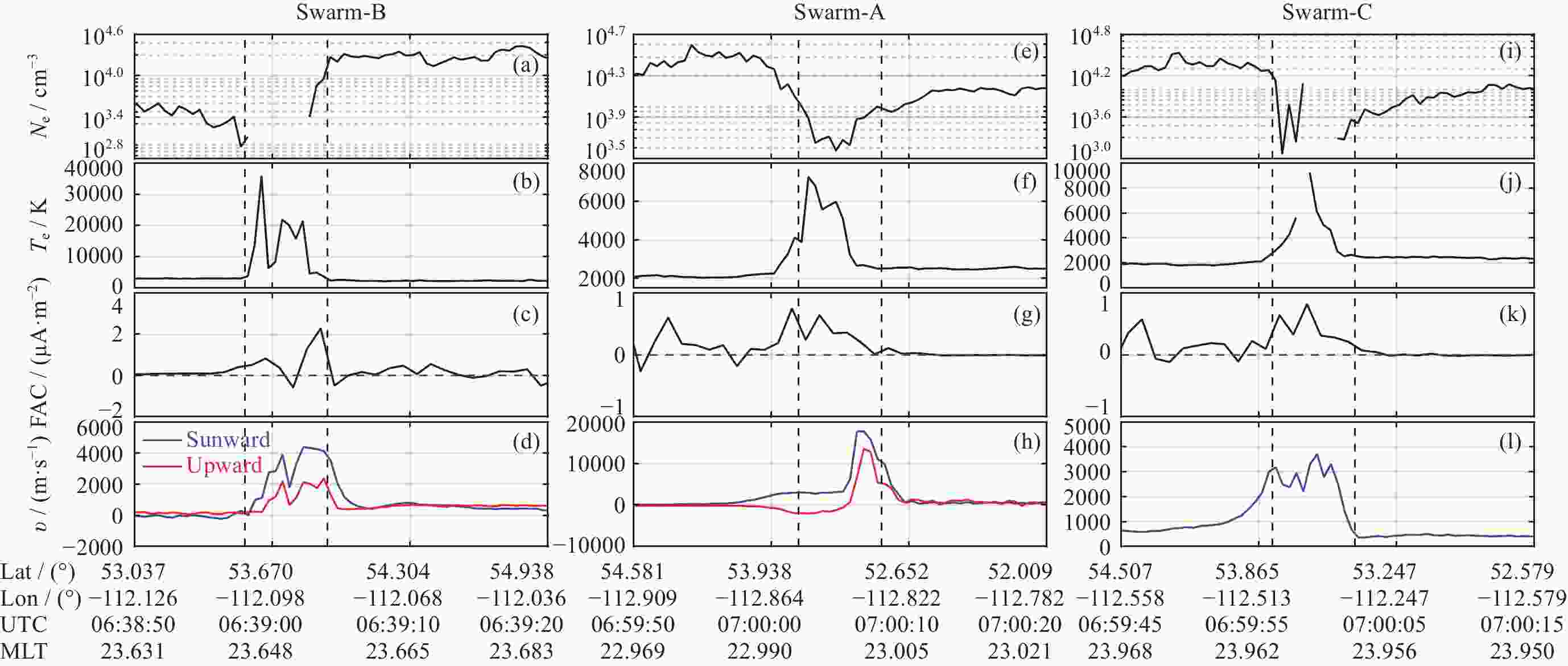
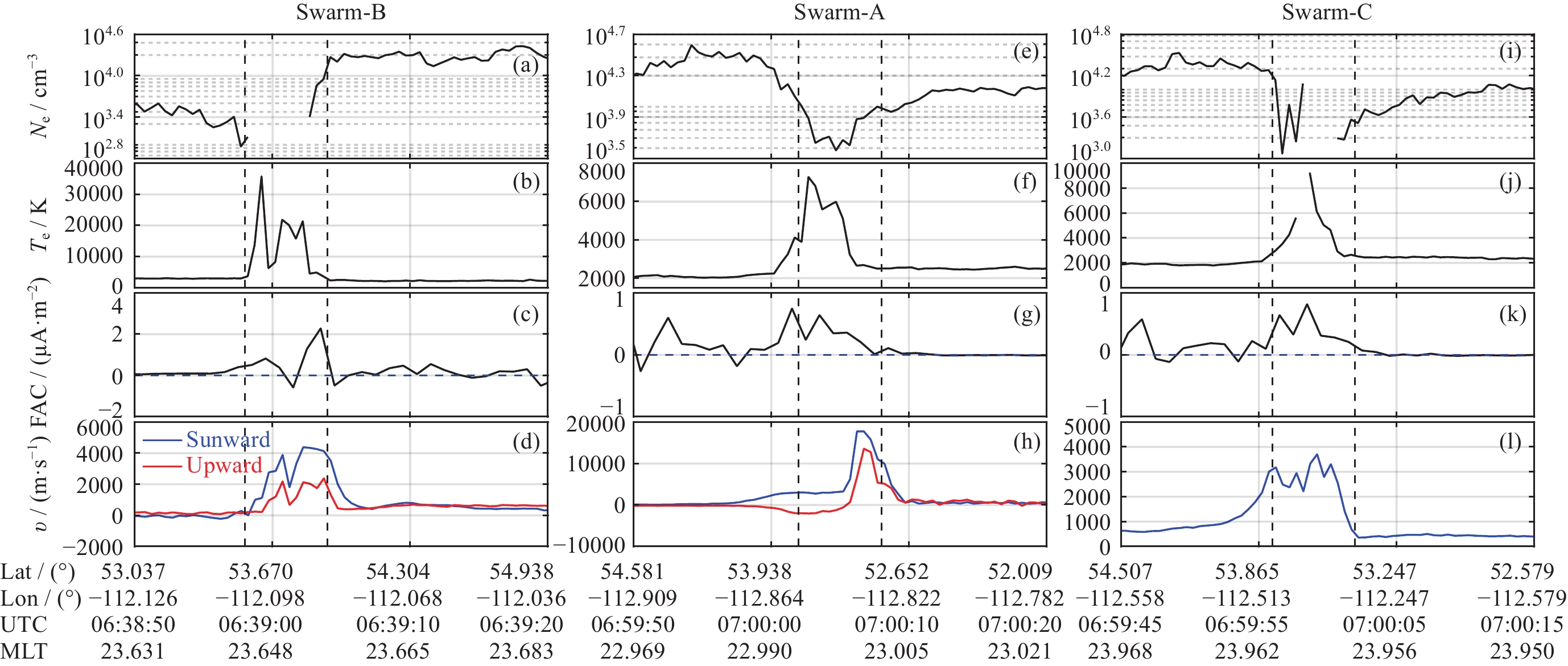
图 3 2021年4月16日STEVE期间Swarm A, B, C卫星的观测数据. (a)(e)(i)电子密度Ne, (b)(f)(j)电子温度Te, (c)(g)(k)场向电流(正向向下), (d)(h)(l)离子在水平方向(蓝色, 正向朝向太阳)和垂直方向(红色, 正向朝上)的跨轨速度
Figure 3. Swarm A, B and C data during the STEVE event on 16 April 2021. (a) (e) (i) Electron density Ne. (b) (f) (j) Electron temperature Te. (c), (g), (k) FAC (positive downward). (d) (h) (l) Ion cross-track velocity in horizontal (in blue, positive sunward) and vertical direction (in red, positive upward)
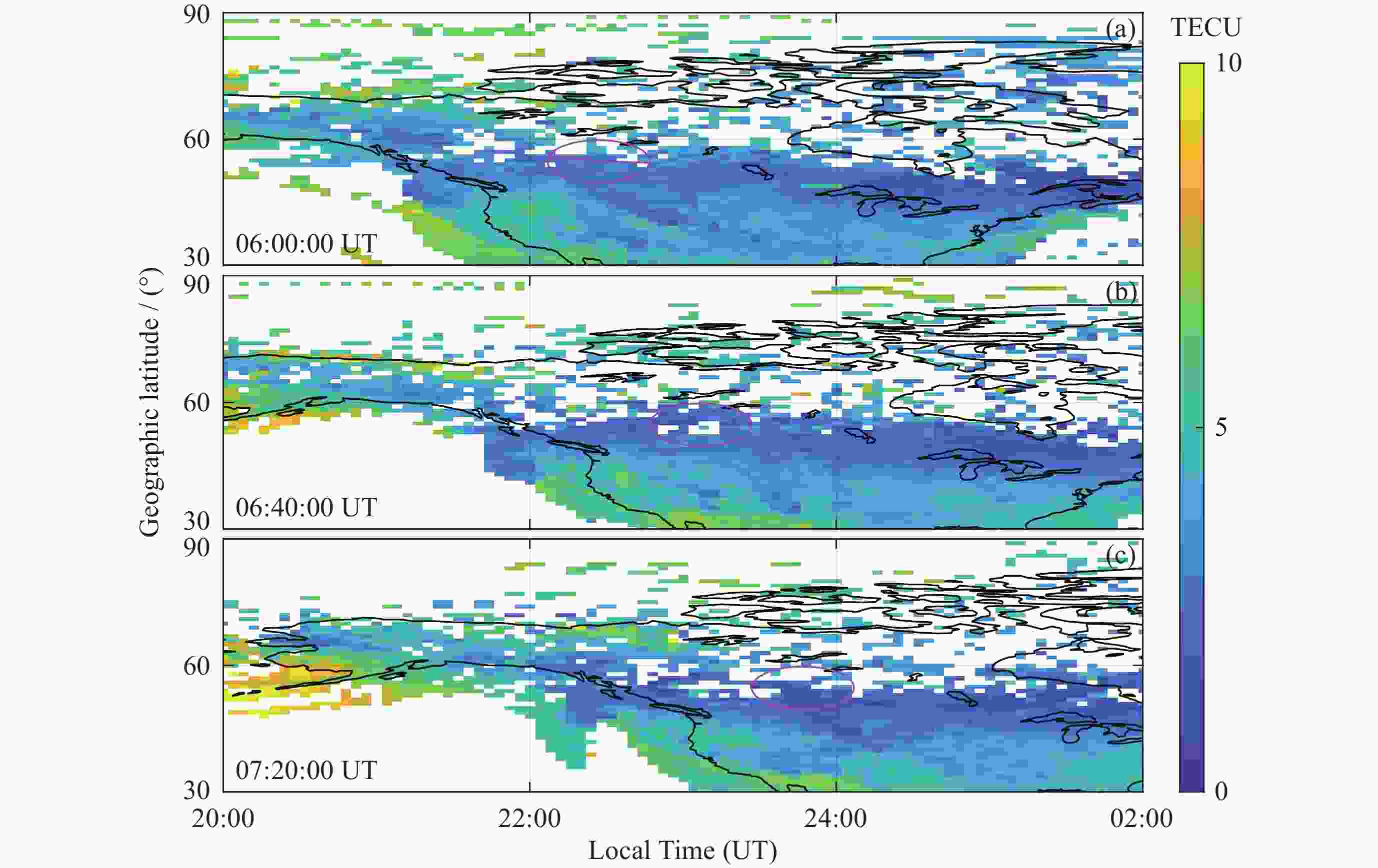
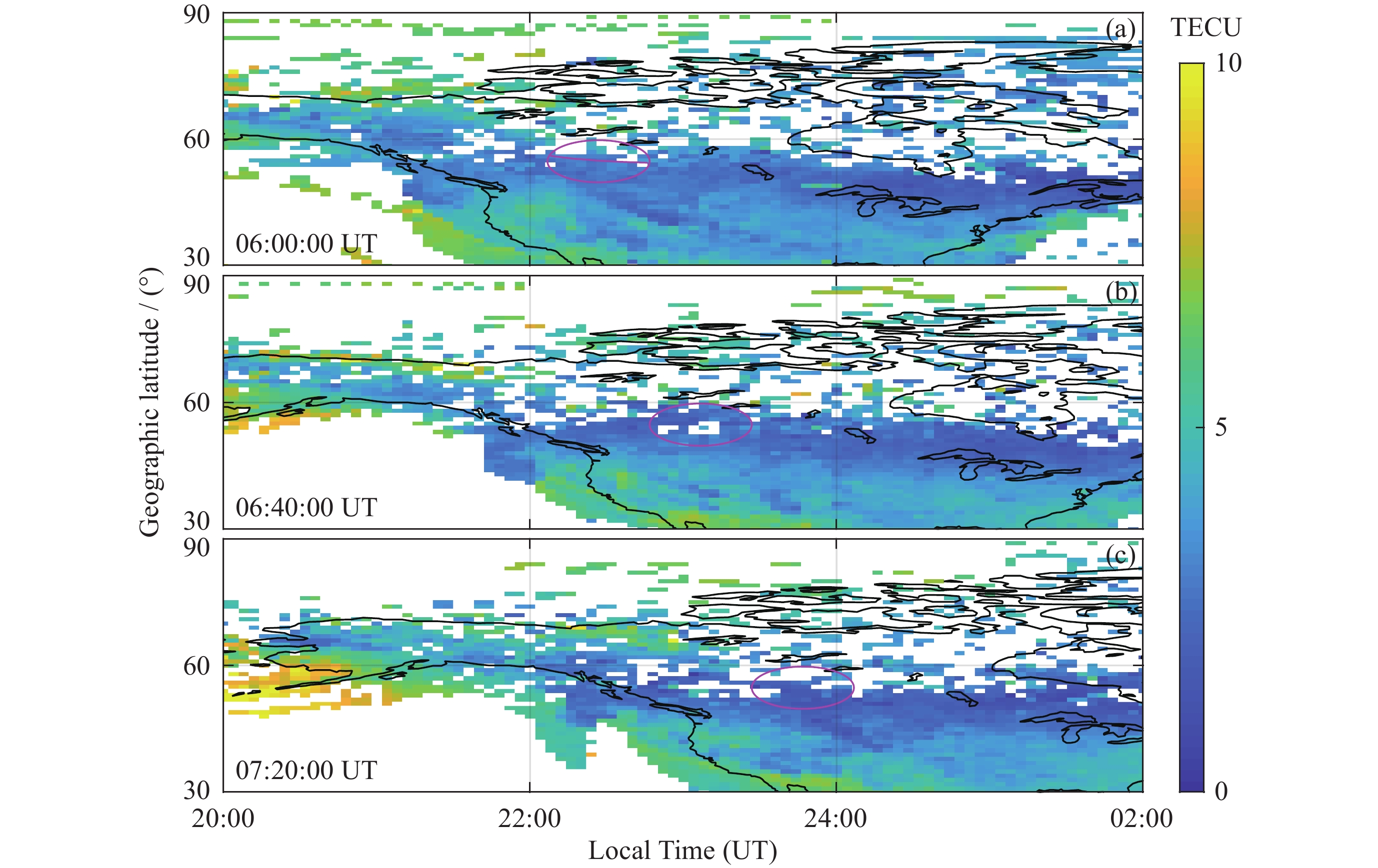
图 4 2021年4月16日地理纬度GLAT(北纬30°―90°)在06:00―07:20 UT下当地时间的GNSS TEC图序列
Figure 4. Sequences of GNSS TEC maps in the coordinates of GLAT (30°―90°N) and local time at 06:00―07:20 UT on 16 April 2021
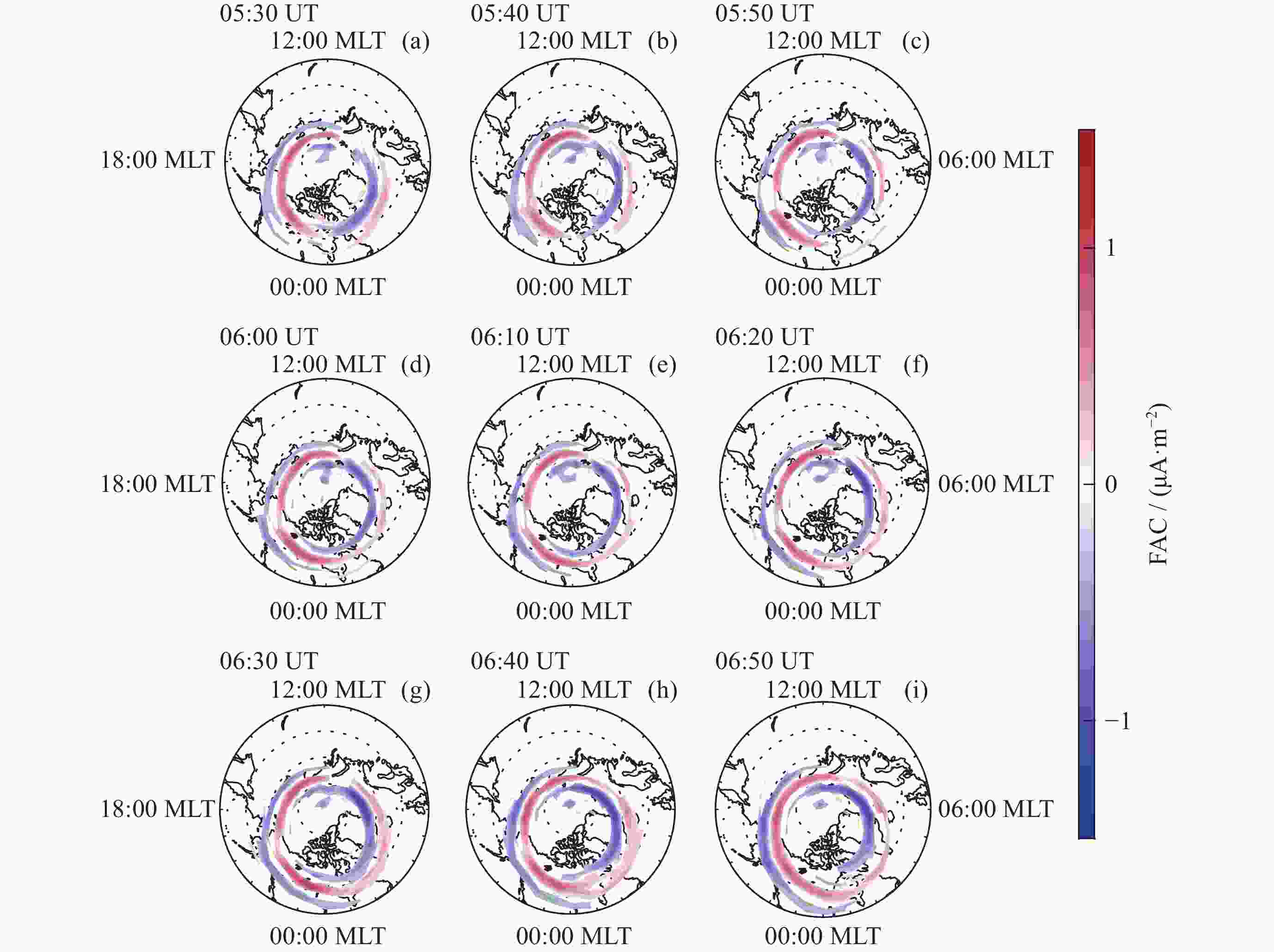
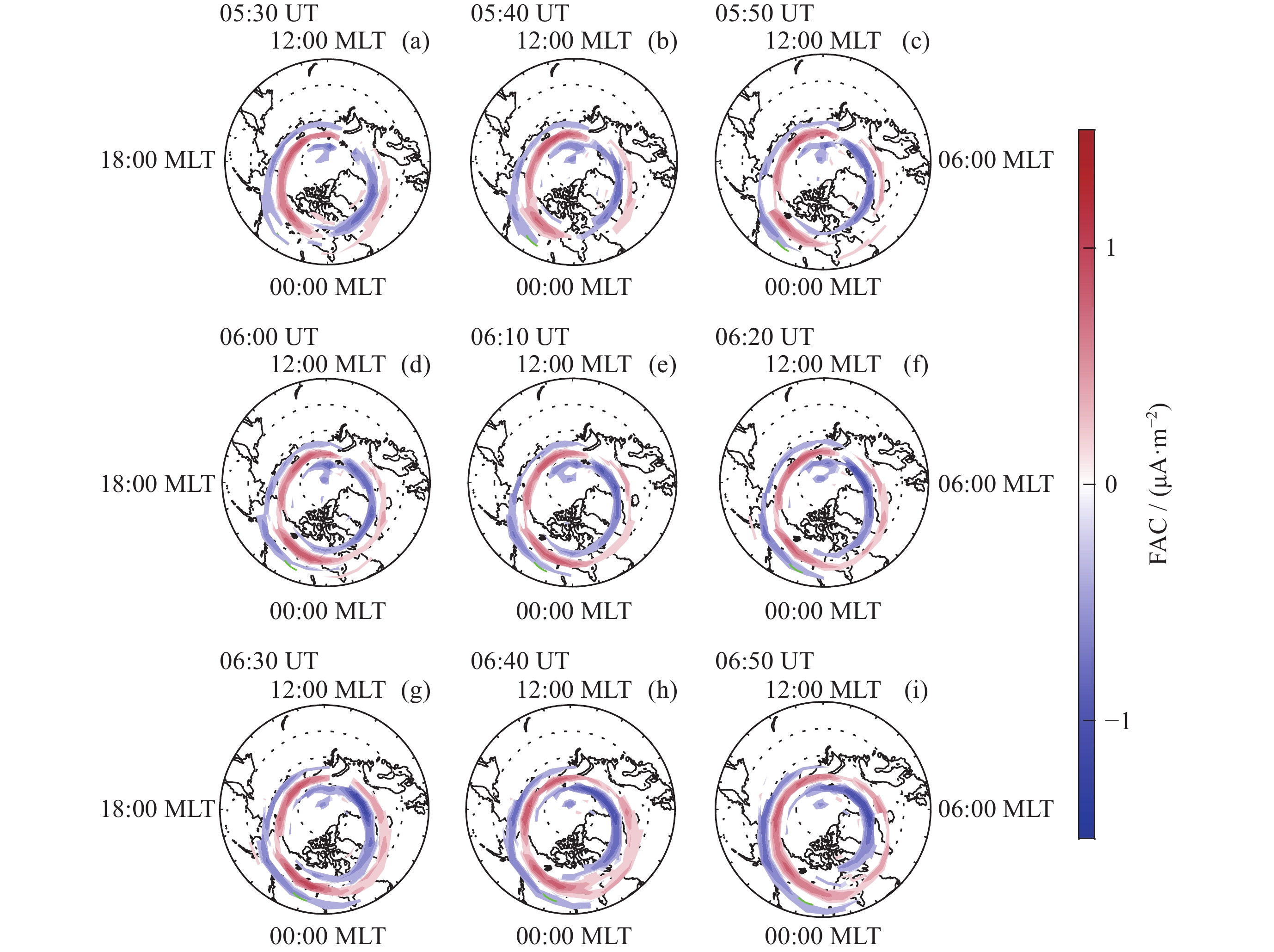
图 5 STEVE事件期间北半球地理坐标下的AMPERE场向电流的分布 (时间范围为05:30-06:50 UT, 以10 min为间隔, 正向为向上)
Figure 5. AMPERE field-aligned currents in a geographic coordinate system during the STEVE event (from 05:30 to 06:50 UT at 10 min intervals, positive upward)
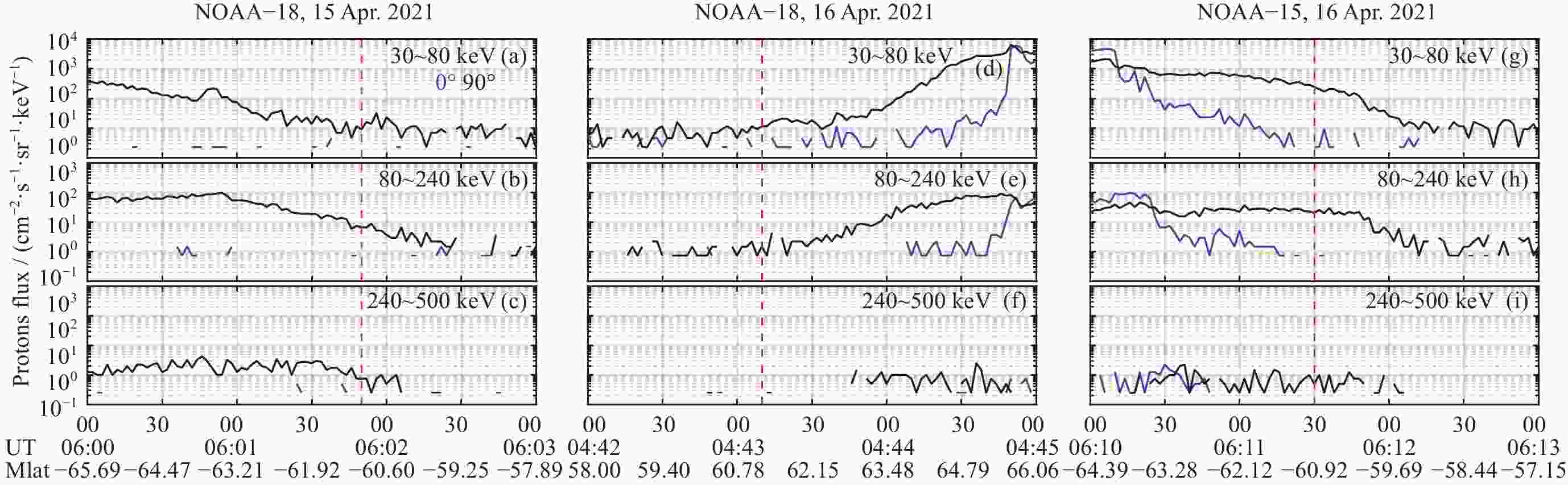
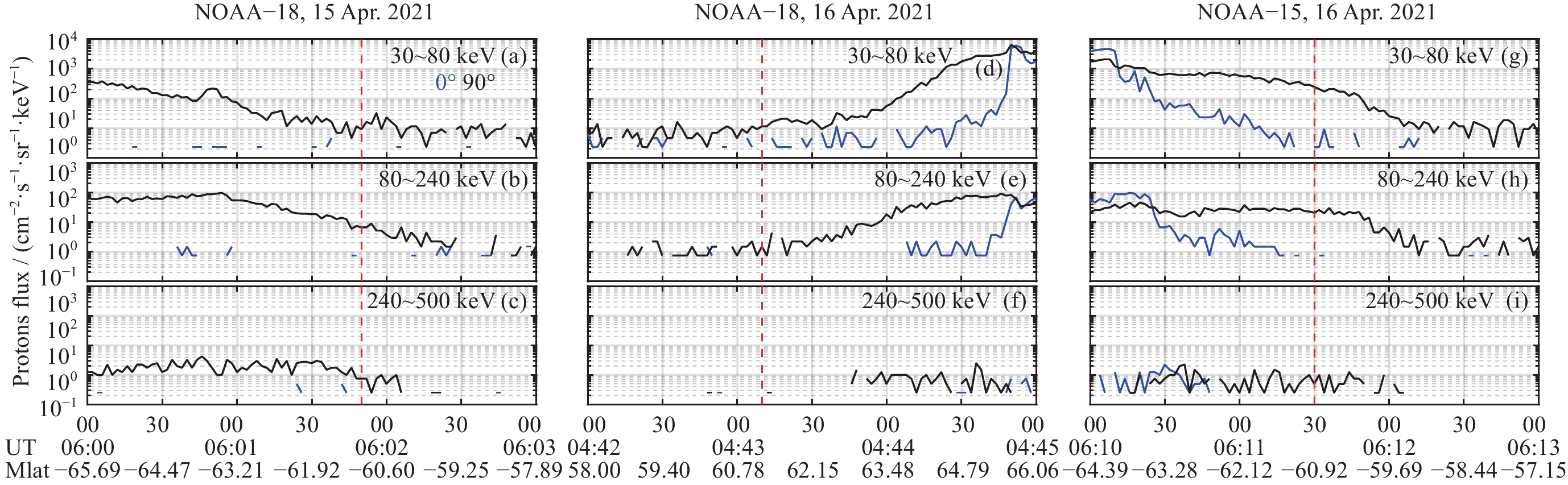
图 6 NOAA 15和NOAA 18卫星的质子能量通量数据. (a)~(c) NOAA 18卫星在参考日的观测数据, (d)~(f) STEVE事件前的观测数据, (g)~(i) STEVE事件期间NOAA 15的观测数据
Figure 6. Proton energy flux from NOAA 15 and 18. (a)-(c) NOAA-18 observations on the refence day, (d)-(f) NOAA 18 observations before the STEVE event, and (g)-(i) NOAA 15 during the STEVE event
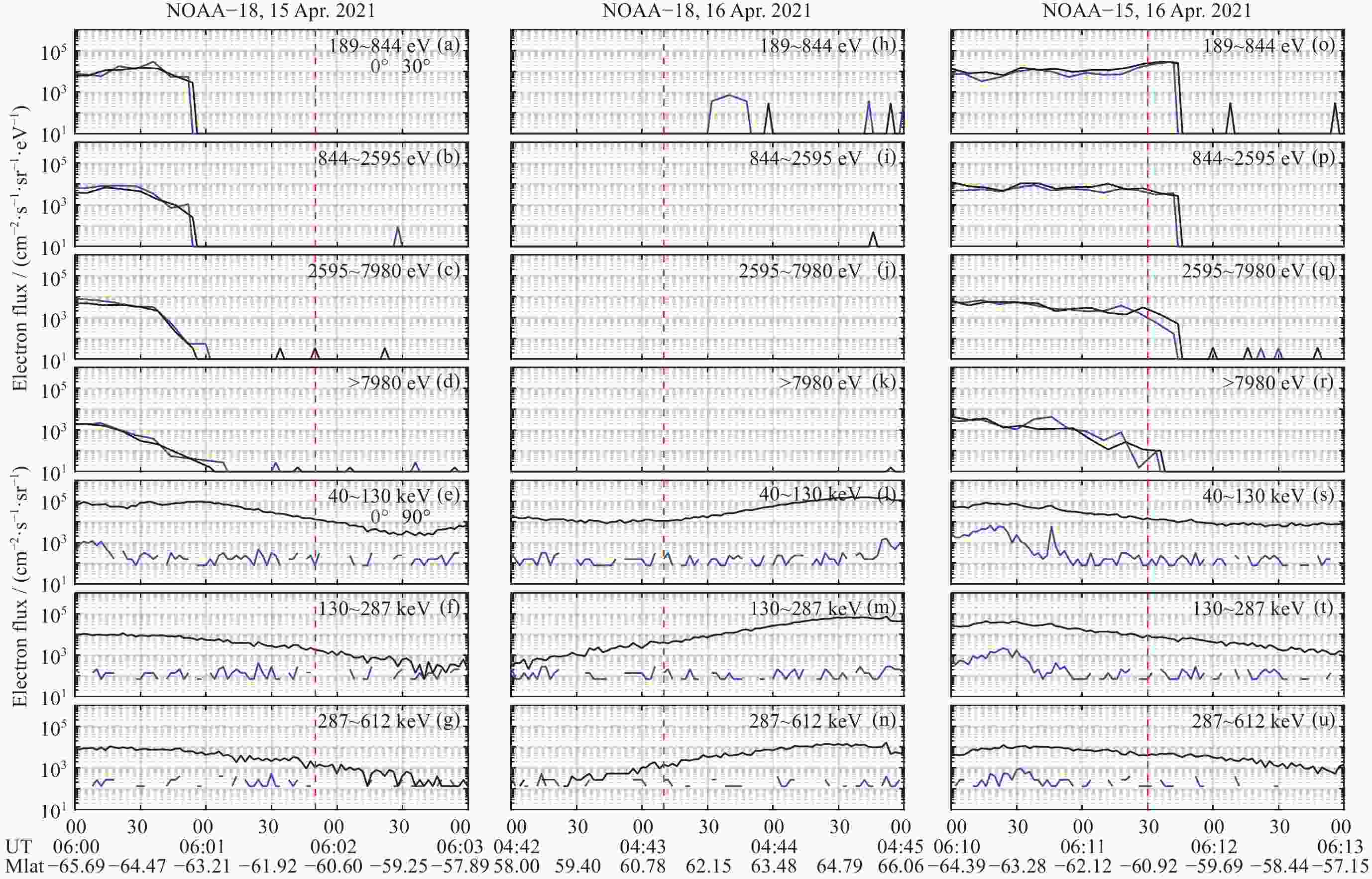
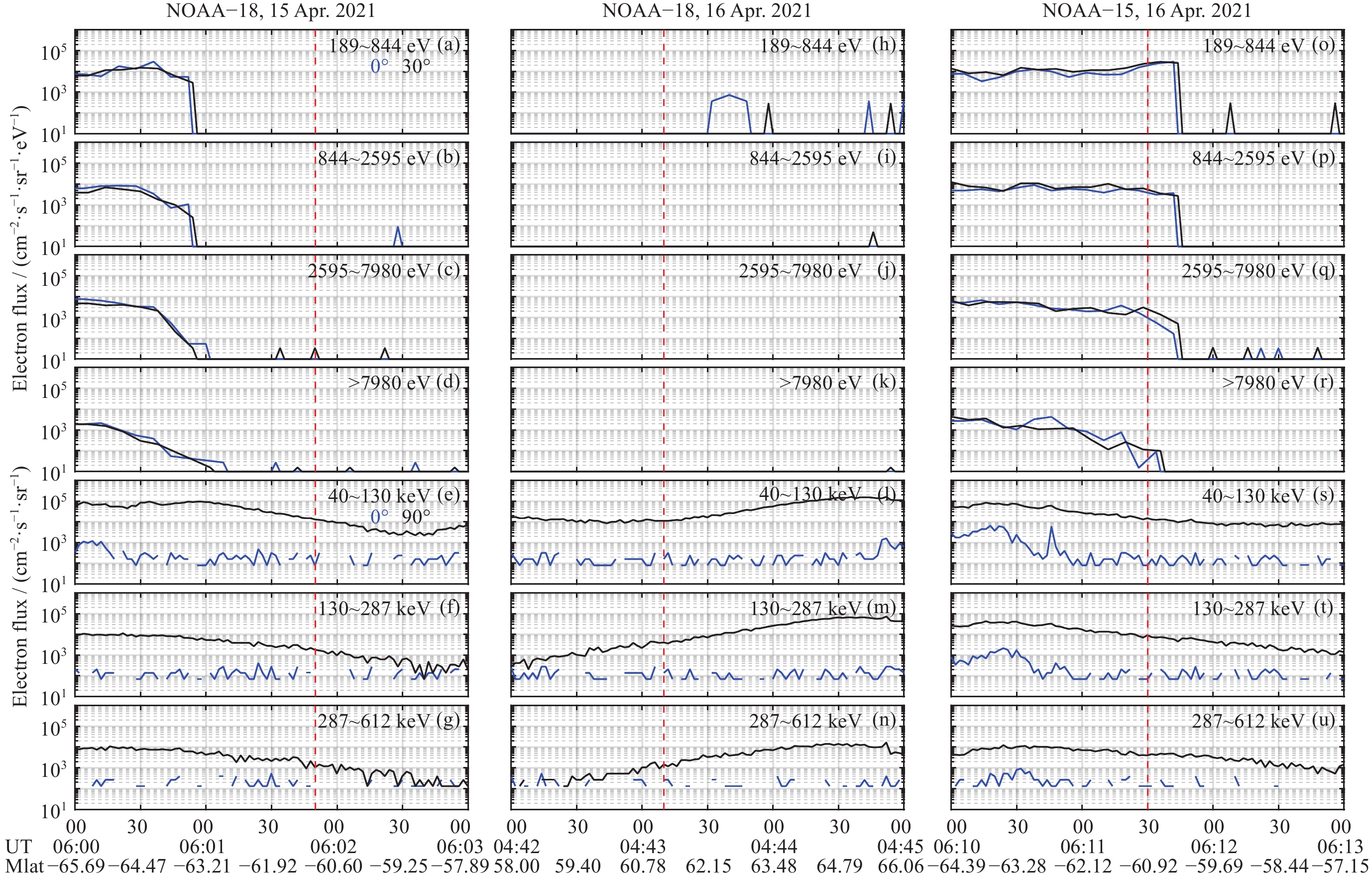
图 7 NOAA 15和NOAA 18卫星的电子能量通量数据. (a)~(g) NOAA 18卫星在参考日的观测数据, (h)~(n) STEVE事件前的观测数据, (o)~(u) STEVE事件期间NOAA 15的观测数据
Figure 7. Electron energy flux from NOAA 15 and 18. (a)~(g) NOAA-18 observations on the refence day, (h) ~(n) NOAA 18 observations before the STEVE event, and (o) ~(u) NOAA 15 during the STEVE event
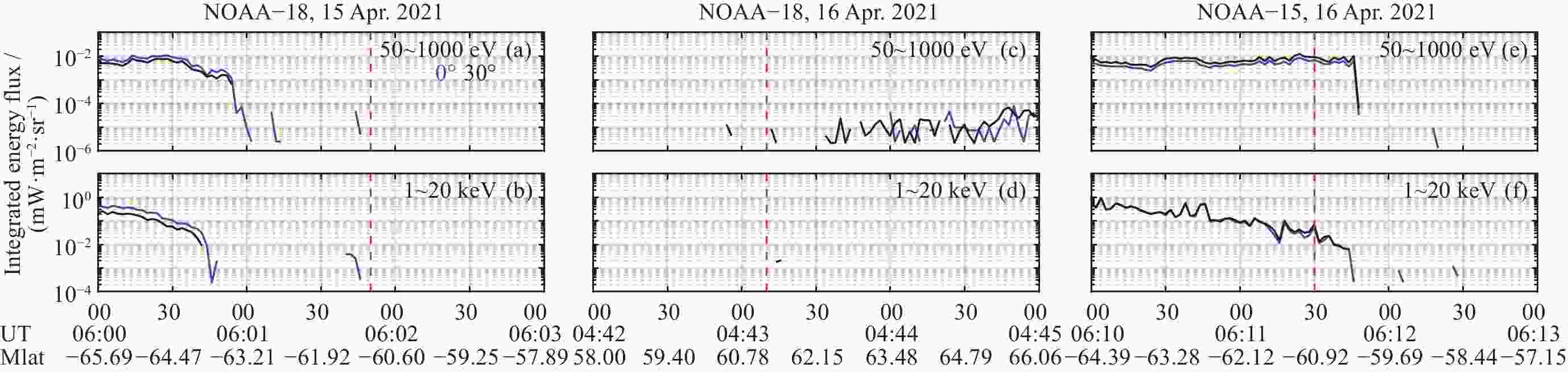
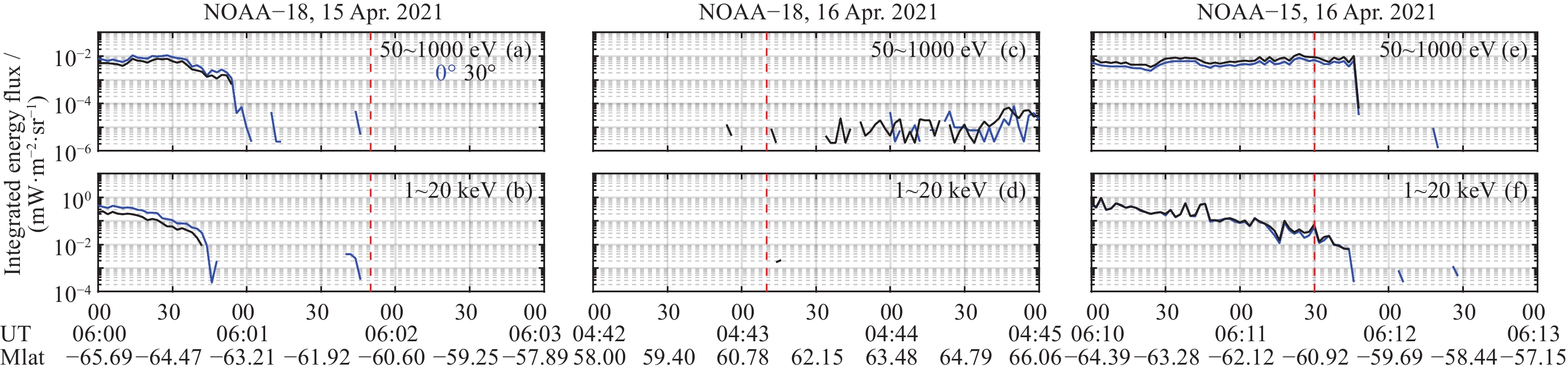
图 8 NOAA 15和NOAA 18卫星的电子积分能量通量数据. (a)(b) NOAA 18卫星在参考日的观测数据, (c)(d) STEVE事件前的观测数据, (e)(f) STEVE事件期间NOAA 15的观测数据
Figure 8. Integrated electron energy flux from NOAA 15 and 18. (a)(b) NOAA-18 observations on the refence day, (c)(d) NOAA 18 observations before the STEVE event, and (e)(f) NOAA 15 during the STEVE event
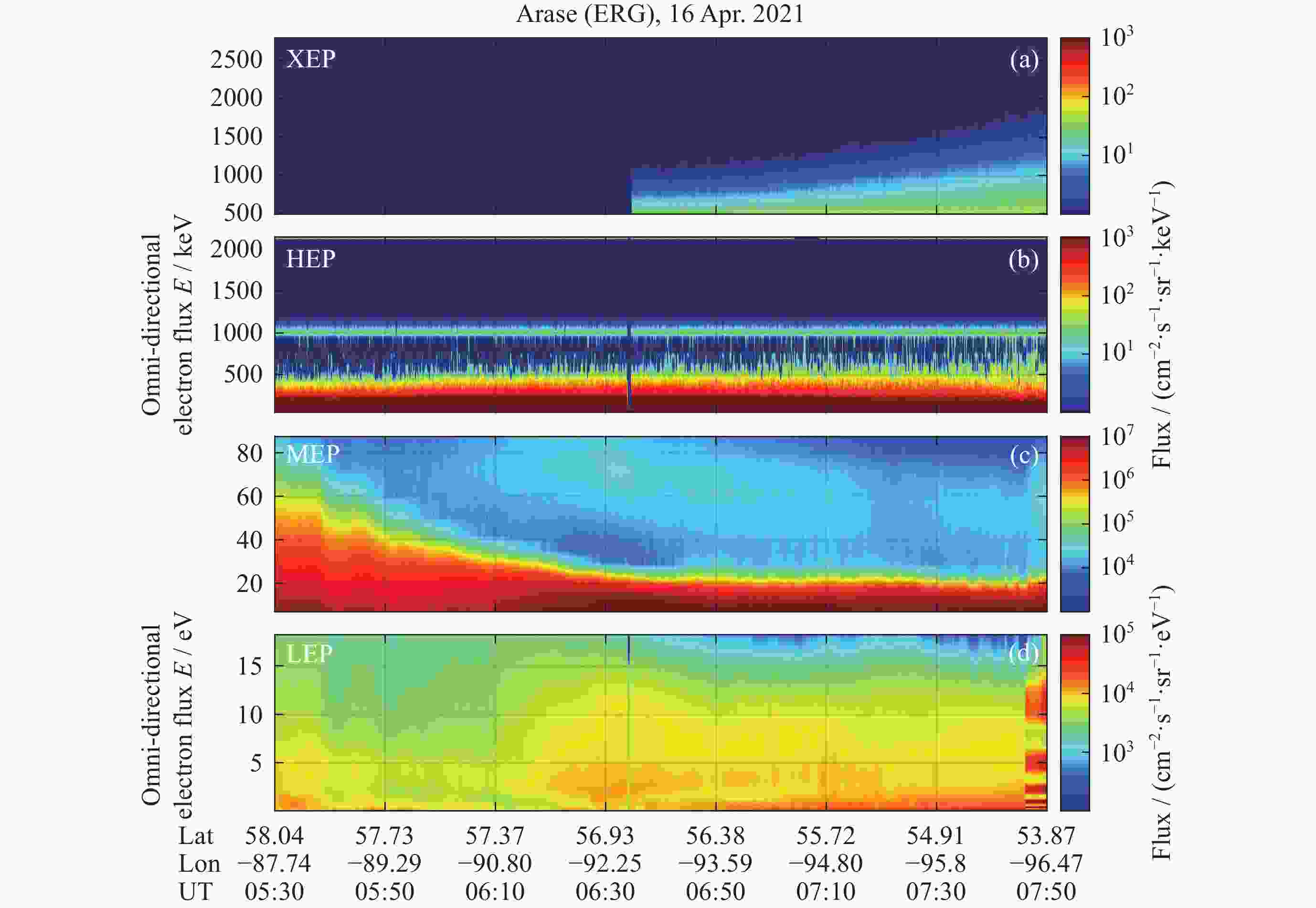
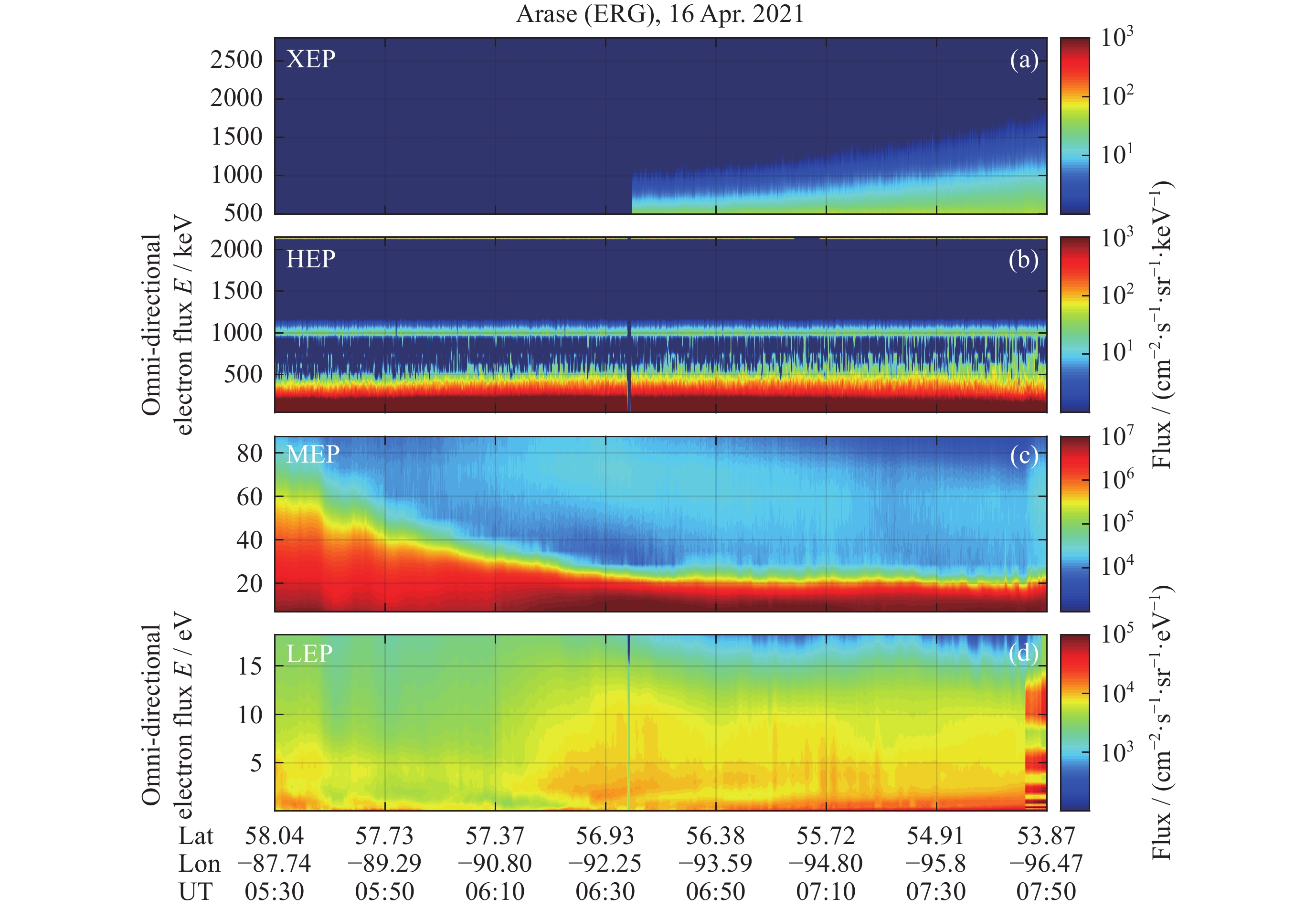
图 9 STEVE事件期间来自Arase(ERG)卫星的电子能量通量
Figure 9. Electron energy flux from Arase (ERG) during the STEVE event
表 1 2018-2022年全天空相机记录的STEVE事件
Table 1. STEVE events from 2018 to 2022
Event Date UT $ {B}_{z} $/nT $ {P}_{\text{dyn}} $/nPa Station start end max min max min 1 2018/4/10 5:09 5:37 4.03 –4.64 3.64 2.27 THEMIS-PINA 2 2018/5/6 4:09 5:02 0.12 –1.86 2.43 1.90 REGO-LUCK 3 2019/2/15 8:10 8:43 1.39 –0.22 1.05 0.63 THEMIS-ATHA 4 2019/5/2 4:48 5:40 2.27 1.22 2.06 1.38 THEMIS-ATHA 5 2019/8/31 6:10 6:45 2.08 –4.06 5.06 3.73 REGO-LUCK 6 2019/9/6 5:20 6:22 1.71 –0.38 1.73 1.44 THEMIS-ATHA 7 2019/10/10 5:50 6:21 3.09 1.00 1.00 2.31 THEMIS-ATHA 8 2020/8/31 3:50 4:45 0.91 –4.10 2.13 1.70 THEMIS-ATHA 9 2021/4/16 5:35 7:10 –0.92 –4.25 1.90 1.40 THEMIS-ATHA 10 2022/4/10 5:05 6:12 –2.66 –14.18 10.99 3.26 REGO-LUCK 11 2022/8/8 6:05 6:48 –1.00 –7.53 3.44 2.43 REGO-LUCK 12 2022/8/30 4:05 4:54 –2.04 –9.54 4.76 2.98 THEMIS-ATHA 13 2022/9/27 2:08 3:00 21.16 6.54 18.50 17.37 REGO-LUCK 注 蓝色标出的是本次研究的事件.  下载: 导出CSV
-
[1] ARCHER W E, MAURICE J P, GALLARDO-LACOURT B, et al. The vertical distribution of the optical emissions of a Steve and picket fence event[J]. Geophysical Research Letters, 2019, 46(19): 10719-10725 doi: 10.1029/2019GL084473 [2] GALLARDO‐LACOURT B, LIANG J, NISHIMURA Y, et al. On the origin of STEVE: particle precipitation or Ionospheric Skyglow?[J]. Geophysical Research Letters, 2018, 45(16): 7968-7973 doi: 10.1029/2018GL078509 [3] GALLARDO‐LACOURT B, NISHIMURA Y, DONOVAN E, et al. A statistical analysis of STEVE[J]. Journal of Geophysical Research: Space Physics, 2018, 123(11): 9893-9905 doi: 10.1029/2018JA025368 [4] NISHIMURA Y, DYER A, KANGAS L, et al. Unsolved problems in Strong Thermal Emission Velocity Enhancement (STEVE) and the picket fence[J]. Frontiers in Astronomy and Space Sciences, 2023, 10: 1087974 doi: 10.3389/fspas.2023.1087974 [5] MACDONALD E A, DONOVAN E, NISHIMURA Y, et al. New science in plain sight: citizen scientists lead to the discovery of optical structure in the upper atmosphere[J]. Science Advances, 2018, 4(3): eaaq0030 doi: 10.1126/sciadv.aaq0030 [6] NISHIMURA Y, DONOVAN E F, ANGELOPOULOS V, et al. Dynamics of auroral precipitation boundaries associated with STEVE and SAID[J]. Journal of Geophysical Research: Space Physics, 2020, 125(8): e2020JA028067 doi: 10.1029/2020JA028067 [7] ARCHER W E, GALLARDO‐LACOURT B, PERRY G W, et al. Steve: the optical signature of intense subauroral ion drifts[J]. Geophysical Research Letters, 2019, 46(12): 6279-6286 doi: 10.1029/2019GL082687 [8] NISHIMURA Y, GALLARDO‐LACOURT B, ZOU Y, et al. Magnetospheric signatures of STEVE: implications for the magnetospheric energy source and interhemispheric conjugacy[J]. Geophysical Research Letters, 2019, 46(11): 5637-5644 doi: 10.1029/2019GL082460 [9] ANDERSON P C, HANSON W B, HEELIS R A, et al. A proposed production model of rapid subauroral ion drifts and their relationship to substorm evolution[J]. Journal of Geophysical Research: Space Physics, 1993, 98(A4): 6069-6078 doi: 10.1029/92JA01975 [10] LIANG J, ST‐MAURICE J P, DONOVAN E. A time-dependent two-dimensional model simulation of lower ionospheric variations under intense SAID[J]. Journal of Geophysical Research: Space Physics, 2021, 126(12): e2021JA029756 doi: 10.1029/2021JA029756 [11] LIU J, WANG W B, OPPENHEIM M, et al. Anomalous electron heating effects on the E region ionosphere in TIEGCM[J]. Geophysical Research Letters, 2016, 43(6): 2351-2358 doi: 10.1002/2016GL068010 [12] CHU X N, MALASPINA D, GALLARDO‐LACOURT B, et al. Identifying STEVE’s magnetospheric driver using conjugate observations in the magnetosphere and on the ground[J]. Geophysical Research Letters, 2019, 46(22): 12665-12674 doi: 10.1029/2019GL082789 [13] GASQUE L C, JANALIZADEH R, HARDING B J, et al. It’s not easy being green: kinetic modeling of the emission spectrum observed in STEVE’s picket fence[J]. Geophysical Research Letters, 2023, 50(21): e2023GL106073 doi: 10.1029/2023GL106073 [14] GALLARDO‐LACOURT B, NISHIMURA Y, KEPKO L, et al. Unexpected STEVE Observations at high latitude during quiet geomagnetic conditions[J]. Geophysical Research Letters, 2024, 51(19): e2024GL110568 doi: 10.1029/2024GL110568 [15] NISHIMURA Y, GALLARDO-LACOURT B, DONOVAN E F, et al. Auroral and magnetotail dynamics during quiet-time STEVE and SAID[J]. Journal of Geophysical Research: Space Physics, 2024, 129(11): e2024JA032941 doi: 10.1029/2024JA032941 [16] MENDE S B, HARRIS S E, FREY H U, et al. The THEMIS array of ground-based observatories for the study of Auroral Substorms[J]. Space Science Reviews, 2008, 141(1/2/3/4): 357-387 [17] DONOVAN E, MENDE S, JACKEL B, et al. The THEMIS all-sky imaging array—system design and initial results from the prototype imager[J]. Journal of Atmospheric and Solar-Terrestrial Physics, 2006, 68(13): 1472-1487 doi: 10.1016/j.jastp.2005.03.027 [18] LIANG J, DONOVAN E, JACKEL B, et al. On the 630 nm red‐line pulsating aurora: red‐line emission geospace observatory observations and model simulations[J]. Journal of Geophysical Research: Space Physics, 2016, 121(8): 7988-8012 doi: 10.1002/2016JA022901 [19] RIDEOUT W, COSTER A. Automated GPS processing for global total electron content data[J]. GPS Solutions, 2006, 10(3): 219-228 doi: 10.1007/s10291-006-0029-5 [20] OLSEN N, FRIIS-CHRISTENSEN E, FLOBERGHAGEN R, et al. The swarm Satellite Constellation Application and Research Facility (SCARF) and swarm data products[J]. Earth, Planets and Space, 2013, 65(11): 1189-1200 doi: 10.5047/eps.2013.07.001 [21] KNIPP D J, MATSUO T, KILCOMMONS L, et al. Comparison of magnetic perturbation data from LEO satellite constellations: statistics of DMSP and AMPERE[J]. Space Weather, 2014, 12(1): 2-23 doi: 10.1002/2013SW000987 [22] KORTH H, ANDERSON B J, WATERS C L. Statistical analysis of the dependence of large-scale Birkeland currents on solar wind parameters[J]. Annales Geophysicae, 2010, 28(2): 515-530 doi: 10.5194/angeo-28-515-2010 [23] EVANS D S, GREER M S. Polar Orbiting Environmental Satellite Space Environment Monitor - 2 : Instrument Descriptions and Archive Data Documentation[EB/OL]. (2000) [24] MIYOSHI Y, SHINOHARA I, TAKASHIMA T, et al. Geospace exploration project ERG[J]. Earth, Planets and Space, 2018, 70(1): 101 doi: 10.1186/s40623-018-0862-0 [25] HIGASHIO N, TAKASHIMA T, SHINOHARA I, et al. The extremely high-energy electron experiment (XEP) onboard the Arase (ERG) satellite[J]. Earth, Planets and Space, 2018, 70(1): 134 doi: 10.1186/s40623-018-0901-x [26] MITANI T, TAKASHIMA T, KASAHARA S, et al. High-energy electron experiments (HEP) aboard the ERG (Arase) satellite[J]. Earth, Planets and Space, 2018, 70(1): 77 doi: 10.1186/s40623-018-0853-1 [27] KASAHARA S, YOKOTA S, MITANI T, et al. Medium-energy particle experiments—electron analyzer (MEP-e) for the exploration of energization and radiation in geospace (ERG) mission[J]. Earth, Planets and Space, 2018, 70(1): 69 doi: 10.1186/s40623-018-0847-z [28] ASAMURA K, KAZAMA Y, YOKOTA S, et al. Low-Energy Particle experiments–ion mass analyzer (LEPi) onboard the ERG (Arase) satellite[J]. Earth, Planets and Space, 2018, 70(1): 70 doi: 10.1186/s40623-018-0846-0 [29] MOFFETT R J, QUEGAN S. The mid-latitude trough in the electron concentration of the ionospheric F-layer: a review of observations and modelling[J]. Journal of Atmospheric and Terrestrial Physics, 1983, 45(5): 315-343 doi: 10.1016/S0021-9169(83)80038-5 [30] FOSTER J C, VO H B. Average characteristics and activity dependence of the subauroral polarization stream[J]. Journal of Geophysical Research: Space Physics, 2002, 107(A12): SIA 16-1-SIA 16-10 [31] KNUDSEN D J, BURCHILL J K, BUCHERT S C, et al. Thermal ion imagers and Langmuir probes in the Swarm electric field instruments[J]. Journal of Geophysical Research: Space Physics, 2017, 122(2): 2655-2673 doi: 10.1002/2016JA022571 [32] TAKAGI Y, SHIOKAWA K, OTSUKA Y, et al. Statistical analysis of SAR ARC detachment from the main oval based on 11‐Year, All‐Sky Imaging observation at Athabasca, Canada[J]. Geophysical Research Letters, 2018, 45(21): 11539-11546 doi: 10.1029/2018gl079615 [33] MOFFETT R J, ENNIS A E, BAILEY G J, et al. Electron temperatures during rapid subauroral ion drift events[J]. Annales Geophysicae, 1998, 16(4): 450-459 doi: 10.1007/s00585-998-0450-x [34] WANG W B, TALAAT E R, BURNS A G, et al. Thermosphere and ionosphere response to Subauroral Polarization Streams (SAPS): Model simulations[J]. Journal of Geophysical Research: Space Physics, 2012, 117(A7): A07301 [35] LIU J, WANG W B, BURNS A, et al. Relative importance of horizontal and vertical transports to the formation of ionospheric storm‐enhanced density and polar tongue of ionization[J]. Journal of Geophysical Research: Space Physics, 2016, 121(8): 8121-8133 doi: 10.1002/2016JA022882 [36] LI S H, LIU J, WANG W B, et al. Impacts of subauroral polarization streams on Storm-Enhanced density plume and consequently on polar tongue of ionization[J]. Earth and Space Science, 2023, 10(9): e2023EA002827 doi: 10.1029/2023EA002827 -
-

 下载:
下载:

计量
- 文章访问数: 1019
- HTML全文浏览量: 101
- PDF下载量: 155
-
被引次数:
0(来源:Crossref)
0(来源:其他)

