


Polar Cap Potential Saturation and Ionospheric Convection Patterns during Superstorms
doi: 10.11728/cjss2026.05.2025-0223 cstr: 32142.14.cjss.2025-0223
-
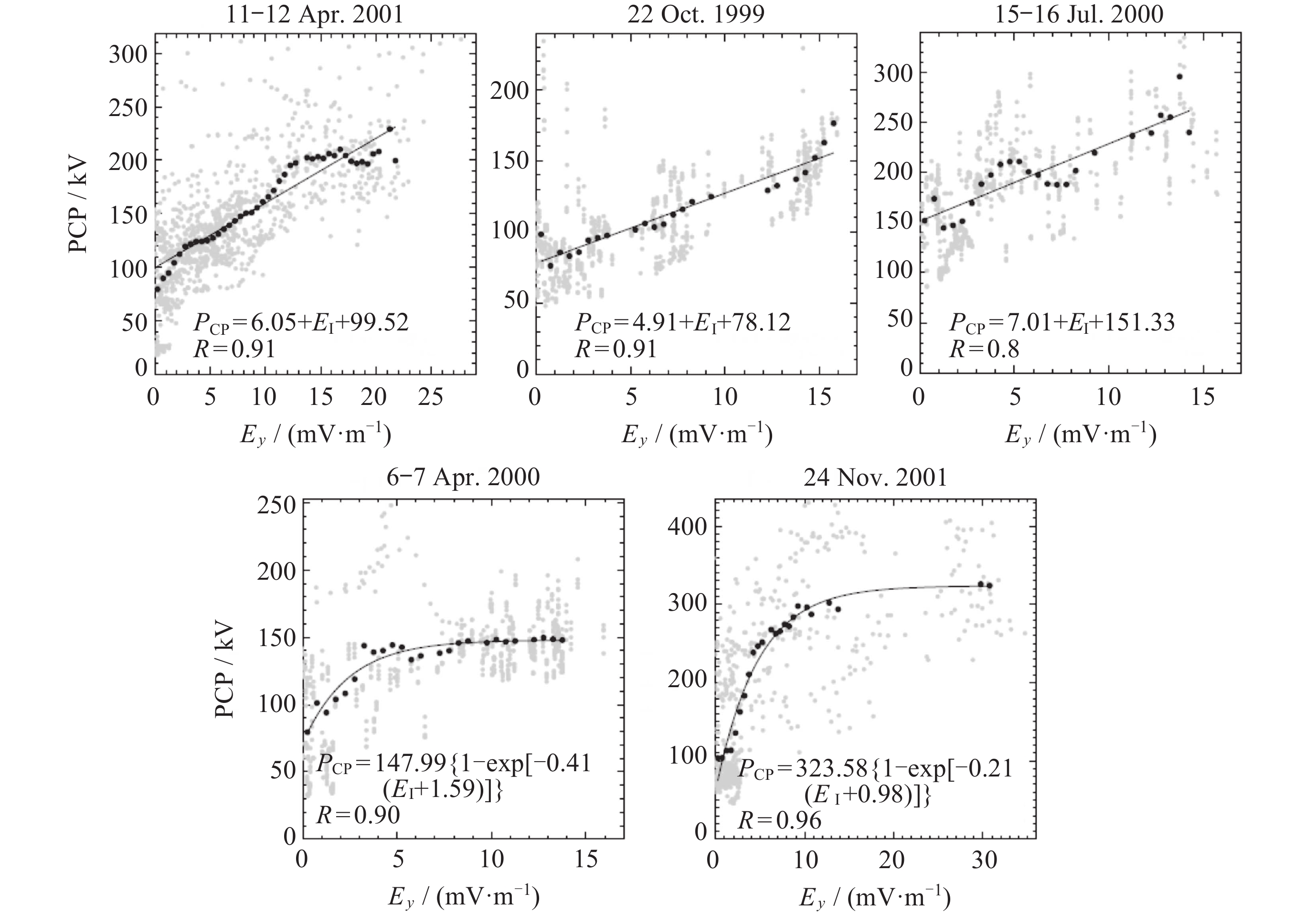
Abstract: Five super intense magnetic storms (with minimum Dst < −200 nT) were examined to investigate the relationship between Polar Cap Potential (PCP) saturation and ionospheric convection patterns. A quantitative method was used to determine whether or not PCP was saturated by applying both linear and nonlinear (exponential) fits for each event. The results showed that PCP saturation occurred for two of five. The two events with saturation had distorted ionospheric convection patterns (D-CONV) with asymmetric vortices, while the other three events without PCP saturation had well-known standard convection (S-CONV) with quasi-symmetric twin vortices. The authors conclude that sporadic midnight sector substorm electric fields may contribute to the asymmetric convection patterns and PCP saturation, in agreement with previous speculations. Further analyses are needed to confirm this hypothesis.
-
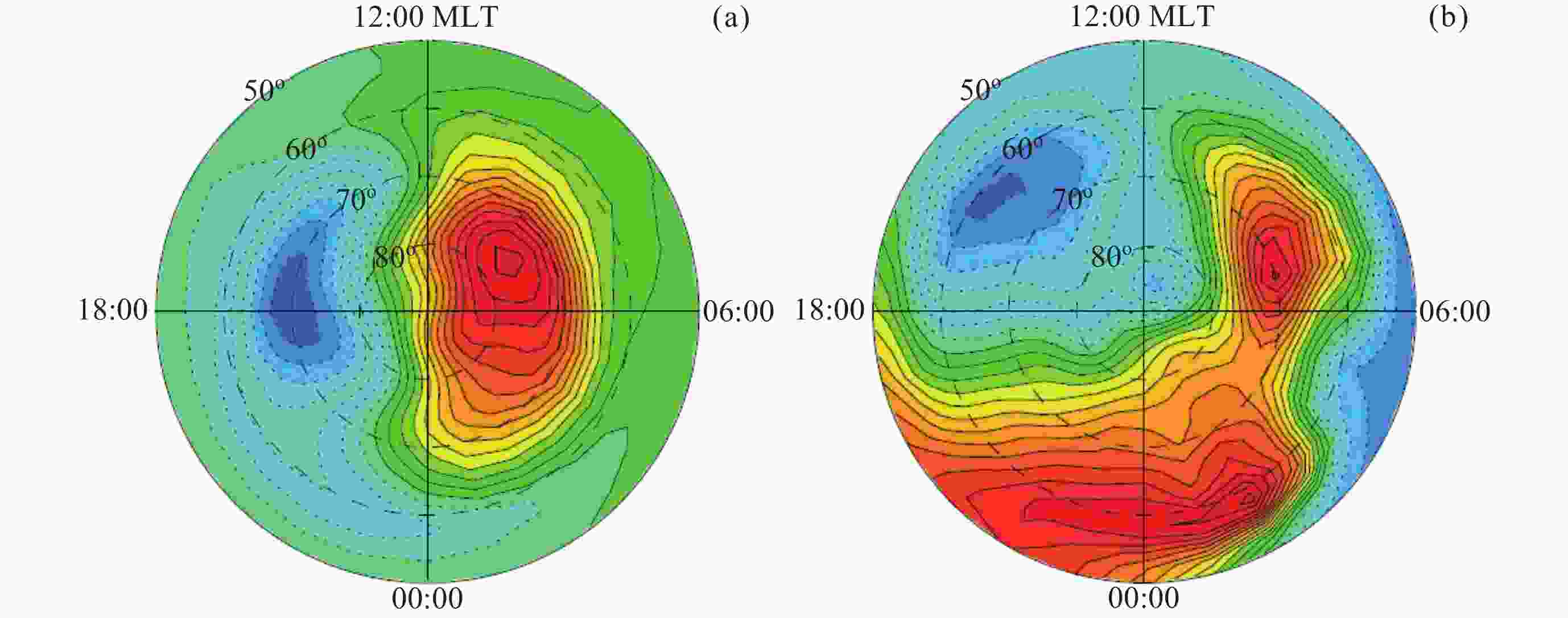
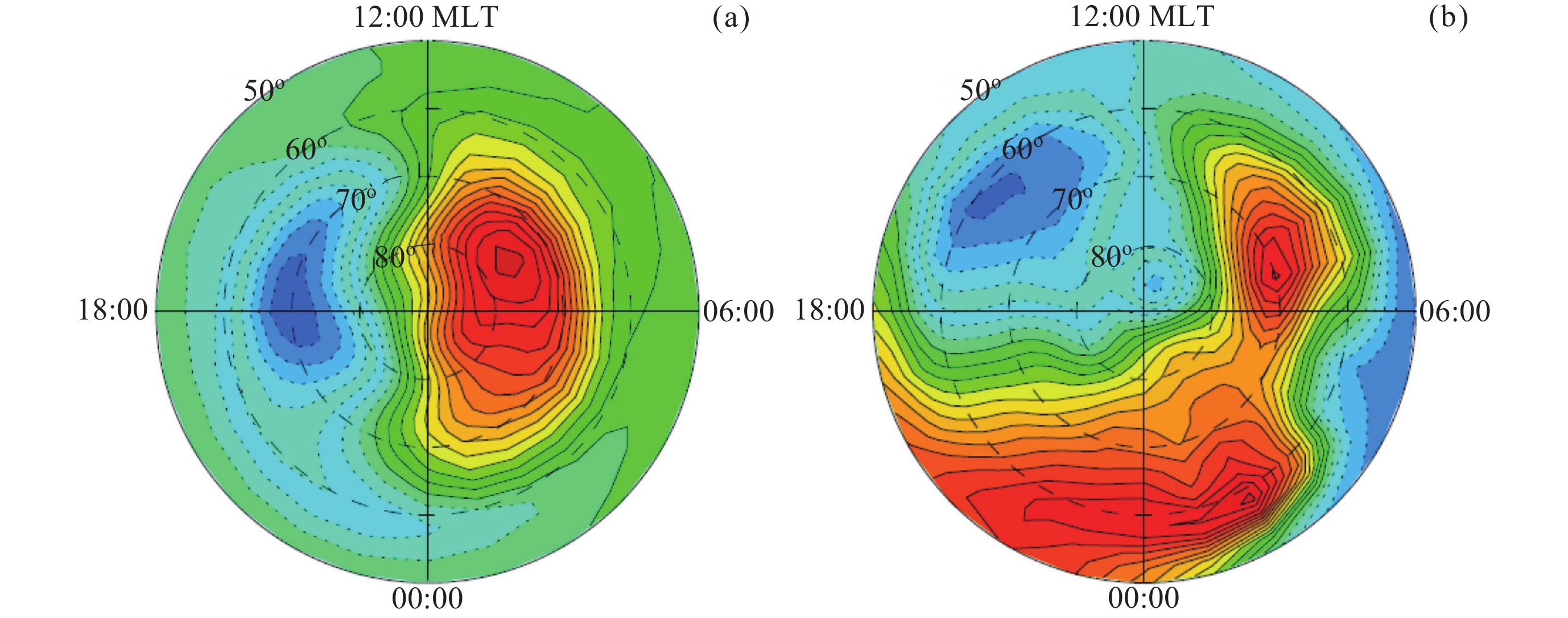
Figure 1. (a) Standard two-cell pattern in the polar cap potential distribution, (b) the distorted one-cell pattern in the polar cap potential distribution
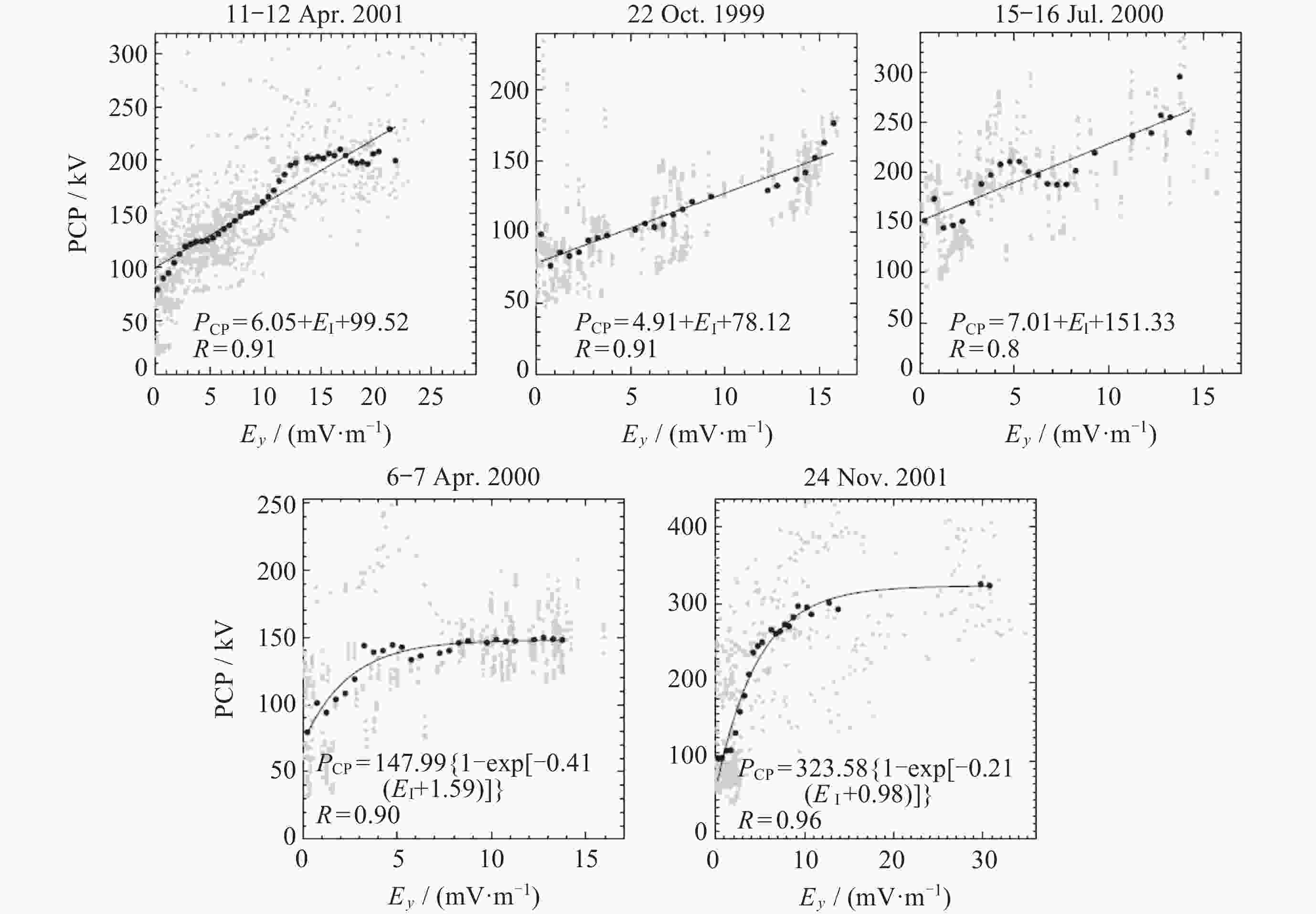
Figure 4. Relationship between PCP and IEF for five storms. The grey dots are from the original PCP and IEF data with a 1-min time resolution. The black points are binned (0.5 mV·m−1 window) and five-point boxcar-smoothed mean values of PCP and IEF, representing the mean PCP as a function of the mean IEF. The black lines or curves indicate linear fits and nonlinear (exponential) fits to the black data points
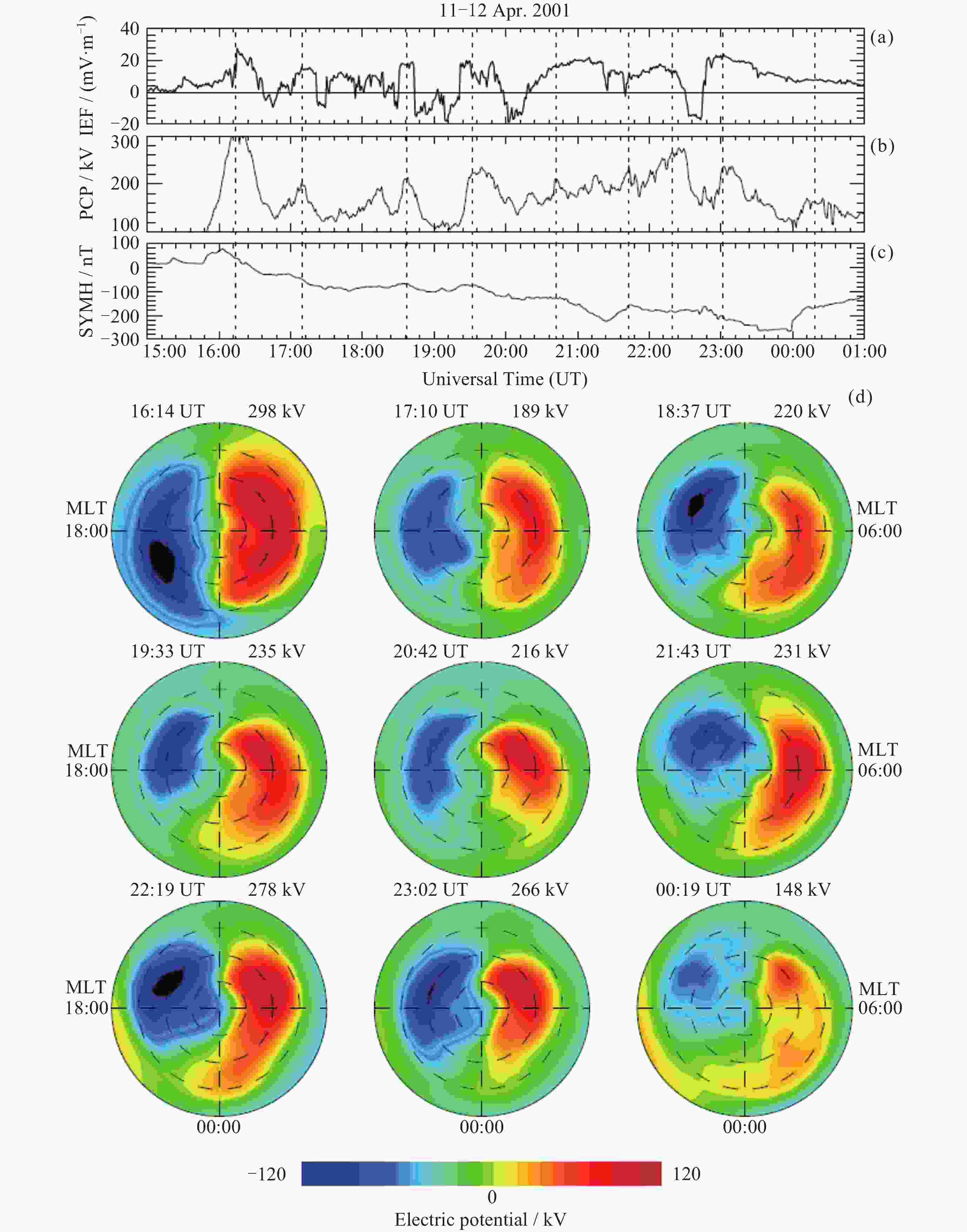
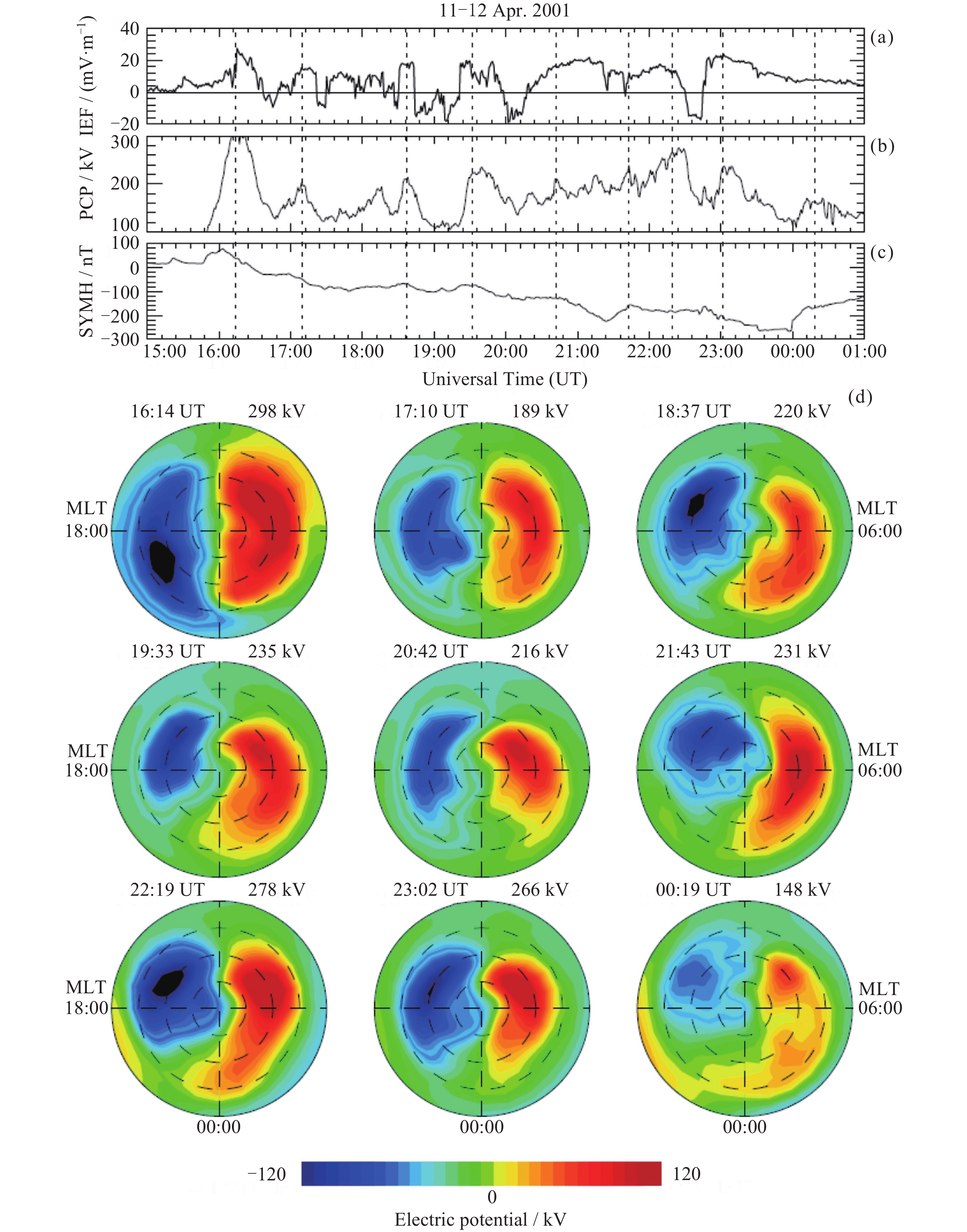
Figure 2. IEF, PCP values, SYM_H index, and nine patterns of global electric potential from 11 April 15:00 UT to 12 April 01:00 UT in 2001. Each PCP pattern is corresponding to a peak value of PCP in each hour marked by the vertical dash line
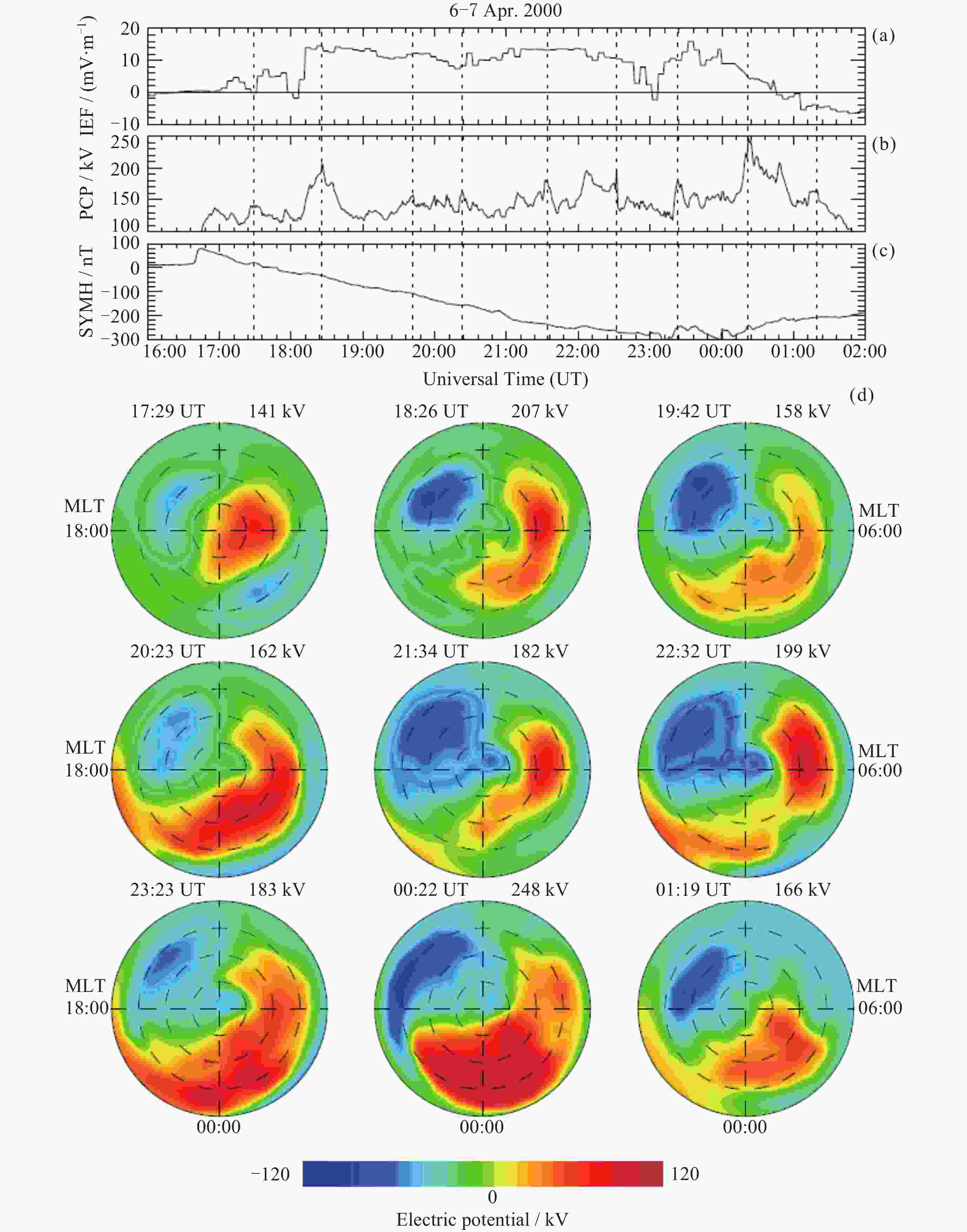
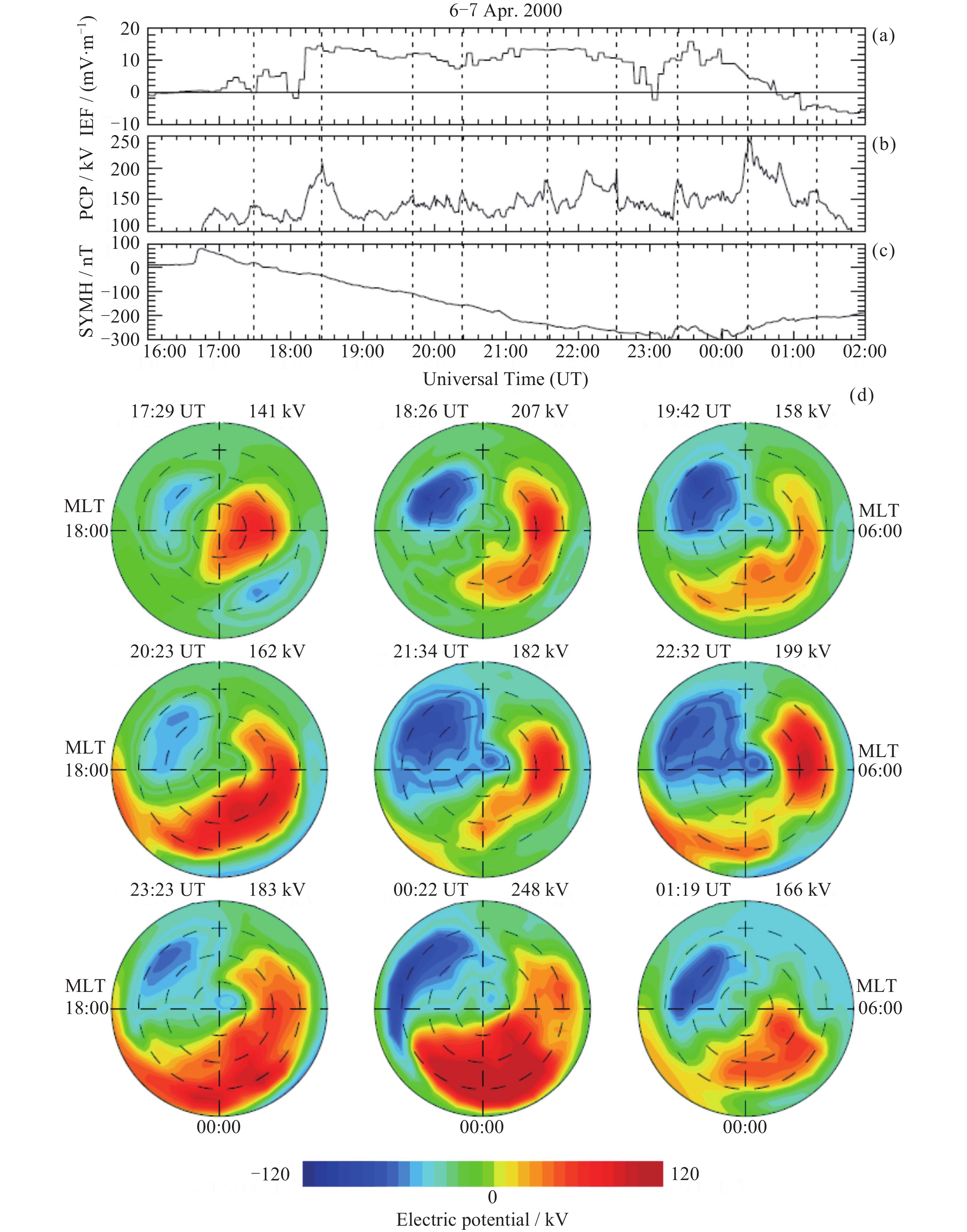
Figure 3. IEF, PCP values, SYM_H index, and nine patterns of global electric potential from 6 April 16:00 UT to 7 April 02:00 UT in 2000. Each PCP pattern is corresponding to a peak value of PCP in each hour marked by the vertical dash line
Table 1. List of five super intense storms with the minimum Dst < −200 nT
Storm type Date Minimum Dst / nT S-CONV 11 April 2001 −280 S-CONV 22 October 1999 −228 S-CONV 15 July 2000 −327 D-CONV 6 April 2000 −320 D-CONV 24 November 2001 −234  下载: 导出CSV
-
[1] SHEPHERD S G. Polar cap potential saturation: observations, theory, and modeling[J]. Journal of Atmospheric and Solar-Terrestrial Physics, 2007, 69(3): 234-248 doi: 10.1016/j.jastp.2006.07.022 [2] RAEDER J, LU G. Polar cap potential saturation during large geomagnetic storms[J]. Advances in Space Research, 2005, 36(10): 1804-1808 doi: 10.1016/j.asr.2004.05.010 [3] TSURUTANI B T, GONZALEZ W D, LAKHINA G S, et al. The extreme magnetic storm of 1-2 September 1859[J]. Journal of Geophysical Research: Space Physics, 2003, 108(A7): 1268. doi: 10.1029/2002JA009504 [4] LOPEZ R E, LYON J G, MITCHELL E, et al. Why doesn’t the ring current injection rate saturate?[J]. Journal of Geophysical Research: Space Physics, 2009, 114(A2): A02204. doi: 10.1029/2008JA013141 [5] HILL T W, DESSLER A J, WOLF R A. Mercury and Mars: the role of ionospheric conductivity in the acceleration of magnetospheric particles[J]. Geophysical Research Letters, 1976, 3(8): 429-432 doi: 10.1029/GL003i008p00429 [6] RUSSELL C T, LUHMANN J G, LU G. Nonlinear response of the polar ionosphere to large values of the interplanetary electric field[J]. Journal of Geophysical Research: Space Physics, 2001, 106(A9): 18495-18504 doi: 10.1029/2001JA900053 [7] SISCOE G L, ERICKSON G M, SONNERUP B U Ö, et al. Hill model of transpolar potential saturation: comparisons with MHD simulations[J]. Journal of Geophysical Research: Space Physics, 2002, 107(A6): 1075. doi: 10.1029/2001JA000109 [8] RIDLEY A J. A new formulation for the ionospheric cross polar cap potential including saturation effects[J]. Annales Geophysicae, 2005, 23(11): 3533-3547 doi: 10.5194/angeo-23-3533-2005 [9] KAN J R, LI H, WANG C, et al. Saturation of polar cap potential: nonlinearity in quasi-steady solar wind-magnetosphere-ionosphere coupling[J]. Journal of Geophysical Research: Space Physics, 2010, 115(A8): A08226. doi: 10.1029/2009JA014389 [10] TSURUTANI B, MANNUCCI A, IIJIMA B, et al. Global dayside ionospheric uplift and enhancement associated with interplanetary electric fields[J]. Journal of Geophysical Research: Space Physics, 2004, 109(A8): A08302. doi: 10.1029/2003JA010342 [11] SISCOE G, RAEDER J, RIDLEY A J. Transpolar potential saturation models compared[J]. Journal of Geophysical Research: Space Physics, 2004, 109(A9): A09203. doi: 10.1029/2003JA010318 [12] DUNGEY J W. Interplanetary magnetic field and the auroral zones[J]. Physical Review Letters, 1961, 6(2): 47-48 doi: 10.1103/PhysRevLett.6.47 [13] AKASOFU S I. What is a magnetospheric substorm?[C]//Proceedings of the A. G. U. Chapman Conference ‘Magnetospheric Substorms and Related Plasma Processes’. Los Alamos: Springer, 1978: 447-460 [14] ROSTOKER G, AKASOFU S I, BAUMJOHANN W, et al. The roles of direct input of energy from the solar wind and unloading of stored magnetotail energy in driving magnetospheric substorms[J]. Space Science Reviews, 1988, 46(1/2): 93-111 doi: 10.1007/bf00173876 [15] KAMIDE Y, KOKUBUN S. Two-component auroral electrojet: importance for substorm studies[J]. Journal of Geophysical Research: Space Physics, 1996, 101(A6): 13027-13046. doi: 10.1029/96JA00142 [16] SUN W, ZHOU X Y, DU A. Quantitative separation of the directly-driven and unloading components of the ionospheric electric field[J]. Geophysical Research Letters, 2008, 35(13): L13104. doi: 10.1029/2008GL033931 [17] RICHMOND A D, KAMIDE Y (1988), Mapping electrodynamic features of the high-latitude ionosphere from localized observations: Technique, J. Geophys. Res., 93(A6), 5741–5759, doi:10.1029/JA093iA06p05741. [18] RICHMOND A D (1992), Assimilative mapping ionospheric electrodynamics, Adv. Space Res. , 12, 59, 1992. [19] WOLF R A. Calculations of magnetospheric electric fields[M]//MCCORMAC B M. Magnetospheric Physics. Dordrecht: Springer, 1974: 167-177 [20] FOK M C, WOLF R A, SPIRO R W, et al. Comprehensive computational model of Earth’s ring current[J]. Journal of Geophysical Research: Space Physics, 2001, 106(A5): 8417-8424 doi: 10.1029/2000JA000235 [21] FOK M C, MOORE T E, WILSON G R, et al. Global ENA image simulations[J]. Space Science Reviews, 2003, 109(1/2/3/4): 77-103 [22] WOLF R A, SAZYKIN S, XING X, et al. Direct effects of the IMF on the inner magnetosphere[M]//BURCH J L, SCHULZ M, SPENCE H E. Inner Magnetosphere Interactions: New Perspectives from Imaging. Washington: American Geophysical Union, 2005: 127-139 [23] TSURUTANI B T, GOLDSTEIN B E, GONZALEZ W D and SUGIURA M (1990), Interplanetary Alfvén waves and auroral (substorm) activity: IMP 8, J. Geophys. Res., 95(A3), 2241–2252, doi:10.1029/JA095iA03p02241. [24] DAI L, HAN Y M, WANG C, et al. Geoeffectiveness of interplanetary Alfvén waves. I. Magnetopause magnetic reconnection and directly driven substorms[J]. The Astrophysical Journal, 2023, 945(1): 47. doi: 10.3847/1538-4357/acb267 [25] TSURUTANI B T, VERKHOGLYADOVA O P, MANNUCCI A J, et al. Oxygen ion uplift and satellite drag effects during the 30 October 2003 daytime superfountain event[J]. Annales Geophysicae, 2007, 25(3): 569-574. doi: 10.5194/angeo-25-569-2007 [26] LU G, LI W H, RAEDER J, et al. Reversed two-cell convection in the Northern and Southern hemispheres during northward interplanetary magnetic field[J]. Journal of Geophysical Research: Space Physics, 2011, 116(A12): A12237. doi: 10.1029/2011JA017043 -
-

 下载:
下载:

计量
- 文章访问数: 151
- HTML全文浏览量: 45
- PDF下载量: 9
-
被引次数:
0(来源:Crossref)
0(来源:其他)

