


多事件磁层亚暴演化对地球外辐射带的影响
doi: 10.11728/cjss2026.05.2025-0225 cstr: 32142.14.cjss.2025-0225
-
 汤朝灵 男, 1979年7月出生于安徽省黟县, 现为山东大学教授, 硕士生导师,主要研究方向为空间天气学, 包括地球外辐射带、磁层亚暴、磁暴等数据分析和模拟等. E-mail: tcl@sdu.edu.cn
作者简介:
Impact of Magnetospheric Substorm Evolution of a Multi-event on the Earth’s Outer Radiation Belt
-
摘要: 磁层亚暴对地球外辐射带的动力学过程十分重要. 然而, 亚暴演化过程对外辐射带的影响尚不明确. 利用THEMIS卫星和范艾伦探测器的联合观测, 研究不同磁层亚暴事件对外辐射带的影响(源电子或合声波、种子电子的增强). 研究发现: 亚暴膨胀相触发的近地磁场偶极化是驱动能量电子向地球方向注入并最终影响外辐射带的关键环节; 外辐射带合声波的活动水平受到亚暴注入电子特性(注入电子通量、持续时间和投掷角分布)的显著调制, 并存在一定的事件依赖性; 亚暴的时序结构(脉冲式或连续式)会显著影响外辐射带的响应模式(一次响应或多阶段响应). 上述结果有助于进一步理解外辐射带动力学过程.Abstract: The magnetospheric substorms play a crucial role in the dynamic processes of the Earth’s outer radiation belt. However, the specific influence of substorm evolution on the outer radiation belt remains insufficiently understood. This study investigates the effects of different substorm events on the outer radiation belt—specifically focusing on the enhancements of the source electrons (or chorus waves) and seed populations—by using joint observations from the THEMIS satellites and Van Allen Probes. Our analysis reveals the following key findings: The magnetic field dipolarization in the near-Earth tail, triggered by the substorm expansion phase, is a key process that facilitates the earthward injections of energetic electrons and ultimately affects the dynamics of the outer radiation belt. The activity level of chorus waves in the outer radiation belt is significantly modulated by the characteristics of substorm-injected electrons (the injected electron fluxes, durations, and pitch angle distributions) and shows a certain event dependence. The temporal structure of substorms (pulsed or continuous) significantly affects the response patterns of the outer radiation belt (single response or multi-stage response). These findings provide valuable insights for advancing our understanding of the dynamic processes of the outer radiation belt.
-
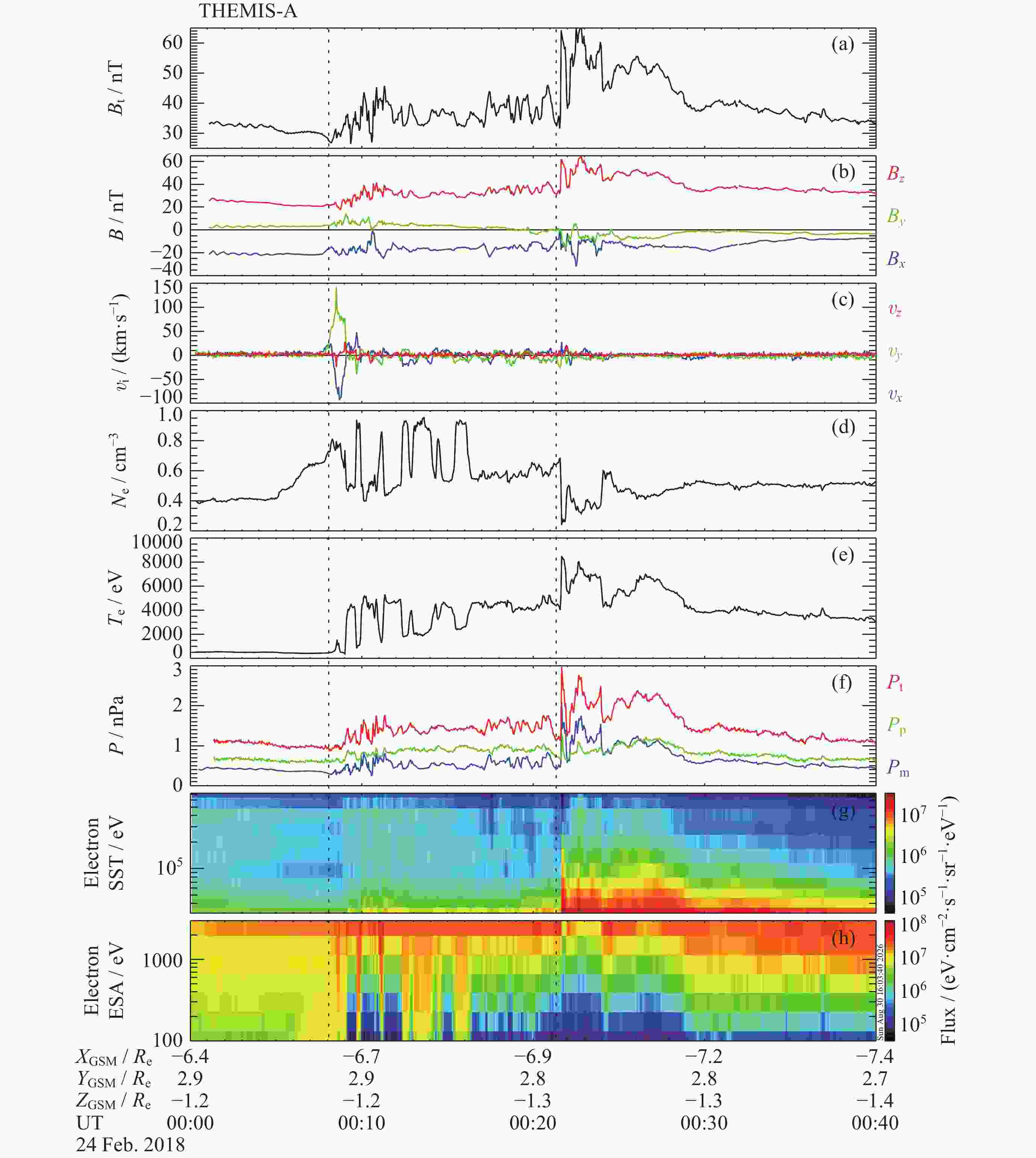
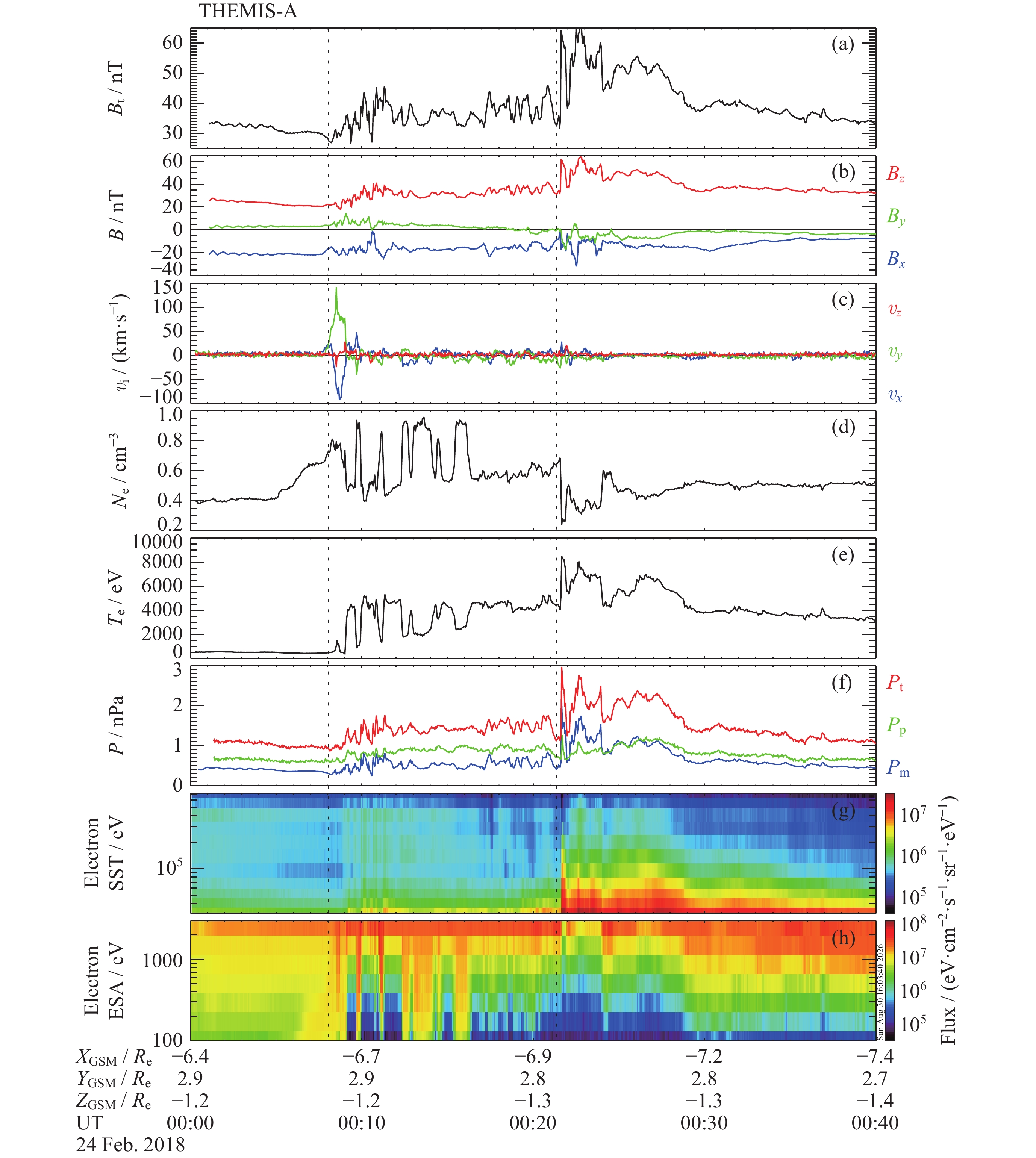
图 1 2018年2月24日00:00-00:40 UT期间THEMIS-A的观测结果. (a)(b)由磁通门磁力计(FGM)测量的总磁场(Bt)和磁场(B), (c)~(e)由静电分析仪(ESA)和固态望远镜(SST)测量的离子速度(vi)、电子密度(Ne)和温度(Te), (f)磁场压强Pm(蓝线)、等离子体压强(离子与电子之和)Pth(绿线)和总压强Pt(红线), (g)(h)由SST和ESA仪器观测得到的0.1~700 keV电子能谱
Figure 1. Observations from THEMIS-A during 00:00-00:40 UT on 24 February 2018. (a)(b) Total magnetic field (Bt) and magnetic field (B) measured by the Flux Gate Magnetometer (FGM) instrument; (c)~(e) ion velocity (vi), electron density (Ne) and temperature (Te) measured by the Electrostatic Analyzer (ESA) and Solid State Telescope (SST) instruments; (f) magnetic pressure Pm (the blue line), plasma pressure (ions plus electrons) Pth (the green line), and the total pressure Pt (the red line); (g)(h) tenergy spectra of 0.1 ~700 keV electrons observed by the SST and ESA instruments
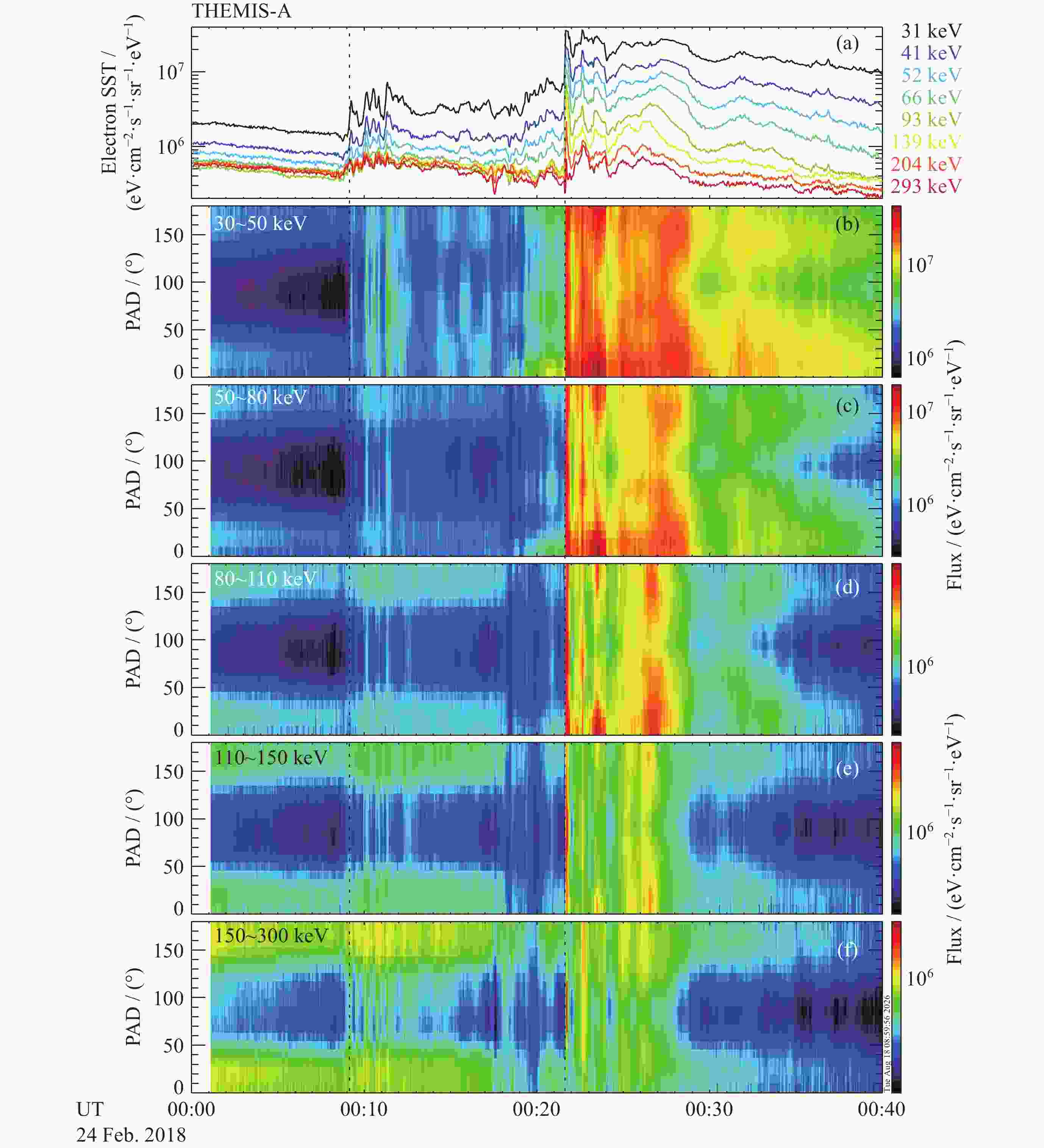
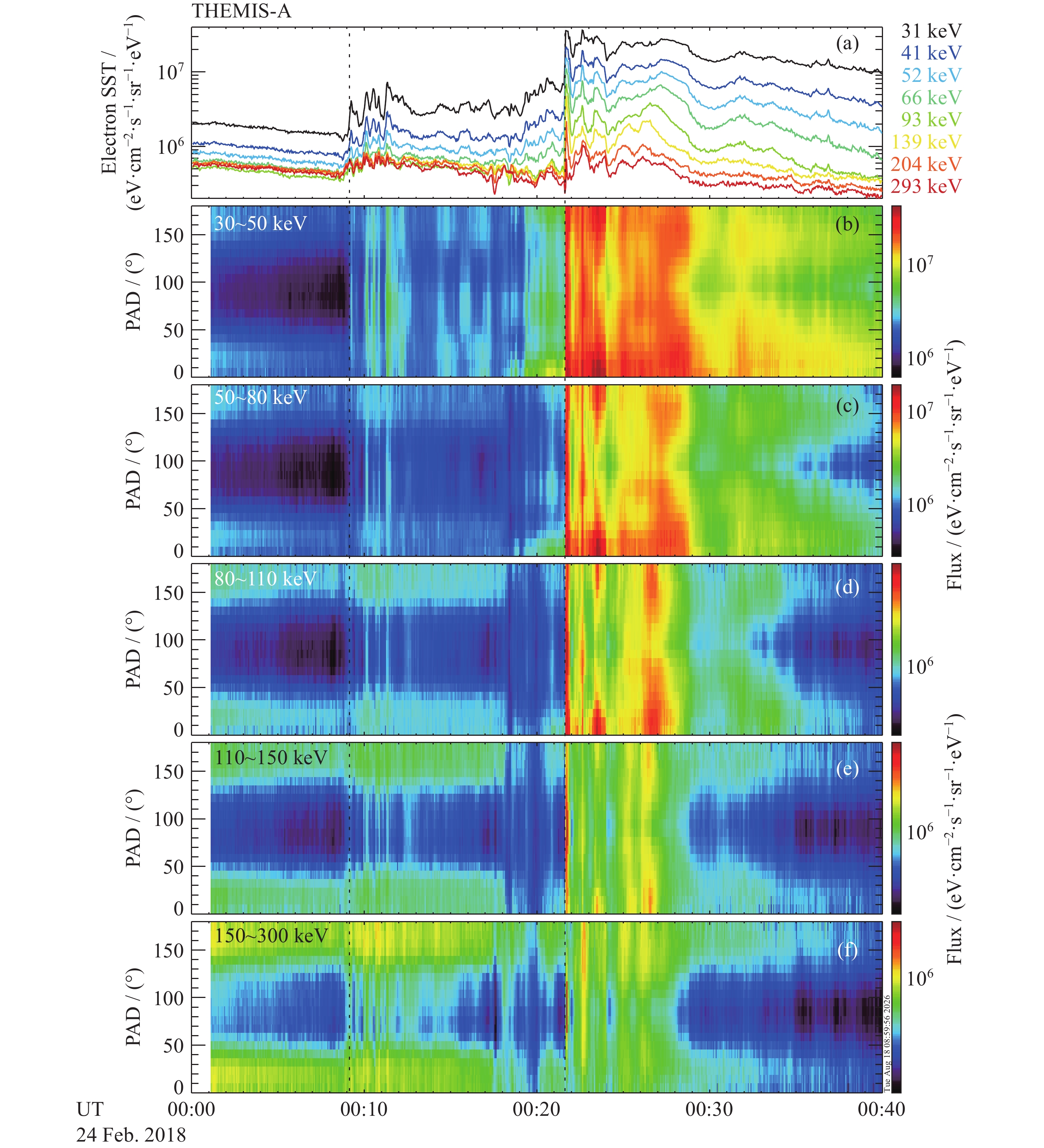
图 2 2018年2月24日00:00-00:40 UT THEMIS-A电子观测结果. (a) SST测量的电子全向微分通量, (b)~(f) SST能量范围(30~300 keV)内电子通量随投掷角的变化
Figure 2. Observations from THEMIS-A during 00:00-00:40 UT on 24 February 2018. (a) Electron omnidirectional differential energy flux from SST instrument, (b)~(f) electron flux variations in the SST energy range (30~300 keV) as a function of pitch angle
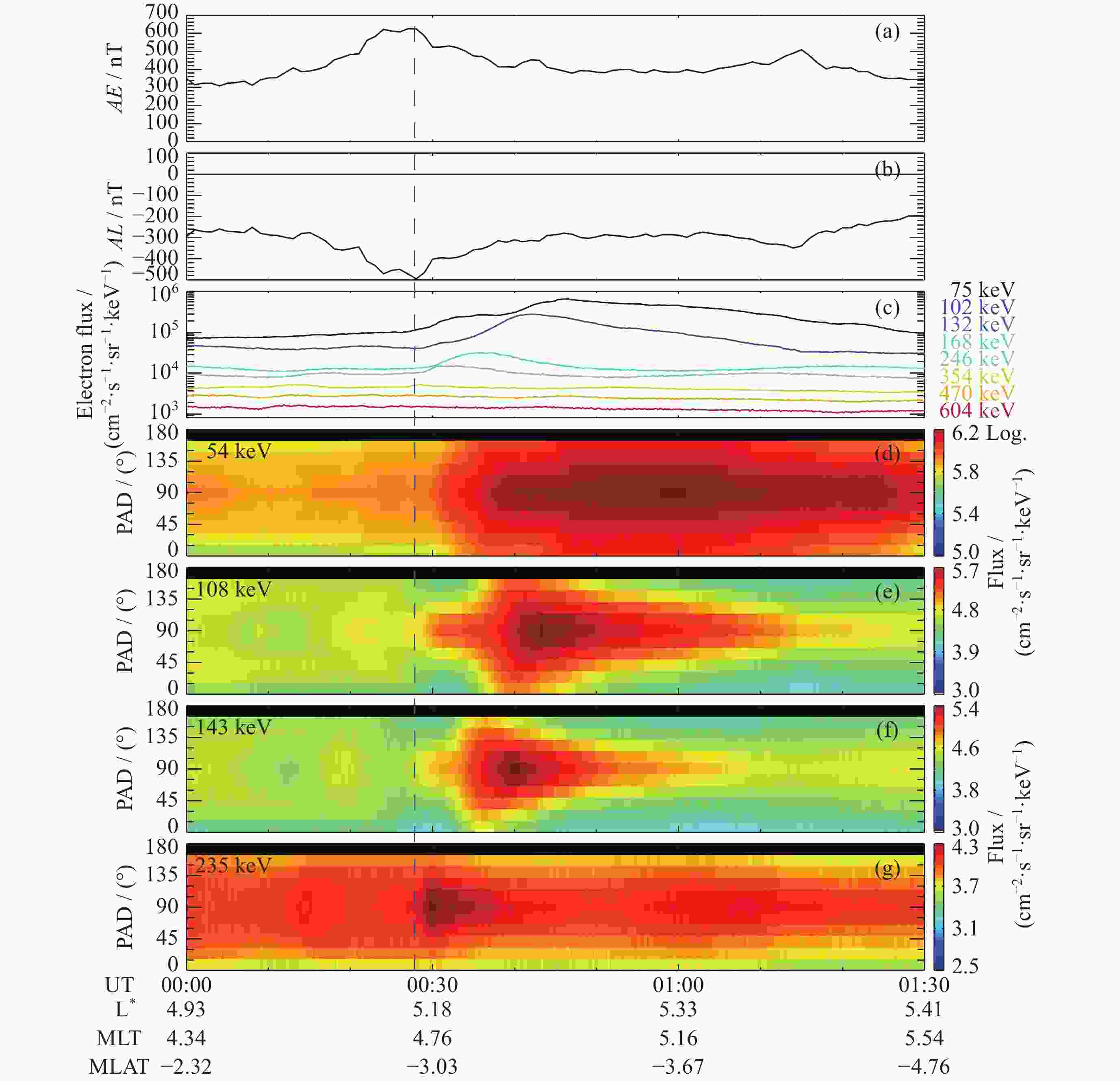
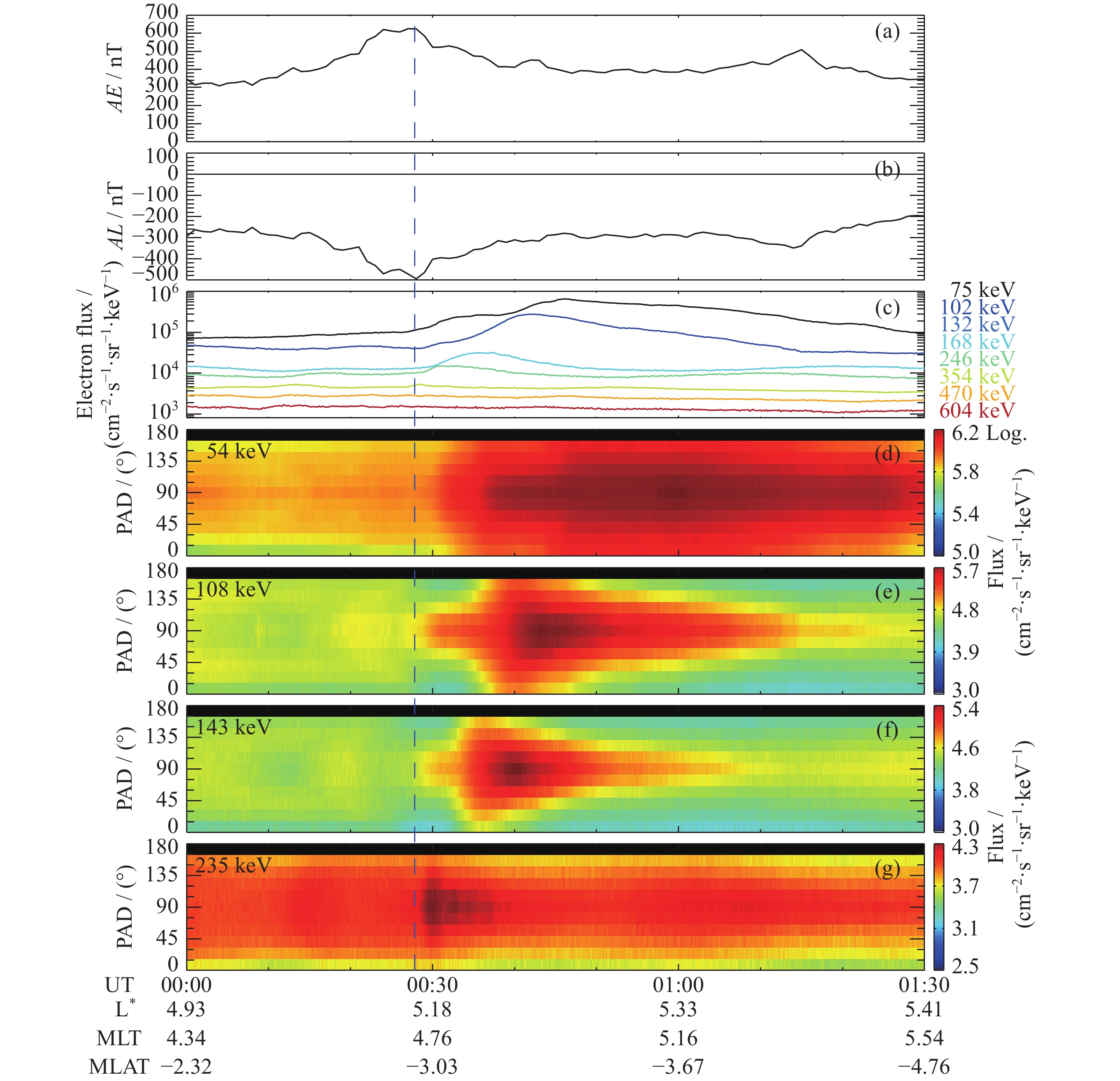
图 3 2018年2月24日00:00-01:30 UT期间范艾伦探测器B的观测结果. (a)(b)地磁指数(AE与AL); (c)~(g) MagEIS测量的能量电子微分通量、不同能量(54~235 keV)电子的投掷角分布
Figure 3. Observations from Van Allen Probe B during 00:00-01:30 UT on 24 February 2018. (a) (b) Geomagnetic indices (AE and AL). (c)~(g) Differential fluxes of energetic electrons, the Pitch Angle Distributions (PAD) of different electrons (54~235 keV) from the MagEIS instrument
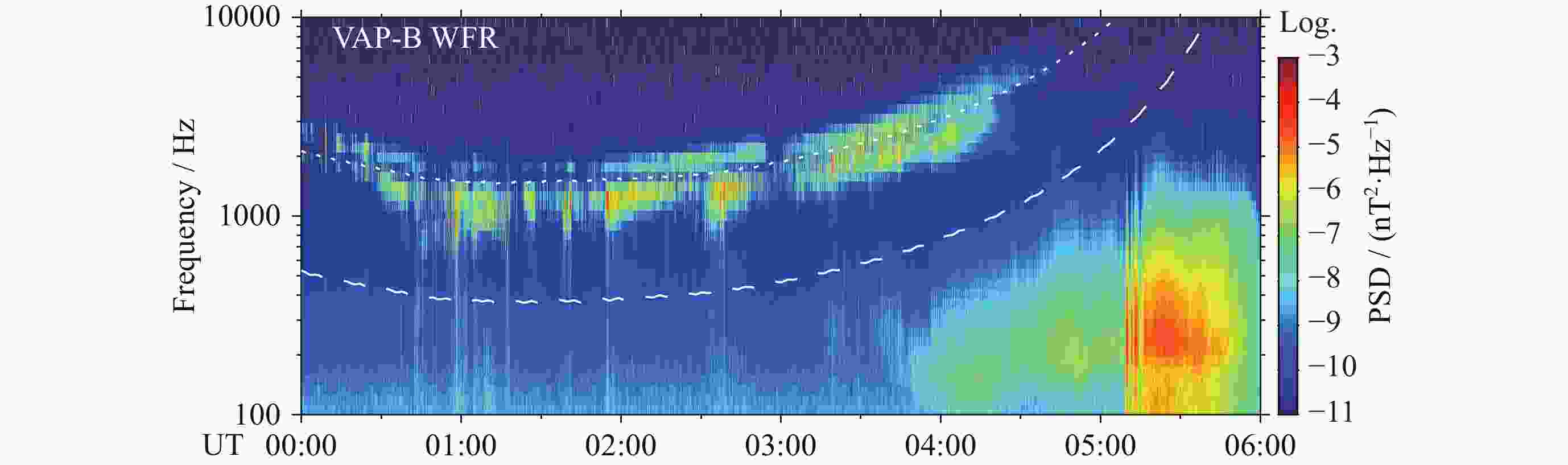
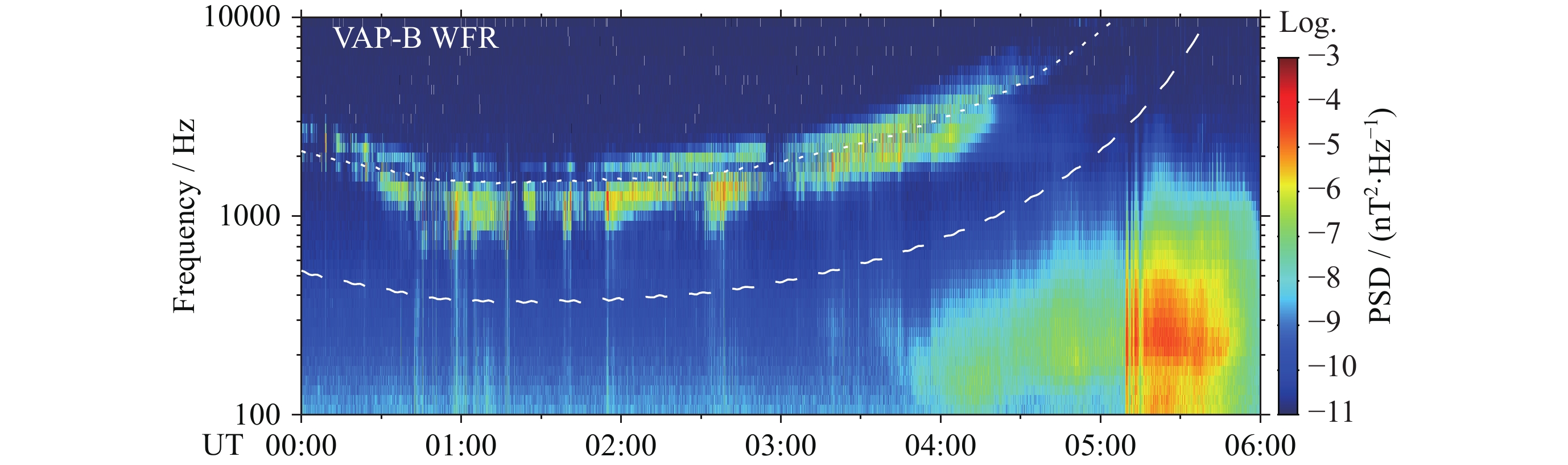
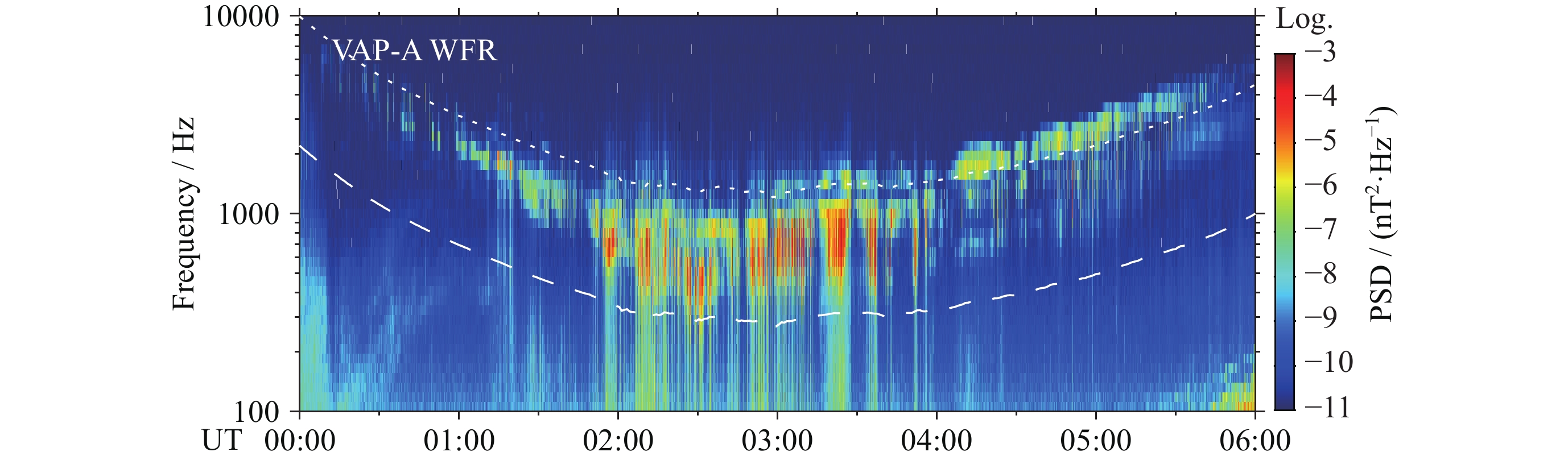
图 4 2018年2月24日00:00-06:00 UT期间范艾伦探测器B上EMFISIS测量的磁场谱
Figure 4. Magnetic-field spectra measured by EMFISIS on Van Allen Probe B during 00:00-06:00 UT on 24 February 2018
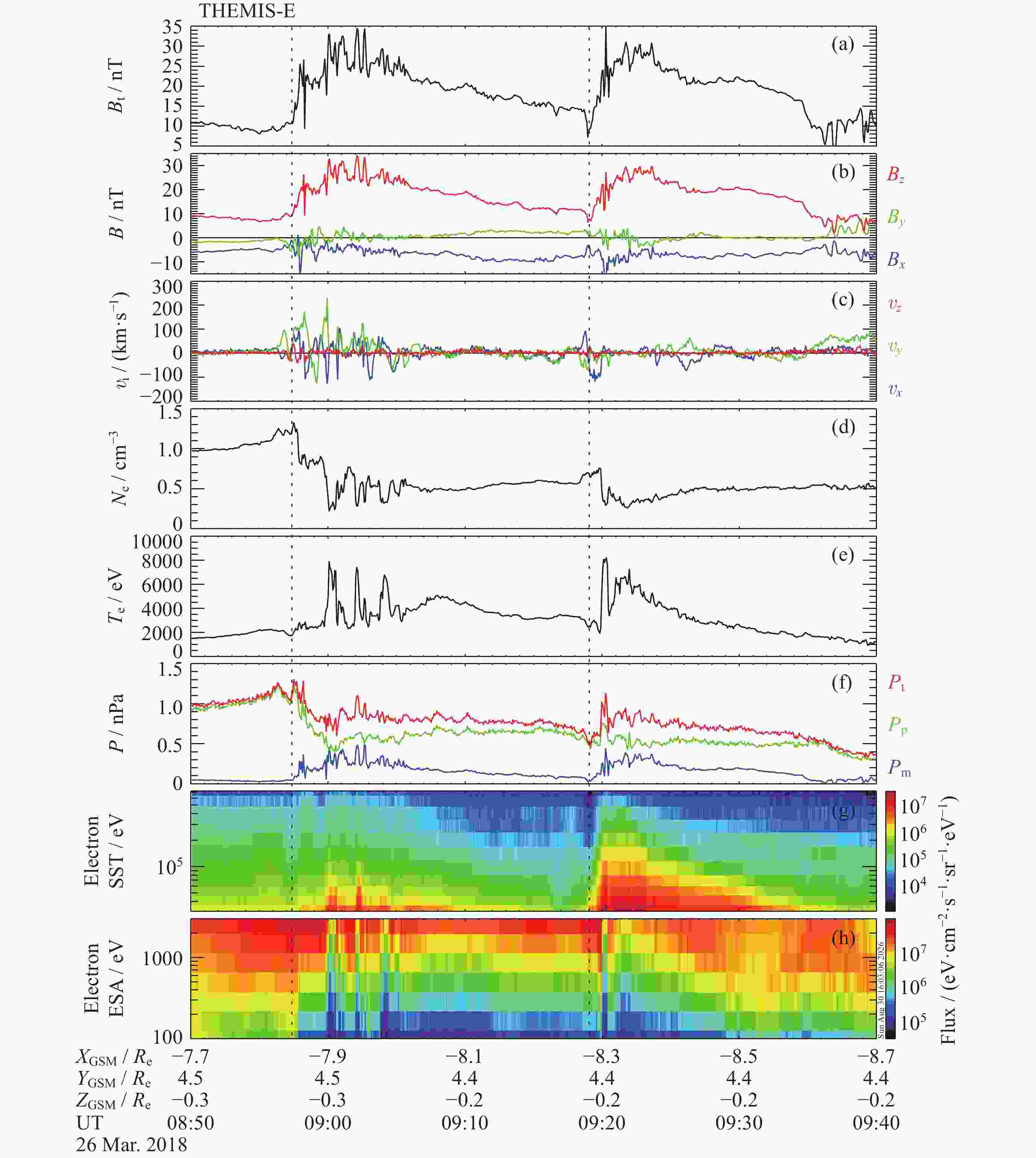
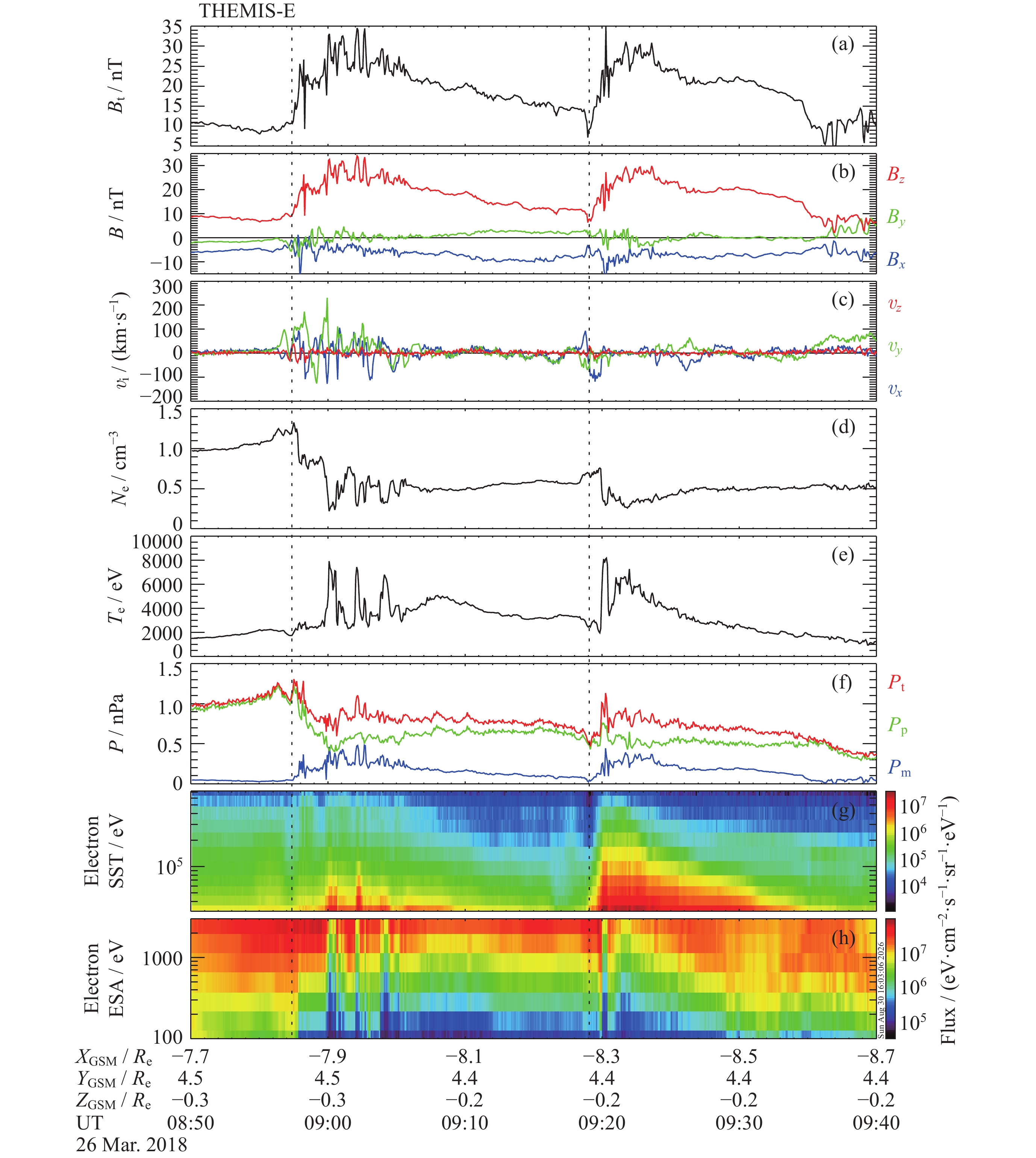
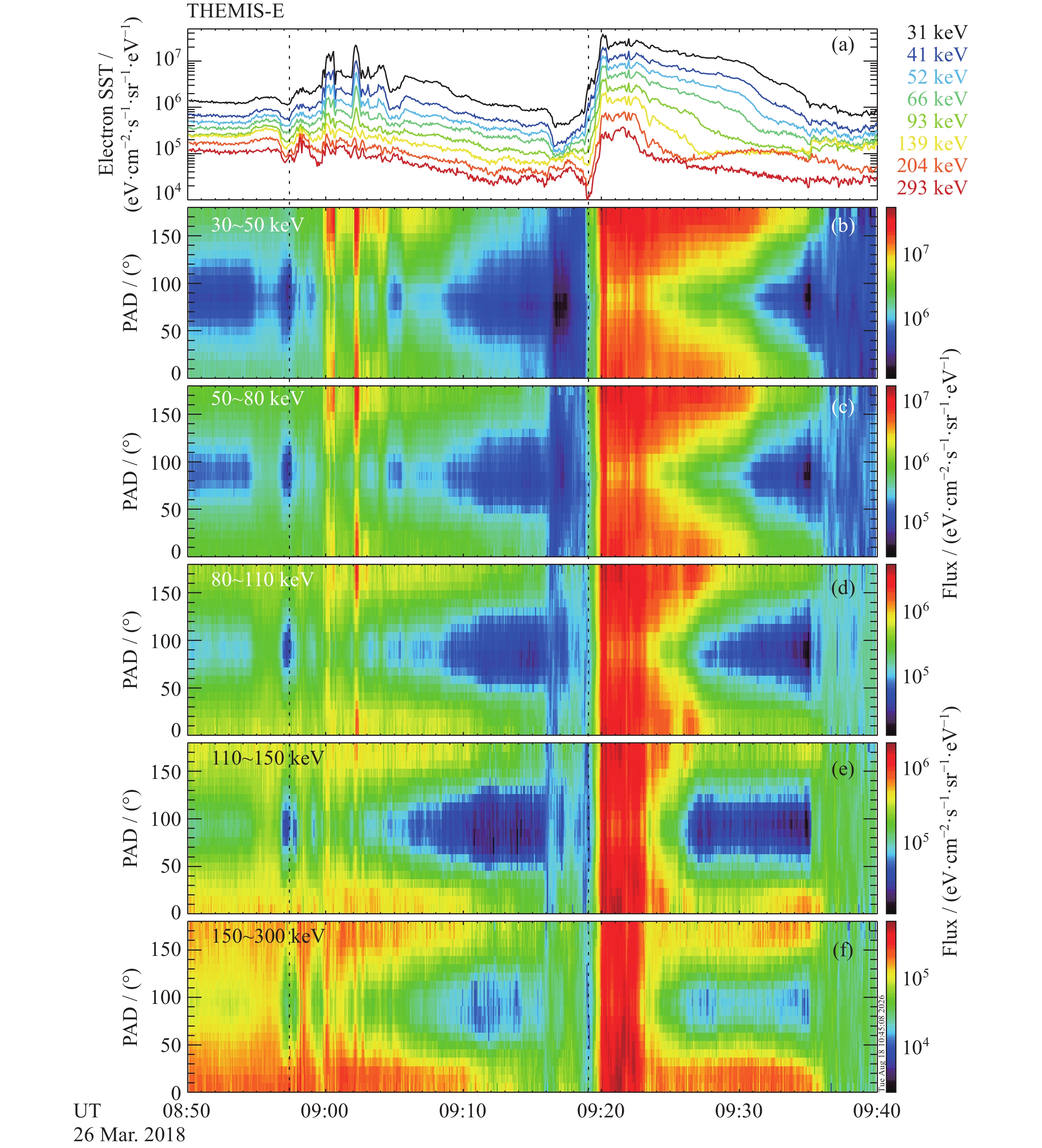
图 5 2018年3月26日08:50-09:40 UT期间THEMIS-E的观测结果
Figure 5. Observations from THEMIS-E during 08:50-09:40 UT on 26 March 2018
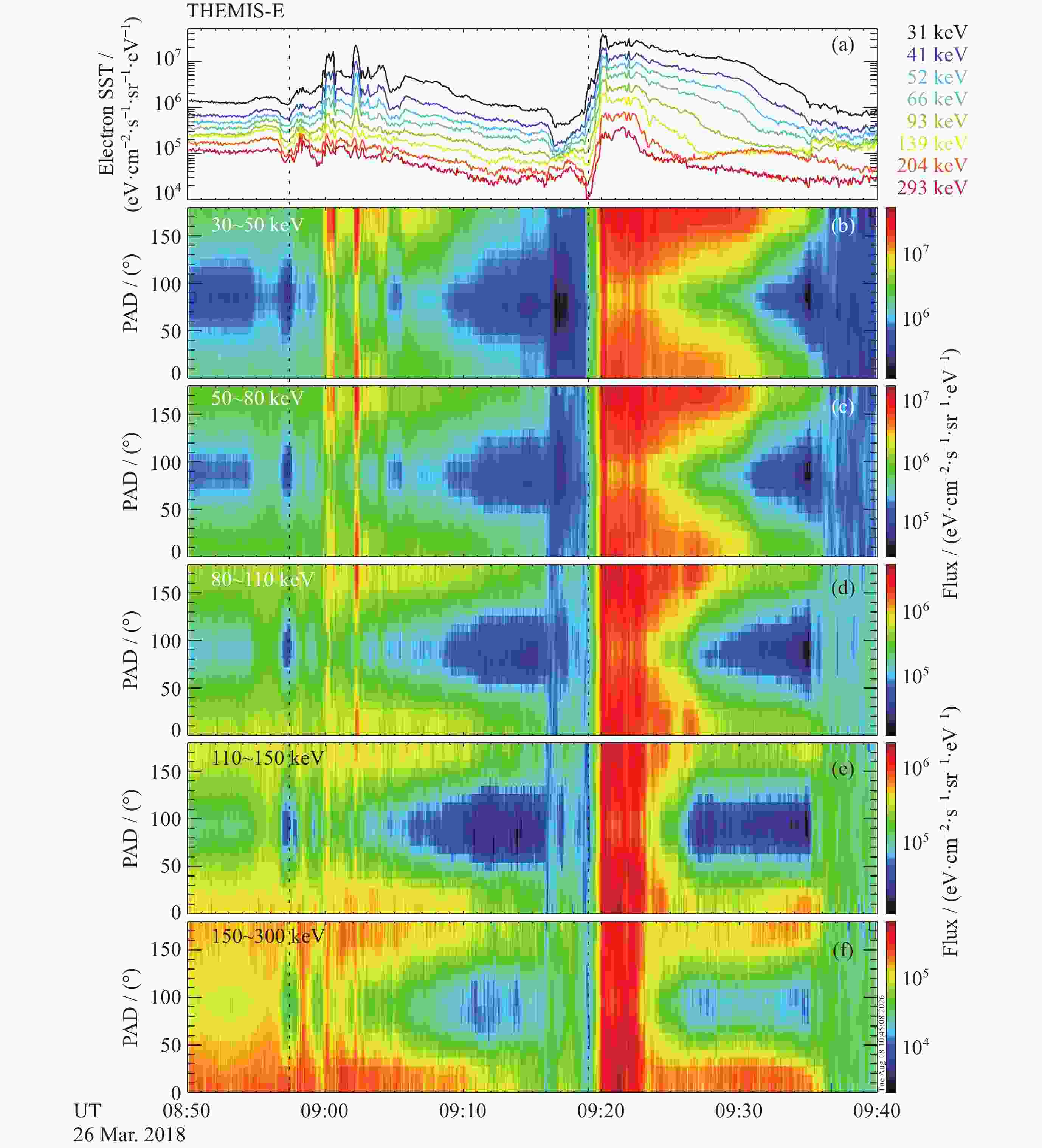
图 6 2018年3月26日08:50-09:40 UT期间THEMIS-E的电子观测结果
Figure 6. Observations from THEMIS-E during 08:50-09:40 UT on 26 March 2018
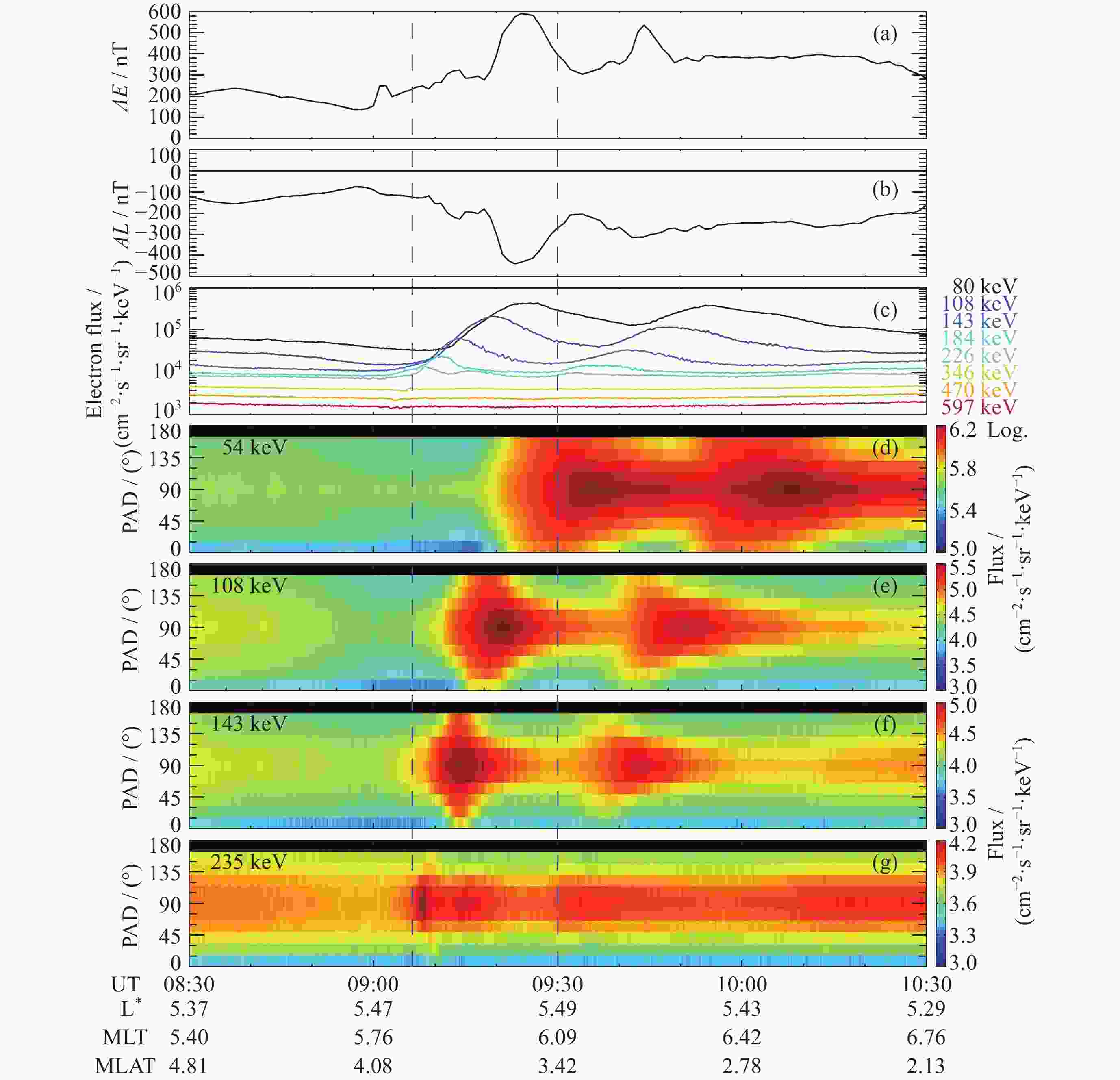
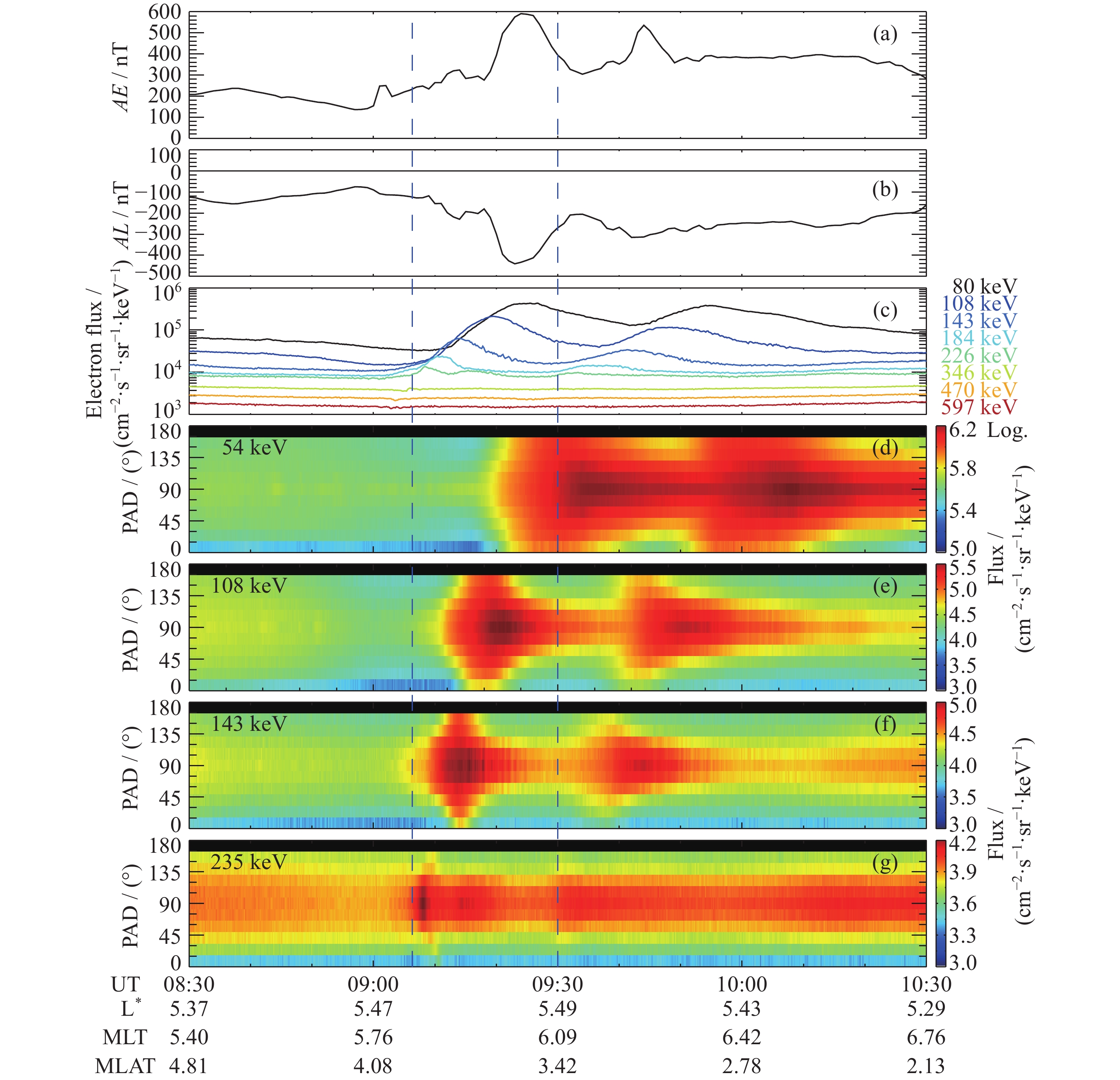
图 7 2018年3月26日08:30-10:30 UT期间范艾伦探测器A的观测结果
Figure 7. Observations from Van Allen Probe A during 08:30-10:30 UT on 26 March 2018
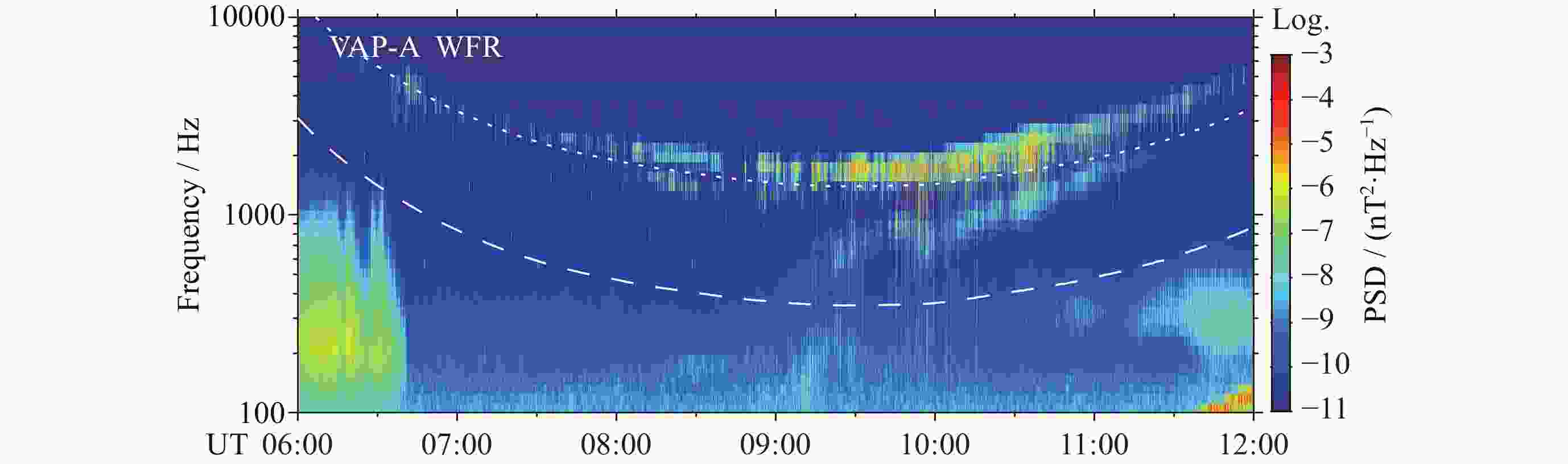
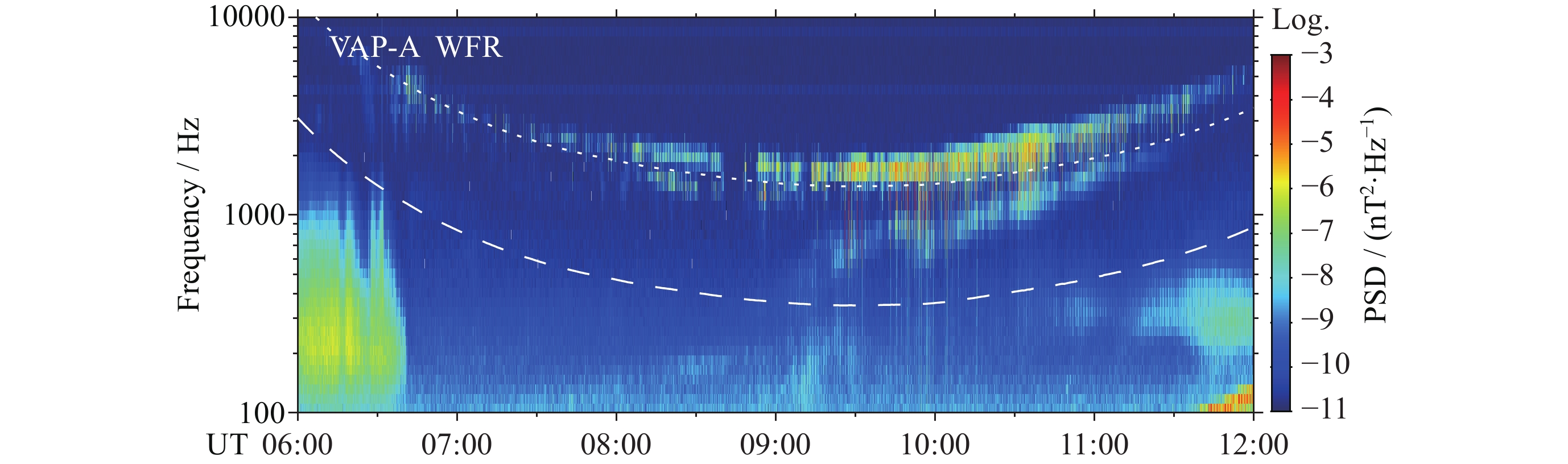
图 8 2018年3月26日06:00-12:00 UT范艾伦探测器A上EMFISIS测量的磁场谱
Figure 8. Magnetic-field spectra measured by EMFISIS on Van Allen Probe A during 06:00-12:00 UT on 26 March 2018
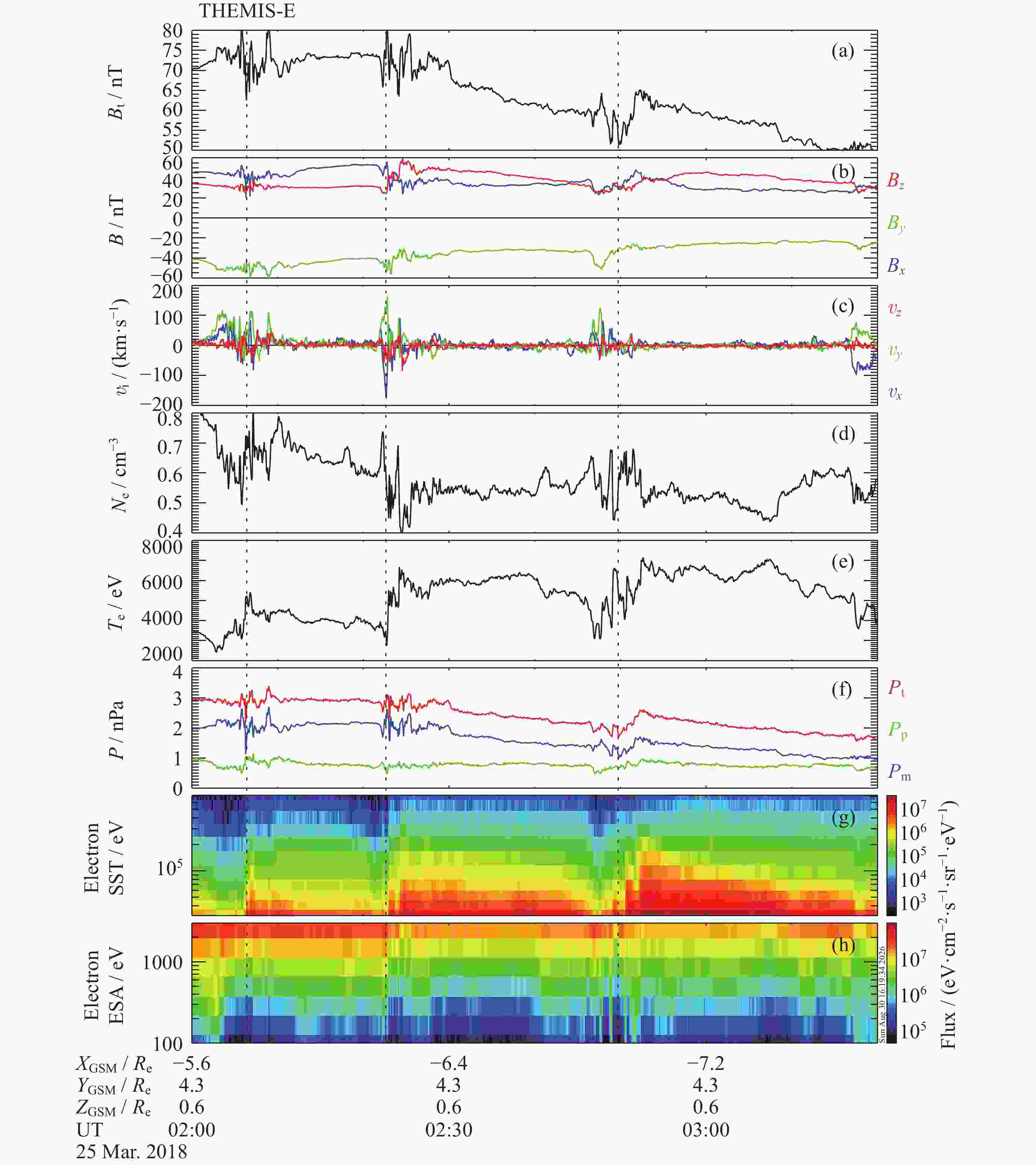
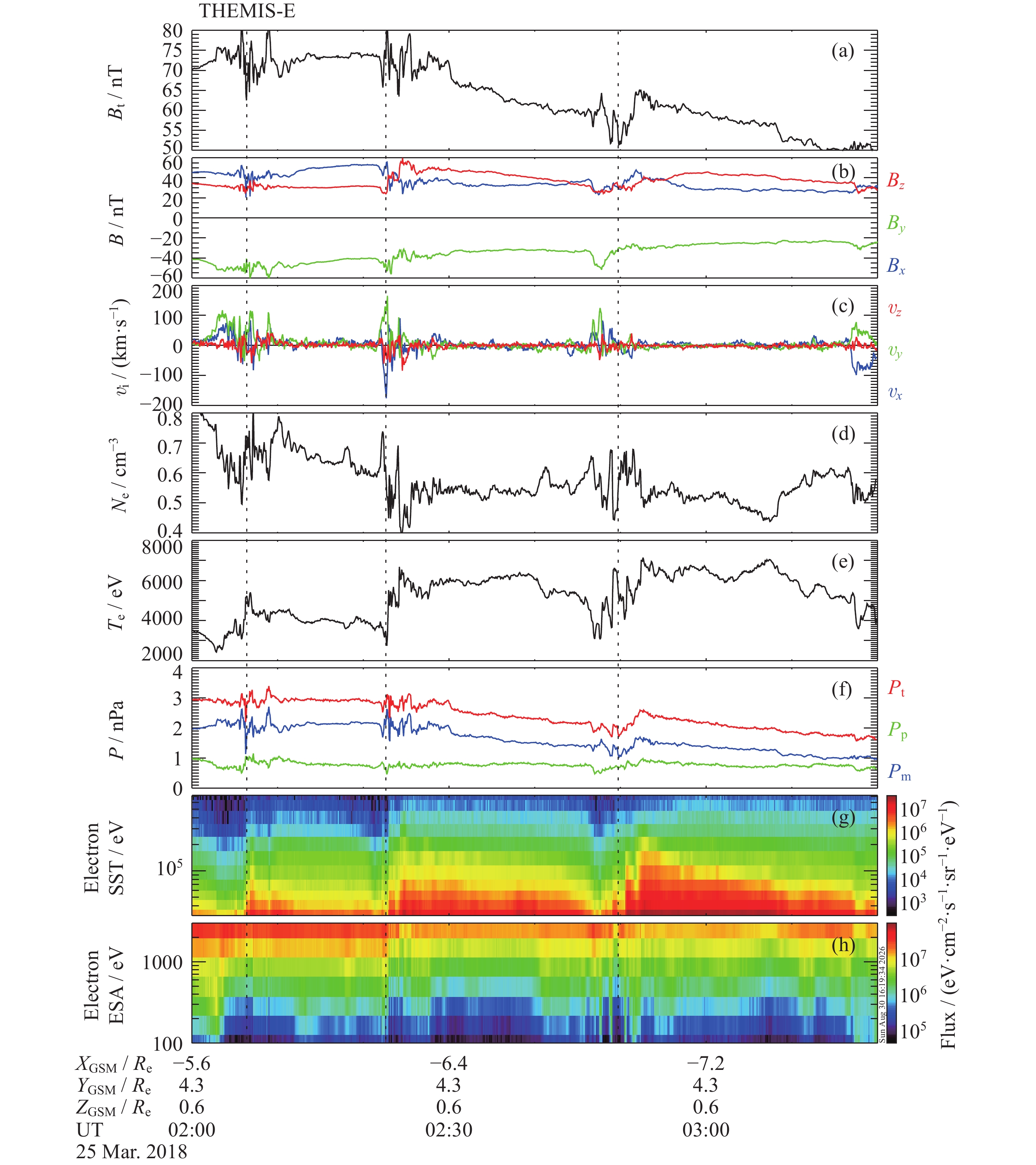
图 9 2018年3月25日02:00-03:20 UT期间THEMIS-E的观测结果
Figure 9. Observations of THEMIS-E during 02:00-03:20 UT on 25 March 2018
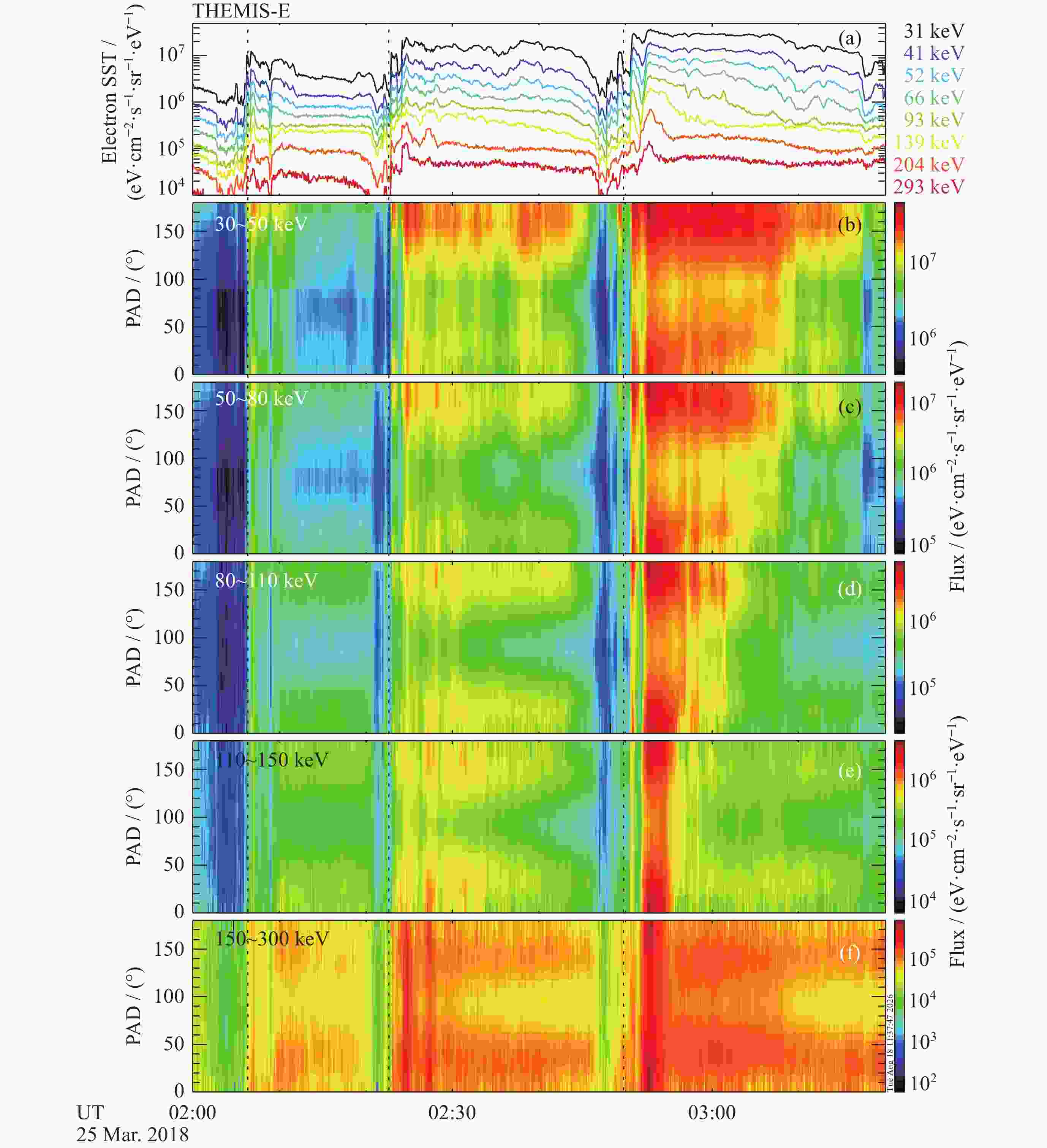
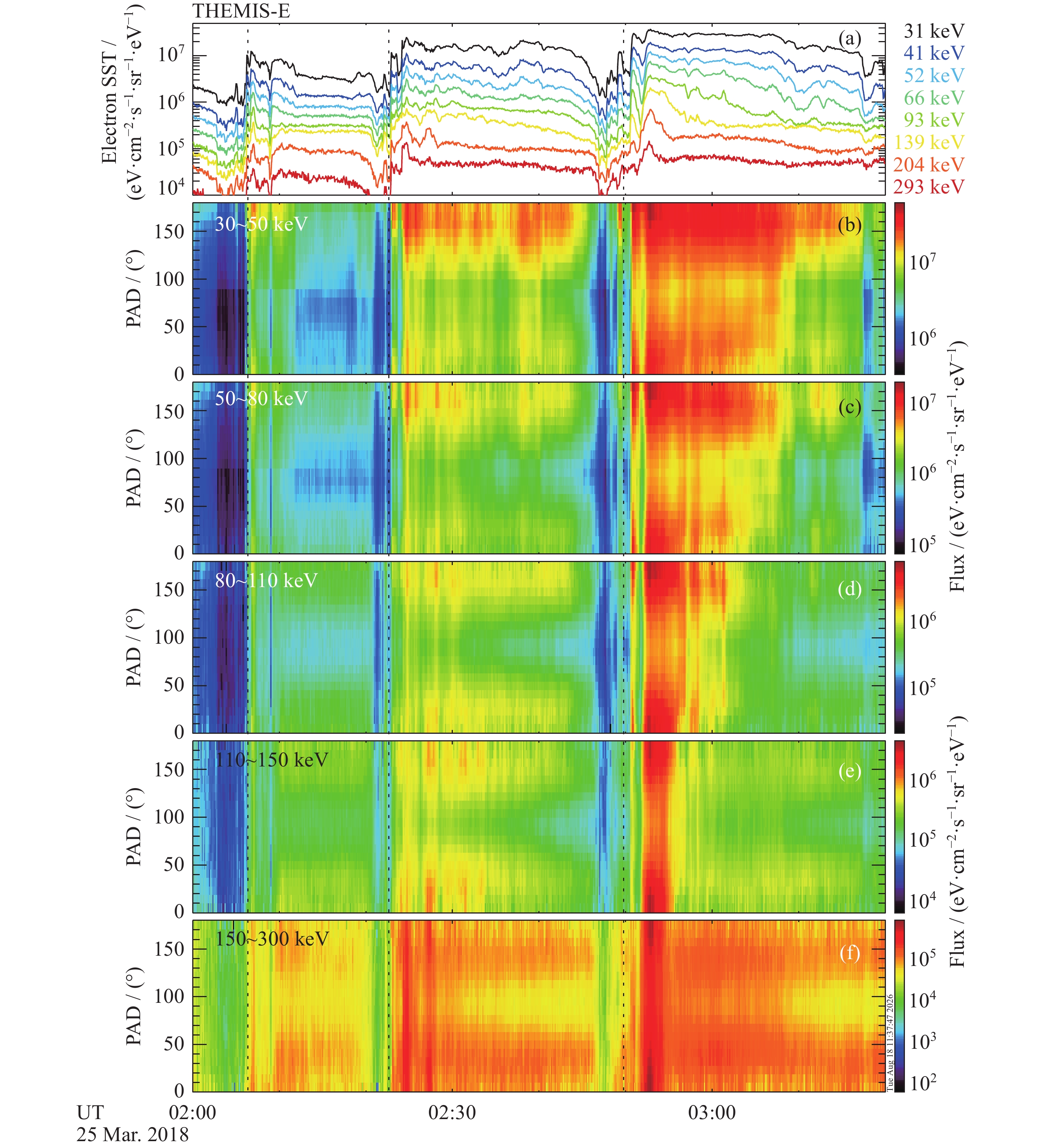
图 10 2018年3月25日02:00-03:20 UT期间THEMIS-E的电子观测结果
Figure 10. Observations from THEMIS-E during 02:00-03:20 UT on 25 March 2018
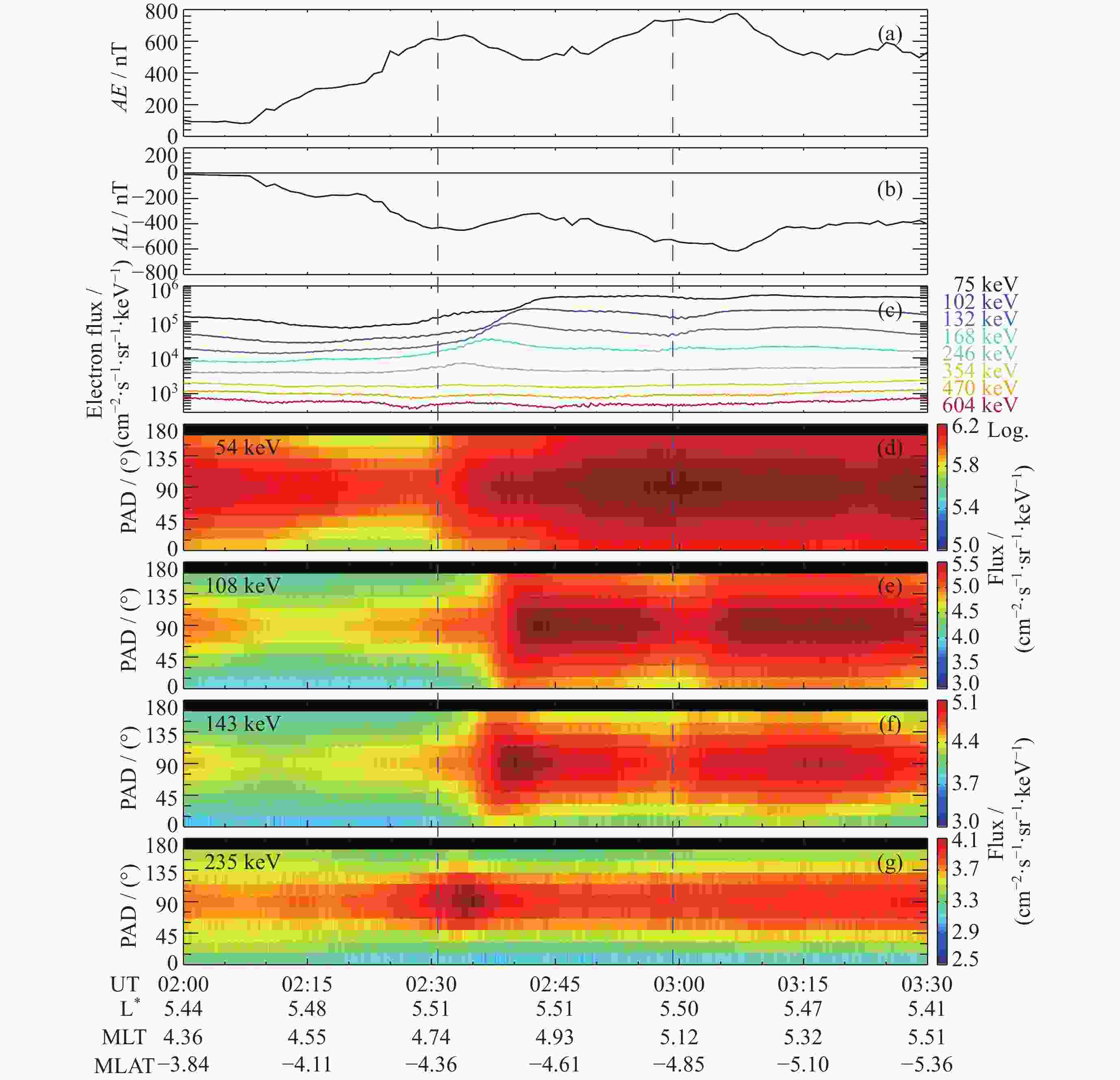
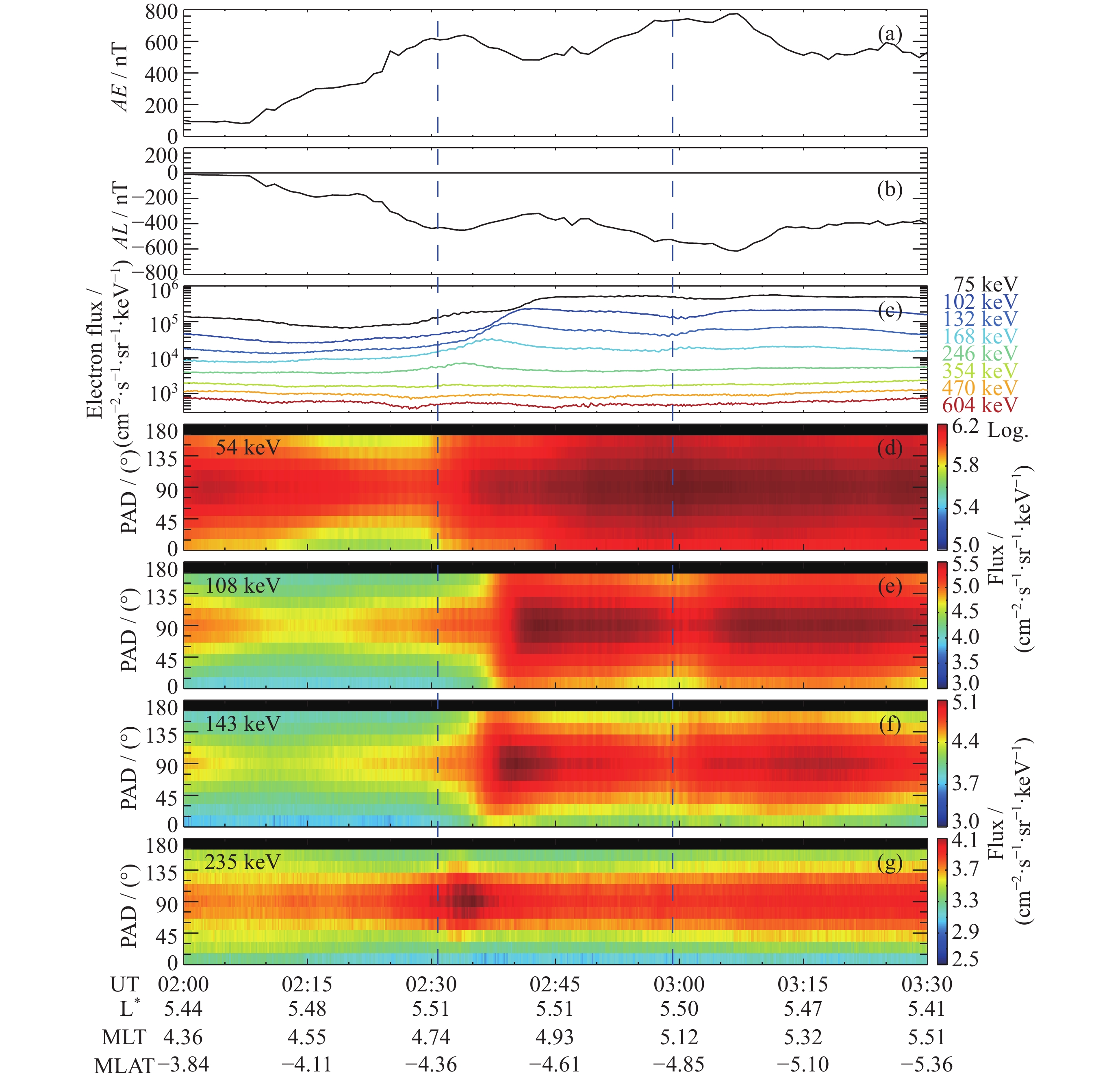
图 11 2018年3月25日02:00-03:30 UT期间范艾伦探测器B的观测结果
Figure 11. Observations from Van Allen Probe B during 02:00-03:30 UT on 25 March 2018
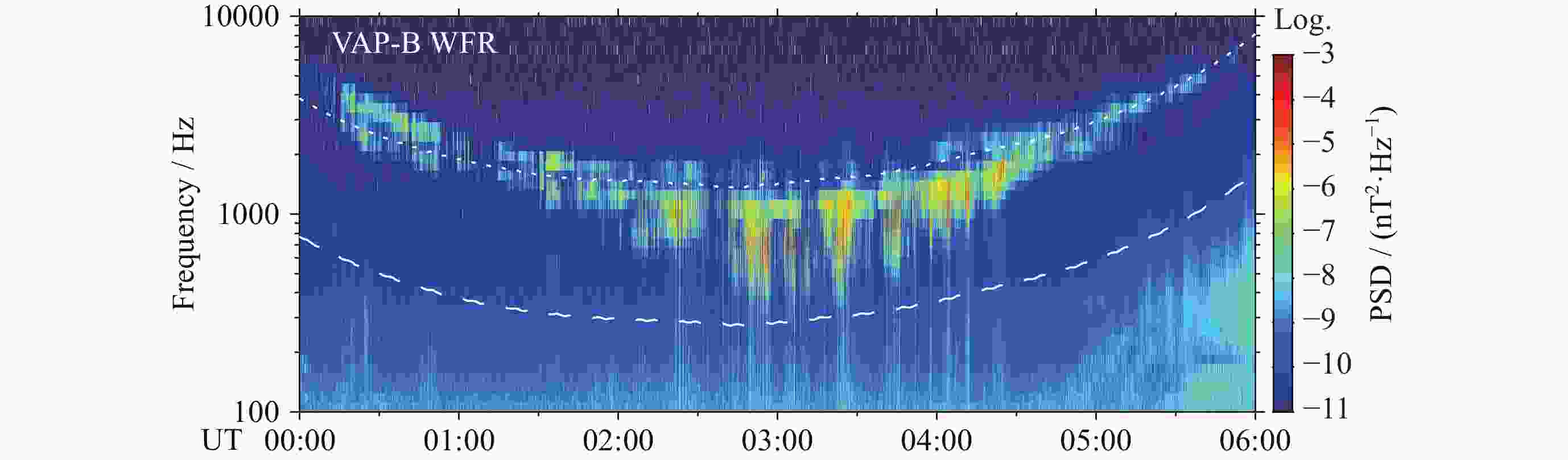
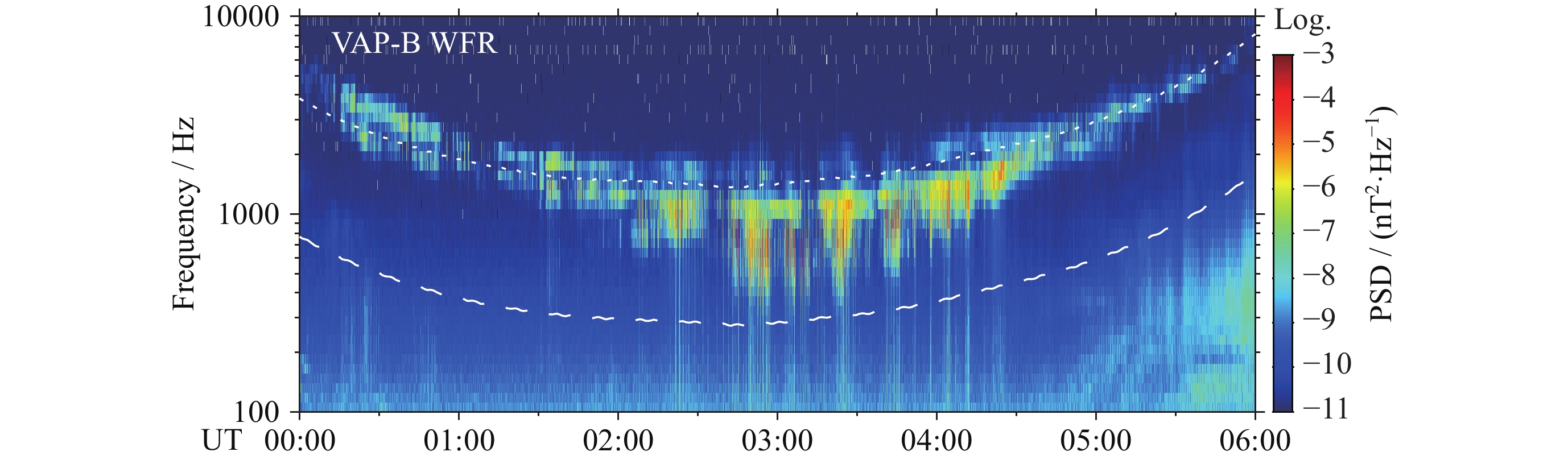
图 12 2018年3月25日00:00-06:00 UT范艾伦探测器B上EMFISIS仪器测量的磁场谱
Figure 12. Magnetic-field spectra measured by EMFISIS on Van Allen Probe B during 00:00-06:00 UT on 25 March 2018
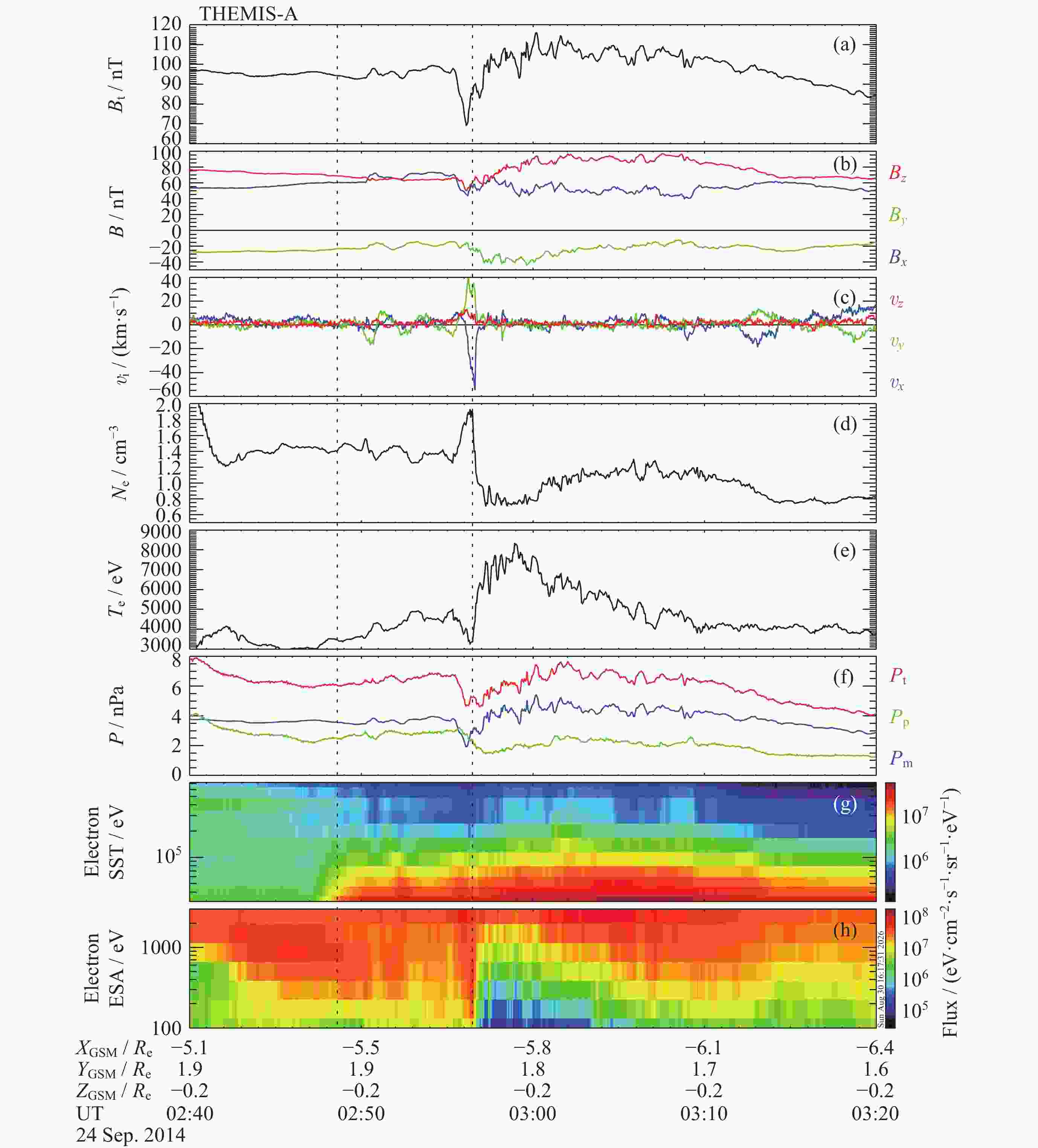
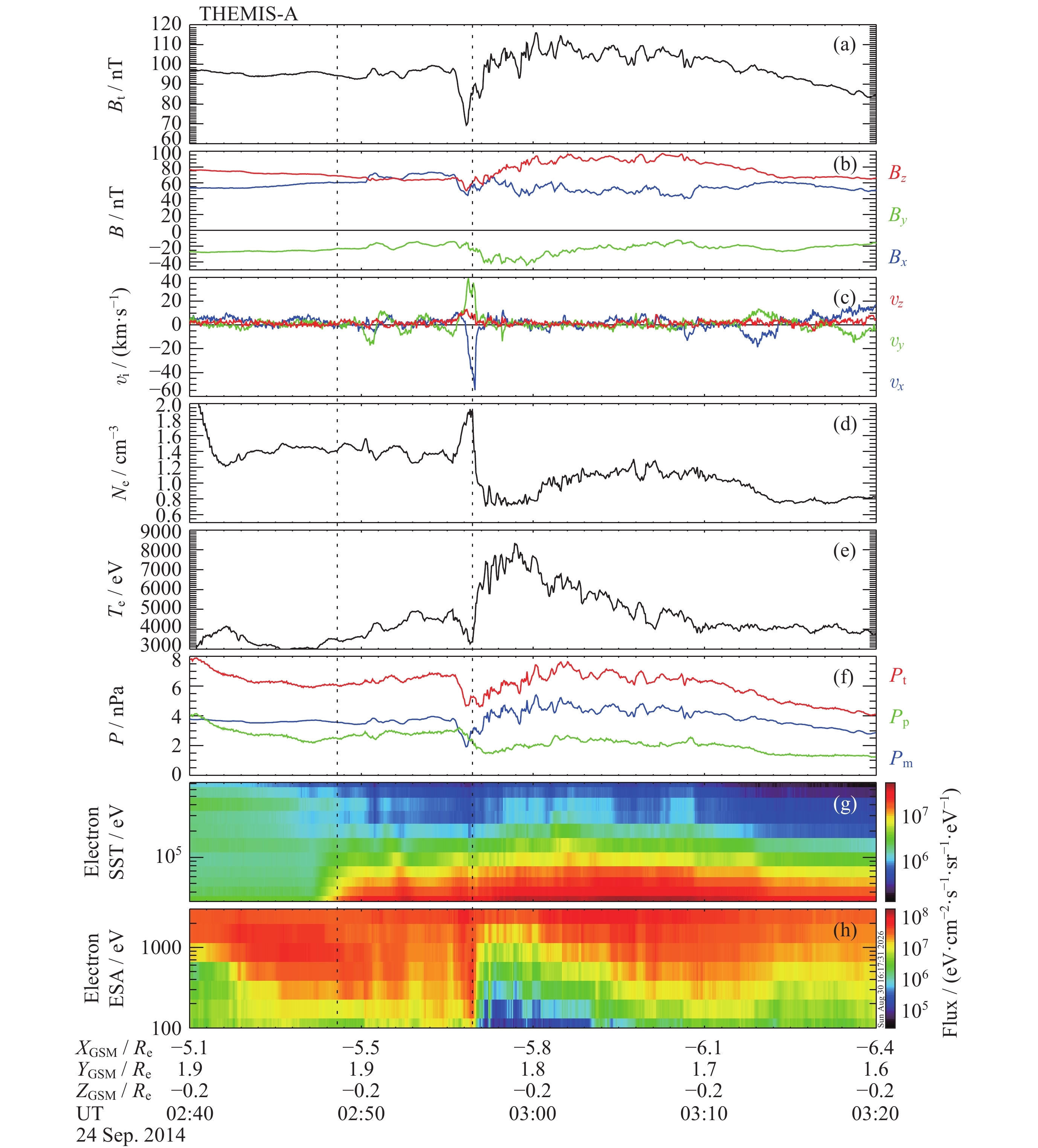
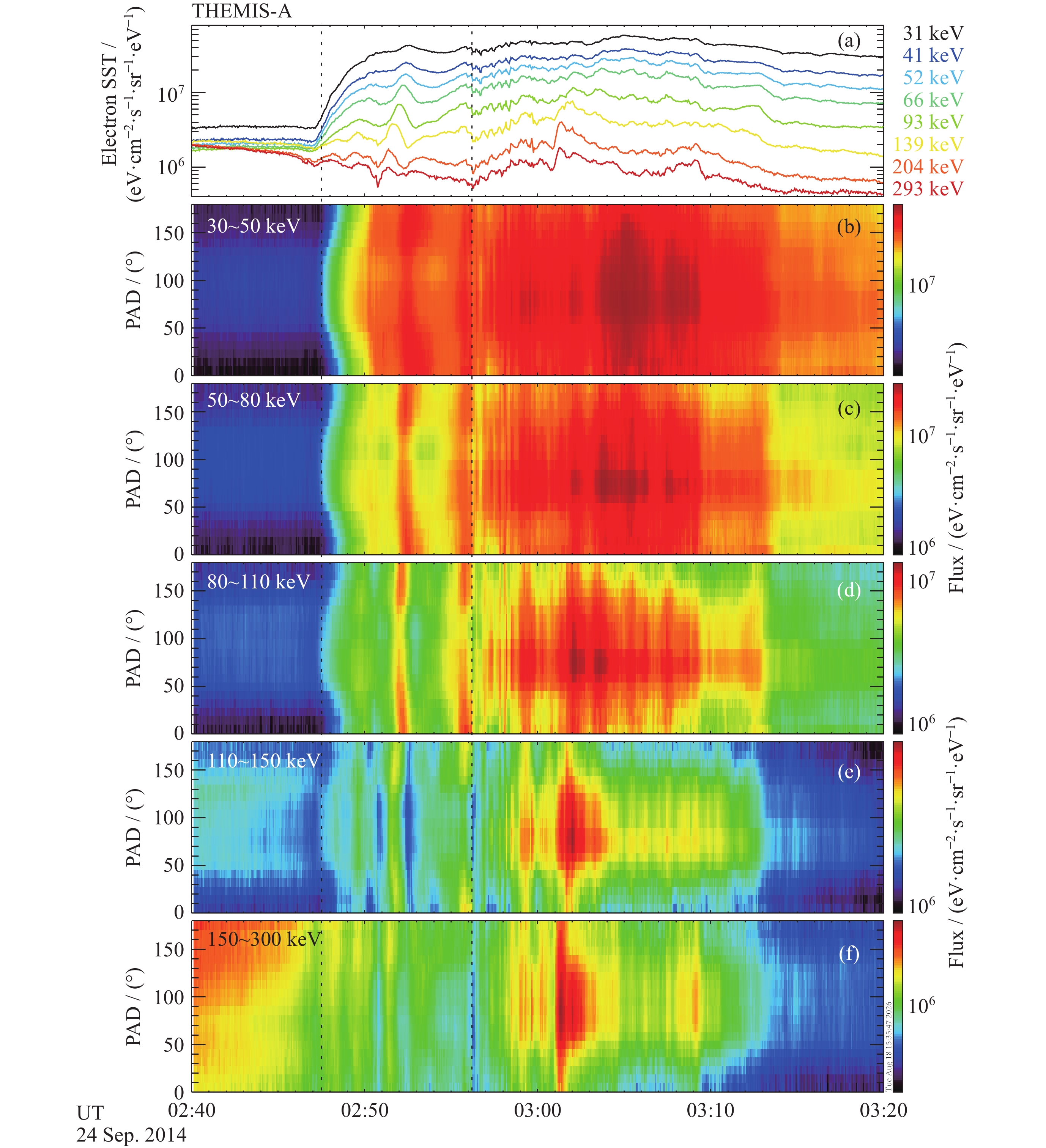
图 13 2014年9月24日02:40-03:20 UT期间THEMIS-A的观测结果
Figure 13. Observations from THEMIS-A during 02:40-03:20 UT on 24 September 2014
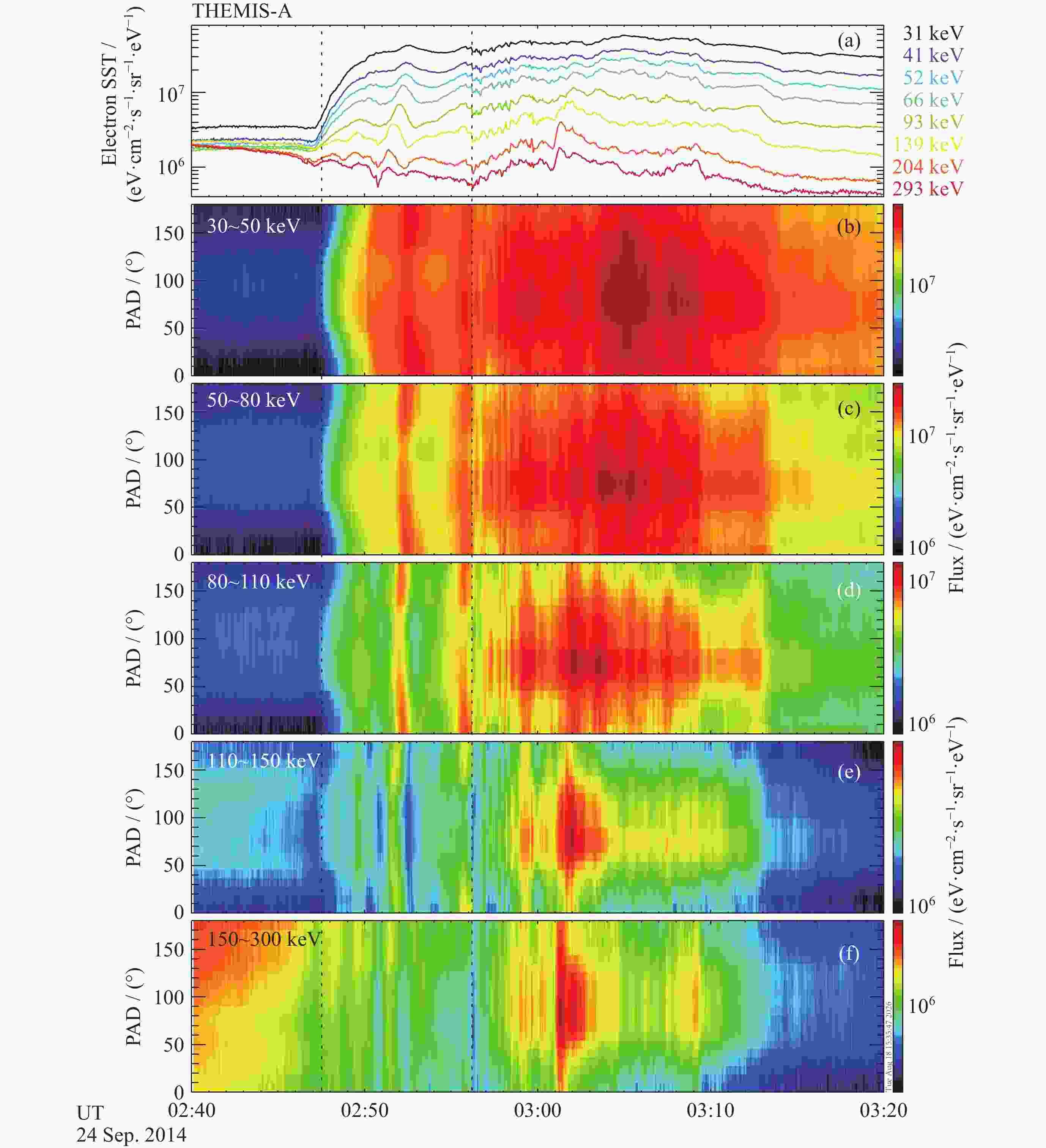
图 14 2014年9月24日02:40-03:20 UT期间THEMIS-E的电子观测结果
Figure 14. Observations from THEMIS-E during 02:40-03:20 UT on 24 September 2014
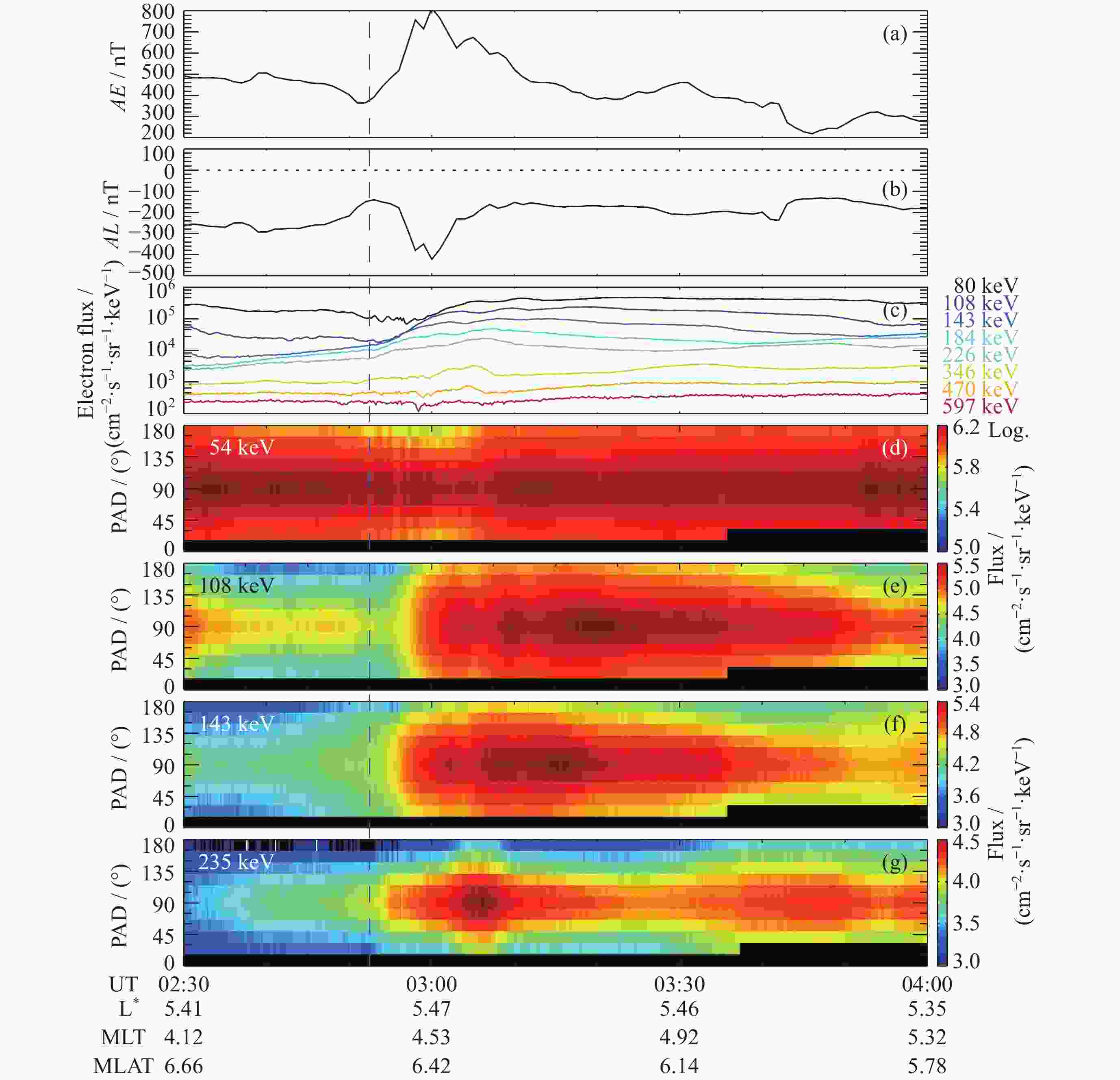
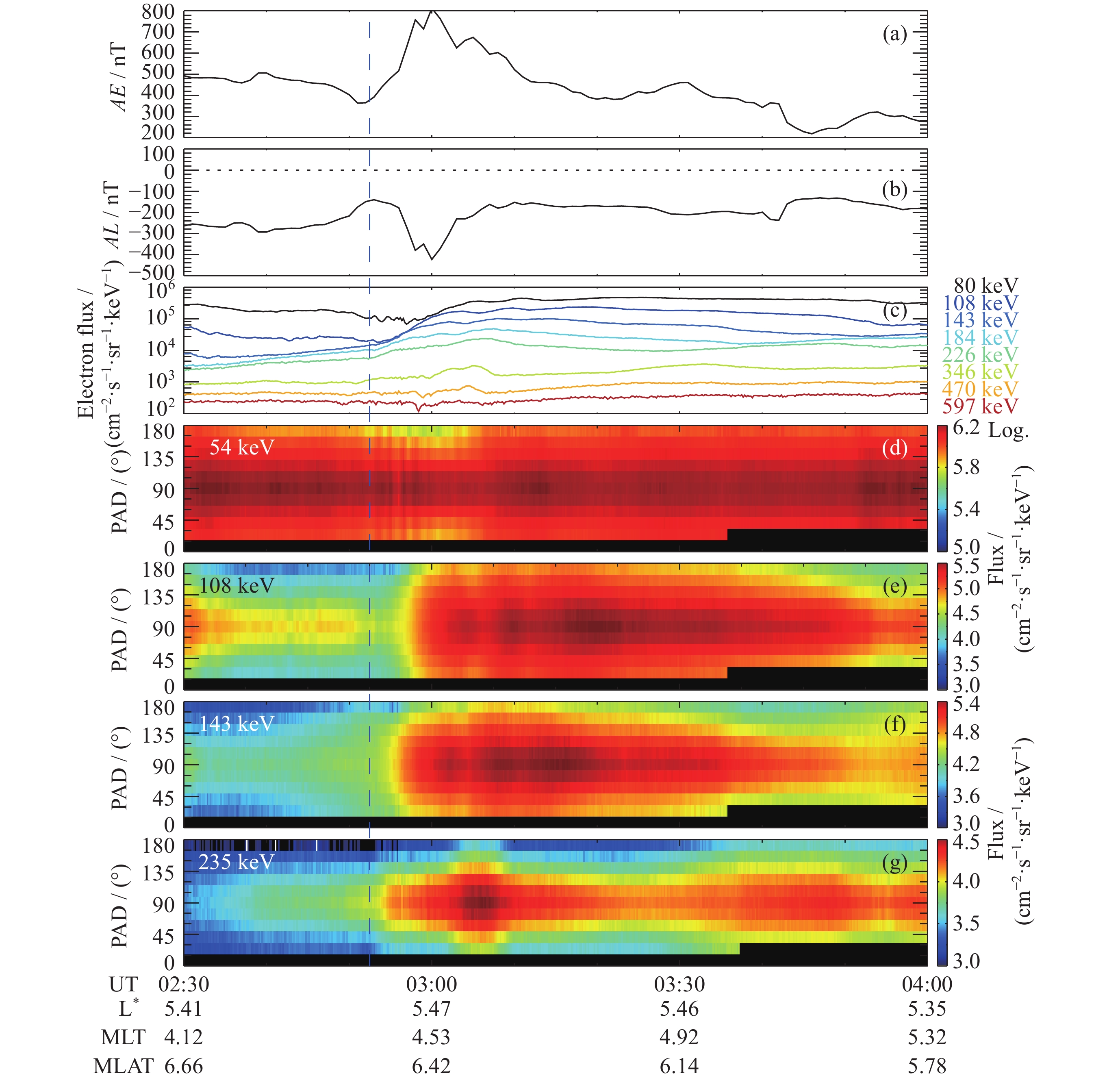
图 15 2014年9月24日02:30-04:00 UT期间范艾伦探测器A的观测结果
Figure 15. Observations from Van Allen Probe A during 02:30-04:00 UT on 24 September 2014
-
[1] DAI L, WANG C, REN Y, et al. Geomagnetic storms and substorms: progress and perspectives[J]. Chinese Science Bulletin, 2025, 70(27): 4769-4774 [2] LI L Y, CAO J B, ZHOU G C, et al. Statistical roles of storms and substorms in changing the entire outer zone relativistic electron population[J]. Journal of Geophysical Research: Space Physics, 2009, 114(A12): A12214 doi: 10.1029/2009ja014333 [3] SU Z P, ZHU H, XIAO F L, et al. Intense duskside Lower band chorus waves observed by Van Allen Probes: generation and potential acceleration effect on radiation belt electrons[J]. Journal of Geophysical Research: Space Physics, 2014, 119(6): 4266-4273 doi: 10.1002/2014JA019919 [4] TANG C L, ZHANG J-C, REEVES G D, et al. Prompt enhancement of the Earth’s outer radiation belt due to substorm electron injections[J]. Journal of Geophysical Research: Space Physics, 2016, 121(12): 11826-11838 doi: 10.1002/2016ja023550 [5] TANG C L, WANG Y X, NI B, et al. Radiation belt seed population and its association with the relativistic electron dynamics: a statistical study[J]. Journal of Geophysical Research: Space Physics, 2017, 122(5): 5261-5276 doi: 10.1002/2017JA023905 [6] TANG C L, WANG Y X, NI B, et al. The effects of magnetospheric processes on relativistic electron dynamics in the Earth's outer radiation belt[J]. Journal of Geophysical Research: Space Physics, 2017, 122(10): 9952-9968 doi: 10.1002/2017JA024407 [7] TANG C L, XIE X J, NI B, et al. Rapid enhancements of the seed populations in the heart of the Earth’s outer radiation belt: a multicase study[J]. Journal of Geophysical Research: Space Physics, 2018, 123(6): 4895-4907 doi: 10.1029/2017JA025142 [8] HUA M, BORTNIK J, MA Q L. Upper limit of outer radiation belt electron acceleration driven by whistler-mode chorus waves[J]. Geophysical Research Letters, 2022, 49(15): e2022GL099618 doi: 10.1029/2022GL099618 [9] WANG X, TANG C L, NI B B, et al. The seed populations in the Earth's outer radiation belt during the main phase of magnetic storms: a statistical study[J]. Journal of Geophysical Research: Space Physics, 2022, 127(3): e2021JA030193 doi: 10.1029/2021JA030193 [10] WANG X, TANG C L, NI B B, et al. The evolutions of the seed and relativistic electrons in the Earth’s outer radiation belt during the geomagnetic storms: a statistical study[J]. Journal of Geophysical Research: Space Physics, 2023, 128(5): e2023JA031284 doi: 10.1029/2023JA031284 [11] REEVES G D, SPENCE H E, HENDERSON M G, et al. Electron acceleration in the heart of the Van Allen radiation belts[J]. Science, 2013, 341(6149): 991-994 doi: 10.1126/science.1237743 [12] THORNE R M, LI W, NI B, et al. Rapid local acceleration of relativistic radiation-belt electrons by magnetospheric chorus[J]. Nature, 2013, 504(7480): 411-414 doi: 10.1038/nature12889 [13] LI W, THORNE R M, MA Q, et al. Radiation belt electron acceleration by chorus waves during the 17 March 2013 storm[J]. Journal of Geophysical Research: Space Physics, 2014, 119(6): 4681-4693 doi: 10.1002/2014JA019945 [14] BOYD A J, TURNER D L, REEVES G D, et al. What causes radiation belt enhancements: a survey of the van Allen probes era[J]. Geophysical Research Letters, 2018, 45(11): 5253-5259 doi: 10.1029/2018GL077699 [15] YANG C, XIAO F L, HE Y H, et al. Storm time evolution of outer radiation belt relativistic electrons by a nearly continuous distribution of chorus[J]. Geophysical Research Letters, 2018, 45(5): 2159-2167 doi: 10.1002/2017GL075894 [16] ALLISON H J, SHPRITS Y Y. Local heating of radiation belt electrons to ultra-relativistic energies[J]. Nature Communications, 2020, 11(1): 4533 doi: 10.1038/s41467-020-18053-z [17] CHEN J R, TANG C L, CHU X X, et al. A statistical study on the acceleration conditions of ultrarelativistic electrons in the Earth’s outer radiation belt during geomagnetic storms[J]. Journal of Geophysical Research: Space Physics, 2023, 128(10): e2023JA032024 doi: 10.1029/2023JA032024 [18] BOYD A J, SPENCE H E, CLAUDEPIERRE S G, et al. Quantifying the radiation belt seed population in the 17 March 2013 electron acceleration event[J]. Geophysical Research Letters, 2014, 41(7): 2275-2281 doi: 10.1002/2014GL059626 [19] JAYNES A N, BAKER D N, SINGER H J, et al. Source and seed populations for relativistic electrons: their roles in radiation belt changes[J]. Journal of Geophysical Research: Space Physics, 2015, 120(9): 7240-7254 doi: 10.1002/2015JA021234 [20] TANG C L, LI Z Y, ANGELOPOULOS V, et al. THEMIS observations of the near-Earth plasma sheet during a substorm[J]. Journal of Geophysical Research: Space Physics, 2009, 114(A9): A09211 doi: 10.1029/2008ja013729 [21] TANG C L, ANGELOPOULOS V, RUNOV A, et al. Precursor activation and substorm expansion associated with observations of a dipolarization front by Time History of Events and Macroscale Interactions during Substorms (THEMIS)[J]. Journal of Geophysical Research: Space Physics, 2010, 115(A7): A07215 doi: 10.1029/2009ja014879 [22] TANG C L, LU L, ZHOU M, et al. THEMIS observations of electron acceleration associated with the evolution of substorm dipolarization in the near-Earth tail[J]. Journal of Geophysical Research: Space Physics, 2013, 118(7): 4237-4247 doi: 10.1002/jgra.50418 [23] TANG C L, ZHOU M, YAO Z H, et al. Electron acceleration associated with the magnetic flux pileup regions in the near-Earth plasma sheet: a multicase study[J]. Journal of Geophysical Research: Space Physics, 2016, 121(5): 4331-4342 doi: 10.1002/2016JA022406 [24] OMURA Y, KATOH Y, SUMMERS D. Theory and simulation of the generation of whistler-mode chorus[J]. Journal of Geophysical Research: Space Physics, 2008, 113(A4): A04223 doi: 10.1029/2007ja012622 [25] TSURUTANI B T, SMITH E J. Two types of magnetospheric ELF chorus and their substorm dependences[J]. Journal of Geophysical Research, 1977, 82(32): 5112-5128 doi: 10.1029/JA082i032p05112 [26] 何甜, 刘四清, 郑金磊, 等. 哨声模合声波与地球同步轨道高能电子通量增强事件事例研究[J]. 空间科学学报, 2013, 33(2): 170-175 doi: 10.11728/cjss2013.02.170HE Tian, LIU Siqing, ZHENG Jinlei, et al. Study on high energy electron flux enhancement events and whistler chorus wave[J]. Chinese Journal of Space Science, 2013, 33(2): 170-175 doi: 10.11728/cjss2013.02.170 [27] XIAO F L, YANG C, HE Z G, et al. Chorus acceleration of radiation belt relativistic electrons during March 2013 geomagnetic storm[J]. Journal of Geophysical Research: Space Physics, 2014, 119(5): 3325-3332 doi: 10.1002/2014JA019822 [28] OMURA Y, MIYASHITA Y, YOSHIKAWA M, et al. Formation process of relativistic electron flux through interaction with chorus emissions in the Earth's inner magnetosphere[J]. Journal of Geophysical Research: Space Physics, 2015, 120(11): 9545-9562 doi: 10.1002/2015JA021563 [29] TANG C L, YANG C, CHEN J R, et al. Rapid enhancements of relativistic electrons in the Earth's outer radiation belt caused by the intense substorms: a statistical study[J]. Journal of Geophysical Research: Space Physics, 2023, 128(2): e2022JA031089 doi: 10.1029/2022JA031089 [30] TANG C L, SU Z P, NI B B, et al. The effects of geomagnetic activities on acceleration regions of radiation belt electrons[J]. Journal of Geophysical Research: Space Physics, 2023, 128(6): e2022JA031229 doi: 10.1029/2022JA031229 [31] WANG D D, SHPRITS Y Y, ZHELAVSKAYA I S, et al. Analytical chorus wave model derived from van Allen probe observations[J]. Journal of Geophysical Research: Space Physics, 2019, 124(2): 1063-1084 doi: 10.1029/2018JA026183 [32] ZHAO H, BAKER D N, LI X, et al. On the acceleration mechanism of ultrarelativistic electrons in the center of the outer radiation belt: a statistical study[J]. Journal of Geophysical Research: Space Physics, 2019, 124(11): 8590-8599 doi: 10.1029/2019JA027111 [33] BINGHAM S T, MOUIKIS C G, KISTLER L M, et al. The storm time development of source electrons and chorus wave activity during CME-and CIR-driven storms[J]. Journal of Geophysical Research: Space Physics, 2019, 124(8): 6438-6452 doi: 10.1029/2019JA026689 [34] LI W, THORNE R M, ANGELOPOULOS V, et al. Global distribution of whistler‐mode chorus waves observed on the THEMIS spacecraft[J]. Geophysical Research Letters, 2009, 36(9): L09104 doi: 10.1029/2009gl037595 [35] MEREDITH N P, HORNE R B, ANDERSON R R. Substorm dependence of chorus amplitudes: Implications for the acceleration of electrons to relativistic energies[J]. Journal of Geophysical Research: Space Physics, 2001, 106(A7): 13165-13178 doi: 10.1029/2000JA900156 [36] MEREDITH N P, HORNE R B, SICARD-PIET A, et al. Global model of Lower band and Upper band chorus from multiple satellite observations[J]. Journal of Geophysical Research: Space Physics, 2012, 117(A10): A10225 doi: 10.1029/2012ja017978 [37] HORNE R B, THORNE R M, GLAUERT S A, et al. Timescale for radiation belt electron acceleration by whistler mode chorus waves[J]. Journal of Geophysical Research: Space Physics, 2005, 110(A3): A03225 doi: 10.1029/2004ja010811 [38] LI X L, BAKER D N, TEMERIN M, et al. Simulation of dispersionless injections and drift echoes of energetic electrons associated with substorms[J]. Geophysical Research Letters, 1998, 25(20): 3763-3766 doi: 10.1029/1998GL900001 [39] GANUSHKINA N Y, AMARIUTEI O A, SHPRITS Y Y, et al. Transport of the plasma sheet electrons to the geostationary distances[J]. Journal of Geophysical Research: Space Physics, 2013, 118(1): 82-98 doi: 10.1029/2012JA017923 [40] SU Z P, ZHU H, XIAO F L, et al. Quantifying the relative contributions of substorm injections and chorus waves to the rapid outward extension of electron radiation belt[J]. Journal of Geophysical Research: Space Physics, 2014, 119(12): 10023-10040 [41] DAI L, WANG C, DUAN S P, et al. Near-Earth injection of MeV electrons associated with intense dipolarization electric fields: van Allen Probes observations[J]. Geophysical Research Letters, 2015, 42(15): 6170-6179 doi: 10.1002/2015GL064955 [42] TANG C L, WANG X, NI B B, et al. The 600 keV electron injections in the Earth’s outer radiation belt: a statistical study[J]. Earth and Planetary Physics, 2022, 6(2): 149-160 [43] KIM H-J, LEE D-Y, WOLF R, et al. Rapid injections of MeV electrons and extremely fast step like outer radiation belt enhancements[J]. Geophysical Research Letters, 2021, 48(9): e2021GL093151 doi: 10.1029/2021GL093151 [44] XIONG S L, DAI L, WANG C, et al. Relativistic electron enhancements through successive dipolarizations during a CIR-driven storm[J]. Journal of Geophysical Research: Space Physics, 2022, 127(3): e2021JA030088 doi: 10.1029/2021JA030088 [45] XIONG S L, DAI L, WANG C, et al. Rapid relativistic electron enhancements and associated particle injections: a multi-spacecraft statistical study[J]. Journal of Geophysical Research: Space Physics, 2024, 129(1): e2023JA032095 doi: 10.1029/2023JA032095 [46] ZONG Q G, ZHOU X Z, WANG Y F, et al. Energetic electron response to ULF waves induced by interplanetary shocks in the outer radiation belt[J]. Journal of Geophysical Research: Space Physics, 2009, 114(A10): A10204 doi: 10.1029/2009ja014393 [47] SU Z P, ZHU H, XIAO F L, et al. Ultra-low-frequency wave-driven diffusion of radiation belt relativistic electrons[J]. Nature Communications, 2015, 6: 10096 doi: 10.1038/ncomms10096 [48] GU X D, XIA S J, FU S, et al. Dynamic responses of radiation belt electron fluxes to magnetic storms and their correlations with magnetospheric plasma wave activities[J]. The Astrophysical Journal, 2020, 891(2): 127 doi: 10.3847/1538-4357/ab71fc [49] TANG C L, CHU X X, SU Z P, et al. Three-step acceleration of the radiation belt relativistic electrons by interplanetary shocks[J]. The Astrophysical Journal Supplement Series, 2025, 281(1): 15 doi: 10.3847/1538-4365/ae0a15 [50] NOSÉ M, IYEMORI T, NAKABE S, et al. ULF pulsations observed by the ETS-Vi satellite: substorm associated azimuthal Pc 4 pulsations on the nightside[J]. Earth, Planets and Space, 1998, 50(1): 63-80 doi: 10.1186/bf03352087 [51] HAO Y X, ZONG Q G, WANG Y F, et al. Interactions of energetic electrons with ULF waves triggered by interplanetary shock: van Allen Probes observations in the magnetotail[J]. Journal of Geophysical Research: Space Physics, 2014, 119(10): 8262-8273 doi: 10.1002/2014JA020023 [52] CHU X X, TANG C L, SU Z P, et al. Relativistic electron flux oscillations in the Earth’s outer radiation belt: a statistical study[J]. Journal of Geophysical Research: Space Physics, 2025, 130(10): e2025JA034359 doi: 10.1029/2025JA034359 [53] TANG C L. A plasma flow vortex in the magnetotail and its related ionospheric signatures[J]. Annales Geophysicae, 2012, 30(3): 537-544 doi: 10.5194/angeo-30-537-2012 [54] TANG C L, WANG X, ZHOU M. Electron pitch angle distributions around dipolarization fronts at the off magnetic equator[J]. Journal of Geophysical Research: Space Physics, 2021, 126(2): e2020JA028787 doi: 10.1029/2020JA028787 [55] FU H S, KHOTYAINTSEV Y V, ANDRÉ M, et al. Fermi and betatron acceleration of suprathermal electrons behind dipolarization fronts[J]. Geophysical Research Letters, 2011, 38(16): L16104 doi: 10.1029/2011gl048528 [56] ZHOU M, DENG X H, ASHOUR-ABDALLA M, et al. Cluster observations of kinetic structures and electron acceleration within a dynamic plasma bubble[J]. Journal of Geophysical Research: Space Physics, 2013, 118(2): 674-684 doi: 10.1029/2012JA018323 [57] BLAKE J B, CARRANZA P A, CLAUDEPIERRE S G, et al. The Magnetic Electron Ion Spectrometer (MagEIS) instruments aboard the Radiation Belt Storm Probes (RBSP) spacecraft[J]. Space Science Reviews, 2013, 179(1/4): 383-421 [58] KLETZING C A, BORTNIK J, HOSPODARSKY G, et al. The Electric and Magnetic Fields Instrument Suite and Integrated Science (EMFISIS): science, data, and usage best practices[J]. Space Science Reviews, 2023, 219(4): 28 doi: 10.1007/s11214-023-00973-z [59] AGAPITOV O, ARTEMYEV A, KRASNOSELSKIKH V, et al. Statistics of whistler mode waves in the outer radiation belt: cluster STAFF-SA measurements[J]. Journal of Geophysical Research: Space Physics, 2013, 118(6): 3407-3420 doi: 10.1002/jgra.50312 [60] ARYAN H, YEARBY K, BALIKHIN M, et al. Statistical study of chorus wave distributions in the inner magnetosphere using Ae and solar wind parameters[J]. Journal of Geophysical Research: Space Physics, 2014, 119(8): 6131-6144 doi: 10.1002/2014JA019939 -
-

 下载:
下载:

计量
- 文章访问数: 527
- HTML全文浏览量: 74
- PDF下载量: 71
-
被引次数:
0(来源:Crossref)
0(来源:其他)

