


基于子午工程流星雷达数据的微流星体环境特征分析
doi: 10.11728/cjss2026.05.2025-0236 cstr: 32142.14.cjss.2025-0236
-
 石敏钰 女, 1999年12月出生于新疆维吾尔自治区乌鲁木齐市, 现为中国科学院国家空间科学中心飞行器设计专业在读博士生, 主要研究方向为空间碎片建模与碰撞预警等. E-mail: shiminyu24@mails.ucas.ac.cn
 -
 王荣兰 女, 1976年10月出生于山西省运城市,现为中国科学院国家空间科学中心副研究员, 硕士生导师, 主要研究方向为空间碎片预警与大气建模应用. E-mail: wangrl@nssc.ac.cn
作者简介:
通讯作者:
Analysis of Micrometeoroid Environment Characteristics Using Meteor Radar Data from the Meridian Project
-
摘要: 微流星体是威胁中国空间航天器安全的重要因素, 历史上已发生多起流星体撞击导致航天器异常的事件, 因此开展流星体环境的建模研究具有重大意义. 基于中国子午工程漠河站的观测数据, 反演近地空间微流星体的特征, 分析中国中高纬度上空微流星体的数量、高度、方位角、天顶角及通量等时空分布特征, 并反演了其质量和速度等物理特性. 结果表明, 流星体活动呈现明显季节与昼夜波动差异, 夏季多于冬季, 夜间高于白天; 空间分布不均, 主要集中在西北方向; 速度多在20~80 km·s–1之间, 高度集中于75~125 km. 反演通量结果与经典Grün模型对比发现, 对于大尺寸流星体的通量结果, 二者一致性较好. 该研究可为中国自主流星体环境建模研究提供技术支撑.Abstract: Micrometeoroids represent a significant factor threatening the safety of China’s spacecraft in space. Historically, numerous incidents of spacecraft anomalies due to meteoroid impacts have been reported; therefore, conducting modeling studies on the meteoroid environment is of great significance. This study utilizes observational data from the Mohe Station of China’s Meridian Project to retrieve the characteristics of micrometeoroids in near-Earth space. We analyzed the temporal-spatial distribution of micrometeoroids over China’s mid-to-high latitudes, specifically examining parameters including number, velocity, altitude, azimuth, zenith angle, and flux. Furthermore, physical properties such as mass were derived from the observational data. The results indicate that meteoroid activity exhibits distinct seasonal and diurnal variations: activity is higher in summer than in winter and significantly higher at night than during daytime. In addition, the spatial distribution of meteoroids is non-uniform and primarily concentrated in the northwest direction; their velocities predominantly range from 20 to 80 km·s–1, and altitudes are mainly concentrated on 75-125 km. Comparing the retrieved inversed flux results with the classical Grün model indicates that there is good consistency between the two sets of results for the flux of larger-sized meteoroids. This research can provide technical support for developing China's independent meteoroid environment modeling studies.
-
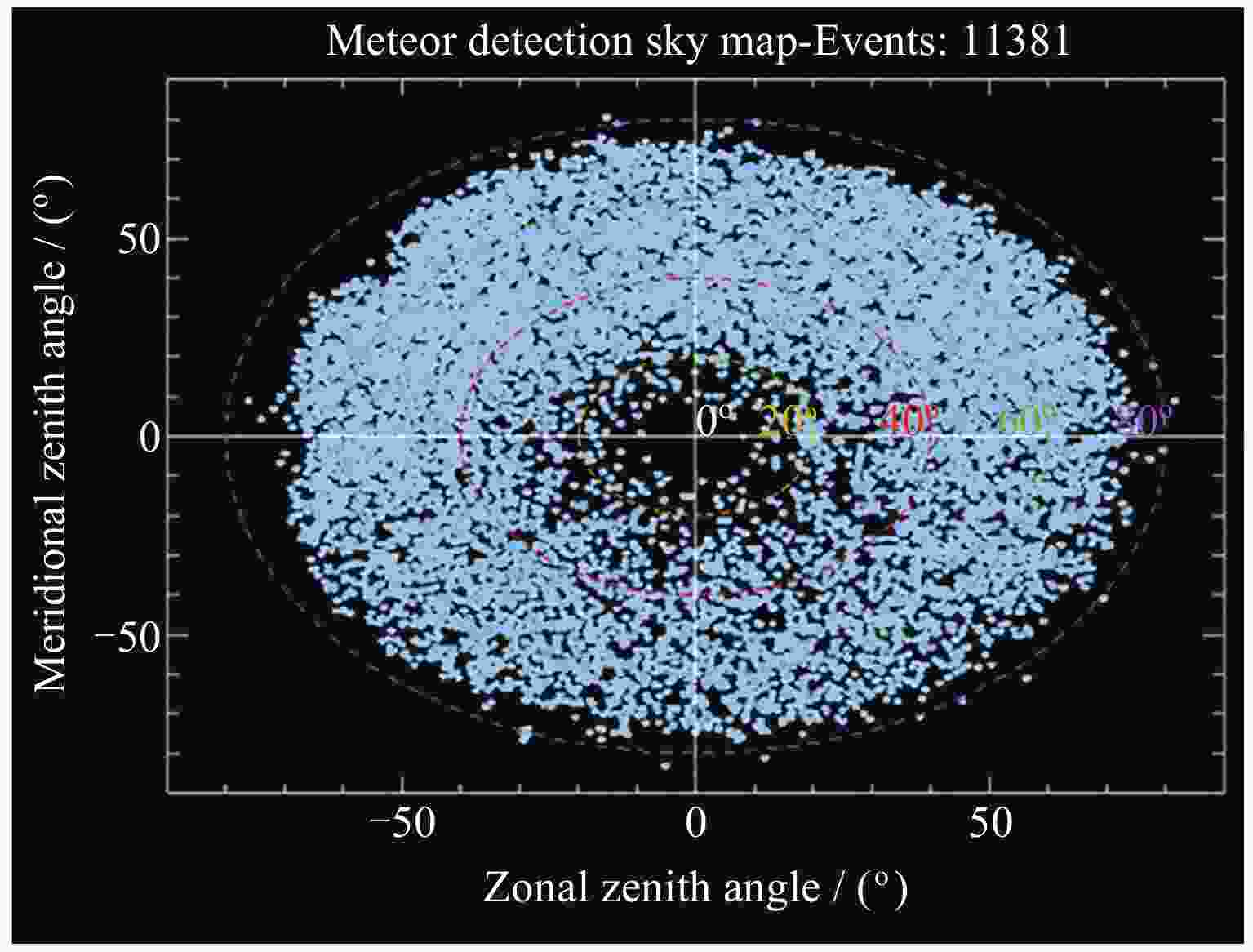
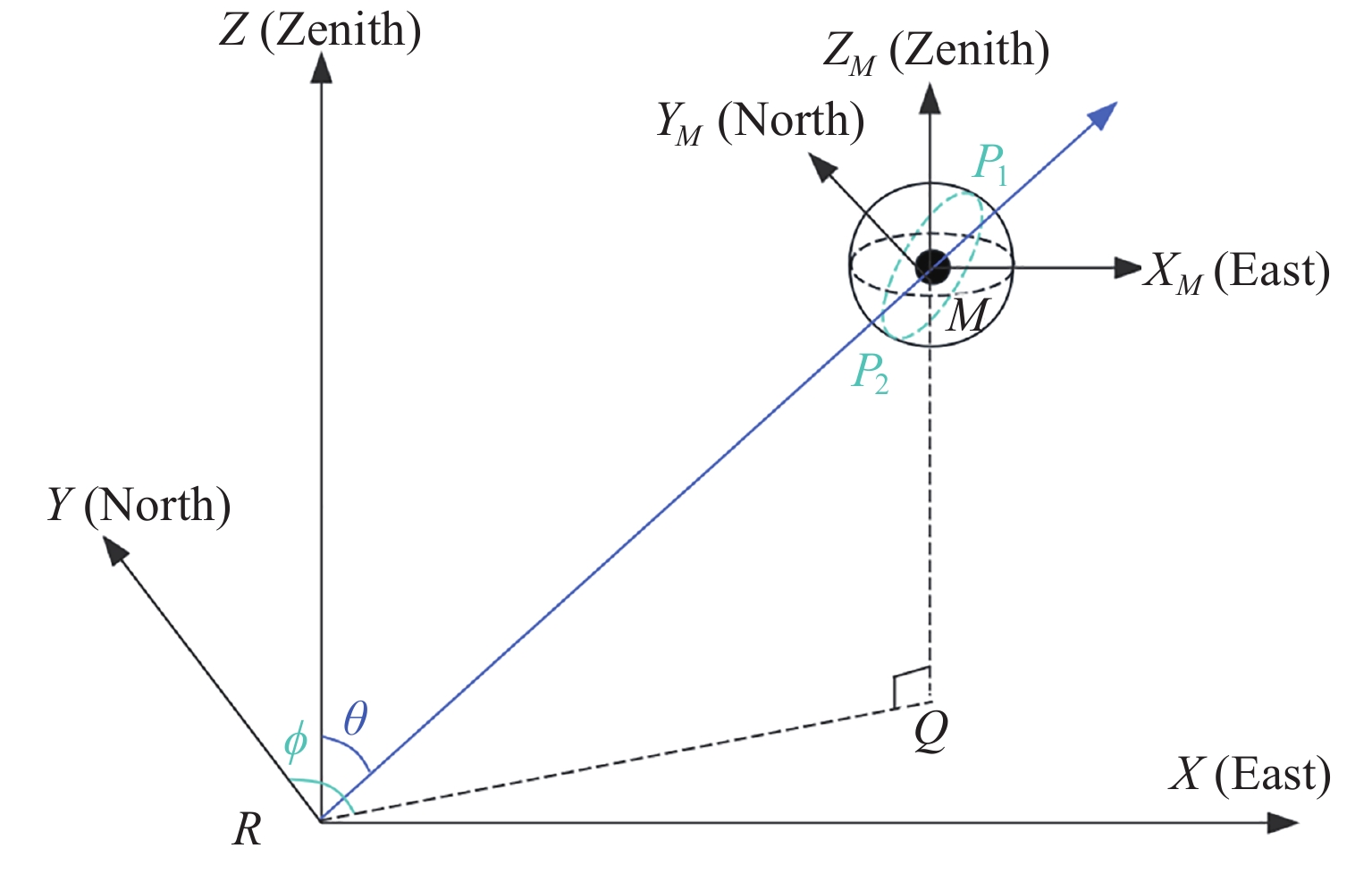
图 1 漠河站流星雷达2022年3月31日 12:00:00 UT流星参数图形文件
Figure 1. Meteor parameter graphic file of meteor radar at Mohe Station at 12:00:00 UT on 31 March 2022
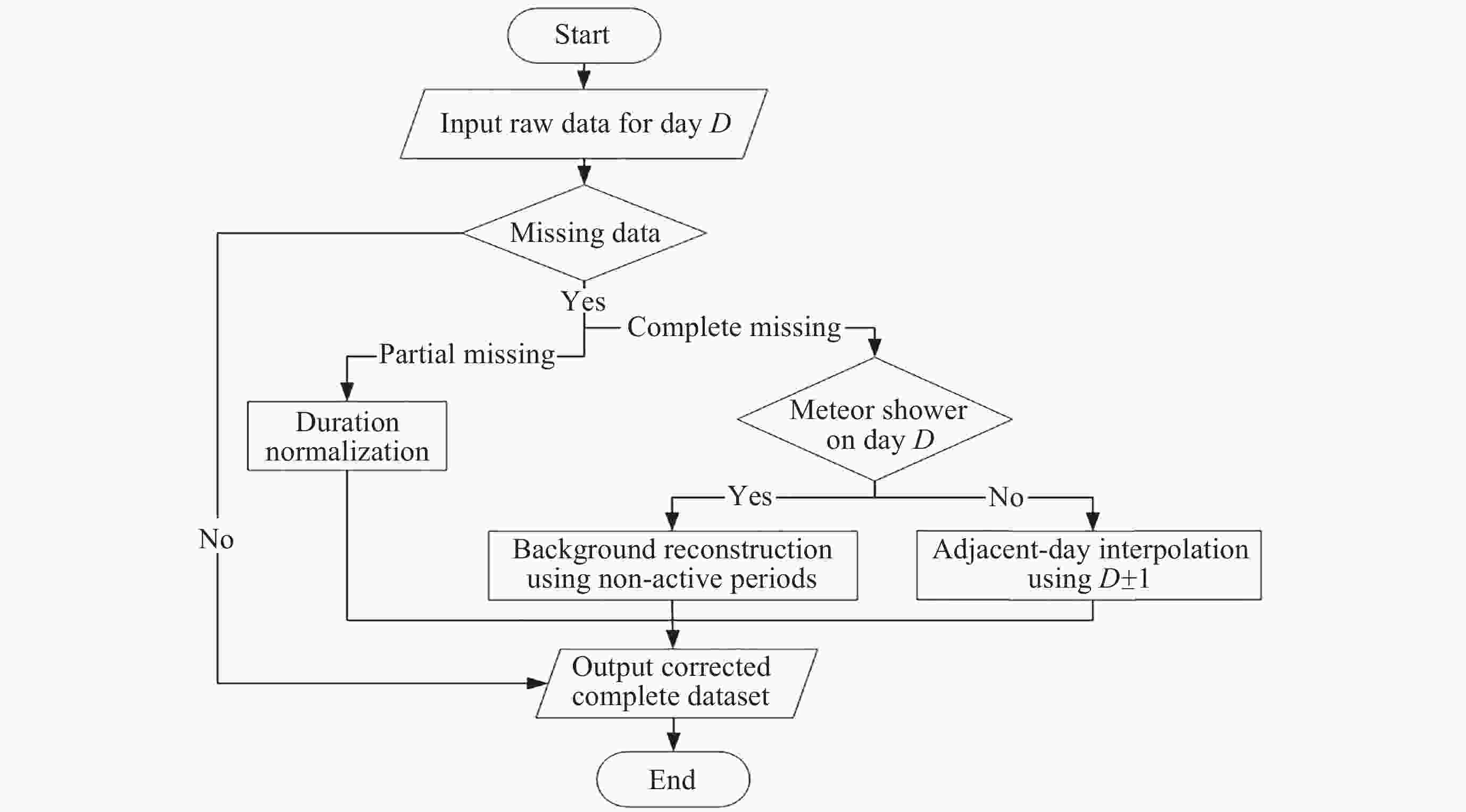
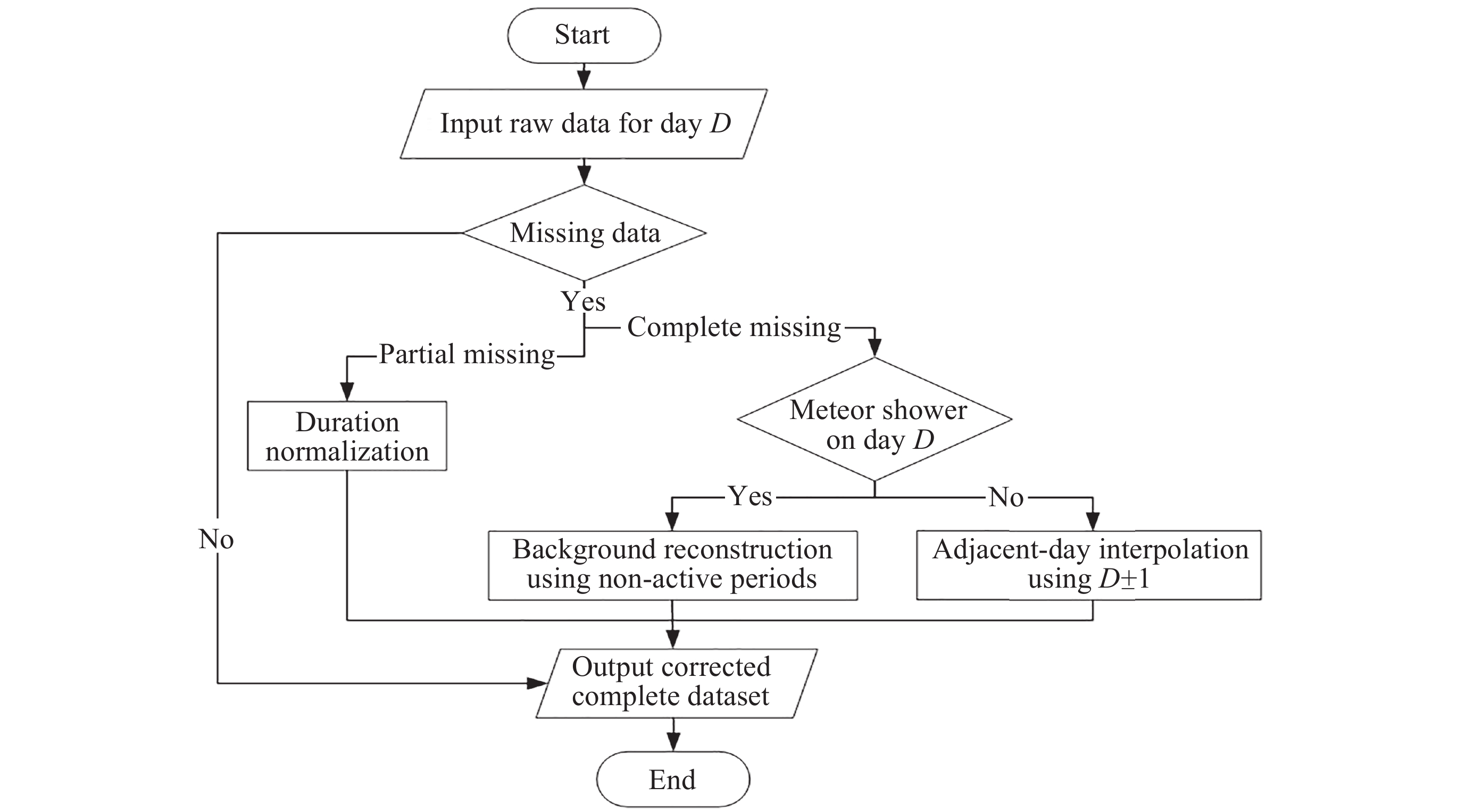
图 2 数据缺失补全与预处理逻辑流程
Figure 2. Logical flowchart of data completion and preprocessing strategy
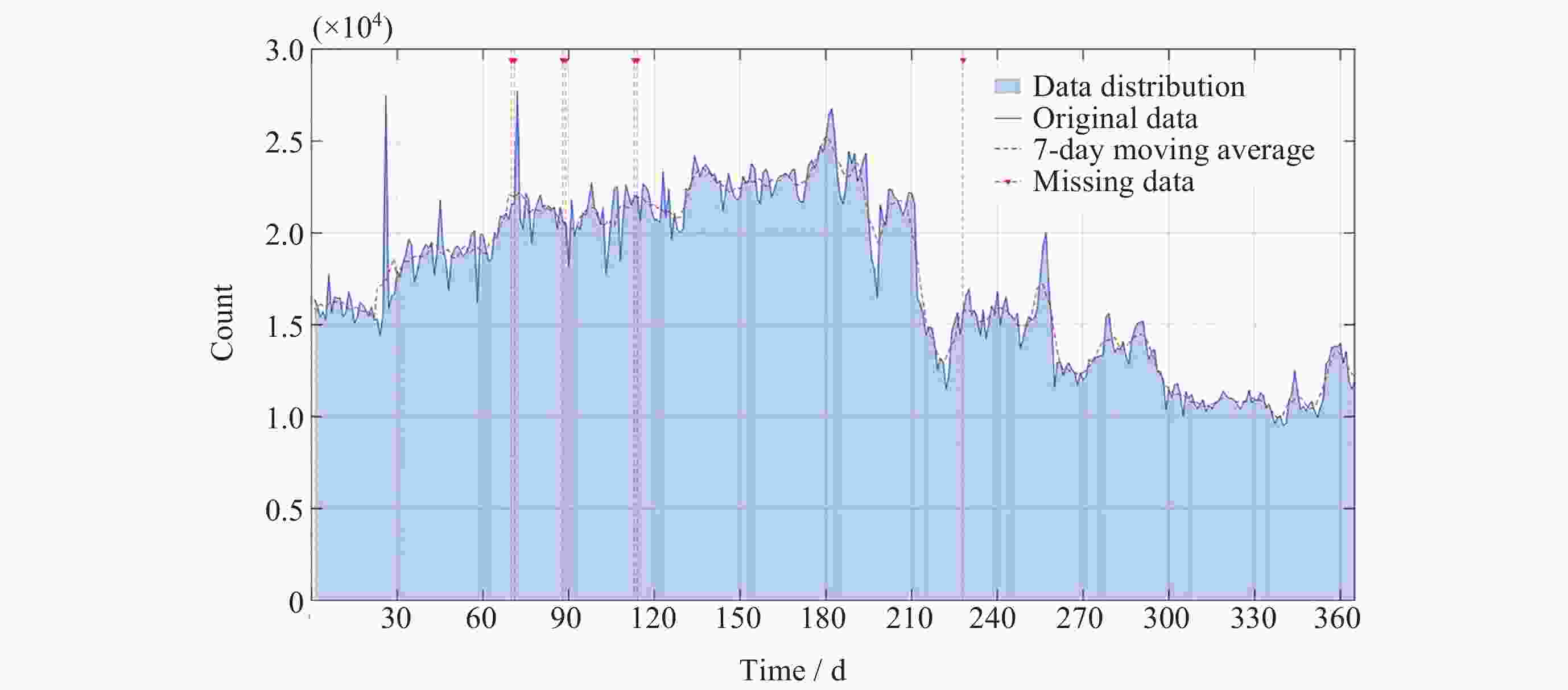
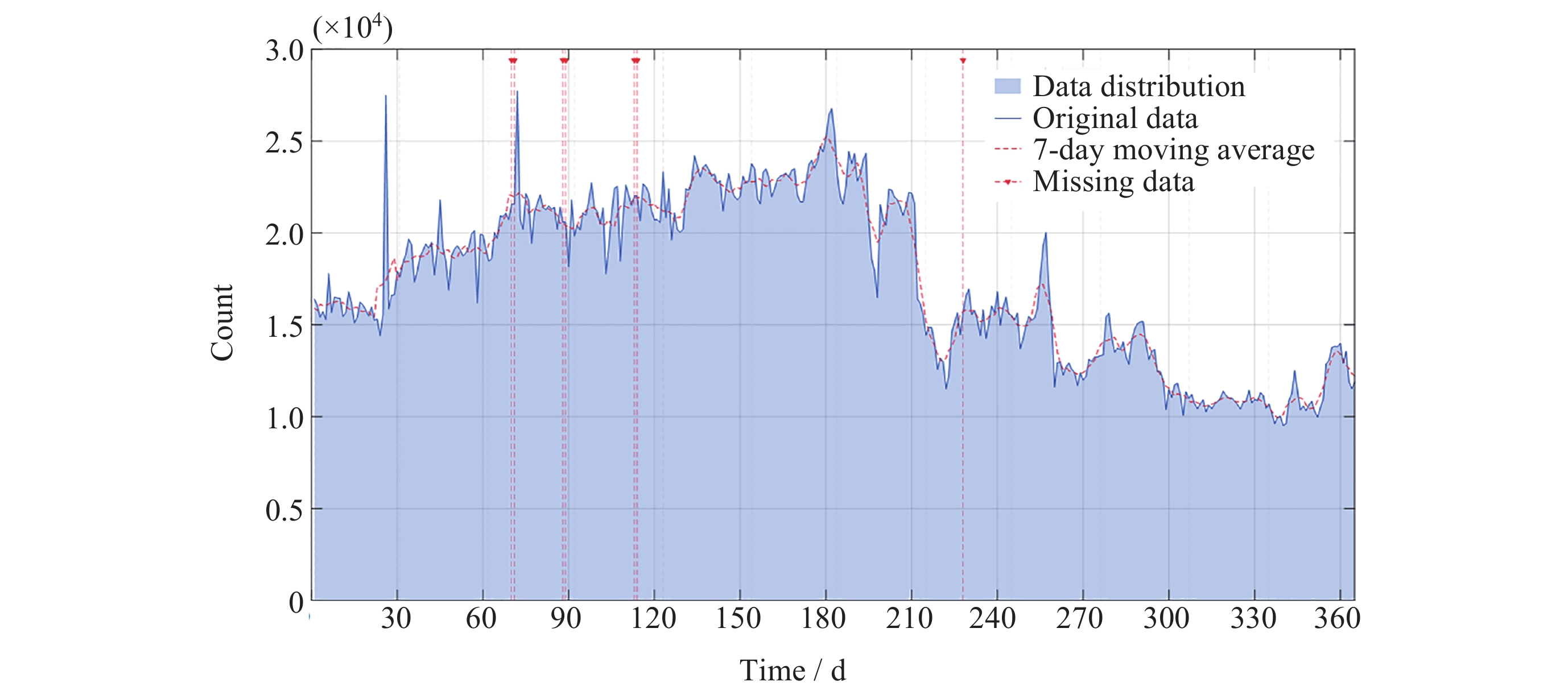
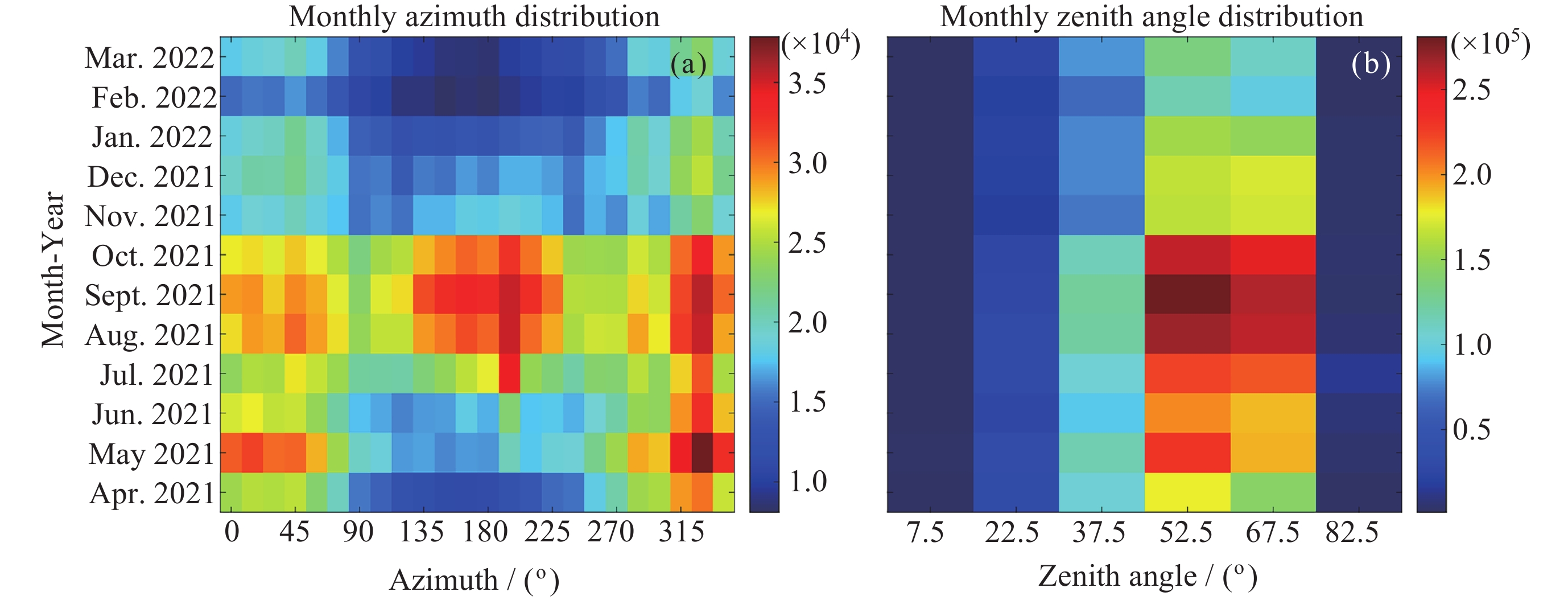
图 7 2021年4月1日至2022年3月31日每日流星体总数分布
Figure 7. Distribution of daily total meteoroid counts from 1 April 2021 to 31 March 2022
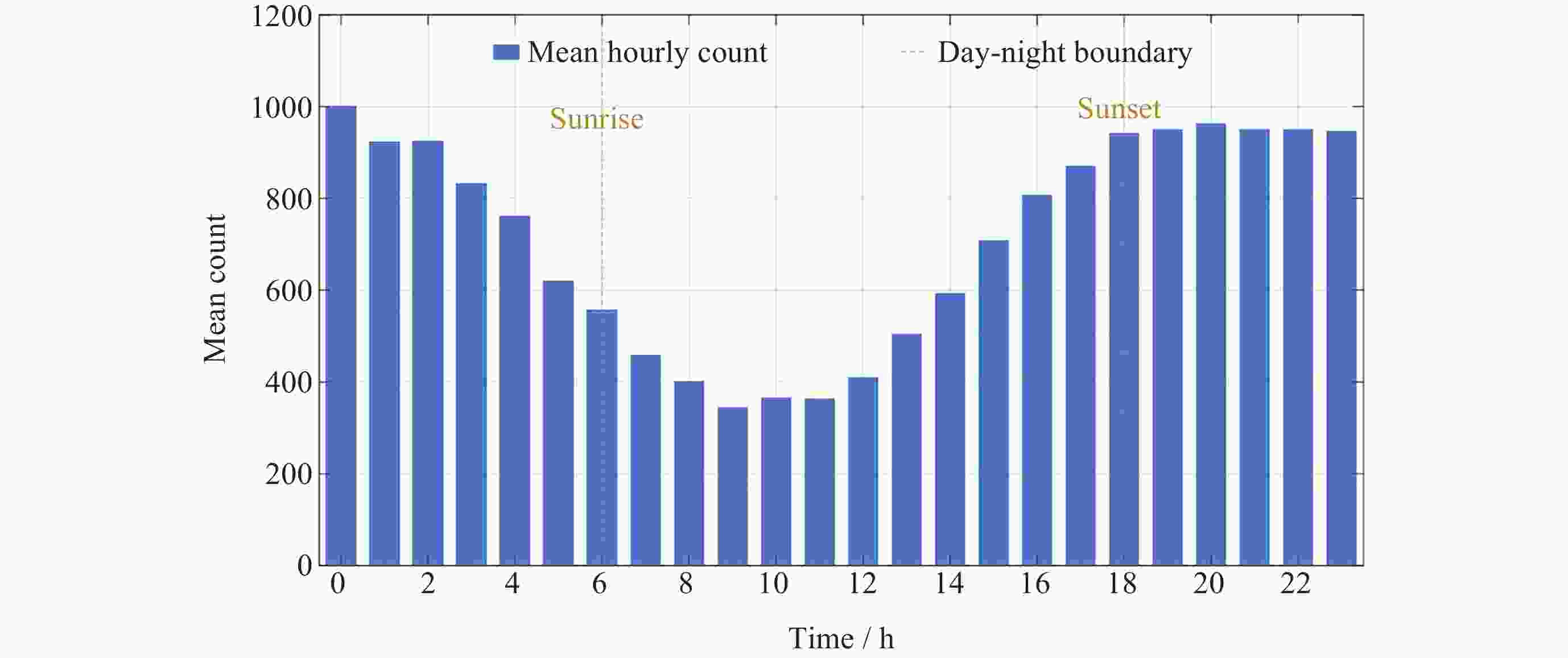
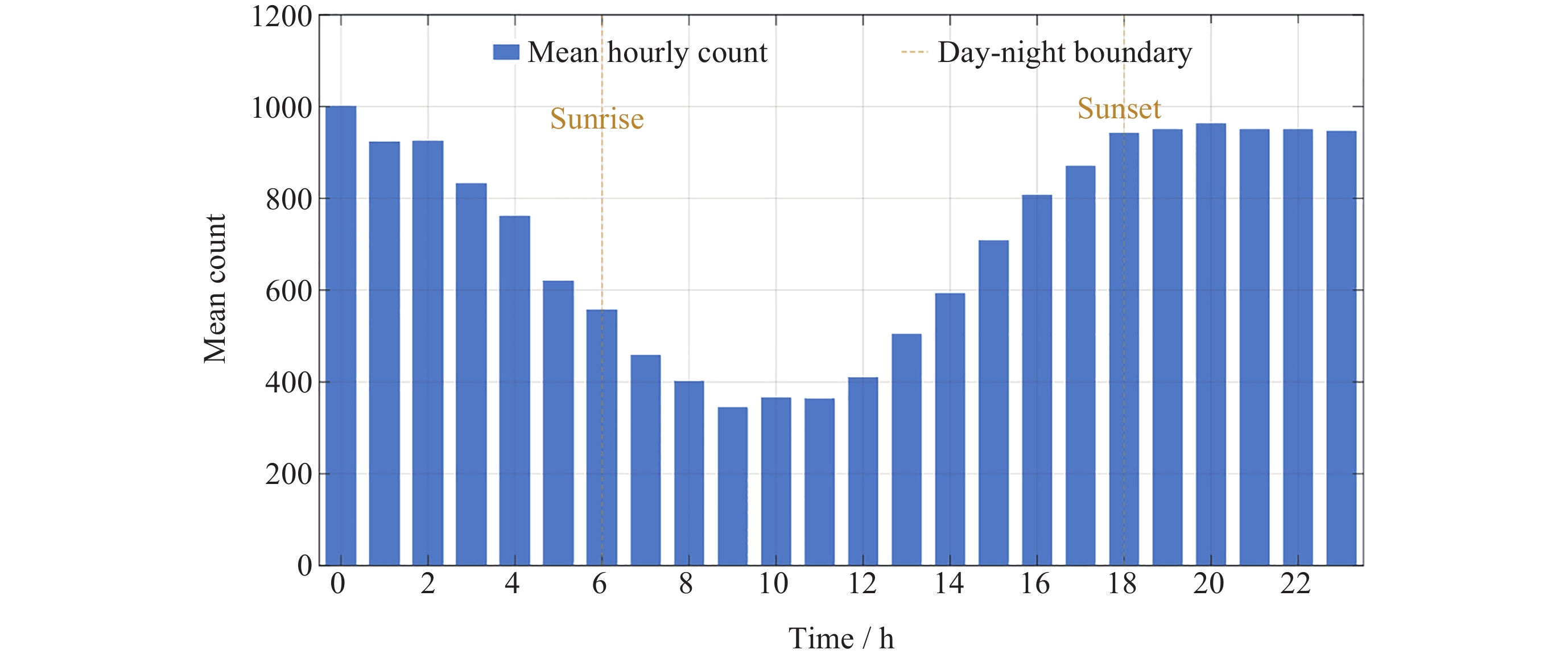
图 8 全年每小时流星体平均数量分布
Figure 8. Distribution of mean hourly meteoroid counts across the year
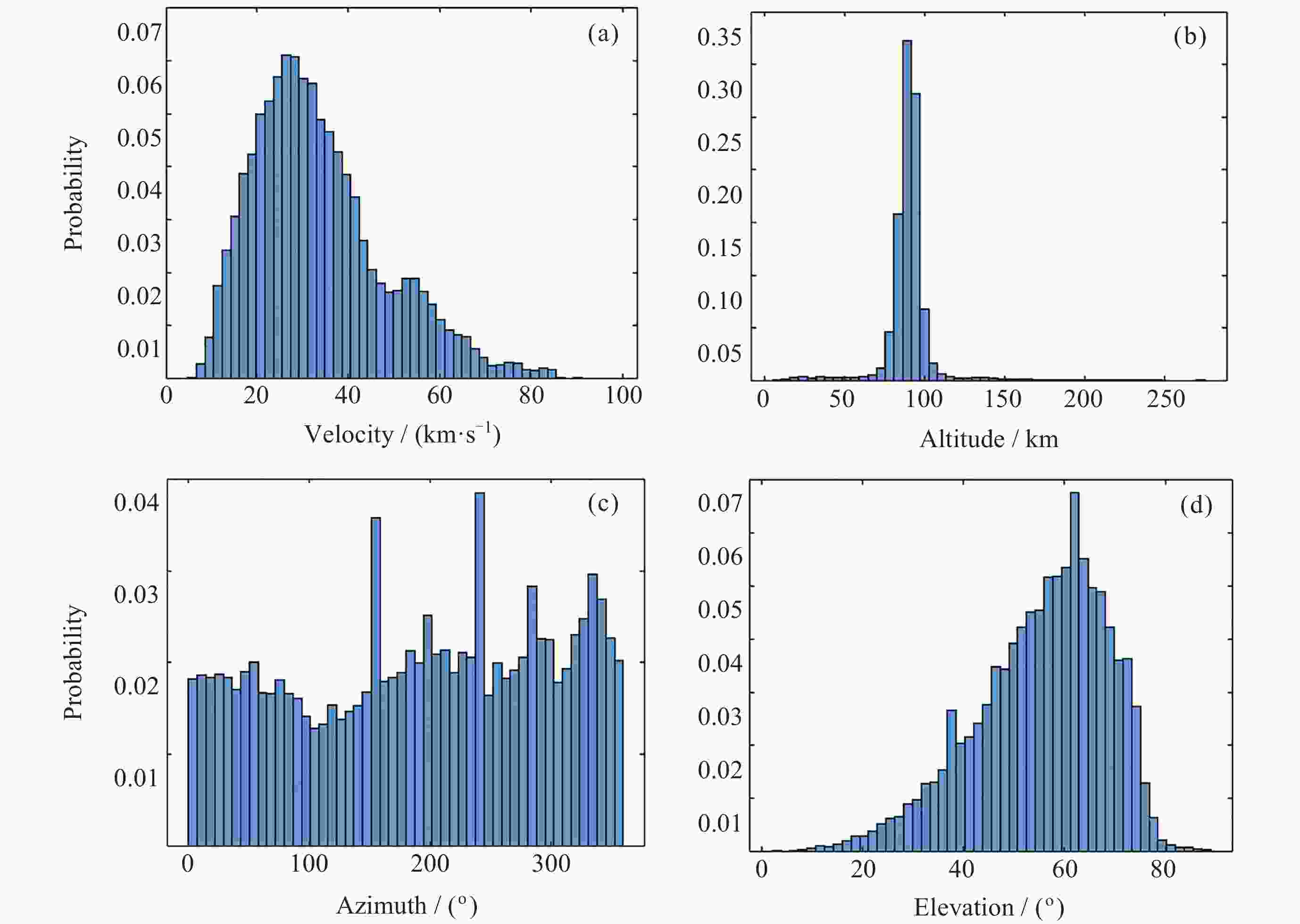
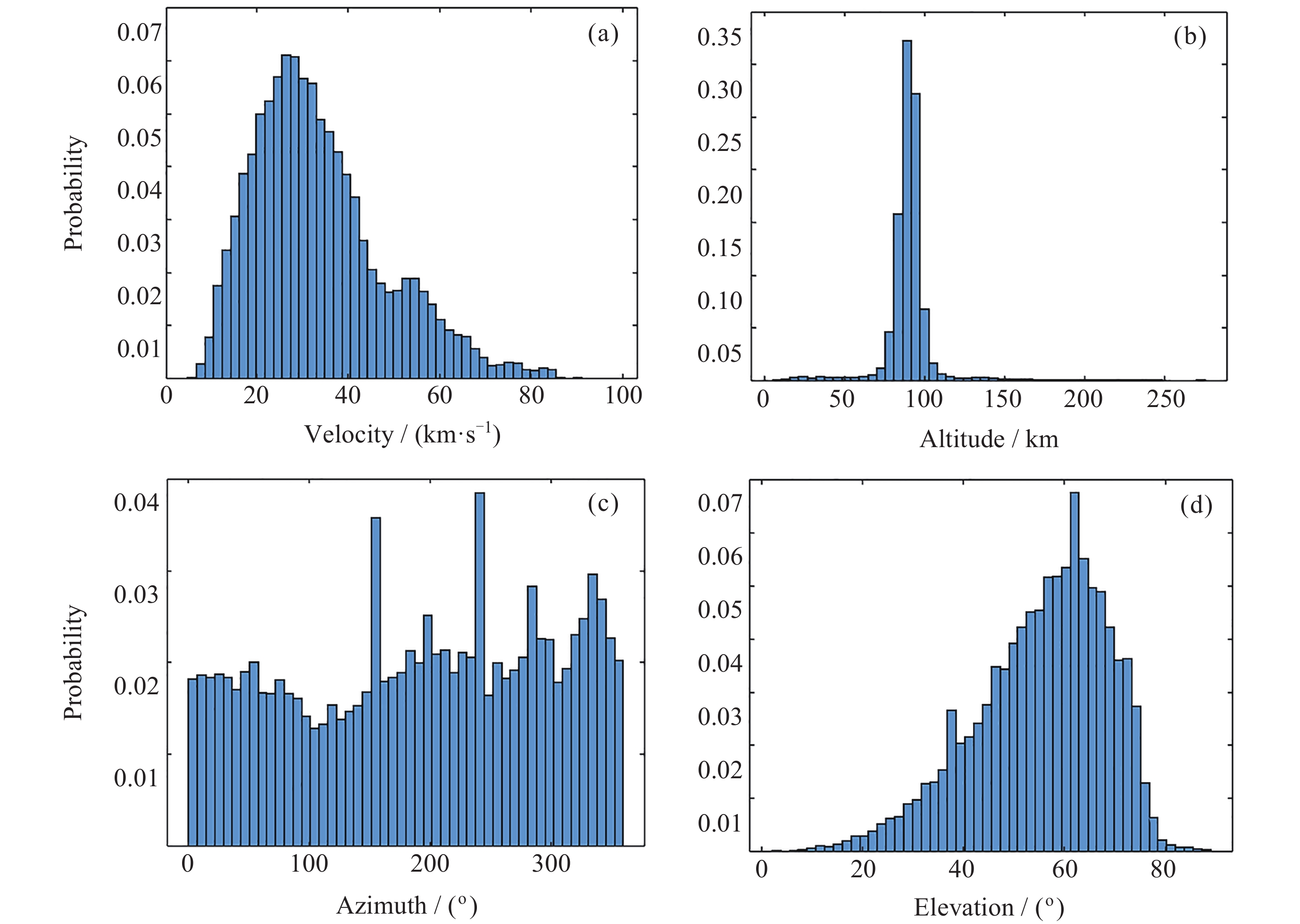
图 10 2024年10月2日流星体参数分布
Figure 10. Distribution map of meteoroid parameters on 2 October 2024
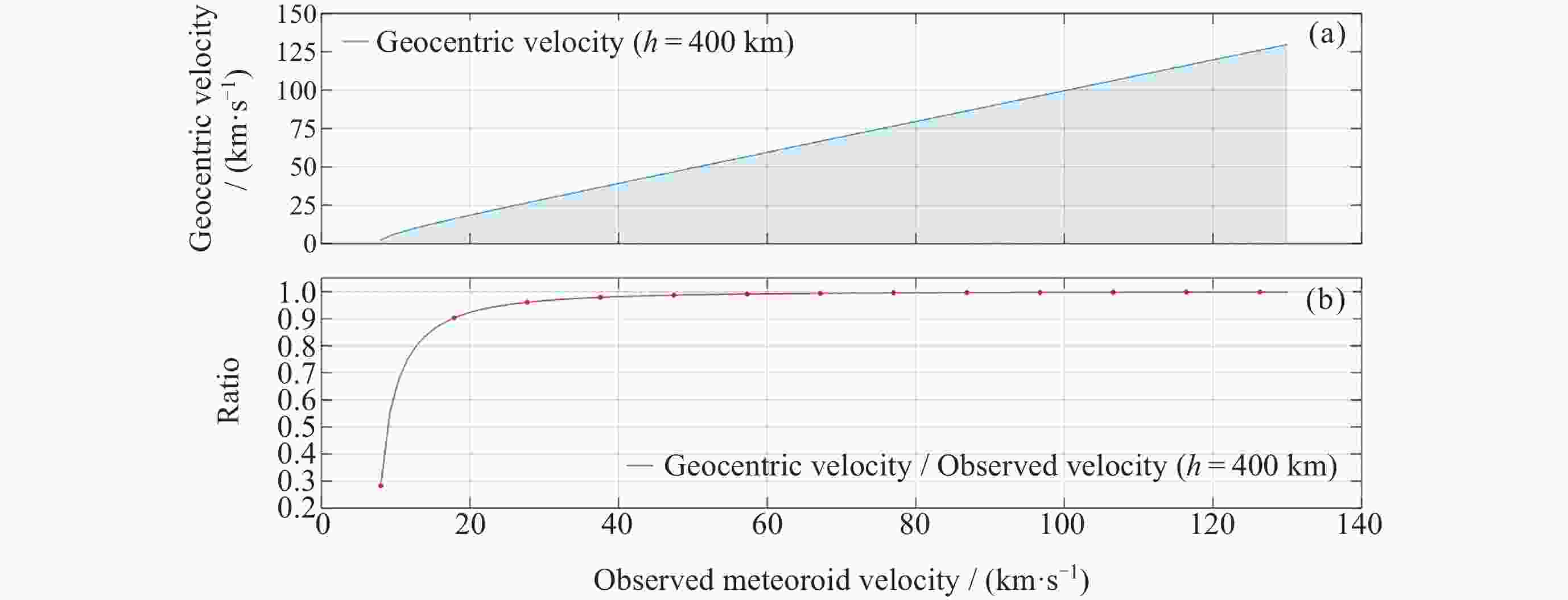
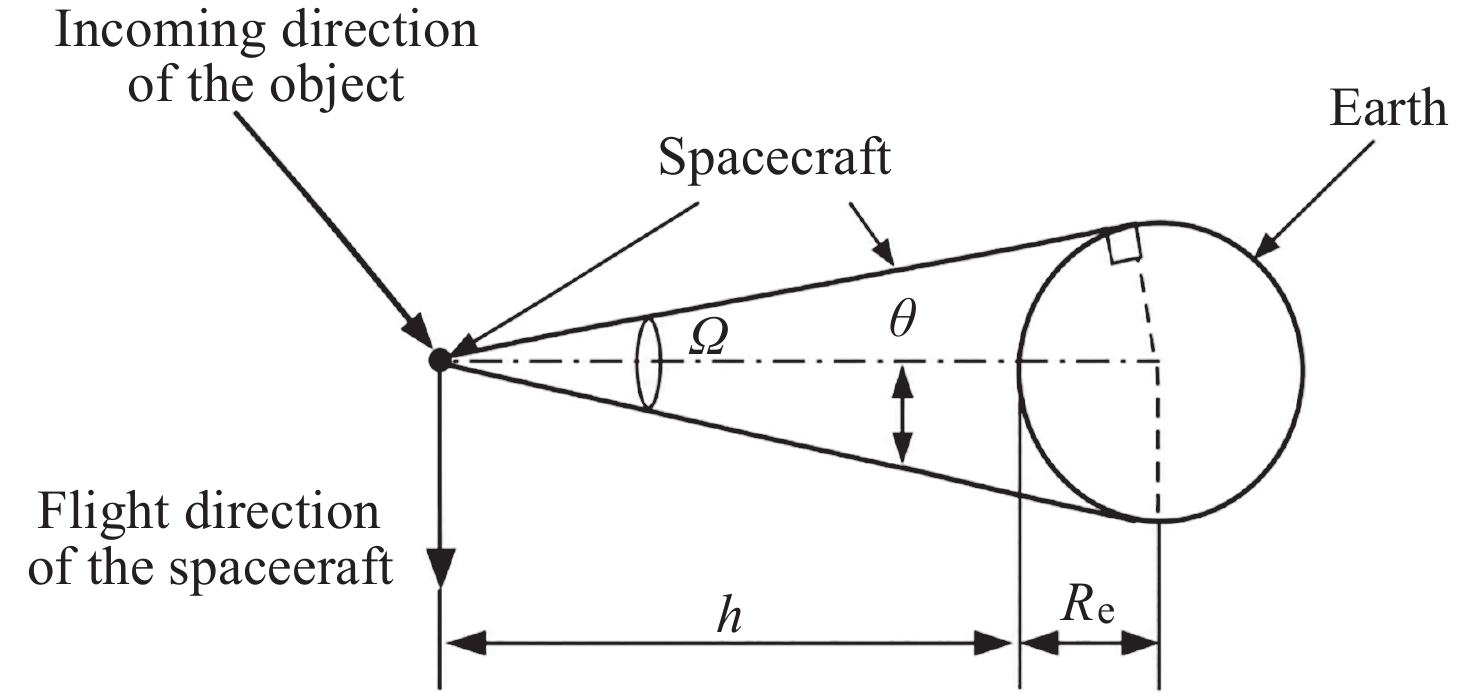
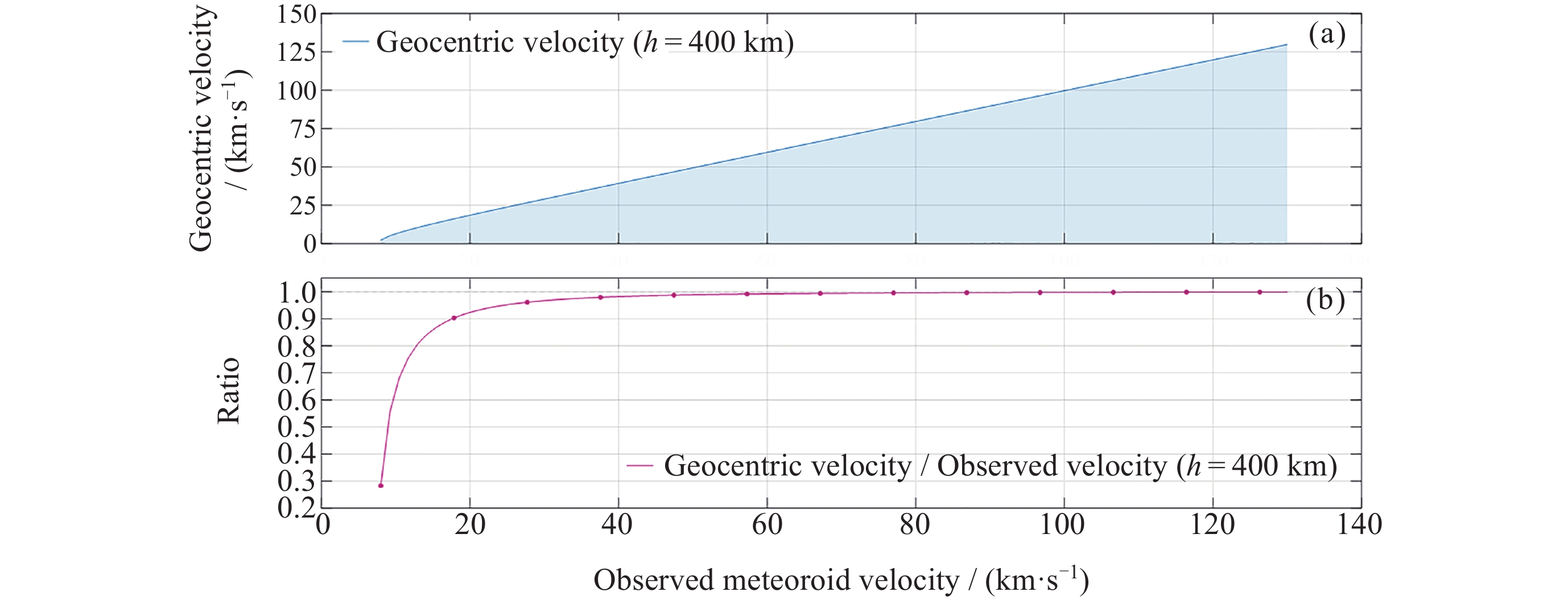
图 11 流星体的地心速度随观测速度和高度的变化(h = 400 km)
Figure 11. Variation of meteoroid geocentric velocity with observed velocity and altitude (h = 400 km)
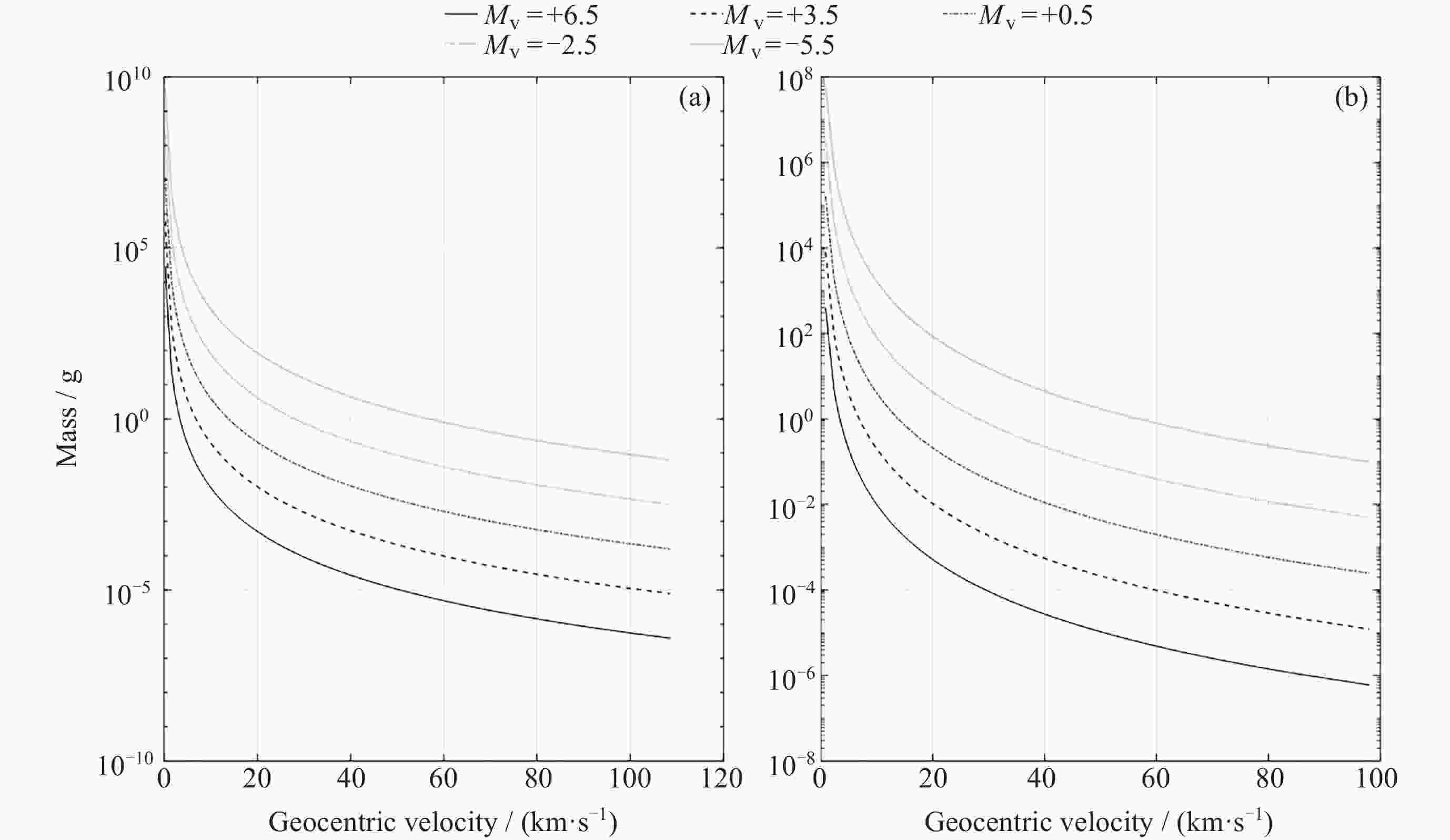
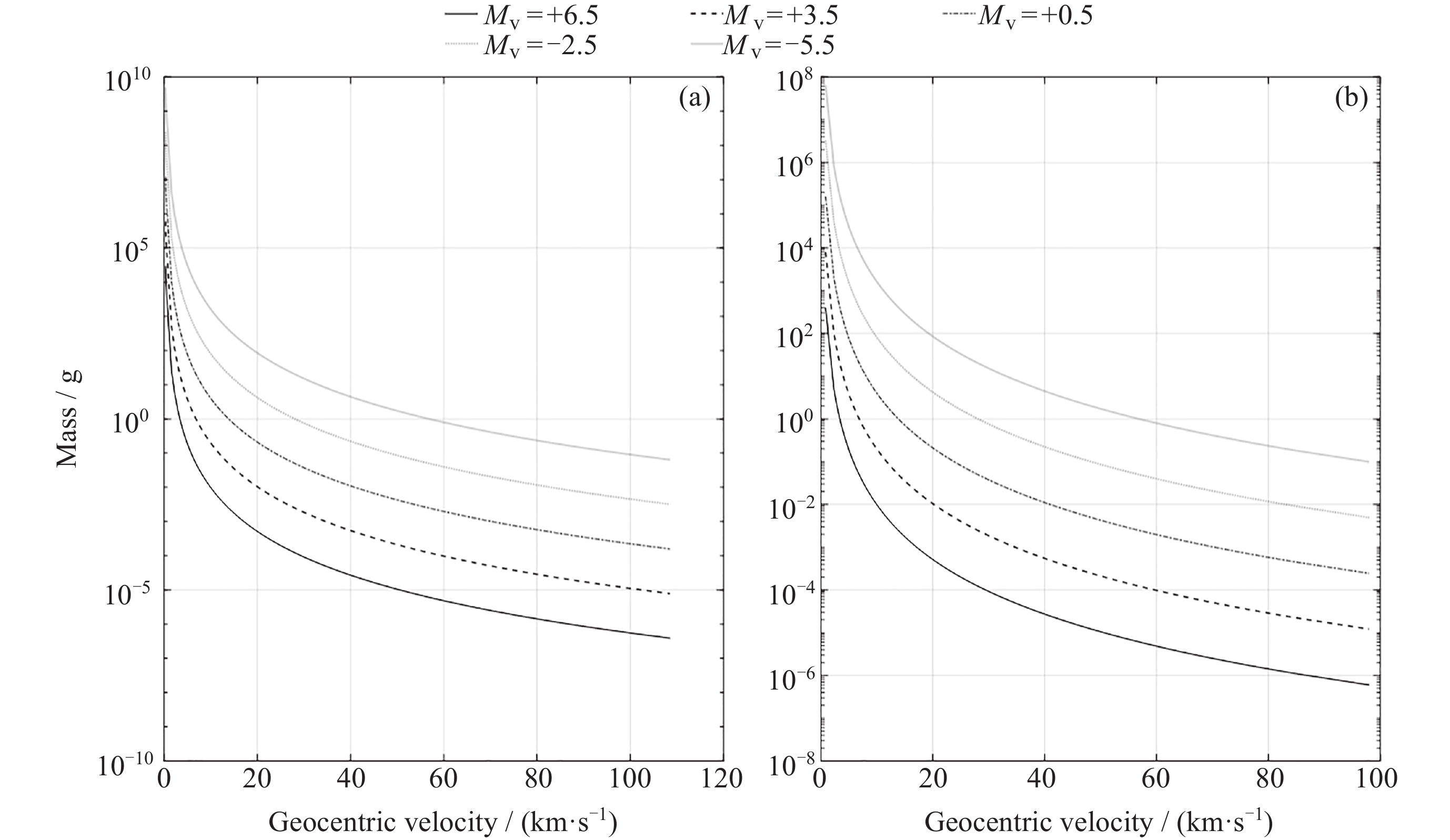
图 12 2021年9月30日和2022年3月7日流星体的质量与地心速度的分布
Figure 12. Distribution of meteoroid mass and geocentric velocity on 30 September 2021 and 7 March 2022
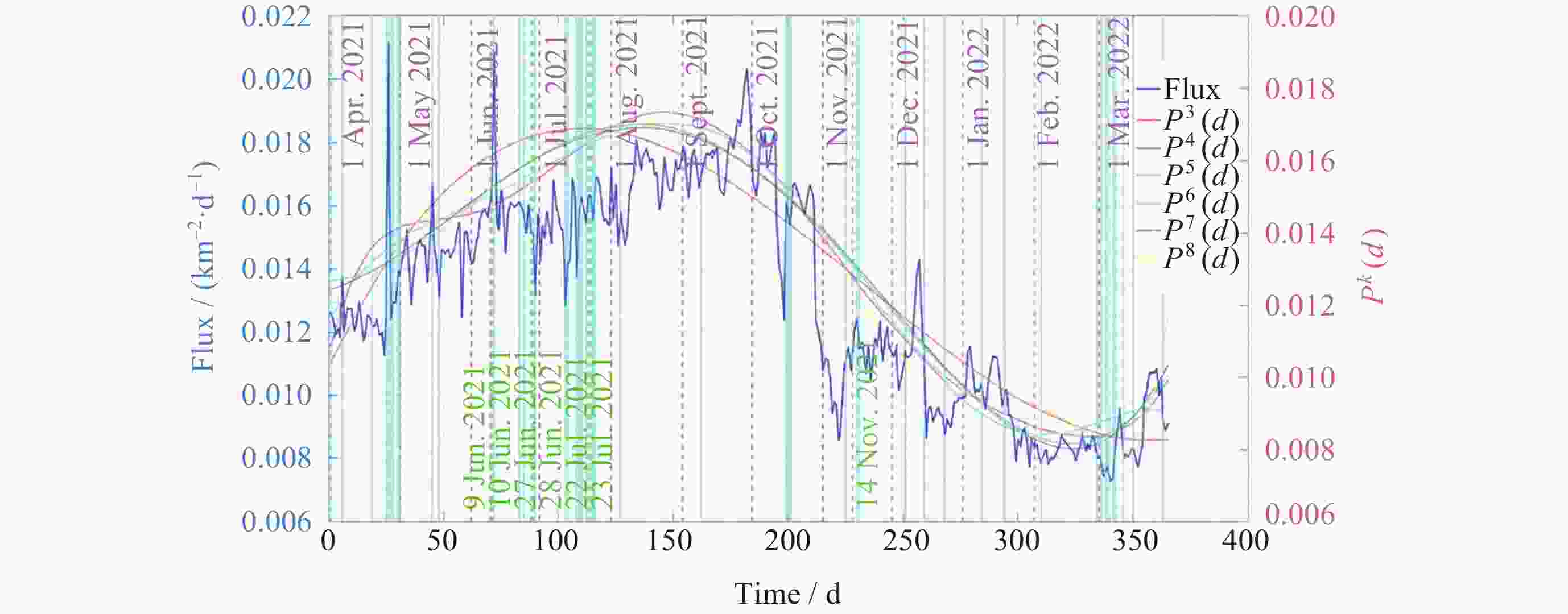
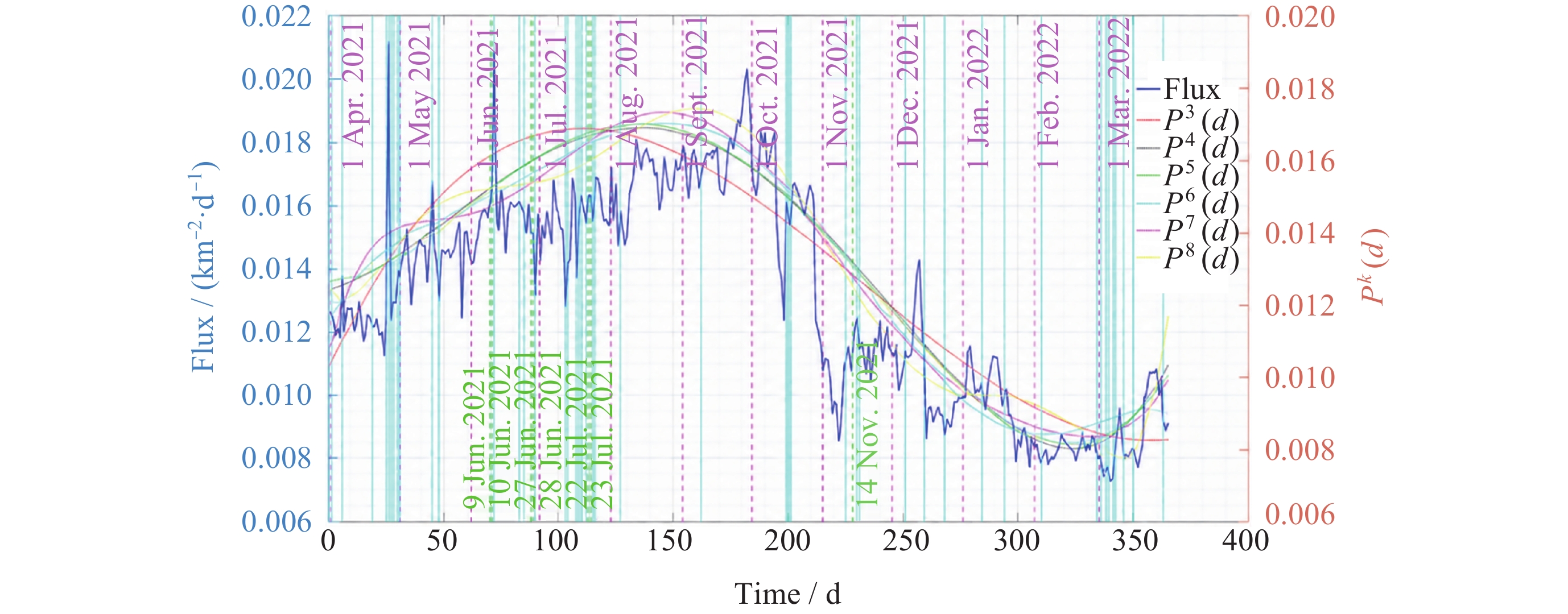
图 13 每日平均通量(24 h)与多项式拟合结果
Figure 13. Daily average flux (over a 24 h period) and polynomial fitting results
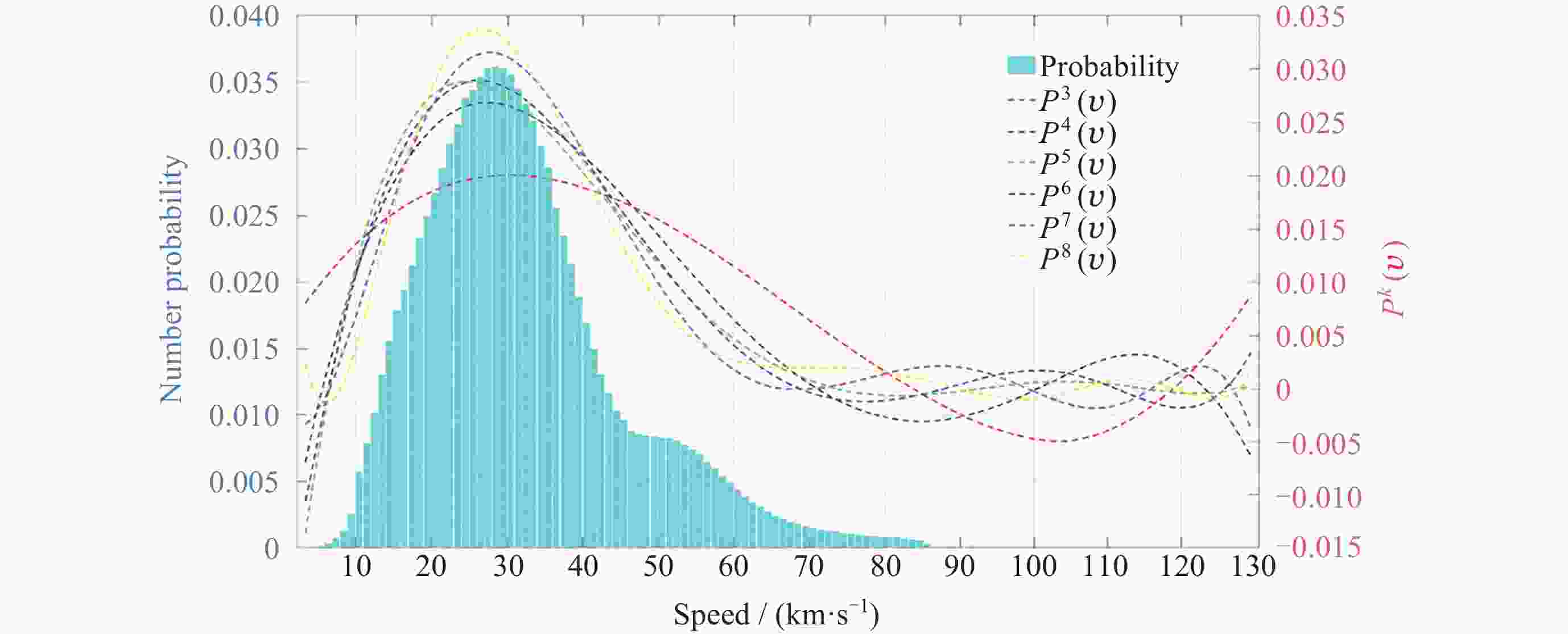
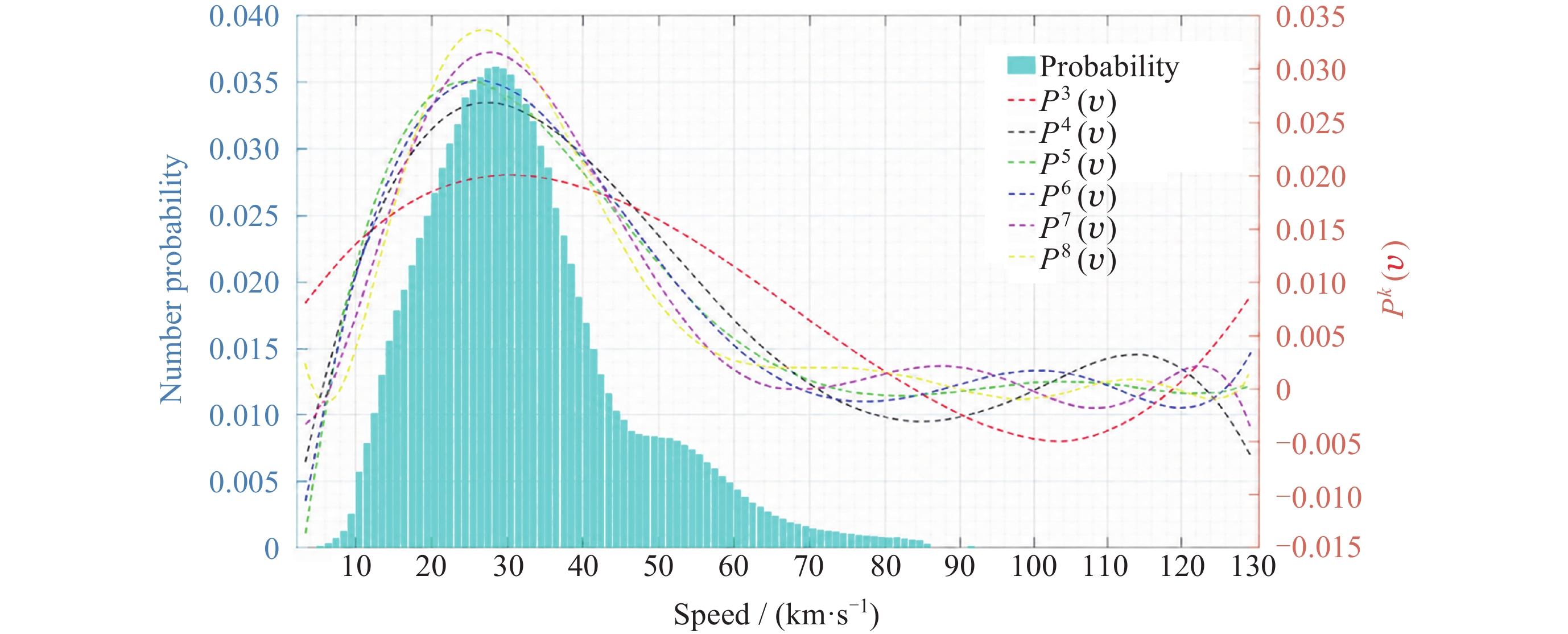
图 14 每个速度区间的流星体数量密度分布
Figure 14. Meteoroid number density distribution per velocity interval
表 1 漠河站流星雷达的运行参数
Table 1. Operational parameters of meteor radar at Mohe Station
参数 数值 位置 53.49°N, 122.34°E 雷达工作频率/MHz 38.9 固态发射机峰值功率/kW 20 发射脉冲重复频率/Hz 430 脉冲波形 高斯 高度/km 70~110 发射机可工作最大脉冲占空比/(%) 10 发射信号极化方式 圆极化 相干接收机通道数 5 距离分辨率/km 1.8 角度分辨率/(°) 2  下载: 导出CSV
表 2 子午工程一期漠河站流星雷达观测数据文件主要参数描述
Table 2. Description of the main parameters of meteor radar observation data files at Mohe Station of Meridian Project Phase I
Parameter Data type Data size Valid range Event start time/s Float 4 ≥ 0 Angle of arrival/(°) Float array 4×2 Azimuth φ: 0~360
Zenith θ: 0~90Decay time/s Float 4 ≥ 0 Diffusion coefficient/(m2·s–1) Float 4 ≥ 0 Radial velocity/(m·s–1) Float 4 ≥ 0 Meteoroid speed/(m·s–1) Float 4 ≥ 0 Fitted range estimate/km Float 4 ≥ 0
下载: 导出CSV
表 3 子午工程二期漠河站流星雷达观测数据文件主要参数
Table 3. Main parameters of meteor radar observation data files at Mohe Station Ⅱ
Parameter Data type Data size Valid range Missing value flag Time (UTC) String 19 characters – – Range Float F8.4 ≥ 0 km –99999999 ECode Integer I2 0~17 (0 indicates excellent quality) –99 SNR Float F6.1 ≥ 0 dB –999999 Power Float F10.1 ≥0 (ADACU)2 –9999999999 Azimuth Float F6.2 0°~360° –999999 Zenith Float F5.2 0°~90° –99999 DecayTm Float F5.3 ≥ 0 s –99999 DifCof Float F5.1 ≥ 0 m2·s–1 –99999 RadialVel Float F6.1 m·s–1 (Positive/negative indicates moving away from/
toward the radar)–999999 MeteorVel Float F8.1 ≥ 0 m·s–1 –99999999
下载: 导出CSV
表 4 缺失7天数据的补充
Table 4. Supplement for missing 7 days of data
Date Meteor shower ΔD1 ΔD2 ND 9 Jun. 2021 Arietids, Dayt. Arietids, ζ-Perseids, β-Taurids, June Bootids 3 13 21561 10 Jun. 2021 Arietids, Dayt. Arietids, ζ-Perseids, β-Taurids, June Bootids 3 13 21561 27 Jun. 2021 June Bootids, ζ-Perseids, β-Taurids 4 3 20581 28 Jun. 2021 June Bootids, ζ-Perseids, β-Taurids 4 3 20581 22 Jul. 2021 Perseids 4 31 22017 23 Jul. 2021 Perseids 4 31 22017 14 Nov. 2021 N. Taurids, Leonids, Nov. Orionids 0 15 15702
下载: 导出CSV
表 5 近地空间不同高度的观测速度 (Mv = +6.5, m = 1 g)
Table 5. Observation speed at different heights in near-Earth space (Mv = +6.5, m = 1 g)
h /(km) 75 100 125 150 175 200 225 250 275 vR /(km·s–1) 11.201 11.180 11.159 11.137 11.117 11.096 11.075 11.054 11.034
下载: 导出CSV
表 6 通量随时间的多项式函数$ {P}^{k}(d) $的评价指标
Table 6. Evaluation index of polynomial function Pk(d) of the meteoroid flux with day
k SSE $ \overline{y} $ SST R2 3 9.192×10⁻⁴ 1.313×10⁻² 4.149×10⁻³ 7.785×10⁻¹ 4 7.360×10⁻⁴ 1.313×10⁻² 4.149×10⁻³ 8.226×10⁻¹ 5 7.333×10⁻⁴ 1.313×10⁻² 4.149×10⁻³ 8.233×10⁻¹ 6 6.971×10⁻⁴ 1.313×10⁻² 4.149×10⁻³ 8.320×10⁻¹ 7 6.720×10⁻⁴ 1.313×10⁻² 4.149×10⁻³ 8.380×10⁻¹ 8 5.896×10⁻⁴ 1.313×10⁻² 4.149×10⁻³ 8.579×10⁻¹
下载: 导出CSV
表 7 速度数量密度随速度的多项式函数$ {P}^{k}(v) $的评价指标
Table 7. Evaluation index of polynomial function $ {P}^{k}(v) $ of the number probability with velocity bin
k SSE $ \overline{P} $ SST R2 3 6.104×10⁻³ 7.576×10⁻³ 1.660×10⁻² 6.323×10⁻¹ 4 2.242×10⁻³ 7.576×10⁻³ 1.660×10⁻² 8.650×10⁻¹ 5 1.579×10⁻³ 7.576×10⁻³ 1.660×10⁻² 9.049×10⁻¹ 6 1.458×10⁻³ 7.576×10⁻³ 1.660×10⁻² 9.122×10⁻¹ 7 7.451×10⁻⁴ 7.576×10⁻³ 1.660×10⁻² 9.551×10⁻¹ 8 3.114×10⁻⁴ 7.576×10⁻³ 1.660×10⁻² 9.812×10⁻¹
下载: 导出CSV
-
[1] GRÜN E, ZOOK H A, FECHTIG H, et al. Collisional balance of the meteoritic complex[J]. Icarus, 1985, 62(2): 244-272 doi: 10.1016/0019-1035(85)90121-6 [2] DIVINE N. Five populations of interplanetary meteoroids[J]. Journal of Geophysical Research: Planets, 1993, 98(E9): 17029-17048 doi: 10.1029/93JE01203 [3] STAUBACH P, GRÜN E, JEHN R. The meteoroid environment near Earth[J]. Advances in Space Research, 1997, 19(2): 301-308 doi: 10.1016/S0273-1177(97)00017-3 [4] DIKAREV V, GRÜN E, BAGGALEY J, et al. The new ESA meteoroid model[J]. Advances in Space Research, 2005, 35(7): 1282-1289 doi: 10.1016/j.asr.2005.05.014 [5] MCNAMARA H, JONES J, KAUFFMAN B, et al. Meteoroid Engineering Model (MEM): a meteoroid model for the inner solar system[J]. Earth, Moon, and Planets, 2004, 95(1/2/3/4): 123-139 [6] MOORHEAD A V, KOEHLER H M, COOKE W J. NASA Meteoroid Engineering Model Release 2.0[R]. Huntsville, AL, USA: NASA Marshall Space Flight Center, 2015, NASA/TM-2015-218214 [7] MOORHEAD A V. Meteoroid Engineering Model (MEM) 3: NASA’s newest meteoroid model[R]. Huntsville, AL, USA: NASA Marshall Space Flight Center, 2020, NASA/TM-2020-220555 [8] SOJA R H, GRÜN E, STRUB P, et al. IMEM2: a meteoroid environment model for the inner solar system[J]. Astronomy & Astrophysics, 2019, 628: A109 doi: 10.1051/0004-6361/201834892 [9] DROLSHAGEN G, DIKAREV V, LANDGRAF M, et al. Comparison of meteoroid flux models for near earth space[J]. Earth, Moon, and Planets, 2008, 102(1/2): 191-197 [10] GRÜN E, SRAMA R, HORANYI M, et al. Comparative analysis of the ESA and NASA interplanetary meteoroid enviroment models[C]//6th European Conference on Space Debris. Darmstadt: ESA Space Debris Office, 2013 [11] RODMANN J, MILLER A, TRAUD M, et al. Micrometeoroid impact risk assessment for interplanetary missions[C]//Proceedings of 8th European Conference on Space Debris. Darmstadt: ESA Space Debris Office, 2021 [12] JONES J, BROWN P. Sporadic meteor radiant distributions: orbital survey results[J]. Monthly Notices of the Royal Astronomical Society, 1993, 265(3): 524-532 doi: 10.1093/mnras/265.3.524 [13] GALLIGAN D P, BAGGALEY W J. The orbital distribution of radar-detected meteoroids of the Solar system dust cloud[J]. Monthly Notices of the Royal Astronomical Society, 2004, 353(2): 422-446 doi: 10.1111/j.1365-2966.2004.08078.x [14] HOCKING W K, FULLER B, VANDEPEER B. Real-time determination of meteor-related parameters utilizing modern digital technology[J]. Journal of Atmospheric and Solar-Terrestrial Physics, 2001, 63(2/3): 155-169 doi: 10.1016/s1364-6826(00)00138-3 [15] VALENTIC T A, AVERY J P, AVERY S K. MEDAC/SC: a third generation meteor echo detection and collection system[J]. IEEE Transactions on Geoscience and Remote Sensing, 1996, 34(1): 15-21 doi: 10.1109/36.481886 [16] WANG C. New chains of space weather monitoring stations in China[J]. Space Weather, 2010, 8(8): S08001 doi: 10.1029/2010sw000603 [17] 解海永, 刘立波, 宁百齐, 等. 2018年黑龙江漠河站全天空无线电流星雷达数据集[J]. 中国科学数据, 2021, 6(2): 88-98 doi: 10.11922/csdata.2020.0067.zhXIE Haiyong, LIU Libo, NING Baiqi, et al. A dataset from Mohe all-sky meteor radar in 2018[J]. China Scientific Data, 2021, 6(2): 88-98 doi: 10.11922/csdata.2020.0067.zh [18] 蔡冰. MLT中频雷达流星余迹测风技术及太阳活动效应观测研究[D]. 北京: 中国科学院大学(中国科学院国家空间科学中心), 2021CAI Bing. Researches on MLT Meteor Wind Techniques and Observations of Solar Activities with MF Rada[D]. Beijing: University of Chinese Academy of Sciences, 2021 [19] HOLDSWORTH D A, REID I M, CERVERA M A. Buckland Park all-sky interferometric meteor radar[J]. Radio Science, 2004, 39(5): RS5009 doi: 10.1029/2003rs003014 [20] MATRIGO-RODRIGUEZ J, FABREGAT J, LLORCA J. Leonid fluxes: 1994-1998 activity patterns[J]. Meteoritics & Planetary Science, 2001, 36(12): 1597-1604 doi: 10.1111/j.1945-5100.2001.tb01851.x [21] TRIGO-RODRÍGUEZ J M, BLUM J. Learning about comets from the study of mass distributions and fluxes of meteoroid streams[J]. Monthly Notices of the Royal Astronomical Society, 2022, 512(2): 2277-2289 doi: 10.1093/mnras/stab2827 [22] YOUNGER J P, REID I M, LI G, et al. Observations of the new Camelopardalids meteor shower using a 38.9MHz radar at Mohe, China[J]. Icarus, 2015, 253: 25-30 doi: 10.1016/j.icarus.2015.02.021 [23] YOUNGER J P, REID I M, VINCENT R A, et al. A southern hemisphere survey of meteor shower radiants and associated stream orbits using single station radar observations[J]. Monthly Notices of the Royal Astronomical Society, 2009, 398(1): 350-356 doi: 10.1111/j.1365-2966.2009.15142.x [24] GENG S, ZHOU B, LI M. Near-Earth object 2022 EB5: from atmospheric entry to physical properties and orbit[J]. Astronomy & Astrophysics, 2023, 670: A27 doi: 10.1051/0004-6361/202244084 [25] BRONSHTEN V A. Physics of Meteoric Phenomena[M]. Dordrecht: Springer Netherlands, 1983 [26] POPOVA O. Meteoroid ablation models[J]. Earth, Moon, and Planets, 2004, 95(1/2/3/4): 303-319 -
-

 下载:
下载:

计量
- 文章访问数: 829
- HTML全文浏览量: 110
- PDF下载量: 101
-
被引次数:
0(来源:Crossref)
0(来源:其他)

