


2025年缅甸Mw7.7地震诱发的电离层扰动观测分析
doi: 10.11728/cjss2026.05.2025-0247 cstr: 32142.14.cjss.2025-0247
-
 韩芸蔓 女, 2006年7月出生于江苏省宿迁市, 现为南京信息工程大学大气物理学院2024级本科生, 主要研究方向为电离层物理. E-mail: 3505725130@qq.com
 -
 杨雨嫣 女, 1996年11月出生于山东省临沂市, 现为南京信息工程大学讲师, 主要研究方向为电离层与高层大气物理. E-mail: yangyuyan@nuist.edu.cn
作者简介:
通讯作者:
Observation and Analysis of Ionospheric Perturbations Triggered by the 2025 Mw 7.7 Myanmar Earthquake
-
摘要: 针对2025年3月28日缅甸Mw 7.7级走滑型地震激发的同震电离层扰动(CSID), 探究复杂震源破裂对地震–大气–电离层耦合过程的影响. 基于IONISE与IGS地基GNSS观测网络的高时空分辨率TEC数据, 通过滑动平均去趋势与2~6 min周期四阶Butterworth带通滤波, 有效提取CSID信号. 结果表明, 震后06:36-06:39 UTC期间, 近场(<1000 km)区域清晰出现周期约5 min的“N”型扰动, 最大振幅达0.97 TECU; 扰动在方位上呈现显著东西不对称性, 即东侧(30°-225°)振幅远高于西侧. 该特征在多颗不同方位的卫星观测中均存在, 排除了视线方向几何效应或地磁场调制的主导作用. CSID水平传播速度介于1.6~3.4 km·s–1, 具有明显方位依赖性, 与地表瑞利波速度范围基本吻合, 表明扰动主要由瑞利波模态激发. 结合该地震初期双向破裂, 随后转为南向超剪切单向破裂的动力学特征, 超剪切破裂理论上可能通过马赫波效应增强特定方向的瑞利波辐射. 本研究结果表明, GNSS TEC观测能捕捉震源破裂的方向性特征, 为理解瑞利波辐射模式及跨圈层耦合过程提供了有价值的观测线索.
-
关键词:
- GNSS TEC /
- 地震电离层扰动 /
- 岩石圈–大气层–电离层耦合
Abstract: This study investigates Co-Seismic Ionospheric Disturbances (CSID) triggered by the Mw7.7 strike-slip earthquake in Myanmar on 28 March 2025, with a focus on how complex source rupture processes influence the earthquake–atmosphere–ionosphere coupling. High spatiotemporal resolution Total Electron Content (TEC) data from the ground-based GNSS networks IONISE and IGS are employed. CSID signals are effectively extracted through sliding-window detrending and a fourth-order Butterworth band-pass filter with a period band of 2-6 min. Results show that during 06:36–06:39 UTC, a clear N-shaped disturbance with a dominant period of approximately 5 minutes and a peak amplitude of 0.97 TECU emerged in the near-field region (<1000 km from the epicenter). The disturbance exhibits pronounced east-west azimuthal asymmetry, with significantly larger amplitudes in the eastern sector (azimuth 30°-225°) compared to the west. This asymmetry is consistently observed across multiple satellites with diverse viewing geometries—including near-zenith and geostationary satellites—ruling out line-of-sight geometric effects or geomagnetic modulation as primary causes. The horizontal propagation velocity of the CSID ranges from 1.6 to 3.4 km·s–1, showing clear azimuthal dependence and aligning closely with surface Rayleigh wave speeds, indicating that the disturbance is predominantly excited by the Rayleigh wave mode. The observed azimuthal asymmetry may reflect the modulation of Rayleigh wave radiation by the rupture directivity—initial bilateral propagation followed by unidirectional southward supershear rupture. Supershear rupture may theoretically enhance Rayleigh wave radiation in specific directions through Mach wave effects. Our findings suggest that GNSS-derived TEC observations are capable of capturing the directional characteristics of coseismic rupture, providing valuable observational insights into Rayleigh wave radiation patterns and lithosphere–atmosphere–ionosphere coupling processes. -
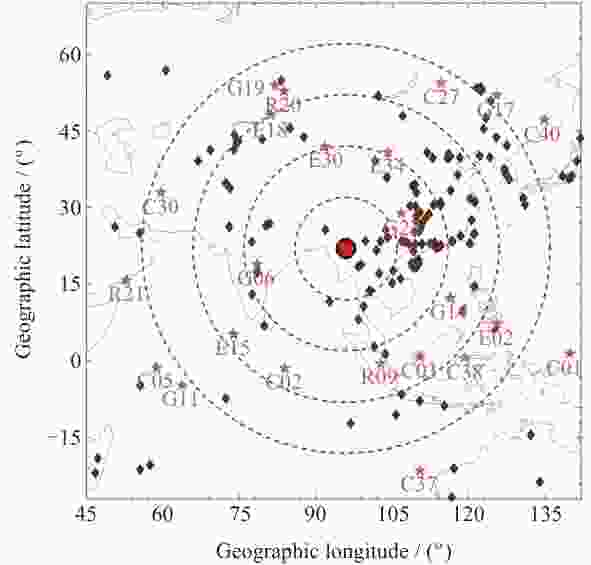
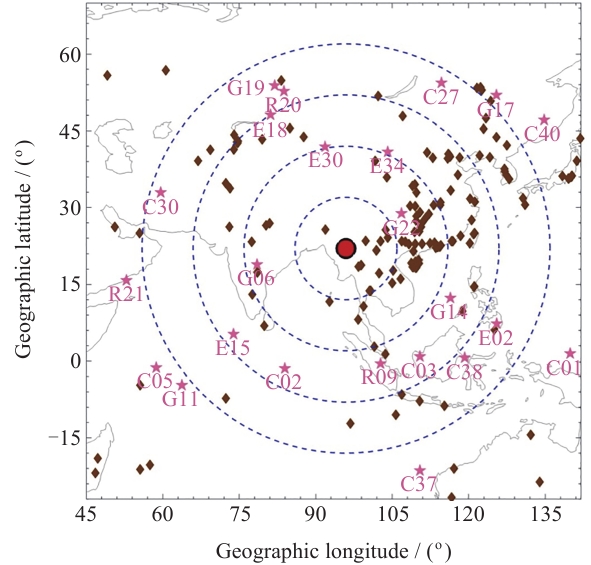
图 1 2025年3月28日缅甸地震震中和所用GNSS地基接收机的地理位置以及地震前后接收机上空GNSS卫星地面投影位置
Figure 1. Geographic distribution of the epicenter of the 28 March 2025 Myanmar earthquake, ground-based GNSS receivers used in this study, and the ground-projected positions of GNSS satellites above the receiver network before and after the earthquake
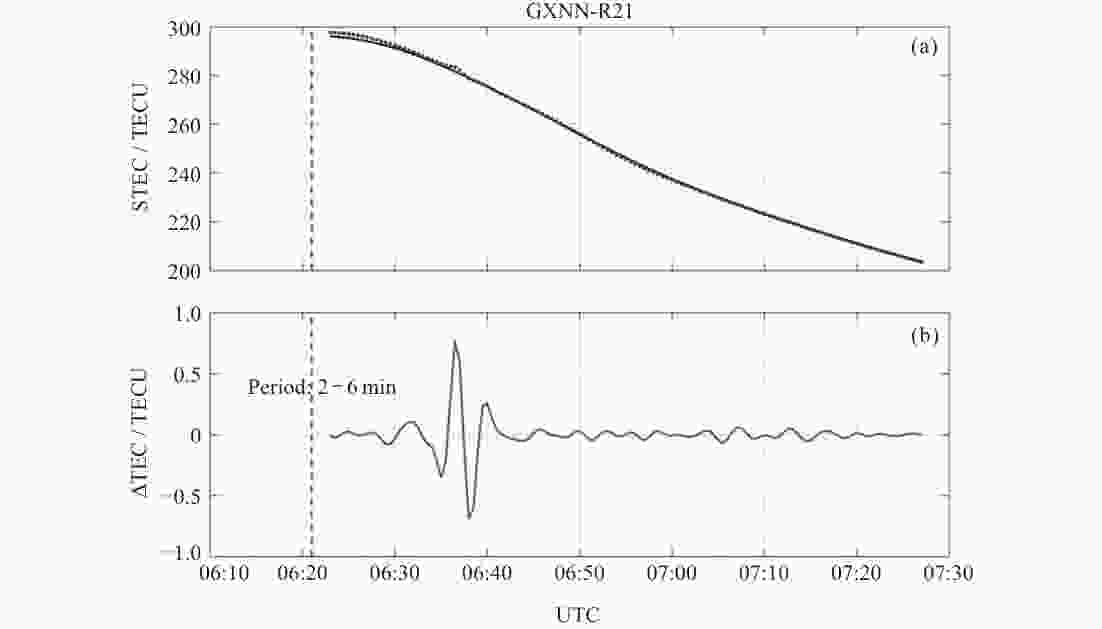
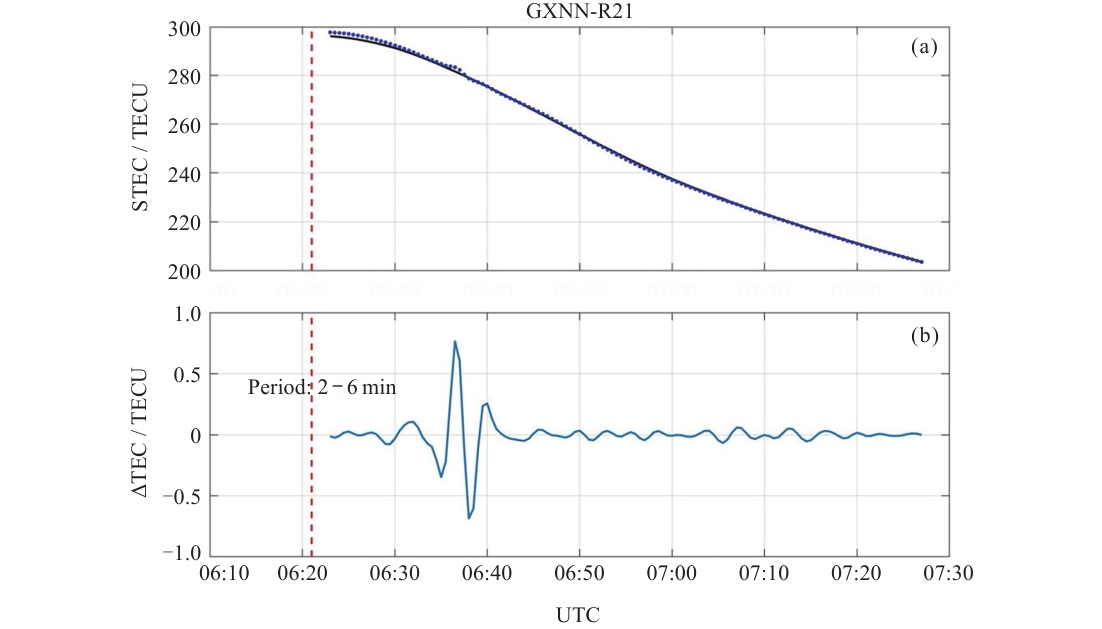
图 2 接收机GXNN与R21卫星之间的STEC扰动提取. (a) STEC原始观测值与滑动平均背景趋势, (b) 2~6 min带通滤波后的TEC扰动
Figure 2. Extraction of STEC perturbations between receiver GXNN and satellite R21. (a) Original STEC observations and fitted background trend, (b) TEC perturbations after applying a 2-6 min band-pass filter
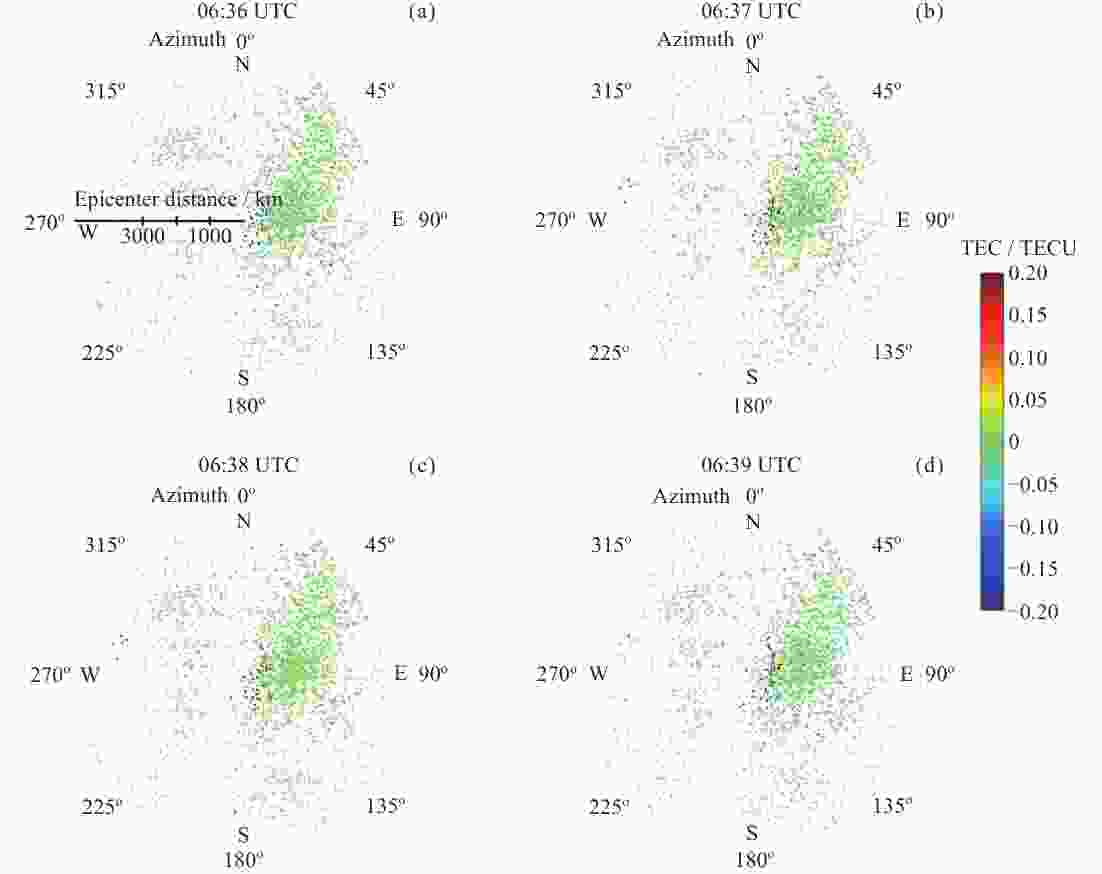
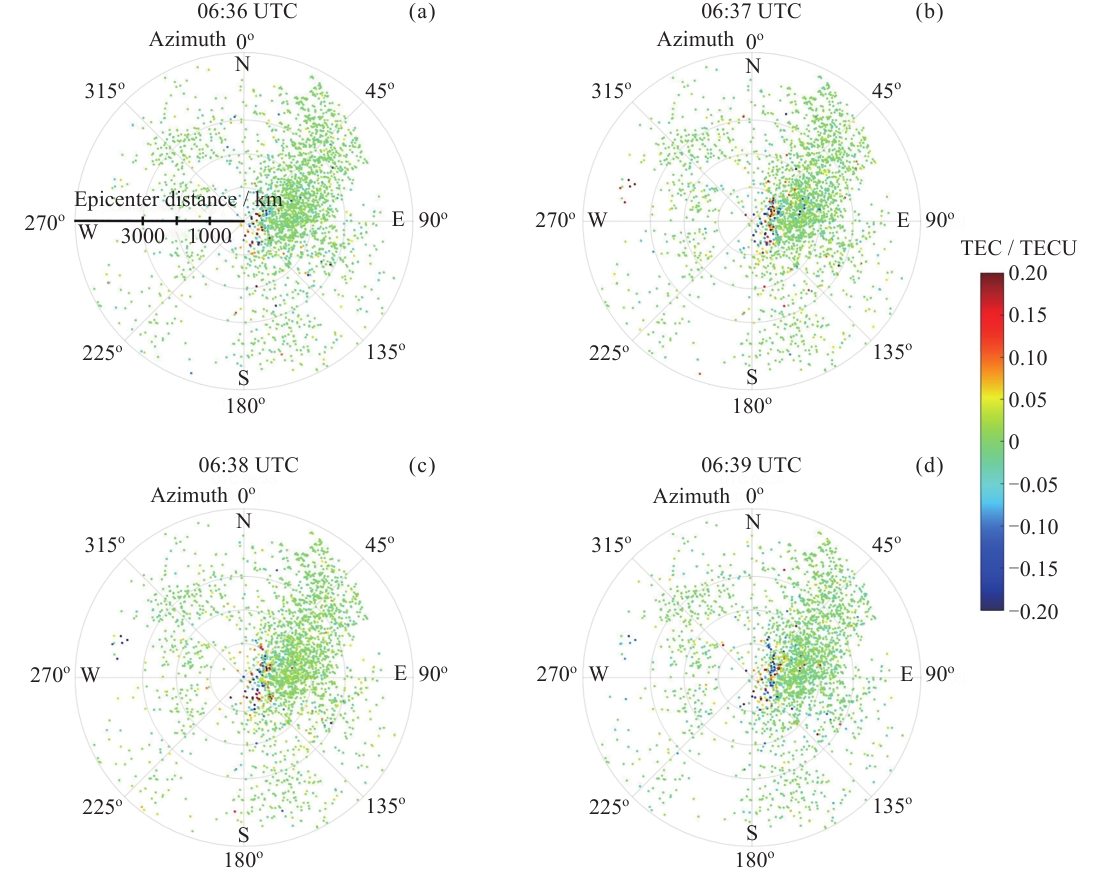
图 3 经2~6 min带通滤波得到的TEC扰动相对于地震震中的方位–距离分布.
Figure 3. Azimuth-distance distribution of TEC perturbations after 2–6 minute period band-pass filtering relative to the earthquake epicenter
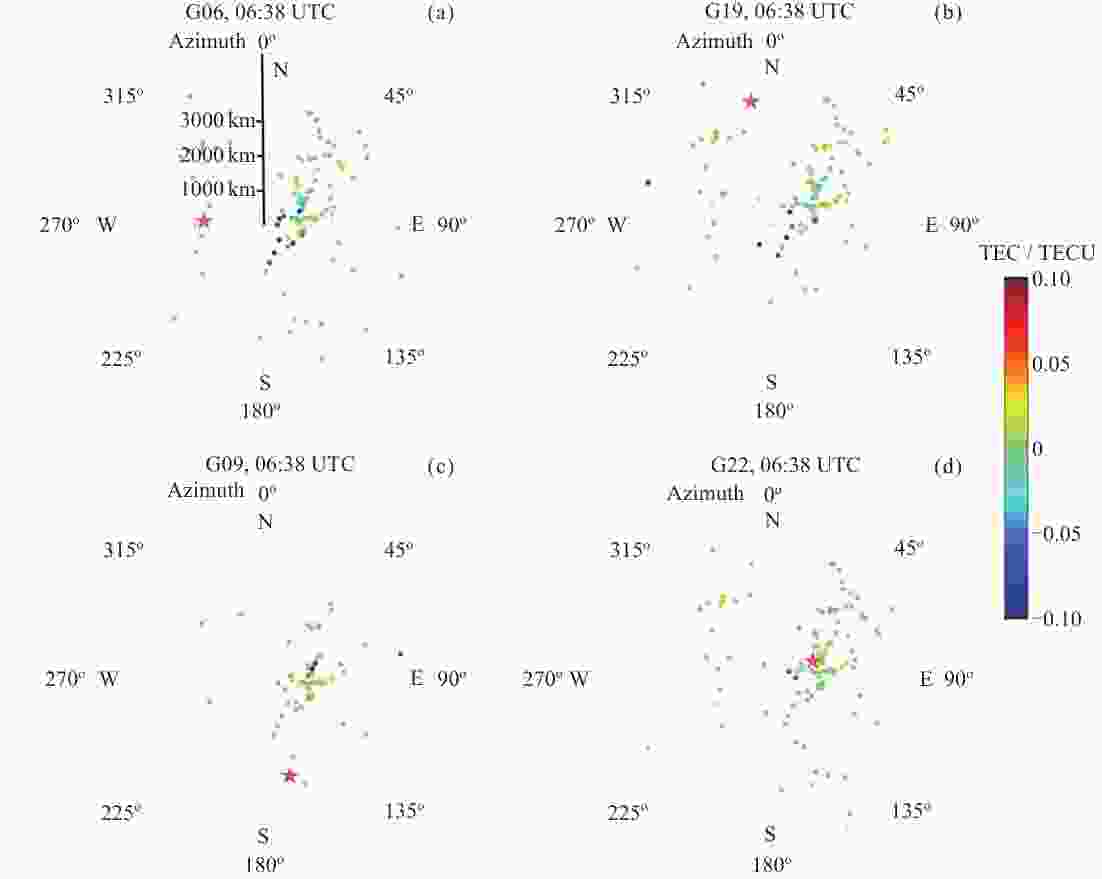
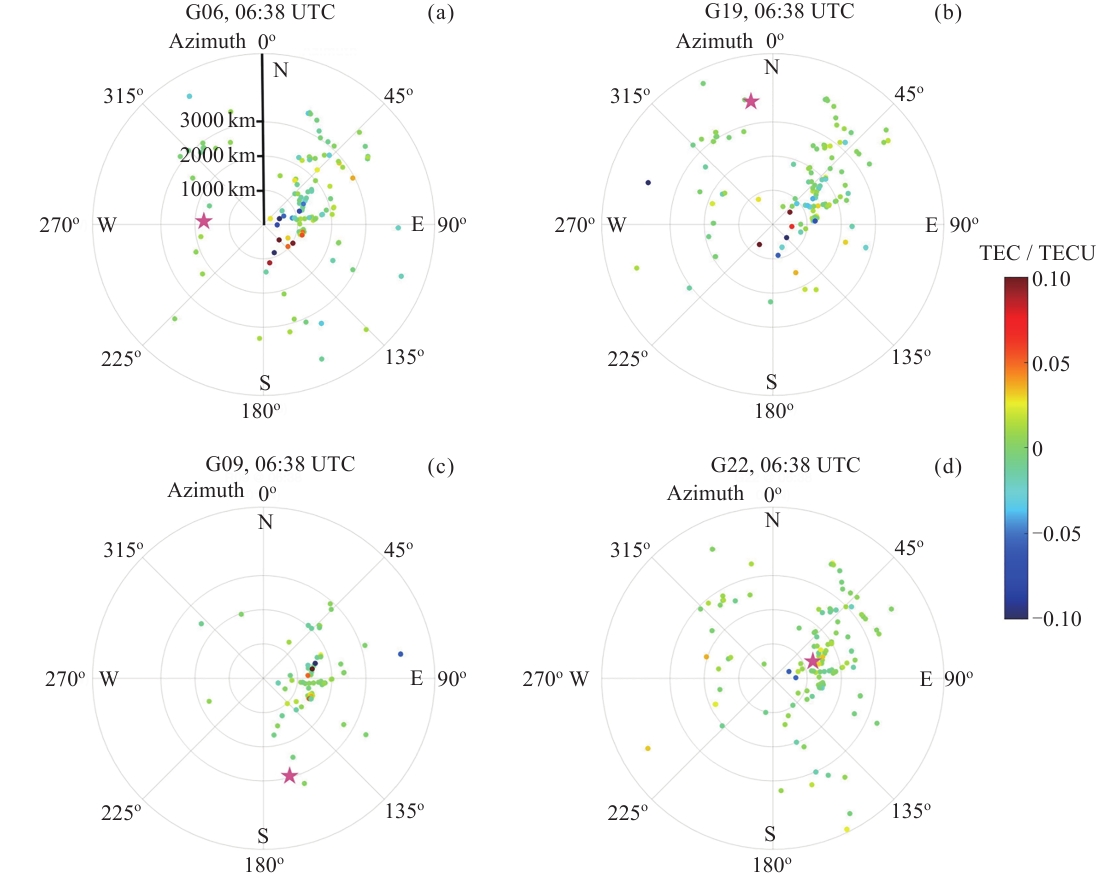
图 4 在06:38 UTC时刻4颗卫星观测的经2~6 min带通滤波的TEC扰动相对于地震震中的方位–距离分布. (a) G06, (b) G19, (c) R09, (d) G22
Figure 4. Azimuth-distance distribution of 2-6 minute band-pass-filtered TEC perturbations observed by four satellites at 06:38 UTC. (a) G06, (b) G19, (c) R09, (d) G22
-
[1] ZEL’DOVICH Y B, RAIZER Y P. Physics of Shock Waves and High-Temperature Hydrodynamic Phenomena[M]. Mineola: Dover Publications, 2002 [2] ASTAFYEVA E. Ionospheric detection of natural hazards[J]. Reviews of Geophysics, 2019, 57(4): 1265-1288 doi: 10.1029/2019RG000668 [3] HUANG C Y, HELMBOLDT J F, PARK J, et al. Ionospheric detection of explosive events[J]. Reviews of Geophysics, 2019, 57(1): 78-105 doi: 10.1029/2017RG000594 [4] HINES C. O. Internal atmospheric gravity waves at ionospheric heights[J]. Canadian Journal of Physics, 1960, 38(11): 1441-1481 doi: 10.1139/p60-150 [5] RAO H, CHEN C H, MENG G J, et al. Relationship between TEC perturbations and Rayleigh waves associated with 2023 Turkey earthquake doublet[J]. Journal of Geophysical Research: Space Physics, 2025, 130(1): e2024JA033267 doi: 10.1029/2024JA033267 [6] VESNIN A, YASYUKEVICH Y, PEREVALOVA N, et al. Ionospheric response to the 6 February 2023 Turkey–Syria earthquake[J]. Remote Sensing, 2023, 15(9): 2336 doi: 10.3390/rs15092336 [7] INCHIN P A, SNIVELY J B, KANEKO Y, et al. Inferring the evolution of a large earthquake from its acoustic impacts on the ionosphere[J]. AGU Advances, 2021, 2(2): e2020AV000260 doi: 10.1029/2020AV000260 [8] 郝永强, 李泉翰, 郭建广, 等. 利用中国GPS站网对地震波引发的大尺度电离层扰动的观测[J]. 地球物理学报, 2021, 64(11): 3925-3932 doi: 10.6038/cjg2021P0088HAO Y Q, LI Q H, GUO J G, et al. Imaging of the large-scale ionospheric disturbances induced by seismic waves using GPS network in China[J]. Chinese Journal of Geophysics, 2021, 64(11): 3925-3932 doi: 10.6038/cjg2021P0088 [9] LI J D, RUDE C M, PANKRATIUS V. Characterizing the complex two N‐wave ionospheric signature of the 2016 Kaikoura earthquake[J]. Journal of Geophysical Research: Space Physics, 2018, 123(12): 10358-10367 doi: 10.1029/2018ja025376 [10] ASTAFYEVA E, HEKI K, KIRYUSHKIN V, et al. Two-mode long-distance propagation of coseismic ionosphere disturbances[J]. Journal of Geophysical Research, 2009, 114(A10): A10307 [11] ZHAO B Q, HAO Y Q. Ionospheric and geomagnetic disturbances caused by the 2008 Wenchuan earthquake: a revisit[J]. Journal of Geophysical Research: Space Physics, 2015, 120(7): 5758-5777 doi: 10.1002/2015JA021035 [12] INCHIN P A, SNIVELY J B, ZETTERGREN M D, et al. Modeling of ionospheric responses to atmospheric acoustic and gravity waves driven by the 2015 Nepal Mw 7.8 Gorkha earthquake[J]. Journal of Geophysical Research: Space Physics, 2020, 125(4): e2019JA027200 doi: 10.1029/2019JA027200 [13] DAVIES K, BAKER D M. Ionospheric effects observed around the time of the Alaskan earthquake of March 28, 1964[J]. Journal of Geophysical Research, 1965, 70(9): 2251-2253 doi: 10.1029/JZ070i009p02251 [14] LEONARD R S, BARNES JR R A. Observation of ionospheric disturbances following the Alaska earthquake[J]. Journal of Geophysical Research, 1965, 70(5): 1250-1253 doi: 10.1029/JZ070i005p01250 [15] ARTRU J, FARGES T, LOGNONNÉ P. Acoustic waves generated from seismic surface waves: propagation properties determined from Doppler sounding observations and normal-mode modelling[J]. Geophysical Journal International, 2004, 158(3): 1067-1077 doi: 10.1111/j.1365-246X.2004.02377.x [16] CHUM J, LIU J Y, LAŠTOVIČKA J, et al. Ionospheric signatures of the April 25, 2015 Nepal earthquake and the relative role of compression and advection for Doppler sounding of infrasound in the ionosphere[J]. Earth, Planets and Space, 2016, 68(1): 24 doi: 10.1186/s40623-016-0401-9 [17] MARUYAMA T, SHINAGAWA H. Infrasonic sounds excited by seismic waves of the 2011 Tohoku-oki earthquake as visualized in ionograms[J]. Journal of Geophysical Research: Space Physics, 2014, 119(5): 4094-4108 doi: 10.1002/2013JA019707 [18] MARUYAMA T, SHINAGAWA H, YUSUPOV K, et al. Sensitivity of ionosonde detection of atmospheric disturbances induced by seismic Rayleigh waves at different latitudes[J]. Earth, Planets and Space, 2017, 69(1): 20 doi: 10.1186/s40623-017-0600-z [19] BAGIYA M S, SUNIL P S, SUNIL A S, et al. Coseismic contortion and coupled nocturnal ionospheric perturbations during 2016 Kaikoura, Mw 7.8 New Zealand earthquake[J]. Journal of Geophysical Research: Space Physics, 2018, 123(2): 1477-1487 doi: 10.1002/2017JA024584 [20] HEKI K, PING J. Directivity and apparent velocity of the coseismic ionospheric disturbances observed with a dense GPS array[J]. Earth and Planetary Science Letters, 2005, 236(3/4): 845-855 doi: 10.1016/j.epsl.2005.06.010 [21] LIU H T, ZHANG K K, IMTIAZ N, et al. Relating far-field coseismic ionospheric disturbances to geological structures[J]. Journal of Geophysical Research: Space Physics, 2021, 126(7): e2021JA029209 doi: 10.1029/2021JA029209 [22] LIU J Y, CHEN C H, LIN C H, et al. Ionospheric disturbances triggered by the 11 March 2011 M9.0 Tohoku earthquake[J]. Journal of Geophysical Research: Space Physics, 2011, 116(A6): A06319 doi: 10.1029/2011ja016761 [23] CALAIS E, MINSTER J B. GPS detection of ionospheric perturbations following the January 17, 1994, Northridge earthquake[J]. Geophysical Research Letters, 1995, 22(9): 1045-1048 doi: 10.1029/95GL00168 [24] PEREVALOVA N P, SANKOV V A, ASTAFYEVA E I, et al. Threshold magnitude for ionospheric TEC response to earthquakes[J]. Journal of Atmospheric and Solar-Terrestrial Physics, 2014, 108: 77-90 doi: 10.1016/j.jastp.2013.12.014 [25] XU X W, KANG W J, WANG T, et al. The Mw7.7 Myanmar earthquake: a continental longest surface-rupturing supershear cascading event[J]. npj Natural Hazards, 2025, 2(1): 73 doi: 10.1038/s44304-025-00125-z [26] United State Geological Survey. M 7.7 - 2025 Mandalay, Burma (Myanmar) earthquake: finite fault[EB/OL]. (2025-03-28)[2025-12-20]. https://earthquake.usgs.gov/earthquakes/eventpage/us7000pn9s/finite-fault [27] SUN W J, WU B Y, WU Z, et al. IONISE: an ionospheric observational network for irregularity and scintillation in East and Southeast Asia[J]. Journal of Geophysical Research: Space Physics, 2020, 125(8): e2020JA028055 doi: 10.1029/2020JA028055 [28] BEUTLER G, ROTHACHER M, SCHAER S, et al. The International GPS Service (IGS): an interdisciplinary service in support of Earth sciences[J]. Advances in Space Research, 1999, 23(4): 631-653 doi: 10.1016/S0273-1177(99)00160-X [29] YANG Y Y, LIU L B, ZHAO X K, et al. Ionospheric nighttime enhancements at low latitudes challenge performance of the global ionospheric maps[J]. Remote Sensing, 2022, 14(5): 1088 doi: 10.3390/rs14051088 [30] YANG Y Y, SUN W J, LI W, et al. Special ionospheric structure over the Asia-Australia sector during the May 2024 superstorm recovery phase[J]. Journal of Geophysical Research: Space Physics, 2025, 130(8): e2025JA033822 doi: 10.1029/2025JA033822 [31] NAUGOLNYKH K, OSTROVSKY L. Nonlinear Wave Processes in Acoustics[M]. Cambridge: Cambridge University Press, 1998 [32] HEKI K. Explosion energy of the 2004 eruption of the Asama Volcano, central Japan, inferred from ionospheric disturbances[J]. Geophysical Research Letters, 2006, 33(14): L14303 doi: 10.1029/2006gl026249 [33] ROLLAND L M, VERGNOLLE M, NOCQUET J M, et al. Discriminating the tectonic and non-tectonic contributions in the ionospheric signature of the 2011, Mw7.1, dip-slip Van earthquake, Eastern Turkey[J]. Geophysical Research Letters, 2013, 40(11): 2518-2522 doi: 10.1002/grl.50544 [34] CAHYADI M N, HEKI K. Coseismic ionospheric disturbance of the large strike-slip earthquakes in North Sumatra in 2012: Mw dependence of the disturbance amplitudes[J]. Geophysical Journal International, 2015, 200(1): 116-129 doi: 10.1093/gji/ggu343 [35] BAGIYA M S, HEKI K, GAHALAUT V K. Anisotropy of the near-field coseismic ionospheric perturbation amplitudes reflecting the source process: the 2023 February Turkey earthquakes[J]. Geophysical Research Letters, 2023, 50(14): e2023GL103931 doi: 10.1029/2023GL103931 [36] BAGIYA M S, SUNIL A S, SUNIL P S, et al. Efficiency of coseismic ionospheric perturbations in identifying crustal deformation pattern: case study based on Mw 7.3 May Nepal 2015 earthquake[J]. Journal of Geophysical Research: Space Physics, 2017, 122(6): 6849-6857 doi: 10.1002/2017JA024050 [37] MALETCKII B, ASTAFYEVA E, SANCHEZ S A, et al. The 6 February 2023 Türkiye earthquake sequence as detected in the ionosphere[J]. Journal of Geophysical Research: Space Physics, 2023, 128(9): e2023JA031663 doi: 10.1029/2023JA031663 [38] JIN S G, JIN R, LI D. GPS detection of ionospheric Rayleigh wave and its source following the 2012 Haida Gwaii earthquake[J]. Journal of Geophysical Research: Space Physics, 2017, 122(1): 1360-1372 doi: 10.1002/2016JA023727 [39] CHAI Y, JIN S G. Two‐azimuth co‐seismic ionospheric disturbances following the 2020 Jamaica earthquake from GPS observations[J]. Journal of Geophysical Research: Space Physics, 2021, 126(9): e2020JA028995 doi: 10.1029/2020JA028995 [40] LIU Y H, JIN S G. Ionospheric Rayleigh wave disturbances following the 2018 Alaska earthquake from GPS observations[J]. Remote Sensing, 2019, 11(8): 901 doi: 10.3390/rs11080901 [41] 罗亦泳, 吴大卫, 陈强, 等. 2020年7月22日阿拉斯加7.8级地震同震电离层扰动分析[J]. 地球物理学报, 2024, 67(1): 34-49 doi: 10.6038/cjg2022P0661LUO Yiyong, WU Dawei, CHEN Qiang, et al. Analysis of coseismic ionospheric disturbance of Alaska M7.8 earthquake on July 22, 2020[J]. Chinese Journal of Geophysics, 2024, 67(1): 34-49 doi: 10.6038/cjg2022P0661 [42] HARALAMBOUS H, GUERRA M, CHUM J, et al. Multi-instrument observations of various ionospheric disturbances caused by the 6 February 2023 Turkey earthquake[J]. Journal of Geophysical Research: Space Physics, 2023, 128(12): e2023JA031691 doi: 10.1029/2023JA031691 [43] SALIKHOV N, SHEPETOV A, PAK G, et al. Investigation of the pre- and co-seismic ionospheric effects from the 6 February 2023 M7.8 Turkey earthquake by a Doppler ionosonde[J]. Atmosphere, 2023, 14(10): 1483 doi: 10.3390/atmos14101483 [44] CATHERINE J K, VIJAYAN M S M, SYEDA RABIYA U B, et al. Dichotomy in mode propagation of coseismic ionospheric disturbance: observations from 11 April 2012 Indian ocean earthquake[J]. Journal of Geophysical Research: Space Physics, 2015, 120(5): 3854-3867 doi: 10.1002/2014JA020621 [45] BAGIYA M S, PAUL H, RAJEWAR S K, et al. Strong Rayleigh wave radiation toward southwest from ionospheric observations of the Elbistan earthquake of the 2023 Kahramanmaras, Türkiye, Doublet[J]. Geophysical Research Letters, 2025, 52(6): e2024GL112923 doi: 10.1029/2024GL112923 -
-

 下载:
下载:

计量
- 文章访问数: 1300
- HTML全文浏览量: 146
- PDF下载量: 115
-
被引次数:
0(来源:Crossref)
0(来源:其他)

