


磁暴期间与非磁暴期间的超强亚暴对比研究
doi: 10.11728/cjss2026.05.2026-0009 cstr: 32142.14.cjss.2026-0009
-
 马佳荣 男, 北京大学地球与空间科学学院博士研究生, 主要研究方向为天体与小行星物理. E-mail: jrma25@stu.pku.edu.cn
 -
 乐超 女, 北京大学地球与空间科学学院研究员、长聘副教授、博士生导师. 主要研究方向为行星磁层物理, 包括地球与其他行星磁层中环电流粒子的动力学过程、波粒相互作用以及机器学习在行星磁层物理的应用等. E-mail: yuechao@pku.edu.cn
作者简介:
通讯作者:
Comparative Study of Super Substorms during Geomagnetic Storm Time and Non-storm Time
-
摘要: 磁层亚暴作为太阳风–磁层–电离层耦合的一种基本模式, 对近地空间环境具有显著影响. 超强亚暴是指AE或SME指数最大值超过2000 nT的亚暴, 相较于一般强度的亚暴有着更强的能量注入过程和不同的响应模式. 本文基于现有的亚暴列表, 选取太阳风条件相近、分别发生于磁暴期间与非磁暴期间的两个超强亚暴案例, 利用地球同步轨道卫星LANL与GOES的实地观测数据、OMNI与SuperMAG的极光电急流与环电流参数以及CIMI模型的模拟结果从空间环境、能量运输与环电流的角度对两案例进行了对比分析. 结果表明: 磁暴期间的超强亚暴信号传播可能比非磁暴期间的超强亚暴信号传播距离更短, 这主要是因为背景等离子体环境不同导致的; 非磁暴期间超强亚暴SME指数在地方时上出现明显的双峰结构; 磁暴的出现会造成氧离子的增强, 使得超强亚暴期间环电流更强. 通过对磁暴期间和非磁暴期间超强亚暴异同点的研究, 可以更深入地理解超强亚暴的作用过程和影响机制、超强亚暴与磁暴之间的联系, 进一步推动对空间天气与日地空间环境的认识.Abstract: As a fundamental coupling mode between the solar wind, magnetosphere, and ionosphere, substorms have profound impacts on the near-Earth space environment. Super substorms refer to those during which the maximum value of the AE or the SME index exceeds 2000 nT, featuring stronger energy injection processes and different response modes compared with normal substorms. In this study, based on an existing substorm list, we selected two cases of super substorms with similar solar wind conditions—one occurring during a geomagnetic storm and the other during a non-storm period. Using in-situ observation data from geosynchronous orbit satellites—the Los Alamos National Laboratory (LANL) and the Geostationary Operational Environmental Satellite (GOES), auroral electrojet and ring current parameters from OMNI and SuperMAG, as well as numerical simulation results from the Comprehensive Inner Magnetosphere-Ionosphere (CIMI) model, we conduct a comparative analysis of these two cases from the perspectives of particle injection, energy input, and ring current dynamics. The results show that: During geomagnetic storms, the propagation distance of super substorm signals may be shorter than that during non-storm periods, primarily due to differences in the background plasma environment; During non-storm periods, the SME index of super substorms exhibits a distinct bimodal structure as a function of local time; the occurrence of geomagnetic storms leads to enhanced oxygen ion flux, thereby intensifying the ring current during super substorms. By studying the similarities and differences between super substorms during and outside of geomagnetic storms, this research can better serve future studies on the physical processes and impact mechanisms of super substorms, as well as the relationship between super substorms and geomagnetic storms, further promoting the understanding of space weather and the Earth-space environment.
-
Key words:
- Super substorm /
- Geomagnetic storm /
- Auroral electrojet /
- Ring current
-
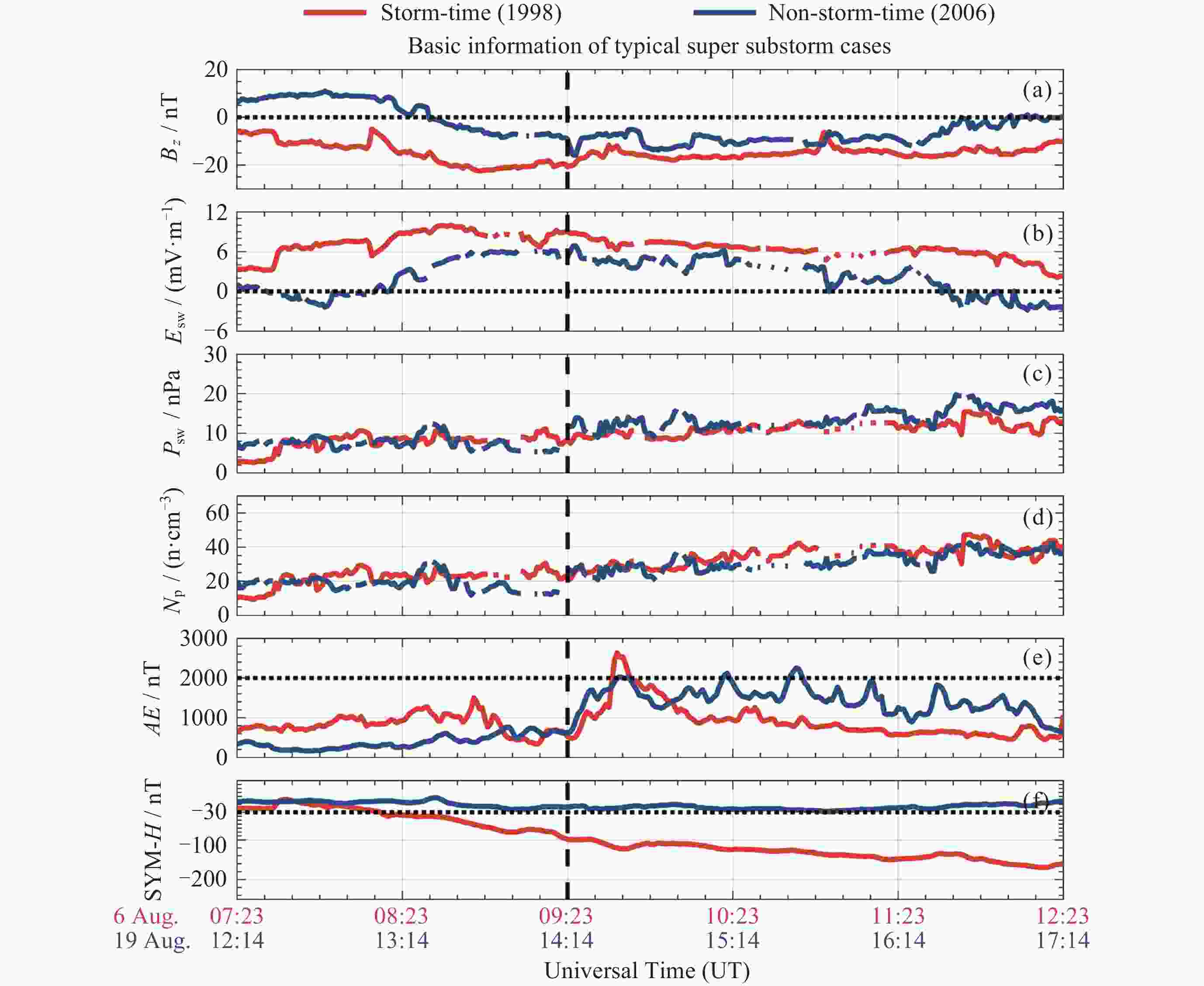
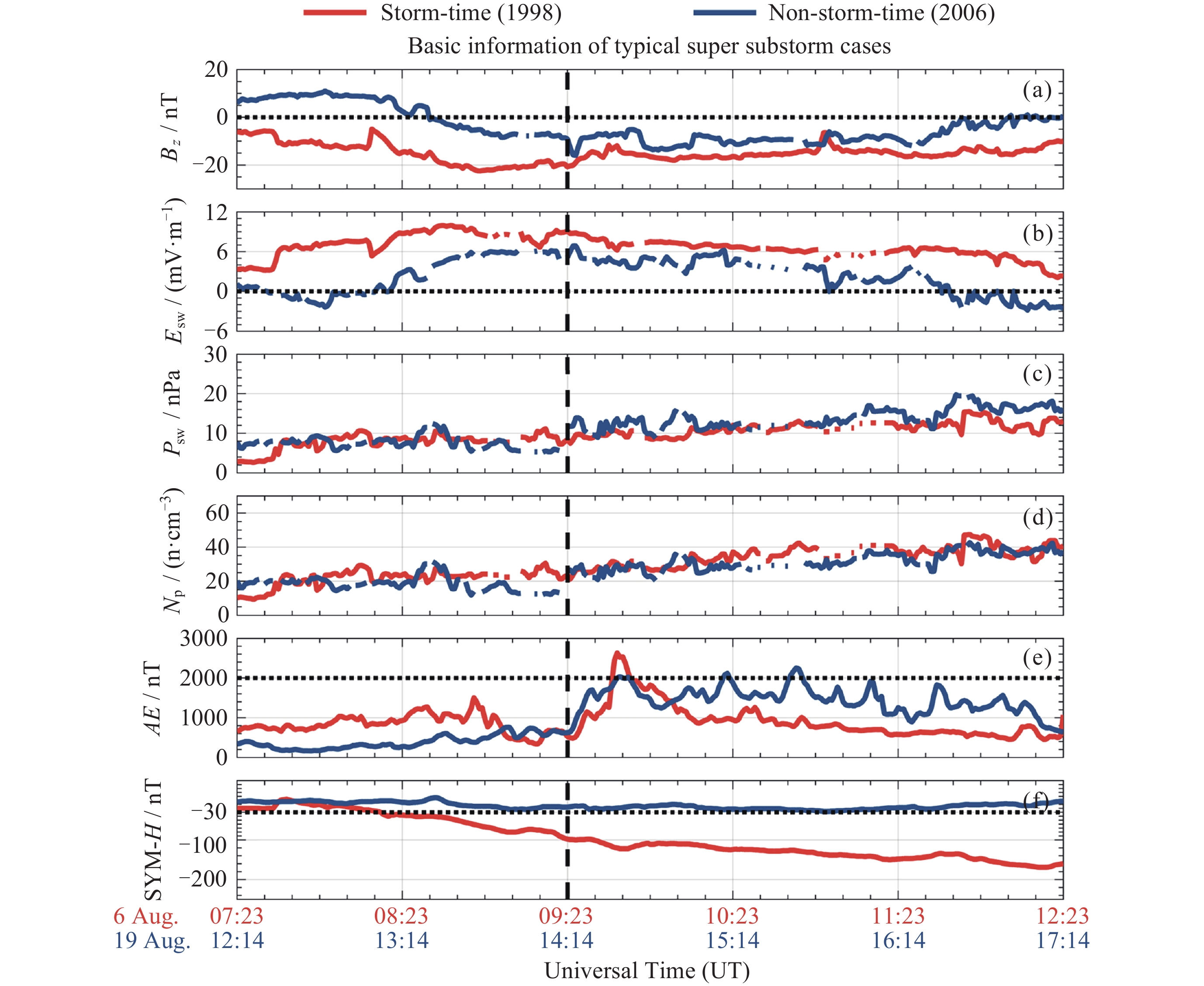
图 1 典型磁暴期间与非磁暴期间的超强亚暴空间环境基本信息与太阳风参数
Figure 1. Basic information on the space environment and solar wind parameters during typical super substorms during storm time and non-storm period
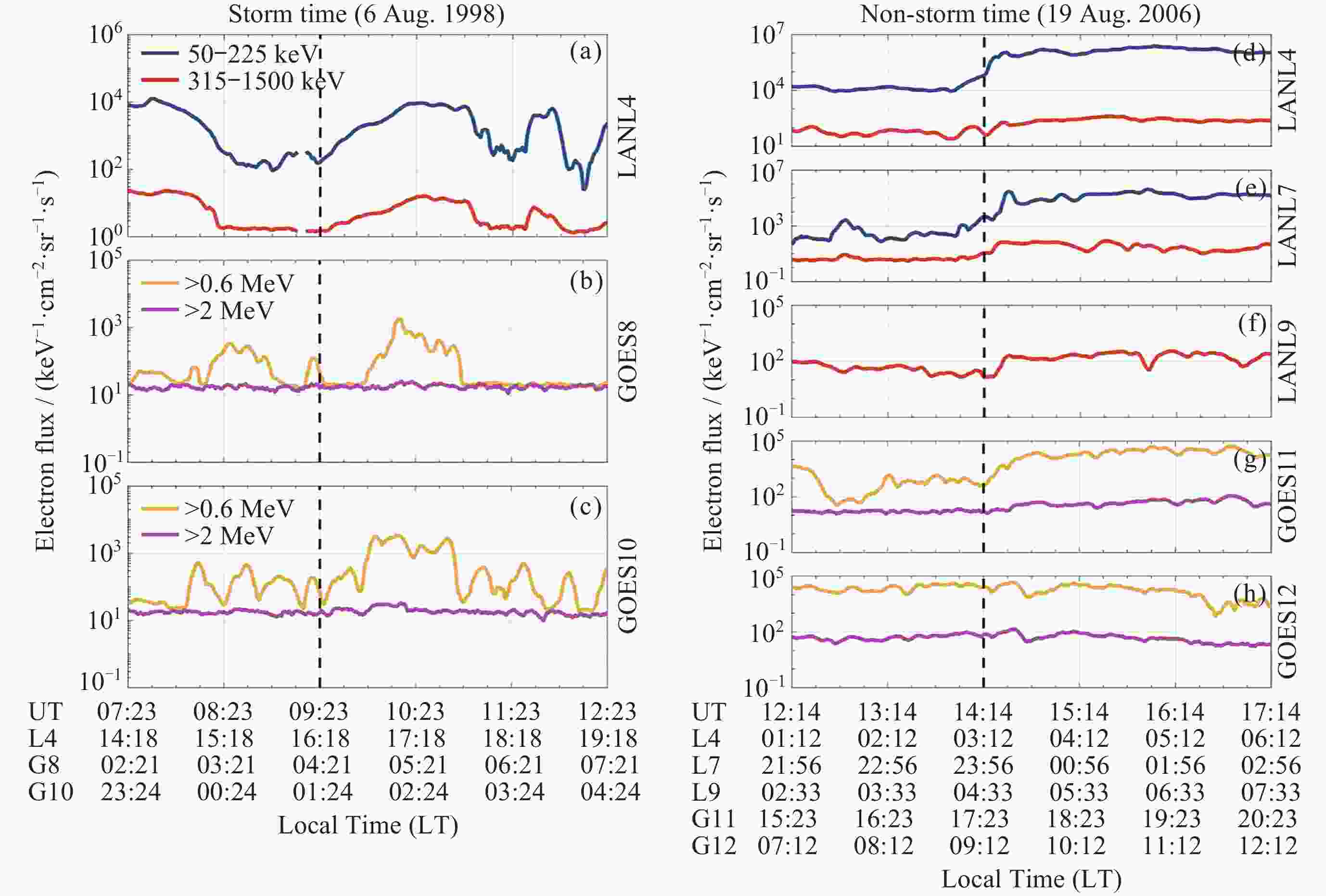
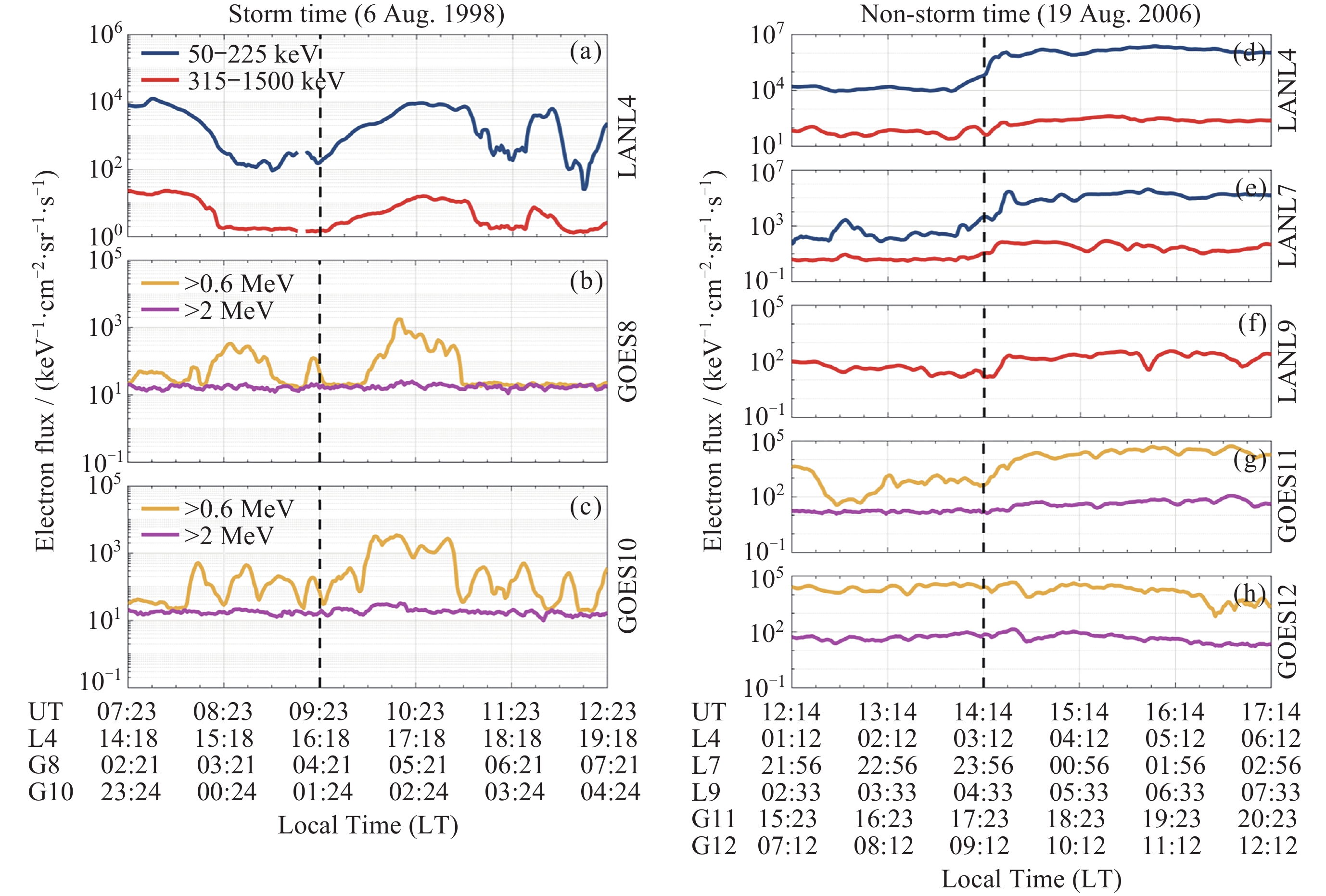
图 2 典型磁暴期间与非磁暴期间的超强亚暴时期电子通量变化情况
Figure 2. Electron flux variations at the GEO for a typical super substorms during storm time and non-storm time
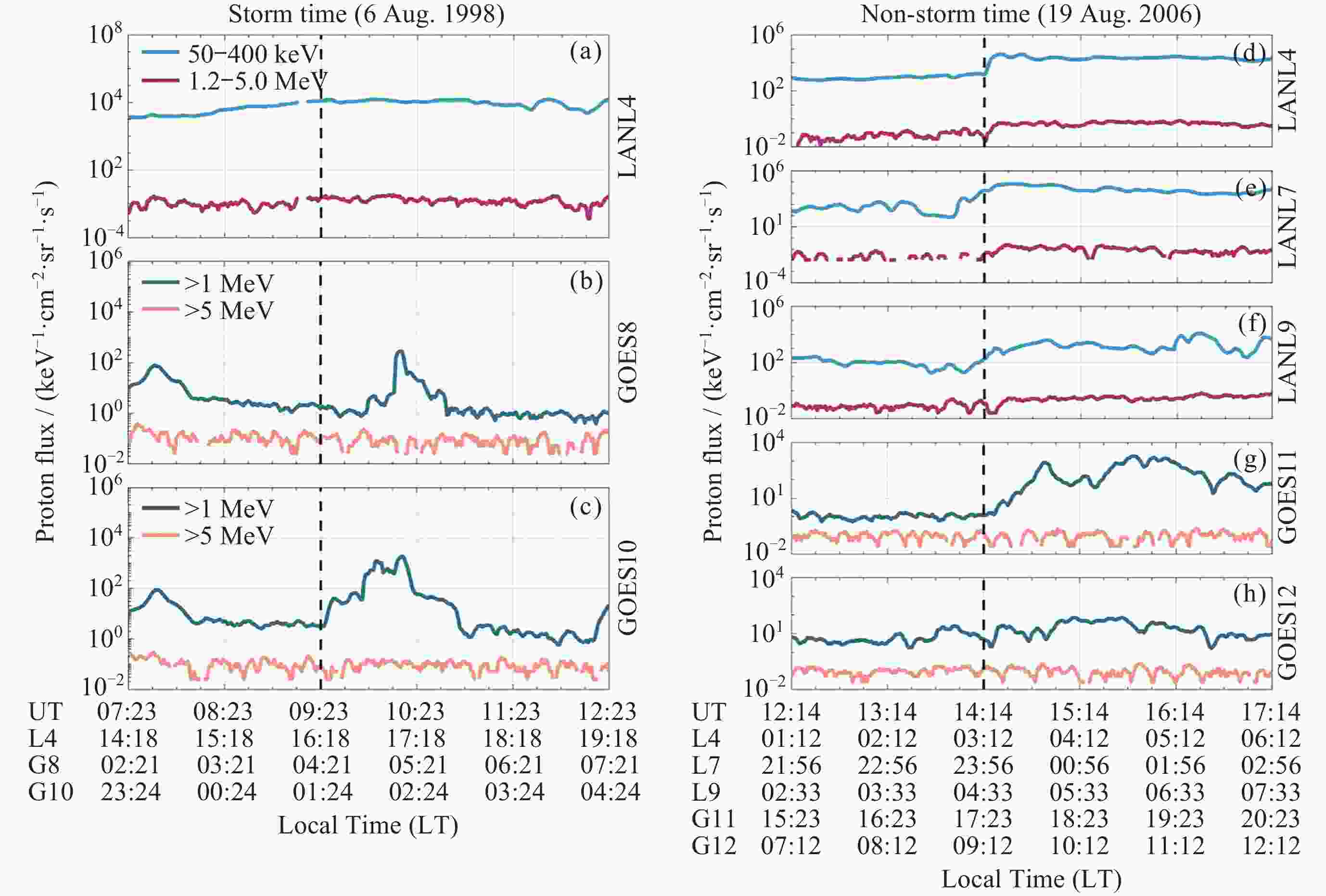
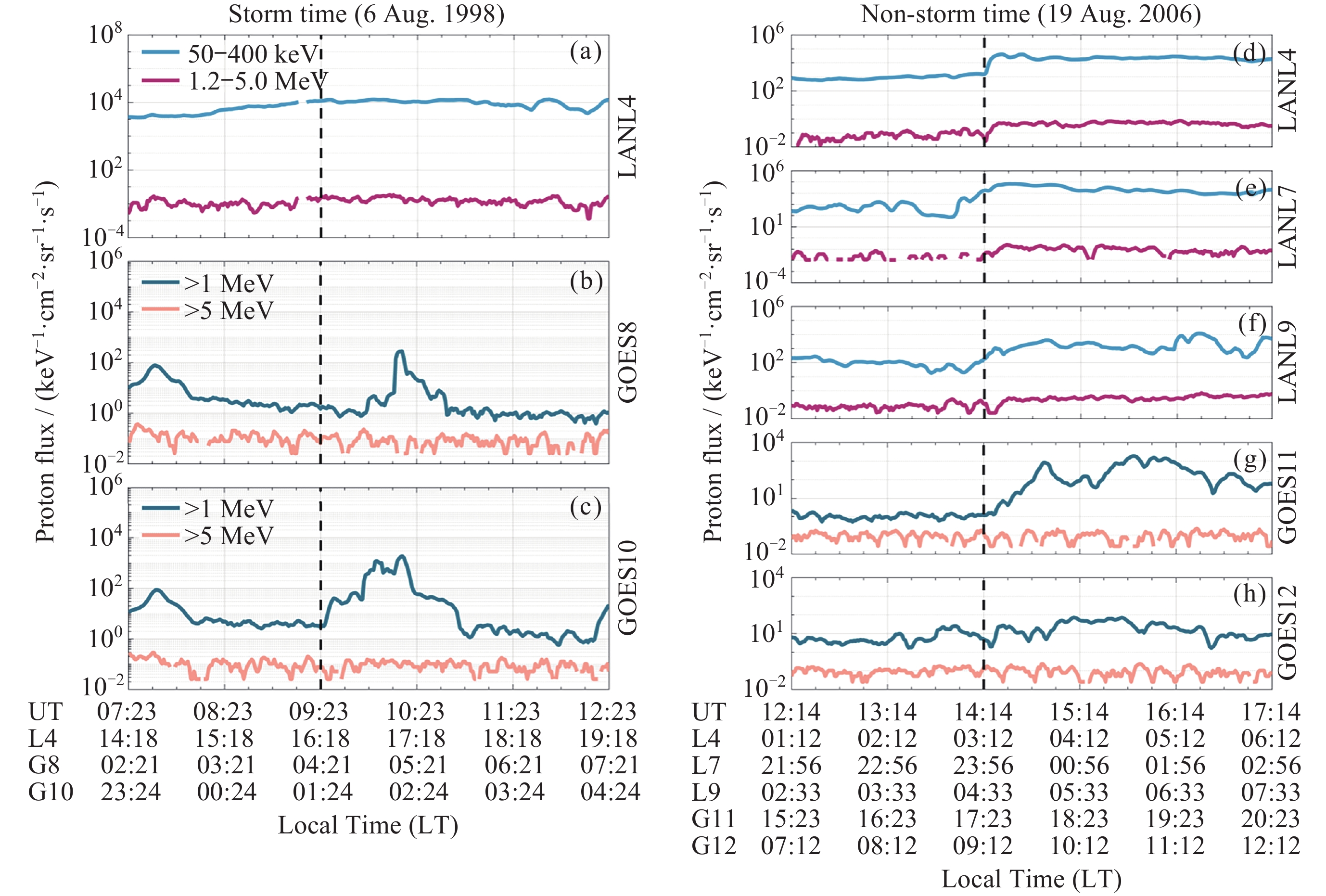
图 3 典型磁暴期间与非磁暴期间的超强亚暴时期质子通量变化情况
Figure 3. Proton flux variations at the Geosynchronous Orbit (GEO) for a typical super substorms during storm time and non-storm time
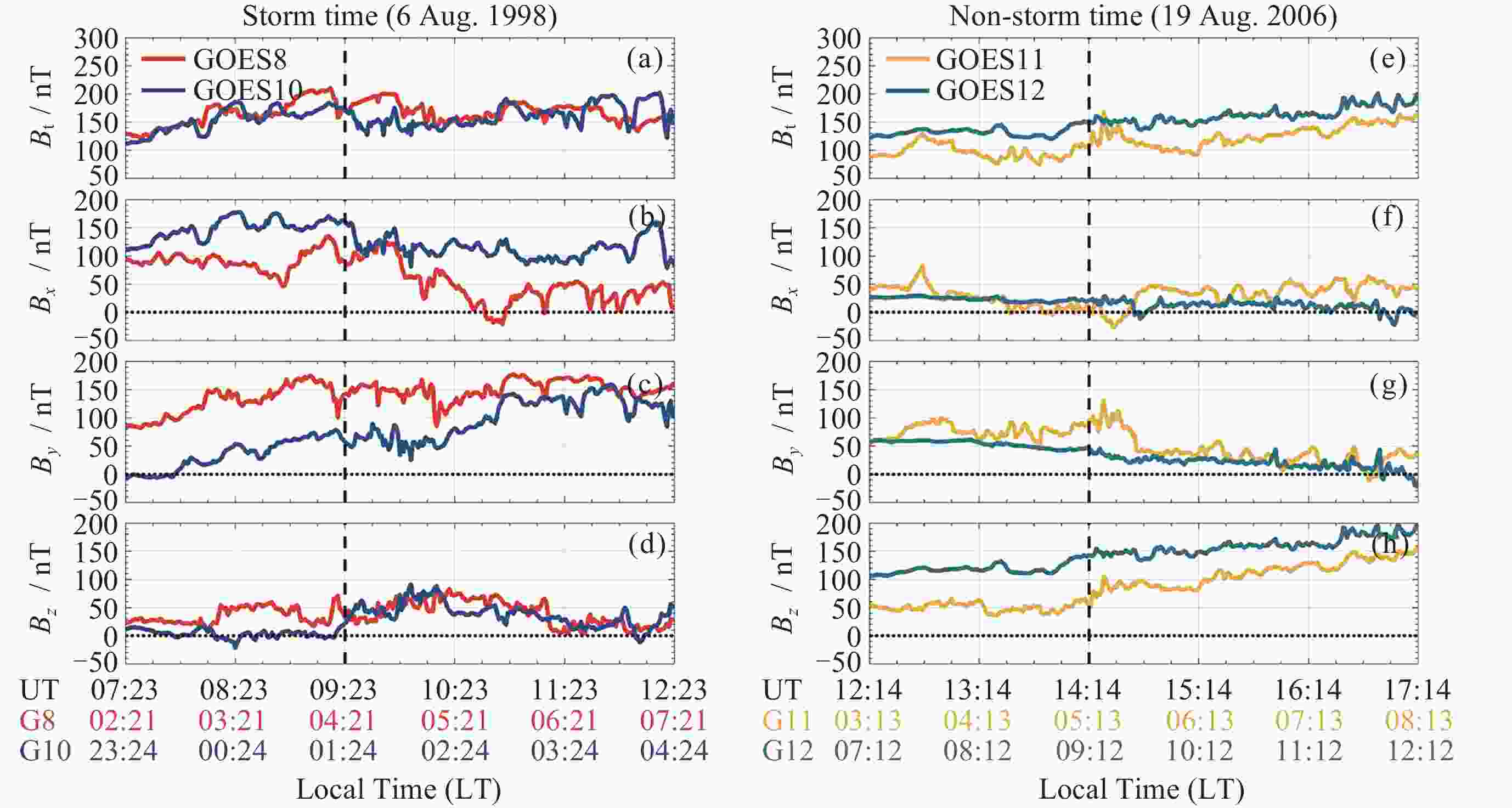
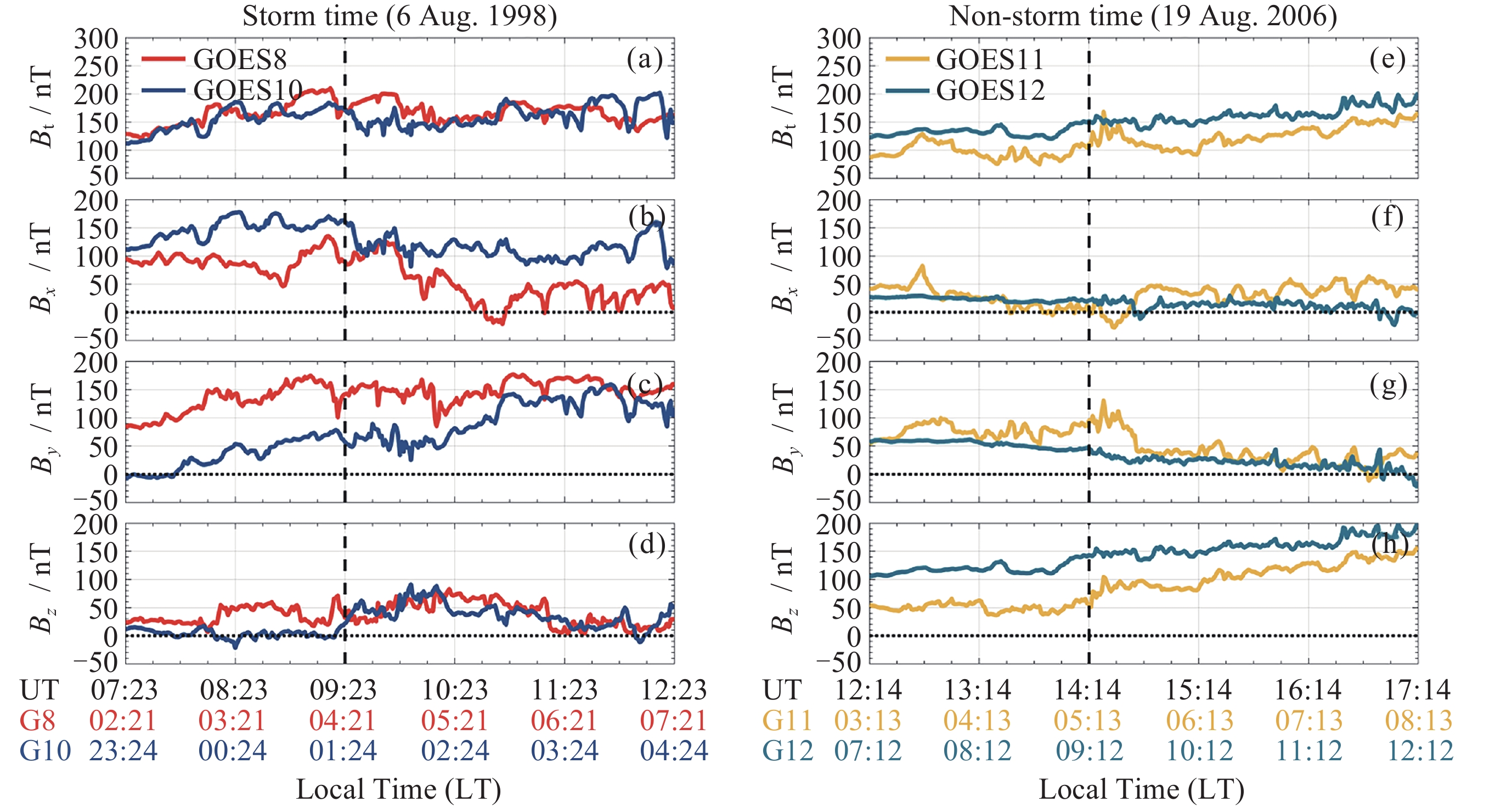
图 4 典型磁暴期间与非磁暴期间的超强亚暴地球同步轨道磁场变化情况
Figure 4. Geomagnetic field variations at GEO for a typical super substorms during storm time and non-storm time
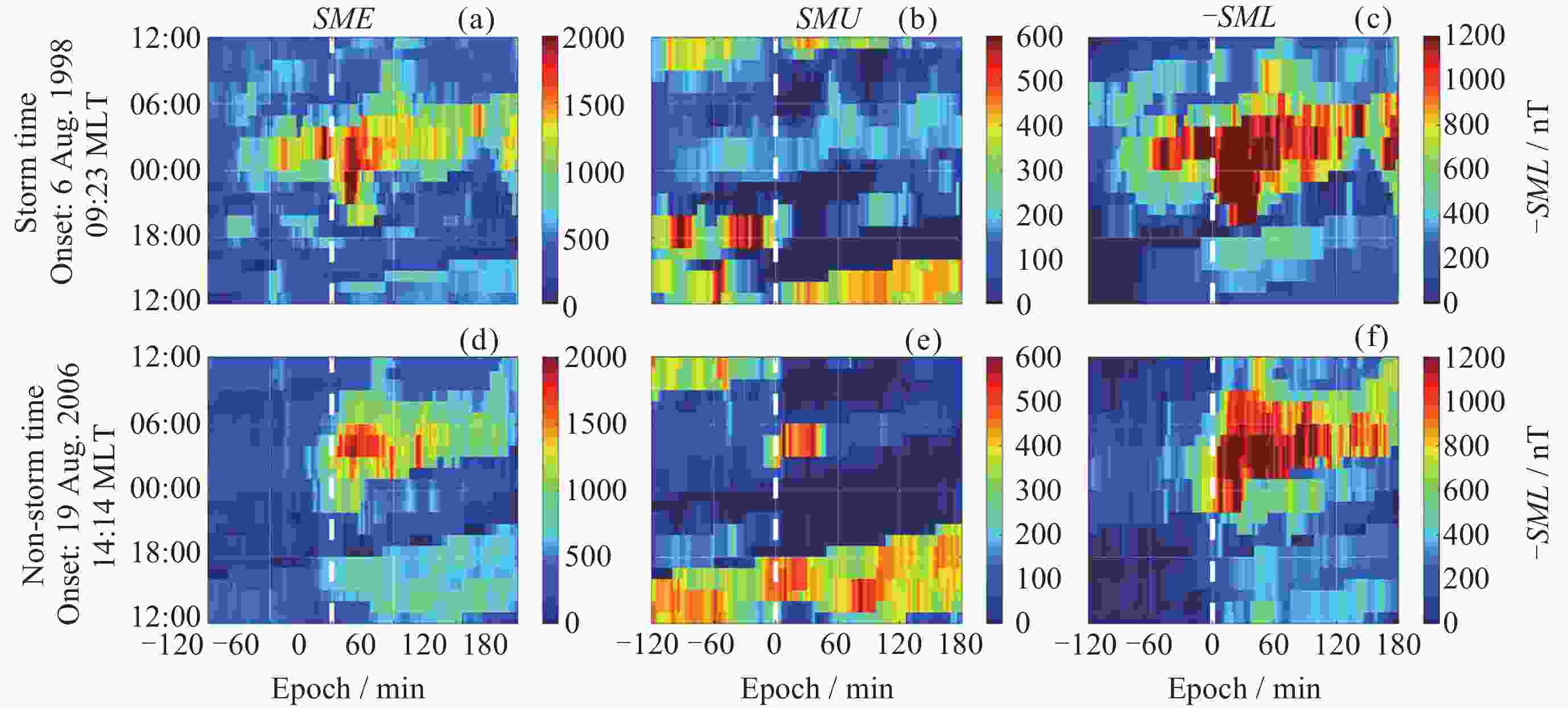
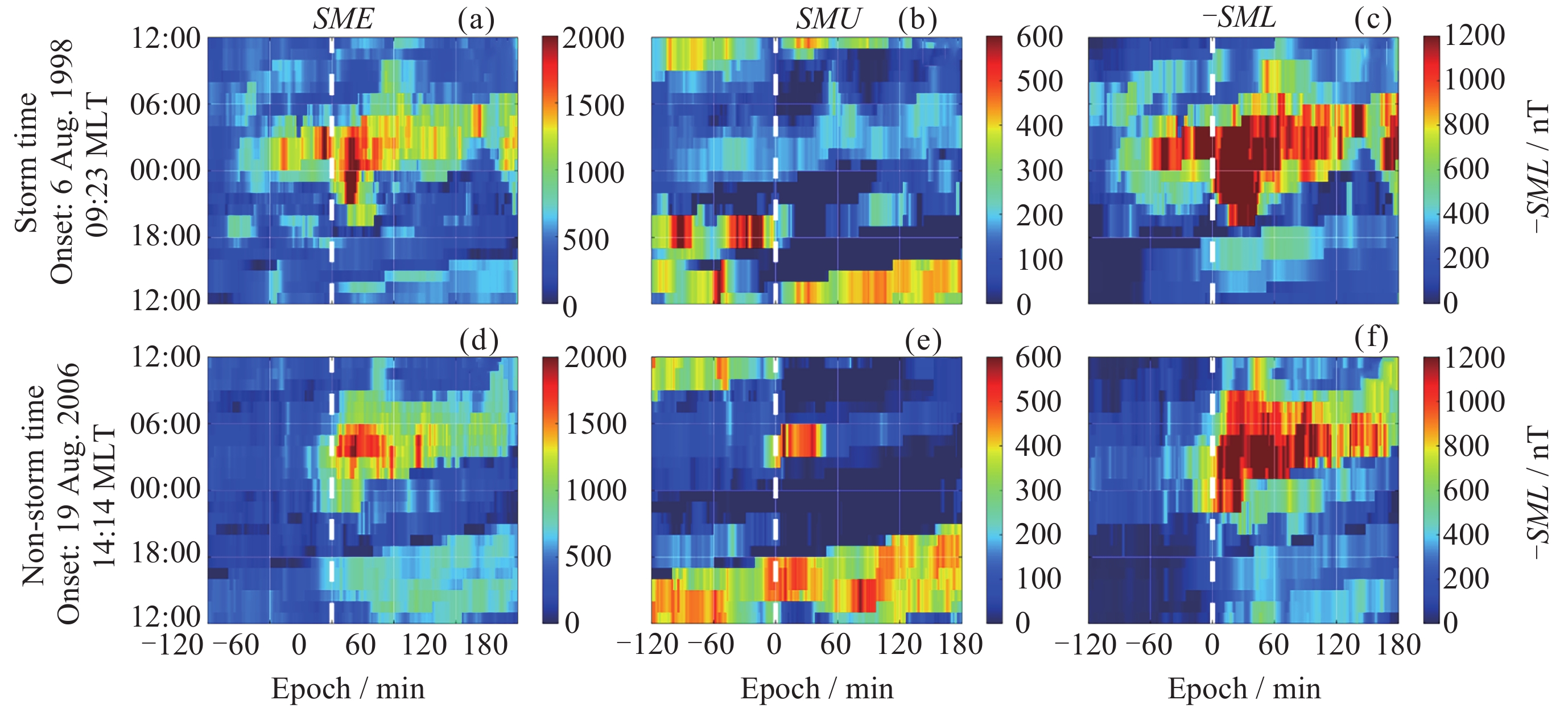
图 5 典型磁暴期间与非磁暴期间的超强亚暴极光电急流演化情况
Figure 5. Evolution of auroral electrojet for a typical super substorms duringstorm time and non-storm time
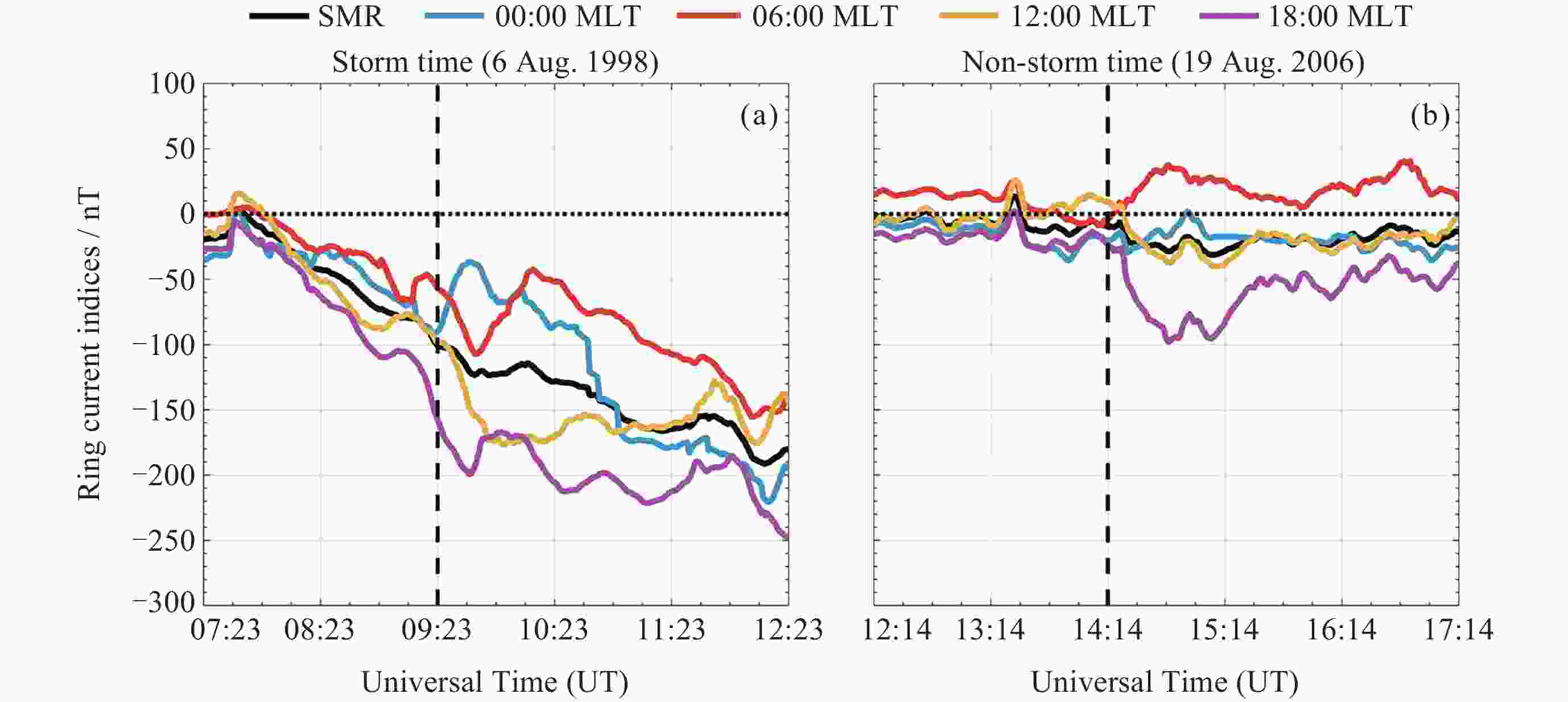
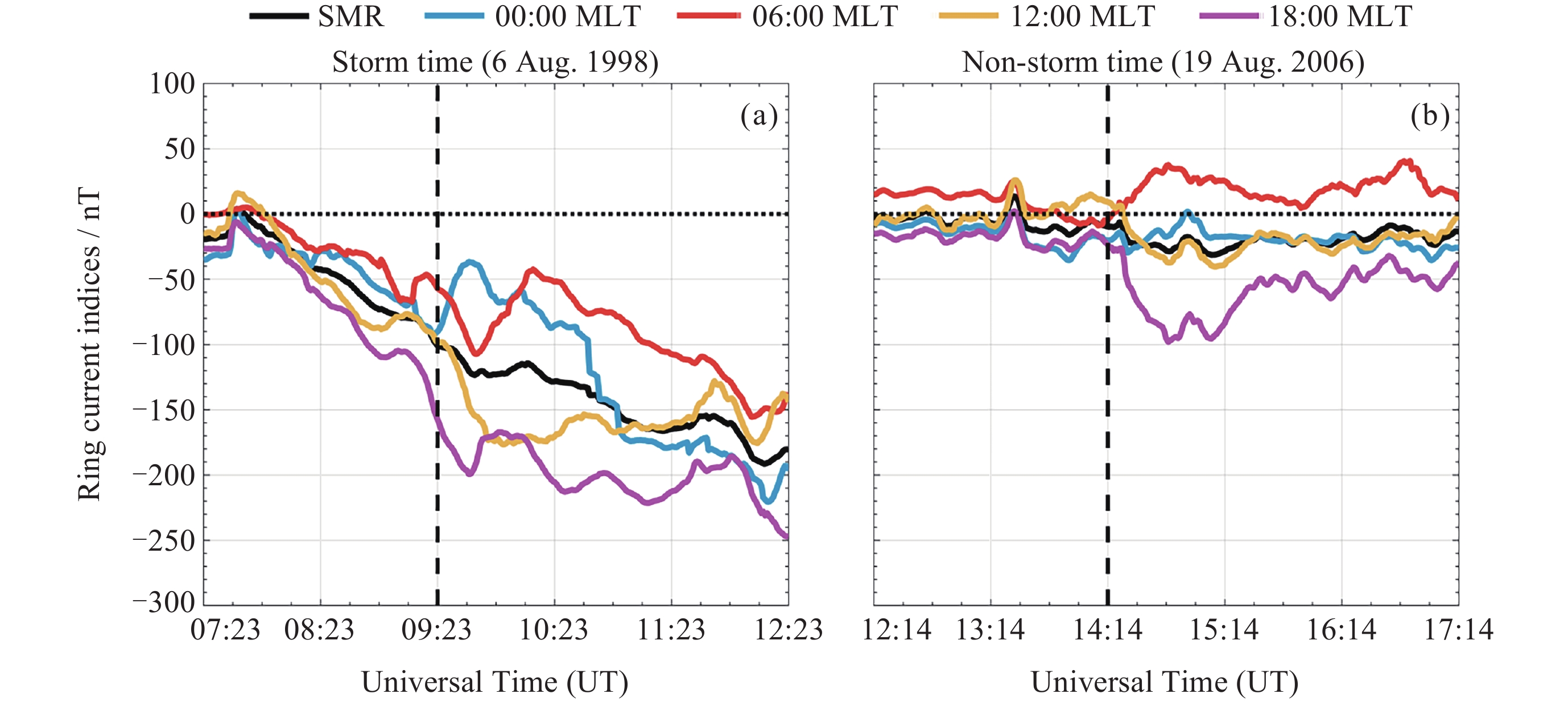
图 6 典型磁暴期间与磁暴期间的超强亚暴环电流指数 (SMR) 变化情况
Figure 6. Variations of ring current indices (SMR) for a typical supers substorms duringstorm time and non-storm time
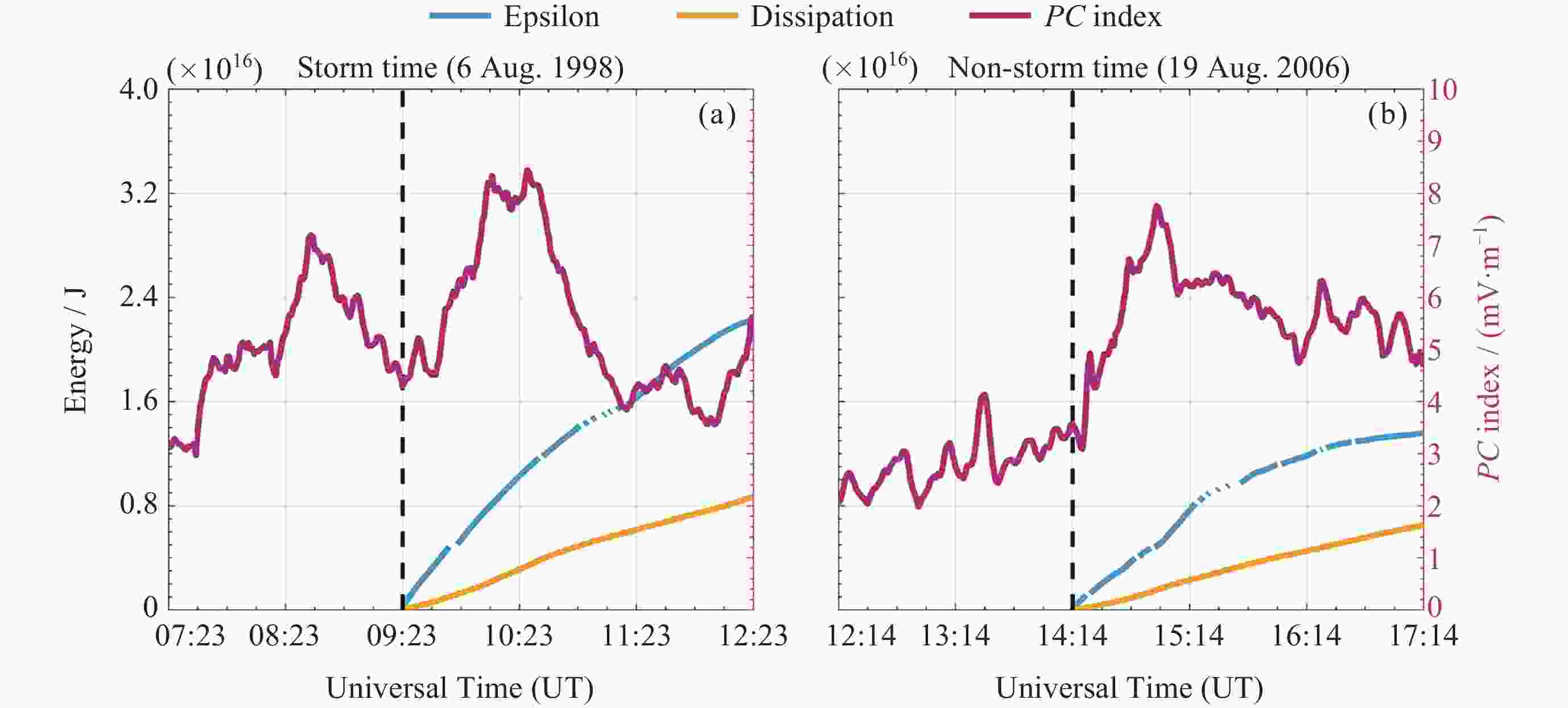
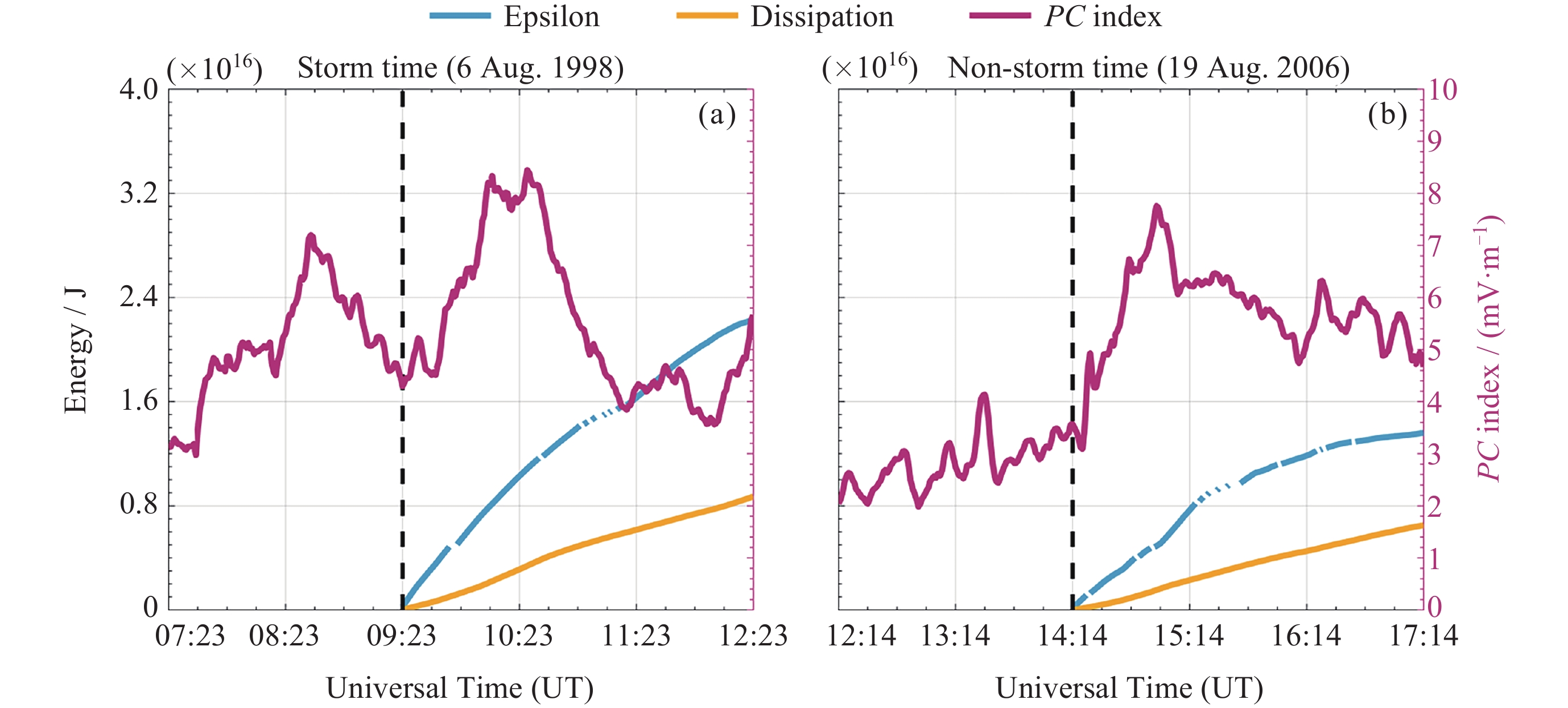
图 7 典型磁暴期间与非磁暴期间的超强亚暴能量注入与耗散情况
Figure 7. Energy injection and dissipation for a typical super substorms during storm time and non-storm time
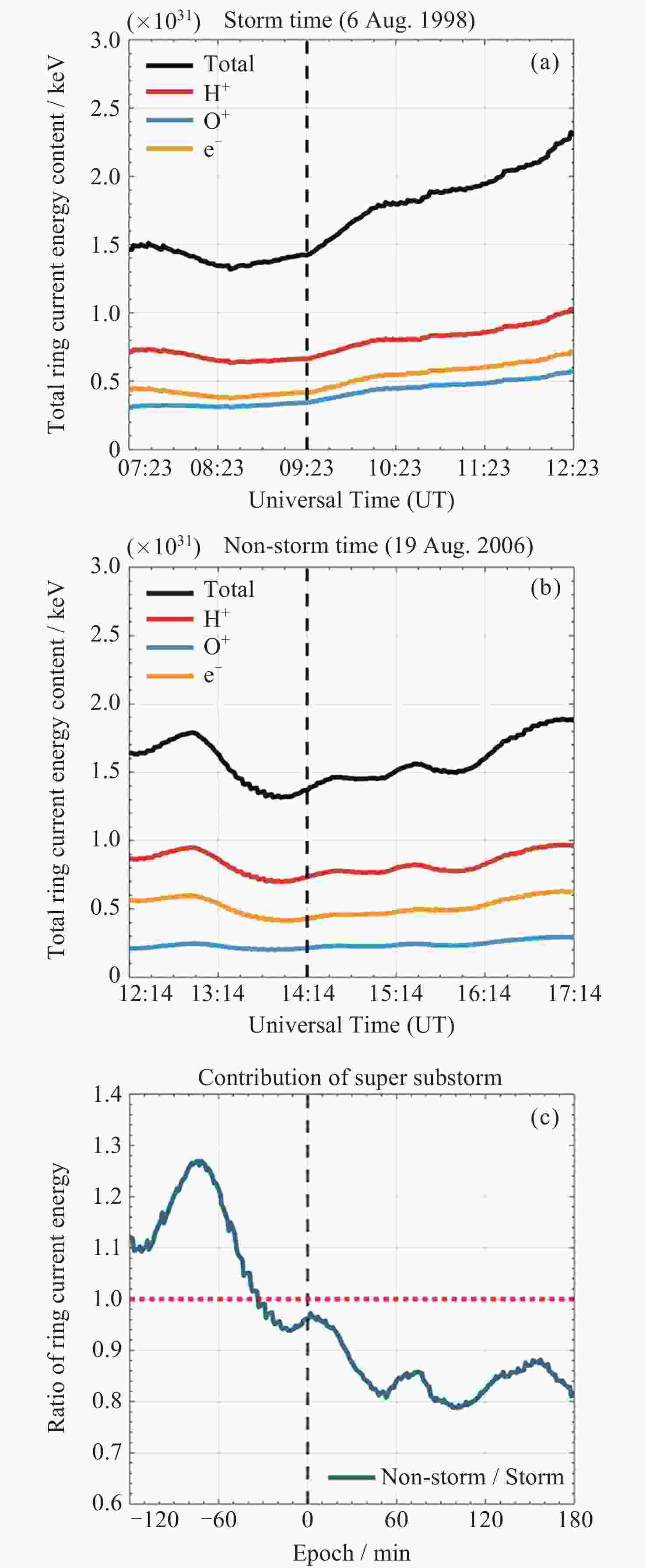
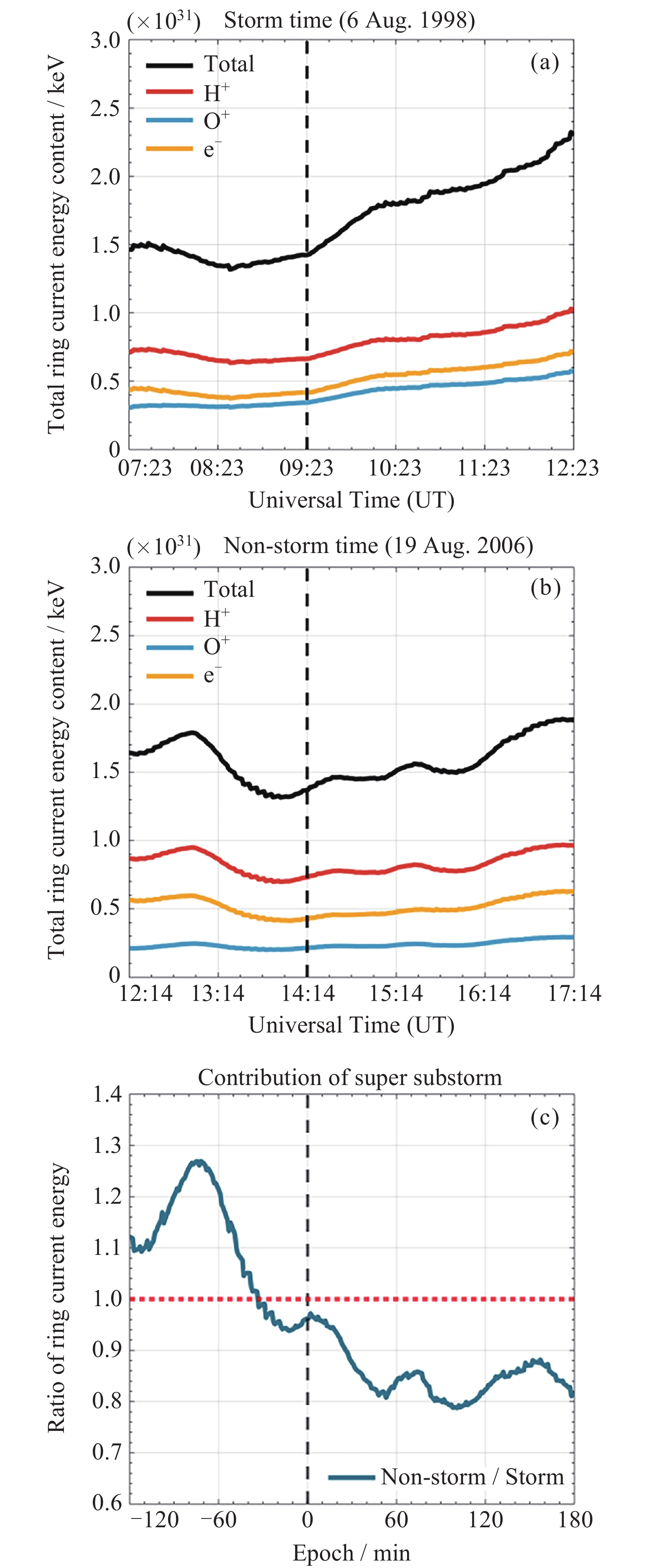
图 8 典型磁暴期间(a)与非磁暴期间(b)的超强亚暴环电流总能量模拟演化情况, 非磁暴期间与磁暴期间环电流总能量比值演化(c)
Figure 8. Simulated evolution of ring current for a typical super substorms duringstorm time (a) and non-storm time (b), and ratio of total ring current energy between non-storm time and storm time (c)
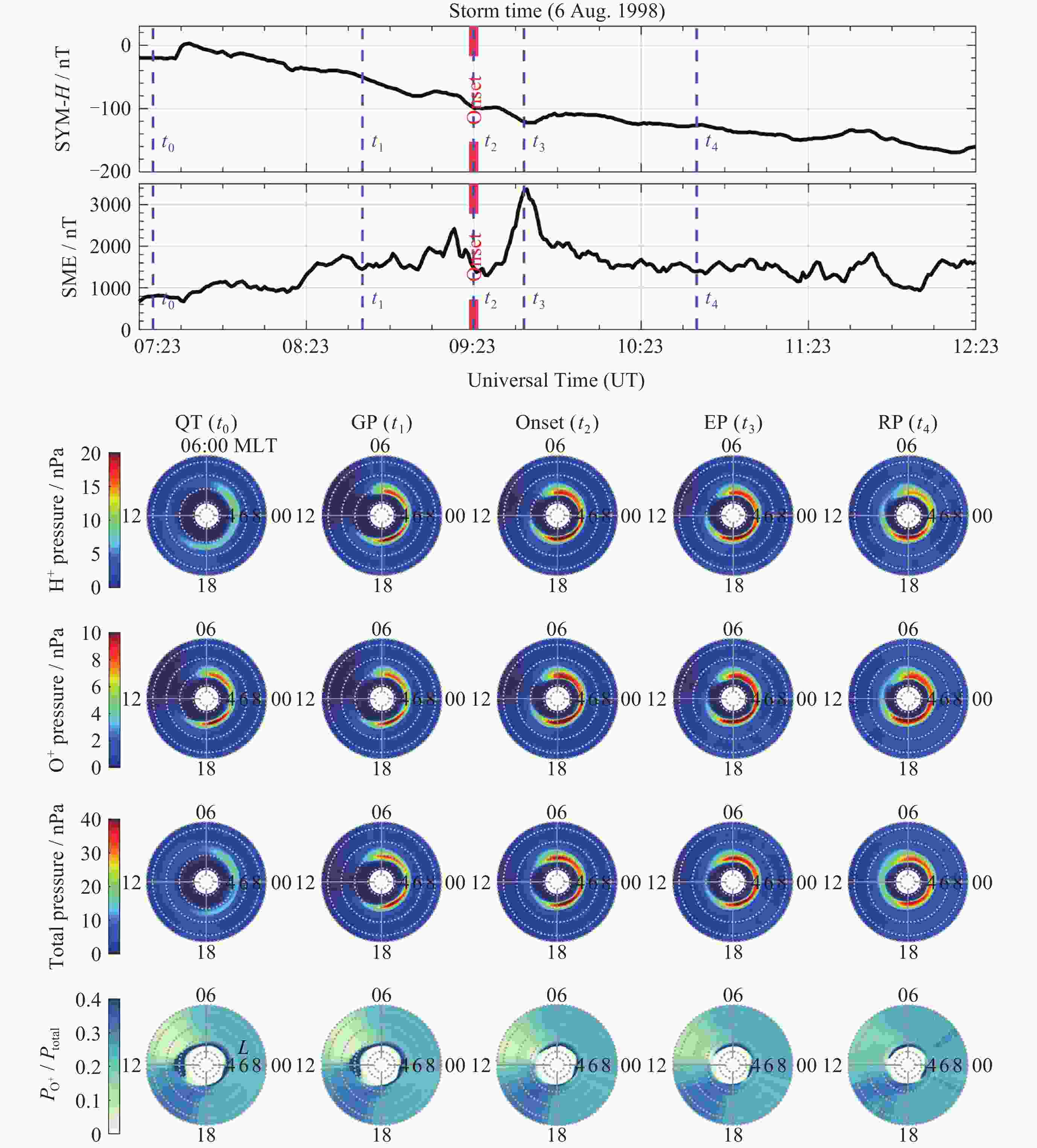
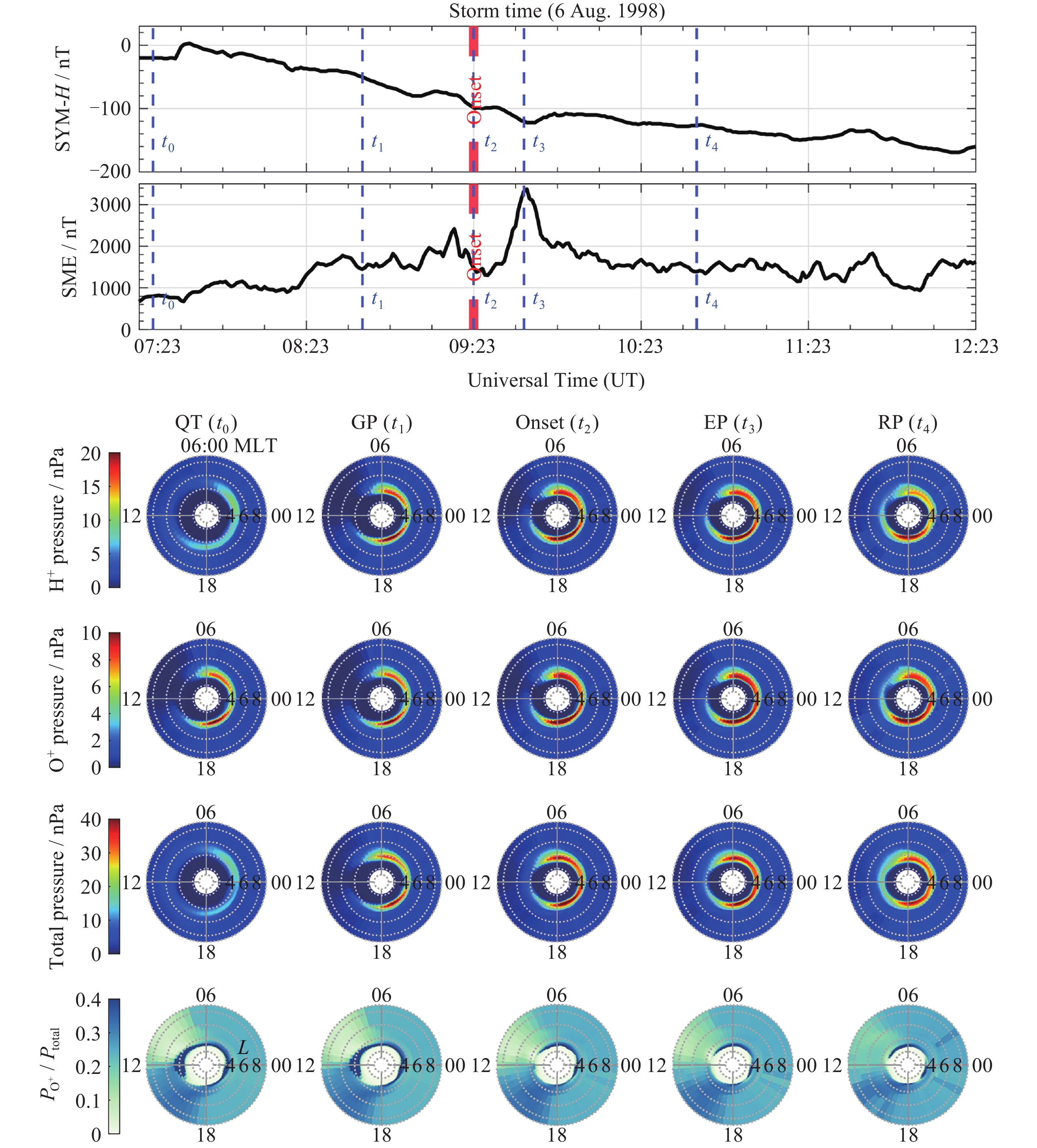
图 9 典型磁暴期间超强亚暴等离子体压强模拟演化
Figure 9. Simulated evolution of plasma pressure for a typical super substorm during storm time
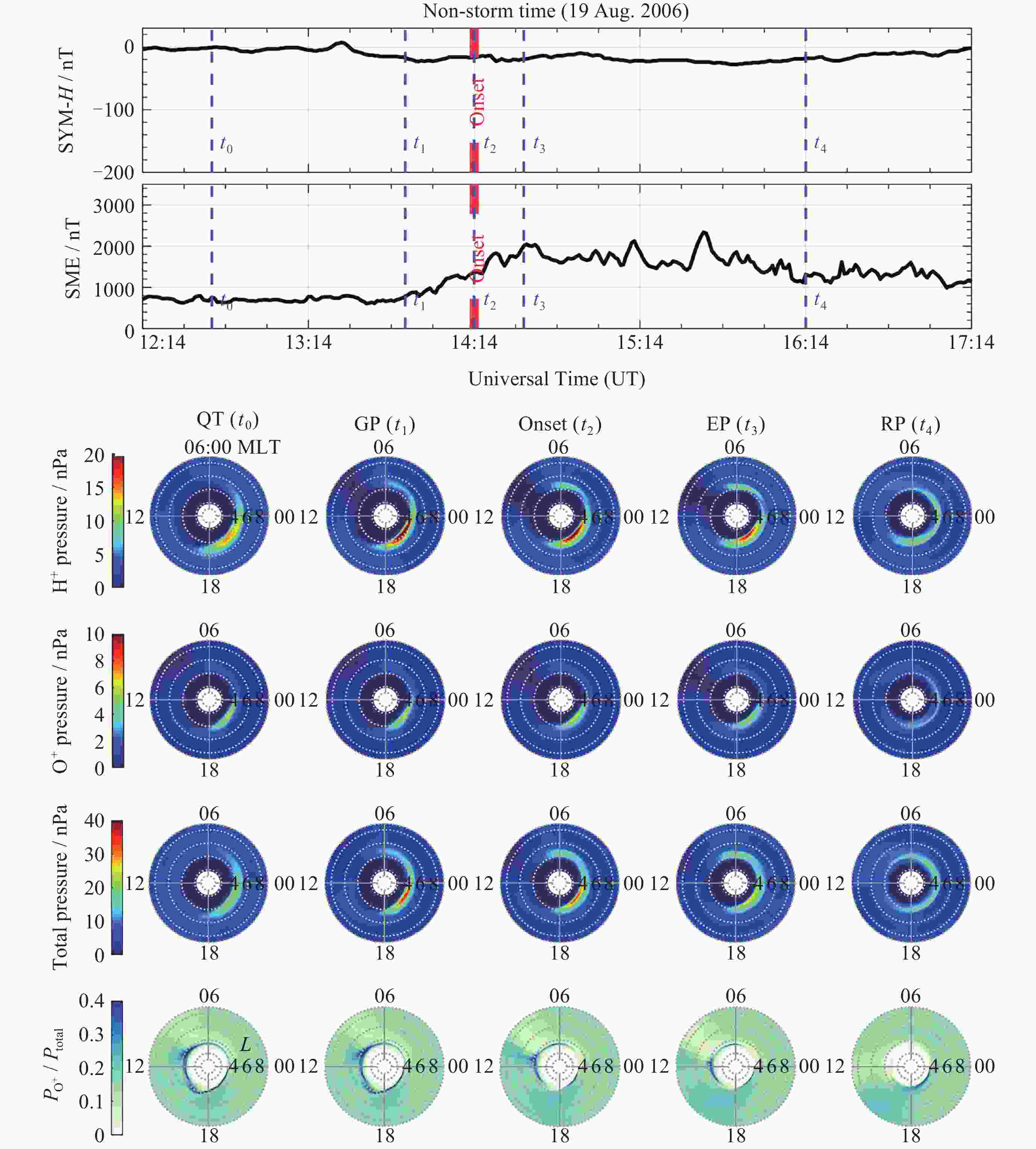
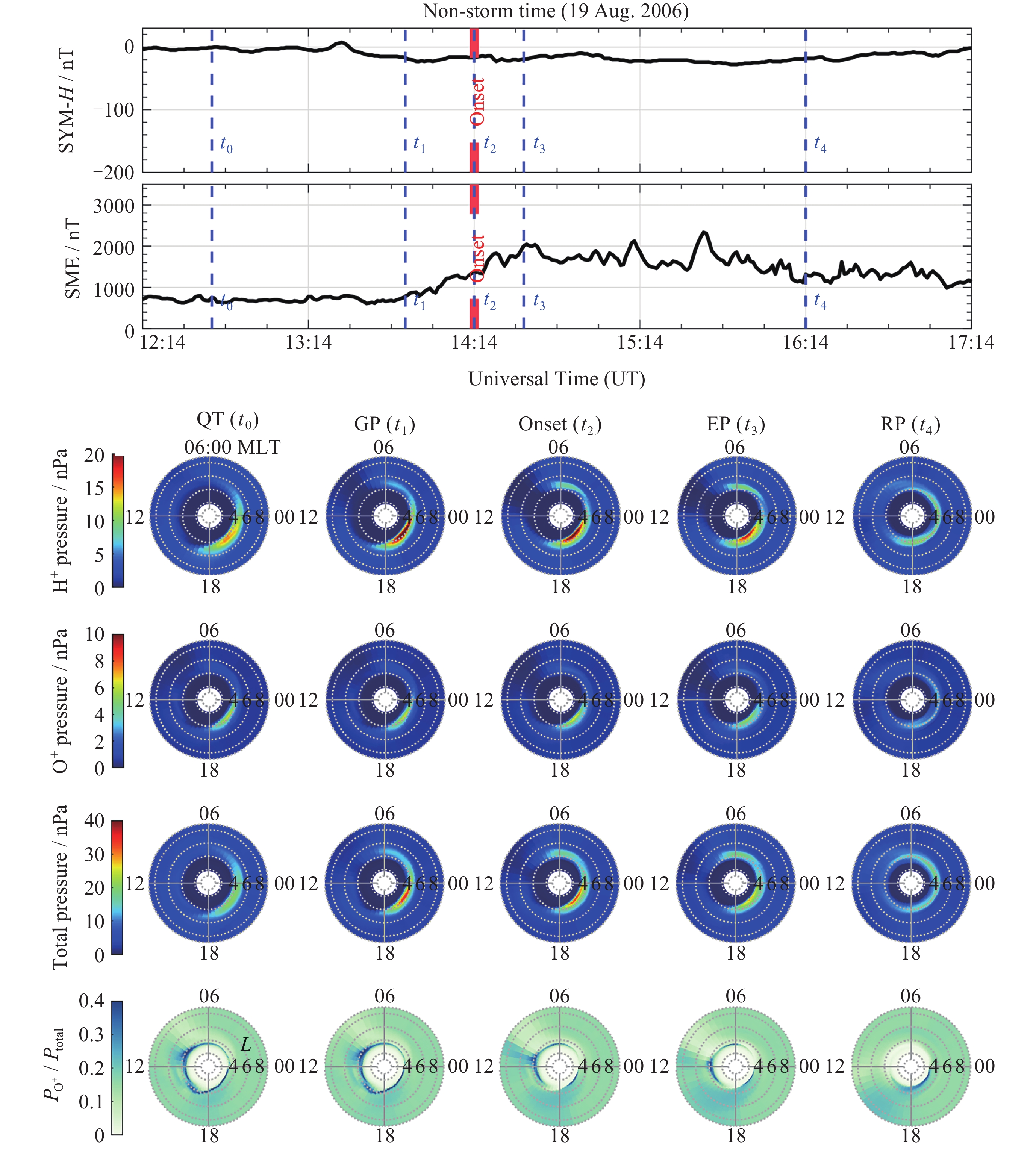
图 10 典型非磁暴期间超强亚暴等离子体压强演化情况
Figure 10. Simulated evolution of plasma pressure for a typical super substorm during non-storm time. (a) SYM-H index, (b) SME index, (c) proton plasma pressure, (d) oxygen ion plasma pressure, (e) total plasma pressure, (f) proportion of oxygen ion plasma pressure
表 1 CIMI模型主要基本参数设置
Table 1. Basic parameter settings in CIMI model
参数名称 具体设置 电离层极区边界纬度/(°) 70.299 模拟粒子成分 氢离子、氧离子、电子 损失锥高度/km 100 等离子体层设置 包含等离子体层 波动设置 包含合声波、嘶声波  下载: 导出CSV
-
[1] ROSTOKER G, AKASOFU S I, FOSTER J, et al. Magnetospheric substorms—Definition and signatures[J]. Journal of Geophysical Research: Space Physics, 1980, 85(A4): 1663-1668 doi: 10.1029/JA085iA04p01663 [2] PULKKINEN A, BERNABEU E, EICHNER J, et al. Generation of 100-year geomagnetically induced current scenarios[J]. Space Weather, 2012, 10(4): S04003 doi: 10.1029/2011sw000750 [3] EASTWOOD J P, NAKAMURA R, TURC L, et al. The scientific foundations of forecasting magnetospheric space weather[J]. Space Science Reviews, 2017, 212(3): 1221-1252 [4] ZONG Q G, YUE C, FU S Y. Shock induced strong substorms and super substorms: preconditions and associated oxygen ion dynamics[J]. Space Science Reviews, 2021, 217(2): 33 doi: 10.1007/s11214-021-00806-x [5] TSURUTANI B T, HAJRA R, ECHER E, et al. Extremely intense (SML≤–2500 nT) substorms: isolated events that are externally triggered?[J]. Annales Geophysicae, 2015, 33(5): 519-524 doi: 10.5194/angeo-33-519-2015 [6] HAJRA R, TSURUTANI B T, ECHER E, et al. Supersubstorms (SML < –2500 nT): Magnetic storm and solar cycle dependences[J]. Journal of Geophysical Research: Space Physics, 2016, 121(8): 7805-7816 doi: 10.1002/2015JA021835 [7] DESPIRAK I V, LYUBCHICH A A, KLEIMENOVA N G. Supersubstorms and conditions in the solar wind[J]. Geomagnetism and Aeronomy, 2019, 59(2): 170-176 doi: 10.1134/S0016793219020075 [8] MA X H, ZONG Q G, LIU Y. The intense substorm incidence in response to interplanetary shock impacts and influence on energetic electron fluxes at geosynchronous orbit[J]. Journal of Geophysical Research: Space Physics, 2019, 124(5): 3210-3221 doi: 10.1029/2018JA026115 [9] FU H B, YUE C, ZONG Q G, et al. Statistical characteristics of substorms with different intensity[J]. Journal of Geophysical Research: Space Physics, 2021, 126(8): e2021JA029318 doi: 10.1029/2021JA029318 [10] LYONS L R, LEE D Y, WANG C P, et al. Global auroral responses to abrupt solar wind changes: dynamic pressure, substorm, and null events[J]. Journal of Geophysical Research: Space Physics, 2005, 110(A8): A08208 doi: 10.1029/2005ja011089 [11] YUE C, ZONG Q G, ZHANG H, et al. Geomagnetic activity triggered by interplanetary shocks[J]. Journal of Geophysical Research: Space Physics, 2010, 115(A5): A00I05 doi: 10.1029/2010ja015356 [12] XU S G, YUE C, ZONG Q G, et al. Solar wind energy budget dilemma during substorms induced by interplanetary shocks[J]. Journal of Geophysical Research: Space Physics, 2023, 128(8): e2022JA031192 doi: 10.1029/2022JA031192 [13] BURCH J L. Preconditions for the triggering of polar magnetic substorms by storm sudden commencements[J]. Journal of Geophysical Research: Space Physics, 1972, 77(28): 5629-5632 doi: 10.1029/JA077i028p05629 [14] KOKUBUN S, MCPHERRON R L, RUSSELL C T. Triggering of substorms by solar wind discontinuities[J]. Journal of Geophysical Research: Space Physics, 1977, 82(1): 74-86 doi: 10.1029/JA082i001p00074 [15] TSURUTANI B T, ZHOU X Y. Interplanetary shock triggering of substorms: WIND and Polar[J]. Advances in Space Research, 2003, 31(4): 1063-1067 doi: 10.1016/S0273-1177(02)00796-2 [16] LEE D Y, CHOI K C, OHTANI S, et al. Can intense substorms occur under northward IMF conditions?[J]. Journal of Geophysical Research: Space Physics, 2010, 115(A1): A01211 doi: 10.1029/2009ja014480 [17] YUE C, ZONG Q G. Solar wind parameters and geomagnetic indices for four different interplanetary shock/ICME structures[J]. Journal of Geophysical Research: Space Physics, 2011, 116(A12): A12201 doi: 10.1029/2011ja017013 [18] LUGAZ N, FARRUGIA C J, WINSLOW R M, et al. Factors affecting the geoeffectiveness of shocks and sheaths at 1 AU[J]. Journal of Geophysical Research: Space Physics, 2016, 121(11): 10861-10879 doi: 10.1002/2016ja023100 [19] HAJRA R, TSURUTANI B T. Interplanetary shocks inducing magnetospheric supersubstorms (SML<– 2500 nT): Unusual auroral morphologies and energy flow[J]. The Astrophysical Journal, 2018, 858(2): 123 doi: 10.3847/1538-4357/aabaed [20] ADHIKARI B, BARUWAL P, CHAPAGAIN N P. Analysis of supersubstorm events with reference to polar cap potential and polar cap index[J]. Earth and Space Science, 2017, 4(1): 2-15 doi: 10.1002/2016EA000217 [21] FU H B, Yue C, ZONG Q G, et al. Substorm influences on plasma pressure and current densities inside the geosynchronous orbit[J]. Journal of Geophysical Research: Space Physics, 2023, 128(3): e2022JA031099 doi: 10.1029/2022JA031099 [22] ZHUANG Y, YUE C, ZONG Q G, et al. The effect of energetic ion dispersionless injections on the ring current dynamics[J]. Journal of Geophysical Research: Space Physics, 2023, 128(2): e2022JA030914 doi: 10.1029/2022JA030914 [23] SHAY M A, SWISDAK M. Three-species collisionless reconnection: effect of O+ on magnetotail reconnection[J]. Physical Review Letters, 2004, 93(17): 175001 doi: 10.1103/PhysRevLett.93.175001 [24] FU S Y, ZONG Q G, WILKEN B, et al. Temporal and spatial variation of the ion composition in the ring current[J]. Space Science Reviews, 2001, 95(1): 539-554 doi: 10.1023/a:1005212906199 [25] BAUMJOHANN W, KAMIDE Y, NAKAMURA R. Substorms, storms, and the near-Earth tail[J]. Journal of Geomagnetism and Geoelectricity, 1996, 48(2): 177-185 [26] MCPHERRON R L, HSU T S. A comparison of substorms occurring during magnetic storms with those occurring during quiet times[J]. Journal of Geophysical Research: Space Physics, 2002, 107(A9): 1259 doi: 10.1029/2001ja002008 [27] PARTAMIES N, JUUSOLA L, TANSKANEN E, et al. Substorms during different storm phases[J]. Annales Geophysicae, 2011, 29(11): 2031-2043 doi: 10.5194/angeo-29-2031-2011 [28] DU A M, TSURUTANI B T, SUN W. Anomalous geomagnetic storm of 21-22 January 2005: A storm main phase during northward IMFs[J]. Journal of Geophysical Research: Space Physics, 2008, 113(A10): A10214 doi: 10.1029/2008ja013284 [29] JANG E, YUE C, ZONG Q G, et al. The effect of non-storm time substorms on the ring current dynamics[J]. Earth and Planetary Physics, 2021, 5(3): 251-258 [30] HE Z H, DAI L, WANG C, et al. Contributions of substorm injections to SYM‐H depressions in the main phase of storms[J]. Journal of Geophysical Research: Space Physics, 2016, 121(12): 11729-11736 [31] 戴磊, 王赤, 任勇, 等. 磁暴和亚暴研究进展与展望[J]. 科学通报, 2025, 70(27): 4759-4774DAI Lei, WANG Chi, REN Yong, et al. Geomagnetic storms and substorms: progress and perspectives[J]. Chinese Science Bulletin, 2025, 70(27): 4759-4774 [32] CHU X N, MCPHERRON R L, HSU T S, et al. Solar cycle dependence of substorm occurrence and duration: implications for onset[J]. Journal of Geophysical Research: Space Physics, 2015, 120(4): 2808-2818 doi: 10.1002/2015JA021104 [33] GONZALEZ W D, JOSELYN J A, KAMIDE Y, et al. What is a geomagnetic storm?[J]. Journal of Geophysical Research: Space Physics, 1994, 99(A4): 5771-5792 doi: 10.1029/93JA02867 [34] LOEWE C A, PRÖLSS G W. Classification and mean behavior of magnetic storms[J]. Journal of Geophysical Research: Space Physics, 1997, 102(A7): 14209-14213 doi: 10.1029/96JA04020 [35] BELIAN R D, GISLER G R, CAYTON T, et al. High-Z energetic particles at geosynchronous orbit during the great solar proton event series of October 1989[J]. Journal of Geophysical Research: Space Physics, 1992, 97(A11): 16897-16906 doi: 10.1029/92JA01139 [36] KRESS B T, RODRIGUEZ J V, ONSAGER T G. The GOES-R space environment in situ suite (SEISS): measurement of energetic particles in geospace[M]//GOODMAN S J, SCHMIT T J, DANIELS J, et al. The GOES-R Series. Amsterdam: Elsevier, 2020: 243-250 [37] NEWELL P T, GJERLOEV J W. Evaluation of SuperMAG auroral electrojet indices as indicators of substorms and auroral power[J]. Journal of Geophysical Research: Space Physics, 2011, 116(A12): A12211 doi: 10.1029/2011ja016779 [38] FOK M C, WOLF R A, SPIRO R W, et al. Comprehensive computational model of Earth's ring current[J]. Journal of Geophysical Research: Space Physics, 2001, 106(A5): 8417-8424 doi: 10.1029/2000JA000235 [39] FOK M C, HORNE R B, MEREDITH N P, et al. Radiation Belt Environment model: application to space weather nowcasting[J]. Journal of Geophysical Research: Space Physics, 2008, 113(A3): A03S08 doi: 10.1029/2007ja012558 [40] FOK M C, GLOCER A, ZHENG Q, et al. Recent developments in the radiation belt environment model[J]. Journal of Atmospheric and Solar-Terrestrial Physics, 2011, 73(11/12): 1435-1443 doi: 10.1016/j.jastp.2010.09.033 [41] FOK M C, BUZULUKOVA N Y, CHEN S H, et al. The comprehensive inner magnetosphere-ionosphere model[J]. Journal of Geophysical Research: Space Physics, 2014, 119(9): 7522-7540 doi: 10.1002/2014JA020239 [42] PERREAULT P, AKASOFU S I. A study of geomagnetic storms[J]. Geophysical Journal International, 1978, 54(3): 547-573 doi: 10.1111/j.1365-246X.1978.tb05494.x [43] KNIPP D J, WELLIVER T, MCHARG M G, et al. Climatology of extreme upper atmospheric heating events[J]. Advances in Space Research, 2005, 36(12): 2506-2510 doi: 10.1016/j.asr.2004.02.019 [44] ØSTGAARD N, VONDRAK R R, GJERLOEV J W, et al. A relation between the energy deposition by electron precipitation and geomagnetic indices during substorms[J]. Journal of Geophysical Research: Space Physics, 2002, 107(A9): 1246 [45] DE MICHELIS P, DAGLIS I A, CONSOLINI G. Average terrestrial ring current derived from AMPTE/CCE-CHEM measurements[J]. Journal of Geophysical Research: Space Physics, 1997, 102(A7): 14103-14111 doi: 10.1029/96JA03743 [46] ZHAO H, LI X, BAKER D N, et al. The evolution of ring current ion energy density and energy content during geomagnetic storms based on Van Allen Probes measurements[J]. Journal of Geophysical Research: Space Physics, 2015, 120(9): 7493-7511 doi: 10.1002/2015JA021533 [47] HE Z H, DAI L, WANG C, et al. Characteristics of isolated and storm‐time ion injections[J]. Journal of Geophysical Research: Space Physics, 2023, 128(3): e2022JA030745 doi: 10.1029/2022JA030745 [48] MCPHERRON R L. Substorm related changes in the geomagnetic tail: the growth phase[J]. Planetary and Space Science, 1972, 20(9): 1521-1539 doi: 10.1016/0032-0633(72)90054-2 [49] YUE C, BORTNIK J, LI W, et al. The composition of plasma inside geostationary orbit based on Van Allen Probes observations[J]. Journal of Geophysical Research: Space Physics, 2018, 123(8): 6478-6493 doi: 10.1029/2018JA025344 [50] YUE C, BORTNIK J, LI W, et al. Oxygen ion dynamics in the Earth's ring current: van allen probes observations[J]. Journal of Geophysical Research: Space Physics, 2019, 124(10): 7786-7798 doi: 10.1029/2019JA026801 -
-

 下载:
下载:

计量
- 文章访问数: 834
- HTML全文浏览量: 106
- PDF下载量: 99
-
被引次数:
0(来源:Crossref)
0(来源:其他)

