


张衡一号地球物理场探测卫星高精度在轨定标技术
doi: 10.11728/cjss2026.05.2026-0023 cstr: 32142.14.cjss.2026-0023
-
 泽仁志玛 女, 藏族, 四川省甘孜藏族自治州九龙县人, 现为应急管理部国家自然灾害防治研究院研究员, 博士生导师, 主要研究方向为空间物理学、地球物理场卫星探测技术、电磁卫星观测技术及自然灾害监测应用等. E-mail: zerenzhima@ninhm.ac.cn
作者简介:
High-precision In-orbit Calibration Technology for the CSES-01 Geophysical-field-detection Satellite
-
摘要: 聚焦张衡一号电磁监测试验卫星(01星)4大类8种载荷的数据定标难题, 构建了电磁卫星数据全链路在轨定标技术体系. 该体系纵向实现了各载荷原始电信号—物理量—数据的逐级在轨定标, 横向发展了载荷间、星间、星地、模型与实测数据之间的多维交叉校验方法. 经过在轨定标优化, 张衡一号01星(CSES-01)数据指标满足: 电磁场频率分辨率为0.45 Hz、高能粒子通量0.01 MeV及投掷角分辨率5°; 磁场精度优于1 nT、等离子体相对精度优于10%; 基于掩星接收机观测数据估算GPS卫星仪器偏差精度0.8 ns. 该在轨定标技术体系形成了电磁卫星定标领域的自主技术方案,已成功应用于张衡一号01星常规数据生产, 并驱动了张衡一号02星(CSES-02)工程改进, 提升了卫星整体观测性能, 为中国在该领域实现从技术追赶向并跑与引领的跨越奠定了关键技术基础.Abstract: This study focuses on the data calibration challenges of eight types of payloads in four major categories (electromagnetic field, in-situ plasma, energetic particles, and ionospheric structure) carried by the China Seismo-Electromagnetic Satellite (CSES-01, also known as Zhangheng-1), The in-orbit full-chain calibration system for electromagnetic satellite data has been established. Vertically, this system achieves precise end-to-end validation from “raw signals to physical quantities and then to data products” for each payload. Horizontally, it conducts multidimensional cross-validation among payloads, satellites, and ground-based observations, as well as between models and measurements. Overall, the validated data from CSES-01 have reached an internationally advanced level, with some indicators leading globally. The frequency resolution of electromagnetic fields (0.45 Hz), as well as the flux (0.01 MeV) and pitch angle (5°) resolution of high-energy particles, outperform those of DEMETER and POES; the magnetic field accuracy (better than 1 nT) and plasma relative accuracy (better than 10%) are comparable to those of the Swarm satellites; the instrument bias accuracy of the GNSS occultation receiver is comparable to that of COSMIC. The magnetic field data have become an important data source for international models such as IGRF and CHAOS-8. This on-orbit validation technology system establishes a proprietary technical framework in the field of electromagnetic satellites, and has been successfully applied to the data production of the CSES-01 satellite and has driven engineering improvements for the CSES-02 satellite, significantly enhancing satellite observational performance. The validated data products have been applied to earthquake monitoring and space weather research, laying a key technological foundation for China’s transition from “catching up” to “keeping pace” and even “leading” in related technological domains.
-
Key words:
- CSES-01 /
- Electromagnetic satellite /
- Data processing /
- In-orbit calibration technology
-
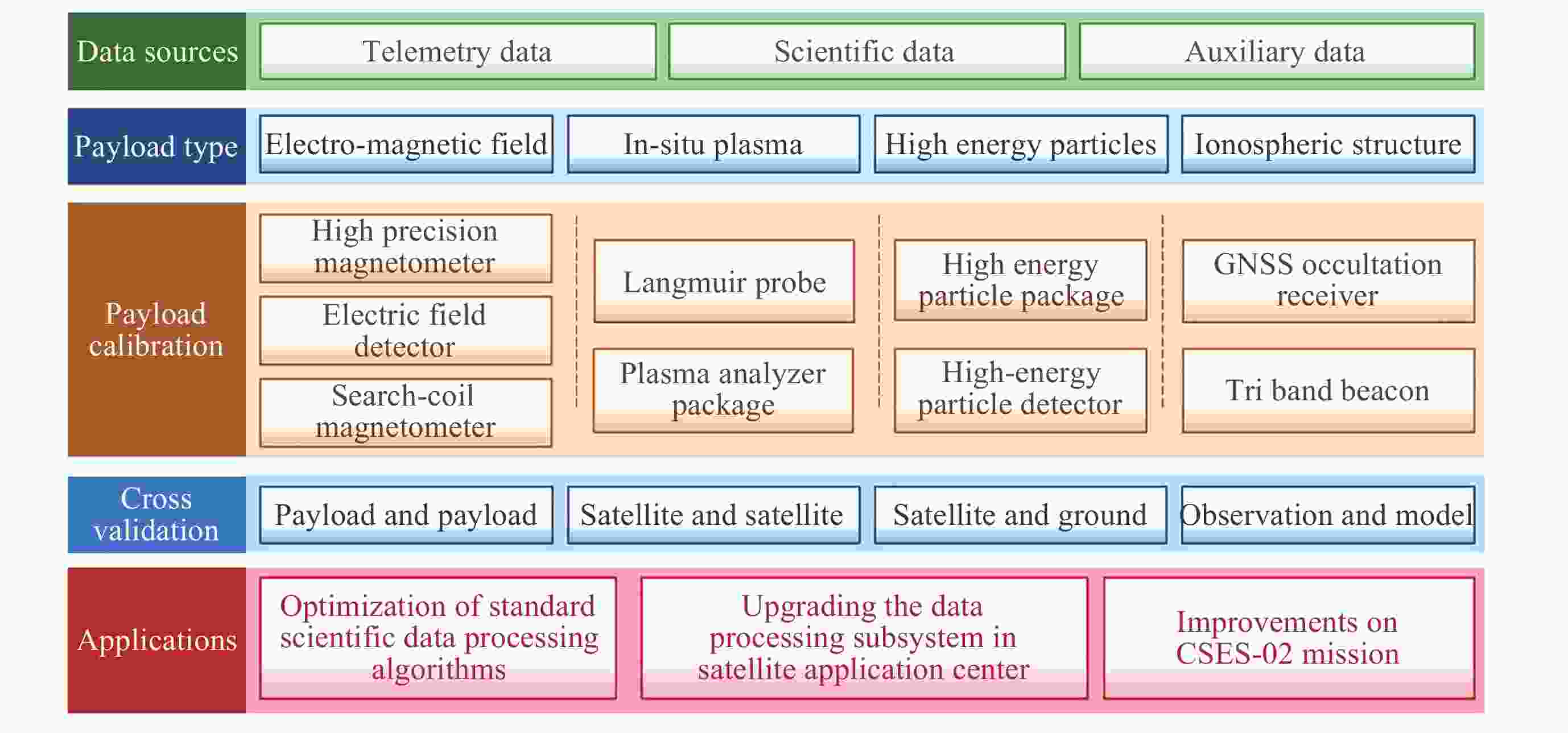
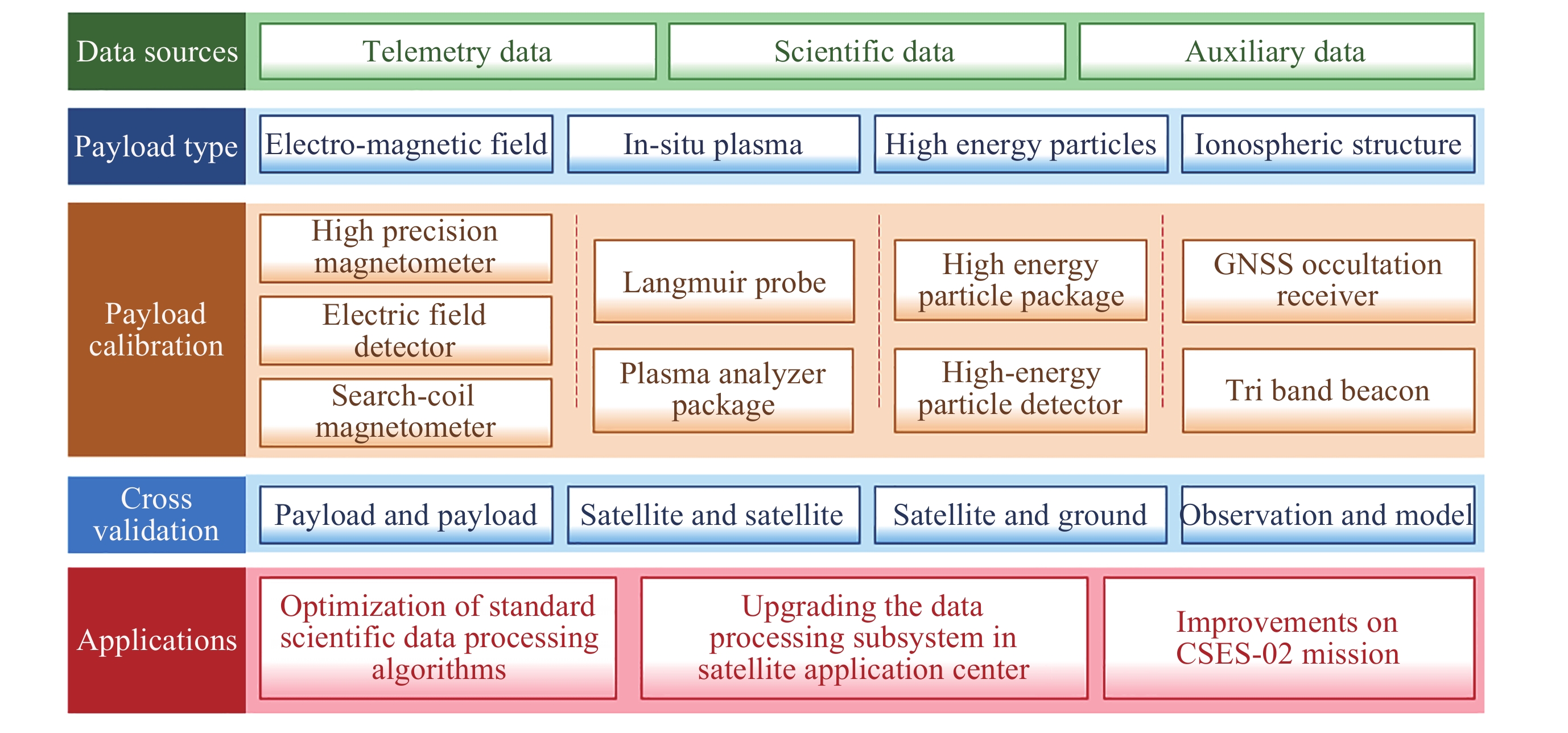
图 1 张衡一号卫星电磁卫星数据在轨定标技术流程
Figure 1. Flowchart of the on-orbit data validation process for the CSES-01
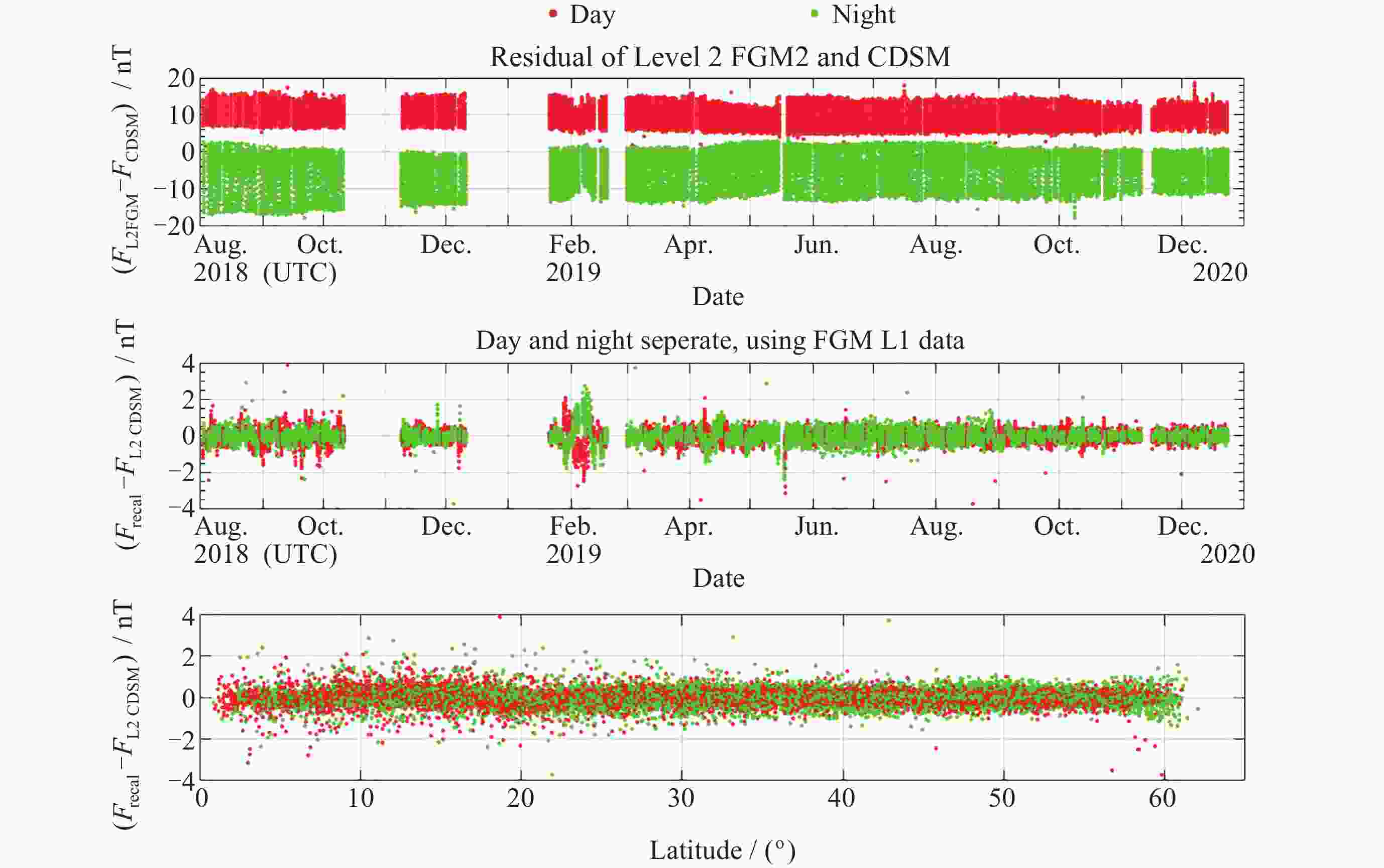
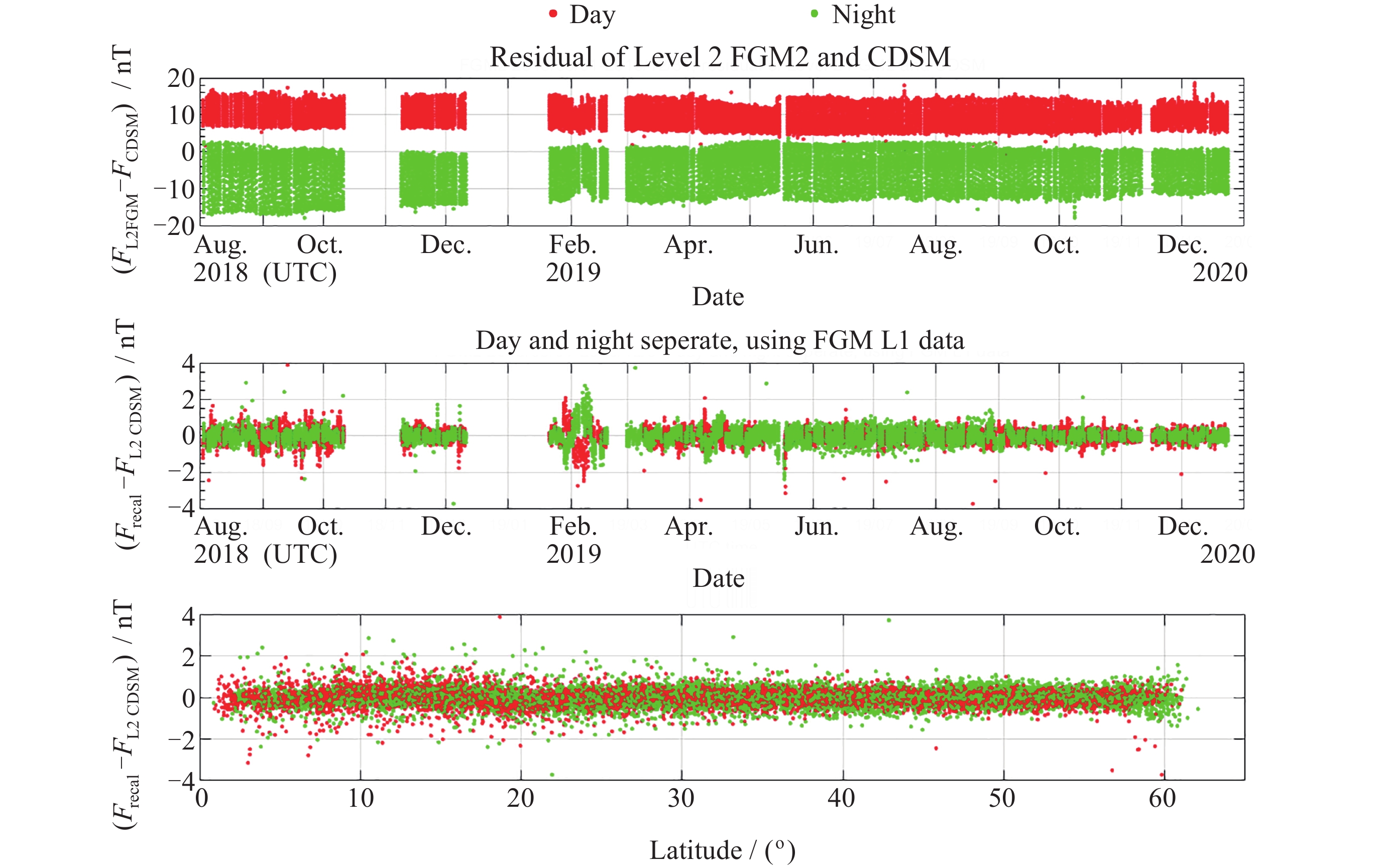
图 2 张衡一号卫星(CSES-01)三频信标磁干扰修正前后磁场数据对比. (a)(b)三频信标磁干扰修正前和后FGM计算总场与CDSM测量总场残差随时间的变化, (c)三频信标磁干扰修正后FGM计算总场与CDSM测量总场残差随纬度的变化
Figure 2. Comparison of magnetic data from CSES-01 satellite before and after correction for TBB magnetic interference. Time series of residuals between the total magnetic field calculated by FGM and that measured by CDSM, before (a) and after (b) correction for TBB magnetic interference, respectively, (c) latitudinal variation of residuals between the total magnetic field calculated by FGM and that measured by CDSM after correction for TBB magnetic interference
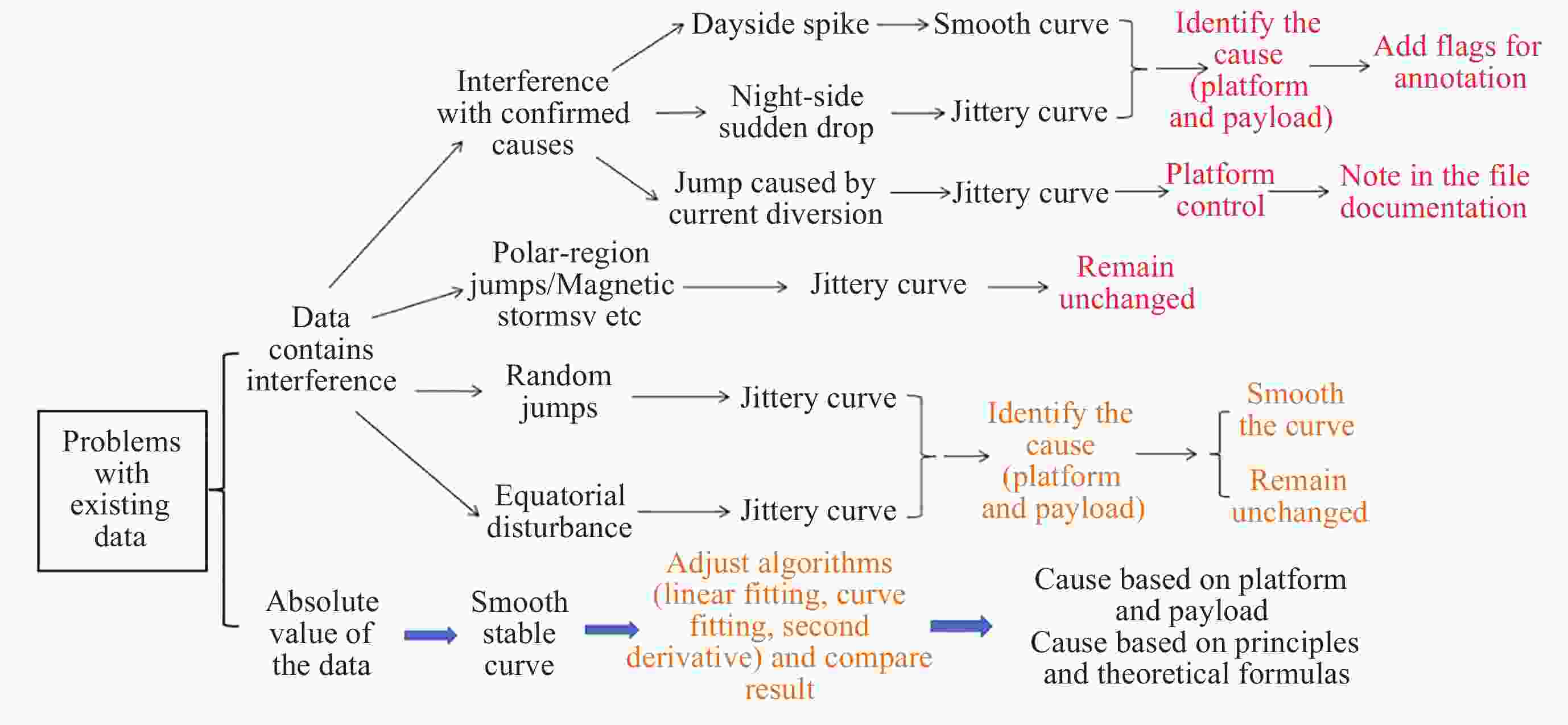
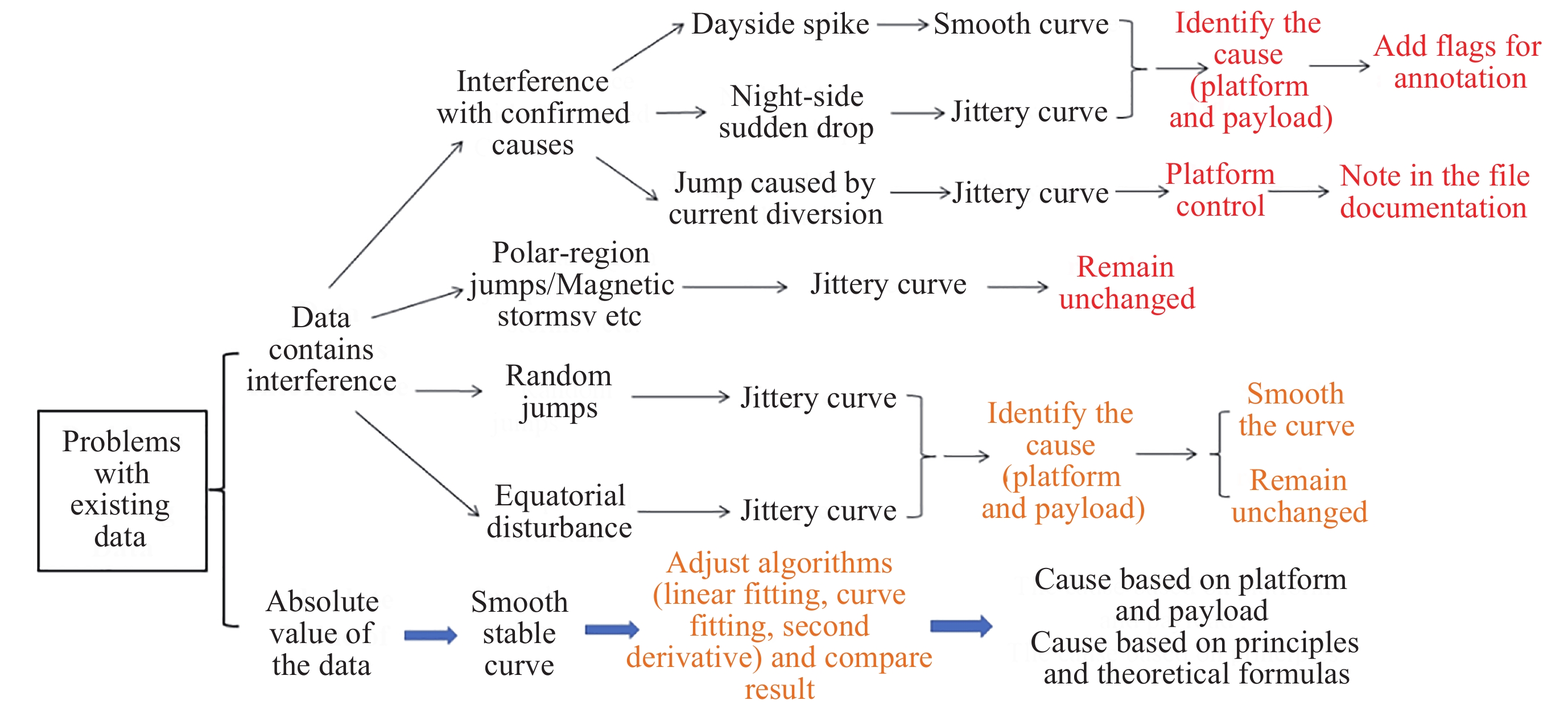
图 4 LAP数据出现的不同干扰溯源与定标技术
Figure 4. Technical process for traceability and validation of different interferences in LAP data
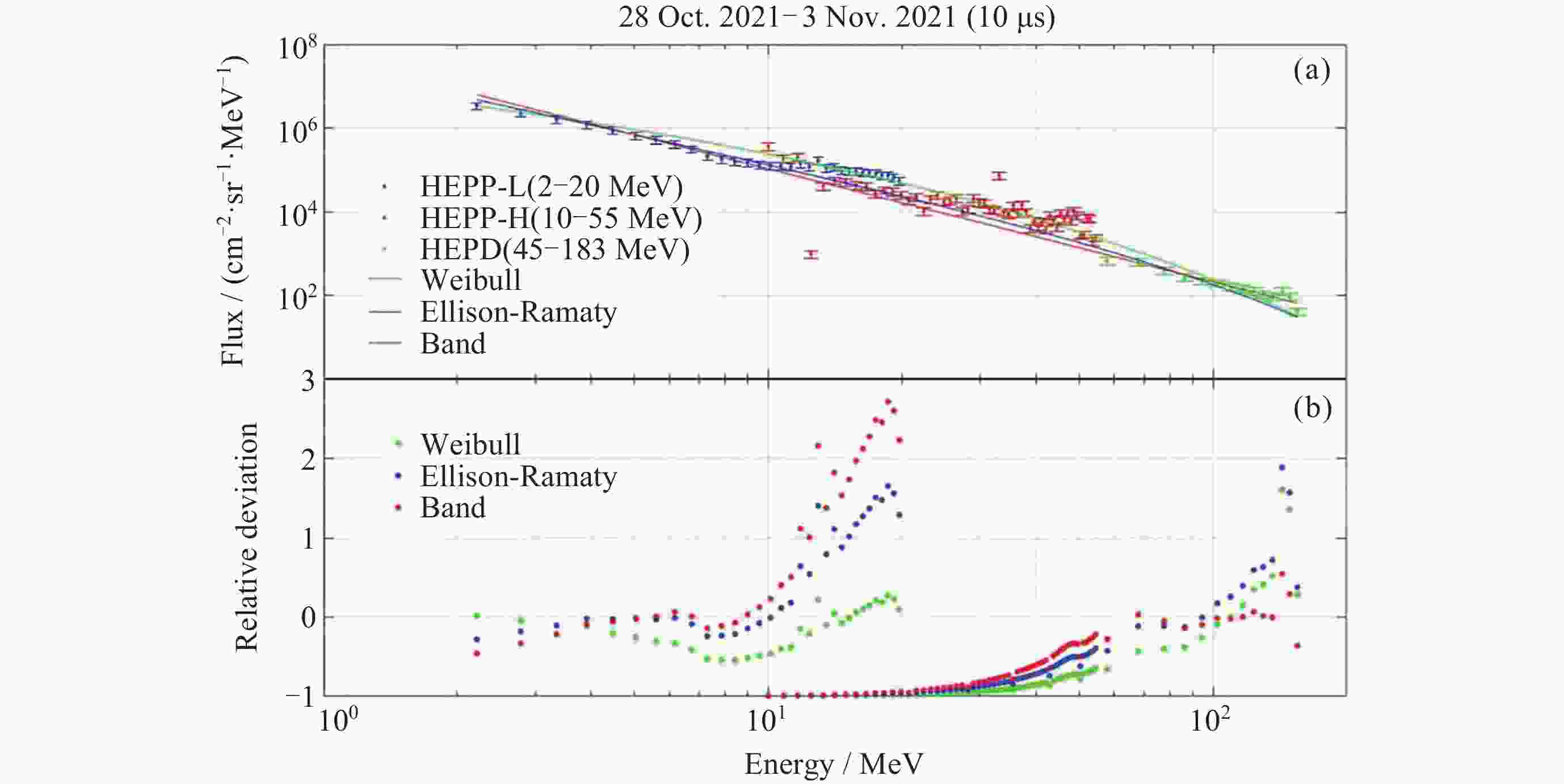
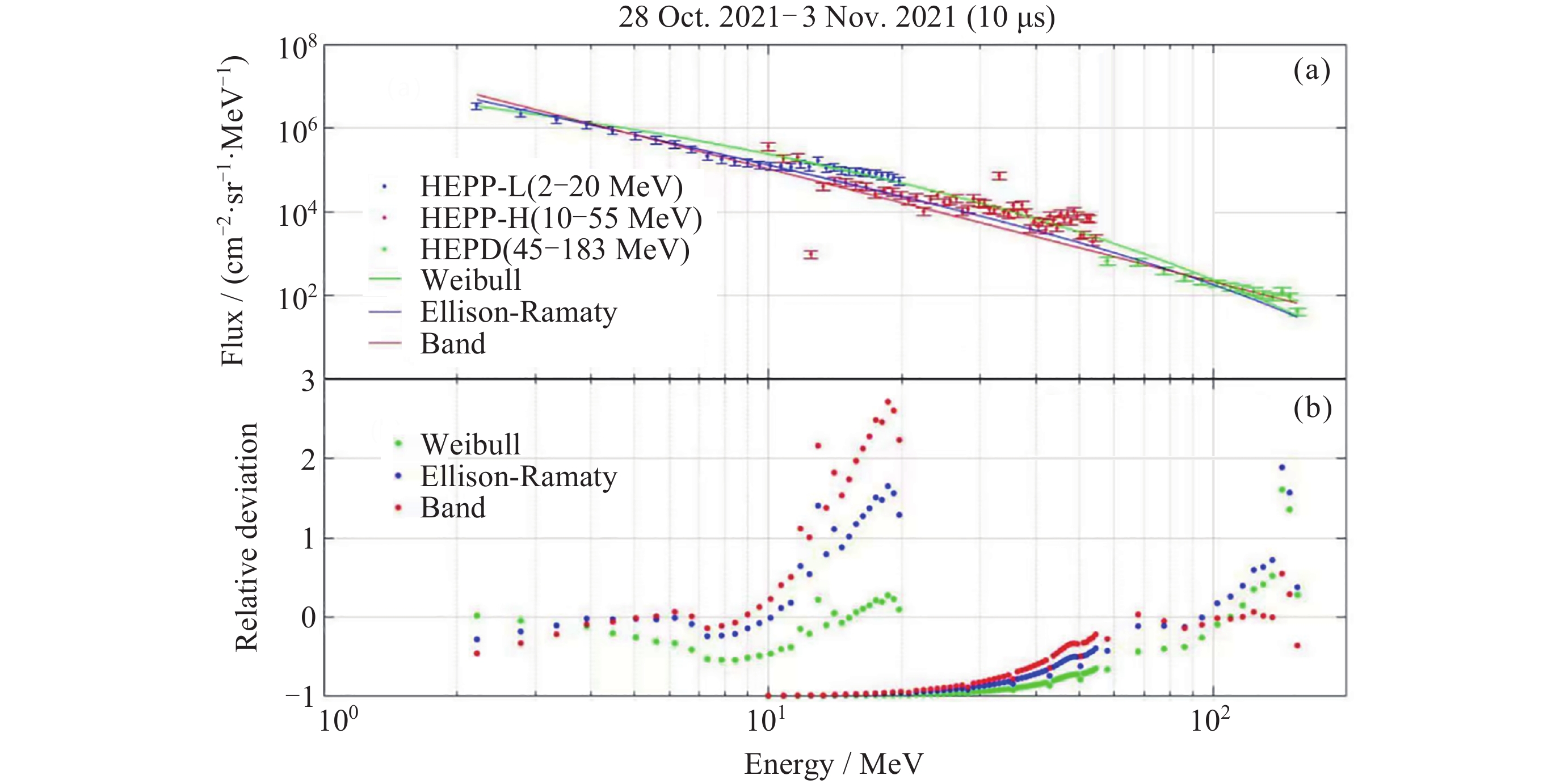
图 5 三个高能粒子探测器的能谱连续性定标. (a)经修正后总事件积分谱拟合结果, (b)实测修正通量与不同理论模型在不同能量点的相对偏差分布[50]
Figure 5. Energy spectrum continuity validation for the three high-energy particle detectors. (a) Fitting results of the corrected total event integral spectra, (b)relative deviation distributions corresponding to different fitting functions[50]
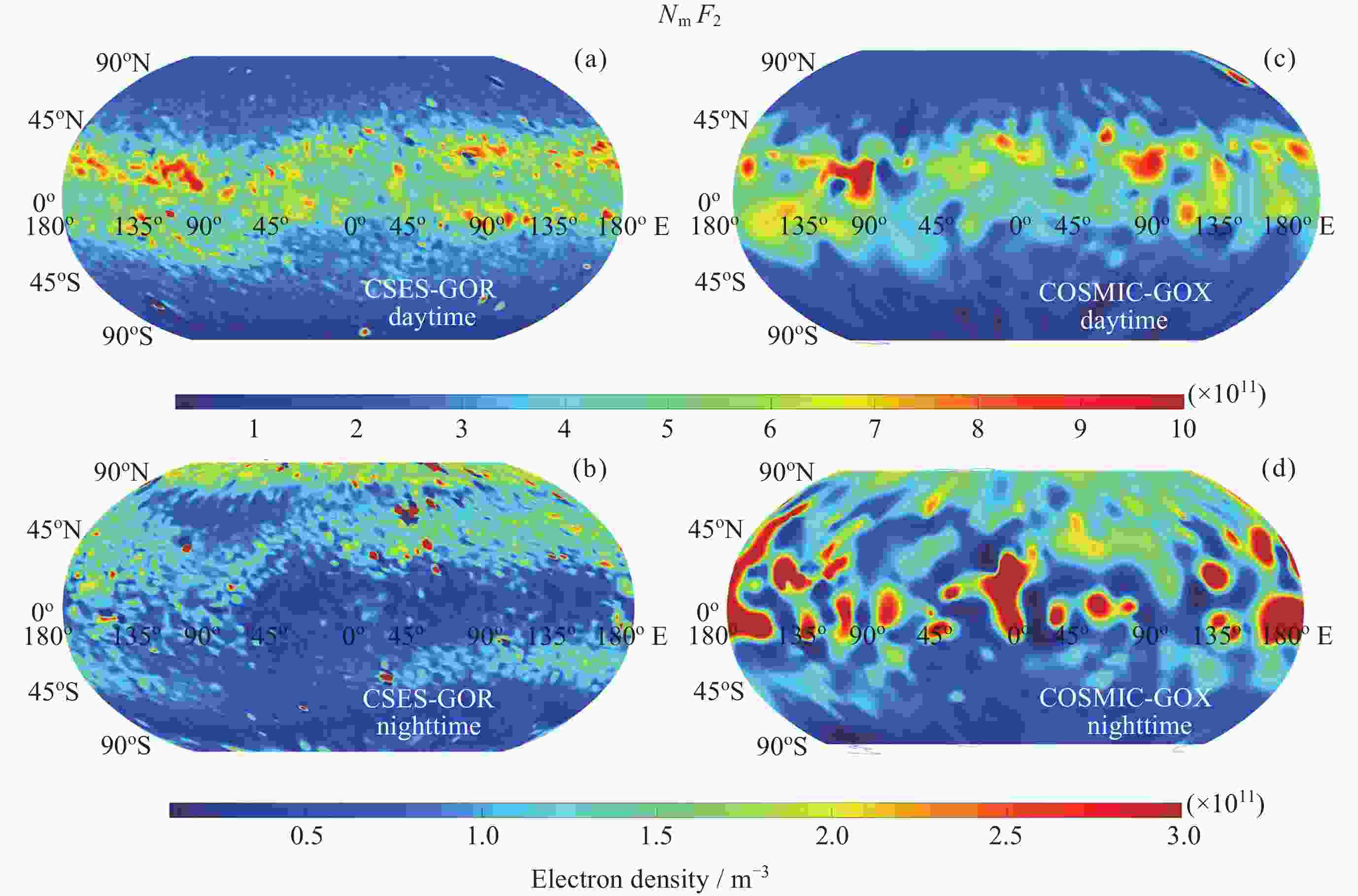
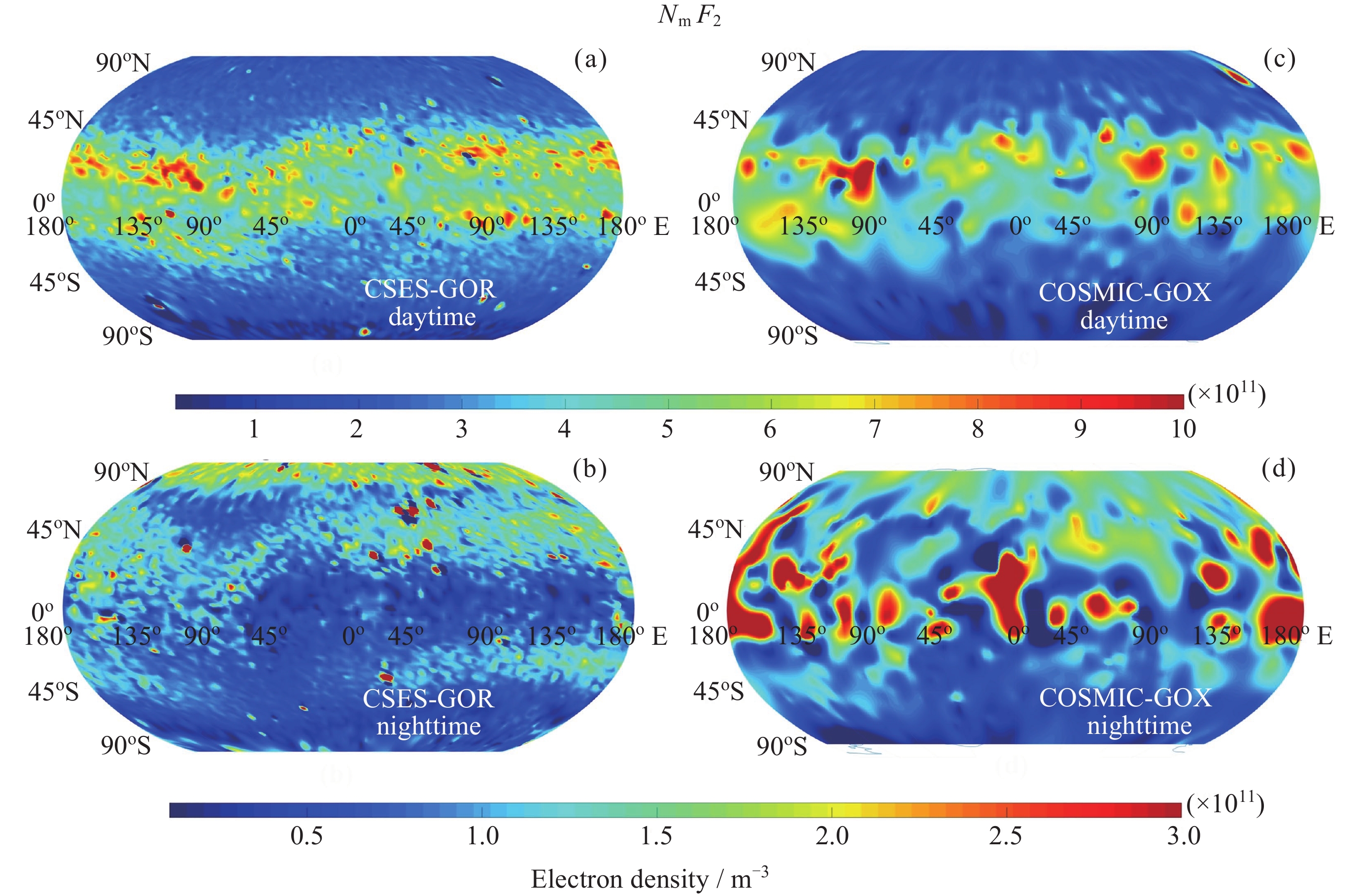
图 6 2019年7-8月张衡一号GOR与COSMIC-GOX观测的NmF2全球分布特征比较. (a)(b) GOR观测的白天与夜间结果, (c)(d) COSMIC-GOX观测的白天与夜间结果[16]
Figure 6. Comparison of the global NmF2 distribution characteristics observed by the CSES-GOR and COSMIC-GOX from July to August 2019. Daytime (a) and nighttime (b) results from CSES-GOR observations, daytime (c) and nighttime (d) results from COSMIC-GOX observations[16]
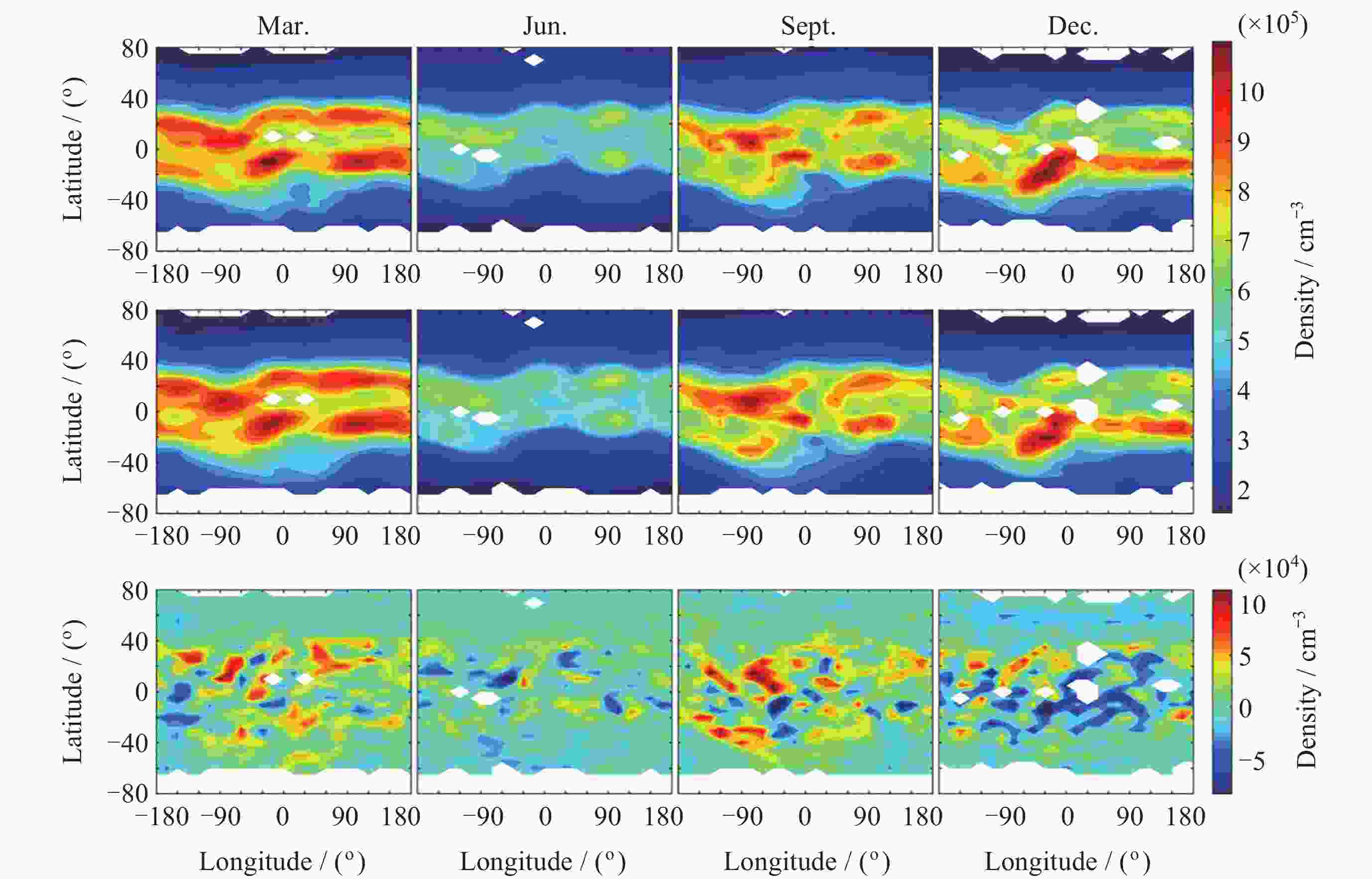
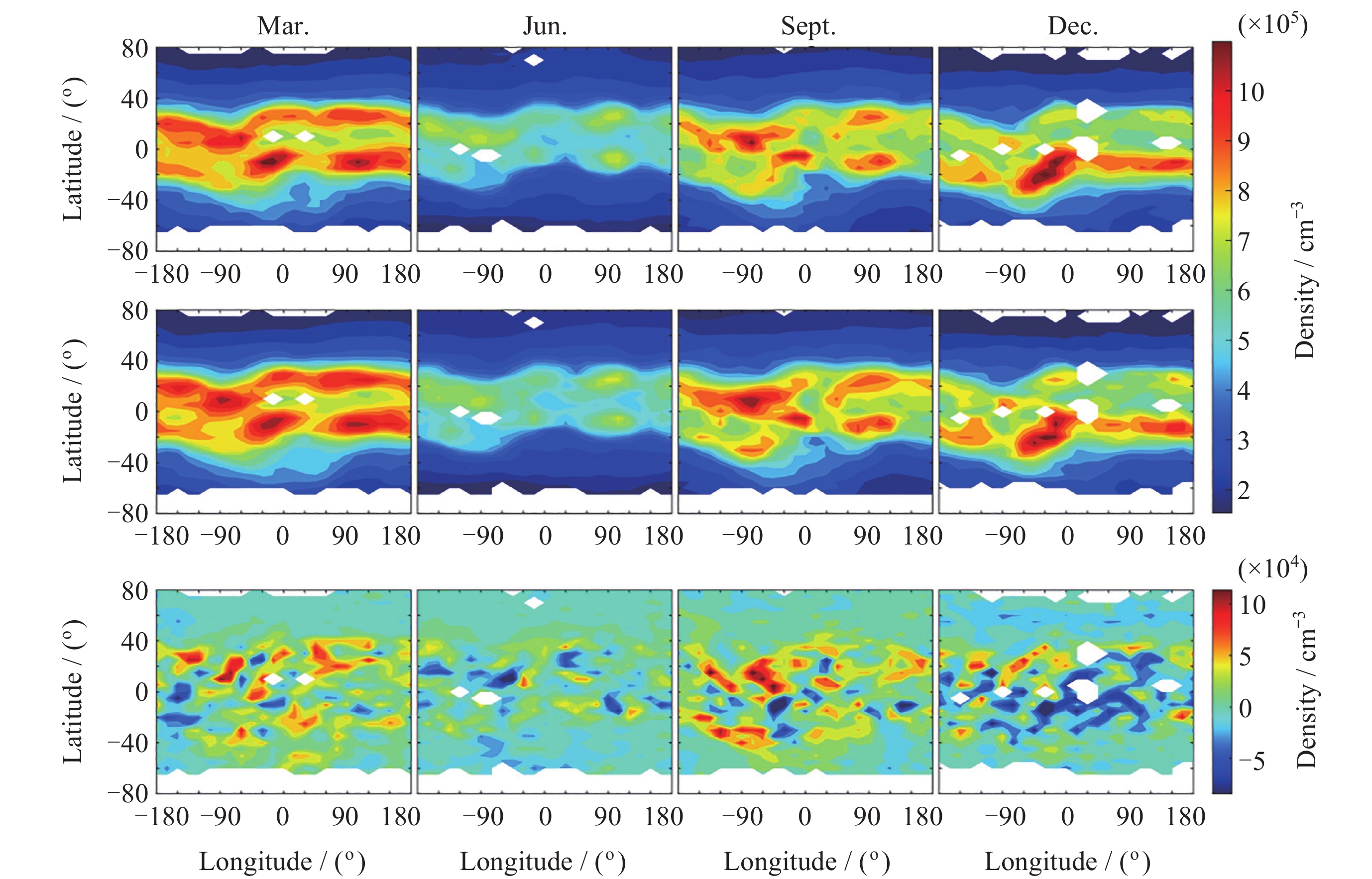
图 7 14:00 LT张衡一号观测与基于其构建的电子密度模型NmF2比较. (a)观测结果, (b)模型结果, (c)二者差值[58]
Figure 7. Comparison of NmF2 between CSES observations and the electron density model constructed based on CSES data at 14:00 Local Time (LT). (a) Observational results, (b) model results, (c) differences between observations and model[58]
表 1 张衡一号卫星科学载荷及探测物理量分类表
Table 1. Classification of scientific payloads and detected physical parameters of the CSES-01
类别 物理量名称 科学载荷 电磁类 地磁场矢量(北向分量Bn, 东向分量Be, 地向分量Bc), 标量(F), 频段: DC-15 Hz 高精度磁强计(High Precision Magnetometer, HPM)[3–5], 包括两个磁通门磁力仪(Fluxgate Magnetometer, FGM) 和一个光泵磁力仪(Coupled Dark State Magnetometer, CDSM) 感应磁场波形和功率谱(0 Hz~25 kHz), 分别为ULF, ELF, VLF三个频段 感应式磁力仪(Search-Coil Magnetometer, SCM)[6] 空间电场波形和功率谱(DC-3.5 MHz), 分别为ULF, ELF, VLF, HF四个频段 电场探测仪(Electric Field Detector, EFD)[7] 原位等离子体类 电子密度(Ne)/温度(Te)、悬浮电位(Vf)/等离子体电位(Vp) 朗缪尔探针(Langmuir Probe, LAP)[8,9] 离子密度(H+/He+/O+), 离子温度, 离子漂移速度(Vx, Vy, Vz) 等离子体分析仪(Plasma Analyzer Package, PAP)[8,10] 高能粒子类 粒子通量, 能谱, 投掷角等信息, 具体能段如下.
HEPP-L: 电子0.1~3 MeV, 质子 2~20 MeV
HEPP-H: 电子2.0~50 MeV, 质子 15~200 MeV
HEPP-X: 太阳X射线 1.0~20 keV
HEPD: 电子3~100 MeV, 质子30~200 MeV高能粒子探测器(High Energy Particle Package, HEPP)[11,12]、意大利高能粒子探测器(High-Energy Particle Detector, HEPD)[13] 电离层结构类 电子密度总含量(TEC)、电离层电子密度剖面(EDP), F2层峰值高度(hmF2), F2层峰值电子密度(NmF2) GNSS掩星接收机(GNSS Occultation Receiver, GOR)[14–16] 绝对TEC、电离层闪烁指数、电子密度剖面 三频信标机(Tri Band Beacon, TBB)[17,18]  下载: 导出CSV
-
[1] PULINETS S, BOYARCHUK K. Ionospheric Precursors of Earthquakes[M]. Berlin, Heidelberg: Springer, 2005 [2] PARROT M, BERTHELIER J J, LEBRETON J P, et al. Examples of unusual ionospheric observations made by the DEMETER satellite over seismic regions[J]. Physics and Chemistry of the Earth, Parts A/B/C, 2006, 31(4/5/6/7/8/9): 486-495 doi: 10.1016/j.pce.2006.02.011 [3] CHENG B J, ZHOU B, MAGNES W, et al. High precision magnetometer for geomagnetic exploration onboard of the China Seismo-Electromagnetic Satellite[J]. Science China Technological Sciences, 2018, 61(5): 659-668 doi: 10.1007/s11431-018-9247-6 [4] POLLINGER A, LAMMEGGER R, MAGNES W, et al. Coupled dark state magnetometer for the China Seismo-Electromagnetic Satellite[J]. Measurement Science and Technology, 2018, 29(9): 095103 doi: 10.1088/1361-6501/aacde4 [5] ZHOU B, CHENG B J, GOU X C, et al. First in-orbit results of the vector magnetic field measurement of the high precision magnetometer onboard the China seismo-electromagnetic satellite[J]. Earth, Planets and Space, 2019, 71(1): 119 doi: 10.1186/s40623-019-1098-3 [6] CAO J B, ZENG L, ZHAN F, et al. The electromagnetic wave experiment for CSES mission: search coil magnetometer[J]. Science China Technological Sciences, 2018, 61(5): 653-658 doi: 10.1007/s11431-018-9241-7 [7] HUANG J P, LEI J G, LI S X, et al. The Electric Field Detector (EFD) onboard the ZH-1 satellite and first observational results[J]. Earth and Planetary Physics, 2018, 2(6): 469-478 doi: 10.26464/epp2018045 [8] LIU C, GUAN Y B, ZHENG X Z, et al. The technology of space plasma in-situ measurement on the China Seismo-Electromagnetic Satellite[J]. Science China Technological Sciences, 2019, 62(5): 829-838 doi: 10.1007/s11431-018-9345-8 [9] YAN R, GUAN Y B, SHEN X H, et al. The Langmuir Probe onboard CSES: data inversion analysis method and first results[J]. Earth and Planetary Physics, 2018, 2(6): 479-488 doi: 10.26464/epp2018046 [10] LIU D P, ZEREN Z, HUANG H, et al. The ionospheric plasma perturbations before a sequence of strong earthquakes in Southeast Asia and northern Oceania in 2018[J]. Remote Sensing, 2023, 15(24): 5735 doi: 10.3390/rs15245735 [11] CHU W, HUANG J P, SHEN X H, et al. Preliminary results of the high energetic particle package on-board the China Seismo-Electromagnetic Satellite[J]. Earth and Planetary Physics, 2018, 2(6): 489-498 doi: 10.26464/epp2018047 [12] LI X Q, XU Y B, AN Z H, et al. The high-energy particle package onboard CSES[J]. Radiation Detection Technology and Methods, 2019, 3(3): 22 doi: 10.1007/s41605-019-0101-7 [13] SCOTTI V, OSTERIA G, CSES-Limadou Collaboration, et al. The HEPD detector on board CSES satellite: in-flight performance[J]. Nuclear and Particle Physics Proceedings, 2019, 306-308: 92-97 [14] CHENG Y, LIN J, SHEN X H, et al. Analysis of GNSS radio occultation data from satellite ZH-01[J]. Earth and Planetary Physics, 2018, 2(6): 499-504 doi: 10.26464/epp2018048 [15] LIN J, SHEN X H, HU L C, et al. CSES GNSS ionospheric inversion technique, validation and error analysis[J]. Science China Technological Sciences, 2018, 61(5): 669-677 doi: 10.1007/s11431-018-9245-6 [16] XU S, CUI J, ZHIMA Z, et al. The Global Navigation Satellite System occultation receiver onboard the China Seismo-Electromagnetic Satellite: data and observational results[J]. Acta Astronautica, 2025, 236: 914-928 doi: 10.1016/j.actaastro.2025.07.030 [17] CHEN L, OU M, YUAN Y P, et al. Preliminary observation results of the Coherent Beacon System onboard the China Seismo-Electromagnetic Satellite-1[J]. Earth and Planetary Physics, 2018, 2(6): 505-514 doi: 10.26464/epp2018049 [18] 鲁恒新, 申旭辉, 赵庶凡, 等. 张衡一号卫星三频信标载荷典型事件观测[J]. 电波科学学报, 2022, 37(3): 426-433LU Hengxin, SHEN Xuhui, ZHAO Shufan, et al. Typical event observation of the tri-band beacon onboard the CSES (ZH-1) satellite[J]. Chinese Journal of Radio Science, 2022, 37(3): 426-433 [19] OLSEN N, CLAUSEN L T, SABAKA T J, et al. Calibration of the Ørsted vector magnetometer[J]. Earth, Planets and Space, 2003, 55(1): 11-18 [20] YANG Y Y, ZHOU B, HULOT G, et al. CSES high precision magnetometer data products and example study of an intense geomagnetic storm[J]. Journal of Geophysical Research: Space Physics, 2021, 126(4): e2020JA028026 doi: 10.1029/2020JA028026 [21] ALKEN P, OLSEN N, FINLAY C C. Co-estimation of geomagnetic field and in-orbit fluxgate magnetometer calibration parameters[J]. Earth, Planets and Space, 2020, 72(1): 49 doi: 10.1186/s40623-020-01163-9 [22] ZHIMA Z, ZHOU B, ZHAO S F, et al. Cross-calibration on the electromagnetic field detection payloads of the China Seismo-Electromagnetic Satellite[J]. Science China Technological Sciences, 2022, 65(6): 1415-1426 doi: 10.1007/s11431-021-1965-2 [23] HUANG J P, JIA J, YIN H C, et al. Study of the statistical characteristics of artificial source signals based on the CSES[J]. Frontiers in Earth Science, 2022, 10: 883836 doi: 10.3389/feart.2022.883836 [24] LIU J L, HUANG J P, LI Z, et al. Recent advances and challenges in Schumann resonance observations and research[J]. Remote Sensing, 2023, 15(14): 3557 doi: 10.3390/rs15143557 [25] HU Y P, ZHIMA Z, WANG T Y, et al. The typical ELF/VLF electromagnetic wave activities in the upper ionosphere recorded by the China Seismo-Electromagnetic Satellite[J]. Remote Sensing, 2024, 16(15): 2835 doi: 10.3390/rs16152835 [26] HAO B, HUANG J P, LI Z, et al. Spatiotemporal characteristics of parallel stacked structure signals in VLF electric field observations from CSES-01 satellite[J]. Atmosphere, 2025, 16(10): 1198 doi: 10.3390/atmos16101198 [27] HUANG J P, LI Z Y, LI Z, et al. Automatic identification and statistical analysis of data steps in electric field measurements from CSES-01 satellite[J]. Remote Sensing, 2023, 15(24): 5745 doi: 10.3390/rs15245745 [28] HUANG J P, LI Z Y, LI Z, et al. Evaluation of the satellite’s wake effect on the electric field detector onboard the CSES-01 satellite[J]. Earth and Planetary Physics, 2025, 9(2): 400-409 doi: 10.26464/epp2024077 [29] YANG D H, ZHIMA Z, WANG Q, et al. Stability validation on the VLF waveform data of the China-Seismo-Electromagnetic Satellite[J]. Science China Technological Sciences, 2022, 65(12): 3069-3078 doi: 10.1007/s11431-022-2059-8 [30] ZHIMA Z, HUANG J P, SHEN X H, et al. Simultaneous observations of ELF/VLF rising-tone quasiperiodic waves and energetic electron precipitations in the high-latitude upper ionosphere[J]. Journal of Geophysical Research: Space Physics, 2020, 125(5): e2019JA027574 doi: 10.1029/2019JA027574 [31] HU Y P, ZHIMA Z, FU H S et al. A large-scale magnetospheric line radiation event in the upper ionosphere recorded by the China-Seismo-Electromagnetic satellite[J]. Journal of Geophysical Research: Space Physics, 2023, 128(2): e2022JA030743 doi: 10.1029/2022JA030743 [32] ZHIMA Z, CAO J B, LIU W L, et al. Storm time evolution of ELF/VLF waves observed by DEMETER satellite[J]. Journal of Geophysical Research: Space Physics, 2014, 119(4): 2612-2622 doi: 10.1002/2013JA019237 [33] ZHIMA Z, HU Y P, SHEN X, et al. Storm-time features of the ionospheric ELF/VLF waves and energetic electron fluxes revealed by the China Seismo-Electromagnetic Satellite[J]. Applied Sciences, 2021, 11(6): 2617 doi: 10.3390/app11062617 [34] RAN Z L, LU C, HU Y P, et al. Automatic detection of quasi-periodic emissions from satellite observations by using DETR method[J]. Remote Sensing, 2024, 16(15): 2850 doi: 10.3390/rs16152850 [35] LEBRETON J P, STVERAK S, TRAVNICEK P, et al. The ISL Langmuir probe experiment processing onboard DEMETER: scientific objectives, description and first results[J]. Planetary and Space Science, 2006, 54(5): 472-486 doi: 10.1016/j.pss.2005.10.017 [36] WANG X, SAMANIEGO J I, HSU H W, et al. Development of a double hemispherical probe for improved space plasma measurements[J]. Journal of Geophysical Research: Space Physics, 2018, 123(4): 2916-2925 doi: 10.1029/2018JA025415 [37] LOMIDZE L, KNUDSEN D J, BURCHILL J, et al. Calibration and validation of Swarm plasma densities and electron temperatures using ground-based radars and satellite radio occultation measurements[J]. Radio Science, 2018, 53(1): 15-36 doi: 10.1002/2017RS006415 [38] CATAPANO F, BUCHERT S, QAMILI E, et al. Swarm Langmuir probes’ data quality validation and future improvements[J]. Geoscientific Instrumentation, Methods and Data Systems, 2022, 11(1): 149-162 doi: 10.5194/gi-11-149-2022 [39] YAN R, GUAN Y B, MIAO Y Q, et al. The regular features recorded by the Langmuir probe onboard the low earth polar orbit satellite CSES[J]. Journal of Geophysical Research: Space Physics, 2022, 127(1): e2021JA029289 doi: 10.1029/2021JA029289 [40] PU W X, YAN R, GUAN Y B, et al. Study on the impact of the potential variation in the CSES satellite platform on Langmuir probe observations[J]. Acta Astronautica, 2025, 230: 104-118 doi: 10.1016/j.actaastro.2025.02.020 [41] LIU D P, ZEREN Z, SHEN X H, et al. Typical ionospheric disturbances revealed by the plasma analyzer package onboard the China Seismo-Electromagnetic Satellite[J]. Advances in Space Research, 2021, 68(9): 3796-3805 doi: 10.1016/j.asr.2021.08.009 [42] YAN R, ZHIMA Z, XIONG C, et al. Comparison of electron density and temperature from the CSES satellite with other space-borne and ground-based observations[J]. Journal of Geophysical Research: Space Physics, 2020, 125(10): e2019JA027747 doi: 10.1029/2019JA027747 [43] YAN R, XIONG C, ZHIMA Z, et al. Correlation between Ne and Te around 14: 00 LT in the topside ionosphere observed by CSES, Swarm and CHAMP satellites[J]. Frontiers in Earth Science, 2022, 10: 860234 doi: 10.3389/feart.2022.860234 [44] 刘大鹏, 申旭辉, 杨德贺, 等. 张衡一号卫星观测的地基VLF波电离层加热扰动特征[J]. 电波科学学报, 2021, 36(6): 970-976 doi: 10.12265/j.cjors.2021044LIU Dapeng, SHEN Xuhui, YANG Dehe, et al. Characteristics of ionospheric heating disturbances caused by ground-based VLF waves observed by ZHANGHENG-1satellite[J]. Chinese Journal of Radio Science, 2021, 36(6): 970-976 doi: 10.12265/j.cjors.2021044 [45] VAN ALLEN J A, LUDWIG G H, RAY E C, et al. Observation of high intensity radiation by satellites 1958 Alpha and Gamma[J]. Journal of Jet Propulsion, 1958, 28(9): 588-592 doi: 10.2514/8.7396 [46] KRESS B T, RODRIGUEZ J V, ONSAGER T G. The GOES-R Space Environment in Situ Suite (SEISS): measurement of energetic particles in geospace[M]//GOODMAN S J, SCHMIT T J, DANIELS J, et al. The GOES-R Series. Amsterdam: Elsevier, 2020: 243-250 [47] ZOU H, XIAO Z, HAO Y Q, et al. Observation of the disturbed events by the particle detector inside “Zy-1” satellite[J]. Chinese Journal of Geophysics, 2006, 49(3): 559-564 doi: 10.1002/cjg2.869 [48] 乐贵明, 叶宗海, 周国成. 地磁长期变化引起的低高度卫星轨道辐射带粒子环境的变化[J]. 空间科学学报, 2001, 21(3): 238-245 doi: 10.3969/j.issn.0254-6124.2001.03.006LE Guiming, YE Zonghai, ZHOU Guocheng. Low altitude satellite orbit radiaition belt particleenvironment variation due to geomagnetic long term variation[J]. Chinese Journal of Space Science, 2001, 21(3): 238-245 doi: 10.3969/j.issn.0254-6124.2001.03.006 [49] 杨艳艳, 王婕, 申旭辉, 等. 低轨卫星磁测及全球地磁场建模[J]. 地球与行星物理论评(中英文), 2024, 55(6): 652-667 doi: 10.19975/j.dqyxx.2023-054YANG Yanyan, WANG Jie, ZHIMA Z, et al. Advancements in low Earth orbit satellite magnetic field measurements and global geomagnetic field modeling[J]. Reviews of Geophysics and Planetary Physics, 2024, 55(6): 652-667 doi: 10.19975/j.dqyxx.2023-054 [50] ZHANG Z X, LI X Q, WANG L, et al. Evaluation of the proton contamination to MeV electrons by solar proton events based on CSES observations[J]. Journal of Geophysical Research: Space Physics, 2022, 127(9): e2022JA030550 doi: 10.1029/2022JA030550 [51] 王璐, 张振霞, 李新乔等. 南大西洋异常区质子通量演化研究——基于CSES卫星6年观测[J]. 中国科学: 地球科学, 2025, 55(11): 3918–3931, doi: 10.1360/N072025-0208Wang L, Zhang Z, Li X, et al. Investigation of the South Atlantic Anomaly (SAA) by proton flux variabilities based on 6 years’ CSES data[J]. Science China Earth Sciences, 2025, 68(11): 3776-3788, https://doi.org/10.1007/s11430-025-1672-2 [52] Zhang, Z. , Chen, L. , Li, X. , Xia, Z. , et al. Observed propagation route of VLF transmitter signals in the magnetosphere. Journal of Geophysical Research: Space Physics, 2018, 123. https://doi.org/10.1029/2018JA025637 [53] LEI J H, SYNDERGAARD S, BURNS A G, et al. Comparison of COSMIC ionospheric measurements with ground-based observations and model predictions: preliminary results[J]. Journal of Geophysical Research: Space Physics, 2007, 112(A7): A07308 doi: 10.1029/2006ja012240 [54] ZENG Z, HU X, ZHANG X J. Applying artificial neural network to the short-term prediction of electron density structure using GPS occultation data[J]. Geophysical Research Letters, 2002, 29(9): 1321 doi: 10.1029/2001gl013656 [55] WU X C, HU X, GONG X Y, et al. Analysis of inversion errors of ionospheric radio occultation[J]. GPS Solutions, 2009, 13(3): 231-239 doi: 10.1007/s10291-008-0116-x [56] 林剑, 吴云. Abel电离层掩星反演方法及误差分析[J]. 地球物理学报, 2013, 56(4): 1070-1076 doi: 10.6038/cjg20130402LIN Jian, WU Yun. Abel ionospheric inversion technique and its error analysis[J]. Chinese Journal of Geophysics, 2013, 56(4): 1070-1076 doi: 10.6038/cjg20130402 [57] YUE X, SCHREINER W S, LEI J, et al. Error analysis of Abel retrieved electron density profiles from radio occultation measurements[J]. Annales Geophysicae, 2010, 28(1): 217-222 doi: 10.5194/angeo-28-217-2010 [58] HUANG H, LIN J, XU S, et al. A 3D empirical model of electron density based on CSES radio occultation measurements[J]. Space Weather, 2022, 20(5): e2021SW003018. doi: 10.1029/2021SW003018 -
-

 下载:
下载:

计量
- 文章访问数: 659
- HTML全文浏览量: 72
- PDF下载量: 57
-
被引次数:
0(来源:Crossref)
0(来源:其他)

