


“十四五”期间中国空间环境微生物研究进展
doi: 10.11728/cjss2026.06.2026-0035 cstr: 32142.14.cjss.2026-0035
-
 马宏 女, 现为北京理工大学医学技术学院教授、博士生导师, 主要研究方向为航天医学工程、神经生物学与分子肿瘤学. E-mail: 04656@bit.edu.cn
-
 邓玉林 男, 现为国际宇航科学院院士、北京理工大学讲席教授, 主要研究方向为xxx. E-mail: deng@bit.edu.cn
作者简介:
通讯作者:
Research Progress of Space Environmental Microorganisms: Review of China’s Achievements during the 14 th Five-Year Plan Period
-
摘要: 随着中国航天事业的高速发展, 载人航天任务执行频率不断增加, 航天员在轨驻留时长显著延长, 微生物对航天员健康、空间站环境及设施的影响日益突出, 空间环境中的微生物活动已成为影响航天任务成功实施的关键因素之一. 空间特殊环境会致使人体菌群平衡失调, 与多系统功能损伤直接相关, 而空间环境微生物的变异与污染同样是航天员身体健康的潜在威胁. 此外, 部分微生物还会对航天器材料和设施造成严重腐蚀. 因此, 深入探究微生物在空间环境中的响应规律及其影响机制、开发新型高效的检测平台、研制航天器微生物防控技术以及加速空间微生物资源的开发利用, 对于保障未来深空探测任务的顺利开展具有重要意义. 本文对中国“十四五”期间在空间微生物研究领域取得的重要进展进行系统梳理, 涵盖微生物检测、航天器微生物防治、微生物资源利用等方面内容, 旨在为未来空间微生物的防控与利用提供参考.Abstract: With the rapid development of China’s space industry, the frequency of manned space missions has increased significantly, accompanied by substantially extended in-orbit residence durations for astronauts. Consequently, the impact of microorganisms on crew health, space station environments, and facility integrity has become increasingly prominent, rendering microbial activities in space a critical factor influencing mission success. The unique space environment disrupts human microbiome homeostasis, directly correlating with multi-system functional impairments, while microbial mutation and contamination in space pose additional threats to astronaut health. Furthermore, certain microorganisms can induce severe corrosion of spacecraft materials and equipment. Therefore, investigating microbial response patterns and underlying mechanisms in space, developing novel and efficient detection platforms, establishing microbial prevention and control technologies for spacecraft, and accelerating the exploitation of space microbial resources are of paramount importance for ensuring the success of future deep-space exploration missions. This review systematically summarizes significant advances in space microbiology research achieved by China during the 14th Five-Year Plan period, encompassing microbial detection, spacecraft microbial prevention and control, and microbial resource utilization, aiming to provide references for future microbial prevention, control, and utilization in space.
-
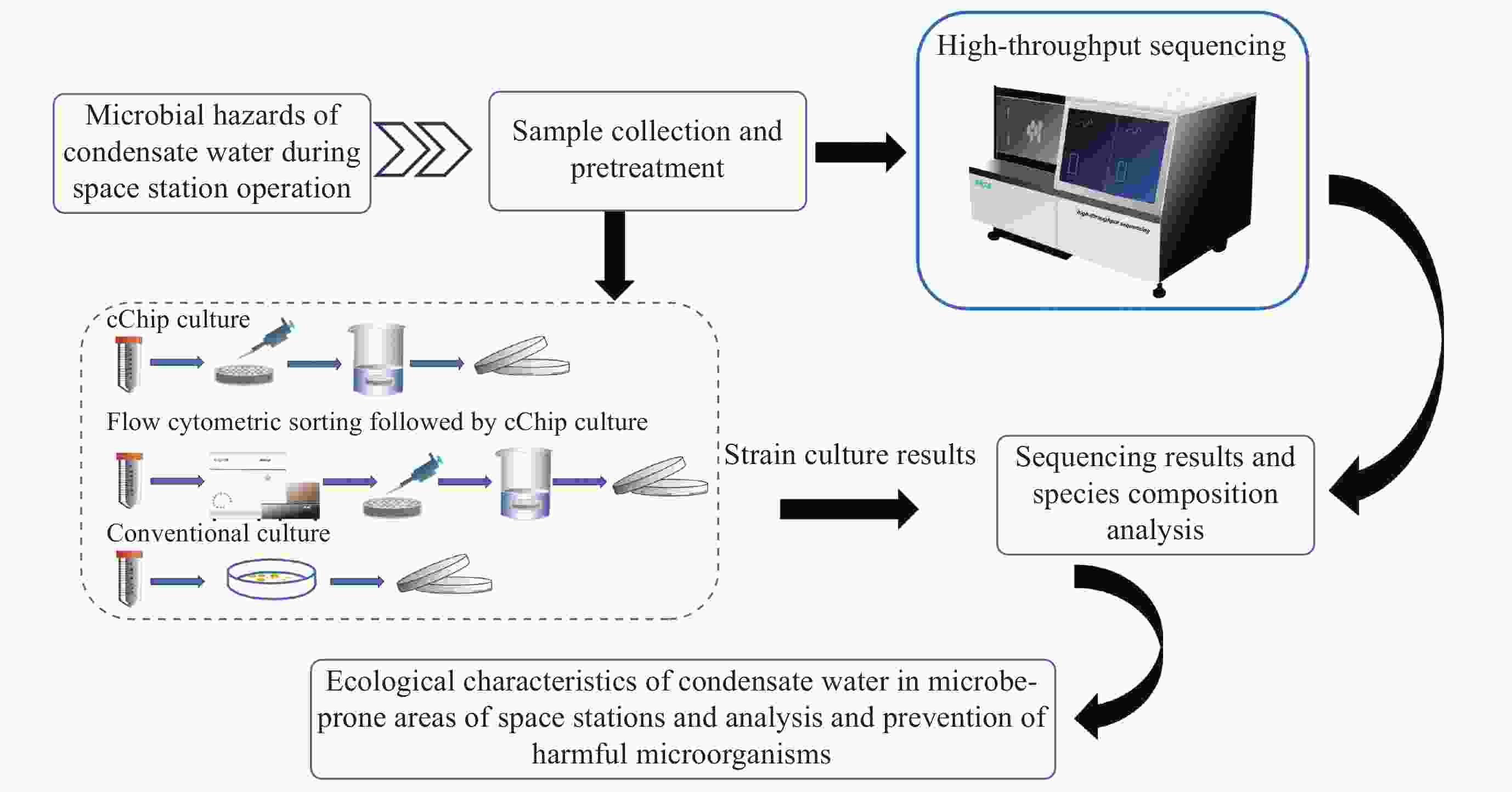
图 1 空间站微生物易滋生区完整生态研究实验流程
Figure 1. Complete ecological research experiment process for the areas prone to microbial growth in the space station
表 1 近五年(模拟)空间环境微生物对工程材料腐蚀行为研究汇总
Table 1. A five-year summary of research on microbial corrosion of engineering materials, encompassing both real and simulated space environments
物种 作用材料 作用环境 主要发现 文献 巴西曲霉 Aspergillus brasiliensis PCB-裸露铜电路 中国空间站
地面同步实验受高水平铜离子毒性影响, 测试菌的形态发生变化.
地面测试菌通过形成新的细胞壁来降低铜离子毒性的影响; 空间环境下测试菌分泌更多草酸, 与铜离子反应形成草酸盐解毒.
结果表明铜在空间环境下经历更严重的局部腐蚀. 氧浓度差电池和酸腐蚀可能是铜腐蚀的主要腐蚀机制.[27] 巴西曲霉 Aspergillus brasiliensis PCB-PU涂层 中国空间站
地面同步实验测试菌的形态、低分子量有机酸分泌量和细胞超微结构等特征在空间中相比地面表现出显著变化.
涂层的劣化与有机酸引起的化学降解和生物膜引起的生物降解有关. 空间环境中测试菌形成更成熟生物膜, 有助于捕获营养及抗逆. 但菌丝大多中空, 细胞器减少, 可能发生了自噬.
地面样品内部出现多空腐蚀, 而太空样本局部腐蚀, 这表明微重力
改变了涂层劣化的机制.[29] 巴西曲霉 Aspergillus brasiliensis 镁合金
铝合金
无涂层保护PCB
聚酰亚胺
聚乙烯
硫化橡胶中国空间站
地面同步实验验证了微生物–材料相互作用科学实验装置的可行性. 巴西曲霉在空间环境下各种材料中出现了形态变化, 且随着时间延长变化愈发明显.
空间环境下, 微生物对材料的腐蚀趋势加剧.[30] 耐受酸和铝的微生物:
芽孢杆菌属
Bacillus、
青霉属
Penicillium、
曲霉属
Aspergillus改良的酸性含铝LB液体培养基 地面实验室 从中国天宫空间站组装洁净室分离出9个细菌菌株与10个真菌菌株. 主要为芽孢杆菌属、青霉属和曲霉属. 表明其具备在极端环境下存活并可能参与金属腐蚀的潜力. [31] 蜡样芽孢杆菌Bacillus cereus 5 A06铝合金 模拟微重力 模拟微重力环境通过营养限制, 导致蜡样芽孢杆菌分泌胞外聚合物的增加和细胞聚集, 继而导致生物膜形成, 这些变化加速了铝合金钝化膜的降解, 表明微重力会增加航天器水回收系统管道金属的腐蚀风险. [28] 纤维素降解微生物:
芽孢杆菌属Bacillus、
镰刀菌属
Fusarium、
木霉属
Trichoderma滤纸培养基 中国空间站
地面同步实验空间样本中β-内切葡聚糖酶和胞外总蛋白含量显著增加, 微生物群落结构发生变化, 导致纤维素降解能力增强, 纤维素酶基因上调证实
了这一点. 研究为宇航服等航天物品的设计提供了理论依据.[32] 巴西曲霉 Aspergillus brasiliensis 交联聚乙烯 中国空间站
地面同步实验空间环境中巴西曲霉成膜能力提升, 有机酸分泌显著增加, 较地面高出一个数量级. 交联聚乙烯材料出现裂纹和剥落, 短期内对绝缘性能影响较小. 提示长期任务需关注聚合物材料的微生物腐蚀风险. [33] 草酸青霉 Penicillium oxalicum 5 A06铝合金 地面低剂量质子辐射 在低辐射下, 测试菌的存活率仅24.8%, 但生长速度得到提高, 同时真菌代谢产生的有机酸分泌增加. 相比对照组, 腐蚀更严重. 电化学试验表明, 铝合金腐蚀速率与有机酸含量有关. [23] 巴西曲霉 Aspergillus brasiliensis 铍青铜 中国空间站
地面同步实验微重力环境使液膜的动力学和腐蚀产物的沉积特性发生改变, 腐蚀层的致密度和厚度显著增强. 空间环境中的腐蚀中二价铜离子富集, 形成致密的复合层, 使腐蚀介质均匀扩散, 将腐蚀模式由地面的垂直渗透变为横向膨胀. [34] 炭黑曲霉 Aspergillus carbonarius、
巴西曲霉 Aspergillus brasiliensis钛合金、铝合金、铁以及铝和铜板 模拟微重力 模拟微重力显著促进测试菌的生长和有机酸的分泌, 其中主要是柠檬酸和草酸大幅增加. [35] 注 菌株ATCC 16404在历史上及本表部分引用的文献中被称为“黑曲霉Aspergillus niger”. 然而, 基于分子鉴定, 美国模式培养物集存库已将其分类更新为“巴西曲霉Aspergillus brasiliensis”. 本表采用其当前确认的名称.  下载: 导出CSV
-
[1] PRABODHA T, DANNER L, ILES G N, et al. Initiating sensory science research in space conditions—current practices and future perspectives[J]. Comprehensive Reviews in Food Science and Food Safety, 2025, 24(5): e70241 doi: 10.1111/1541-4337.70241 [2] WUYTS F L, DEBLIECK C, VANDEVOORDE C, et al. Brains in space: impact of microgravity and cosmic radiation on the CNS during space exploration[J]. Nature Reviews Neuroscience, 2025, 26(6): 354-371 doi: 10.1038/s41583-025-00923-4 [3] LI G, LIU R Q, CHEN Y Y, et al. Evolutionary dynamics and codon bias analysis of canine circovirus: insights into global spread and host adaptability[J]. Molecular Phylogenetics and Evolution, 2025, 209: 108369 doi: 10.1016/j.ympev.2025.108369 [4] JOHNSON M D, SHEPHERD D C, SAKAI H D, et al. Cell-to-cell interactions revealed by cryo-tomography of a DPANN co-culture system[J]. Nature Communications, 2024, 15(1): 7066 doi: 10.1038/s41467-024-51159-2 [5] SZYDLOWSKI L M, BULBUL A A, SIMPSON A C, et al. Adaptation to space conditions of novel bacterial species isolated from the International Space Station revealed by functional gene annotations and comparative genome analysis[J]. Microbiome, 2024, 12(1): 190 doi: 10.1186/s40168-024-01916-8 [6] GREENBLUM S. Microbial adaptability in changing environments[J]. Nature Reviews Microbiology, 2024, 22(6): 327 doi: 10.1038/s41579-024-01046-w [7] BIJLANI S, STEPHENS E, SINGH N K, et al. Advances in space microbiology[J]. iScience, 2021, 24(5): 102395 doi: 10.1016/j.isci.2021.102395 [8] ETLIN S, ROSE J, BIELSKI L, et al. The human microbiome in space: parallels between Earth-based dysbiosis, implications for long-duration spaceflight, and possible mitigation strategies[J]. Clinical Microbiology Reviews, 2024, 37(3): e00163-22 doi: 10.1128/cmr.00163-22 [9] ZEA L, MCLEAN R J C, ROOK T A, et al. Potential biofilm control strategies for extended spaceflight missions[J]. Biofilm, 2020, 2: 100026 doi: 10.1016/j.bioflm.2020.100026 [10] TIERNEY B T, KIM J, OVERBEY E G, et al. Longitudinal multi-omics analysis of host microbiome architecture and immune responses during short-term spaceflight[J]. Nature Microbiology, 2024, 9(7): 1661-1675 doi: 10.1038/s41564-024-01635-8 [11] SALIDO R A, ZHAO H N, MCDONALD D, et al. The International Space Station has a unique and extreme microbial and chemical environment driven by use patterns[J]. Cell, 2025, 188(7): 2022-2041. e23. DOI: 10.1016/j.cell.2025.01.039 [12] ALON D M, MITTELMAN K, STIBBE E, et al. CRISPR-based genetic diagnostics in microgravity[J]. Biosensors and Bioelectronics, 2023, 237: 115479 doi: 10.1016/j.bios.2023.115479 [13] FLORES P, MCBRIDE S A, GALAZKA J M, et al. Biofilm formation of Pseudomonas aeruginosa in spaceflight is minimized on lubricant impregnated surfaces[J]. npj Microgravity, 2023, 9(1): 66 doi: 10.1038/s41526-023-00316-w [14] KIM H W, RHEE M S. Space food and bacterial infections: realities of the risk and role of science[J]. Trends in Food Science & Technology, 2020, 106: 275-287 doi: 10.1016/j.tifs.2020.10.023 [15] MCDONAGH F, CORMICAN M, MORRIS D, et al. Medical astro-microbiology: current role and future challenges[J]. Journal of the Indian Institute of Science, 2023, 103(3): 771-796 doi: 10.1007/s41745-023-00360-1 [16] 陆月盈, 杨建楼, 付玉明, 等. 航天器组装环境中极端微生物的筛选与特性[J]. 应用与环境生物学报, 2022, 28(6): 1400-1407 doi: 10.19675/j.cnki.1006-687x.2021.06040LU Yueying, YANG Jianlou, FU Yuming, et al. Screening and characterization of extremophiles in spacecraft assembly environment[J]. Chinese Journal of Applied and Environmental Biology, 2022, 28(6): 1400-1407 doi: 10.19675/j.cnki.1006-687x.2021.06040 [17] ZHAO J T, SHAKIR Y, DENG Y L, et al. Use of modified ichip for the cultivation of thermo-tolerant microorganisms from the hot spring[J]. BMC Microbiology, 2023, 23(1): 56 doi: 10.1186/s12866-023-02803-2 [18] LODHI A F, ZHANG Y, ADIL M, et al. Design and application of a novel culturing chip (cChip) for culturing the uncultured aquatic microorganisms[J]. Archives of Microbiology, 2023, 205(8): 285 doi: 10.1007/s00203-023-03613-w [19] KAROUIA F, PEYVAN K, POHORILLE A. Toward biotechnology in space: high-throughput instruments for in situ biological research beyond Earth[J]. Biotechnology Advances, 2017, 35(7): 905-932 doi: 10.1016/j.biotechadv.2017.04.003 [20] 韩培, 侯红渠, 樊云龙, 等. LAMP耦合荧光侧向流层析试纸条的空间微生物快速检测技术[J]. 空间科学学报, 2023, 43(2): 302-309 doi: 10.11728/cjss2023.02.211125124HAN Pei, HOU Hongqu, FAN Yunlong, et al. Space microbial detection method based on fluorescent LAMP[J]. Chinese Journal of Space Science, 2023, 43(2): 302-309 doi: 10.11728/cjss2023.02.211125124 [21] XU Z H, LIU F W, ZHANG X L, et al. Development of the Microbial Online Monitoring Module (MOMM) for the Chinese space station[J]. Microgravity Science and Technology, 2024, 36(4): 39 doi: 10.1007/s12217-024-10125-9 [22] 陆月盈, 付玉明, 刘红. 基于图像处理方法的空间站舱室材料表面真菌滋生监测[J]. 载人航天, 2021, 27(2): 190-197 doi: 10.16329/j.cnki.zrht.2021.02.009LU Yueying, FU Yuming, LIU Hong. Monitoring of fungal growth on surface of space station cabin materials based on image processing methods[J]. Manned Spaceflight, 2021, 27(2): 190-197 doi: 10.16329/j.cnki.zrht.2021.02.009 [23] CHEN N N, LIU Q Q, FENG Y L, et al. Microbial corrosion behavior and mechanism of 5A06 aluminum alloy under low dose proton radiation[J]. Journal of Materials Research and Technology, 2023, 27: 4533-4540 doi: 10.1016/j.jmrt.2023.11.022 [24] LU Y Y, FU Y F, CHEN L T, et al. Combined effect of simulated microgravity and low-dose ionizing radiation on structure and antibiotic resistance of a synthetic community model of bacteria isolated from spacecraft assembly room[J]. Life Sciences in Space Research, 2023, 38: 29-38 doi: 10.1016/j.lssr.2023.04.005 [25] 刘倩倩, 姚琼, 王宁, 等. 文昌航天发射场室内外可培养微生物的分离与鉴定[J]. 科技导报, 2023, 41(7): 114-126 doi: 10.3981/j.issn.1000-7857.2023.07.012LIU Qianqian, YAO Qiong, WANG Ning, et al. Isolation and identification of indoor and outdoor culturable microorganisms in Wenchang Spacecraft Launch Site[J]. Science & Technology Review, 2023, 41(7): 114-126 doi: 10.3981/j.issn.1000-7857.2023.07.012 [26] ZHANG Y, PENG Y, QU X, et al. On-orbit microbial succession patterns of the China Space Station during the construction period[J]. Microbiome, 2025, 13(1): 73 doi: 10.1186/s40168-024-02025-2 [27] LIU Q Q, ZHANG Q, DANG L, et al. The interaction between Aspergillus brasiliensis and exposed copper circuits in the space microgravity environment[J]. Corrosion Science, 2024, 234: 112132 doi: 10.1016/j.corsci.2024.112132 [28] FENG Y L, CHEN J H, LIU Q Q, et al. Low-shear modeled microgravity accelerated the degradation of passive films of aluminium alloy by Bacillus cereus through increased extracellular polymeric substances[J]. Applied Surface Science, 2024, 655: 159618 doi: 10.1016/j.apsusc.2024.159618 [29] LIU Q Q, ZHANG W D, YUAN J X, et al. Study on biodegradation of polyurethane coating on PCB by Aspergillus brasiliensis in space[J]. Chemical Engineering Journal, 2024, 490: 151514 doi: 10.1016/j.cej.2024.151514 [30] ZHANG W D, CHEN N N, YUAN J X, et al. Initial attempt: design and application of microorganism-material interaction test on on-orbit space microgravity conditions[J]. Acta Astronautica, 2025, 228: 384-395 doi: 10.1016/j.actaastro.2024.12.006 [31] RCHEULISHVILI N, PAPUKASHVILI D, SHAKIR Y, et al. Acid and aluminium-tolerant microbes isolated from China space station assembly cleanroom surfaces and identified by 16S rRNA/ITS sequencing and MALDI-TOF MS[J]. International Journal of Astrobiology, 2021, 20(2): 133-141 doi: 10.1017/S1473550420000427 [32] SHAKIR Y, RCHEULISHVILI N, ZHANG Y, et al. Effects of short-term space conditions on cellulose degradation ability and biodiversity of microorganisms[J]. Cellulose, 2022, 29(9): 5061-5077 doi: 10.1007/s10570-022-04574-x [33] ZHANG S Y, DANG L, LI W L, et al. Differential microbial degradation of cross-linked polythene by Aspergillus niger in space and on the ground[J]. Chemical Engineering Journal, 2025, 509: 161394 doi: 10.1016/j.cej.2025.161394 [34] SONG X W, HE Z W, CHEN N N, et al. Corrosion behavior and mechanism of beryllium bronze induced by Aspergillus brasiliensis in space[J]. Corrosion Science, 2026, 258: 113421 doi: 10.1016/j.corsci.2025.113421 [35] JIANG C M, YANG S X, GUO D, et al. Simulated microgravity accelerates alloy corrosion by Aspergillus sp. via the enhanced production of organic acids[J]. Applied and Environmental Microbiology, 2022, 88(19): e00912-22 doi: 10.1128/aem.00912-22 [36] QU X, WANG H, LODHI A F, et al. Evaluation of decontamination potential of wet wipes against microbial contamination of Chinese spacecraft materials[J]. Astrobiology, 2023, 23(7): 746-755 doi: 10.1089/ast.2022.0129 [37] 杨建楼, 孙儒馨, 张兰涛, 等. 载人航天器内菌斑清除装置设计及初步应用验证[J]. 航天器环境工程, 2021, 38(6): 699-706 doi: 10.12126/see.2021.06.014YANG Jianlou, SUN Ruxin, ZHANG Lantao, et al. Design of plaque removal device used in manned spacecraft with preliminary application verification[J]. Spacecraft Environment Engineering, 2021, 38(6): 699-706 doi: 10.12126/see.2021.06.014 [38] 杨建楼, 付玉明, 刘红. 载人航天器内腐蚀材料表面原位修护装置设计[J]. 航天器环境工程, 2022, 39(3): 255-261 doi: 10.12126/see.2022.03.006YANG Jianlou, FU Yuming, LIU Hong. Design of in situ repair device for the microbial corrosion surface material used in manned spacecraft[J]. Spacecraft Environment Engineering, 2022, 39(3): 255-261 doi: 10.12126/see.2022.03.006 [39] QIN W Q, LIU Y F, LIU J F, et al. The metabolic and physiological responses to spaceflight of a lipopeptide-producing Bacillus subtilis[J]. Microbial Biotechnology, 2025, 18(3): e70111 doi: 10.1111/1751-7915.70111 [40] SU X L, GUO Y H, FANG T Z, et al. Effects of simulated microgravity on the physiology of Stenotrophomonas maltophilia and multiomic analysis[J]. Frontiers in Microbiology, 2021, 12: 701265 doi: 10.3389/fmicb.2021.701265 [41] YI Y, ZHAO Z Y, CAO B, et al. Effects of simulated microgravity on current generation of electrochemically active bacteria: insights from case-control study using random positioning machine[J]. Bioresource Technology, 2024, 399: 130618 doi: 10.1016/j.biortech.2024.130618 [42] 王维, 张利敏, 夏庆银, 等. 链霉菌在模拟微重力效应下浸出矿物中元素试验研究[J]. 湿法冶金, 2025, 44(3): 370-378 doi: 10.13355/j.cnki.sfyj.2025.03.011WANG Wei, ZHANG Limin, XIA Qingyin, et al. Leaching of elements from minerals by streptomyces under simulated microgravity effects[J]. Hydrometallurgy of China, 2025, 44(3): 370-378 doi: 10.13355/j.cnki.sfyj.2025.03.011 [43] WANG W J, YU Y, LI X Q, et al. Microfluidic chip-based long-term preservation and culture of engineering bacteria for DNA damage evaluation[J]. Applied Microbiology and Biotechnology, 2022, 106(4): 1663-1676 doi: 10.1007/s00253-022-11797-2 -
-

 下载:

图(1) / 表(1)
计量
- 文章访问数: 875
- HTML全文浏览量: 80
- PDF下载量: 60
-
被引次数:
0(来源:Crossref)
0(来源:其他)

