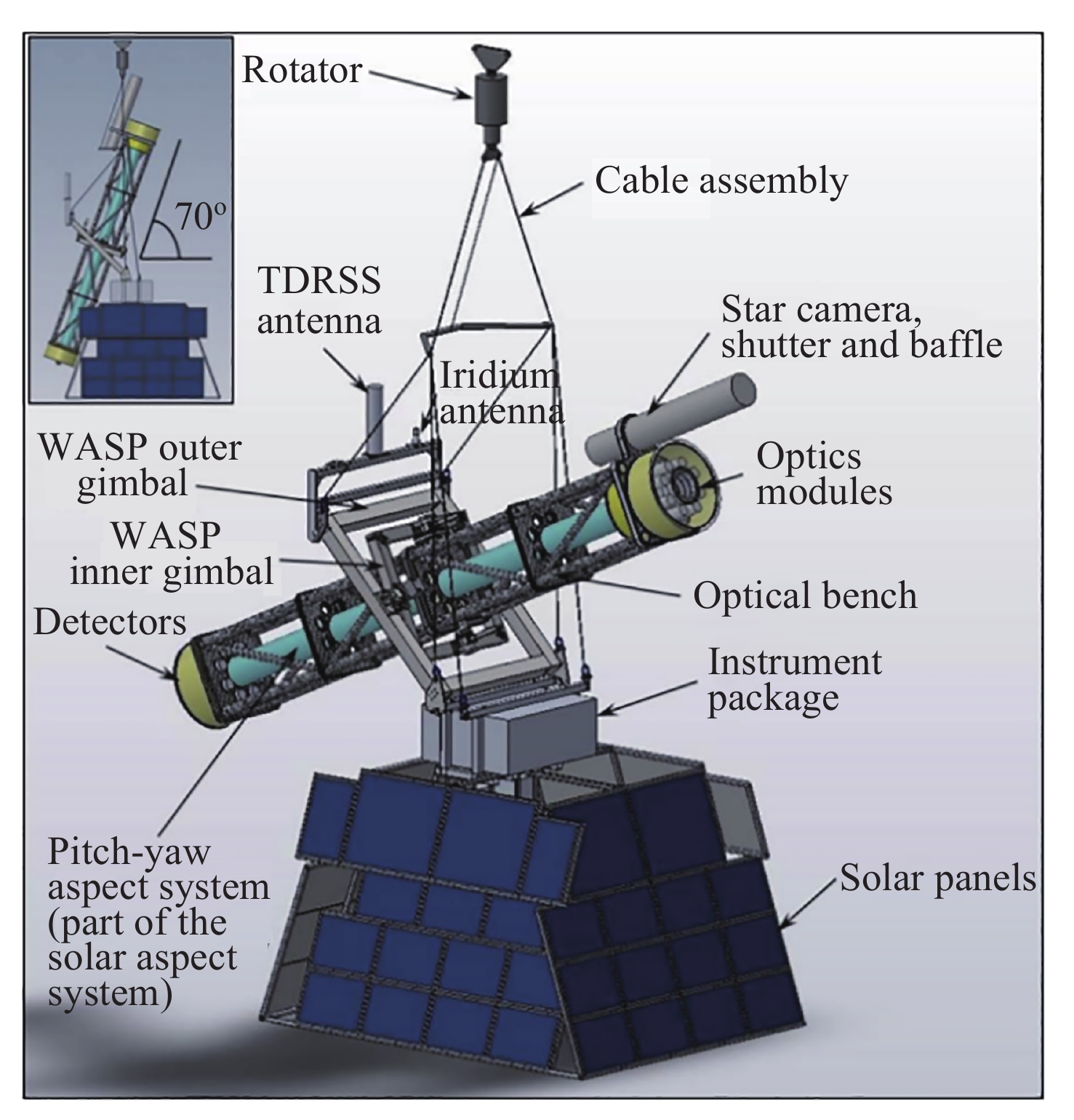
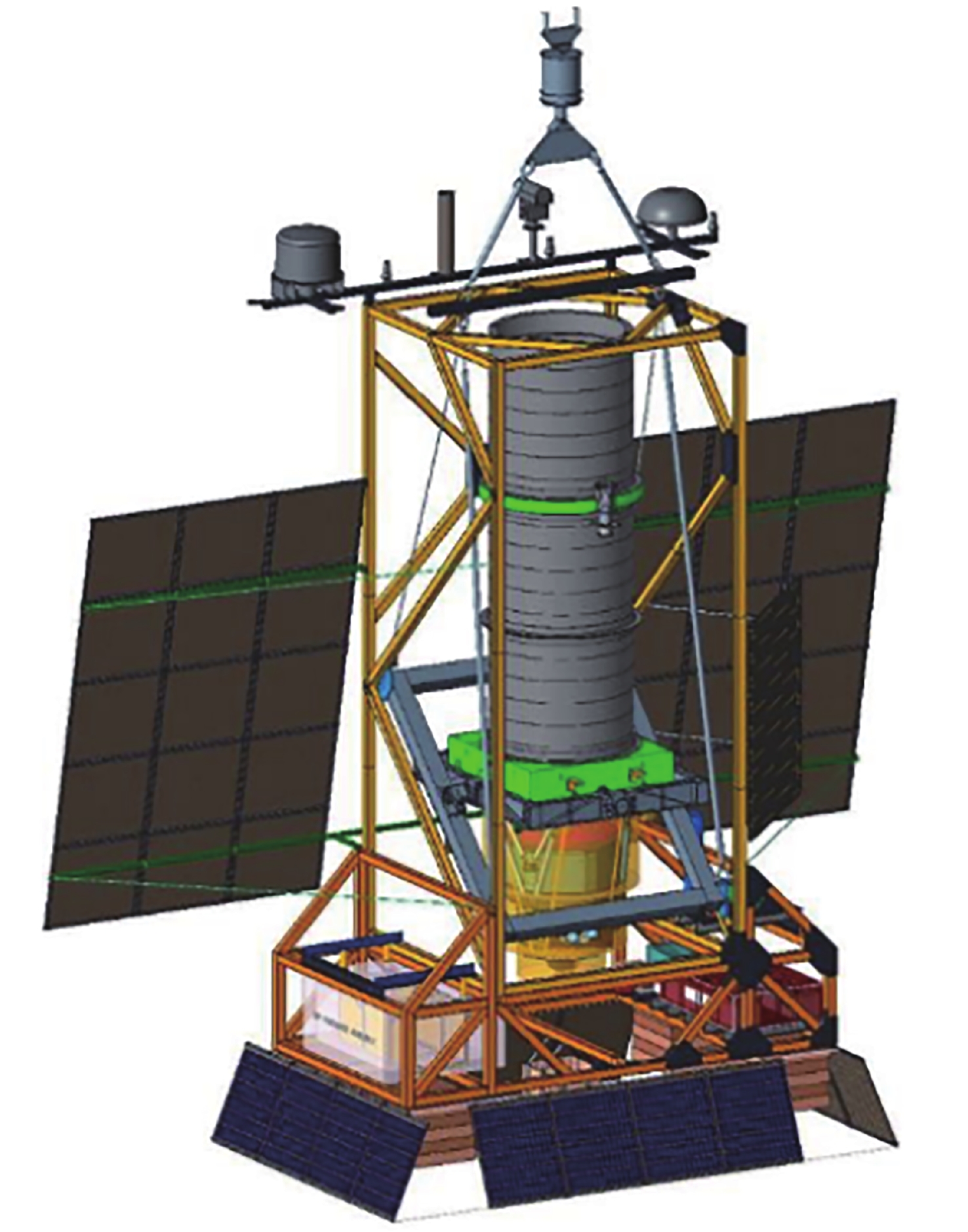
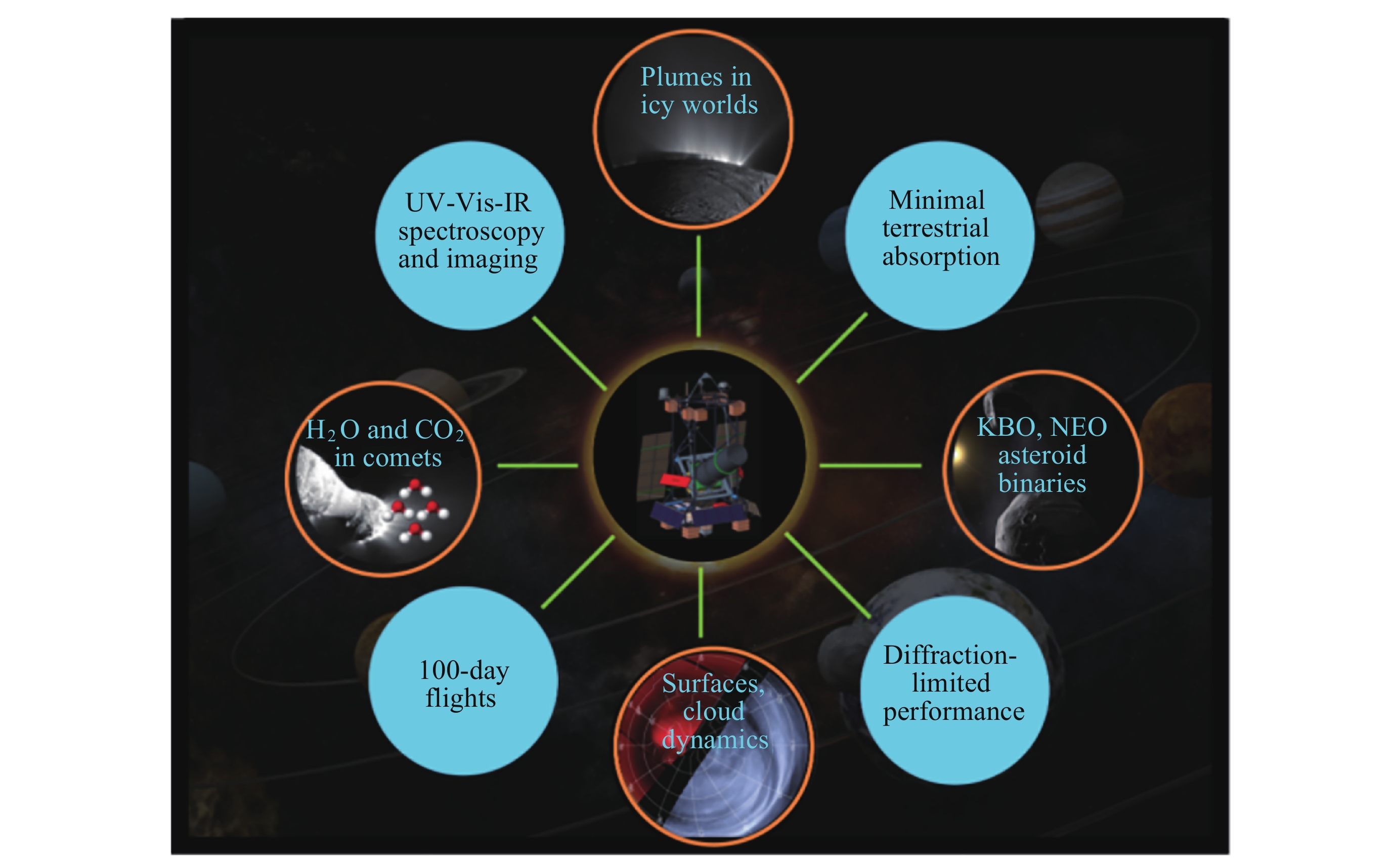
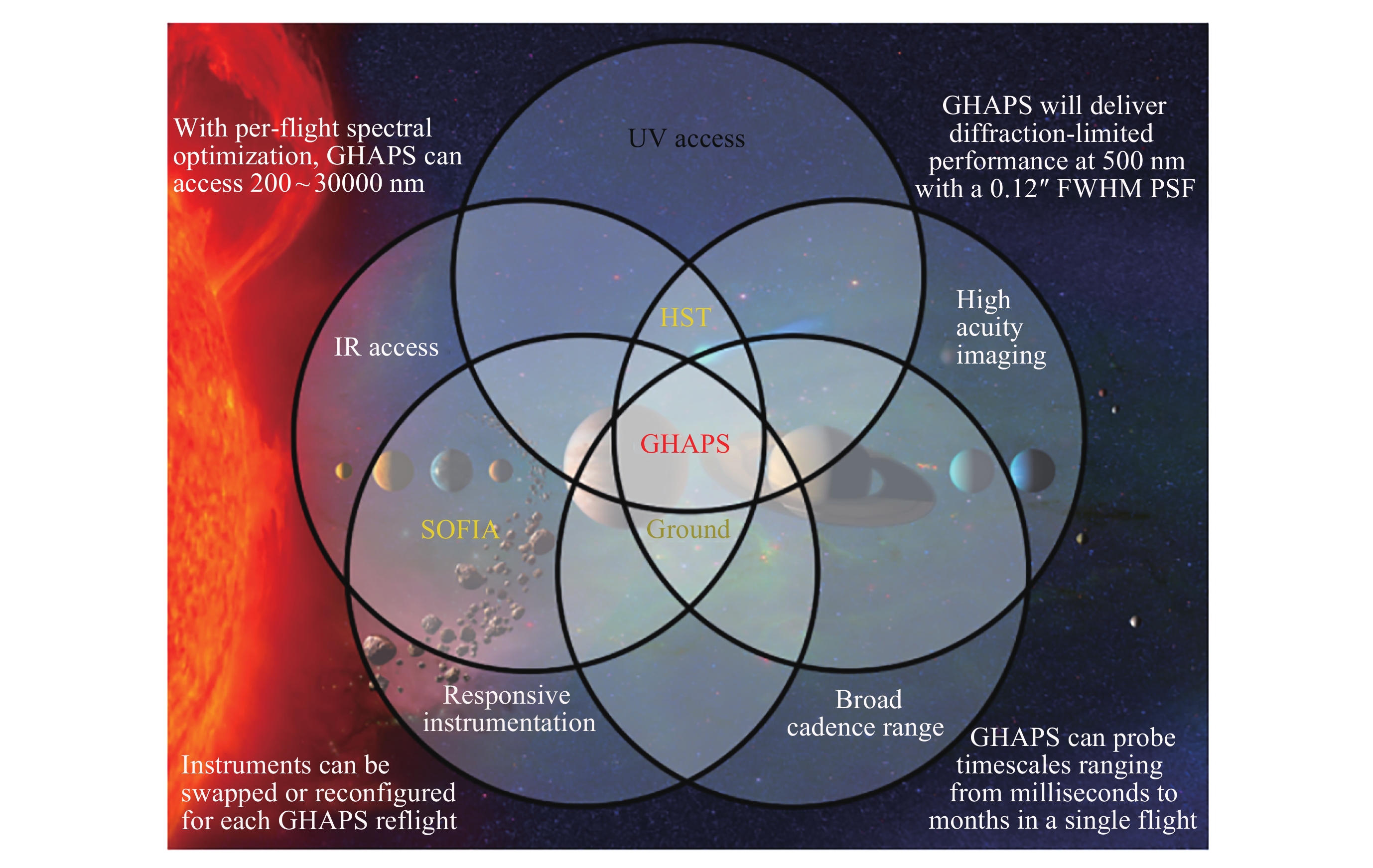
| Citation: | CUI Yulang, LI Yijian, ZHOU Jianghua. Arc Second Pointing System of Near Space Observatories WASP (in Chinese). Chinese Journal of Space Science, 2025, 45(4): 1016-1037 doi: 10.11728/cjss2025.04.2024-0094

|

| [1] |
黄宛宁, 张晓军, 李智斌, 等. 临近空间科学技术的发展现状及应用前景[J]. 科技导报, 2019, 37(21): 46-62
HUANG Wanning, ZHANG Xiaojun, LI Zhibin, et al. Development status and application prospect of near space science and technology[J]. Science Technology Review, 2019, 37(21): 46-62
|
| [2] |
SMITH-PIERCE M C, CHAROENBOONVIVAT Y C, SHUKLA D, et al. High altitude aerodynamic reflectors to counter climate change[C]//2018 Applied Aerodynamics Conference. New York: AIAA, 2018
|
| [3] |
STREETMAN B J. Attitude tracking control simulating the Hubble Space Telescope[C]//Proceedings of the AIAA Guidance, Control, and Dynamics Conference. Reston: American Institute of Aeronautics and Astronautics, 2003
|
| [4] |
SMITH R L, JOHNSON T K, DAVIS M J, et al. High-altitude balloon platforms for optical imaging: System design and feasibility analysis[J]. Journal of Astronomical Telescopes, Instruments, and Systems, 2010, 6(2): 023001
|
| [5] |
黄宛宁, 李智斌, 张钊, 等. 2019年临近空间科学技术热点回眸[J]. 科技导报, 2020, 38(1): 38-46
HUANG Wanning, LI Zhibin, ZHANG Zhao, et al. Summary of hot spots of near space vehicles in 2019[J]. Science :Times New Roman;">& Technology Review, 2020, 38(1): 38-46
|
| [6] |
李智斌, 黄宛宁, 张钊, 等. 2020年临近空间科技热点回眸[J]. 科技导报, 2021, 39(1): 54-68
LI Zhibin, HUANG Wanning, ZHANG Zhao, et al. Summary of the hot spots of near space science and technology in 2020[J]. Science Technology Review, 2021, 39(1): 54-68
|
| [7] |
顾逸东. 关于空间科学发展的一些思考[J]. 中国科学院院刊, 2022, 37(8): 1031-1049
GU Yidong. Thoughts on space science development[J]. Bulletin of Chinese Academy of Sciences, 2022, 37(8): 1031-1049
|
| [8] |
王赤, 时蓬, 宋婷婷, 等. 远航2050: 欧洲空间科学规划及启示[J]. 科技导报, 2022, 40(4): 6-15
WANG Chi, SHI Peng, SONG Tingting, et al. Voyage 2050: ESA Science’s Long-term plane and enlightenment[J]. Science Technology Review, 2022, 40(4): 6-15
|
| [9] |
FAIRBROTHER D A. The NASA balloon program - positioning for the future[C]//AIAA Balloon Systems Conference. Dallas, TX: American Institute of Aeronautics and Astronautics, 2015
|
| [10] |
祝榕辰, 王生. 超压气球研究与发展现状[C]//第二十四届全国空间探测学术交流会论文摘要集. 西安: 中国空间科学学会, 2011
ZHU Rongchen, WANG Sheng. Research and development status of superpressure balloons[C]//Summary of Papers at the 24th National Space Exploration Academic Exchange Conference. Xi’an: Chinese Society of Space Sciences, 2011
|
| [11] |
祝榕辰, 王生, 杨燕初, 等. 南瓜型超压气球球体设计与地面试验[C]//第四届高分辨率对地观测学术年会论文集. 北京: 中国科学院高分辨率对地观测系统重大专项管理办公室, 2017
ZHU Rongchen, WANG Sheng, YANG Yanchu, et al. Design and ground experiments of pumpkin shaped overpressure balloon spheres[C]//Proceedings of the 4th High Resolution Earth Observation Academic Annual Conference. Beijing: Office of Major Special Management of High Resolution Earth Observation Systems, Chinese Academy of Sciences, 2017
|
| [12] |
YAJIMA N. A new design and fabrication approach for pressurized balloon[J]. Advances in Space Research, 2000, 26(9): 1357-1360 doi: 10.1016/S0273-1177(00)00060-0
|
| [13] |
DEWEESE K D, WARD P R. Demonstration of a balloon borne arc-second pointer design[C]//36th COSPAR Scientific Assembly. Beijing: NTRS, 2006
|
| [14] |
WARD P R, DEWEESE K. Arc-Second Pointer for Balloon-Borne Astronomical Instrument[R]. Greenbelt: NASA Goddard Space Flight Center, 2004. NASA-CR-2004-213153
|
| [15] |
STUCHLIK D. The wallops Arc second pointer-a balloon borne fine pointing system[C]//AIAA Balloon Systems Conference. Dallas: AIAA, 2015
|
| [16] |
STUCHLIK D. The NASA Wallops Arc-Second Pointer (WASP) system for precision pointing of scientific balloon instruments and telescopes[C]//AIAA Balloon Systems Conference. Denver: AIAA, 2017
|
| [17] |
SMITH I S JR. Advancements in NASA balloon research and development[J]. Advances in Space Research, 1996, 17(9): 37-44 doi: 10.1016/0273-1177(95)00674-4
|
| [18] |
FAIRBROTHER D A. 2017 NASA balloon program update[C]//AIAA Balloon Systems Conference. Denver, Colorado: American Institute of Aeronautics and Astronautics, 2017
|
| [19] |
YAJIMA N, KOGAJI S, HASHINO K. Research on the Direction Control System of a Balloon-Borne Telescope[R]. Tsukuba: Mechanical Engineering Laboratory, AIST, 1986. MEL Technical Report 86-015
|
| [20] |
叶祥明. 大型球载望远镜高精度姿态控制及指向技术研究[D]. 北京: 中国科学院北京天文台, 1999
YE Xiangming. Study on High-accuracy Attitude Control and Pointing Technology of A Large Balloon-borne Solar Telescope[D]. Beijing: National Astronomical Observatories, Chinese Academy of Sciences, 1999
|
| [21] |
PASCALE E, ADE P A R, BOCK J J, et al. The balloon-borne large aperture submillimeter telescope: BLAST[J]. The Astrophysical Journal, 2008, 681(1): 400 doi: 10.1086/588541
|
| [22] |
张伟, 袁朝辉, 章卫国, 等. 平流层球载系统方位控制仿真与试验研究[J]. 计算机仿真, 2009, 26(8): 37-40 doi: 10.3969/j.issn.1006-9348.2009.08.010
ZHANG Wei, YUAN Zhaohui, ZHANG Weiguo, et al. Simulation and experiment study of attitude control for stratospheric balloon-borne gondola system[J]. Computer Simulation, 2009, 26(8): 37-40 doi: 10.3969/j.issn.1006-9348.2009.08.010
|
| [23] |
何琳琳, 刘兆瑜, 窦满锋, 等. 高空气球吊篮方位控制的反作用飞轮系统[J]. 微特电机, 2007, 35(8): 36-38,41 doi: 10.3969/j.issn.1004-7018.2007.08.013
HE Linlin, LIU Zhaoyu, DOU Manfeng, et al. Research on the reaction wheel control system in the azimuth control of nacelle[J]. Small :Times New Roman;">& Special Electrical Machines, 2007, 35(8): 36-38,41 doi: 10.3969/j.issn.1004-7018.2007.08.013
|
| [24] |
刘艳霄, 宋腾飞, 张涛, 等. 欧洲球载太阳望远镜SUNRISE及相关研究成果简介[J]. 天文研究与技术, 2021, 18(3): 314-336
LIU Yanxiao, SONG Tengfei, ZHANG Tao, et al. Overview of balloon-borne solar telescope-SUNRISE[J]. Astronomical Research :Times New Roman;">& Technology, 2021, 18(3): 314-336
|
| [25] |
王鸿辉, 袁朝辉, 何长安. 球载吊篮方位控制综合解耦器设计[C]//第三十二届中国控制会议论文集(D卷). 西安: 中国自动化学会控制理论专业委员会, 中国系统工程学会, 2013: 5222-5226
WANG Honghui, YUAN Zhaohui, HE Chang’an. Design of comprehensive decoupler for balloon-borne Gondola’s Azimuth control[C]//Proceedings of the 32nd Chinese Control Conference (D Volume). Xi’an: Technical Committee on Control Theory, Chinese Association of Automation, Systems Engineering Society of China, 2013: 5222-5226
|
| [26] |
SHOJI Y, TAGUCHI M, NAKANO T, et al. FUJIN-2: Balloon borne telescope for optical observation of planets[J]. Transactions of the Japan Society for Aeronautical and Space Sciences, Aerospace Technology Japan, 2016, 14(ists30): 95-102
|
| [27] |
YE X, YAJIMA N, AI G, et al. Attitude control and high precision pointing control system of a large balloon borne solar telescope[J]. Advances in Space Research, 2000, 26(9): 1419-1422 doi: 10.1016/S0273-1177(00)00076-4
|
| [28] |
HANAGUD A, SIMPSON J, LANZI R, et al. A solar pointing system for the long duration balloon missions[C]//International Balloon Technology Conference. San Francisco: AIAA, 2012
|
| [29] |
KOPP G, SMITH P, BELTING C, et al. Radiometric flight results from the HyperSpectral imager for climate science (HySICS)[J]. Geoscientific Instrumentation, Methods and Data Systems, 2017, 6(1): 169-191 doi: 10.5194/gi-6-169-2017
|
| [30] |
HURFORD T A, MANDELL A M, REDDY V, et al. Observatory for planetary investigations from the stratosphere[J]. Earth and Space Science, 2015, 2(4): 171-184
|
| [31] |
KISLAT F, BEHESHTIPOUR B, DOWKONTT P, et al. Design of the telescope truss and gondola for the balloon-borne X-ray polarimeter X-Calibur[J]. Journal of Astronomical Instrumentation, 2017, 6(2): 1740008 doi: 10.1142/S2251171717400086
|
| [32] |
ABARR Q, BEHESHTIPOUR B, BEILICKE M, et al. Performance of the X-Calibur hard X-ray polarimetry mission during its 2018/19 long-duration balloon flight[J]. Astroparticle Physics, 2022, 143: 102749 doi: 10.1016/j.astropartphys.2022.102749
|
| [33] |
ABARR Q, AWAKI H, BARING M G, et al. XL-Calibur -- a second-generation balloon-borne hard X-ray polarimetry mission[J]. Astroparticle Physics, 2021, 126: 102529
|
| [34] |
GONG Q, GOPALSWAMY N, NEWMARK J. Innovative Compact Coronagraph Approach for Balloon-borne Investigation of Temperature and Speed of Electrons in the Corona (BITSE)[C]//Astronomical Optics: Design, Manufacture, and Test of Space and Ground Systems II. San Diego, United States: SPIE, 2019: 111160F
|
| [35] |
GOPALSWAMY N, NEWMARK J, YASHIRO S, et al. The Balloon-borne Investigation of Temperature and Speed of Electrons in the corona (BITSE): mission description and preliminary results[J]. Solar Physics, 2021, 296(1): 15 doi: 10.1007/s11207-020-01751-8
|
| [36] |
COOK T, CAHOY K, CHAKRABARTI S, et al. Planetary imaging concept testbed using a recoverable experiment–coronagraph (PICTURE C)[J]. Journal of Astronomical Telescopes, Instruments, and Systems, 2015, 1(4): 044001 doi: 10.1117/1.JATIS.1.4.044001
|
| [37] |
MENDILLO C B, HEWAWASAM K, HOWE G A, et al. Decoupling the image-plane and low-order wavefront sensors for the PICTURE-C coronagraph[C]//Proceedings Volume 11117, Techniques and Instrumentation for Detection of Exoplanets IX. San Diego: SPIE, 2019
|
| [38] |
MENDILLO C B, HEWAWASAM K, MARTEL J, et al. Balloon flight demonstration of coronagraph focal plane wavefront correction with PICTURE-C[J]. Journal of Astronomical Telescopes, Instruments, and Systems, 2023, 9(2): 025005
|
| [39] |
MENDILLO C B, HEWAWASAM K, MARTEL J, et al. The PICTURE-C exoplanetary imaging balloon mission: second flight results and the transition to a new mission, PICTURE-D[C]//Proceedings Volume 12680, Techniques and Instrumentation for Detection of Exoplanets XI. San Diego: SPIE, 2023
|
| [40] |
GASKIN J, APPLE J, CHAVIS K S, et al. High energy replicated optics to explore the sun: hard X-ray balloon-borne telescope[C]//2013 IEEE Aerospace Conference. Big Sky, MT: IEEE, 2013: 1-11
|
| [41] |
GASKIN J, ELSNER R, RAMSEY B, et al. SuperHERO: Design of a new hard-X-ray focusing telescope[C]//2015 IEEE Aerospace Conference. Big Sky, MT: IEEE, 2015: 1-15
|
| [42] |
YOUNG R. Overview of the Gondola for High Altitude Planetary Science (GHAPS)[R]. Greenbelt: International Society for Optical Engineering, 2016
|
| [43] |
LEWIS M, JUERGENS J R, ARETSKIN-HARITON E, et al. Gondola for High Altitude Planetary Science (GHAPS) Guide System Trade Study[R]. Pasadena: NASA Jet Propulsion Laboratory, 2020
|
| [44] |
UDINSKI E P, LANZI R J. Wallops Arc-Second Pointing (WASP) System[R]. Athens: NASA, 2023
|
| [45] |
HEATWOLE S H, CRAIG S D, CASTELLUCCI K J, et al. Low-Cost Star Tracker Development for Suborbital and Small Satellite Platforms[R]. Greenbelt: NASA Goddard Space Flight Center, 2019
|
| [46] |
GALCHENKO P, PERNICKA H. Neural network attitude control system design for the wallops arc-second pointer[J]. Journal of Guidance, Control, and Dynamics, 2022, 45(7): 1365-1370 doi: 10.2514/1.G006465
|
| [47] |
马俊, 朱猛, 王才喜, 等. 临近空间光电探测技术与发展展望[J]. 空天技术, 2022(2): 85-96
MA Jun, ZHU Meng, WANG Caixi, et al. Technology and development prospect of electro-optical detection in near space[J]. Aerospace Technology, 2022(2): 85-96
|
Figures(33) / Tables(2)
Journal Introduction
ISSN 2097-7689 CN 11-1783/V
Copyright © Editorial Office of Chinese Journal of Space Science. 京ICP备08100722号
Supported by: Beijing Renhe Information Technology Co., Ltd.


 DownLoad: