| Citation: | PAN Jinhui, LIU Jiajia, LIU Rui. Dataset of Solar Active Regions in the Solar Full-disk Magnetograms (in Chinese). Chinese Journal of Space Science, 2025, 45(6): 1650-1655 doi: 10.11728/cjss2025.06.2025-0086

|

| [1] |
VAN DRIEL-GESZTELYI L, GREEN L M. Evolution of active regions[J]. Living Reviews in Solar Physics, 2015, 12(1): 1 doi: 10.1007/lrsp-2015-1
|
| [2] |
LIU R, KLIEM B, TÖRÖK T, et al. Slow rise and partial eruption of a double-decker filament. I. Observations and interpretation[J]. The Astrophysical Journal, 2012, 756(1): 59 doi: 10.1088/0004-637X/756/1/59
|
| [3] |
DANG T, LI X L, LUO B X, et al. Unveiling the space weather during the Starlink satellites destruction event on 4 February 2022[J]. Space Weather, 2022, 20(8): e2022SW003152 doi: 10.1029/2022SW003152
|
| [4] |
ZHANG J, WANG Y M, LIU Y. Statistical properties of solar active regions obtained from an automatic detection system and the computational biases[J]. The Astrophysical Journal, 2010, 723(2): 1006-1018 doi: 10.1088/0004-637X/723/2/1006
|
| [5] |
WANG R H, JIANG J, LUO Y K. Toward a live homogeneous database of solar active regions based on SOHO/MDI and SDO/HMI synoptic magnetograms. I. Automatic detection and calibration[J]. The Astrophysical Journal Supplement Series, 2023, 268(2): 55 doi: 10.3847/1538-4365/acef1b
|
| [6] |
GIRSHICK R, DONAHUE J, DARRELL T, et al. Rich feature hierarchies for accurate object detection and semantic segmentation[C]//Proceedings of the IEEE Conference on Computer Vision and Pattern Recognition. Columbus: IEEE, 2014: 580-587
|
| [7] |
BAEK J H, KIM S, CHOI S, et al. Solar event detection using deep-learning-based object detection methods[J]. Solar Physics, 2021, 296(11): 1-15
|
| [8] |
REDMON J, DIVVALA S, GIRSHICK R, et al. You only look once: Unified, real-time object detection[C]//Proceedings of the IEEE Conference on Computer Vision and Pattern Recognition. Las Vegas: IEEE, 2016: 779-788
|
| [9] |
GONG L, YANG Y F, FENG S, et al. Solar active regions detection and tracking based on deep learning[J]. Solar Physics, 2024, 299(8): 1-22
|
| [10] |
LIU J J, JI C Y, WANG Y M, et al. Improving the automated coronal jet identification with U-NET[J]. The Astrophysical Journal, 2024, 972(2): 187 doi: 10.3847/1538-4357/ad66be
|
| [11] |
Pan J, Liu J, Fang S, et al. SARD: A YOLOv8-based system for solar active region detection with SDO/HMI magnetograms[J]. Solar Physics, 2025, 300(8): 111 doi: 10.1007/s11207-025-02525-w
|
| [12] |
PESNELL W D, THOMPSON B J, CHAMBERLIN P C, et al. The Solar Dynamics Observatory (SDO)[J]. Solar Physics, 2012, 275(1): 3-15
|
| [13] |
OTSU N. A threshold selection method from gray-level histograms[J]. Automatica, 1975, 11: 23-27
|
| [14] |
COUVIDAT S, SCHOU J, HOEKSEMA J T, et al. Observables processing for the Helioseismic and Magnetic imager instrument on the Solar dynamics observatory[J]. Solar Physics, 2016, 291(7): 1887-1938 doi: 10.1007/s11207-016-0957-3
|
| [15] |
BOBRA M G, SUN X, HOEKSEMA J T, et al. The Helioseismic and Magnetic Imager (HMI) vector magnetic field pipeline: SHARPs–space-weather HMI active region patches[J]. Solar Physics, 2014, 289(9): 3549-3578 doi: 10.1007/s11207-014-0529-3
|
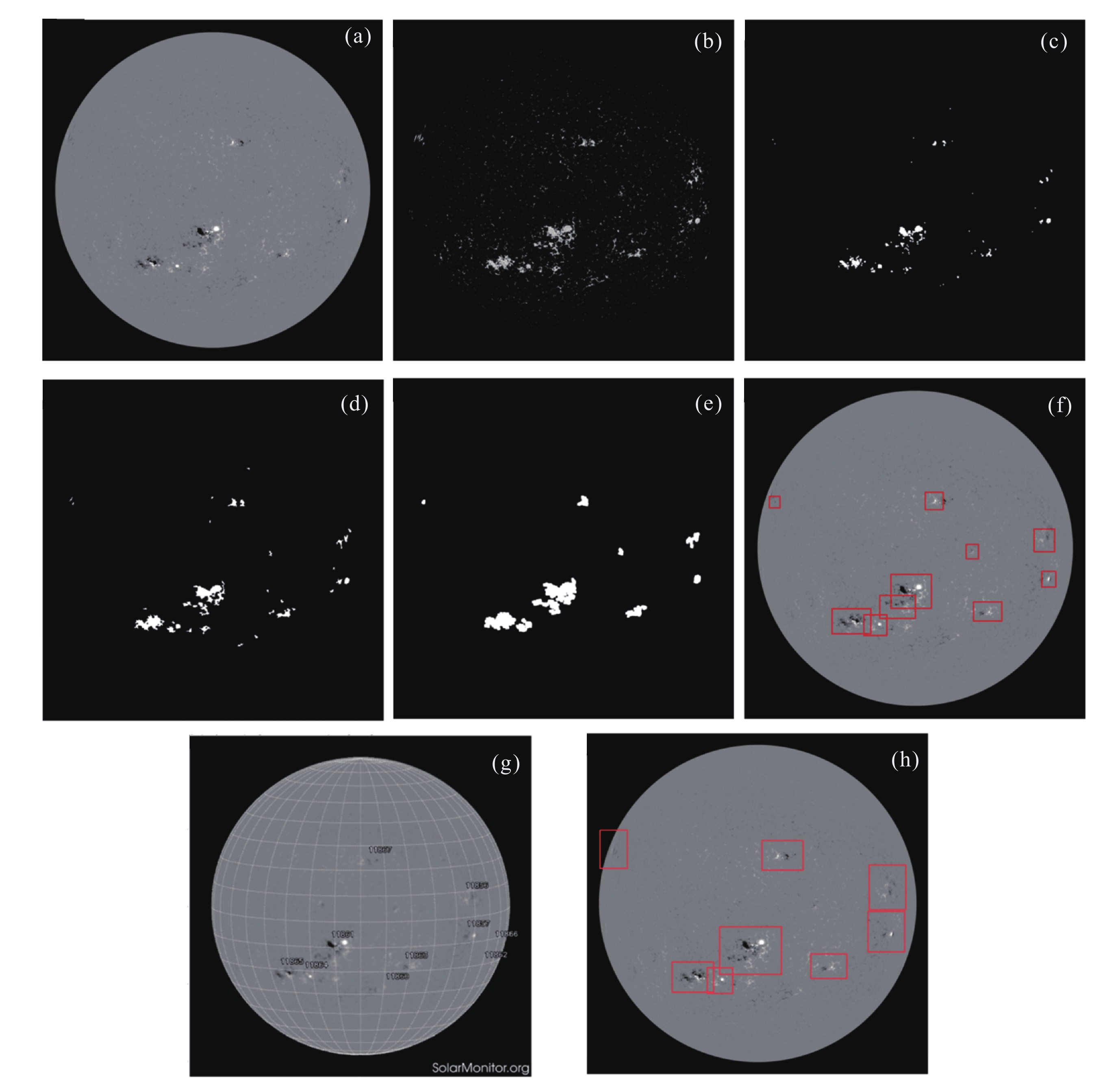
Figures(1) / Tables(1)
Journal Introduction
ISSN 2097-7689 CN 11-1783/V
Copyright © Editorial Office of Chinese Journal of Space Science. 京ICP备08100722号
Supported by: Beijing Renhe Information Technology Co., Ltd.



 DownLoad: