Turn off MathJax
Article Contents
WANG Yitao, ZHANG Quanhao, LIU Jiajia. Dataset of Solar Prominences from 2011 to 2022 (in Chinese). Chinese Journal of Space Science, 2025, 45(6): 1675-1680 doi: 10.11728/cjss2025.06.2025-0089
Citation: WANG Yitao, ZHANG Quanhao, LIU Jiajia. Dataset of Solar Prominences from 2011 to 2022 (in Chinese). Chinese Journal of Space Science, 2025, 45(6): 1675-1680 doi: 10.11728/cjss2025.06.2025-0089

Dataset of Solar Prominences from 2011 to 2022

doi: 10.11728/cjss2025.06.2025-0089 cstr: 32142.14.cjss.2025-0089
  • Received Date: 2025-06-06
  • Rev Recd Date: 2025-09-19
  • Available Online: 2025-10-22
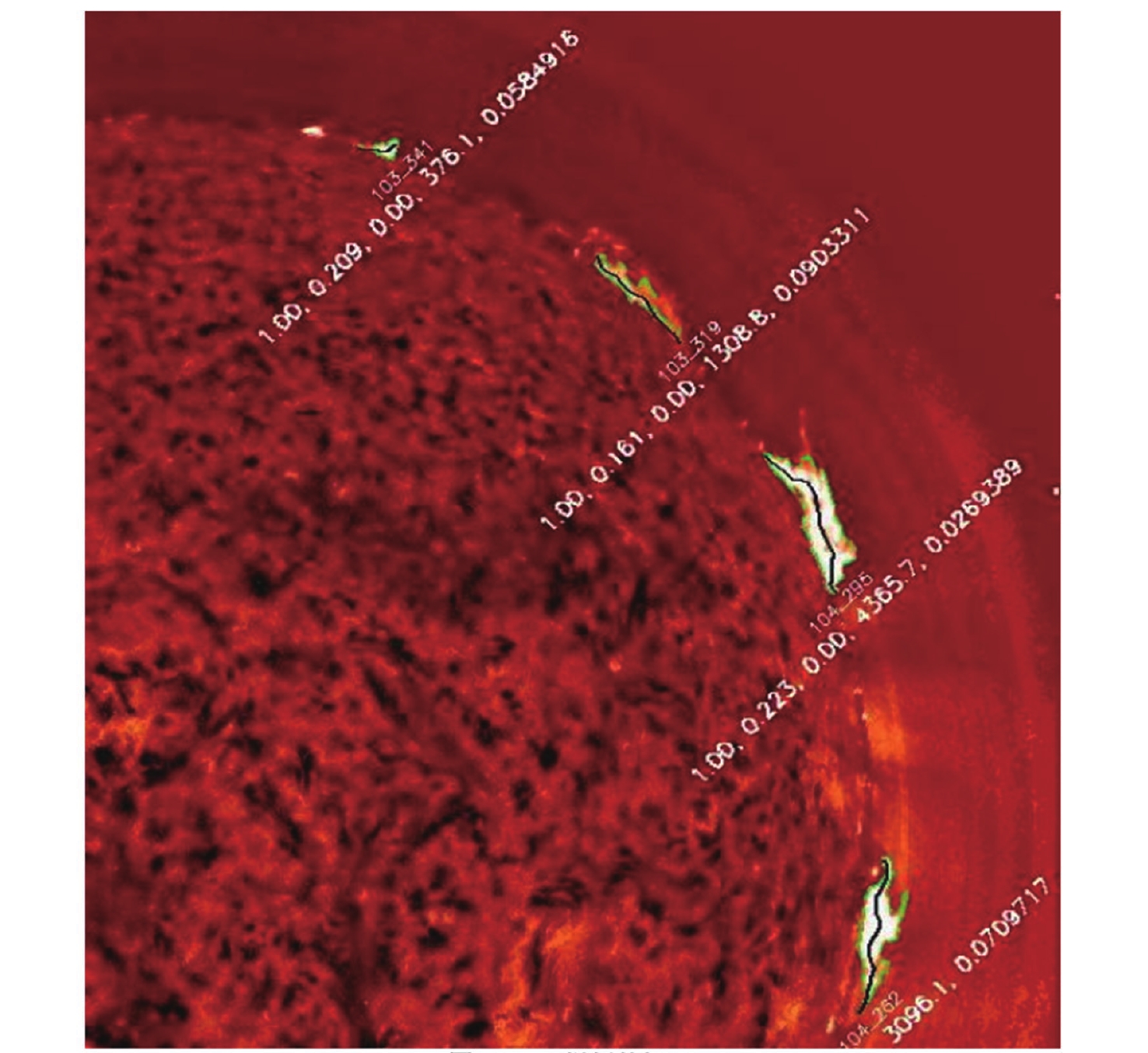
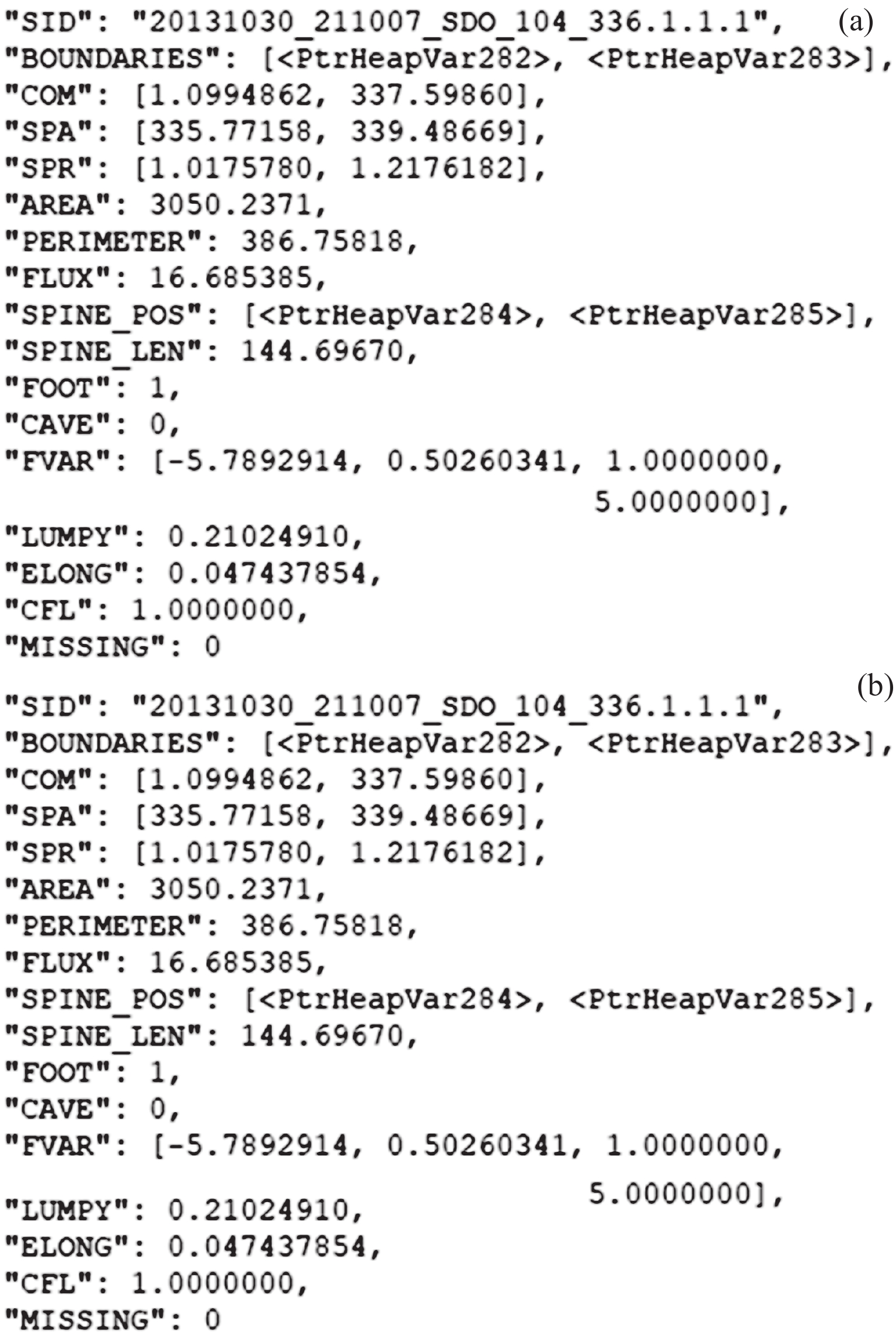
  • Solar prominences are magnetic structures suspended in the corona, characterized by relatively low temperatures (typically below 10000K) and higher electron densities(109~1011 cm–3). Research indicates a clear correlation between prominences and solar eruptive activities, such as solar flares and coronal mass ejections that may trigger hazardous space weather. Studying the spatiotemporal distribution of solar prominences can aid in forecasting space weather efforts and help mitigate potential catastrophic impacts. This dataset is based on the 30.4 nm wavelength images captured by the Atmospheric Imaging Assembly (AIA) instrument aboard the Solar Dynamics Observatory (SDO) satellite, with a temporal resolution of 10 minutes. By employing background reconstruction to enhance the contrast of off-limb images, the automated algorithms, such as the skeleton extraction and the region-growing techniques, were used to identify prominence regions in the reconstructed images and extract relevant parameters. For those evolving in the same region during continuous frames, Misidentification caused by duplicate naming is avoided by K-Nearest Neighbor (KNN) classification . Before tracking a procedure called non-prominence feature removal is used to discriminate real prominences from non-prominence features: Through Linear Discriminant Analysis (LDA), the eigenvalue of any target region can be calculated, and compare it with the derived distribution which is fitted with Gaussian distribution functions, to determine the likeliness of a real prominence, by which SLIPCAT can exclude active regions without involving other observation methods. Persisting prominences were tracked and stored in data files. At last, the processed images and prominence data files are organized in a year-month-day three-level directory structure. The dataset encompasses a total of 101741 prominence files, covering the period from 00:00 UT on 1 January 2011 to 23:50 UT on 31 December 2022. Rigorous validation was conducted in accordance with relevant protocols and classification standards to ensure high reliability. This dataset provides scientific support for research on the spatiotemporal distribution of solar prominences over their activity cycles and for the prediction of hazardous space weather events.


  • loading
  • [1]
    LABROSSE N, HEINZEL P, VIAL J C, et al. Physics of solar prominences: I—spectral diagnostics and non-LTE modelling[J]. Space Science Reviews, 2010, 151(4): 243-332 doi: 10.1007/s11214-010-9630-6
    [2]
    KOLEVA K, GOPALSWAMY N, DEVI P, et al. Spatial relationship between CMEs and prominence eruptions during SC 24 and SC 25[J]. The Astrophysical Journal, 2024, 966(1): 22 doi: 10.3847/1538-4357/ad2df3
    [3]
    FILIPPOV B P, DEN O G. Prominence height and vertical gradient in magnetic field[J]. Astronomy Letters, 2000, 26(5): 322-327 doi: 10.1134/1.20397
    [4]
    BERNASCONI P N, RUST D M, HAKIM D. Advanced automated solar filament detection and characterization code: description, performance, and results[J]. Solar Physics, 2005, 228(1/2): 97-117
    [5]
    FOULLON C, VERWICHTE E. Automated detection of EUV prominences[J]. Solar Physics, 2006, 234(1): 135-150 doi: 10.1007/s11207-006-0054-0
    [6]
    LOBODA I P, BOGACHEV S A. Quiescent and eruptive prominences at solar minimum: a statistical study via an automated tracking system[J]. Solar Physics, 2015, 290(7): 1963-1980 doi: 10.1007/s11207-015-0735-7
    [7]
    WANG Y M, CAO H, CHEN J H, et al. Solar limb prominence catcher and tracker (SLIPCAT): an automated system and its preliminary statistical results[J]. The Astrophysical Journal, 2010, 717(2): 973-986 doi: 10.1088/0004-637X/717/2/973
    [8]
    LEMEN J R, TITLE A M, AKIN D J, et al. The Atmospheric Imaging Assembly (AIA) on the Solar Dynamics Observatory (SDO)[J]. Solar Physics, 2012, 275(1/2): 17-40
    [9]
    FISHER R A. The use of multiple measurements in taxonomic problems[J]. Annals of Human Genetics, 1936, 7(2): 179-188
    [10]
    PARENTI S. Solar prominences: observations[J]. Living Reviews in Solar Physics, 2014, 11(1): 1
  • 加载中

Catalog

    通讯作者: 陈斌, bchen63@163.com
    • 1. 

      沈阳化工大学材料科学与工程学院 沈阳 110142

    1. 本站搜索
    2. 百度学术搜索
    3. 万方数据库搜索
    4. CNKI搜索

    Figures(3)  / Tables(1)

    Article Metrics

    Article Views(153) PDF Downloads(15) Cited by()
    Proportional views
    Related

    /

    DownLoad:  Full-Size Img  PowerPoint
    Return
    Return